
Electroactive Polymer Market Size Analysis Report 2035
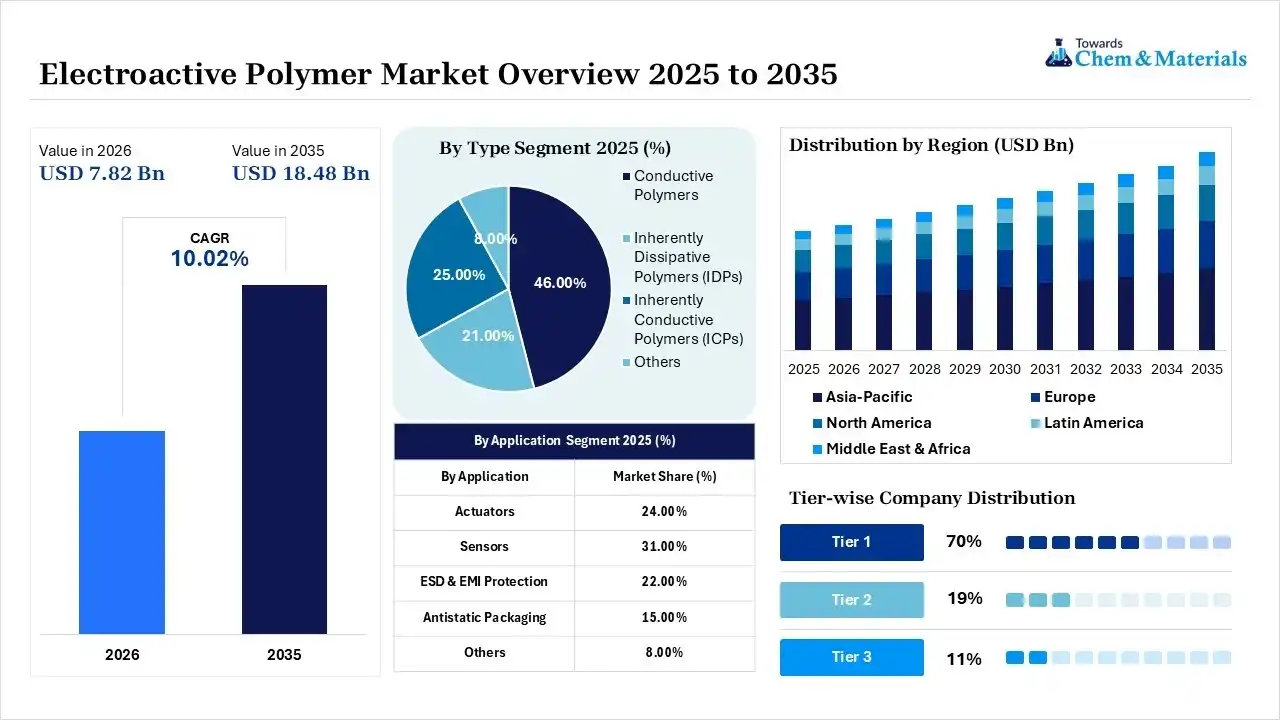
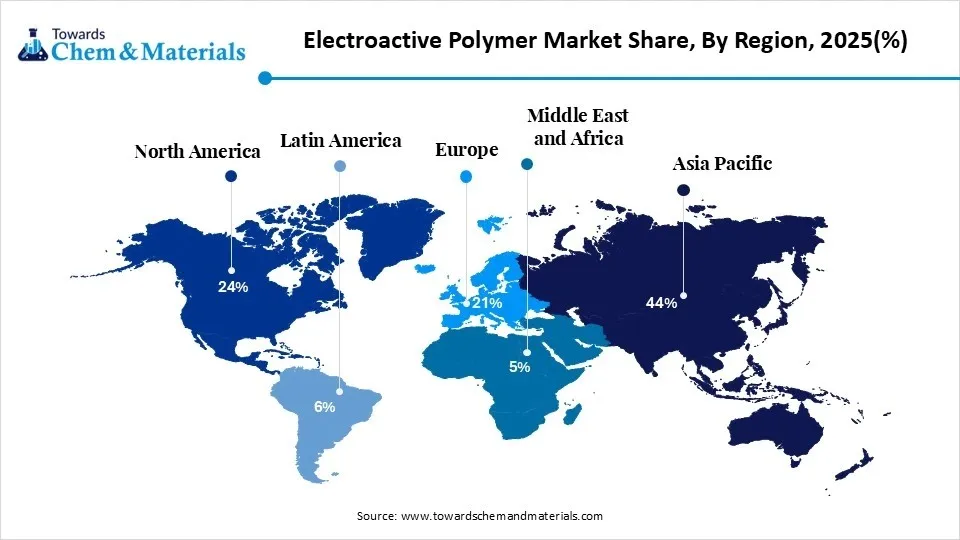
The global electroactive polymer market size was valued at USD 7.11 billion in 2025, is estimated to reach USD 7.82 billion in 2026, and is projected to reach USD 18.48 billion by 2035, exhibiting a compound annual growth rate (CAGR) of 10.02% over the forecast period from 2026 to 2035. Asia Pacific dominated the electroactive polymer market with the largest revenue share of 44.00% in 2025 and is expected to grow at the fastest CAGR of 10.14% during the forecast period.
The Smart materials that respond to electrical stimulation are applicable in soft robotics and biomechanics, wearable and smart clothing, haptics, and acoustics, as these materials can emulate biological movement, which increases demand. Consumer electronics, ESD protection, and rising demand for remote healthcare monitoring drive the growth of the market. The key collaboration and partnering of major companies is also a major factor for the expansion of the market, like Datwyler and CTsystems partnership aiming to industrialize stacked polymer actuator technology, which plays an important role in the growth of the market in the coming years.
Market Highlights
- By region, Asia Pacific dominated the market with a share of 44% in 2025 and is expected to grow at a CAGR of 8.92% over the forecast period.
- By region, North America held 24% market share in 2025 and is expected to experience the fastest growth with a CAGR of 10.68% in the forecast period.
- By type, the conductive polymers segment dominated the market with a 46% share in 2025. and is expected to grow at a CAGR of 9.58% over the forecast period.
- By type, the inherently conductive polymers segment held 25% market share in 2025 and is expected to have the fastest growth with a CAGR of 10.64% in the forecast period.
- By application, the sensors segment dominated the market with a 31% share in 2025 and is expected to grow at a CAGR of 10.24% over the forecast period.
- By application, the actuators segment held 24% market share in 2025 and is expected to have the fastest growth with a CAGR of 10.82% in the forecast period.
Significance of the Electroactive Polymer
According to Towards Chemicals and Materials Analytics and Consulting, the global electroactive polymer market volume was valued at 352.9 thousand metric tons in 2025 and is expected to surpass around 844.8 thousand metric tons by 2035, accelerating a compound annual growth rate (CAGR) of 9.12% over the forecast period from 2026 to 2035.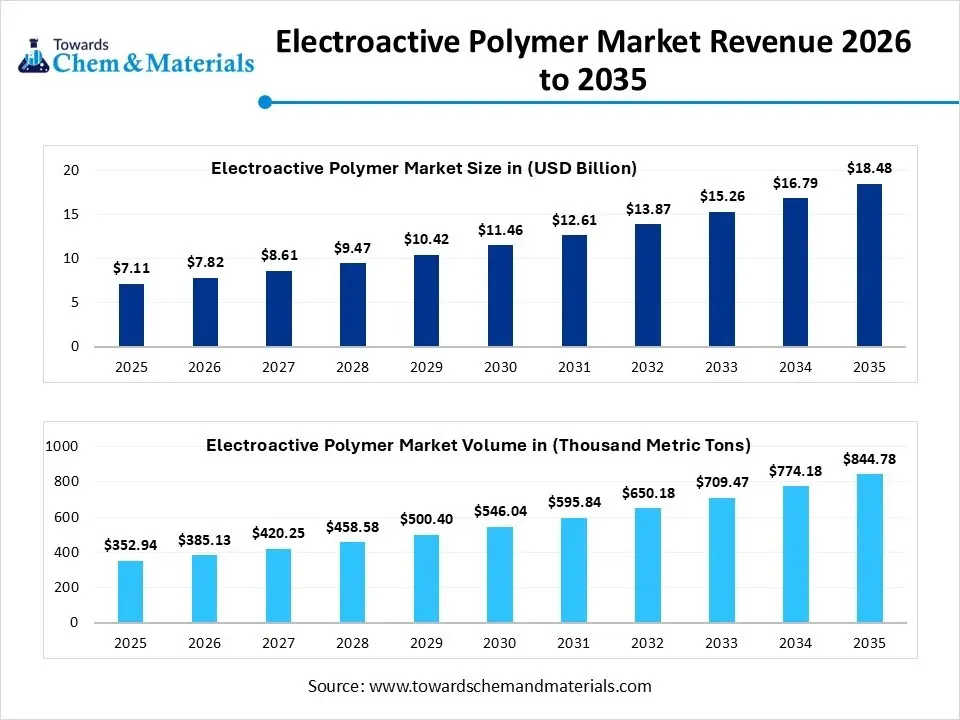
An electroactive polymer (EAP) is a type of polymer that changes its size or shape when exposed to an electric field. It is commonly used in actuators and sensors. EAPs are characterized by their ability to undergo significant deformation while supporting substantial forces. Historically, actuators were mainly made from ceramic piezoelectric materials, which can endure large forces but typically deform only slightly less than a percent. In robotics, EAPs are often called artificial muscles because they can serve as soft, flexible actuators. Due to the ease of processing many polymers, EAPs can be manufactured into various shapes, making them highly versatile. They are also potential candidates for integration into microelectromechanical systems to create smart actuators.
The EAP market is substantial, driven by their role as "smart" materials that mimic biological muscles, enabling applications in soft robotics, artificial muscles, and flexible sensors. Because they change shape in response to electrical signals, they are valuable in medical and defense fields, such as for active catheters, surgical robots, and haptic feedback devices. Their lightweight and flexible properties make EAPs ideal for continuous health monitoring, including electronic skin and real-time movement tracking. Furthermore, conductive plastics, a subset of EAPs, are essential for protecting delicate electronics from electrostatic discharge and electromagnetic interference.
- For instance, the paper introduces V-EMS (Vacuum-gap Electrostatic Multilayer Actuators), a groundbreaking class of electrostatic actuators designed specifically for space robotics. Instead of treating a vacuum as a limitation, this technology utilizes the vacuum environment as a high-performing bulk dielectric layer.(Source: www.nature.com)
Global Investment Flow for Electroactive Polymer Market 2026
The key investments by government bodies like NSF, DARPA, NIST, and the European Commission, and material companies like Solvay S.A., Arekema, 3M, and Parker Hannifin fund key sectors like electronics, healthcare, and aerospace for the development of flexible sensors, artificial muscle development, and next-generation battery binders.
EU consortiums are heavily funding smart materials research to scale the manufacturing of bio-derived Electro-Active Polymers (EAPs). Backed by programs like Horizon Europe, cross-border collaborations in Germany, France, and the Netherlands aim to transition these lightweight, adaptive materials into high-volume applications for the automotive and aerospace sectors.
- For instance, in May 2026, The Trendlines Group’s portfolio company, ElastiMed Ltd., has secured a strategic U.S. distribution agreement for its FDA-cleared MyoSleeve wearable compression device.(Source: links.sgx.com)
- For instance, in July 2026, Tactile Medical (NASDAQ: TCMD) has finalized an exclusive distribution deal with ElastiMed to supply the MyoSleeve wearable compression device directly to Department of Veterans Affairs (VA) and Department of Defense (DoD) patients across the United States.(Source: www.investing.com)
Electroactive Polymer Market Growth Trends
- The growing adoption of smart materials, especially in the biomedical and healthcare sector, where there is a need for a real-time monitoring system that records the data and also helps maintain precision. The increasing adoption of artificial muscles, implants, smart prosthetics, and flexible diagnostic sensors is a growing trend in the market.
- The product preferences from the manufacturer for their seamless adoption increase the demand for touch panels and OLED displays. Growing manufacturing of the products is a major factor and a key trend in the market. Meanwhile, electroactive coatings are rapidly rising in popularity for industrial rollers and medical devices.
- The growing electronic and EV adoption across regions due to their low impact on the environment and growing awareness among consumers is driving massive demand for weight reduction and energy-efficient EVs, fueling the demand and expansion of the market.
Report Scope
| Report Attributes | Details |
| Market Size in 2026 | USD 7.82 Billion/ 385.1 Thousand Metric Tons |
| Expected Size in 2035 | USD 18.48 Billion/ 844.8 Thousand Metric Tons |
| Growth Rate | CAGR of 10.02% |
| Base Year of Estimation | 2025 |
| Forecast Period | 2025-2035 |
| Dominant Region | Asia Pacific |
| Segment Covered | By Type, By Application, By Region |
| Key Companies Profiled | 3M Company, Parker Hannifin Corporation, Merck Group, AGFA-Gevaert N.V., The Lubrizol Corporation, Premix Group, Avient Corporation, BASF SE, DuPont de Nemours, Novasentis, Inc., Covestro AG, Cabot Corporation, RTP Company, Sumitomo Chemical Co., Ltd., Heraeus Group, Sabic, Kenner Material & System Co., Ltd. |
Key Technological Shifts in the Electroactive Polymer Market through AI integration
The key technological shifts in the electroactive polymer market are accelerating the shift from traditional to precision-driven smart materials. AI integration helps in transforming with real-time computing for advanced applications. The key technological shifts include AI-driven material discovery and synthesis, autonomous smart manufacturing, and real-time actuation and computational intelligence, which fuel the growth of the market. The sustainability integration through AI helps in faster ingredient substitution, from fossil-based to bio-based DEAPs, by optimizing the natural feedstock and predicting polymer degradation pathways, which contributes to the growth and expansion of the market.
Supply Chain Analysis of Electroactive Polymer Market
Chemical Synthesis and Processing
- Electroactive polymers are produced using standard polymer synthesis and modification methods like solvent casting, free radical polymerization, photopolymerization, and electropolymerization. They are then processed into usable materials, films, or actuators using techniques such as solvent casting, spin coating, photopolymerization, and additive manufacturing/3D printing.
- 3M Company is a leading innovator in electroactive polymers, primarily known for leveraging its materials science expertise to engineer advanced dielectric elastomers and smart polymer coatings. Their research and production heavily focus on sensor tech, soft actuators, and medical devices.
- Key players: 3M Company, Parker Hannifin Corporation, Merck Group, AGFA-Gevaert N.V., The Lubrizol Corporation
Quality Testing and Certification
- Quality testing and certification for Electroactive Polymers validate their mechanical, electrical, and environmental durability. Testing verifies parameters like actuation strain, dielectric constant, and response time, while certifications ensure the materials meet industry-specific safety and performance standards.
Parker Hannifin Corporation develops smart sensors and actuators using Electroactive Polymer (EAP) technology. - Originating from their acquisition of Artificial Muscle Incorporated and intellectual property from Bayer Material Science, their EAP-based products are ultra-low power, silent, and lightweight. The technology is utilized in medical devices and musculoskeletal movement tracking.
- Key players: ASTM International, ASTM D & E Standards, IEC Standards, Aerospace & Automotive Protocols, UL Solutions
Distribution to Industrial Users
- Electroactive polymers are distributed across several high-tech industries, primarily electronics, automotive, aerospace, healthcare, and robotics, because they act as lightweight "artificial muscles" and highly sensitive sensors. Leading manufacturers and distributors of these advanced compounds include major chemical and material suppliers like Arkema, specializing in fluorinated EAP thin films and powders, Avient Corporation, and Dow Inc.
- Premix Group, headquartered in Finland with U.S. operations in Gaston County, North Carolina, is a key global player in the electroactive and electrically conductive polymers (ECPs) market. Rather than creating moving, soft robotics polymers themselves, they act as a specialized material developer focusing on high-performance functional polymer compounds.
- Key players: Premix Group, Avient Corporation, BASF SE, DuPont de Nemours, Novasentis, Inc.
Electroactive Polymer Regulatory Landscape
| Country / Region | Regulatory Body | Key Regulations | Focus Areas | Notable Notes |
| United States | Environmental Protection Agency; National Institute of Standards and Technology | Toxic Substances Control Act; Advanced Manufacturing Standards | Smart materials, electronic polymers | The U.S. supports electroactive polymer development for robotics, medical devices, sensors, and flexible electronics. |
| European Union | European Chemicals Agency; European Commission | REACH Regulation; RoHS Directive | Chemical safety, sustainable electronics | Europe promotes environmentally compliant electroactive polymers for advanced electronics and healthcare applications. |
| China | Ministry of Industry and Information Technology; Ministry of Ecology and Environment | Environmental Protection Law; Advanced Materials Development Policies | Flexible electronics, intelligent manufacturing | China is expanding electroactive polymer production to support wearable devices, sensors, and electronic manufacturing. |
| Japan | Ministry of Economy, Trade and Industry | Chemical Substances Control Law; Industrial Standards | High-performance polymers, precision electronics | Japan focuses on advanced electroactive polymers for robotics, actuators, and medical technologies. |
| South Korea | Ministry of Trade, Industry and Energy; Ministry of Environment | K-REACH; Electronics Industry Standards | Flexible displays, smart devices | South Korea is investing in electroactive polymers for next-generation displays, wearable electronics, and semiconductor applications. |
| Germany | Federal Ministry for Economic Affairs and Energy; German Institute for Standardization | REACH Compliance; Advanced Materials Standards | Industrial automation, smart materials | Germany is a leading innovator in electroactive polymers for automotive, industrial automation, and healthcare applications. |
What are the Key Product Types of Electroactive Polymer Products?
The electroactive polymers are smart materials that change shape and size when they are stimulated by an electric field. The EAPs are categorized into two basic categories: dielectric and ionic.
Electronic Electroactive Polymers
Electronic EAPs are driven by high-voltage electric fields and are highly valued for their rapid response times and high mechanical energy density. Dielectric elastomers are capable of high strains when a voltage is applied.
- Dielectric Elastomers (DEs): Consist of a thin elastomeric film sandwiched between two compliant electrodes. When a voltage is applied, the film compresses and expands, making it ideal for artificial muscles, actuators, and sensors.
- Piezoelectric Polymers: Materials like PVDF (polyvinylidene fluoride) generate an electrical charge in response to mechanical stress and vice versa. They are widely used in acoustic devices, tactile sensors, and wearable electronics.
- Liquid Crystal Elastomers (LCEs): Combine the elastic properties of rubber with the self-organizing capabilities of liquid crystals. They undergo significant shape changes upon heating or electrical stimulation and are used in smart optical devices and soft robotics.
- Electrostrictive Polymers: Change dimensions proportionally to the square of the applied electric field, providing precise movement for mechanical controls.
Ionic Electroactive Polymers
Ionic EAPs rely on the diffusion or mobility of ions within the polymer network and generally operate at much lower voltages.
- Inherently Conductive Polymers (ICPs): Organic polymers like polyaniline and polypyrrole that conduct electricity without the need for additional conductive fillers. They are a major product type for sensors, actuators, and antistatic applications.
- Ionic Polymer-Metal Composites (IPMCs): Highly active actuators made of an ionomeric membrane plated with noble metal electrodes. They show high deformation at low voltage and are promising for bio-mimetic robots and medical devices
- Conductive Plastics: Blend traditional plastics with conductive fibers or carbon nanotubes to provide Electromagnetic Interference (EMI) shielding and Electrostatic Discharge (ESD) protection.
- Inherently Dissipative Polymers (IDPs): Polymers specifically engineered to have static dissipation characteristics, heavily utilized in antistatic packaging and specialized industrial coatings.
Key Product Applications
The raw materials are processed into films, gels, or composites, leading to distinct commercial products across industries:
- Actuators & Artificial Muscles: Products designed to produce mechanical movement without heavy motors, often used in medical devices, miniature pumps, and robotics.
- Intelligent Sensors: Thin, flexible sensors utilized in smart textiles, wearable health monitors measuring expansive/compressive body movements, and athletic equipment.
- Energy Harvesters: Products capable of converting mechanical energy like human motion or vibrations into electrical power.
Market Dynamics
What are the key growth drivers in the electroactive polymer market?
The electroactive polymer market is driven by the surging demand for flexible, lightweight, and responsive smart materials across various industries that are high-tech industries. These materials are used over traditional metals and rigid actuators; this is because of their unique properties and ability to alter the shape and structure when exposed to an electric field. The other key growth drivers are the miniaturization of consumer electronics, automotive and EV lightweighting, innovation in medical robotics, soft robotics, and defense. The advancements in technology and automation sectors due to robust procurement further drive the growth of the market and support expansion.
What are the key growth challenges in the electroactive polymer market?
The key growth challenges in the electroactive polymer market are the high production and material costs, as synthesis processes for highly specialized electroactive polymers are very complex and also require expensive raw materials, which is a challenge for production and for manufacturers, restricting the growth of the market. The other key challenges are durability, long-term performance, lack of standardization, regulatory hurdles, integration hurdles, environmental sensitivity, and thermal sensitivity. Environmental sensitivity, including moisture and extreme heat, and maintaining electrical stability and responsiveness in severe environmental conditions, are key growth challenges that hinder the growth and expansion of the market.
What are the key growth opportunities in the electroactive polymer market?
The electroactive polymer markets primary growth opportunities center on soft robotics and biomimetics, that is, biomedical innovations like the development of artificial muscles and advanced prosthetics, which support the growth of the market. The growing demand for miniaturization and energy efficiency across major industries, which are increasingly replacing traditional actuators and sensors with new and precise flexible materials that are flexible materials and lightweight, presents a growing opportunity for the growth of the market. Key opportunities are demand for flexible electronics, automotive, aerospace, healthcare, wearables, soft robotics, and biomimetics, which support expansion.
Segmental Insights
Type Insights
The conductive polymers segment dominated the market with a 46% share in 2025. It is expected to grow at a CAGR of 9.58% over the forecast period, driven by demand for flexible electronics, lightweight battery components, and medical devices. Inherently conductive polymers dominate commercial adoption due to growing adoption and use in industry, which fuels the growth. In medical fields, conductive polymers are increasingly replacing metallic interfaces in biosensors, surgical micro-robots, and active tissue scaffolds.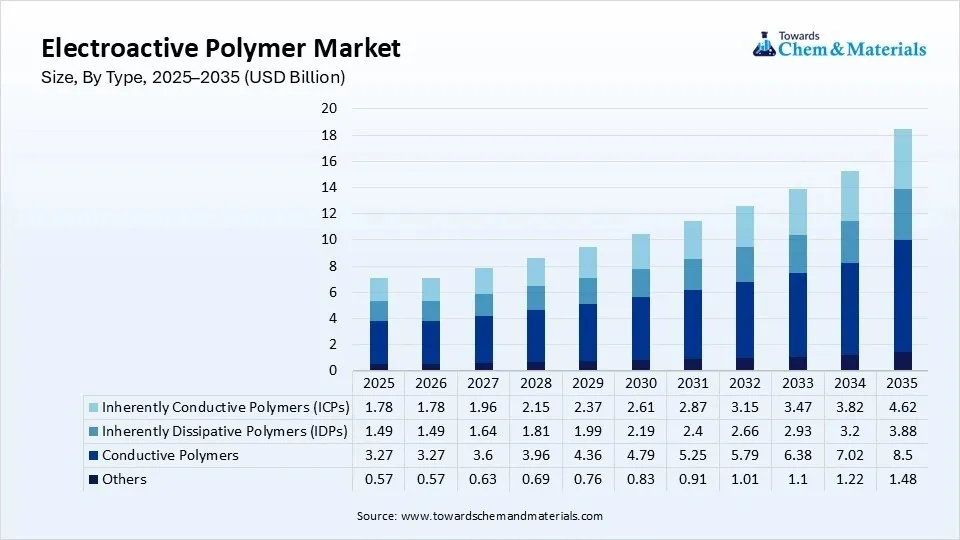
The inherently conductive polymers segment held 25% market share in 2025 and is expected to have the fastest growth with a CAGR of 10.64% in the forecast period, driven by their ability to provide bulk metallic-level conductivity alongside mechanical flexibility. These materials are increasingly replacing heavier, traditional metals in high-tech manufacturing and smart electronics, supporting the growth and expansion of the market.
Electroactive Polymer Market Share, By Type, 2025 (%)
| By Type | Market Share (%) |
| Conductive Polymers | 46.00% |
| Inherently Dissipative Polymers (IDPs) | 21.00% |
| Inherently Conductive Polymers (ICPs) | 25.00% |
| Others | 8.00% |
Application Insights
The sensors segment dominated the market with a 31% share in 2025 and is expected to grow at a CAGR of 10.24% over the forecast period, driven by the expanding use due to its lightweight design, high sensitivity, and flexibility, which helps in monitoring biosensing, real-time pressure, and strain in industries supporting the growth of the market. The rising expansion of electronic manufacturing and IT hardware manufacturing hubs, which are present worldwide, is increasing the material demand and fueling growth. They are extensively used for their quick response, which helps in real-time monitoring of patients irregularities through sensor-integrated wearables, increasing the demand for the market, further propelling growth in each sector.
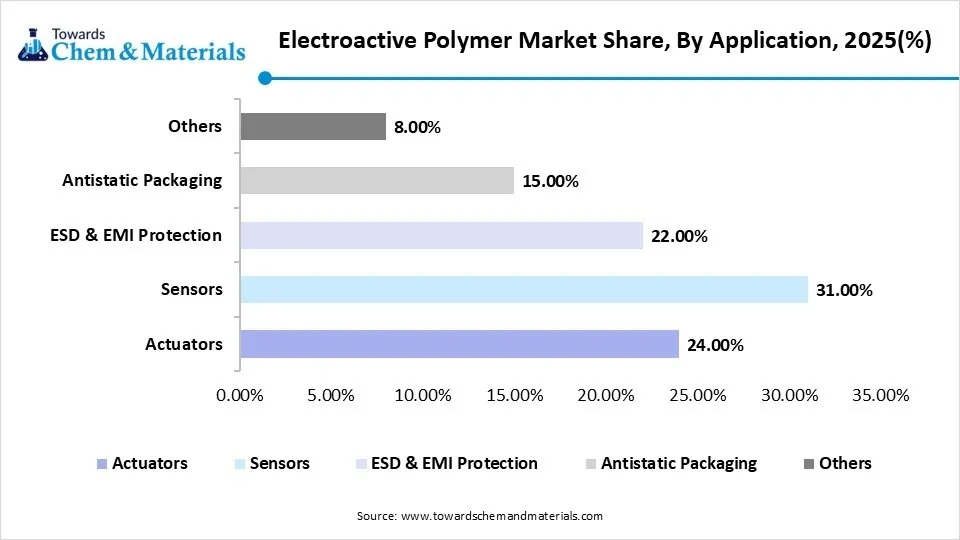
The actuators segment held 24% market share in 2025 and is expected to have the fastest growth with a CAGR of 10.82% in the forecast period. This expansion is largely fueled by the rising adoption of smart robotics, wearable medical devices, and automotive components that require lightweight, highly flexible, and energy-efficient alternatives to traditional mechanical actuators. Nearly 48% of medical device manufacturers are now exploring polymer-based "artificial muscles" to be used in surgical procedures, prosthetics, and rehabilitation equipment.
Electroactive Polymer Market Share, By Application, 2025(%)
| By Application | Market Share (%) |
| Actuators | 24.00% |
| Sensors | 31.00% |
| ESD & EMI Protection | 22.00% |
| Antistatic Packaging | 15.00% |
| Others | 8.00% |
What are the key benefits of the Electroactive Polymer product?
The electroactive polymers are smart materials that convert electrical energy into mechanical movement. These are often categorized as artificial muscles, which are defined and benefited for their electrical versatility and physical adaptability. They benefit from these material applications in various sectors in robotics, biomechanics, wearables, smart clothing, haptics, and acoustics due to their lightweight and dynamic mechanical impact, which increases the demand for the products. The most important product, which is used extensively, is the artificial muscle, as they help boast high fracture tolerance, massive deformation potential, and low density. They excel as sensors, actuators, and generators and are widely used in soft robotics, smart textiles, and medical devices.
Core Benefits Include
- Lightweight and Flexible: Unlike traditional rigid motors, EAPs are soft, elastic, and ultrathin, making them ideal for integration into tight spaces, smart textiles, and wearables.
- Silent and Maintenance-Free: They function via pure material deformation rather than mechanical gears, resulting in completely noiseless operation with fewer moving parts.
- High Strain and Deformation: EAPs can undergo massive shape changes (large strain), enabling a wider range of motion than many conventional mechanical actuators.
- Simultaneous Actuation and Sensing: Many EAP configurations can both deform when a voltage is applied and generate a detectable electrical signal when physically bent or compressed.
- Energy Efficiency: Depending on the type, such as electronic EAPs, they consume close to zero power when simply holding a static position.
Regional Analysis
How did Asia Pacific dominate the electroactive polymer market in 2025?
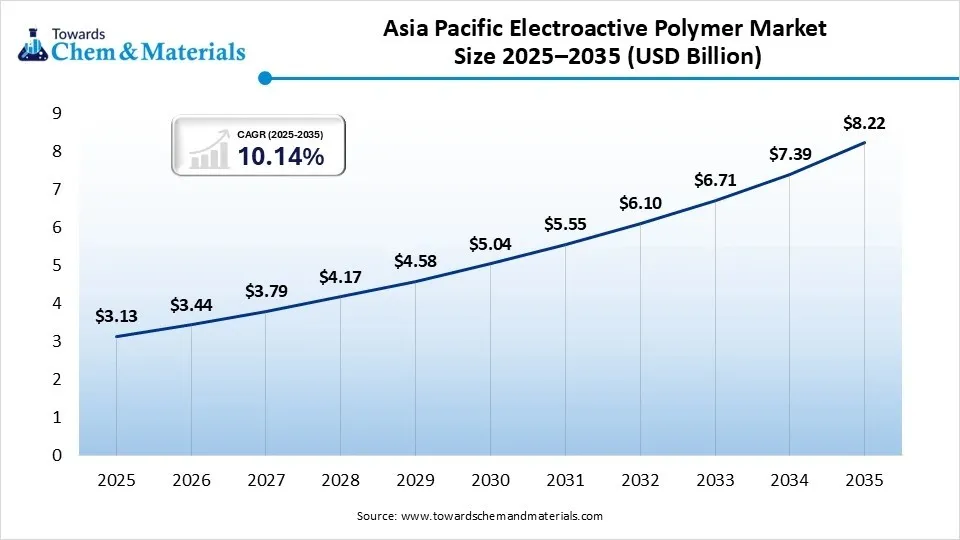
The Asia Pacific electroactive polymer market size was estimated at USD 3.13 billion in 2025 and is projected to reach USD 8.22 billion by 2035, growing at a CAGR of 10.14% from 2026 to 2035. Asia Pacific dominated the market with a share of 44% in 2025 and is expected to grow at a CAGR of 8.92% over the forecast period due to growing demand for consumer electronics, biomedical devices, and robotics, which supports growth. Regions have a strong presence of healthcare, so the innovators are leveraging ionic EAPs in healthcare and soft robotics to develop artificial muscles, wearable medical sensors, and advanced prosthetics, which help in advancements by responding to the micro-currents, making advanced devices for consumers comfort, and driving growth. The growing key players presence in the region is heavily investing in the innovation of flexible sensors, smart textiles, and soft robotics, further supporting the growth and expansion of the market.
India Development of Products Through Academic Hubs
The electroactive polymer market is an emerging sector in India, driven by advanced flexible product development, the development of soft robotics, and electronics due to domestic demand from various sectors, especially smart sensor manufacturing industries, healthcare sectors, and mechatronics, supporting the growth of the market. the growing research and development in the country primarily focusing on synthesizing and testing ionic EAPs for the development of artificial muscles and low-powered soft robotic actuators by major laboratory presences like CSIR-National Aerospace Laboratories, academic hubs like IIT Bombay, PSG Institute of Technology and Applied Research, and IIT Delhi, and CSIR-Central Electrochemical Research Institute, which plays a major role in the development of smart polymers and composites and electroactive actuator mechanics supporting growth.
China: The Manufacturer Hub
Chinas electroactive polymers market is experiencing growth driven by massive consumption of electronics, and also being the manufacturer of electronics due to growing demand. Chinas push towards the use of robotics and demand for advancements and AI integration and EAPs are being actively researched for use in artificial muscles. The academic innovations by the top-tier Chinese institutes are involved in innovation and advancements in EAP material science, like researchers at Tsinghua University are involved in developing the polymer actuators aligned with the carbon nanotubes, which contributes to the growth of the market in the country.
North America Electroactive Polymer Market Growth Factor
The North America electroactive polymer market size was estimated at USD 1.71 billion in 2025 and is projected to reach USD 4.53 billion by 2035, growing at a CAGR of 10.23% from 2026 to 2035. North America held 24% market share in 2025 and is expected to experience the fastest growth with a CAGR of 10.68% in the forecast period, driven by the heavy investments by the key manufacturers and investors supporting the development of soft robotics, wearable medical devices, defense, and flexible electronics, which support growth. The key players, such as Arkema USA, supply the essential powders and coatings for sensors and actuators, along with other key players like Evonik Industries. The key research hubs like Stanford University and MIT are developing and investing in dielectric elastomers and ionic EAPs, which help improve mechanical efficiency and response time, supporting the growth of the market. The EAPs are heavily utilized in aerospace and medical technology due to their application and properties, which further support the growth and expansion of the market.
United States is Commercializing the Product Across Hubs
The US electroactive polymer (EAP) market is driven by the countrys aerospace and medical sectors. EAPs are used due to their lightweight properties and are used in sensors and actuators, which are used and highly adopted for adaptive aerodynamics and next-generation energy storage, driving growth. The focus of research and academic hubs like the University of Washington and the California Institute of Technology which are investing in the advancement of artificial muscle technology which further contributes to the growth of the market. The key players and materials used by the US manufacturers and suppliers focus on commercializing the products, driving the growth and expansion of the market in the country.
Canada Innovation and Advancements
Electroactive Polymers (EAPs) research and development in Canada are primarily concentrated in top-tier academic institutions and specialized materials suppliers, focusing on smart sensors, actuators, soft robotics, and flexible electronics supporting the growth of the market. The innovation and advancements through institutions like the University of Waterloo, the University of British Columbia (UBC) & Simon Fraser University (SFU) play a major role in studies and focus on theoretical modelling and reshaping the design, which contributes to the growth of the market.
Europe Electroactive Polymer Market Growth Factor
The Europe electroactive polymer market size was estimated at USD 1.49 billion in 2025 and is projected to reach USD 3.97 billion by 2035, growing at a CAGR of 10.30% from 2026 to 2035. Europe held a market share of 21% in 2025, driven by the rising strict EU regulations supporting energy efficiency, and also supporting in fulfilling the rising demand for smart materials in various sectors due to their lightweight adoption and flexible polymers in automotive and aerospace industries, driving growth. The regions research hubs in countries like Belgium and Germany drive demand for EAPs in medical and defence sectors, supporting further expansion of the market. Industrial collaborations and robotics demand for the market drive demand for ionic and dielectric EAPs, which are used to manufacture precise actuators and responsive sensors supporting the growth and expansion of the market in the region.
United Kingdom Industrial Automation and Soft Robotics
The UK electroactive polymer market is driven by manufacturers strong demand for biomedical innovation, smart prosthetics, and soft robotics in healthcare and wearables, due to strong demand for maintaining and recording with precision, influencing growth. UK’s aerospace and defense industry demands EAPs for noise and vibration reduction, structural health monitoring, and morphing aircraft structures, supporting growth. Along with the UK’s rapidly expanding industrial automation and robotic sectors, replacing traditional rigid materials with flexible actuators and precision sensors, which further supports the growth and expansion of the market in the country.
Italy Institutional Research and Development
The Italian electroactive Polymer market is experiencing rapid growth driven by growing investments in robotics and automation, as Italy is a major European hub for industrial robotics, which is a crucial factor in the growth of the market. The need for miniaturized medical devices, smart catheters, and wearable biomonitoring technology drives the adoption of ionic EAPs, which can function effectively in wet environments, further propelling the growth of the market. The support of academic and institutional research and development, such as the Italian Institute of Technology – IIT in Genoa, and also multinational corporations, fuels the commercial demand, fueling the expansion of the market.
Latin America Electroactive Polymer Market Growth Factor
The Latin America electroactive polymer market size was estimated at USD 0.43 billion in 2025 and is projected to reach USD 1.20 billion by 2035, growing at a CAGR of 10.81% from 2026 to 2035. Latin America held a market share of 6% in 2025, driven by the rising demand for flexible electronics and expanding consumer use in the country, which drives the growth. The growing industrialization and industrial automation, including robotics, through the integration of AI and IoT devices, directly push the demand for electroactive polymers across the region. The innovation and advancement in healthcare, like biomimetic devices and artificial muscles, are gaining attention due to their unique lightweight and flexible properties, which drive the growth and expansion of the market in the region.
Brazil High-Performance Polymer Capabilities
The Brazilian electroactive polymer market is experiencing rapid growth driven by the rising government initiatives promoting technological modernization and the adoption of sustainable, high-performance materials, which continue to strengthen long-term regional prospects, fueling the growth of the market. Brazils electronics and specialty chemical sectors are receiving increased investment to reduce import reliance, pushing the development of domestic, high-performance polymer capabilities. There is a strong surge in the application of polymers in the rise of soft robotics and automation, healthcare and biomedical innovation, and the expansion of flexible electronics, propelling growth.
Argentina Smart and Lightweight Material Demand
Argentinas electroactive polymer (EAP) market growth is driven primarily by the rising demand for smart, lightweight materials in flexible electronics, healthcare devices, and industrial automation, which fuels the growth of the market. EAPs are increasingly favored over conventional metals due to being lighter, more durable, and offering superior conductivity. Expanding industrial automation and robotics sectors in Latin America are boosting the demand for EAP-based actuators, replacing traditional, rigid electromechanical ceramics, supporting growth and expansion of the market in the country.
Middle East and Africa Electroactive Polymer Market Growth Factor
The Middle East and Africa electroactive polymer market size was estimated at USD 0.36 billion in 2025 and is projected to reach USD 1.02 billion by 2035, growing at a CAGR of 10.98% from 2026 to 2035. The Middle East and Africa held a market share of 5% in 2025. This expansion is primarily driven by expanding healthcare infrastructure, industrial automation, and aerospace material modernization across major regional hubs like the UAE, Saudi Arabia, and South Africa. The regions growing tech-savvy population and rising disposable incomes have accelerated the adoption of consumer electronics, haptic devices, and wearable sensors that rely on EAP. Manufacturing diversification programs in countries like Saudi Arabia and the UAE are increasing the use of smart sensors and actuators in factory automation and energy harvesting, improving overall operational efficiency.
Saudi Arabia Infrastructure Project Development
The Saudi Arabia electroactive polymer market is experiencing growth driven by the Saudi Vision 2030 and infrastructure projects like NEOM and the Red Sea project, mandating smart, lightweight engineering and building solutions, accelerating local demand for advanced specialty polymers. The transition toward electric vehicles (EVs), the expansion of regional aviation, and innovations in healthcare soft robotics all rely heavily on the flexibility and lightweight nature of EAP technologies.
UAE IoT Adoption and Smart City Initiatives
The UAE electroactive polymer market is expanding rapidly due to the booming technology sector, rising demand for smart materials, and expanded use in the nations aerospace, automotive, and emerging soft robotics industries. The UAEs push for IoT adoption and smart city initiatives is increasing the need for adaptive, flexible materials. An expanding technology sector and advancing medical device manufacturing create local opportunities for EAP usage in biomedical devices and rehabilitation, further supporting the growth and expansion of the market in the country.
Recent Developments
- In Feb 2026, Artimus Robotics Inc is launching its newest generation of contracting HASEL artificial muscles to achieve lifelike, dexterous robotic manipulation. The latest iteration of these electrohydraulic actuators delivers more than twice the mechanical output performance of the previous generation due to advancements in materials science and manufacturing processes. They are also fully encapsulated to ensure safer physical interaction and streamlined integration into robotic hardware.(Source: www.prnewswire.com)
Competitive Analysis
The key collaborations between key players like Arkema, Solvay, Parker Hannifin, and Bayer Material Science play a major role in the market because of the global demand for specific polymer formulations and customized component production for the development of advanced and innovative products.
- Lubrizol Corporation and Polyhose India Pvt Ltd officially launched and inaugurated a new, state-of-the-art medical tubing manufacturing facility in Chennai, Tamil Nadu, India. The strategic partnership merges Lubrizol’s extensive polymer expertise with Polyhose’s high-precision extrusion capabilities to establish India as a global medical device manufacturing hub.(Source: www.chemanalyst.com)
Top players in the Electroactive Polymer Market & Their Offerings:
| Company | Company Type/Position | Major Headquarters | Geographic Presence | Electroactive Polymer Offerings | Key Offering/Strength |
| Solvay S.A. | Advanced polymer materials manufacturer | Brussels, Belgium | Europe, North America, Asia Pacific | PVDF-based electroactive polymers for sensors, actuators, energy storage, and electronic applications | Strong expertise in high-performance fluoropolymers and advanced functional materials |
| Arkema S.A. | Global specialty polymer producer | Colombes, France | Europe, North America, Asia Pacific | Kynar® PVDF electroactive polymers for batteries, sensors, actuators, and electronic devices | Leadership in PVDF technology with a broad portfolio for energy and electronics markets |
| Celanese Corporation | Engineered materials and specialty polymers supplier | Irving, Texas, USA | North America, Europe, Asia Pacific | Conductive engineering polymers and specialty thermoplastic materials for electronic applications | Broad engineering polymer portfolio with expertise in advanced material solutions |
| The Chemours Company | Fluoroproducts and advanced materials manufacturer | Wilmington, Delaware, USA | North America, Europe, Asia Pacific | Fluoropolymer materials for electroactive films, energy storage, and industrial electronics | High-performance fluoropolymer technologies with strong global manufacturing capabilities |
| Kureha Corporation | Functional polymers and advanced materials producer | Tokyo, Japan | Asia Pacific, Europe, North America | PVDF resins and electroactive polymer materials for lithium-ion batteries, sensors, and electronic components | Expertise in high-purity PVDF materials for advanced electronic and energy applications |
Other Top Players Are
- 3M Company
- Parker Hannifin Corporation
- Merck Group
- AGFA-Gevaert N.V.
- The Lubrizol Corporation
- Premix Group
- Avient Corporation
- BASF SE
- DuPont de Nemours
- Novasentis, Inc.
- Covestro AG
- Cabot Corporation
- RTP Company
- Sumitomo Chemical Co., Ltd.
- Heraeus Group
- Sabic
- Kenner Material & System Co., Ltd.
Segments Covered
By Type
- Conductive Polymers
- Polyaniline (PANI)
- Polypyrrole (PPy)
- Polyacetylene (PA)
- PEDOT
- Others
- Inherently Dissipative Polymers (IDPs)
- Thermoplastic IDPs
- Thermoset IDPs
- Inherently Conductive Polymers (ICPs)
- Ionic Electroactive Polymers
- Electronic Electroactive Polymers
- Others
- Dielectric Elastomers
- Electrostrictive Polymers
- Ferroelectric Polymers
By Application
- Actuators
- Soft Robotics
- Artificial Muscles
- Precision Motion Systems
- Sensors
- Pressure Sensors
- Strain Sensors
- Biosensors
- Wearable Sensors
- ESD & EMI Protection
- Electronic Components
- Industrial Equipment
- Aerospace Electronics
- Antistatic Packaging
- Semiconductor Packaging
- Electronic Device Packaging
- Pharmaceutical Packaging
- Others
- Energy Storage
- Smart Textiles
- Displays
- Medical Devices
By Regions
- North America
- Europe
- Asia Pacific
- Middle East & Africa
- Latin America
Table of Contents
Chapter 1. Methodology and Scope
1.1. Market Segmentation & Scope
1.2. Market Definition
1.3. Information Procurement
1.3.1. Purchased Database
1.3.2. TCM’s Internal Database
1.3.3. Secondary Sources & Third-Party Perspectives
1.3.4. Primary Research
1.4. Information Analysis
1.4.1. Data Analysis Models
1.5. Market Formulation & Data Visualization
1.6. Data Validation & Publishing
Chapter 2. Executive Summary
2.1. Market Insights
2.2. Segmental Outlook
2.3. Competitive Outlook
Chapter 3. Electroactive Polymers Market Variables, Trends & Scope
3.1. Global Electroactive Polymers Market Outlook
3.2. Industry Value Chain Analysis
3.3. Average Price Trend Analysis
3.4. Supply-Demand Gap Analysis, 2026
3.5. Regulatory Framework
3.5.1. Policies and Incentive Plans
3.5.2. Standards and Compliances
3.5.3. Regulatory Impact Analysis
3.6. Market Dynamics
3.6.1. Market Driver Analysis
3.6.2. Market Restraint Analysis
3.6.3. Industry Challenges
3.7. Porter’s Five Forces Analysis
3.7.1. Supplier Power
3.7.2. Buyer Power
3.7.3. Substitution Threat
3.7.4. Threat from New Entrant
3.7.5. Competitive Rivalry
3.8. PESTEL Analysis
3.8.1. Political Landscape
3.8.2. Economic Landscape
3.8.3. Social Landscape
3.8.4. Technological Landscape
3.8.5. Environmental Landscape
3.8.6. Legal Landscape
Chapter 4. Electroactive Polymers Market: Type Outlook Estimates & Forecasts
4.1. Electroactive Polymers Market: Type Movement Analysis, 2026 & 2035
4.1.1. Conductive Polymers
4.1.1.1. Market Estimates and Forecast, 2021 - 2035
4.1.2. Inherently Dissipative Polymers (IDPs)
4.1.2.1. Market Estimates and Forecast, 2021 - 2035
4.1.3. Inherently Conductive Polymers (ICPs)
4.1.3.1. Market Estimates and Forecast, 2021 - 2035
4.1.4. Others
4.1.4.1. Market Estimates and Forecast, 2021 - 2035
Chapter 5. Electroactive Polymers Market: Application Outlook Estimates & Forecasts
5.1. Electroactive Polymers Market: Application Movement Analysis, 2026 & 2035
5.1.1. Actuators
5.1.1.1. Market Estimates and Forecast, 2021 - 2035
5.1.2. Sensors
5.1.2.1. Market Estimates and Forecast, 2021 - 2035
5.1.3. ESD & EMI Protection
5.1.3.1. Market Estimates and Forecast, 2021 - 2035
5.1.4. Antistatic Packaging
5.1.4.1. Market Estimates and Forecast, 2021 - 2035
5.1.5. Others
5.1.5.1. Market Estimates and Forecast, 2021 - 2035
Chapter 6. Electroactive Polymers Market Regional Outlook Estimates & Forecasts
6.1. Regional Snapshot
6.2. Electroactive Polymers Market: Regional Movement Analysis, 2026 & 2035
6.3. North America
6.3.1. Market Estimates and Forecast, 2021 - 2035
6.3.2. Market Estimates and Forecast, By Type, 2021 - 2035
6.3.3. Market Estimates and Forecast, By Application, 2021 - 2035
6.3.4. U.S.
6.3.4.1. Market Estimates and Forecast, 2021 - 2035
6.3.4.2. Market Estimates and Forecast, By Type, 2021 - 2035
6.3.4.3. Market Estimates and Forecast, By Application, 2021 - 2035
6.3.5. Canada
6.3.5.1. Market Estimates and Forecast, 2021 - 2035
6.3.5.2. Market Estimates and Forecast, By Type, 2021 - 2035
6.3.5.3. Market Estimates and Forecast, By Application, 2021 - 2035
6.3.6. Mexico
6.3.6.1. Market Estimates and Forecast, 2021 - 2035
6.3.6.2. Market Estimates and Forecast, By Type, 2021 - 2035
6.3.6.3. Market Estimates and Forecast, By Application, 2021 - 2035
6.4. Europe
6.4.1. Market Estimates and Forecast, 2021 - 2035
6.4.2. Market Estimates and Forecast, By Type, 2021 - 2035
6.4.3. Market Estimates and Forecast, By Application, 2021 - 2035
6.4.4. UK
6.4.4.1. Market Estimates and Forecast, 2021 - 2035
6.4.4.2. Market Estimates and Forecast, By Type, 2021 - 2035
6.4.4.3. Market Estimates and Forecast, By Application, 2021 - 2035
6.4.5. Germany
6.4.5.1. Market Estimates and Forecast, 2021 - 2035
6.4.5.2. Market Estimates and Forecast, By Type, 2021 - 2035
6.4.5.3. Market Estimates and Forecast, By Application, 2021 - 2035
6.4.6. France
6.4.6.1. Market Estimates and Forecast, 2021 - 2035
6.4.6.2. Market Estimates and Forecast, By Type, 2021 - 2035
6.4.6.3. Market Estimates and Forecast, By Application, 2021 - 2035
6.4.7. Italy
6.4.7.1. Market Estimates and Forecast, 2021 - 2035
6.4.7.2. Market Estimates and Forecast, By Type, 2021 - 2035
6.4.7.3. Market Estimates and Forecast, By Application, 2021 - 2035
6.4.8. Spain
6.4.8.1. Market Estimates and Forecast, 2021 - 2035
6.4.8.2. Market Estimates and Forecast, By Type, 2021 - 2035
6.4.8.3. Market Estimates and Forecast, By Application, 2021 - 2035
6.4.9. Russia
6.4.9.1. Market Estimates and Forecast, 2021 - 2035
6.4.9.2. Market Estimates and Forecast, By Type, 2021 - 2035
6.4.9.3. Market Estimates and Forecast, By Application, 2021 - 2035
6.4.10. Denmark
6.4.10.1. Market Estimates and Forecast, 2021 - 2035
6.4.10.2. Market Estimates and Forecast, By Type, 2021 - 2035
6.4.10.3. Market Estimates and Forecast, By Application, 2021 - 2035
6.4.11. Sweden
6.4.11.1. Market Estimates and Forecast, 2021 - 2035
6.4.11.2. Market Estimates and Forecast, By Type, 2021 - 2035
6.4.11.3. Market Estimates and Forecast, By Application, 2021 - 2035
6.4.12. Norway
6.4.12.1. Market Estimates and Forecast, 2021 - 2035
6.4.12.2. Market Estimates and Forecast, By Type, 2021 - 2035
6.4.12.3. Market Estimates and Forecast, By Application, 2021 - 2035
6.5. Asia Pacific
6.5.1. Market Estimates and Forecast, 2021 - 2035
6.5.2. Market Estimates and Forecast, By Type, 2021 - 2035
6.5.3. Market Estimates and Forecast, By Application, 2021 - 2035
6.5.4. China
6.5.4.1. Market Estimates and Forecast, 2021 - 2035
6.5.4.2. Market Estimates and Forecast, By Type, 2021 - 2035
6.5.4.3. Market Estimates and Forecast, By Application, 2021 - 2035
6.5.5. India
6.5.5.1. Market Estimates and Forecast, 2021 - 2035
6.5.5.2. Market Estimates and Forecast, By Type, 2021 - 2035
6.5.5.3. Market Estimates and Forecast, By Application, 2021 - 2035
6.5.6. Japan
6.5.6.1. Market Estimates and Forecast, 2021 - 2035
6.5.6.2. Market Estimates and Forecast, By Type, 2021 - 2035
6.5.6.3. Market Estimates and Forecast, By Application, 2021 - 2035
6.5.7. Australia
6.5.7.1. Market Estimates and Forecast, 2021 - 2035
6.5.7.2. Market Estimates and Forecast, By Type, 2021 - 2035
6.5.7.3. Market Estimates and Forecast, By Application, 2021 - 2035
6.5.8. South Korea
6.5.8.1. Market Estimates and Forecast, 2021 - 2035
6.5.8.2. Market Estimates and Forecast, By Type, 2021 - 2035
6.5.8.3. Market Estimates and Forecast, By Application, 2021 - 2035
6.5.9. Indonesia
6.5.9.1. Market Estimates and Forecast, 2021 - 2035
6.5.9.2. Market Estimates and Forecast, By Type, 2021 - 2035
6.5.9.3. Market Estimates and Forecast, By Application, 2021 - 2035
6.5.10. Vietnam
6.5.10.1. Market Estimates and Forecast, 2021 - 2035
6.5.10.2. Market Estimates and Forecast, By Type, 2021 - 2035
6.5.10.3. Market Estimates and Forecast, By Application, 2021 - 2035
6.6. Latin America
6.6.1. Market Estimates and Forecast, 2021 - 2035
6.6.2. Market Estimates and Forecast, By Type, 2021 - 2035
6.6.3. Market Estimates and Forecast, By Application, 2021 - 2035
6.6.4. Brazil
6.6.4.1. Market Estimates and Forecast, 2021 - 2035
6.6.4.2. Market Estimates and Forecast, By Type, 2021 - 2035
6.6.4.3. Market Estimates and Forecast, By Application, 2021 - 2035
6.6.5. Argentina
6.6.5.1. Market Estimates and Forecast, 2021 - 2035
6.6.5.2. Market Estimates and Forecast, By Type, 2021 - 2035
6.6.5.3. Market Estimates and Forecast, By Application, 2021 - 2035
6.7. Middle East & Africa
6.7.1. Market Estimates and Forecast, 2021 - 2035
6.7.2. Market Estimates and Forecast, By Type, 2021 - 2035
6.7.3. Market Estimates and Forecast, By Application, 2021 - 2035
6.7.4. South Africa
6.7.4.1. Market Estimates and Forecast, 2021 - 2035
6.7.4.2. Market Estimates and Forecast, By Type, 2021 - 2035
6.7.4.3. Market Estimates and Forecast, By Application, 2021 - 2035
6.7.5. Saudi Arabia
6.7.5.1. Market Estimates and Forecast, 2021 - 2035
6.7.5.2. Market Estimates and Forecast, By Type, 2021 - 2035
6.7.5.3. Market Estimates and Forecast, By Application, 2021 - 2035
6.7.6. UAE
6.7.6.1. Market Estimates and Forecast, 2021 - 2035
6.7.6.2. Market Estimates and Forecast, By Type, 2021 - 2035
6.7.6.3. Market Estimates and Forecast, By Application, 2021 - 2035
6.7.7. Kuwait
6.7.7.1. Market Estimates and Forecast, 2021 - 2035
6.7.7.2. Market Estimates and Forecast, By Type, 2021 - 2035
6.7.7.3. Market Estimates and Forecast, By Application, 2021 - 2035
Chapter 7. Competitive Landscape
7.1. Recent Developments & Impact Analysis, By Key Market Participants
7.2. Vendor Landscape
7.2.1. Company Categorization
7.2.2. List of Key Distributors and Channel Partners
7.2.3. List of Potential Customers/End Users
7.3. Competitive Dynamics
7.3.1. Competitive Benchmarking
7.3.2. Strategy Mapping
7.3.3. Heat Map Analysis
7.4. Company Profiles/Listing
7.4.1. 3M Company
7.4.1.1. Participant’s Overview
7.4.1.2. Financial Performance
7.4.1.3. Product Benchmarking
7.4.1.4. Strategic Initiatives
7.4.2. Parker Hannifin Corporation
7.4.2.1. Participant’s Overview
7.4.2.2. Financial Performance
7.4.2.3. Product Benchmarking
7.4.2.4. Strategic Initiatives
7.4.3. Solvay S.A.
7.4.3.1. Participant’s Overview
7.4.3.2. Financial Performance
7.4.3.3. Product Benchmarking
7.4.3.4. Strategic Initiatives
7.4.4. AGFA-Gevaert N.V.
7.4.4.1. Participant’s Overview
7.4.4.2. Financial Performance
7.4.4.3. Product Benchmarking
7.4.4.4. Strategic Initiatives
7.4.5. Merck Group
7.4.5.1. Participant’s Overview
7.4.5.2. Financial Performance
7.4.5.3. Product Benchmarking
7.4.5.4. Strategic Initiatives
7.4.6. Heraeus Holding GmbH
7.4.6.1. Participant’s Overview
7.4.6.2. Financial Performance
7.4.6.3. Product Benchmarking
7.4.6.4. Strategic Initiatives
7.4.7. The Lubrizol Corporation
7.4.7.1. Participant’s Overview
7.4.7.2. Financial Performance
7.4.7.3. Product Benchmarking
7.4.7.4. Strategic Initiatives
7.4.8. PolyOne Corporation
7.4.8.1. Participant’s Overview
7.4.8.2. Financial Performance
7.4.8.3. Product Benchmarking
7.4.8.4. Strategic Initiatives
7.4.9. RTP Company
7.4.9.1. Participant’s Overview
7.4.9.2. Financial Performance
7.4.9.3. Product Benchmarking
7.4.9.4. Strategic Initiatives
7.4.10. Kenner Material & System Co., Ltd.
7.4.10.1. Participant’s Overview
7.4.10.2. Financial Performance
7.4.10.3. Product Benchmarking
7.4.10.4. Strategic Initiatives
A Seven-Phase Framework
Our methodology is designed to be universally applicable across commodity chemicals, specialty chemicals, petrochemicals, construction chemicals, coatings, electronic chemicals, industrial gases, agrochemicals, water treatment chemicals, and performance materials. Each phase builds upon the last, creating a layered validation structure that minimizes estimation error and maximizes analytical confidence.
The framework ensures comprehensive market coverage, robust cross-validation, and reliable long-term forecasting — producing market estimates that withstand scrutiny from investors, regulators, and corporate strategy teams.

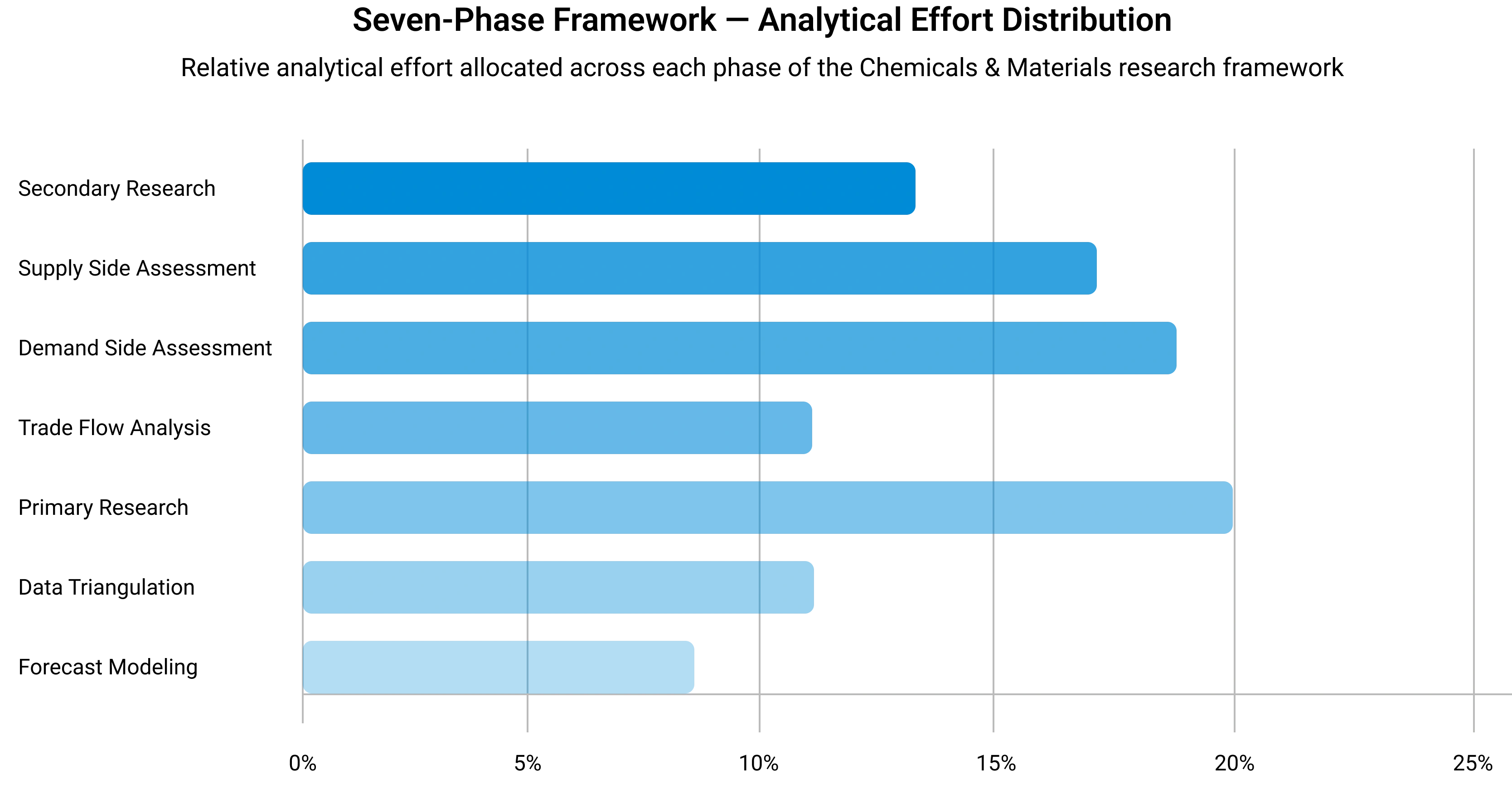
Seven-Phase Framework — Analytical Effort Distribution
Relative analytical effort allocated across each phase of the Chemicals & Materials research framework
Phase 1 - Secondary Research: Establishing the Foundation
Secondary research collects and evaluates publicly available information from authoritative sources, establishing the foundational understanding of market structure, value chain dynamics, competitive landscape, and end-use demand patterns. Every source is evaluated for credibility, recency, geographic relevance, and methodological soundness before inclusion.
Industry Associations
Sources include ACC, CEFIC, ICCA, JCIA, CPCIF, and SOCMA providing production volumes, consumption trends, capacity developments, and sustainability initiatives.
Company Disclosures
Annual reports, investor presentations, earnings transcripts, and regulatory filings reveal product portfolios, manufacturing footprints, capacity expansions, and revenue segmentation.
Government Databases
National statistical offices, customs authorities, environmental agencies, and industrial production databases provide verified statistics on output, trade flows, and regulatory compliance.
Trade Databases
UN Comtrade, ITC, Eurostat, and national customs authorities enable assessment of global product movement, import dependency, and export competitiveness across regions.
Our Secondary Research Sources
- Ministry of Chemicals and Fertilizers
- European Chemicals Agency
- United States Department of Energy
- Ministry of Industry and Information Technology
- Ministry of Economy Trade and Industry
- Ministry of Trade Industry and Energy
- National Institute of Standards and Technology
- Council of Scientific and Industrial Research
- Fraunhofer Society
- National Institute for Materials Science
Phase 2 — Supply-Side Assessment: Mapping Production Capabilities
Production Capacity Analysis
All major manufacturers are assessed for existing installed capacity, planned additions, expansions, new plant announcements, and technology adoption — mapped at global, regional, and country levels.
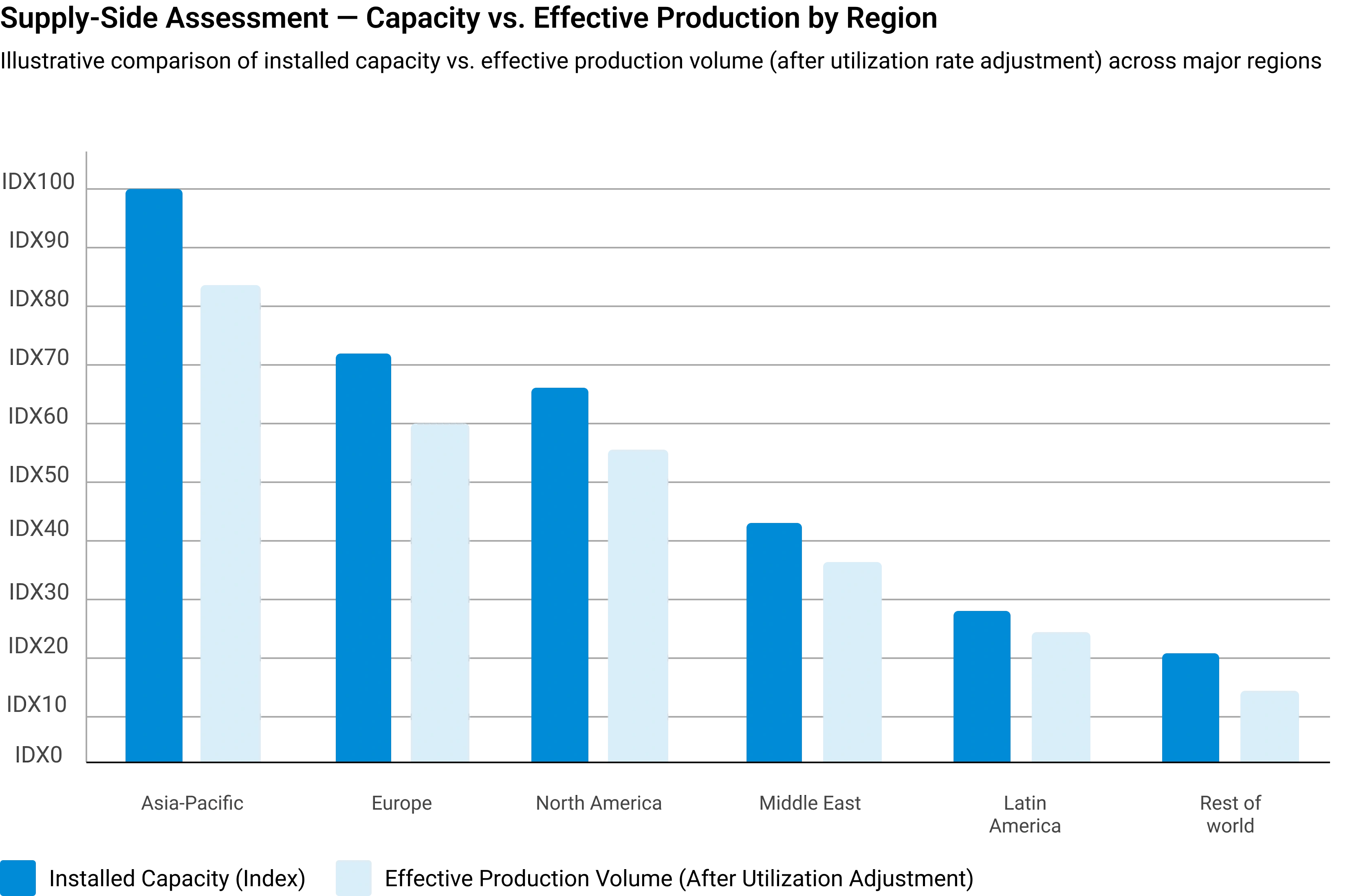
Capacity Utilization Adjustment
Installed capacity is adjusted using utilization rates based on demand conditions, feedstock availability, plant operating rates, maintenance schedules, and regulatory restrictions.
Manufacturer Revenue Analysis
Product-specific revenues, segment-level performance, regional distribution, average selling prices, and margin trends are evaluated to establish market value estimates.
Supply-Side Assessment — Capacity vs. Effective Production by Region
Illustrative comparison of installed capacity vs. effective production volume (after utilization rate adjustment) across major regions
Phase 3 — Demand-Side Assessment: Quantifying Chemical Consumption
Demand-side analysis quantifies chemical consumption across industries, applications, and geographies — identifying where and how chemicals are consumed throughout the value chain with precision.
End-Use Industry Analysis
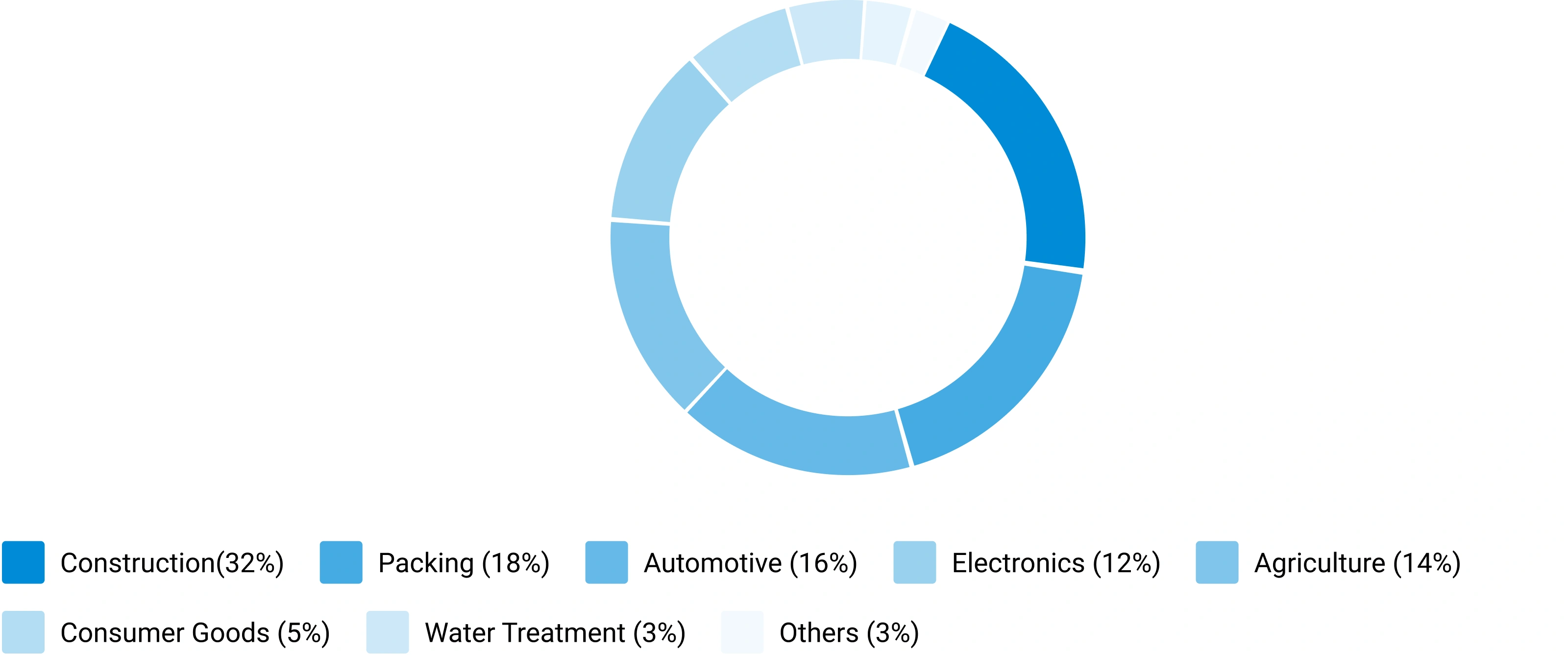
Chemical demand is evaluated across automotive, construction, packaging, electronics, agriculture, healthcare, consumer goods, industrial manufacturing, energy and utilities, and water treatment. Industry output, production trends, and consumption intensity are analyzed to determine demand patterns.
Consumption Modeling
Demand is estimated using measurable indicators: kilograms per vehicle, kilograms per square meter of construction, dosage per cubic meter of water treated, kilograms per hectare of agricultural land, and kilograms per ton of manufactured products. Consumption factors are validated through industry publications and primary interviews.
Application Analysis
The market is segmented by application area to understand product performance requirements, formulation trends, technology adoption, customer preferences, and regulatory requirements improving demand accuracy and segmentation granularity.
Demand-Side Assessment — End-Use Industry Demand Distribution
Illustrative distribution of chemical & materials demand across key end-use industries
Phase 4 - Trade Flow Analysis: Balancing Regional Supply and Demand
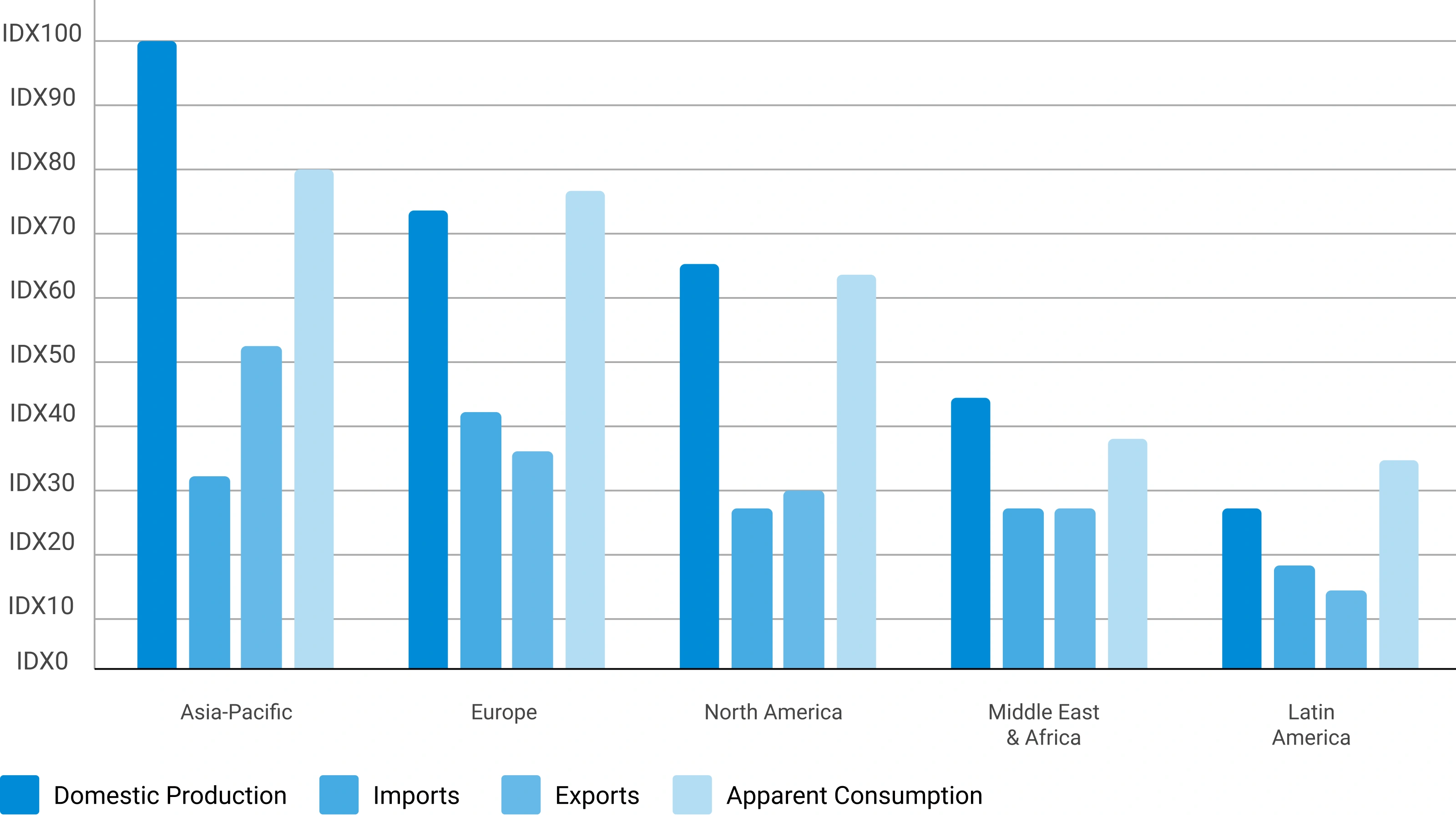
Trade flow analysis reconciles regional supply and demand estimates through import and export data, identifying net supply positions, regional dependencies, and market imbalances. It serves as an independent validation layer that tests the consistency of supply-side and demand-side estimates.
Import Analysis
Import data is evaluated to determine volumes, source countries, product dependency, regional supply gaps, and pricing trends — identifying markets that rely heavily on external supply and where domestic production is insufficient to meet demand.
Export Analysis
Export assessments reveal production surplus, export competitiveness, regional manufacturing strength, and global market participation. Export patterns also help validate domestic production estimates and identify net exporting regions.
Apparent Consumption Model
Regional consumption is assessed using the standard apparent consumption formula:
Results identify net importing regions, net exporting regions, regional deficits, and surpluses — serving as an independent validation of supply and demand estimates.
Trade Flow Analysis — Net Supply Position by Region
Illustrative apparent consumption vs. domestic production across major regions — positive gap indicates net import dependency
Phase 5 — Primary Research: The Critical Validation Layer
Primary research tests and refines findings from secondary research through direct engagement with industry participants across the supply chain, demand side, and expert community. It captures intelligence that no database or published report can provide — the real-world experience of manufacturers, buyers, and specialists operating in the market.

Supply-Side Interviews
Conversations with chemical manufacturers, raw material suppliers, contract manufacturers, technology providers, and plant operators cover production trends, capacity utilization, pricing developments, technology shifts, and competitive dynamics.

Demand-Side Interviews
Engagement with OEMs, industrial consumers, procurement managers, distributors, formulators, and end-use manufacturers focuses on consumption trends, purchasing behavior, product substitution, demand outlook, and emerging applications.

Industry Expert Consultations
Additional interviews with industry consultants, independent experts, regulatory specialists, technical professionals, and research institutions provide deeper market context and validate key analytical assumptions.
Focus Areas of Primary Research:
Market Size & Forecast Validation
Revenue estimates, volume consumption, growth rates, forecast assumptions, regional demand.Supply Chain & Value Chain Assessment
Raw material sourcing, supply chain challenges, distribution networks, procurement practices.Production & Capacity Analysis
Manufacturing capacity, utilization rates, expansion projects, plant investments.Pricing & Cost Structure Analysis
Product pricing trends, feedstock costs, energy costs, margin pressures, pricing outlook.Competitive Landscape Assessment
Volume and value estimates confirmed to be fully consistent with one another before publicationInterview Volume by Market Scope
| Study Scope | Number of Interviews |
|---|---|
| Niche Market | 20 – 30 |
| Mid-Sized Market | 30 – 50 |
| Global Market | 50 – 80 |
| Highly Fragmented Market | 80 – 120 |
Interview Details:
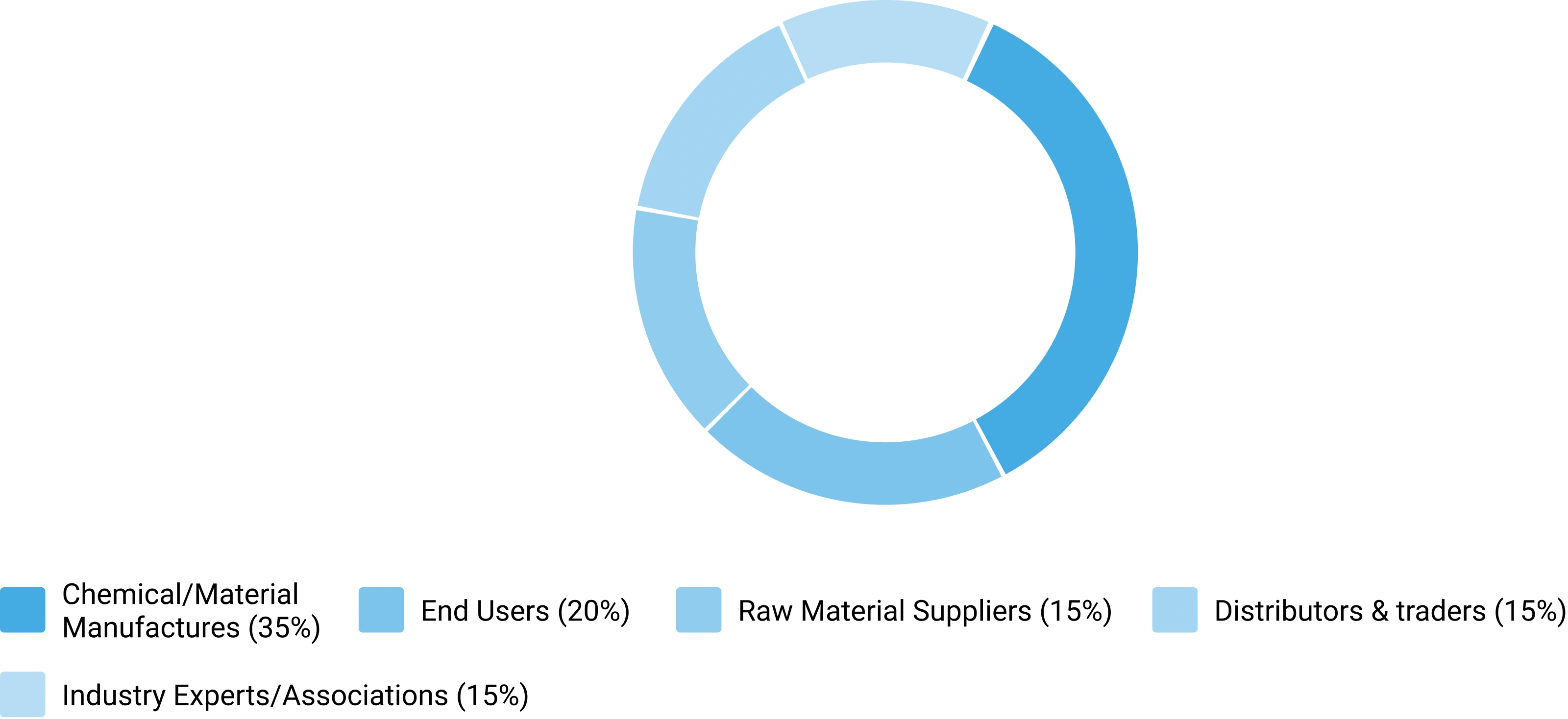
Category : Manufacturers, Suppliers, Distributors, End Users, Experts/Associations
Average Duration : 30–60 Minutes
Interview Mode : Video calls, telephonic interviews, expert consultations
Interview Format : Structured / Semi-Structured questionnaire
Focus Areas of Primary Research:
Market Size & Forecast Validation :
Revenue estimates, volume consumption, growth rates, forecast assumptions, regional demand.
Supply Chain & Value Chain Assessment :
Raw material sourcing, supply chain challenges, distribution networks, procurement practices.
Production & Capacity Analysis :
Manufacturing capacity, utilization rates, expansion projects, plant investments.
Pricing & Cost Structure Analysis :
Product pricing trends, feedstock costs, energy costs, margin pressures, pricing outlook.
Competitive Landscape Assessment :
Market share, competitor positioning, strategic initiatives, partnerships, acquisitions.
Primary Research — Stakeholder Coverage by Category
Distribution of interview respondents across stakeholder categories (% share from PPT data)
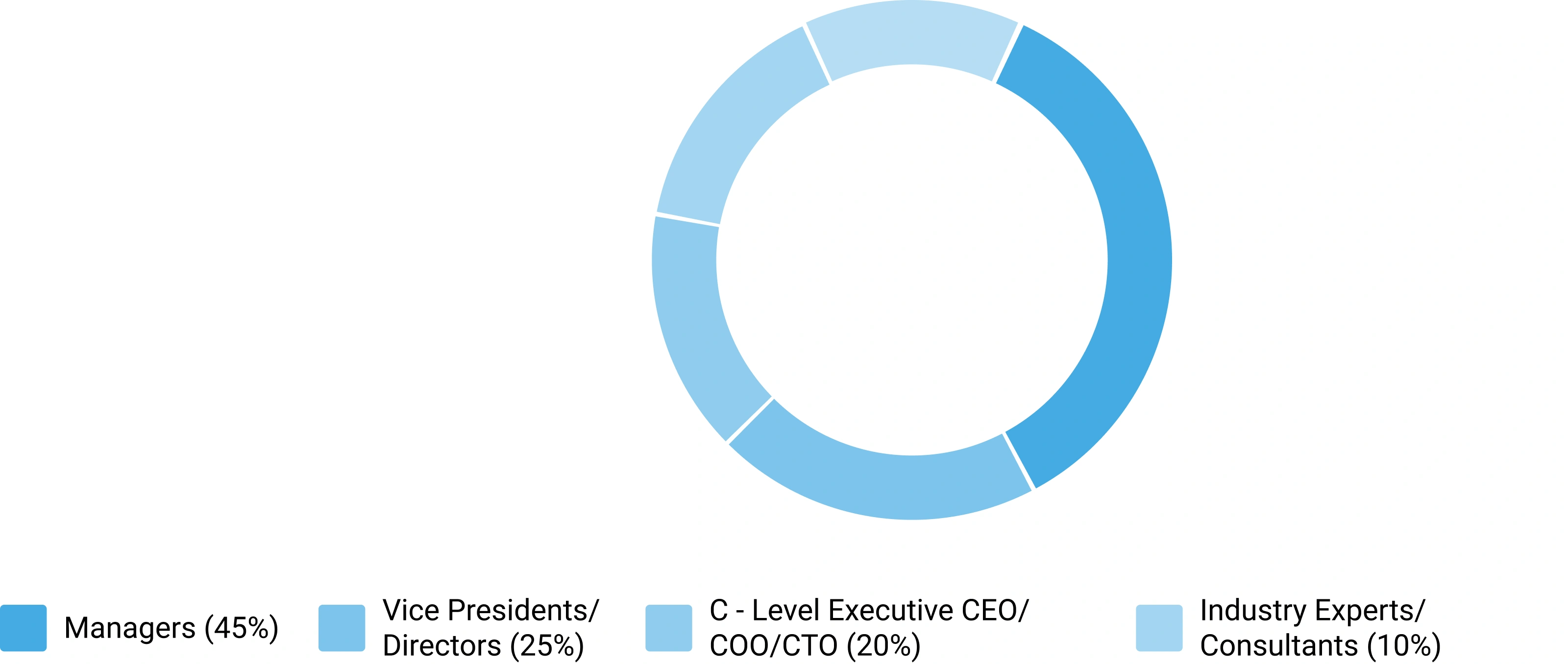
Primary Research — Respondent Designation Profile
Seniority breakdown of interview respondents (% share from PPT data)
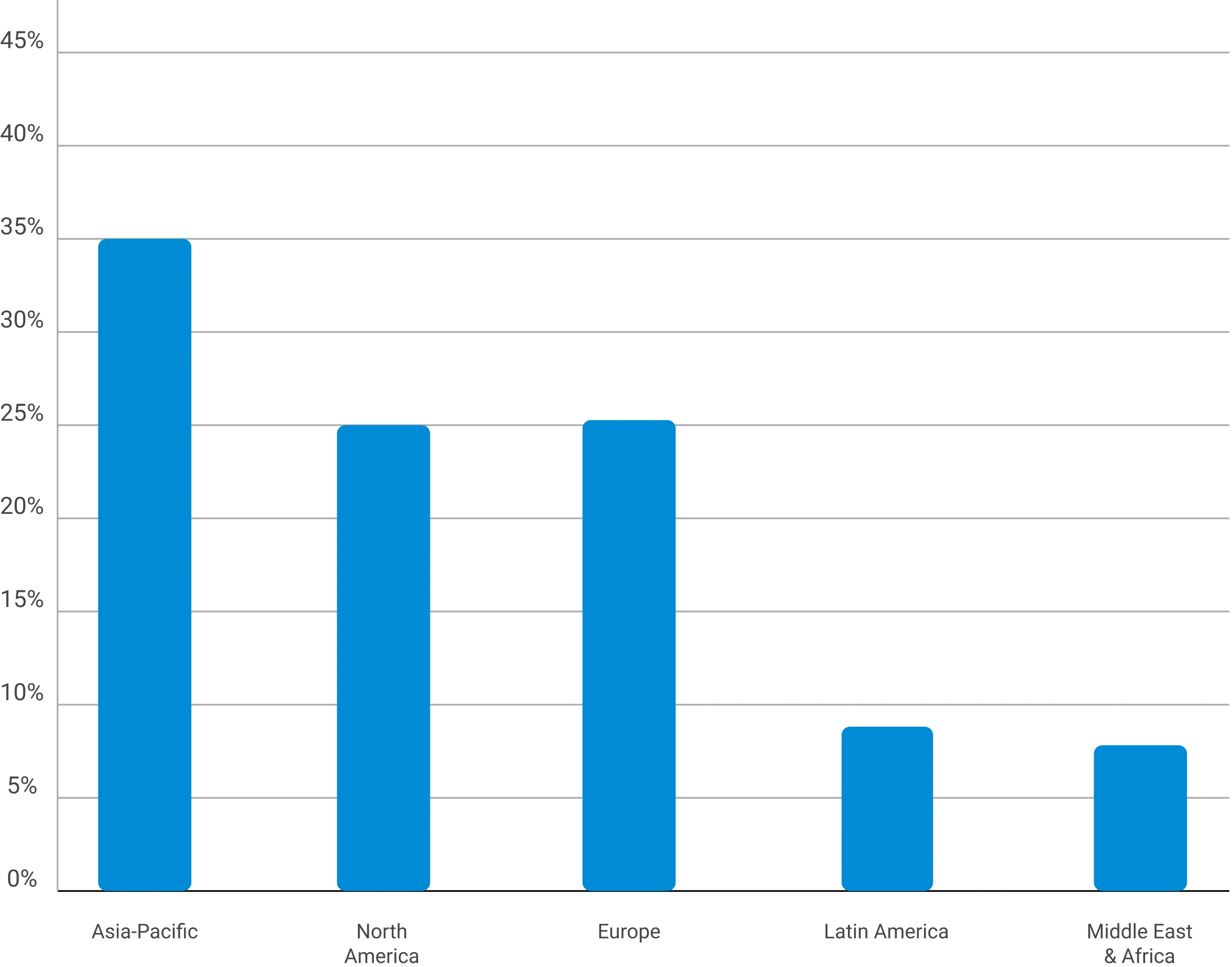
Primary Research — Geographic Coverage of Interviews
Regional distribution of primary research engagement (% share from PPT data)
Phase 6 — Data Triangulation and Market Validation
No single methodology is relied upon in isolation. Multiple independent estimation approaches are combined and reconciled to ensure consistency, accuracy, and analytical defensibility. Any material deviations between approaches are investigated and adjusted through additional validation cycles.
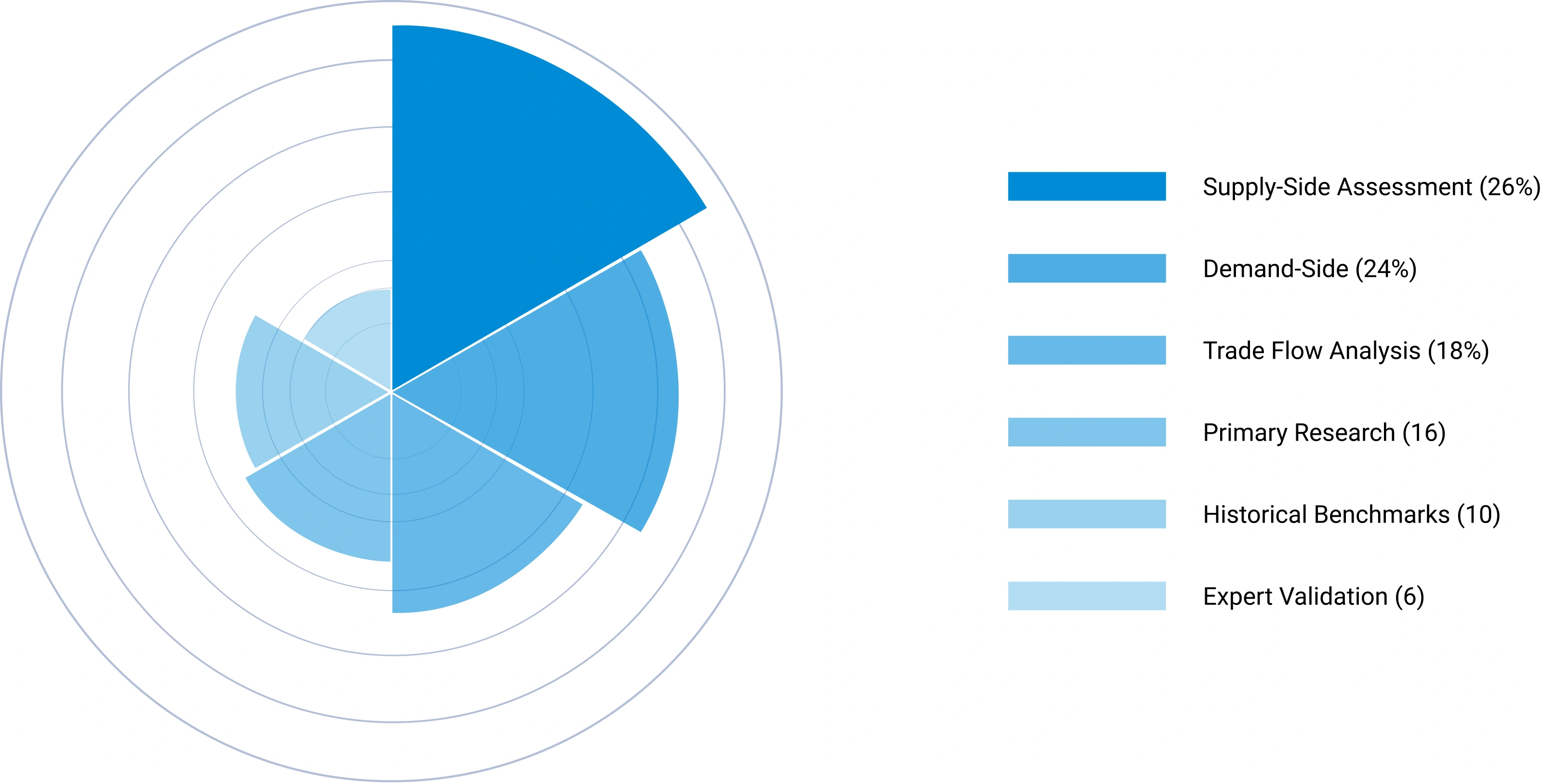
The final market size is derived through weighted triangulation of all validated methodologies. Any material deviations between approaches are investigated and adjusted through additional validation cycles. The outcome represents the most realistic assessment of the market based on available evidence and expert confirmation ensuring that volume and value estimates are fully consistent with one another.
Triangulation Framework — Input Contribution Weight
Relative weight each sizing input contributes to the final reconciled market estimate
Phase 7 — Forecast Modeling: Projecting Future Market Evolution
Forecasting evaluates the future trajectory of the market using a combination of quantitative indicators and qualitative assessments across economic, industry, and regulatory dimensions. Rather than simple extrapolation, each driver is independently modeled and integrated into a composite forecast.
Macroeconomic Indicators
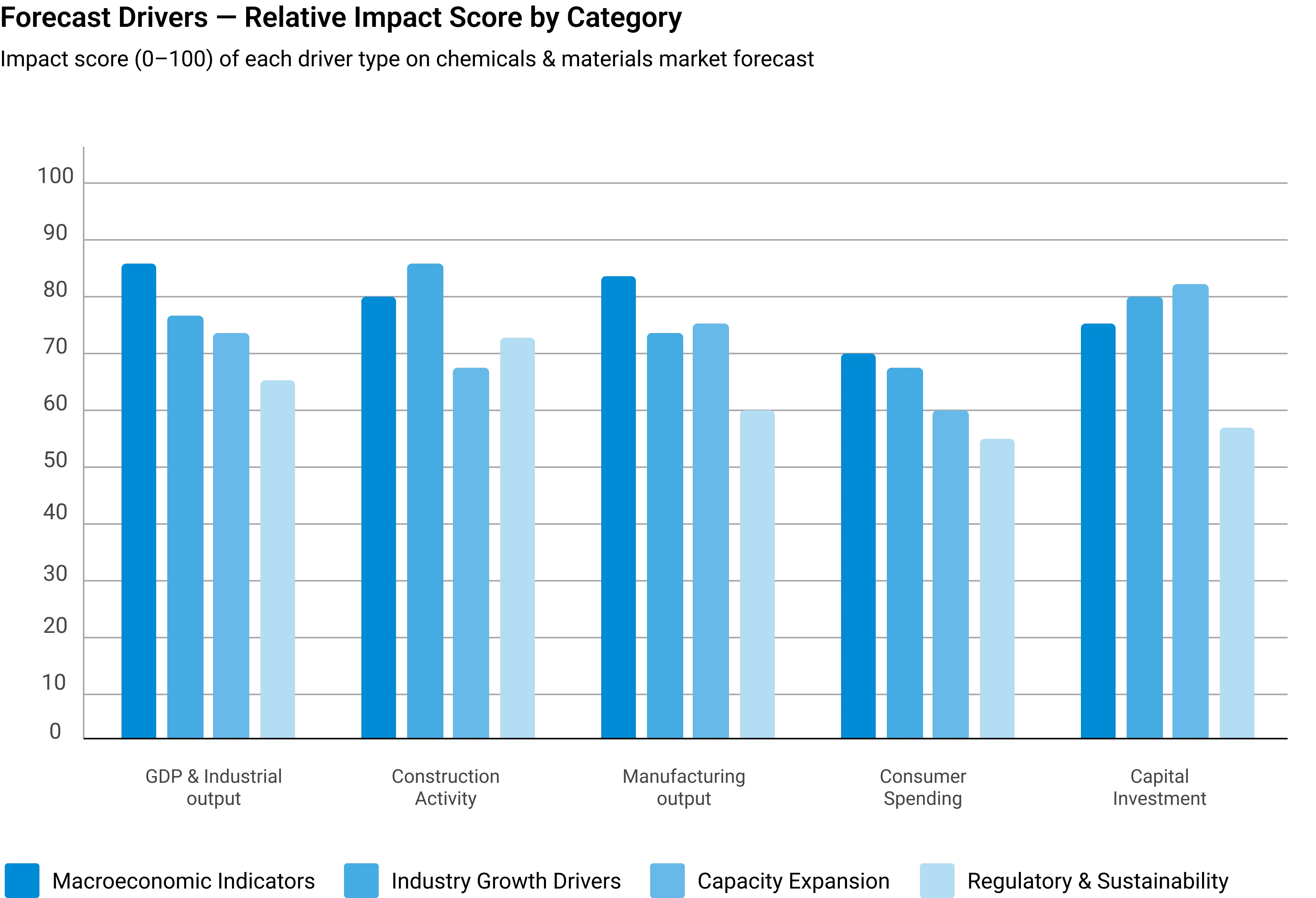
GDP growth, industrial production, manufacturing output, construction activity, consumer spending, and capital investment form the quantitative foundation of long-term demand projections. These are applied at country, regional, and global levels.
Industry Growth Drivers
Urbanization, infrastructure development, industrialization, technological innovation, sustainability initiatives, and evolving product performance requirements are assessed at regional and industry levels — capturing both structural and cyclical demand drivers.
Capacity Expansion Analysis
Announced plant expansions, new manufacturing facilities, technology upgrades, and strategic investments are evaluated to determine future supply-demand dynamics and potential market tightness or oversupply situations.
Regulatory & Sustainability
Environmental regulations, chemical safety standards, emission reduction targets, circular economy initiatives, and sustainability requirements are incorporated as they often influence product adoption rates and market growth trajectories.
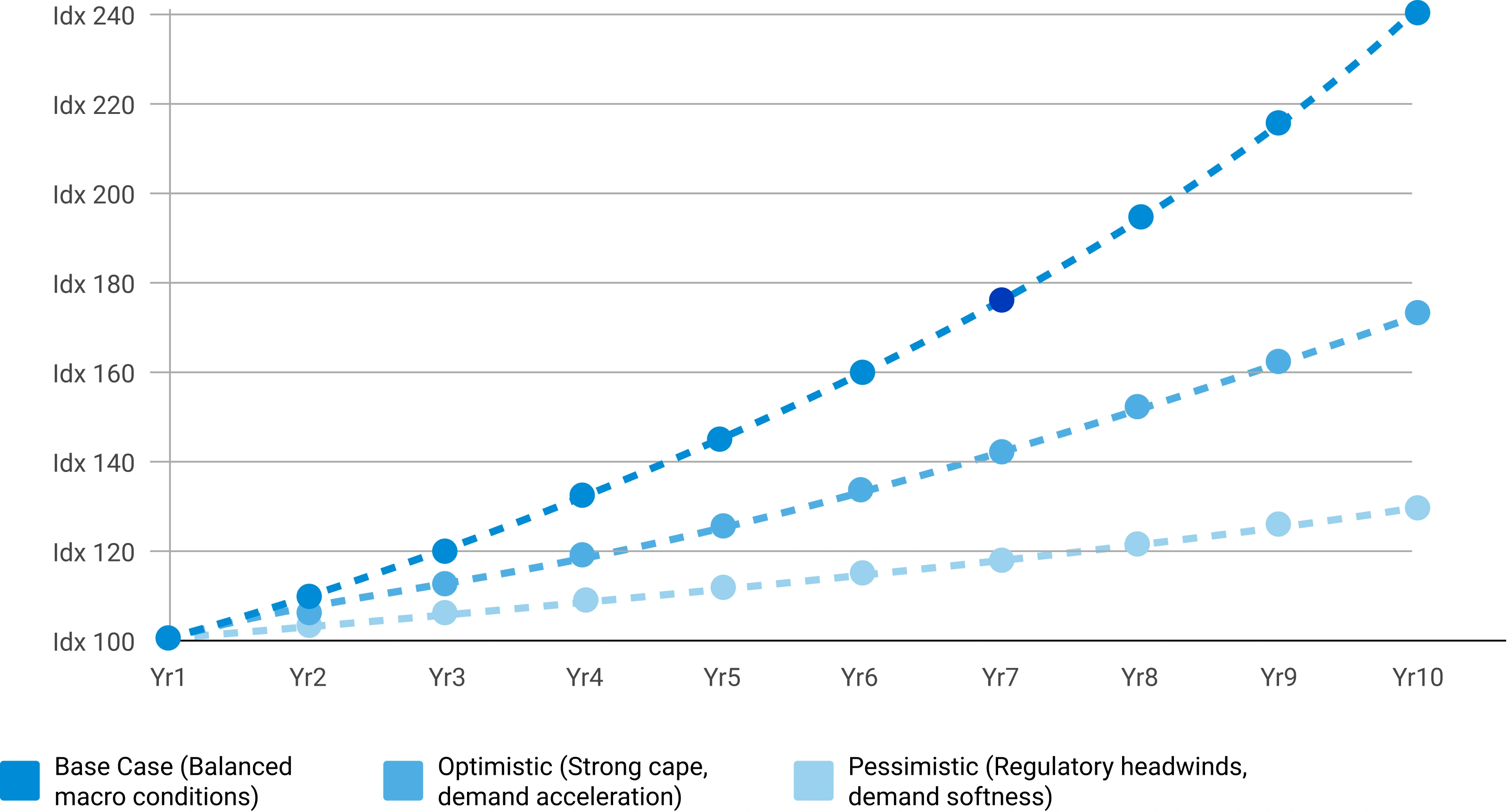
Scenario Forecast Range — Indexed Market Growth (Year 1–10)
Illustrative indexed growth trajectories across Base, Optimistic, and Pessimistic scenarios over a 10-year forecast horizon
Forecast Drivers — Relative Impact Score by Category
Impact score (0–100) of each driver type on chemicals & materials market forecast



Comments
Share your thoughts, ask a question, or provide feedback about this report.