
Circular Polymers Market Size, Competitive Landscape Analysis Report 2035
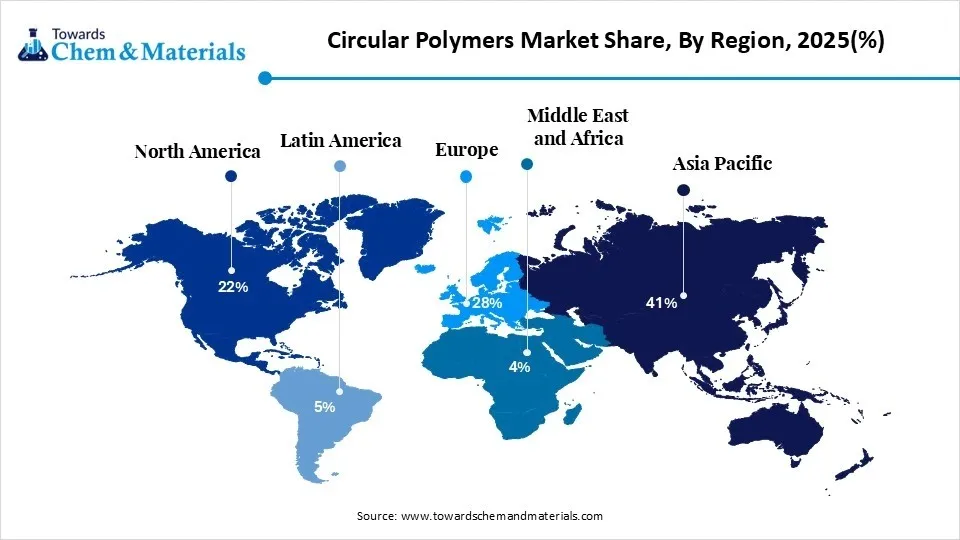
The global circular polymers market size was valued at USD 97.34 billion in 2025, is estimated to reach USD 107.95 billion in 2026, and is projected to reach USD 273.91 billion by 2035, exhibiting a compound annual growth rate (CAGR) of 10.90% over the forecast period from 2026 to 2035.Asia Pacific dominated the circular polymers market with the largest revenue share of 41.00% in 2025 and is expected to grow at the fastest CAGR of 11.03% during the forecast period.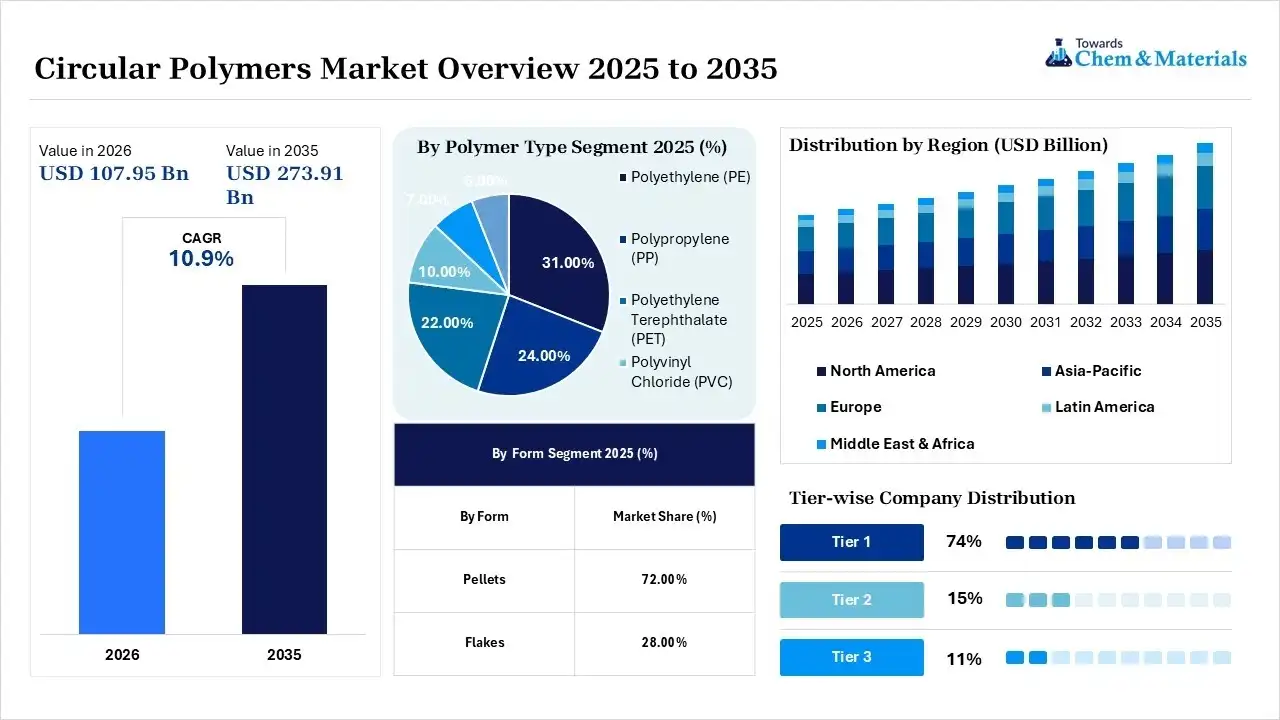
The Higher demand for sustainable packaging, bio-based materials, and circular economy habits is pushing companies to adopt these solutions across several industries, even when budgets are tight. The circular polymers market is climbing because more sustainability commitments are showing up, there are growing worries about plastic waste, the regulations are supportive, plus recycling technologies are getting better each year.
Market Highlights
- By region, Asia Pacific dominated the circular polymers market by holding 41% share in 2025 and is expected to grow at a CAGR of 11.03% during the forecast period.
- By region, North America held 22.00% market share in 2025 and is expected to grow at the fastest with a CAGR of 11.15% during the forecast period.
- By polymer type, the polyethylene (PE) segment dominated the market with the largest share of 31% in 2025 and is expected to grow at a CAGR of 9.86% during the forecast period.
- By polymer type, the polypropylene (PP) segment held 24% market share in 2025 and is expected to grow at the fastest CAGR of 10.82% over the forecast period.
- By form, the pellets segment dominated the market with the largest share of 72% in 2025 and is expected to grow at a CAGR of 10.54% during the forecast period.
- By form, the flakes segment held 28% market share in 2025 and is expected to grow at the fastest CAGR of 8.74% over the forecast period.
- By application, the food packaging segment dominated the market with the largest share of 34% in 2025 and is expected to grow at a CAGR of 10.36% during the forecast period.
- By application, the interior & exterior components segment held 22% market share in 2025 and is expected to grow at the fastest CAGR of 11.08% over the forecast period.
- By end use, the packaging segment dominated the market with the largest share of 43% in 2025 and is expected to grow at a CAGR of 10.42% during the forecast period.
- By end use, the automotive segment held 18% market share in 2025 and is expected to grow at the fastest CAGR of 11.24% over the forecast period.
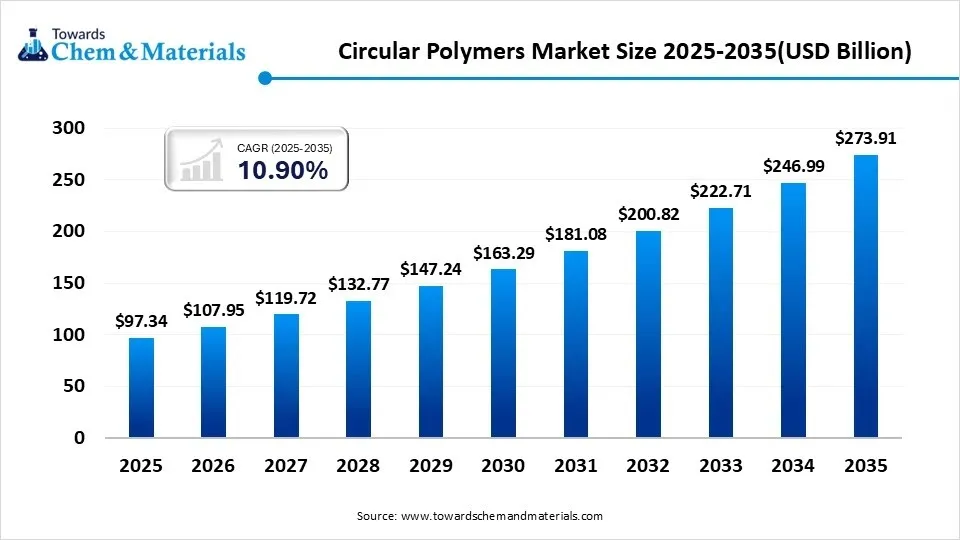
As regulations become stricter, corporate sustainability initiatives gain momentum, and consumer awareness of the benefits of recycled and renewable polymer materials continues to rise; adoption is being driven in packaging, automotive, electronics, and construction applications. The circular polymers market is experiencing robust growth as industries shift from linear plastic consumption to a resource-efficient circular economy. The polymer quality is improving due to constant developments of chemical recycling, dissolution technologies, AI-based sorting solutions, and bio-based feedstocks, also broadening application potential. The manufacturers are investing in “integrated recycling ecosystems,” which are able to recover valuable materials from post-consumer waste without sacrificing performance. The future growth of the market will be driven by the development of recycling facilities, digital traceability, and cooperation between all players in the plastics value chain.
- For instance, in June 2026, IMG Group opened the Everbio Innovation Hub in Portugal, establishing a worldwide platform for the development, testing, and commercialization of polymer materials from recycling and bio-based sources. The initiative brings together several subsidiaries in order to increase the pace of circular polymer innovations and promote sustainable material solutions.(Source: recyclingtoday.com)
Global Investment Movement for the Circular Polymers Market
Large amounts of investments are being directed into different chemical recycling technologies like pyrolysis and depolymerization, and solvent-based purification. These technologies help to transform mixed plastic waste and contaminated plastic waste into high-grade polymer feedstocks for use in high-quality packaging, automotive, and engineering applications and enhance overall material recovery.
Increased collaboration is occurring between polymer manufacturers and recycling specialists, as well as technology providers, to bolster circular supply chains. Collaborations provide greater access to recycled feedstocks, speed up the commercialization of new recycling technologies, and enable high-quality circular polymers for various industrial uses.
Investments in waste collection, sorting, and material recovery infrastructure continue to be robust, especially in emerging markets. With more advanced and automated processing equipment and systems, modern recycling plants enhance the quality of the feedstock and expand the supply of recycled polymers for industrial use.
Circular Polymers Market Trends
- Sustainability efforts are being enhanced through strategic partnerships between polymer manufacturers, packaging companies, recyclers, and consumer brands to collect plastics in a post-consumer sense and reuse these materials in new products. These closed-loop systems will decrease waste and provide a consistent stream of recycled material to be used in the long term.
- Circular polymers are being used more and more in automotive parts, electrical, construction, consumer goods, industrial products, etc. Their performance properties and eco-friendliness are creating new commercial applications, in addition to their packaging uses.
- The use of renewable raw materials such as biomass and agri-based materials in polymer production is increasingly seen in the manufacturing sector. Bio-circular feedstocks offer a measure of reducing fossil resources, and support companies in meeting carbon reduction targets and long-term sustainability strategies.
Report Scope
| Report Attributes | Details |
| Market Size in 2026 | USD 107.95 Billion |
| Expected Size in 2035 | USD 273.91 Billion |
| Growth Rate | CAGR of 10.90% |
| Base Year of Estimation | 2025 |
| Forecast Period | 2025-2035 |
| Dominant Region | Asia Pacific |
| Segment Covered | By Polymer, By Form, By Application, By End-use, By Region |
| Key Companies Profiled | 3M Company, Parker Hannifin Corporation, Merck Group, AGFA-Gevaert N.V., The Lubrizol Corporation, Premix Group, Avient Corporation, BASF SE, DuPont de Nemours, Novasentis, Inc., Covestro AG, Cabot Corporation, RTP Company, Sumitomo Chemical Co., Ltd., Heraeus Group, Sabic, Kenner Material & System Co., Ltd. |
Driving Innovation through Smart Recycling Technologies
The circular polymers industry is rapidly developing as new recycling technologies are developed to extract high-quality materials from complex polymer waste streams. Contaminated plastics can be converted back into virgin-quality raw materials using chemical recycling processes such as depolymerization, pyrolysis, and solvolysis. The quality of recycled polymer for more specialized applications is further improved through the use of improved washing systems, filtration techniques, and deodorizing processes. The innovation of materials is also driving the development of products and polymers derived from sources of renewable raw materials that are easier to recycle. Digital product passports and traceability platforms are enhancing regulatory compliance and transparency across the polymer value chain.
Supply Chain Analysis of the Circular Polymers Market
Feedstock Procurement
- The supply chain starts with collecting, sorting, cleaning, and preparing post-consumer plastic waste, industrial scrap, and renewable feedstocks for recycling.
- Efficient material recovery systems provide a steady supply of feedstock for recycling and a better recycling rate, helping sustainable polymer production along the global circular economy chain.
- Neste Oyj: The contribution is in the form of renewable and mass balance-certified circular feedstocks from waste plastics, thus enhancing the supply of sustainable raw materials for circular polymer manufacturing.
- Other Key Players: Veolia, Suez Group, Plastic Energy.
Chemical Synthesis and Processing
- Advanced recycling technologies, including depolymerization, pyrolysis, solvolysis, and purification, are used to convert recovered plastic waste into high-quality polymer feedstocks for a new generation of circular products.
Sophisticated technologies enhance materials and facilitate effective use of resources and environmental sustainability. - BASF AG: The technologies that BASF uses for recycling mixed plastics to high-quality feedstocks for new circular polymers are advanced.
- Other Key Players: Dow Inc., SABIC, Eastman Chemical Company.
Compound Formulation and Blending
- Recycled polymer feedstocks are compounded with additives, stabilizers, and performance modifiers to meet the mechanical, thermal, and processing properties needed for several industrial uses.
Custom formulations enhance durability, processability, and product consistency, and enable circular manufacturing. - LyondellBasell: LyondellBasell ensures product quality and value with the development of high-performance circular polymer formulations using recycled materials and advanced processing technologies.
- Other Key Players: Borealis AG, Ascend Performance Materials.
Regulatory Framework: Circular Polymers Market
| Country Region | Regulatory Body | Key Regulations | Focus Areas |
| Asia Pacific | Central Pollution Control Board (CPCB) | Plastic Waste Management (PWM) Rules | Mandatory QR/barcode tracking |
| North America | Environmental Protection Agency (EPA) & State Agencies | FTC Green Guides | Post-consumer resin (PCR) minimums (e.g., California, Washington), updating definitions for "recyclable" claims |
| European Union | European Commission (EC) | Packaging & Packaging Waste Regulation (PPWR) | Mandatory post-consumer recycled (PCR) targets |
What are Circular Polymers, and How are Polymers Categorized?
Circular polymers are polymer materials designed for a closed-loop polymer life cycle, which aim at minimizing waste and optimizing resource use. Circular polymers are created from recycled plastics, renewable feedstocks, or cutting-edge recovery technology, in contrast to traditional polymers made from virgin fossil fuel resources.These polymers are designed with principles of the circular economy, which means they are designed to be used continuously through recycling, reusing, and recovering. They can be used to limit the use of fossil fuels, decrease the generation of plastic waste, and reduce the environmental footprint of conventional polymer manufacturing.
Types of polymers are as follows:
- Recycled Polymers:Recycled polymers are manufactured by converting and processing used plastic materials to get new polymer products. Plastic waste is generally cleaned, sorted, and reprocessed into recycled materials by mechanical recycling. These polymers help to minimise landfill waste and virgin plastic production.
- Chemically Recycled Polymers:Chemically recycled polymers are made from plastic waste by employing high-tech recycling processes to separate the plastic into its molecular constituents. Pyrolysis, depolymerisation, and purification of materials by solvent action make materials available as high-quality feedstocks again. These polymers can be used for applications where high purity in the material is required, and can be used to achieve performance levels comparable to virgin polymers.
- Bio-Based Circular Polymers:In bio-based circular polymers, renewable resources, including plant-based feedstocks, agricultural residues, and other biological materials, are used in the production process. These polymers are able to decrease reliance on fossil fuels and promote reduced carbon production methods. They are used for packaging, consumer items, and specialty applications.
- Renewable and Compostable Polymers:Renewable polymers and compostable polymers are produced from renewable resources and can be broken down under certain conditions. They aid in waste reduction and offer alternatives to applications where traditional plastics pose disposal problems.
- Upcycled Polymers:Upcycled polymers are produced by adding value to the lower-value plastic waste materials. The polymers enhance the utilization of materials by converting them into useful products with better properties and longer life cycles, from discarded plastics
Circular Polymers Market Dynamics
Driver: Corporate Sustainability Commitments Accelerating Market Expansion
The global trend towards carbon neutrality is increasing the demand for circular polymer solutions. Companies are turning to recycled and renewable polymers to lessen reliance on plastics from virgin sources. Sustainability is becoming a key element of packaging, automotive, and consumer goods production. These are waste reduction and resource efficiency initiatives. Businesses are also urged to invest in circular manufacturing practices and sustainable polymer alternatives due to regulatory pressure and environmental targets.
Restraint: Limited Availability of High-Quality Recyclable Feedstock
A disadvantage is the scarcity of stable, recyclable polymers for the market of circular polymers. Waste collection is still not consolidated in some areas. Recycling is impacted by post-consumer plastic contamination and the resulting poor quality of the material. All this raises the processing needs and production costs. However, there are also limited applications of high-quality recycled materials due to the lack of materials in certain sectors that have high-performance requirements, such as food packaging, the automotive industry, and other advanced polymer applications.
Opportunity: Advanced Recycling Unlocking High-Value Applications
Trends of using polymers circularly are on the rise, thanks to advanced recycling technologies. These processes transform plastic waste with a high level of complexity into high-value polymer feedstocks. Chemical recycling increases the purity of the material and increases its industrial use. Recycled polymers can be utilized in critical industries that have similar performance specifications as virgin polymers. Innovative recycling technologies are being increasingly invested in, which help in sustainable production and are also boosting polymer recycling in packaging, automotive, and electronics sectors.
Benefits of the Circular Polymers
- Lowers the Need for Fossil Fuels: Circular polymers use recycled plastics and renewable raw materials to help lower dependence on raw materials derived from virgin fossil fuels. The conventional processes for polymer production rely heavily on the extraction of crude oil, leading to the depletion of resources and environmental pollution. Circular polymer solutions include strategies that promote the cyclization of materials, ensuring that resources are used and kept within the production process. This helps to lower the need for additional fossil resources and supports a more sustainable method of polymer production.
- Lowers Carbon Footprint: Circular polymers contribute to reduced greenhouse gas emissions during the production process, when compared to conventional polymers. Recycled materials help in saving energy and emissions from extracted and processed fossil-based feedstocks. Significant carbon reductions can be realized through advanced circular polymer technologies, such as recycled polyester solutions, compared to traditional polymer alternatives. These benefits are aligned with corporate climate goals and help around the world achieve carbon neutrality.
- Prevents Ecosystem Pollution: By channeling plastics from the landfill and ocean into viable and useful uses, circular polymers help lower plastic waste buildup. Plastic materials do not enter landfills, waterways, or natural ecosystems as a result of recycling and reuse systems. This reduces the generation of microplastics, which can affect marine and terrestrial ecosystems, and reduces pollution of the environment. Circular polymer usage contributes to better waste management, which helps to foster a cleaner ecosystem and responsible use of materials.
- Supports Infinite Recycling Potential: Advanced recycling technologies are advancing the capabilities to repeatedly recycle polymers with minimal loss of quality. Chemical recycling, pyrolysis, depolymerization, and solvent-based purification are some of the processes that can transform plastic materials into high-purity raw materials. Advanced recycling techniques preserve polymer functionality, as opposed to traditional mechanical recycling techniques that can lower the performance of the polymer after several cycles. This leads to the possibility of material recyclability and facilitates the implementation of a closed-loop manufacturing system.
- Promotes Sustainable Manufacturing Practices: By promoting circular polymer production models through reuse, recovery, and renewable sources, circular polymers encourage industries to switch to more efficient production models. Waste can be cut, and material efficiency can be enhanced throughout supply chains. The solutions meet the requirements of sustainability regulations and environmental targets, as well as ever-growing consumer demand for eco-friendly solutions.
Segmental Insights
Polymer Type Insights
The polyethylene (PE) segment dominated the market with the largest share of 31% in 2025 and is expected to grow at a CAGR of 9.86% over the forecast period, because of its wide application areas like flexible packaging, consumer products, industrial films, and household applications. It is highly recyclable, has a large processing range, and is easy to collect, which has helped manufacturers efficiently recover and reuse polyethylene in various industries. Growing demand for sustainable packaging solutions and increasing incorporation of post-consumer recycled content further support market leadership. Innovations in the products are also aiding in recycling PE for high-value applications.
- For instance, in March 2026, ExxonMobil Signature Polymers and The Selene Group partnered to develop heavy-duty sacks filled with recycled PE as a way to work towards the circular economy in commercial packaging. (Source:packaginginsights.com)
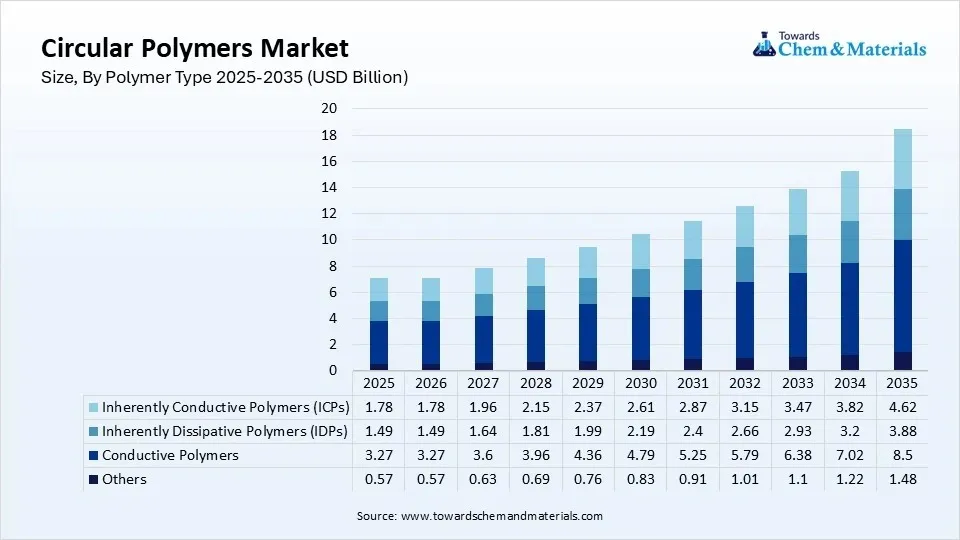 The polypropylene (PP) segment held the 24% market share in 2025 and is expected to grow at the fastest CAGR of 10.82% over the forecast period, because of its use in automotive parts, food packaging, consumer goods, and lightweight and long-lasting applications in the industrial sector. New recycling technology developments increase the rate of recovery of PP, and new applications are becoming available for high-performance recycled PP. Industry is also developing new grades of polymer to address emerging industrial needs and set the goals for the circular economy.
- For instance, in March 2026, New grades of polypropylene random copolymer (PPC) were launched by Rompetrol Rafinare in March 2026, marking a sign of innovation in developing new advanced polymers with increased demand, particularly from the automotive and food industry.(Source:ceenergynews.com)
Circular Polymers Market Share, By Polymer Type, 2025(%)
| By Polymer Type | Market Share (%) |
| Polyethylene (PE) | 31.00% |
| Polypropylene (PP) | 24.00% |
| Polyethylene Terephthalate (PET) | 22.00% |
| Polyvinyl Chloride (PVC) | 10.00% |
| Polyamide (PA) | 7.00% |
| Others | 6.00% |
Form Insights
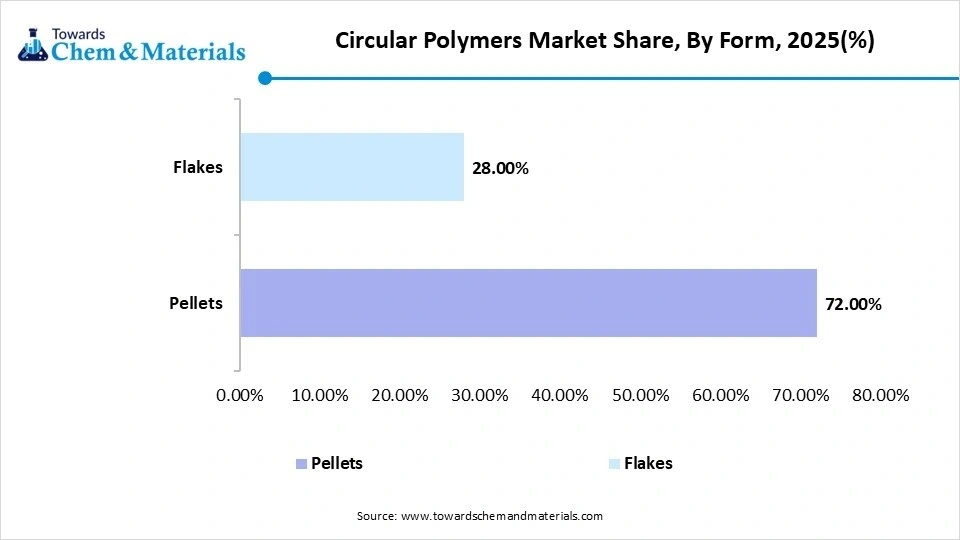
The pellets segment dominated the market with the largest share of 72% in 2025 and is expected to grow at a CAGR of 10.54% over the forecast period, due to uniform properties, convenient transportation, efficient storage, and compatibility with the existing plastic processing infrastructure, which were more important. Recycled pellets are used by manufacturers in all sectors of packaging, automotive, consumer goods, and construction and can be used in current extrusion, injection molding, and blow molding processes with minimal changes to production. Wider industrial uptake is further fuelled by ongoing improvements in the quality of pellets and their material performance.
- For instance, in May 2026, Xenia launched a new line of thermoplastic composite pellets, continuing in its tradition of innovation with material technologies for pellets. (Source: www.voxelmatters.com)
The flakes segment held the 28% market share in 2025 and is expected to grow at the fastest CAGR of 8.74% over the forecast period, due to the increasing number of recycling plants sorting, washing, and processing facilities. Good quality polymer flakes are important feedstock for mechanical and chemical recycling processes, which can efficiently transform them into high-quality recycled polymer. Investment in automated sorting machines, contamination removal equipment, and advanced packaging recycling equipment is enhancing flake quality and facilitating increased use in packaging, automotive, and industrial manufacturing, where companies are developing sustainable alternatives to raw materials.
Circular Polymers Market Share, By Form, 2025(%)
| By Form | Market Share (%) |
| Pellets | 72.00% |
| Flakes | 28.00% |
Application Insights
The food packaging segment dominated the market with the largest share of 34% in 2025 and is expected to grow at a CAGR of 10.36% over the forecast period, as consumer goods manufacturers are looking for sustainable packaging materials that meet stringent safety, quality, and environmental requirements. Over the years, recycling technologies have been developing to make better quality circular polymers for food contact applications and to drive corporate sustainability approaches. In addition, as consumer demand for sustainable packaging increases, it further bolsters market demand.
- For instance, in February 2026, Peak Nanos commitment to sustainability in packaging materials is further highlighted by its development program for biodegradable multilayer polymer films for food and medical packaging.(Source:www.packaginginsights.com)
The interior & exterior components segment held the 22% market share in 2025 and is expected to grow at the fastest CAGR of 11.08% over the forecast period, because the automotive manufacturers are increasingly using recycled polymers to lighten the vehicles, promote sustainability, and enable circular production. Circular polymers offer durability, design flexibility, and environmental performance to meet the changing sustainability requirements of manufacturers. The use of recycled polymers in automotive interior applications, such as dashboards, door panels, trim pieces, and other interior parts, is expected to grow as production for EVs continues and materials continue to innovate.
Circular Polymers Market Share , By Application, 2025(%)
| By Application | Market Share (%) |
| Food Packaging | 34.00% |
| Adhesives & Sealants | 11.00% |
| Interior & Exterior Components | 22.00% |
| Wires & Cables | 13.00% |
| Others | 20.00% |
End Use Insights
The packaging segment dominated the market with the largest share of 43% in 2025 and is expected to grow at a CAGR of 10.42% over the forecast period, as it is the biggest consumer of recycled polymers in all food, beverage, personal care, household, and industrial products. The drive towards recycled content, corporate sustainability goals, and a rising consumer appetite for environmentally conscious packaging continue to push circular polymer solutions into the mainstream. Packaging manufacturers are continuing to revamp packaging materials in order to increase the amount of recycled content in commercially used products without sacrificing protection and functionality.
The automotive segment held the 18% market share in 2025 and is expected to grow at the fastest CAGR of 11.24% over the forecast period, with car makers increasing their use of circular polymers in lightweight structural and non-structural parts. The increased focus on minimizing environmental impact, maximizing material efficiency, and promoting initiatives for the circular economy is bringing recycled polymers to the forefront of vehicle production. Car manufacturers are increasingly using sustainable materials without compromising on the durability, safety, or efficiency of their vehicles, thanks to the advancements in polymer performance, recycling, and material engineering.
Circular Polymers Market Share, By End Use, 2025(%)
| By End-use | Market Share (%) |
| Packaging | 43.00% |
| Building & Construction | 17.00% |
| Automotive | 18.00% |
| Electrical & Electronics | 14.00% |
| Others | 8.00% |
Regional Insights
How Did the Asia Pacific Dominate the Circular Polymers Market In 2025?
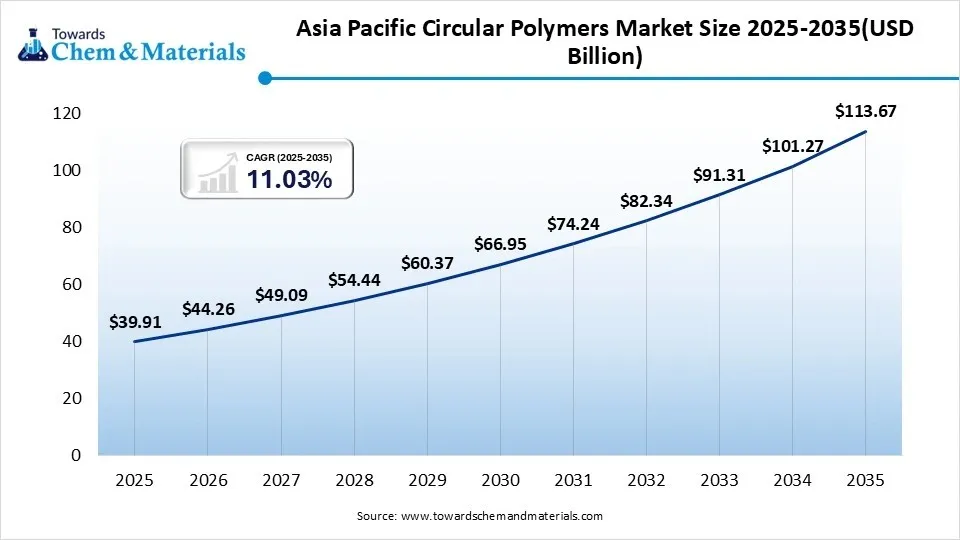
The Asia Pacific circular polymers market size was estimated at USD 39.91 billion in 2025 and is projected to reach USD 113.67 billion by 2035, growing at a CAGR of 11.03% from 2026 to 2035.Asia Pacific dominated the market with the largest share of 41% in 2025 and is expected to grow at a CAGR of 9.46% during the forecast period, due to rapid industrialization, increasing plastic consumption, growth of recycling infrastructure, and increased investments in sustainable manufacturing. The growing number of regulations to promote the circular economy and the greater willingness of producers to use recycled materials are promoting the entry of circular polymers into the packaging, automotive, electronic, and consumer goods sectors.
Advancing Circular Polymer Growth in China
The regional market is still dominated by China, which boasts significant polymer production capacity, is developing recycling facilities, and is increasing the use of circular economy principles. Manufacturers are developing innovative recycling technologies and environmentally friendly production methods to enhance resource efficiency and minimise reliance on virgin plastic. The commercialization of recycled polymers in packaging, electronics, construction, and automotive applications is also being further fueled by government initiatives promoting waste reduction and industrial sustainability.
Strengthening Sustainable Polymer Solutions in India
Investments in recycling infrastructure, sustainable packaging, and polymer recovery are growing in India, and the country is emerging as a crucial market. There is an increasing partnership between manufacturers, recyclers, and packaging businesses that is helping to increase recycled feedstock and promote circular manufacturing practices. Consumer awareness, government support, and an increase in industrial production are likely to drive the usage of circular polymers in different end-use industries.
North America Circular Polymers Market Analysis
The North America circular polymers market size was estimated at USD 21.41 billion in 2025 and is projected to reach USD 61.63 billion by 2035, growing at a CAGR of 11.15% from 2026 to 2035.North America held 22% market share in 2025 and is expected to grow at the fastest CAGR of 11.14% during the forecast period, as advanced recycling technologies are being increasingly invested in, manufacturers are highly committed to sustainability, and there is a growing demand for sustainable polymer solutions. Industrial applications are seeing companies invest in recycled materials that help meet the goals of the circular economy and strengthen their production capabilities in the region.
- For instance, in April 2026, Wyn Polymers ordered a new reactor in April 2026 for water-based polymers for its production plant in Mexico to fulfill the increasing demand for sustainable coatings and adhesive technologies(Source: www.european-coatings.com)
Driving Circular Material Innovation in the United States
The United States continues to make significant strides in the circular polymers market by investing in innovative solutions, forming strategic industry collaborations, and expanding its collaboration with technology developers. Manufacturers are concentrating on making high-quality recycled polymers for packaging, automotive, electronics, and consumer goods uses. The continuous innovation of products and the commitments made by companies are gaining momentum for the adoption of circular materials and thus consolidating the countrys leading role in sustainable polymer production.
Expanding Recycling Infrastructure Across Canada
Canada remains committed to advancing the circular polymer market by investing in recycling facilities, sustainable polymer production, and the use of environmentally friendly materials. Good cooperation among recyclers, polymer producers, and research institutions is stimulating the production of high-value-added recycled materials. The increasing focus on waste reduction, circular economy initiatives, and resource efficiency continues to drive the market growth in several industrial sectors.
Europe Circular Polymers Market Analysis
The Europe circular polymers market size was estimated at USD xx billion in 2025 and is projected to reach USD xx billion by 2035, growing at a CAGR of xx% from 2026 to 2035.Europe held 28% market share in 2025 and is expected to grow at a CAGR of 10.12% over the forecast period, due to firm environmental regulations, developed recycling infrastructure, and the vision of circular economy policies. Sustainability and resource efficiency are helped by continued investment in advanced recycling technologies, renewable raw materials, and sustainable production throughout the region, strengthening the polymer industry.
- For instance, in May 2026, Traceless set up the first production plant for the use of natural polymers in the industry to facilitate the shift towards fossil-free material production and the circular bioeconomy in Europe.(Source: www.traceless.eu)
Accelerating Circular Polymer Development in Germany
Germany continues to be a major market because of its robust industry, cutting-edge recycling facilities, and investments in sustainable polymer technologies. Recycled polymers are being used more and more in motor, packaging, and engineering components, and enhanced recycling systems are being used to boost production efficiency. Germany remains the leader in the field of circular polymer production and resource-saving material development, with strong regulatory support and industrial innovation continuing to drive this.
Supporting Bio-Based Polymer Innovation in France
France is consolidating its position with the growing use of recycled polymers, sustainable packaging programs, and investments in the environmental responsibility of production. Businesses are incorporating circular materials into their line of commercial products and enhancing recyclability and minimizing reliance on traditional plastics. There are opportunities for circular polymer use in a variety of industrial sectors that are continually being developed through ongoing innovation in renewable polymer technologies and supportive sustainability initiatives.
Latin America Circular Polymers Market Analysis
The Latin America circular polymers market size was estimated at USD 4.87 billion in 2025 and is projected to reach USD 15.07 billion by 2035, growing at a CAGR of 11.96% from 2026 to 2035.Latin America held 5% market share in 2025 and is expected to grow at a CAGR of 8.88% over the forecast period, with the increasing number of recycling facilities, waste management initiatives, and increasing awareness among consumers and businesses to adopt sustainable manufacturing practices in the region. In the region, new opportunities are emerging across several industries, such as packaging, construction, automotive, and consumer goods, as investments in circular economy projects and recycled material manufacturing rapidly increase.
Enhancing Sustainable Polymer Adoption in Brazil
The market for circular polymers is continuously expanding in Brazil as investments in recycling technologies, sustainable packaging, and industrial waste recovery continue to increase. Manufacturers are turning to recycled polymer materials in commercial products to not only provide greater environmental benefits, but also pursue circular economy goals. It is expected that the circular polymer ecosystem in the country will be further improved through strong cooperation between recyclers and industrial manufacturers.
Building Circular Material Networks in Chile
Chile is making strides in the circular polymers market by promoting the use of sustainable materials, enhancing recycling practices, and boosting environmental efforts. Industrial manufacturers are looking to minimize plastic waste and add recycled polymers to packaging and industrial materials. The future market development is to be bolstered by continued focus on resource efficiency and environmentally responsible production.
Middle East & Africa Circular Polymers Market Analysis
The Middle East & Africa circular polymers market size was estimated at USD 3.89 billion in 2025 and is projected to reach USD 12.33 billion by 2035, growing at a CAGR of 12.23% from 2026 to 2035.The Middle East & Africa held 4% market share in 2025 and is expected to grow at a CAGR of 8.62% over the forecast period by investing in recycling facilities, industrial diversification, and sustainable waste management. In an effort to minimize the environmental footprint and enhance the potential of the materials in a more sustainable manner, governments and manufacturers are promoting responsible material utilization and increasing recycling capacity.
Circular Polymers Market Share , By Region, 2025(%)
| By Region | Market Share (%) |
| Asia-Pacific | 41.00% |
| Europe | 28.00% |
| North America | 22.00% |
| Latin America | 5.00% |
| Middle East & Africa | 4.00% |
Developing Sustainable Polymer Ecosystems in Saudi Arabia
Saudi Arabia is investing in its circular polymers sector by focusing on sustainable manufacturing, petrochemical diversification, and recycling technologies. Businesses have started implementing circular production processes to enhance resource usage and contribute to the national goals of sustainability. Increased advanced polymer manufacturing facilities should boost the use of recycled materials in industrial applications.
Improving Recycling Capacity Across South Africa
South Africa is taking steps to build out its circular polymer market with better recycling systems and sustainable waste management. There is increasing use of recycled materials in the packaging industry and other industrial applications throughout the country. The development of the circular economy is being supported by rising awareness of the environment and investments in resource-efficient practices, promoting sustainable polymer solutions.
Recent Developments
- In February 2026, Avantium recently joined forces with Will & Co to bring the uptake of bio-based building block FDCA to coatings, adhesives, sealants, and elastomer applications. The partnership is designed to speed up the transition of renewable polymer technologies in sustainable industrial materials.(Source: www.indianchemicalnews.com)
Competitive Analysis
The circular polymers market is starting to grow more competitive, with the major chemical and polymer companies concentrating on increasing their recycled and renewable polymers portfolio, enhancing technologies for polymer processing, and developing a sustainable product portfolio. The companies are focusing on cutting-edge recycling technology, circular feedstock development, and creative polymer solutions to meet the growing demand for eco-friendly materials in packaging, automotive, consumer goods, and industrial applications. Investment in production scalability, process optimization, and technology development is also underway to enhance the quality of recycled polymers and drive more investment into the use of recycled polymers in high-value applications. However, strategic sustainability goals, capacity build-up, and product development are still important elements in the competitive landscape.
- For instance, in April 2026, LyondellBasell reported that its production and marketing of recycled polymers and renewables were growing in April 2026, continuing its emphasis on increasing its circular polymer solutions. The firm also updated its long-term sustainability goal to further build its recycled and renewable polymer business by expanding production capacity in the future.(Source: www.argusmedia.com)
- In September 2025, Dow unveiled DOWSIL™ 5-1050 Polymer Processing Aid (PPA) in September 2025, to enhance film packaging production without using fluoropolymer-based processing aids. The answer enhances polymer processability and meets the changing polymer packaging sustainability demands.
(Source: corporate.dow.com)
Top Players in the Market & Their Offerings
| Company Name | Company Type/Position | Major Headquarters | Geographic Presence | Circular Polymers Offerings | Key Strength |
| LyondellBasell | Global Chemical & Polymer Producer | Houston, Texas, USA | Global (Americas, Europe, APAC) | Circulen | Advanced mass-balance scaling and healthcare packaging. |
| SABIC | Global Diversified Chemical Manufacturer | Riyadh, Saudi Arabia | Global (Middle East, Americas, Europe, Asia) | TRUCIRCLE | Strong IP for EV solutions and strategic advanced recycling joint ventures. |
| Borealis | Polyolefins & Base Chemicals Leader | Vienna, Austria | Pan-European footprint with global compounding/recycling hubs | Borcycle | Leadership in mechanical recycling via proprietary mtm plastics technology. |
Market Top Key Players
- BASF
- Dow
- ExxonMobil
- INEOS Group
- Covestro
- Eastman Chemical
- Arkema
- TotalEnergies
- Neste
- Agilyx
- KW Plastics
- Veolia
Segment Covered in the Report
By Polymer Type
- Polyethylene (PE)
- Recycled HDPE (rHDPE)
- Recycled LDPE (rLDPE)
- Recycled LLDPE (rLLDPE)
- Polypropylene (PP)
- Recycled Homopolymer PP
- Recycled Copolymer PP
- Polyethylene Terephthalate (PET)
- Food-grade rPET
- Fiber-grade rPET
- Bottle-grade rPET
- Polyvinyl Chloride (PVC)
- Rigid Recycled PVC
- Flexible Recycled PVC
- Polyamide (PA)
- Recycled PA6
- Recycled PA66
- Others
- Polystyrene (PS)
- ABS
- Polycarbonate (PC)
- Biobased Circular Polymers
By Form
- Pellets
- Virgin-quality Pellets
- Compounded Pellets
- Flakes
- Washed Flakes
- Unwashed Flakes
By Application
- Food Packaging
- Bottles
- Trays
- Films
- Adhesives & Sealants
- Industrial Adhesives
- Construction Sealants
- Interior & Exterior Components
- Automotive Interior Parts
- Exterior Trim
- Wires & Cables
- Cable Insulation
- Cable Jacketing
- Others
- Consumer Goods
- Textiles
- Industrial Products
By End-use
- Packaging
- Food & Beverage Packaging
- Industrial Packaging
- Consumer Packaging
- Building & Construction
- Pipes & Fittings
- Insulation
- Flooring
- Automotive
- Interior Components
- Exterior Components
- Under-the-Hood Components
- Electrical & Electronics
- Consumer Electronics
- Electrical Components
- Appliances
- Others
- Healthcare
- Agriculture
- Furniture
By Regions
- North America
- Europe
- Asia Pacific
- Middle East & Africa
- Latin America
Table of Contents
Chapter 1. Methodology and Scope
1.1. Market Segmentation & Scope
1.2. Market Definition
1.3. Information Procurement
1.3.1. Purchased Database
1.3.2. TCM’s Internal Database
1.3.3. Secondary Applications & Third-Party Perspectives
1.3.4. Primary Research
1.4. Information Analysis
1.4.1. Data Analysis Models
1.5. Market Formulation & Data Visualization
Chapter 2. Executive Summary
2.1. Market Snapshot, 2026
2.2. Segmental Snapshot, 2026
2.3. Competitive Snapshot
Chapter 3. Market Variables, Trends, and Scope
3.1. Market Lineage Outlook
3.1.1. Global Polymers Market Lineage Outlook
3.2. Industry Value Chain Analysis
3.2.1. Raw Material Trend Analysis
3.3. Technology Overview
3.3.1. Manufacturing Technology
3.4. Regulatory Framework
3.4.1. Standard & Compliances
3.4.2. Safety
3.5. Market Dynamics
3.5.1. Market Driver Analysis
3.5.2. Market Restraint Analysis
3.5.3. Market Challenge Analysis
3.5.4. Market Opportunity Analysis
3.6. Industry Analysis - Circular polymers market
3.6.1. Porter’s Five Force Analysis
3.6.1.1. Bargaining Power of Supplier
3.6.1.2. Bargaining Power of Buyer
3.6.1.3. Threat of Substitution
3.6.1.4. Threat from New Entrant
3.6.1.5. Competitive Rivalry
3.6.2. Macroeconomic Analysis
3.6.2.1. Political Analysis
3.6.2.2. Environmental Analysis
3.6.2.3. Social Analysis
3.6.2.4. Technology Analysis
3.6.2.5. Economic Analysis
3.6.2.6. Legal Analysis
3.6.3. Impact of Russia & Ukraine geopolitical implications on Circular polymers market
3.6.4. Impact of COVID-19 on Circular polymers market
Chapter 4. Circular polymers market: Polymer type Estimates & Trend Analysis
4.1. Polymer type movement analysis & market share, 2025 & 2035
4.2. Polyethylene (PE)
4.2.1. Circular polymers market, estimate and forecasts, by polyethylene (PE), 2021 - 2035
4.3. Polypropylene (PP)
4.3.1. Circular polymers market, estimate and forecasts, by polypropylene (PP), 2021 - 2035
4.4. Polyethylene Terephthalate (PET)
4.4.1. Circular polymers market, estimate, and forecasts, by polyethylene terephthalate (PET), 2021 - 2035
4.5. Polyvinyl Chloride (PVC)
4.5.1. Circular polymers market, estimate and forecasts, by polyvinyl chloride (PVC), 2021 - 2035
4.6. Polyamide (PA)
4.6.1. Circular polymers market, estimate and forecasts, by polyamide (PA), 2021 - 2035
4.7. Others
4.7.1. Circular polymers market, estimate and forecasts, by others, 2021 - 2035
Chapter 5. Circular polymers market: Form Estimates & Trend Analysis
5.1. Form movement analysis & market share, 2025 & 2035
5.2. Pellets
5.2.1. Circular polymers market, estimate and forecasts, by pellets, 2021 - 2035
5.3. Flakes
5.3.1. Circular polymers market, estimate and forecasts, by flakes, 2021 - 2035
Chapter 6. Circular polymers market: Application Estimates & Trend Analysis
6.1. Application movement analysis & market share, 2025 & 2035
6.2. Food packaging
6.2.1. Circular polymers market, estimate and forecasts, by food packaging, 2021 - 2035
6.3. Adhesives & sealants
6.3.1. Circular polymers market, estimate and forecasts, by adhesives & sealants, 2021 - 2035
6.4. Interior & exterior End-use
6.4.1. Circular polymers market, estimate and forecasts, by interior & exterior components, 2021 - 2035
6.5. Wires & cables
6.5.1. Circular polymers market, estimate and forecasts, by wires & cables, 2021 - 2035
6.6. Others
6.6.1. Circular polymers market, estimate and forecasts, by others, 2021 - 2035
Chapter 7. Circular polymers market: End-use Estimates & Trend Analysis
7.1. End-use movement analysis & market share, 2025 & 2035
7.2. Packaging
7.2.1. Circular polymers market, estimate and forecasts, by packaging, 2021 - 2035
7.3. Building & construction
7.3.1. Circular polymers market, estimate and forecasts, by building & construction, 2021 - 2035
7.4. Automotive
7.4.1. Circular polymers market, estimate and forecasts, by automotive, 2021 - 2035
7.5. Electrical & electronics
7.5.1. Circular polymers market, estimate and forecasts, by electrical & electronics, 2021 - 2035
7.6. Others
7.6.1. Circular polymers market, estimate and forecasts, by others, 2021 - 2035
Chapter 8. Circular polymers market: Regional Estimates & Trend Analysis
8.1. Regional movement analysis & market share, 2022 and 2030
8.2. North America
8.2.1. North America Circular polymers market estimates and forecasts, 2021 - 2035
8.2.2. North America Circular polymers market estimates and forecasts, by polymer type, 2021 - 2035
8.2.3. North America Circular polymers market estimates and forecasts, by form, 2021 - 2035
8.2.4. North America Circular polymers market estimates and forecasts, by application, 2021 - 2035
8.2.5. North America Circular polymers market estimates and forecasts, by end-use, 2021 - 2035
8.2.5.1. U.S.
8.2.5.1.1. U.S. Circular polymers market estimates and forecasts, 2021 - 2035
8.2.5.1.2. U.S. Circular polymers market estimates and forecasts, by polymer type, 2021 - 2035
8.2.5.1.3. U.S. Circular polymers market estimates and forecasts, by form, 2021 - 2035
8.2.5.1.4. U.S. Circular polymers market estimates and forecasts, by application, 2021 - 2035
8.2.5.1.5. U.S. Circular polymers market estimates and forecasts, by end-use, 2021 - 2035
8.2.5.2. Canada
8.2.5.2.1. Canada Circular polymers market estimates and forecasts, 2021 - 2035
8.2.5.2.2. Canada Circular polymers market estimates and forecasts, by polymer type, 2021 - 2035
8.2.5.2.3. Canada Circular polymers market estimates and forecasts, by form, 2021 - 2035
8.2.5.2.4. Canada Circular polymers market estimates and forecasts, by application, 2021 - 2035
8.2.5.2.5. Canada Circular polymers market estimates and forecasts, by end-use, 2021 - 2035
8.2.5.3. Mexico
8.2.5.3.1. Mexico Circular polymers market estimates and forecasts, 2021 - 2035
8.2.5.3.2. Mexico Circular polymers market estimates and forecasts, by polymer type, 2021 - 2035
8.2.5.3.3. Mexico Circular polymers market estimates and forecasts, by form, 2021 - 2035
8.2.5.3.4. Mexico Circular polymers market estimates and forecasts, by application, 2021 - 2035
8.2.5.3.5. Mexico Circular polymers market estimates and forecasts, by end-use, 2021 - 2035
8.3. Europe
8.3.1. Europe Circular polymers market estimates and forecasts, 2021 - 2035
8.3.2. Europe Circular polymers market estimates and forecasts, by polymer type, 2021 - 2035
8.3.3. Europe Circular polymers market estimates and forecasts, by form, 2021 - 2035
8.3.4. Europe Circular polymers market estimates and forecasts, by application, 2021 - 2035
8.3.5. Europe Circular polymers market estimates and forecasts, by end-use, 2021 - 2035
8.3.5.1. Germany
8.3.5.1.1. Germany Circular polymers market estimates and forecasts, 2021 - 2035
8.3.5.1.2. Germany Circular polymers market estimates and forecasts, by polymer type, 2021 - 2035
8.3.5.1.3. Germany Circular polymers market estimates and forecasts, by form, 2021 - 2035
8.3.5.1.4. Germany Circular polymers market estimates and forecasts, by application, 2021 - 2035
8.3.5.1.5. Germany Circular polymers market estimates and forecasts, by end-use, 2021 - 2035
8.3.5.2. UK
8.3.5.2.1. UK Circular polymers market estimates and forecasts, 2021 - 2035
8.3.5.2.2. UK Circular polymers market estimates and forecasts, by polymer type, 2021 - 2035
8.3.5.2.3. UK Circular polymers market estimates and forecasts, by form, 2021 - 2035
8.3.5.2.4. UK Circular polymers market estimates and forecasts, by application, 2021 - 2035
8.3.5.2.5. UK Circular polymers market estimates and forecasts, by end-use, 2021 - 2035
8.3.5.3. France
8.3.5.3.1. France Circular polymers market estimates and forecasts, 2021 - 2035
8.3.5.3.2. France Circular polymers market estimates and forecasts, by polymer type, 2021 - 2035
8.3.5.3.3. France Circular polymers market estimates and forecasts, by form, 2021 - 2035
8.3.5.3.4. France Circular polymers market estimates and forecasts, by application, 2021 - 2035
8.3.5.3.5. France Circular polymers market estimates and forecasts, by end-use, 2021 - 2035
8.3.5.4. Italy
8.3.5.4.1. Italy Circular polymers market estimates and forecasts, 2021 - 2035
8.3.5.4.2. Italy Circular polymers market estimates and forecasts, by polymer type, 2021 - 2035
8.3.5.4.3. Italy Circular polymers market estimates and forecasts, by form, 2021 - 2035
8.3.5.4.4. Italy Circular polymers market estimates and forecasts, by application, 2021 - 2035
8.3.5.4.5. Italy Circular polymers market estimates and forecasts, by end-use, 2021 - 2035
8.3.5.5. Netherlands
8.3.5.5.1. Netherlands Circular polymers market estimates and forecasts, 2021 - 2035
8.3.5.5.2. Netherlands Circular polymers market estimates and forecasts, by polymer type, 2021 - 2035
8.3.5.5.3. Netherlands Circular polymers market estimates and forecasts, by form, 2021 - 2035
8.3.5.5.4. Netherlands Circular polymers market estimates and forecasts, by application, 2021 - 2035
8.3.5.5.5. Netherlands Circular polymers market estimates and forecasts, by end-use, 2021 - 2035
8.3.5.6. Spain
8.3.5.6.1. Spain Circular polymers market estimates and forecasts, 2021 - 2035
8.3.5.6.2. Spain Circular polymers market estimates and forecasts, by polymer type, 2021 - 2035
8.3.5.6.3. Spain Circular polymers market estimates and forecasts, by form, 2021 - 2035
8.3.5.6.4. Spain Circular polymers market estimates and forecasts, by application, 2021 - 2035
8.3.5.6.5. Spain Circular polymers market estimates and forecasts, by end-use, 2021 - 2035
8.4. Asia Pacific
8.4.1. Asia Pacific Circular polymers market estimates and forecasts, 2021 - 2035
8.4.2. Asia Pacific Circular polymers market estimates and forecasts, by polymer type, 2021 - 2035
8.4.3. Asia Pacific Circular polymers market estimates and forecasts, by form, 2021 - 2035
8.4.4. Asia Pacific Circular polymers market estimates and forecasts, by application, 2021 - 2035
8.4.5. Asia Pacific Circular polymers market estimates and forecasts, by end-use, 2021 - 2035
8.4.5.1. China
8.4.5.1.1. China Circular polymers market estimates and forecasts, 2021 - 2035
8.4.5.1.2. China Circular polymers market estimates and forecasts, by polymer type, 2021 - 2035
8.4.5.1.3. China Circular polymers market estimates and forecasts, by form, 2021 - 2035
8.4.5.1.4. China Circular polymers market estimates and forecasts, by application, 2021 - 2035
8.4.5.1.5. China Circular polymers market estimates and forecasts, by end-use, 2021 - 2035
8.4.5.2. India
8.4.5.2.1. India Circular polymers market estimates and forecasts, 2021 - 2035
8.4.5.2.2. India Circular polymers market estimates and forecasts, by polymer type, 2021 - 2035
8.4.5.2.3. India Circular polymers market estimates and forecasts, by form, 2021 - 2035
8.4.5.2.4. India Circular polymers market estimates and forecasts, by application, 2021 - 2035
8.4.5.2.5. India Circular polymers market estimates and forecasts, by end-use, 2021 - 2035
8.4.5.3. Japan
8.4.5.3.1. Japan Circular polymers market estimates and forecasts, 2021 - 2035
8.4.5.3.2. Japan Circular polymers market estimates and forecasts, by polymer type, 2021 - 2035
8.4.5.3.3. Japan Circular polymers market estimates and forecasts, by form, 2021 - 2035
8.4.5.3.4. Japan Circular polymers market estimates and forecasts, by application, 2021 - 2035
8.4.5.3.5. Japan Circular polymers market estimates and forecasts, by end-use, 2021 - 2035
8.4.5.4. South Korea
8.4.5.4.1. South Korea Circular polymers market estimates and forecasts, 2021 - 2035
8.4.5.4.2. South Korea Circular polymers market estimates and forecasts, by polymer type, 2021 - 2035
8.4.5.4.3. South Korea Circular polymers market estimates and forecasts, by form, 2021 - 2035
8.4.5.4.4. South Korea Circular polymers market estimates and forecasts, by application, 2021 - 2035
8.4.5.4.5. South Korea Circular polymers market estimates and forecasts, by end-use, 2021 - 2035
8.4.5.5. Australia
8.4.5.5.1. Australia Circular polymers market estimates and forecasts, 2021 - 2035
8.4.5.5.2. Australia Circular polymers market estimates and forecasts, by polymer type, 2021 - 2035
8.4.5.5.3. Australia Circular polymers market estimates and forecasts, by form, 2021 - 2035
8.4.5.5.4. Australia Circular polymers market estimates and forecasts, by application, 2021 - 2035
8.4.5.5.5. Australia Circular polymers market estimates and forecasts, by end-use, 2021 - 2035
8.4.5.6. Indonesia
8.4.5.6.1. Indonesia Circular polymers market estimates and forecasts, 2021 - 2035
8.4.5.6.2. Indonesia Circular polymers market estimates and forecasts, by polymer type, 2021 - 2035
8.4.5.6.3. Indonesia Circular polymers market estimates and forecasts, by form, 2021 - 2035
8.4.5.6.4. Indonesia Circular polymers market estimates and forecasts, by application, 2021 - 2035
8.4.5.6.5. Indonesia Circular polymers market estimates and forecasts, by end-use, 2021 - 2035
8.4.5.7. Thailand
8.4.5.7.1. Thailand Circular polymers market estimates and forecasts, 2021 - 2035
8.4.5.7.2. Thailand Circular polymers market estimates and forecasts, by polymer type, 2021 - 2035
8.4.5.7.3. Thailand Circular polymers market estimates and forecasts, by form, 2021 - 2035
8.4.5.7.4. Thailand Circular polymers market estimates and forecasts, by application, 2021 - 2035
8.4.5.7.5. Thailand Circular polymers market estimates and forecasts, by end-use, 2021 - 2035
8.4.5.8. Vietnam
8.4.5.8.1. Vietnam Circular polymers market estimates and forecasts, 2021 - 2035
8.4.5.8.2. Vietnam Circular polymers market estimates and forecasts, 2021 - 2035
8.4.5.8.3. Vietnam Circular polymers market estimates and forecasts, by polymer type, 2021 - 2035
8.4.5.8.4. Vietnam Circular polymers market estimates and forecasts, by form, 2021 - 2035
8.4.5.8.5. Vietnam Circular polymers market estimates and forecasts, by application, 2021 - 2035
8.4.5.8.6. Vietnam Circular polymers market estimates and forecasts, by end-use, 2021 - 2035
8.5. Central & South America
8.5.1. Central & South America Circular polymers market estimates and forecasts, 2021 - 2035
8.5.2. Central & South America Circular polymers market estimates and forecasts, by polymer type, 2021 - 2035
8.5.3. Central & South America Circular polymers market estimates and forecasts, by form, 2021 - 2035
8.5.4. Central & South America Circular polymers market estimates and forecasts, by application, 2021 - 2035
8.5.5. Central & South America Circular polymers market estimates and forecasts, by end-use, 2021 - 2035
8.5.5.1. Brazil
8.5.5.1.1. Brazil Circular polymers market estimates and forecasts, 2021 - 2035
8.5.5.1.2. Brazil Circular polymers market estimates and forecasts, 2021 - 2035
8.5.5.1.3. Brazil Circular polymers market estimates and forecasts, by polymer type, 2021 - 2035
8.5.5.1.4. Brazil Circular polymers market estimates and forecasts, by form, 2021 - 2035
8.5.5.1.5. Brazil Circular polymers market estimates and forecasts, by application, 2021 - 2035
8.5.5.1.6. Brazil Circular polymers market estimates and forecasts, by end-use, 2021 - 2035
8.5.5.2. Argentina
8.5.5.2.1. Argentina Circular polymers market estimates and forecasts, 2021 - 2035
8.5.5.2.2. Argentina Circular polymers market estimates and forecasts, 2021 - 2035
8.5.5.2.3. Argentina Circular polymers market estimates and forecasts, by polymer type, 2021 - 2035
8.5.5.2.4. Argentina Circular polymers market estimates and forecasts, by form, 2021 - 2035
8.5.5.2.5. Argentina Circular polymers market estimates and forecasts, by application, 2021 - 2035
8.5.5.2.6. Argentina Circular polymers market estimates and forecasts, by end-use, 2021 - 2035
8.6. Middle East & Africa
8.6.1. Middle East & Africa Circular polymers market estimates and forecasts, 2021 - 2035
8.6.2. Middle East & Africa Circular polymers market estimates and forecasts, by polymer type, 2021 - 2035
8.6.3. Middle East & Africa Circular polymers market estimates and forecasts, by form, 2021 - 2035
8.6.4. Middle East & Africa Circular polymers market estimates and forecasts, by application, 2021 - 2035
8.6.5. Middle East & Africa Circular polymers market estimates and forecasts, by end-use, 2021 - 2035
8.6.5.1. Saudi Arabia
8.6.5.1.1. Saudi Arabia Circular polymers market estimates and forecasts, 2021 - 2035
8.6.5.1.2. Saudi Arabia Circular polymers market estimates and forecasts, 2021 - 2035
8.6.5.1.3. Saudi Arabia Circular polymers market estimates and forecasts, by polymer type, 2021 - 2035
8.6.5.1.4. Saudi Arabia Circular polymers market estimates and forecasts, by form, 2021 - 2035
8.6.5.1.5. Saudi Arabia Circular polymers market estimates and forecasts, by application, 2021 - 2035
8.6.5.1.6. Saudi Arabia Circular polymers market estimates and forecasts, by end-use, 2021 - 2035
8.6.5.2. United Arab Emirates (UAE)
8.6.5.2.1. UAE Circular polymers market estimates and forecasts, 2021 - 2035
8.6.5.2.2. UAE Circular polymers market estimates and forecasts, 2021 - 2035
8.6.5.2.3. UAE Circular polymers market estimates and forecasts, by polymer type, 2021 - 2035
8.6.5.2.4. UAE Circular polymers market estimates and forecasts, by form, 2021 - 2035
8.6.5.2.5. UAE Circular polymers market estimates and forecasts, by application, 2021 - 2035
8.6.5.2.6. UAE Circular polymers market estimates and forecasts, by end-use, 2021 - 2035
8.6.5.3. South Africa
8.6.5.3.1. South Africa Circular polymers market estimates and forecasts, 2021 - 2035
8.6.5.3.2. South Africa Circular polymers market estimates and forecasts, 2021 - 2035
8.6.5.3.3. South Africa Circular polymers market estimates and forecasts, by polymer type, 2021 - 2035
8.6.5.3.4. South Africa Circular polymers market estimates and forecasts, by form, 2021 - 2035
8.6.5.3.5. South Africa Circular polymers market estimates and forecasts, by application, 2021 - 2035
8.6.5.3.6. South Africa Circular polymers market estimates and forecasts, by end-use, 2021 - 2035
Chapter 9. Competitive Landscape
9.1. Recent Developments & Their Impact Analysis, by Key Market Participants
9.2. Key Company/Competition Categorization
9.3. Participant’s Overview
9.3.1. LyondellBasell Industries Holdings B.V.
9.3.2. SABIC
9.3.3. Ascend Performance Materials Operations LLC
9.3.4. Advanced Circular Polymers
9.3.5. Borealis AG
9.3.6. Veolia
9.3.7. Exxon Mobil Corporation
9.3.8. The Shakti Plastic Industries
9.3.9. Chevron Phillips Chemical Company LLC
9.3.10. Suez Group
9.4. Financial Application
9.5. Product Benchmarking
9.6. Company Heat Map Analysis
9.7. Company Market Share Analysis, 2026
9.8. Strategy Mapping
9.9. Strategic Framework
9.9.1. Expansion
9.9.2. Mergers & Acquisitions
9.9.3. Collaborations
9.9.4. New Facility/Product Launches
9.9.5. Others
A Seven-Phase Framework
Our methodology is designed to be universally applicable across commodity chemicals, specialty chemicals, petrochemicals, construction chemicals, coatings, electronic chemicals, industrial gases, agrochemicals, water treatment chemicals, and performance materials. Each phase builds upon the last, creating a layered validation structure that minimizes estimation error and maximizes analytical confidence.
The framework ensures comprehensive market coverage, robust cross-validation, and reliable long-term forecasting — producing market estimates that withstand scrutiny from investors, regulators, and corporate strategy teams.

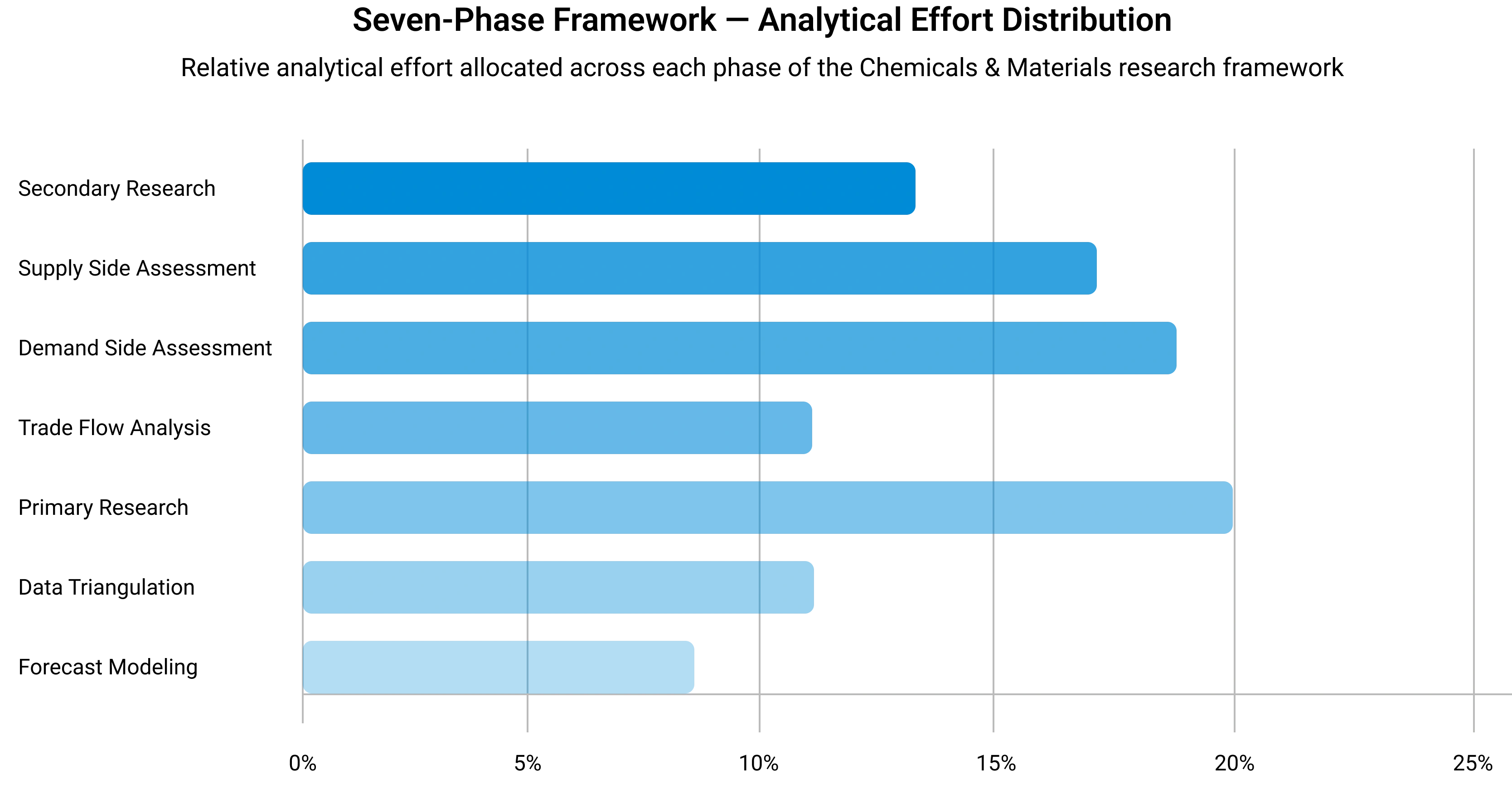
Seven-Phase Framework — Analytical Effort Distribution
Relative analytical effort allocated across each phase of the Chemicals & Materials research framework
Phase 1 - Secondary Research: Establishing the Foundation
Secondary research collects and evaluates publicly available information from authoritative sources, establishing the foundational understanding of market structure, value chain dynamics, competitive landscape, and end-use demand patterns. Every source is evaluated for credibility, recency, geographic relevance, and methodological soundness before inclusion.
Industry Associations
Sources include ACC, CEFIC, ICCA, JCIA, CPCIF, and SOCMA providing production volumes, consumption trends, capacity developments, and sustainability initiatives.
Company Disclosures
Annual reports, investor presentations, earnings transcripts, and regulatory filings reveal product portfolios, manufacturing footprints, capacity expansions, and revenue segmentation.
Government Databases
National statistical offices, customs authorities, environmental agencies, and industrial production databases provide verified statistics on output, trade flows, and regulatory compliance.
Trade Databases
UN Comtrade, ITC, Eurostat, and national customs authorities enable assessment of global product movement, import dependency, and export competitiveness across regions.
Our Secondary Research Sources
- Ministry of Chemicals and Fertilizers
- European Chemicals Agency
- United States Department of Energy
- Ministry of Industry and Information Technology
- Ministry of Economy Trade and Industry
- Ministry of Trade Industry and Energy
- National Institute of Standards and Technology
- Council of Scientific and Industrial Research
- Fraunhofer Society
- National Institute for Materials Science
Phase 2 — Supply-Side Assessment: Mapping Production Capabilities
Production Capacity Analysis
All major manufacturers are assessed for existing installed capacity, planned additions, expansions, new plant announcements, and technology adoption — mapped at global, regional, and country levels.
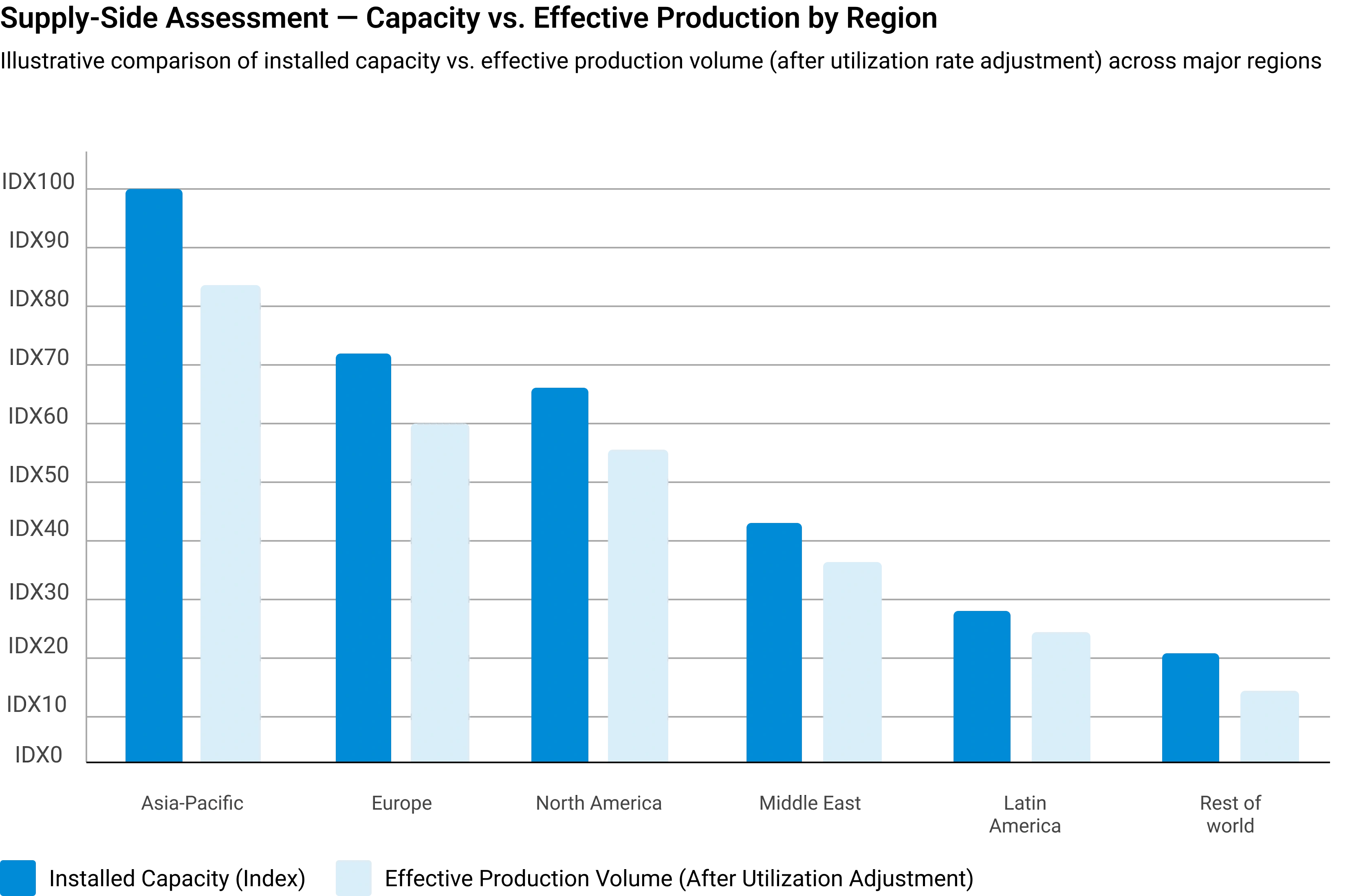
Capacity Utilization Adjustment
Installed capacity is adjusted using utilization rates based on demand conditions, feedstock availability, plant operating rates, maintenance schedules, and regulatory restrictions.
Manufacturer Revenue Analysis
Product-specific revenues, segment-level performance, regional distribution, average selling prices, and margin trends are evaluated to establish market value estimates.
Supply-Side Assessment — Capacity vs. Effective Production by Region
Illustrative comparison of installed capacity vs. effective production volume (after utilization rate adjustment) across major regions
Phase 3 — Demand-Side Assessment: Quantifying Chemical Consumption
Demand-side analysis quantifies chemical consumption across industries, applications, and geographies — identifying where and how chemicals are consumed throughout the value chain with precision.
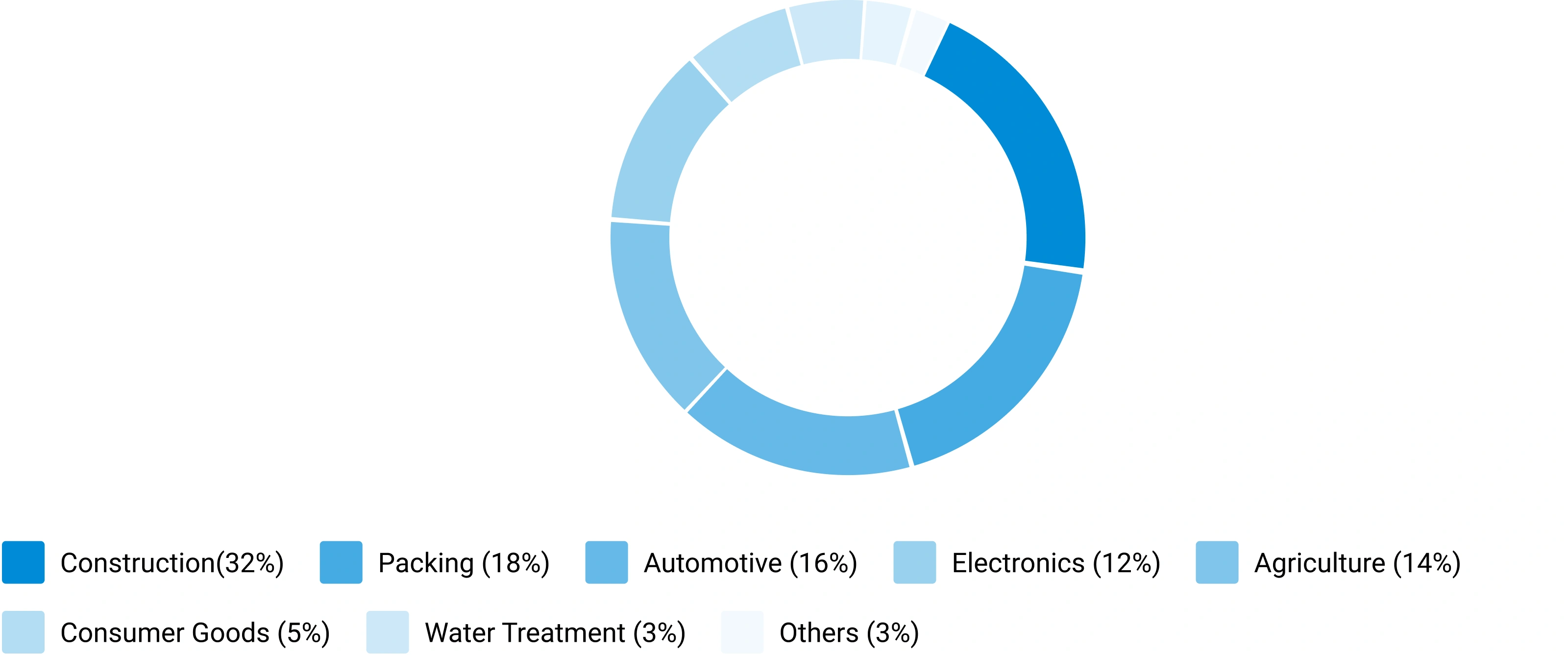
End-Use Industry Analysis
Chemical demand is evaluated across automotive, construction, packaging, electronics, agriculture, healthcare, consumer goods, industrial manufacturing, energy and utilities, and water treatment. Industry output, production trends, and consumption intensity are analyzed to determine demand patterns.
Consumption Modeling
Demand is estimated using measurable indicators: kilograms per vehicle, kilograms per square meter of construction, dosage per cubic meter of water treated, kilograms per hectare of agricultural land, and kilograms per ton of manufactured products. Consumption factors are validated through industry publications and primary interviews.
Application Analysis
The market is segmented by application area to understand product performance requirements, formulation trends, technology adoption, customer preferences, and regulatory requirements improving demand accuracy and segmentation granularity.
Demand-Side Assessment — End-Use Industry Demand Distribution
Illustrative distribution of chemical & materials demand across key end-use industries
Phase 4 - Trade Flow Analysis: Balancing Regional Supply and Demand
Trade flow analysis reconciles regional supply and demand estimates through import and export data, identifying net supply positions, regional dependencies, and market imbalances. It serves as an independent validation layer that tests the consistency of supply-side and demand-side estimates.
Import Analysis
Import data is evaluated to determine volumes, source countries, product dependency, regional supply gaps, and pricing trends — identifying markets that rely heavily on external supply and where domestic production is insufficient to meet demand.
Export Analysis
Export assessments reveal production surplus, export competitiveness, regional manufacturing strength, and global market participation. Export patterns also help validate domestic production estimates and identify net exporting regions.
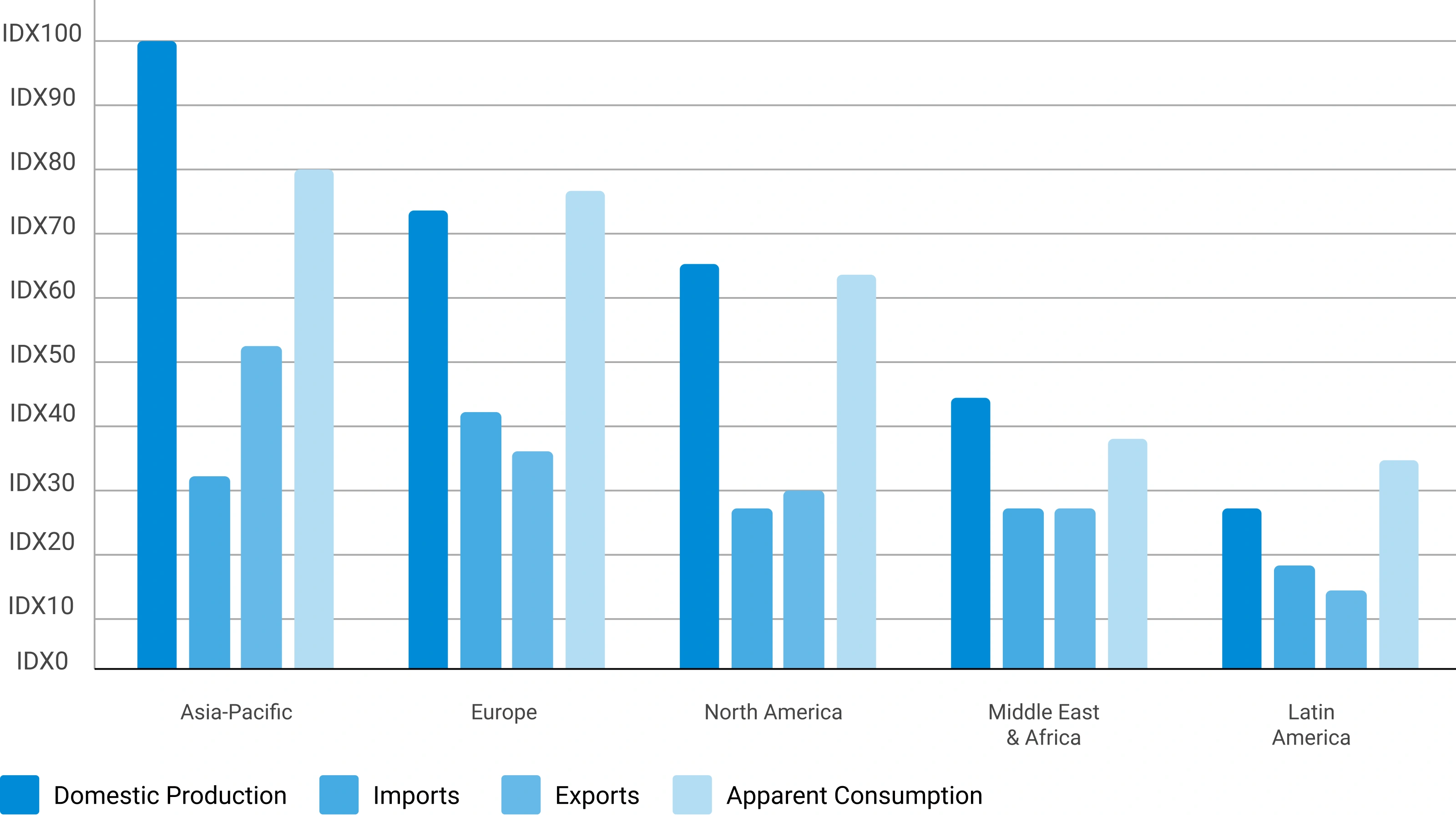
Apparent Consumption Model
Regional consumption is assessed using the standard apparent consumption formula:
Results identify net importing regions, net exporting regions, regional deficits, and surpluses — serving as an independent validation of supply and demand estimates.
Trade Flow Analysis — Net Supply Position by Region
Illustrative apparent consumption vs. domestic production across major regions — positive gap indicates net import dependency
Phase 5 — Primary Research: The Critical Validation Layer
Primary research tests and refines findings from secondary research through direct engagement with industry participants across the supply chain, demand side, and expert community. It captures intelligence that no database or published report can provide — the real-world experience of manufacturers, buyers, and specialists operating in the market.

Supply-Side Interviews
Conversations with chemical manufacturers, raw material suppliers, contract manufacturers, technology providers, and plant operators cover production trends, capacity utilization, pricing developments, technology shifts, and competitive dynamics.

Demand-Side Interviews
Engagement with OEMs, industrial consumers, procurement managers, distributors, formulators, and end-use manufacturers focuses on consumption trends, purchasing behavior, product substitution, demand outlook, and emerging applications.

Industry Expert Consultations
Additional interviews with industry consultants, independent experts, regulatory specialists, technical professionals, and research institutions provide deeper market context and validate key analytical assumptions.
Focus Areas of Primary Research:
Market Size & Forecast Validation
Revenue estimates, volume consumption, growth rates, forecast assumptions, regional demand.Supply Chain & Value Chain Assessment
Raw material sourcing, supply chain challenges, distribution networks, procurement practices.Production & Capacity Analysis
Manufacturing capacity, utilization rates, expansion projects, plant investments.Pricing & Cost Structure Analysis
Product pricing trends, feedstock costs, energy costs, margin pressures, pricing outlook.Competitive Landscape Assessment
Volume and value estimates confirmed to be fully consistent with one another before publicationInterview Volume by Market Scope
| Study Scope | Number of Interviews |
|---|---|
| Niche Market | 20 – 30 |
| Mid-Sized Market | 30 – 50 |
| Global Market | 50 – 80 |
| Highly Fragmented Market | 80 – 120 |
Interview Details:
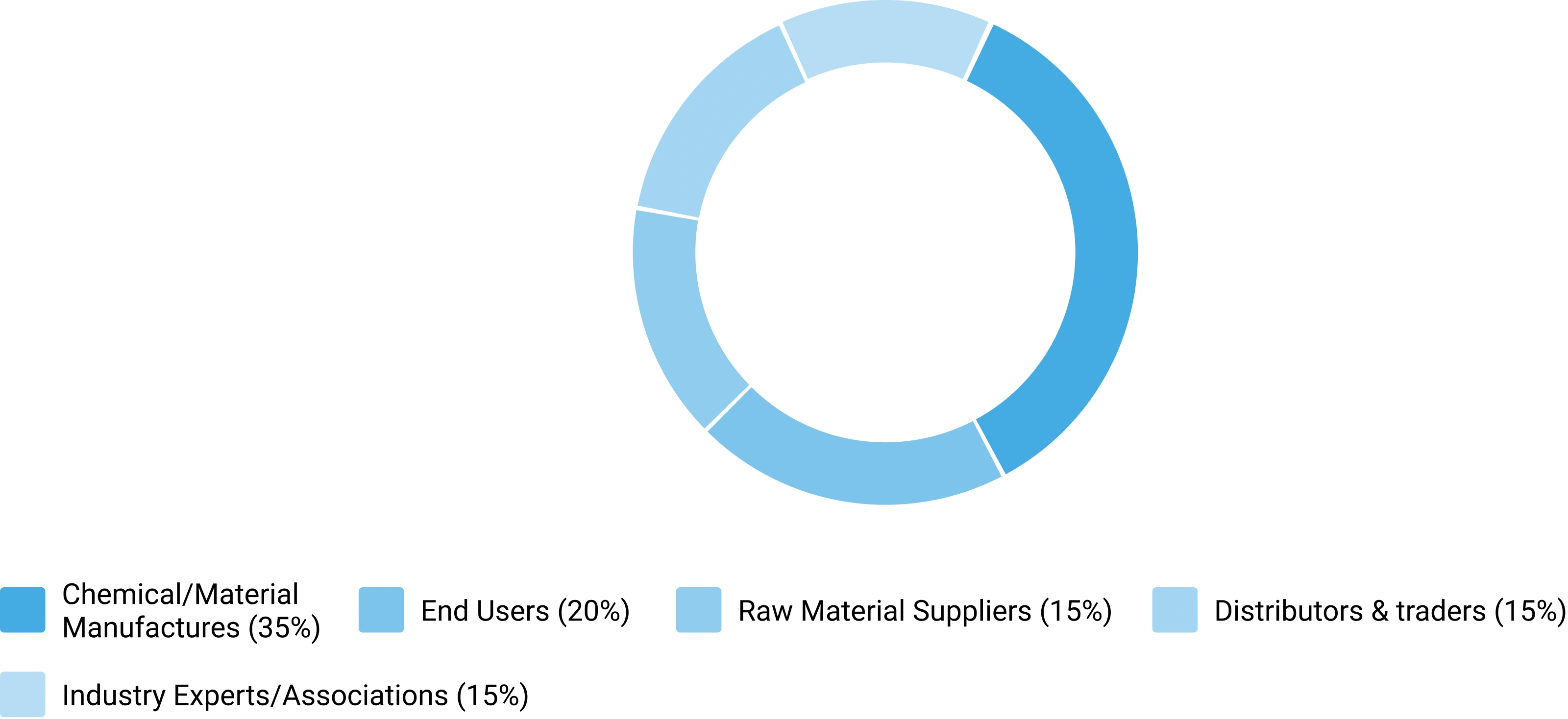
Category : Manufacturers, Suppliers, Distributors, End Users, Experts/Associations
Average Duration : 30–60 Minutes
Interview Mode : Video calls, telephonic interviews, expert consultations
Interview Format : Structured / Semi-Structured questionnaire
Focus Areas of Primary Research:
Market Size & Forecast Validation :
Revenue estimates, volume consumption, growth rates, forecast assumptions, regional demand.
Supply Chain & Value Chain Assessment :
Raw material sourcing, supply chain challenges, distribution networks, procurement practices.
Production & Capacity Analysis :
Manufacturing capacity, utilization rates, expansion projects, plant investments.
Pricing & Cost Structure Analysis :
Product pricing trends, feedstock costs, energy costs, margin pressures, pricing outlook.
Competitive Landscape Assessment :
Market share, competitor positioning, strategic initiatives, partnerships, acquisitions.
Primary Research — Stakeholder Coverage by Category
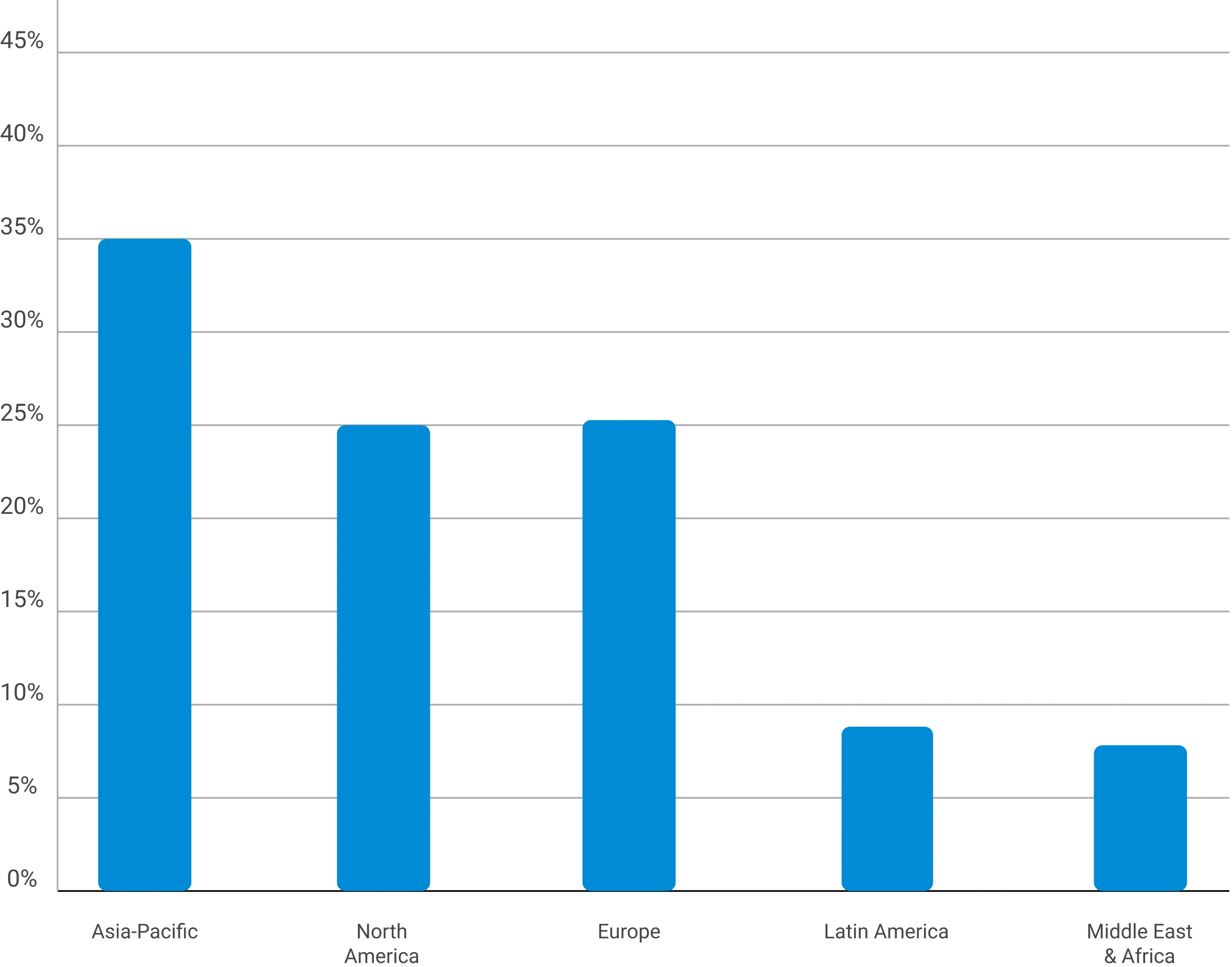
Distribution of interview respondents across stakeholder categories (% share from PPT data)
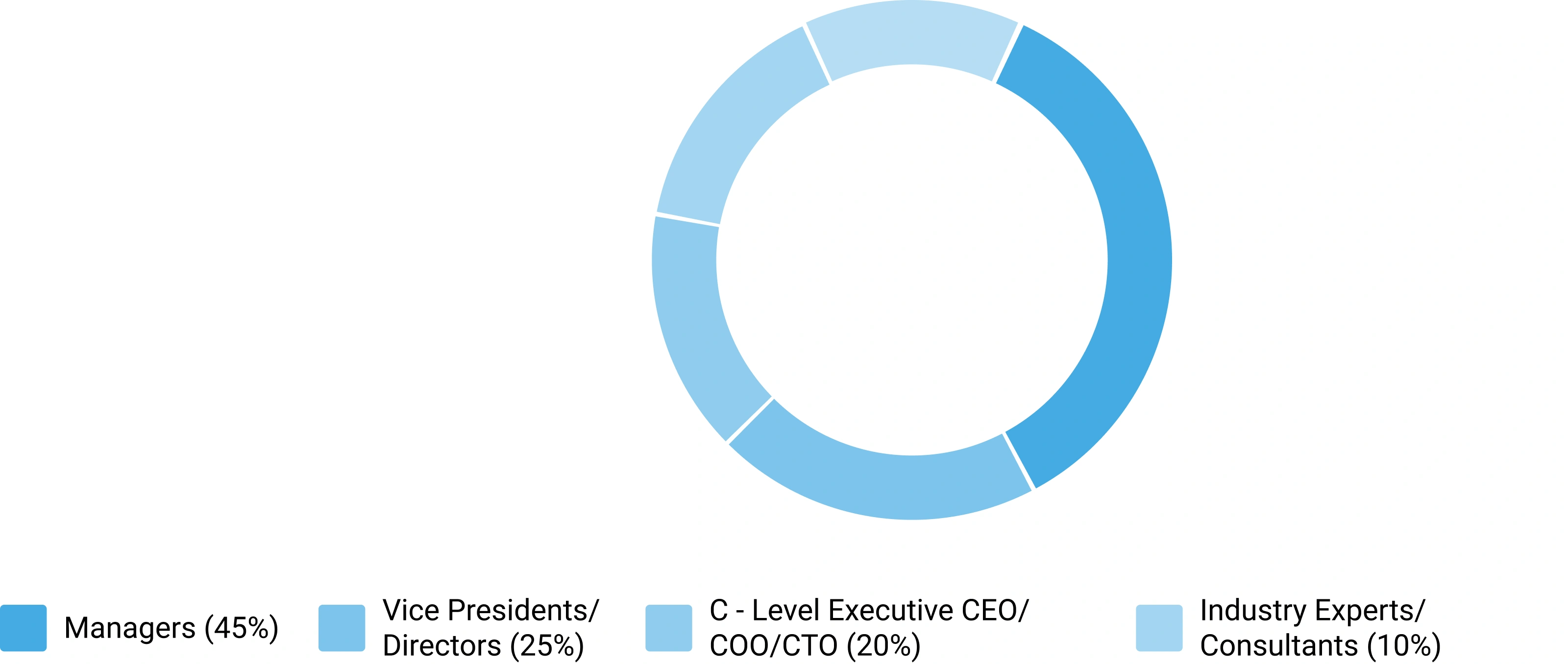
Primary Research — Respondent Designation Profile
Seniority breakdown of interview respondents (% share from PPT data)
Primary Research — Geographic Coverage of Interviews
Regional distribution of primary research engagement (% share from PPT data)
Phase 6 — Data Triangulation and Market Validation
No single methodology is relied upon in isolation. Multiple independent estimation approaches are combined and reconciled to ensure consistency, accuracy, and analytical defensibility. Any material deviations between approaches are investigated and adjusted through additional validation cycles.
The final market size is derived through weighted triangulation of all validated methodologies. Any material deviations between approaches are investigated and adjusted through additional validation cycles. The outcome represents the most realistic assessment of the market based on available evidence and expert confirmation ensuring that volume and value estimates are fully consistent with one another.
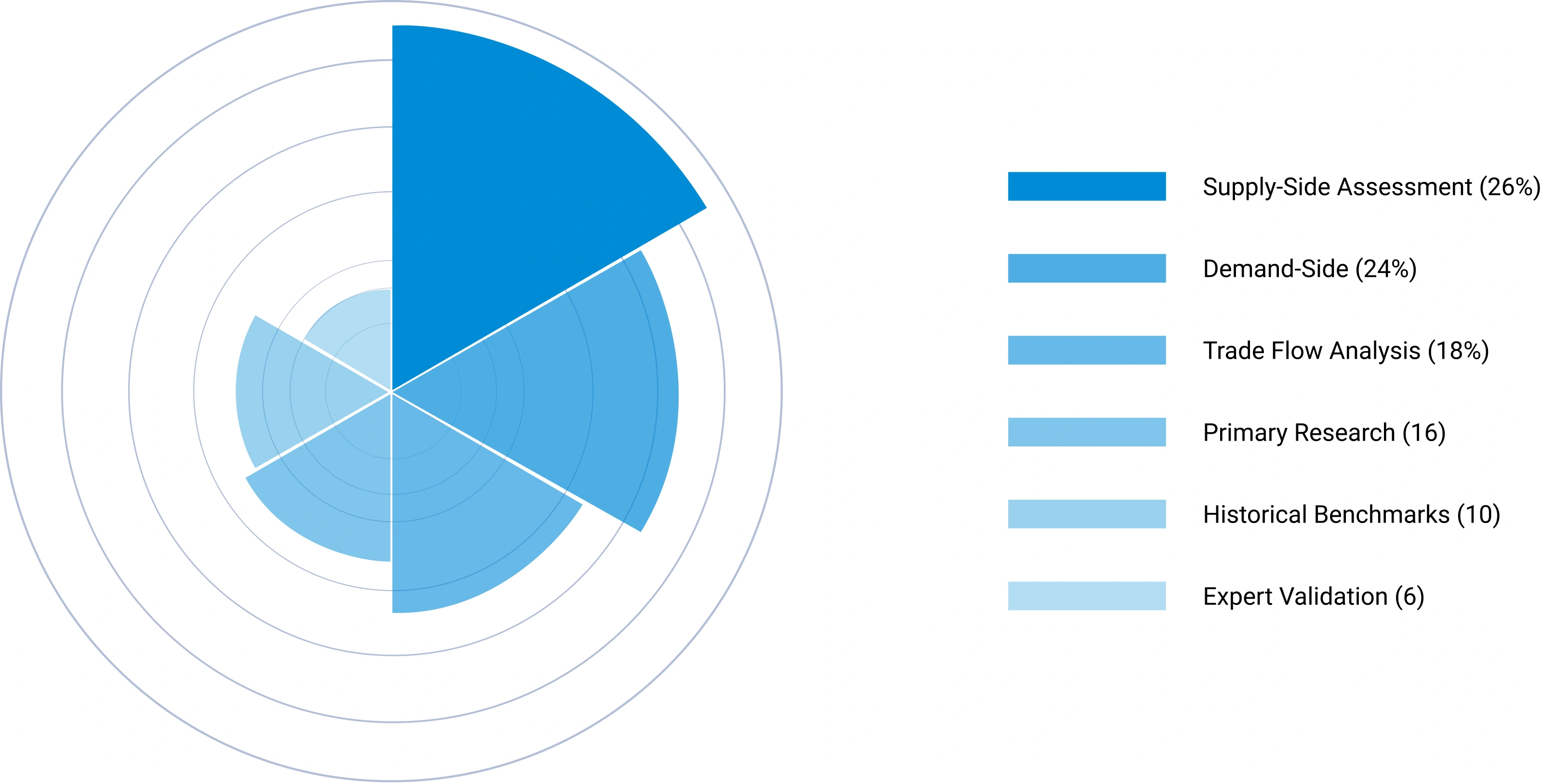
Triangulation Framework — Input Contribution Weight
Relative weight each sizing input contributes to the final reconciled market estimate
Phase 7 — Forecast Modeling: Projecting Future Market Evolution
Forecasting evaluates the future trajectory of the market using a combination of quantitative indicators and qualitative assessments across economic, industry, and regulatory dimensions. Rather than simple extrapolation, each driver is independently modeled and integrated into a composite forecast.
Macroeconomic Indicators
GDP growth, industrial production, manufacturing output, construction activity, consumer spending, and capital investment form the quantitative foundation of long-term demand projections. These are applied at country, regional, and global levels.
Industry Growth Drivers
Urbanization, infrastructure development, industrialization, technological innovation, sustainability initiatives, and evolving product performance requirements are assessed at regional and industry levels — capturing both structural and cyclical demand drivers.
Capacity Expansion Analysis
Announced plant expansions, new manufacturing facilities, technology upgrades, and strategic investments are evaluated to determine future supply-demand dynamics and potential market tightness or oversupply situations.
Regulatory & Sustainability
Environmental regulations, chemical safety standards, emission reduction targets, circular economy initiatives, and sustainability requirements are incorporated as they often influence product adoption rates and market growth trajectories.
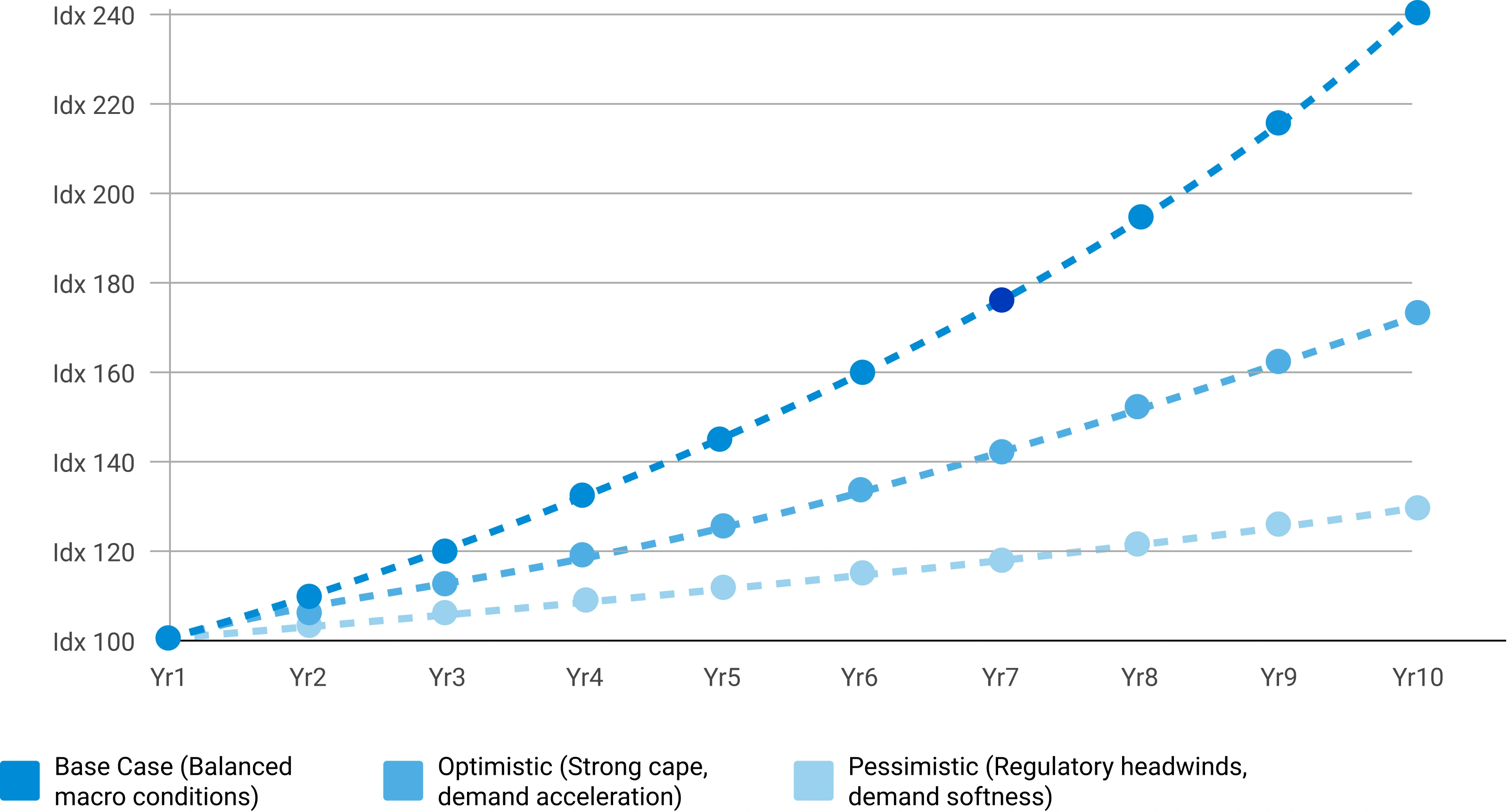
Scenario Forecast Range — Indexed Market Growth (Year 1–10)
Illustrative indexed growth trajectories across Base, Optimistic, and Pessimistic scenarios over a 10-year forecast horizon
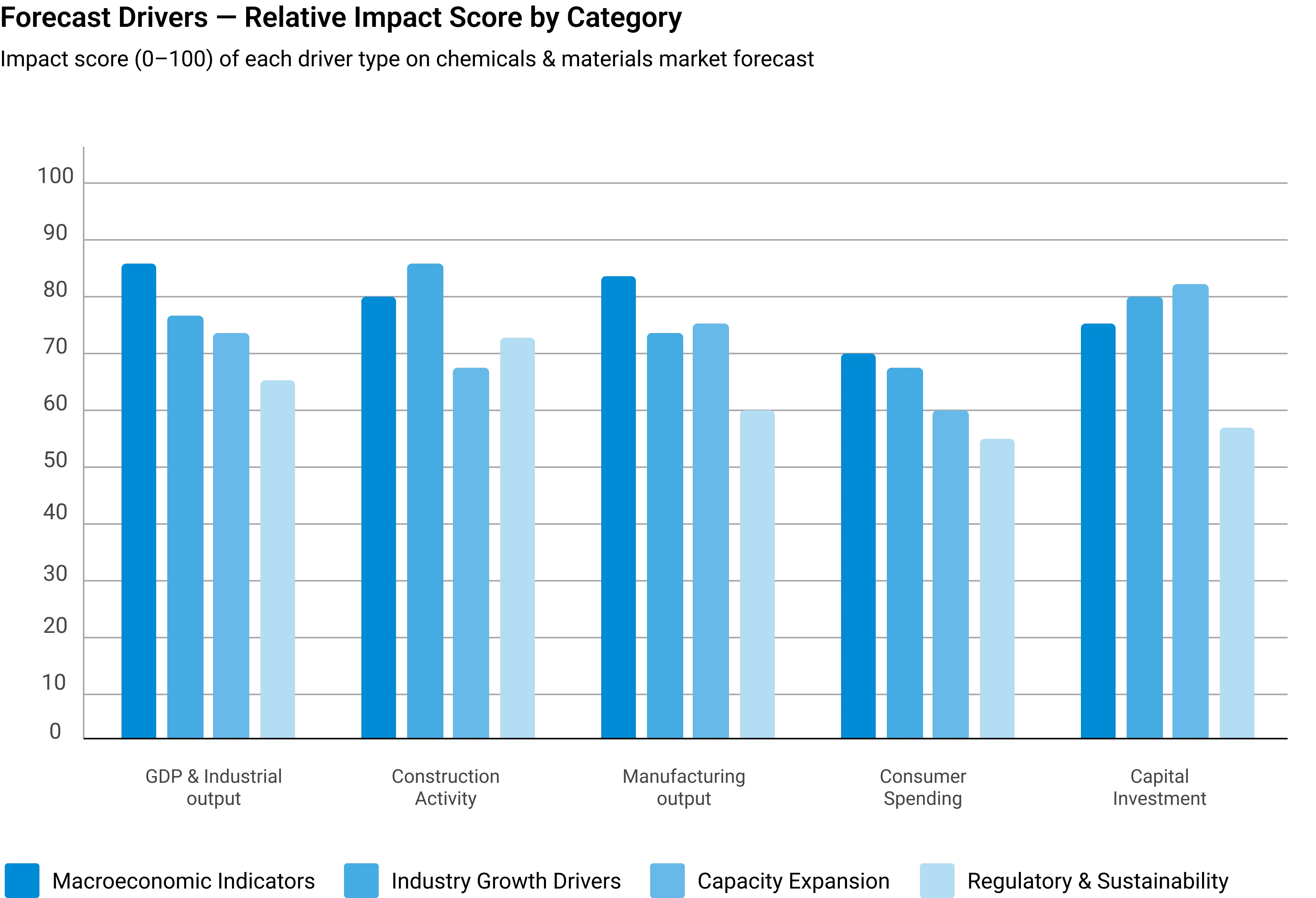
Forecast Drivers — Relative Impact Score by Category
Impact score (0–100) of each driver type on chemicals & materials market forecast



Comments
Share your thoughts, ask a question, or provide feedback about this report.