Content
C5 Fraction Market Size Analysis Report 2035
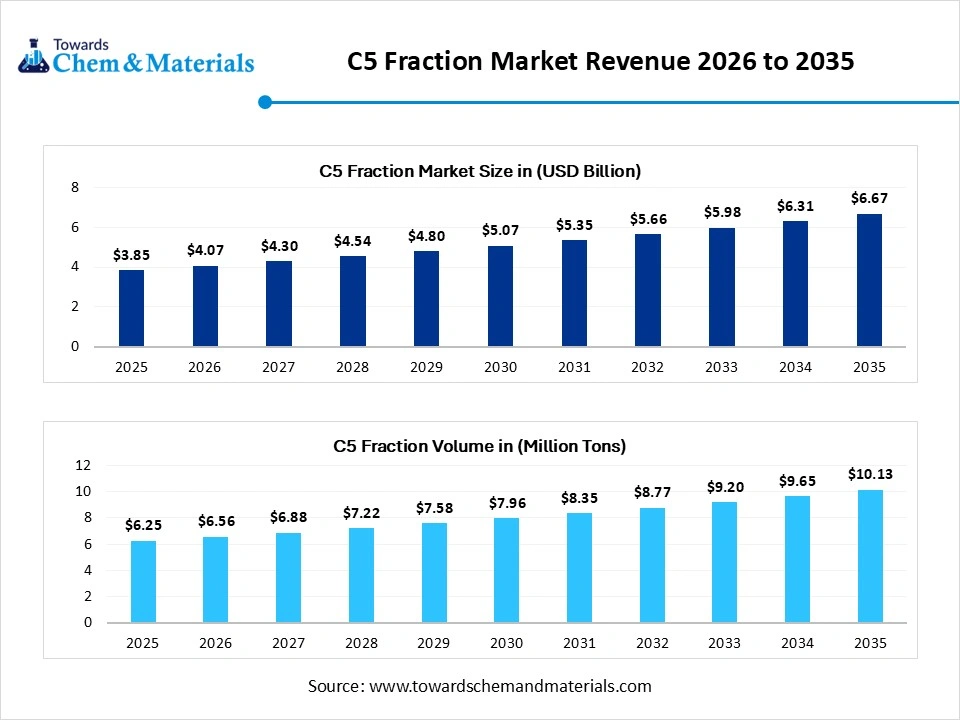
The global C5 fraction market was valued at USD 3.85 billion in 2025, is estimated to reach USD 4.07 billion in 2026, and is projected to reach USD 6.67 billion by 2035, growing at a CAGR of 5.65% from 2026 to 2035. In terms of volume, the C5 fraction market is projected to grow from 6.25 million tons in 2025 to 10.13 million tons by 2035. growing at a CAGR of 4.95% from 2026 to 2035. The market development is driven by a shift towards bio-based C5 fraction, decarbonization targets, technological advancement, and the surge of specialty chemicals in emerging economies.
Key Takeaways
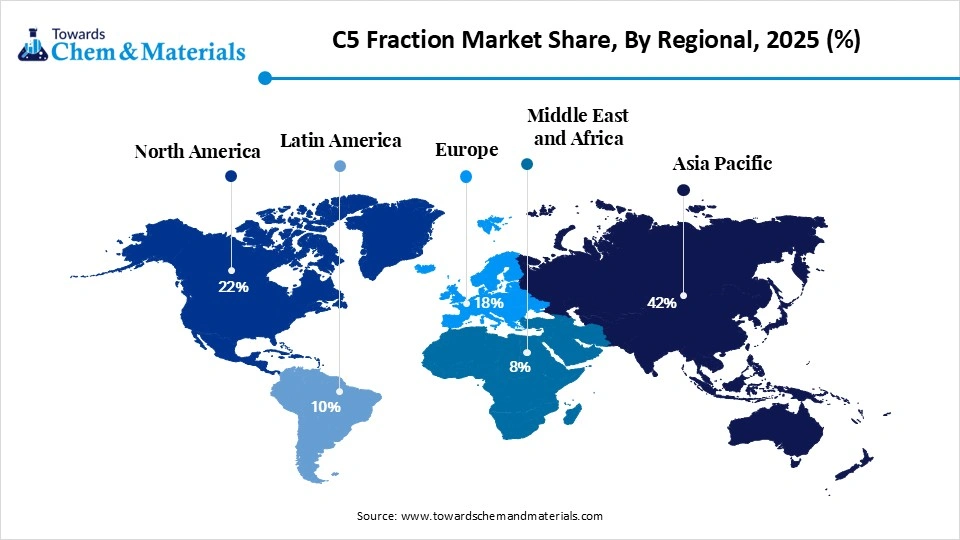
- By region, Asia Pacific dominated the C5 fraction Market by holding 42% share in 2025 and is expected to grow at the fastest CAGR of 6.3% over the forecast period.
- By region, North America held 22% market share in 2025 and expects notable growth in the market with 5.10% CAGR during the forecast period.
- By product type, the piperylene segment dominated the market with the largest share of 28% in 2025
- By product type, the isoprene segment held 24% market share in 2025 and is expected to grow at the fastest CAGR of 5.8% over the forecast period.
- By application, the petroleum resins segment dominated the market with the largest share of 34% in 2025
- By application, the synthetic rubber segment held 26% market share in 2025 and is expected to grow at the fastest CAGR of 5.9% over the forecast period.
- By end-use industry, the automotive segment dominated the market with the largest share of 32% in 2025
- By end-use industry, the packaging segment held 20% market share in 2025 and is expected to grow at the fastest CAGR of 5.8% over the forecast period.
- By source, the steam cracking segment dominated the market with the largest share of 62% in 2025 and is expected to grow at the fastest CAGR of 5.7% over the forecast period.
Market Size and Volume Forecast
- Market Estimated Size (2025): USD 3.85 Billion | CAGR (2026–2035): 5.85%
- Market Projected Size (2035): USD 345.63 Billion
- Market Volume (2025): 78.85 Million Tons (MT) | Volume CAGR (2026–2035): 4.95%
- Market Projected Volume (2035): 78.85 Million Tons (MT)
- Market Pricing (2025):
- Average Manufacturing Price: USD 1,859 per ton
- Average Selling Price: USD 2,510 per ton
- Pricing CAGR (2026–2035): 3.25%
Market Overview
The C5 fraction is represented as a specialized petrochemical derivation that contains five-carbon molecules like piperylene, isoprene, and dicyclopentadiene that are derived from naphtha cracking as a byproduct. It is a key raw material that enables waterproof, flexible, and sticky properties in industrial products. The C5 fraction is utilized in adhesives, synthetic rubbers, tire and the construction sector.
The market is defined by the surge in supply-demand squeeze, especially in EVs, medical-grade, and e-commerce packaging, which makes C5 as high-stake specialty commodity. Additionally, the technological development in purification technology and hydrogeneration capacity is accelerating the market growth.
C5 Fraction Market Trends
- Shift Towards Hydrogenation: The market is transitioning towards hydrogenated C5 resin for high-end hygiene and food-grade packaging that offers high-purity and thermal consistency.
- Industrial Surge for C5 Resins: The rising demand for isoprene, high-performance synthetic tires, hot-melt adhesives, pressure-sensitive tapes, the need for C5 resins for lightweight components, and the surge of e-commerce are fueling the market expansion.
Report Scope
| Report Attribute | Details |
| Market Size and Volume in 2026 | USD 4.07 Billion / 6.56 Million Tons |
| Expected Size and Volume by 2035 | USD 6.67 Billion / 10.13 Million Tons |
| Growth Rate from 2026 to 2035 | CAGR 5.65% |
| Forecast Period | 2026 - 2035 |
| Dominant Region | Asia-Pacific |
| Segment Covered | By Product Type, By Application, By End-Use Industry, By Source and By Region |
| Key companies profiled | Mitsubishi Chemical Corporation, Exxon Mobil, SIBUR International, Mitsui Chemicals, Inc., LyondellBasell, IFP, Chevron Phillips Chemical, China Petrochemical Technology, BASF, UOP, Sinopec, Asahi Kasei, Zeon Corporation, CNPC, Lummus |
Key Technological Shifts and AI in the C5 Fraction Market
The technological development in the C5 fraction market is transforming the byproduct into AI-driven molecular precision. The shift towards advanced catalytic hydrogenation offers saturation of C5 for medical adhesives and premium hygiene products. The integration of chemical recycling and engineered microbes optimized the bio-C5 stream.
The emphasis on digital twin technology ensures thermal stability in C5 of automated E-commerce packaging and EV battery bonding. Overall, digital transformation and implementation of smart catalysts transform refinery byproducts into digitally-perfected polymer and quality control by lowering carbon footprint and enhancing operational efficiency.
Supply Chain Analysis of the C5 Fraction Market
Feedstock Procurement: The stage of separation of C5 hydrocarbons from light olefins. In this stage, crude oil and natural gas are refined to produce naphtha. C5 is a byproduct of steam cracking.
- Key Players: ExxonMobil, PetroChina, Shell Chemicals, SIBUR International, and Reliance Industries
Advanced Separation and Monomer Manufacturing: The stage of separating crude C5 into high-purity chemical grades and monomers like DCPD, piperylene, and isoprene through extractive distillation, purification, and specialized manufacturing.
- Key Players: Zeon Corporation, Mitsui Chemicals, INEOS Group, BASF SE, and Mitsubishi Chemical
End-Use Application and Polymers: The transformation of monomers into hydrocarbon resins and synthetic rubber for key applications like automotive, adhesives, construction, specialty coatings, and sealants.
- Key Players: Kolon Industries, Braskem, Eastman Chemical Company, Arakawa Chemical Industries, and Idemitsu Kosan
Regulatory Framework: C5 Fraction Market
| Region | Key Regulation | Regulatory Focus |
| Global | IMDG Code, ADR/IMO | Standardization of flammable liquids like C5 requires explosion-proof sea and road transportation |
| European Union | REACH Regulation, CLP rule, and ECHA | Mandatory registration of C5 hydrocarbons, strict limits on isoprene, and reinforcing bio-based production. |
| Asia Pacific | MEE Order, Petroleum Act, and Quality Control Orders, CSCL | Management of VOC emission standards for C5-based adhesives and resins. PESO licensing for handling flammable C5 hydrocarbons. The government also promotes the development of bio-based C5 resins and evaluates their biodegradability. |
| United States | TSCA and Clean Air Act, OSHA guidelines | Assessment of chemical risks and VOC emission standards for refineries and adhesives, guidelines for handling carcinogenic components. |
C5 Fraction Market Dynamics
Driver
Sustainability and Water-Based Formulation
The manufacturers focus on bio-based C5 fraction and water-based adhesives is fueling the demand for compatible C5 resin to meet low-VOC emission targets. The trend is reshaped by reducing dependence on petroleum and lowering environmental impact.
Restraints
Feedstock Disruption Creates Replacement Risk
The C5 fraction is a secondary product of naphtha cracking, which creates volatility in feedstock price that reinforces the manufacturer to adopt alternative materials such as hydrogenated hydrocarbons, C9 resins, and esters to limit the implementation of C5.
Opportunity
Emerging Economies and Electric Mobility
The C5 derivatives are used in thermoplastic road marking, high-performance vibration dampening, and battery bonding for EVs, boosting the emerging economies towards the expansion of domestic petrochemical infrastructure and industrialization.
Segmental Insights
Product Type Insights
Piperylene Segment Dominated the C5 Fraction Market with 28% of Market Share in 2025
Piperylene segment dominated the market with the largest share of 28% in 2025, driven by its ability to synthesize specialized hydrocarbon resins by offering superior chemical reactivity. Piperylene is categorized into trans and cis types for producing tackifiers to improve durability, thermal stability, and moisture resistance of modern industrial adhesives and sealants. Additionally, the segment drives innovation in elastomers, strengthening its position in the hydrocarbon industry and technical applications.
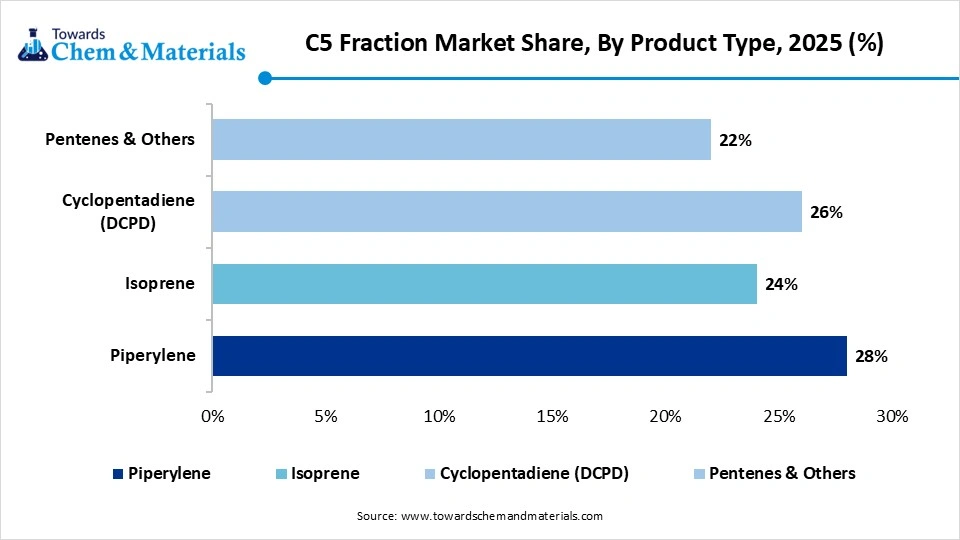
The isoprene segment held the 24% market share in 2025 and is expected to grow at the fastest CAGR of 5.8% over the forecast period. It acts as a key catalyst for synthetic rubber and elastomer manufacturing. Isoprene molecular composition and high chemical reactivity with replication enable polymer-grade and chemical-grade isoprene formulation. The isoprene specialized block copolymers and tackifying resins make them key for high-performance tires and medical-grade applications.
The cyclopentadiene (DCPD) segment held the 26% market share in 2025, due to its reactivity in the production of high-grade hydrocarbon resins and specialty polymers by ensuring toughness and heat resistance, especially in the automotive and marine sectors. DCPD is divided into hydrogenated and unhydrogenated DCPD that is essential for durable coatings and advanced composite materials.
Pentenes & others segment held 22% market share in 2025. It is a key component for high-performance fuel blending and a specialized industrial solvent. Its n-pentane and isopentane compounds act as blowing agents in insulation and packing applications. The segment offers high vapor pressure and octane-enhancing properties by maintaining economic recovery of C5 hydrocarbon streams, driving the market expansion.
Application Insights
The Petroleum Resins Segment Dominated the C5 Fraction Market with 34% of Market Share in 2025
The petroleum resins segment dominated the market with the largest share of 34% in 2025, driven by the C5/C9 hydrocarbon resin derivatives ability to transform petroleum resins raw streams into high-performance tackifying agents for the adhesives industry. Petroleum resins offer higher compatibility, superior heat resistance, bond-strength, and low molecular weight. These resins are essential for construction, packaging, hot-melt system and industrial solutions.
C5 fraction Market Share, By Application, 2025 (%)
| By Application | Revenue Share, 2025 (%) |
| Petroleum Resins | 34% |
| Synthetic Rubber | 26% |
| Adhesives & Sealants | 18% |
| Fuels & Blending | 14% |
| Others | 8% |
The synthetic rubber segment held the 26% market share in 2025 and is expected to grow at the fastest CAGR of 5.9% over the forecast period, fueled by large-scale consumers of polyisoprene rubber and styrene-isoprene-styrene to engineer high-quality elastomers. The segment uses in heavy-duty tires and medical equipment that offers elasticity and superior tensile strength. Additionally, synthetic rubber provides structural stability and durability in the healthcare and automotive sectors.
The adhesives & sealants segment held the 18% market share in 2025, driven by demand for hot-melt adhesives and pressure-sensitive adhesives with improved cohesion of synthetic elastomers and long-term durability. The C5 resins act as a premium tackifier for hygiene and the high-speed packaging, automotive sealants, and construction sector by optimizing product performance.
The fuels & blending segment held 14% market share in 2025, serving as a key sink for hydrocarbons to optimize gasoline performance. The rising adoption of gasoline blending and octane enhancers for reliable engine ignition and clean-burning is boosting the market growth. Additionally, the application enables economic recovery of C5 streams, which make them key for the petroleum industry and transportation sector.
End-Use Industry Insights
Automotive Segment Dominated the C5 Fraction Market with 32% of Market Share in 2025
The automotive segment dominated the market with the largest share of 32% in 2025, due to rising focus on vehicle safety and longevity. The automotive industry utilizes isoprene and C5 resins for the production of structural adhesives, synthetic rubber, and specialty coatings for lightweight assembly. The C5 is used in tires and interior components by acting as key bonding agents and noise reduction material that make them a key pillar of the C5 long-term value chain.
C5 fraction Market Share, By End-Use Industry, 2025 (%)
| By End-Use Industry | Revenue Share, 2025 (%) |
| Automotive | 32% |
| Construction | 24% |
| Packaging | 20% |
| Electronics | 12% |
| Others | 12% |
The construction segment held the 24% market share in 2025, driven by the requirement to improve the durability and weatherproofing of building materials. The C5-based resins enable the manufacturing of high-performance adhesives, roofing materials, sealant and long-term road marking paints. DCPD resins offer corrosion-resistant pipers and durable fixtures. Additionally, the construction industry demand for specialized hydrocarbon streams for industrial projects is boosting the adoption of C5.
The packaging segment held the 20% market share in 2025 and is expected to grow at the fastest CAGR of 5.8% over the forecast period, because C5 tackifiers offer high performance, thermal endurance, and protection in consumer packaging, modern logistics corrugated boxes, and food-grade distribution. The packaging industry utilizes specialized hydrocarbon resins to enhance high-speed assembly and shipping security.
The electronics segment held 12% market share in 2025. The C5 derivative is used for advanced insulation and electronic component protection. The electronics industry demands cyclopentadiene to create high-purity optical polymers and heat-resistant resins for modern circuits and semiconductors. The C5 acts as key material for the reliability of next-generation microelectronics, mobile devices, and hardware.
Source Insights
The Steam Cracking Segment Dominated the C5 Fraction Market with 62% of Market Share in 2025
The steam cracking segment dominated the market with the largest share of 62% in 2025 and is expected to grow at the fastest CAGR of 5.7% over the forecast period. It is high temperature process that breaks naphtha feedstock into raw C5 streams required for extracting piperylene, isoprene, and DCPD. The steam cracking generates essential hydrocarbons as byproducts of ethylene and propylene synthesis, used as a key source in synthetic rubbers and industrial resins.
C5 fraction Market Share, By Source, 2025 (%)
| By Source | Revenue Share, 2025 (%) |
| Steam Cracking | 62% |
| Refinery Streams | 38% |
The refinery streams segment held the 38% market share in 2025. It is a key source for fuel blending, FCC units, high-octane additives, and pyrolysis gasoline extraction. The refinery stream originates from the distillation and catalytic cracking of crude oil. This segment ensures the economic utility of the C5 hydrocarbon and industrial solvents sectors.
Regional Insights
How Did The Asia Pacific Dominated The C5 Fraction Market In 2025?
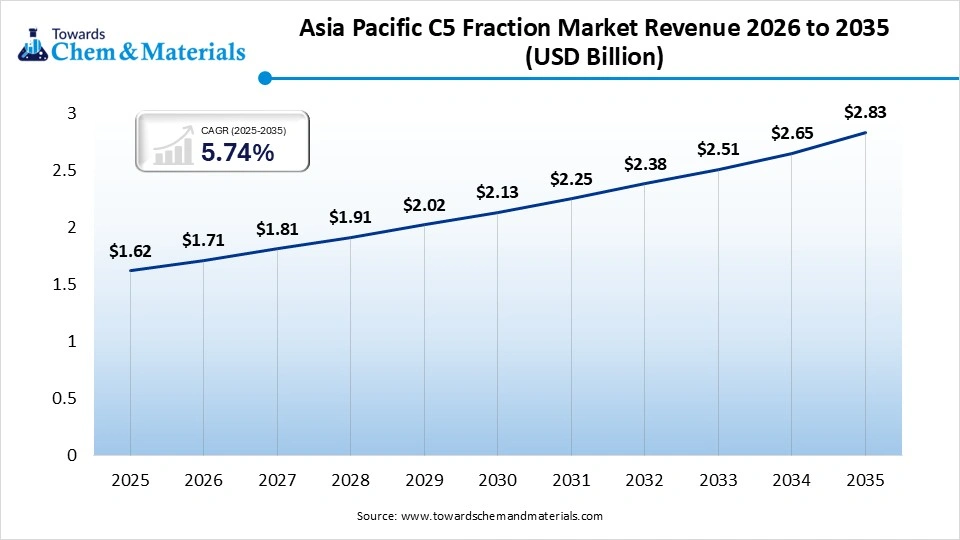
The Asia Pacific C5 fraction market size was estimated at USD 1.62 billion in 2025 and is projected to reach USD 2.83 billion by 2035, growing at a CAGR of 5.74% from 2026 to 2035 The regions growth is driven by its steam cracking infrastructure and vast industrial manufacturing hub. The Asia Pacifics vast consumption of isoprene in the automotive, packaging, and construction industry driving the domestic expansion. The local players are leveraging investment and innovation that make the region the leading producer and largest end-user of these derivatives.
China C5 Fraction Market Growth Trends
China market serves as the largest hub of steam crackers and petrochemical processing facilities. Chinas domestic policy and regulatory framework make them manufacturing capital for the tire industry and C5 resins. China is defined by its raw petrochemical supply and industrial demand, especially in packaging and construction adhesives.
North America C5 Fraction Market Growth Trends
North America held the 22% market share in 2025 and expects notable growth in the market with 5.10% CAGR during the forecast period, driven by its advanced refining technology and regional shift toward high-purity chemical derivatives. The region focuses on technical performance and the extraction of high-value isoprene and DCPD for industrial applications. The regional fuel blending programmes and their innovation infrastructure make the region a key for the adhesives and sealants industry.
U.S. C5 Fraction Market Growth Trends
The United States market is a premium consumer of DCPD and isoprene. The region focuses on high-purity extraction of C5 reins for the medical, aerospace, and adhesives sectors. U.S shifting towards technological innovation and regulatory compliance for fuel blending that positions them as a key exporter that support domestic manufacturing of C5 hydrocarbons.
Recent Developments
- In June 2024, Zeon Corporation signed the letter of intent to acquire a significant 40% stake in ZS Elastomers Co., Ltd from Sumitomo Chemical Company, Ltd. This acquisition is designed to expand C5 for adhesives and rubber compounding.
- In March 2024, Mitsui Chemicals announced production of recycled chemicals from plastic waste with pyrolysis oil to meet Japans commitment for its first bio and circular cracker. Mitsui Chemicals and KAO corporation strategic partnership for closing the loop with polymer recycling.
C5 Fraction Market Competitive Landscape Analysis
Tier 1 Companies
|
Rank
|
Company Name | Headquarters | Country | Why Relevant to This Market | Key Products / Material Portfolio | ||
| 1 | Exxon Mobil Corporation | Spring, Texas | United States | Major global producer of steam cracker derivatives and C5 feedstocks | C5 fractions, isoprene, hydrocarbon resins, petrochemical intermediates | ||
| 2 | Shell plc | London, England | United Kingdom | Large-scale olefins producer with significant C5 stream generation | C5 hydrocarbons, olefins, petrochemical feedstocks | ||
| 3 | Sinopec Corp. | Beijing | China | One of the worlds largest petrochemical producers with extensive C5 processing capacity | C5 fractions, DCPD, isoprene, hydrocarbon resin feedstocks | ||
| 4 | Saudi Basic Industries Corporation (SABIC) | Riyadh | Saudi Arabia | Leading producer of olefins and downstream petrochemicals | C5 streams, synthetic rubber feedstocks, specialty chemicals | ||
| 5 | LyondellBasell Industries N.V. | Houston, Texas | United States | Major global ethylene producer generating substantial C5 by-products | C5 fractions, olefins, hydrocarbon feedstocks | ||
Tier 2 Companies
|
Rank
|
Company Name | Headquarters | Country | Why Relevant to This Market | Key Products / Material Portfolio | |
| 1 | Braskem S.A. | São Paulo, São Paulo | Brazil | Significant producer of olefins and C5-derived products in the Americas | C5 streams, petrochemical intermediates | |
| 2 | LG Chem Ltd. | Seoul | South Korea | Major Asian producer of C5-derived chemicals and synthetic materials | Isoprene, C5 fractions, synthetic rubber feedstocks | |
| 3 | Formosa Plastics Corporation | Taipei | Taiwan | Integrated petrochemical producer with extensive cracker operations | C5 fractions, olefins, downstream chemicals | |
| 4 | Reliance Industries Limited | Mumbai, Maharashtra | India | Large refinery and petrochemical producer with significant C5 output | C5 streams, petrochemical feedstocks, specialty chemicals | |
| 5 | China Petroleum & Chemical Corporation (Sinopec Yanshan) | Beijing | China | Important producer of C5 derivatives and hydrocarbon resin feedstocks | DCPD, isoprene, C5 concentrates | |
Tier 3 Companies
|
Rank
|
Company Name | Headquarters | Country | Why Relevant to This Market | Key Products / Material Portfolio |
| 1 | ZEON Corporation | Tokyo | Japan | Significant consumer and processor of C5-derived isoprene streams | Isoprene rubber, specialty elastomers |
| 2 | Kolon Industries, Inc. | Seoul | South Korea | Active producer of hydrocarbon resins utilizing C5 feedstocks | C5 hydrocarbon resins, specialty materials |
| 3 | Eastman Chemical Company | Kingsport, Tennessee | United States | Producer of tackifier and hydrocarbon resins derived from C5 streams | C5 hydrocarbon resins, adhesive raw materials |
| 4 | Lesco Chemical Limited | Hong Kong | China | Specialized supplier of C5-based hydrocarbon resins | C5 petroleum resins, tackifiers |
Top Companies in the C5 Fraction Market
- Mitsubishi Chemical Corporation
- Exxon Mobil
- SIBUR International
- Mitsui Chemicals, Inc.
- Lyondell Basel
- IFP
- Chevron Phillips Chemical
- China Petrochemical Technology
- BASF
- UOP
- Sinopec
- Asahi Kasei
- Zeon Corporation
- CNPC
- Lummus
C5 Fraction Market Segment Covered in the Report
By Product Type
- Piperylene
- Trans-piperylene
- Cis-Piperylene
- Isoprene
- Polymer-Grade Isoprene
- Chemical-Grade Isoprene
- Cyclopentadiene (CPD)
- Dicyclopentadiene (DCPD)
- Hydrogenated DCPD
- Unhydrogenated DCPD
- Pentene & Others
- 1-Pentene
- 2-Pentene
- Iso-Pentenes
By Application
- Petroleum Resins
- C5 Hydrocarbon Resin
- C5/C9 Resin
- Synthetic Rubber
- Polyisoprene Rubber
- Styrene-Isoprene-Styrene (SIS)
- Adhesives & Sealants
- Hot Melt Adhesives
- Pressure-Sensitive Adhesives
- Fuels & Blending
- Gasoline Blending
- Octane Enhancers
- Others
- Specialty Chemicals
- Solvents
By End-Use Industry
- Automotive
- Tires
- Interior Components
- Construction
- Roofing Materials
- Sealants
- Packaging
- Flexible Packaging
- Labels & Tapes
- Electronics
- Insulation Materials
- Adhesives
- Others
- Industrial Manufacturing
- Consumer Goods
By Source
- Steam Cracking
- Naphtha-Based
- Ethane-Based
- Refinery Streams
- FCC Units
- Pyrolysis Gasoline Extraction
By Region
- North America:
- U.S.
- Canada
- Mexico
- Rest of North America
- Latin America:
- Brazil
- Argentina
- Rest of Latin America
- Europe:
- Western Europe 
- Germany
- Italy
- France
- Netherlands
- Spain
- Portugal
- Belgium
- Ireland
- UK
- Iceland
- Switzerland
- Poland
- Rest of Western Europe
- Eastern Europe
- Austria
- Russia & Belarus
- Türkiye
- Albania
- Rest of Eastern Europe
-  Asia Pacific:
- China
- Taiwan
- India
- Japan
- Australia and New Zealand,
- ASEAN Countries (Singapore, Malaysia)
- South Korea
- Rest of APAC
- MEA:
- GCC Countries
- Saudi Arabia
- United Arab Emirates (UAE)
- Qatar
- Kuwait
- Oman
- Bahrain
- South Africa
- Egypt
- Rest of MEA
- GCC Countries
FAQ's




Select User License to Buy
Figures (4)






 sales@towardschemandmaterials.com
 Download Sample
 Schedule a Meeting