Content
Steel Decarbonization Market Demand, Size and Growth Rate Forecast
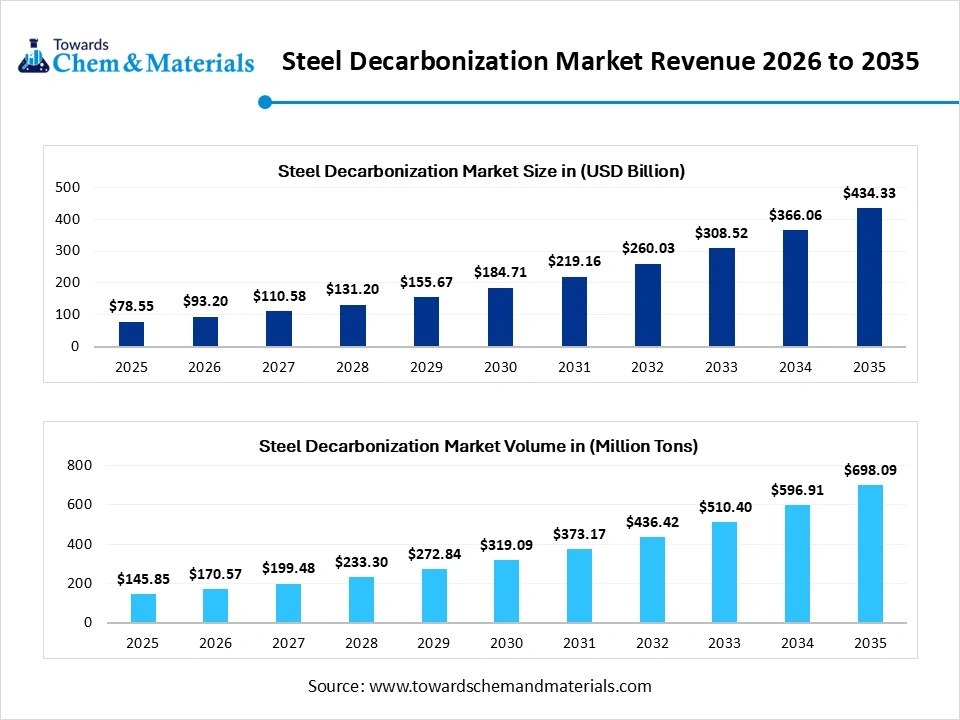
The global steel decarbonization market was valued at USD 78.55 billion in 2025, is estimated to reach USD 93.2 billion in 2026, and is projected to reach USD 434.33 billion by 2035, growing at a CAGR of 18.65% from 2026 to 2035. In terms of volume, the steel decarbonization market is projected to grow from 145.85 million tons in 2025 to 698.09 million tons by 2035. growing at a CAGR of 16.95% from 2026 to 2035. The greater shift towards eco-friendly manufacturing practices has accelerated the market growth in recent years.
Key Takeaways
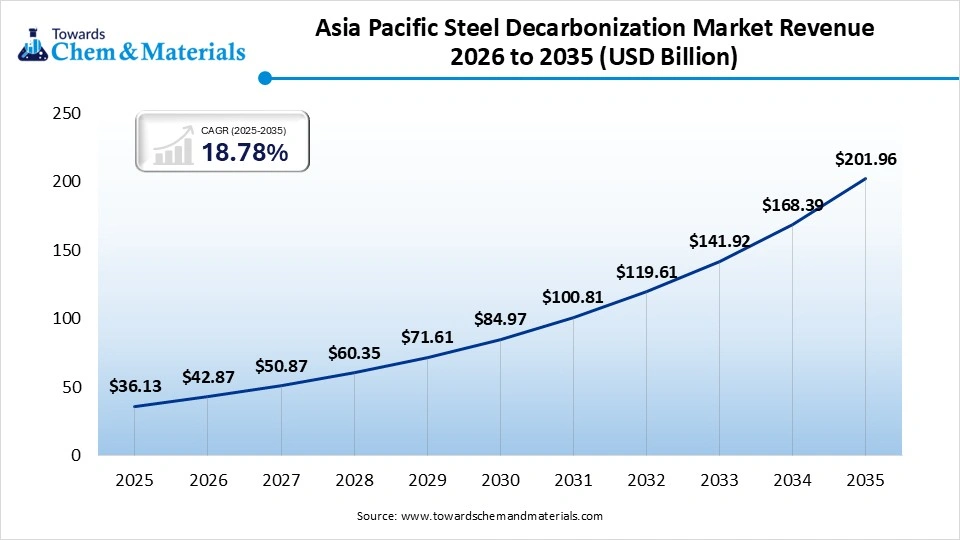
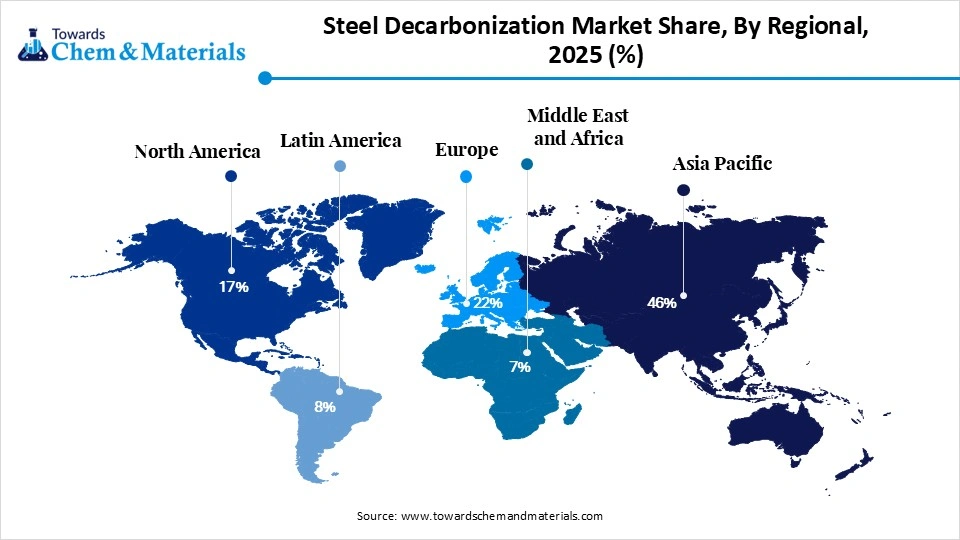
- By region, Asia Pacific dominated the market with a share of 46% in 2025 and is expected to be the fastest-growing region in the market, with a CAGR of 20.2% in the forecast period.
- By region, Europe is notably growing with 22% market share in 2025.
- By technology, the electric arc furnace (EAF) segment dominated the market with 34% share in 2025.
- By technology, the hydrogen-based steelmaking segment held the 21% market share in 2025 and is expected to be the fastest-growing in the market with a CAGR of 24.5% in the forecast period.
- By energy source, the renewable energy segment dominated the market with 38% share in 2025 and is expected to be the fastest-growing in the market, with a CAGR of 23.2% in the forecast period.
- By steel type, the flat steel segment dominated the market with 49% share in 2025.
- By steel type, the specialty steel segment held the 19% market share in 2025 and is expected to be the fastest-growing in the market, with a CAGR of 20.7% in the forecast period.
- By end-use industry, the construction segment dominated the market with 36% share in 2025.
- By end-use industry, the automotive segment held the 23% market share in 2025 and is expected to be the fastest-growing in the market, with a CAGR of 20.8% in the forecast period.
- By emission reduction strategy, the fuel switching segment dominated the market with 27% share in 2025.
- By emission reduction strategy, the circular economy segment held the 25% market share in 2025 and is expected to be the fastest-growing in the market, with a CAGR of 21.3% in the forecast period.
- By investment type, the brownfield upgradation segment dominated the market with 33% share in 2025.
- By investment type, the greenfield projects segment held the 27% market share in 2025 and is expected to be the fastest-growing in the market, with a CAGR of 22.5% in the forecast period.
Market Size and Volume Forecast
- Market Estimated Size (2026): USD 93.20 Billion | CAGR (2026–2035): 18.65%
- Market Projected Size (2035): USD 93.20 Billion
- Market Volume (2025): 145.85 Million Tons (MT) | Volume CAGR (2026–2035): 16.95%
- Market Projected Volume (2035): 698.09 Million Tons (MT)
- Market Pricing (2025):
- Average Manufacturing Price: USD 829/ton
- Average Selling Price: USD 1,058/ton
- Pricing CAGR (2025–2035): 5.8%
Steel Sector Embracing Low-Emission Future
The reduction of carbon emissions from the process of making steel is known as steel decarbonization. Also, by focusing on changing the toxic gas emission process, the steel decarbonization has gained major industry attention in recent years. Moreover, the steel makers have seen using cleaner methods by using electricity, hydrogen fuel, and recycled steel in recent years.
Steel Decarbonization Market Trends:
- The greater shift from the heavy industries to the cleaner industries has enhanced the industry readiness and industry capabilities in recent years. Also, the companies have observed in redesigning their plants, which depend less on coal and more on cleaner fuels in the past few years.
- The increasing consumer awareness about eco-friendly manufacturing has allowed the stakeholders to capitalize on growth opportunities in the current period. Also, consumers are actively demanding a transparent production process and well-labelling nowadays.
- The readjusting of the old plants with new ideas is strengthening the foundation for future sector growth. The companies are seen as improving efficiencies while reducing toxic waste in the current period.
Report Scope
| Report Attribute | Details |
| Market Size and Volume in 2026 | USD 93.2 Billion / 170.57 Million Tons |
| Expected Size and Volume by 2035 | USD 434.33 Billion / 698.09 Million Tons |
| Growth Rate from 2026 to 2035 | CAGR 18.65% |
| Forecast Period | 2026 - 2035 |
| Dominant Region | Asia-Pacific |
| Segment Covered | By Technology, By Energy Source, By Steel Type, By End-Use Industry, By Emission Reduction Strategy, By Investment Type and By Region |
| Key companies profiled | ArcelorMittal, SSAB, Nippon Steel Corporation, Tata Steel, Nucor Corporation, Voestalpine AG, Salzgitter AG, JFE Steel Corporation |
From Coal to Flexible Steelmaking Solutions
The industry is heavily moving from a single dominant method to multiple flexible methods. Earlier, most steel came from one main process based on coal. Now, the industry is exploring different paths like electric-based production, hydrogen-based methods, and high recycling systems. This shift is important because there is no one perfect solution for all regions.
Supply Chain Analysis of the Steel Decarbonization Market:
Distribution to Industrial Users
- Decarbonized steel is distributed primarily to the automotive, construction, and renewable energy sectors.
- Manufacturers use green steel for electric vehicle frames, sustainable infrastructure, and wind turbine towers to meet net-zero targets. Distribution occurs through specialized green supply chains, often involving long-term "offtake" agreements between producers and industrial end-users.
Chemical Synthesis and Processing
- Steel decarbonization replaces traditional coal-based blast furnaces with Green Hydrogen-based Direct Reduced Iron (DRI) and Electric Arc Furnaces (EAF).
- This chemical transition eliminates carbon monoxide as a reductant, emitting water vapor instead. Further processing utilizes Carbon Capture and Storage (CCS) or renewable-powered electrolysis to ensure a carbon-neutral production cycle.
Regulatory Compliance and Safety Monitoring
- Regulatory compliance involves adhering to the EU’s Carbon Border Adjustment Mechanism (CBAM) and ISO 14064 for carbon footprint verification.
- Safety monitoring prioritizes hydrogen handling protocols in DRI plants and high-voltage safety for Electric Arc Furnaces. These frameworks ensure that decarbonization technologies meet strict environmental targets and workplace safety standards.
Steel Decarbonization Market Regulatory Landscape: Regulations
| Country Region | Regulatory Body | Key Regulations | Focus Areas |
| United States | Department of Energy (DOE) & EPA | Inflation Reduction Act (IRA) and Bipartisan Infrastructure Law (BIL). | Buy Clean" Standards: The Federal Government uses its massive procurement power to prioritize steel with lower embodied carbon for infrastructure projects. |
| Europe | European Commission | Carbon Border Adjustment Mechanism (CBAM) | ETS Reform: Phasing out "free allowances" for domestic steelmakers by 2034 to force a shift from blast furnaces to Electric Arc Furnaces (EAF). |
| China | Ministry of Ecology and Environment (MEE) | Steel Industry Work Plan (2025–2026) and Action Plan for Industrial Carbon Peaking. | Scrap Utilization: Targeting 300 million tonnes of scrap use by late 2025 to increase EAF production share to over 15%. |
Market Dynamics
Driver
Stricter Rules Accelerating Steel Market Transformation
The growing pressure to reduce pollution is driving the strategic transformation of the market. Also, governments are setting stricter rules, and companies must follow them to continue operating. At the same time, large industries like construction and automobiles want cleaner materials to meet their own climate goals.
Restraint
Steel Industry Growth Impacted by Costs
The high cost is likely to hinder the industry's growth in the coming years. Moreover, the changing steel production methods require huge investment in new machines, energy systems, and infrastructure. Many companies cannot afford to fully switch, especially in developing regions.
Opportunity
Early Movers Winning Green Steel Market
Companies that move early can become leaders in green steel and attract premium customers, which is a significant opportunity in the market nowadays. Also, there is a chance to build new supply chains around hydrogen, recycling, and clean energy.
Segmental Insights
Technology Insights
The Electric Arc Furnace (EAF) Segment Dominated the Steel Decarbonization Market with 34% Market Share in 2025
The electric arc furnace (EAF) segment dominated the market with 34% share in 2025, owing to they are flexible and already widely used. They mainly use scrap steel, which reduces the need for raw materials and cuts emissions. These furnaces are easier to operate with electricity, which can come from cleaner sources compared to coal.
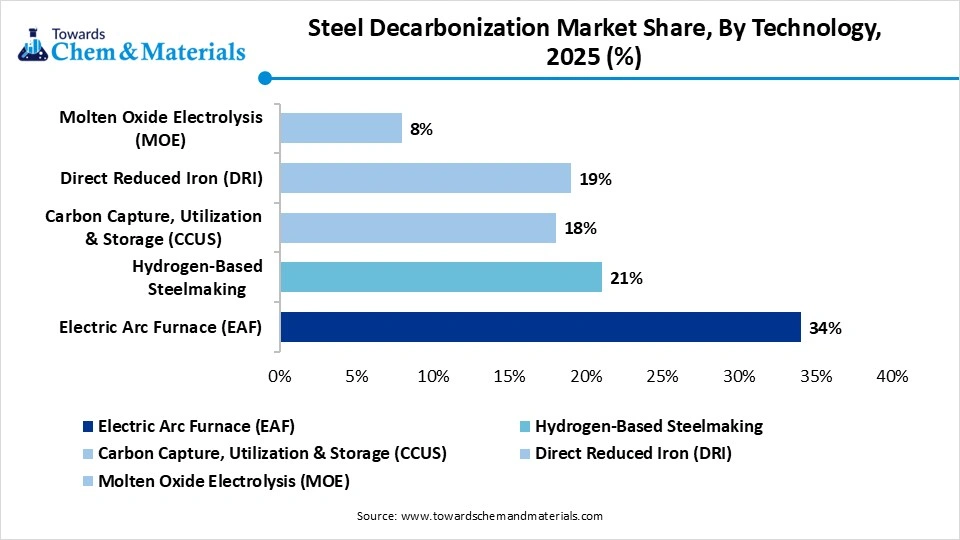
The hydrogen-based steelmaking segment held the 21% market share in 2025 and is expected to be the fastest-growing in the market, with a CAGR of 24.5% in the forecast period, due to it has the potential to remove carbon almost completely from the process. Instead of using coal, hydrogen reacts with iron ore and produces water instead of carbon dioxide. This makes it one of the cleanest possible methods. As renewable energy becomes more available, green hydrogen will become easier to produce.
Energy Source Insights
The Renewable Energy Segment Dominated the Market with 38% Market Share in 2025
The renewable energy segment dominated the market with 38% share in 2025 and is expected to be the fastest-growing in the market, with a CAGR of 23.2% in the forecast period, owing to it directly supports cleaner steel production. Sources like solar and wind reduce dependence on fossil fuels and help cut emissions at the energy level itself. Many steel processes are becoming more electric, so clean electricity becomes very important.
Steel Decarbonization Market Share, By Energy Source, 2025 (%)
| By Energy Source | Revenue Share, 2025 (%) |
| Flat Steel | 49% |
| Long Steel | 32% |
| Specialty Steel | 19% |
The natural gas segment held the 24% market share in 2025, owing to the it acts as a middle step between coal and fully clean energy. It produces less carbon compared to coal, making it a better short-term option. Many existing plants can switch to natural gas without major changes, which makes adoption easier.
Steel Type Insights
The Flat Steel Segment Dominated the Steel Decarbonization Market with 49% Market Share in 2025
The flat steel segment dominated the market with 49% share in 2025, owing to it is widely used in industries like construction, automotive, and appliances. It is easier to produce in large volumes and fits well with modern manufacturing processes. Many decarbonisation technologies, like electric furnaces, are already optimized for flat steel production.
The specialty steel segment held the 19% market share in 2025 and is expected to be the fastest-growing in the market, with a CAGR of 20.7% in the forecast period, due to industries are moving toward high-performance materials. These steels are used in advanced sectors like electric vehicles, aerospace, and clean energy systems. They offer better strength, durability, and efficiency. As technology advances, demand for customized and high-quality steel will increase.
End-Use Industry Insights
The Construction Segment Dominated the Market with 36% Market Share in 2025
The construction segment dominated the market with 36% share in 2025, owing to it uses a huge amount of steel in buildings, bridges, and infrastructure. Growing urbanization and population increase the demand for new structures. Governments are also investing heavily in infrastructure projects, which require large volumes of steel.
Steel Decarbonization Market Share, By End-Use Industry, 2025 (%)
| By End-Use Industry | Revenue Share, 2025 (%) |
| Construction | 36% |
| Automotive | 23% |
| Energy | 16% |
| Machinery & Equipment | 11% |
| Shipbuilding | 8% |
| Consumer Goods | 6% |
The automotive segment held the 23% market share in 2025 and is expected to be the fastest-growing in the market, with a CAGR of 20.8% in the forecast period, owing to the shift toward electric vehicles and lightweight designs. Cars now require stronger but lighter steel to improve efficiency and battery performance. Automakers are also focusing on sustainability, which increases demand for low-emission steel.
Emission Reduction Strategy Insights
The Fuel Switching Segment Dominated the Market with 27% Market Share in 2025
The fuel switching segment dominated the market with 27% share in 2025, owing to its being one of the fastest ways to reduce emissions without rebuilding entire plants. Companies can replace coal with cleaner fuels like natural gas or partial hydrogen. This approach is practical and less expensive compared to a full transformation.
Steel Decarbonization Market Share, By Emission Reduction Strategy, 2025 (%)
| By Emission Reduction Strategy | Revenue Share, 2025 (%) |
| Fuel Switching | 27% |
| Carbon Capture | 22% |
| Circular Economy | 25% |
| Process Optimization | 26% |
The circular economy segment held the 25% market share in 2025 and is expected to be the fastest-growing in the market, with a CAGR of 21.3% in the forecast period, owing to recycling steel saving energy and reducing emissions. Steel is one of the few materials that can be reused many times without losing quality. As resources become limited, recycling will become more important. Companies will focus on collecting, reusing, and reducing waste.
Investment Type Insights
The Brownfield Upgradation Segment Dominated the Market with 33% Market Share in 2025
The brownfield upgradation segment dominated the market with 33% share in 2025, owing to upgrading existing plants is cheaper and faster than building new ones. Companies can improve efficiency, reduce emissions, and extend plant life without starting from zero. It also avoids issues like land acquisition and long approval processes.
Steel Decarbonization Market Share, By Investment Type, 2025 (%)
| By Investment Type | Revenue Share, 2025 (%) |
| Brownfield Upgradation | 33% |
| Greenfield Projects | 27% |
| Retrofitting Existing Plants | 25% |
| R&D Investments | 15% |
The greenfield projects segment held the 27% market share in 2025 and is expected to be the fastest-growing in the market, with a CAGR of 22.5% in the forecast period, owing to they allow companies to build fully modern and clean plants from the beginning. These plants can be designed for hydrogen, renewable energy, and advanced technologies without the limitations of old systems.
Regional Insights:
How will Asia Pacific Dominate the Steel Decarbonization Market in 2025?
The Asia Pacific steel decarbonization market size was estimated at USD 36.13 billion in 2025 and is projected to reach USD 201.96 billion by 2035, growing at a CAGR of 18.78% from 2026 to 2035 Rapid industrial growth, urban development, and infrastructure expansion drive demand. Many large steel-producing countries are located in this region. The presence of both developed and developing economies creates a strong and diverse market.
China Leading Steel Demand and Production
China maintained its dominance in the market, owing to its production and consumption of the largest amount of steel. Rapid industrial growth, urban development, and infrastructure expansion drive demand. Many large steel-producing countries are located in this region. The presence of both developed and developing economies creates a strong and diverse market.
Steel Decarbonization Market Evaluation in Europe
Europe is notably growing with 22% market share in 2025, owing to a strong focus on clean technology and innovation. The region has better access to advanced systems, investment, and policy support for low-carbon production. Companies are actively upgrading their plants and exploring hydrogen-based methods.
Clean Steel Growth Driven by the Germany
The Germany is expected to emerge as a prominent country for the steel decarbonization market in the coming years, due to its strong base of electric arc furnace technology and recycling systems. Many steel companies already use cleaner methods compared to traditional processes. The country is investing in renewable energy and hydrogen projects to further reduce emissions. Supportive policies and an innovation culture help accelerate change
Recent Development
- In April 2026, Tata Steel created a strategic collaboration with Paul Wurth, which is part of SMS Group GMBH. Also, the main motive behind the collaboration is the implementation of technology called EASyMelt, and it supports the low-carbon steel-making process, as per the company's claim.
Steel Decarbonization Market Competitive Landscape Analysis
Tier 1 Companies
| Rank | Company Name | Headquarters | Country | Why Relevant to This Market | Key Products / Material Portfolio |
| 1 | ArcelorMittal S.A. | Luxembourg City | Luxembourg | Global leader in low-carbon steel initiatives, hydrogen DRI projects, and CCUS deployment | XCarb® recycled and renewable steel, low-carbon steel products |
| 2 | SSAB AB | Stockholm | Sweden | Pioneer of fossil-free steel through the HYBRIT hydrogen-based steelmaking project | Fossil-free steel, hydrogen-reduced steel |
| 3 | thyssenkrupp Steel Europe AG | Duisburg, North Rhine-Westphalia | Germany | Major investor in hydrogen-based DRI and green steel production technologies | Bluemint® low-carbon steel, hydrogen DRI technologies |
| 4 | Nucor Corporation | Charlotte, North Carolina | United States | Leading EAF-based steel producer with one of the industry's lowest carbon footprints | EAF-produced low-carbon steel products |
| 5 | POSCO Holdings Inc. | Pohang, North Gyeongsang | South Korea | Developer of hydrogen steelmaking technologies and carbon-neutral steel initiatives | HyREX hydrogen steelmaking technology, low-carbon steel |
Tier 2 Companies
|
Rank
|
Company Name | Headquarters | Country | Why Relevant to This Market | Key Products / Material Portfolio |
| 1 | Nippon Steel Corporation | Tokyo | Japan | Investing heavily in hydrogen reduction, CCUS, and low-carbon steel production | NSCarbolex® low-carbon steel technologies |
| 2 | Tata Steel Limited | Mumbai, Maharashtra | India | Advancing low-carbon steelmaking through hydrogen and carbon capture projects | Green steel initiatives, low-emission steel products |
| 3 | voestalpine AG | Linz, Upper Austria | Austria | Leader in European decarbonization projects and hydrogen steelmaking pilots | Greentec Steel program, low-carbon steel |
| 4 | HBIS Group Co., Ltd. | Shijiazhuang, Hebei | China | Major Chinese producer investing in hydrogen metallurgy and carbon reduction technologies | Green steel products, hydrogen DRI projects |
| 5 | Salzgitter AG | Salzgitter, Lower Saxony | Germany | Developer of the SALCOS® low-carbon steel production program | SALCOS® low-CO₂ steel technologies |
Tier 3 Companies
|
Rank
|
Company Name | Headquarters | Country | Why Relevant to This Market | Key Products / Material Portfolio |
| 1 | H2 Green Steel AB | Stockholm | Sweden | Dedicated green steel producer utilizing renewable hydrogen and renewable energy | Near-zero-emission steel products |
| 2 | Boston Metal Inc. | Woburn, Massachusetts | United States | Developer of molten oxide electrolysis technology for fossil-free steel production | MOE steelmaking technology |
| 3 | Electra Steel Inc. | Boulder, Colorado | United States | Innovator in low-temperature electrochemical ironmaking technologies | Green iron production technology |
| 4 | GravitHy SAS | Marseille, Provence-Alpes-Côte d'Azur | France | Emerging producer focused on renewable hydrogen-based iron production | Low-carbon DRI and green iron |
| 5 | Stegra AB | Stockholm | Sweden | Developer of integrated hydrogen-based steel production facilities | Green hydrogen-based steel |
Top Vendors in the Steel Decarbonization Market & Their Offerings:
- ArcelorMittal: ArcelorMittal, the world's leading integrated steel and mining company, aims for net-zero emissions by 2050. Its strategy includes two main pathways: Smart Carbon, which integrates carbon capture and bio-energy into blast furnaces, and the Hydrogen-DRI route. Recent progress includes commissioning a major Electric Arc Furnace (EAF) in Spain to significantly reduce carbon intensity.
- SSAB (HYBRIT Partner): Sweden-based SSAB is a global leader in fossil-free steelmaking through its HYBRIT initiative with LKAB and Vattenfall. By replacing coking coal with fossil-free hydrogen, the process emits only water vapor. SSAB successfully delivered the world’s first fossil-free steel in 2021 and plans full commercial production by 2026.
- Nippon Steel Corporation: Japan’s largest steelmaker, Nippon Steel, pursues a "multi-track" approach to reach carbon neutrality by 2050. Key projects include COURSE50 and Super COURSE50, which focus on hydrogen injection into existing blast furnaces and carbon capture. The company is also developing large-scale electric arc furnaces and hydrogen-based direct reduction technology for industrial-scale deployment by 2040.
Steel Decarbonization Market Key Players
- Tata Steel
- Nucor Corporation
- Voestalpine AG
- Salzgitter AG (SALCOS program)
- JFE Steel Corporation
Steel Decarbonization Market Segments Covered in the Report
By Technology
- Carbon Capture, Utilization & Storage (CCUS)
- Post-Combustion Capture
- Pre-Combustion Capture
- Oxy-Fuel Combustion
- Hydrogen-Based Steelmaking
- Green Hydrogen (Electrolysis-Based)
- Blue Hydrogen (Natural Gas + CCUS)
- Electric Arc Furnace (EAF)
- Scrap-Based EAF
- Direct Reduced Iron (DRI-EAF)
- Direct Reduced Iron (DRI)
- Gas-Based DRI
- Hydrogen-Based DRI
- Molten Oxide Electrolysis (MOE)
By Energy Source
- Renewable Energy
- Solar
- Wind
- Hydropower
- Natural Gas
- Coal with CCUS
- Nuclear Energy
By Steel Type
- Flat Steel
- Hot Rolled Coil
- Cold Rolled Coil
- Coated Steel
- Long Steel
- Rebars
- Wire Rods
- Structural Sections
- Specialty Steel
- Stainless Steel
- Tool Steel
- Electrical Steel
By End-Use Industry
- Construction
- Residential
- Infrastructure
- Automotive
- Passenger Vehicles
- Electric Vehicles
- Energy
- Renewable Energy Infrastructure
- Oil & Gas
- Machinery & Equipment
- Shipbuilding
- Consumer Goods
By Emission Reduction Strategy
- Process Optimization
- Energy Efficiency Improvements
- Waste Heat Recovery
- Fuel Switching
- Coal to Gas
- Gas to Hydrogen
- Carbon Capture
- Circular Economy
- Scrap Recycling
- Material Efficiency
By Investment Type
- Brownfield Upgradation
- Greenfield Projects
- Retrofitting Existing Plants
- R&D Investments
By Region
- North America:
- U.S.
- Canada
- Mexico
- Rest of North America
- Latin America:
- Brazil
- Argentina
- Rest of Latin America
- Europe:
- Western Europe 
- Germany
- Italy
- France
- Netherlands
- Spain
- Portugal
- Belgium
- Ireland
- UK
- Iceland
- Switzerland
- Poland
- Rest of Western Europe
- Eastern Europe
- Austria
- Russia & Belarus
- Türkiye
- Albania
- Rest of Eastern Europe
-  Asia Pacific:
- China
- Taiwan
- India
- Japan
- Australia and New Zealand,
- ASEAN Countries (Singapore, Malaysia)
- South Korea
- Rest of APAC
- MEA:
- GCC Countries
- Saudi Arabia
- United Arab Emirates (UAE)
- Qatar
- Kuwait
- Oman
- Bahrain
- South Africa
- Egypt
- Rest of MEA
- GCC Countries
FAQ's




Select User License to Buy
Figures (4)






 sales@towardschemandmaterials.com
 Download Sample
 Schedule a Meeting