
Breathable Films Market Size Analysis Report 2034
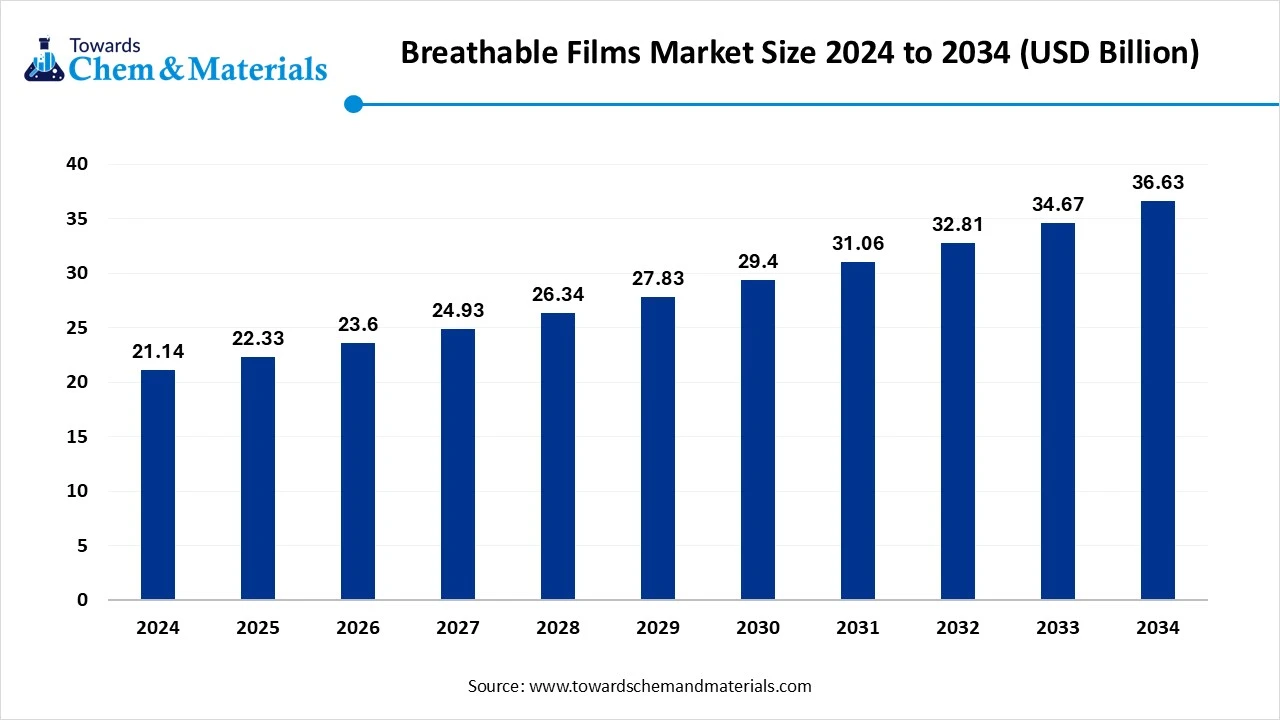
The global breathable films market size was reached at USD 21.14 billion in 2024 and is expected to be worth around USD 36.63 billion by 2034, growing at a compound annual growth rate (CAGR) of 5.65% over the forecast period 2025 to 2034. The growing awareness about hygiene, the increasing production of disposable clothing, and the rise in construction activities drive the market growth.
Key Takeaways
- By region, Asia Pacific held approximately a 40% share in the market in 2024 due to the increasing demand for personal care products.
- By region, North America is growing at the fastest CAGR in the market during the forecast period due to the growing construction activities.
- By type, the polyethylene films segment held approximately a 45% share in the market in 2024 due to the growing demand for hygiene products.
- By type, the polyurethane films segment is expected to grow at the fastest CAGR in the market during the forecast period due to the superior mechanical properties.
- By technology, the microporous films segment held approximately a 55% share in the market in 2024 due to the strong moisture control properties.
- By technology, the monolithic films segment is expected to grow at the fastest CAGR in the market during the forecast period due to the growing demand for personal protective equipment.
- By end-user industry, the packaging & consumer goods segment held approximately a 40% share in the market in 2024 due to the rise in ready-to-eat meals.
- By end-user industry, the healthcare & medical segment is expected to grow at the fastest CAGR in the market during the forecast period due to the development of various medical products.
- By distribution, the direct supply to OEMs segment held approximately a 60% share in the breathable films market in 2024 due to the high availability of customization.
- By distribution, the distributors & converters segment is expected to grow at the fastest CAGR in the market during the forecast period due to the availability of technical support.
Power of Breathable Films in Modern Applications and Smart Protection
Breathable films are a polymer films that consist of a microporous structure. Breathable films are permeable to water vapor, gases, and impermeable to liquids. They offer a barrier to microorganisms like bacteria, viruses, and others. They offer barrier protection against liquids, particles, and contaminants. Breathable films offer benefits like extension of product life, enhancement of user comfort, and improved hygiene.
The growing production of hygiene products like sanitary napkins, baby diapers, and many more uses breathable films. Breathable films are widely used in personal care & hygiene products, food packaging, protective clothing, medical applications, and building & construction materials. Factors like rising hygiene awareness, expanding healthcare demand, sustainable packaging innovations, and increasing use of lightweight breathable materials in construction & industrial applications contribute to the growth of the breathable films market.
- Vietnam exported 83,631 shipments of polyethylene film.(Source: www.volza.com)
- Vietnam exported 8,327 shipments of polypropylene (PP) film.(Source: www.volza.com)
- India exported 62,943 shipments of polyester film.(Source: www.volza.com)
Growing Construction Activities Surge Demand for Breathable Films
The rapid urbanization and growing construction activities in various regions increase demand for breathable films. The growth in residential construction activities increases the adoption of breathable films for the development of wall underlayments and roofing. The strong focus on sustainable construction practices and the increasing adoption of green building materials increase demand for breathable films.
The high investment in infrastructure projects and growing infrastructure development lead to higher adoption of breathable films. The strong focus on energy-efficient building materials and the focus on extending the lifespan of buildings increase demand for breathable films. The stringent building regulations and focus on maintaining healthy indoor environments increase the adoption of breathable films. The growing construction activities are a key driver for the growth of the breathable films market.
Market Trends
- Growing Hygiene Awareness: The increasing awareness about hygiene increases demand for hygienic disposable products like sanitary napkins, baby diapers, and adult diapers that use breathable films to prevent skin irritation and enhance comfort.
- Growth in Food Packaging: The growing packaging of vegetables, cereals, fruits, & other foods, and the rise in packaged foods, increases demand for breathable films to extend the shelf life of products and enhance product safety.
- Increasing Apparel Production: The growing production of apparel like activewear & sportswear, and the high rate of participation in sports activities, increases demand for breathable films due to their moisture-wicking properties.
Report Scope
| Report Attributes | Details |
| Market Size in 2025 | USD 22.33 Billion |
| Expected Size by 2034 | USD 36.63 Billion |
| Growth Rate from 2025 to 2034 | CAGR 5.65% |
| Base Year of Estimation | 2024 |
| Forecast Period | 2025 - 2034 |
| Dominant Region | Asia Pacific |
| Segment Covered | By Type, By Technology, By End-User Industry, By Distribution Model, By Region |
| Key Companies Profiled | Schweitzer-Mauduit International, Inc., Arkema, Berry Global, Inc, Fatra, a.s., Kimberley – Clark, Nitto Denko Corporation, Rahil Foam Pvt. Ltd., RKW North America, Inc., SILON s.r.o, SKYMARK, Daika Kogyo, American Polyfilm, Innovia Films, Mitsui Chemicals, Inc., Omya AG |
Market Opportunity
Growing Healthcare Sector Unlocks Market Opportunity
The growing expansion of healthcare infrastructure and advancements in healthcare increase demand for breathable films for various applications. The increasing need for wound dressing and wound care increases the adoption of breathable films to create a barrier. The increasing production of surgical gowns, disposable medical garments, surgical drapes, and protective medical clothing increases demand for breathable films to protect against microbes and permit sweat.
The increasing packaging of pharmaceutical products and medical devices increases demand for breathable films. The strong focus on infection control and growing healthcare spending increases the production of advanced medical products using breathable films. The increasing prevalence of chronic diseases and growth in surgeries rate increases demand for various medical products that require breathable films. The growing healthcare sector creates an opportunity for the breathable films market.
Market Challenge
High Manufacturing Cost Shuts Down Expansion of the Market
Despite several benefits of the breathable films in various industries, the high manufacturing cost restricts the market growth. Factors like complex manufacturing processes, need for specialized materials, stricter quality control, and volatility in raw material prices contribute to the high manufacturing cost. The need for specialized materials like thermoplastic polyurethane, polyester, and polypropylene increases the cost.
The complex manufacturing processes, like multilayer extrusion techniques and the need for specialized equipment, require high cost. The volatility in the prices of raw materials like petroleum derivatives increases the cost. The stricter quality control and heavy investment in research & development increase the cost. The high manufacturing cost hampers the growth of the breathable films market.
Regional Insights
Asia Pacific Breathable Films Market Trends
Asia Pacific dominated the market in 2024. The growing population and high spending on personal care products increase demand for breathable films. The strong focus on preventing skin irritation and growing awareness about hygiene increases the adoption of breathable films. The increasing medical applications, like surgical drapes, wound dressing, and others, increase demand for breathable films. The rising demand for hygiene products and rapid industrialization increases the adoption of breathable films. The growing packaging and personal care industry drives the overall growth of the market.
China Breathable Films Market Trends
China is a major contributor to the market. The growing demand for feminine hygiene products and the rapid growth in the food packaging sector increase demand for breathable films. The well-developed manufacturing sector and the availability of reliable feedstocks increase the production of breathable films. The well-established healthcare infrastructure and strong focus on sustainable packaging increase the adoption of breathable films, supporting the overall growth of the market.
- China exported 35,564 shipments of polyethylene film.(Source: www.volza.com)
- China exported 1.7K shipments of breathable film.(Source: www.volza.com)
- China exported 8,687 shipments of polypropylene (PP) film.(Source: www.volza.com)
North America Breathable Films Market Trends
North America is experiencing the fastest growth in the market during the forecast period. The increasing consumption of packaged foods and growing construction activities increase demand for breathable films. The growing demand for hygiene products like adult incontinence products, skin-friendly diapers, and feminine products increases the adoption of breathable films.
The strong focus on sustainable packaging and increasing investment in research & development increases the development of breathable films. The growing demand for breathable films across industries like healthcare, construction, and packaging supports the overall growth of the market.
United States Breathable Films Market Trends
The United States is a key contributor to the breathable films market. The well-established healthcare infrastructure and growing production of various medical products increase demand for breathable films. The strong focus on personal hygiene and high utilization of adult incontinence products increases demand for breathable films. The stringent quality standards and increasing demand for comfort-oriented products fuel demand for breathable films, supporting the overall growth of the market.
Segmental Insights
Type Insights
Why did the Polyethylene Films Segment Dominate the Breathable Films Market?
The polyethylene (PE) films segment dominated the breathable films market in 2024. The strong focus on enhancing consumer comfort and the lightweight nature increase demand for PE films. The growing production of hygiene products like sanitary napkins & diapers increases the adoption of PE films. The affordability of raw materials and breathability properties increases demand for PE films. The growing industries like personal care and medical increase the adoption of PE films, driving the overall growth of the market.
The polyurethane (PU) films segment is the fastest-growing in the market during the forecast period. The growing production of medical products like medical garments, surgical gowns, and wound dressing increases the adoption of PU films. This film offers superior mechanical properties and enhances the comfort of the products. It consists of monolithic structures and offers a superior liquid barrier. The growing expansion of the personal care & hygiene industry increases demand for PU films, supporting the overall growth of the market.
Technology Insights
How the Microporous Films Segment Held the Largest Share in the Breathable Films Market?
The microporous films segment held the largest revenue share in the breathable films market in 2024. The strong focus on enhancing user comfort in athletic wear, diapers, and medical gowns increases demand for microporous films. The strong focus on moisture control and balancing breathability increases the adoption of microporous films. The growing demand for packaged food and the increasing production of protective apparel increase demand for microporous films. The growing demand for microporous films in industries like medical and building & construction drives the overall growth of the market.
The monolithic films segment is experiencing the fastest growth in the market during the forecast period. The growing production of medical garments, adult diapers, baby diapers, and sanitary napkins increases demand for monolithic films. The increasing need for personal protective equipment and the expansion of the healthcare sector increase demand for monolithic films. They offer superior moisture management and are highly permeable to water vapor. The growing demand for monolithic films in industries like medical, food packaging, hygiene, and textile supports the overall growth of the market.
End-User Industry Insights
Which End-User Industry Dominated the Breathable Films Market?
The packaging & consumer goods segment dominated the breathable films market in 2024. The growing consumption of packaged foods and the rise in ready-to-eat meals increase the adoption of breathable films. The growing consumer demand for products like adult incontinence products, diapers, and sanitary napkins increases the adoption of breathable films. The aging population and increasing birth rates increase demand for consumer goods. The increasing need for sustainable packaging and increasing demand for premium hygiene products increase the adoption of breathable films, driving the overall growth of the market.
The healthcare & medical segment is the fastest-growing in the market during the forecast period. The need for controlling infection and the focus on enhancing patient comfort increase the adoption of breathable films in various medical products.
The growing production of disposable medical products like surgical gowns and surgical drapes increases the adoption of breathable films. The growing awareness about health and innovations in healthcare increases demand for breathable films. The growing healthcare applications like wound care, disposable products, protective gear, and medical packaging support the overall growth of the market.
Distribution Model Insights
How Direct Supply to OEMs Segment Held the Largest Share in the Breathable Films Market?
The direct supply to OEMs segment held the largest revenue share in the market in 2024. The high-performance requirements and strong demand for customization increase the demand for direct supply to OEMs. The strong focus on consistent film quality and the need for maintaining a stable supply chain increase the adoption of direct supply to OEMs. The development of a unique product design and the availability of detailed technical data increase the adoption of direct supply to OEMs, supporting the overall growth of the market.
The distributors & converters segment is experiencing the fastest growth in the market during the forecast period. The focus on bridging the gap in supply chains and the high availability of technical expertise increase the adoption of distributors to converters. The availability of a wide product range and specialization in particular applications increases the adoption of distributors to converters. The strong focus on logistical agility and innovations in film technologies supports the overall growth of the market.
Breathable Films Market Value Chain Analysis
- Feedstock Procurement : The feedstock procurement of breathable films involves sourcing of feedstocks like polypropylene, polyester, polyethylene, polyurethane, and PTFE polymer.
- Chemical Synthesis and Processing : The chemical synthesis and processing of breathable films include processes like polymer selection & filler incorporation, melt blending & film formation, poration using techniques such as mechanical stretching and drying & gelling, and post-treatment such as surface treatment & heat setting.
- Regulatory Compliance and Safety Monitoring : The regulatory compliance includes European REACH standards & FDA guidelines, and safety monitoring utilizes technologies like IoT sensors to track real-time data.
Recent Developments
- In July 2025, Lintec launched solar control window film, BR-50UH RECYCLE 100. The film offers benefits like insect repellency, heat insulation, & crime prevention, and is made up of 100% recycled PET resin. The film offers high transparency and lowers interior heat. The film is applicable in commercial facilities, offices, buildings, and residences.(Source: www.lintec-global.com)
- In June 2025, Innovia to unveil sustainable & improved label materials at Labelexpo. The product range includes PVC-free graphic materials, pressure-sensitive labels, fully recyclable wet wipe labels, and RayoFloat shrink sleeve materials. The company supports end-of-life recyclability and helps in achieving sustainability goals.(Source: www.innoviafilms.com)
Breathable Films Market Top Companies
- Schweitzer-Mauduit International, Inc.
- Arkema
- Berry Global, Inc
- Fatra, a.s.
- Kimberley - Clark
- Nitto Denko Corporation
- Rahil Foam Pvt. Ltd.
- RKW North America, Inc.
- SILON s.r.o
- SKYMARK
- Daika Kogyo
- American Polyfilm
- Innovia Films
- Mitsui Chemicals, Inc.
- Omya AG
Segments Covered
By Type
- Polyethylene (PE) Breathable Films
- Polypropylene (PP) Breathable Films
- Polyurethane (PU) Breathable Films
- Polytetrafluoroethylene (PTFE) Breathable Films
- Others (Co-Polyester, Specialty Blends)
By Technology
- Microporous Films
- Monolithic Films
- Hybrid / Laminated Structures
By End-User Industry
- Healthcare & Medical
- Packaging & Consumer Goods
- Building & Construction
- Textiles & Apparel
- Industrial & Protective Applications
By Distribution Model
- Direct Supply to OEMs (Hygiene & Medical Product Manufacturers)
- Distributors & Converters
- Specialty Chemical & Film Suppliers
By Region
- North America
- U.S.
- Canada
- Europe
- Germany
- UK
- France
- Italy
- Spain
- Sweden
- Denmark
- Norway
- Asia Pacific
- China
- Japan
- India
- South Korea
- Thailand
- Latin America
- Brazil
- Mexico
- Argentina
- Middle East & Africa
- South Africa
- UAE
- Saudi Arabia
- Kuwait
A Seven-Phase Framework
Our methodology is designed to be universally applicable across commodity chemicals, specialty chemicals, petrochemicals, construction chemicals, coatings, electronic chemicals, industrial gases, agrochemicals, water treatment chemicals, and performance materials. Each phase builds upon the last, creating a layered validation structure that minimizes estimation error and maximizes analytical confidence.
The framework ensures comprehensive market coverage, robust cross-validation, and reliable long-term forecasting — producing market estimates that withstand scrutiny from investors, regulators, and corporate strategy teams.

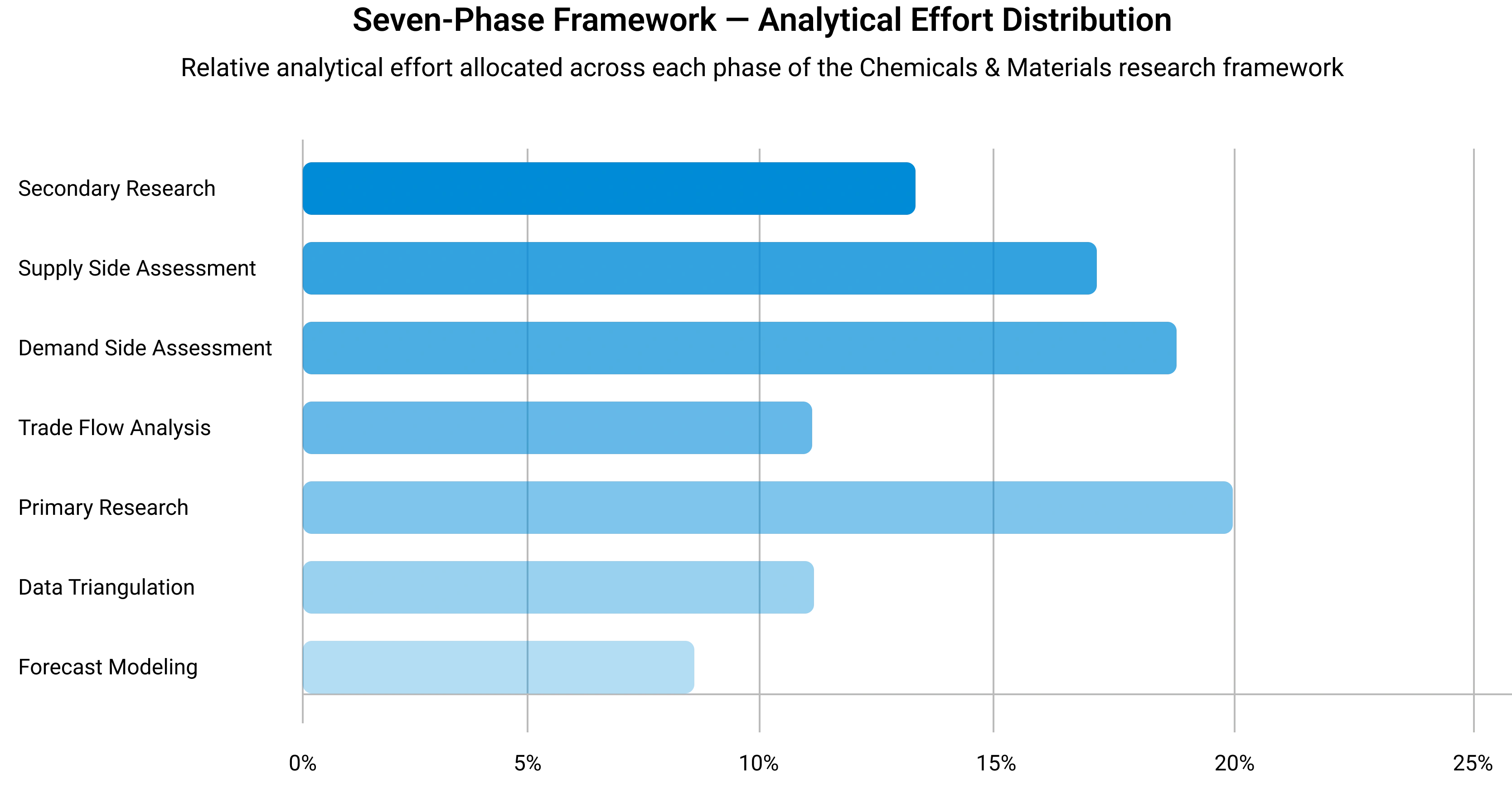
Seven-Phase Framework — Analytical Effort Distribution
Relative analytical effort allocated across each phase of the Chemicals & Materials research framework
Phase 1 - Secondary Research: Establishing the Foundation
Secondary research collects and evaluates publicly available information from authoritative sources, establishing the foundational understanding of market structure, value chain dynamics, competitive landscape, and end-use demand patterns. Every source is evaluated for credibility, recency, geographic relevance, and methodological soundness before inclusion.
Industry Associations
Sources include ACC, CEFIC, ICCA, JCIA, CPCIF, and SOCMA providing production volumes, consumption trends, capacity developments, and sustainability initiatives.
Company Disclosures
Annual reports, investor presentations, earnings transcripts, and regulatory filings reveal product portfolios, manufacturing footprints, capacity expansions, and revenue segmentation.
Government Databases
National statistical offices, customs authorities, environmental agencies, and industrial production databases provide verified statistics on output, trade flows, and regulatory compliance.
Trade Databases
UN Comtrade, ITC, Eurostat, and national customs authorities enable assessment of global product movement, import dependency, and export competitiveness across regions.
Our Secondary Research Sources
- Ministry of Chemicals and Fertilizers
- European Chemicals Agency
- United States Department of Energy
- Ministry of Industry and Information Technology
- Ministry of Economy Trade and Industry
- Ministry of Trade Industry and Energy
- National Institute of Standards and Technology
- Council of Scientific and Industrial Research
- Fraunhofer Society
- National Institute for Materials Science
Phase 2 — Supply-Side Assessment: Mapping Production Capabilities
Production Capacity Analysis
All major manufacturers are assessed for existing installed capacity, planned additions, expansions, new plant announcements, and technology adoption — mapped at global, regional, and country levels.
Capacity Utilization Adjustment
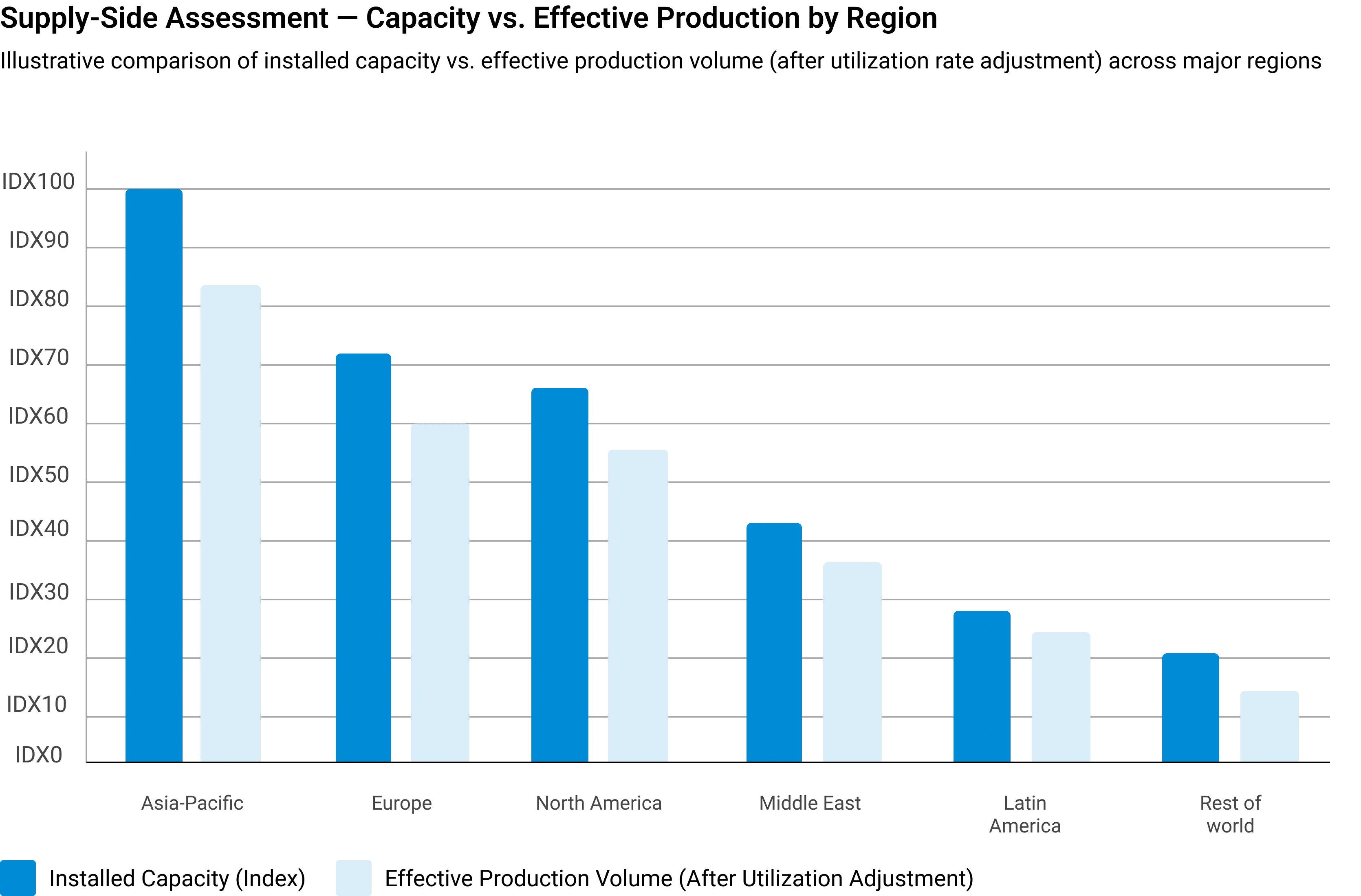
Installed capacity is adjusted using utilization rates based on demand conditions, feedstock availability, plant operating rates, maintenance schedules, and regulatory restrictions.
Manufacturer Revenue Analysis
Product-specific revenues, segment-level performance, regional distribution, average selling prices, and margin trends are evaluated to establish market value estimates.
Supply-Side Assessment — Capacity vs. Effective Production by Region
Illustrative comparison of installed capacity vs. effective production volume (after utilization rate adjustment) across major regions
Phase 3 — Demand-Side Assessment: Quantifying Chemical Consumption
Demand-side analysis quantifies chemical consumption across industries, applications, and geographies — identifying where and how chemicals are consumed throughout the value chain with precision.
End-Use Industry Analysis
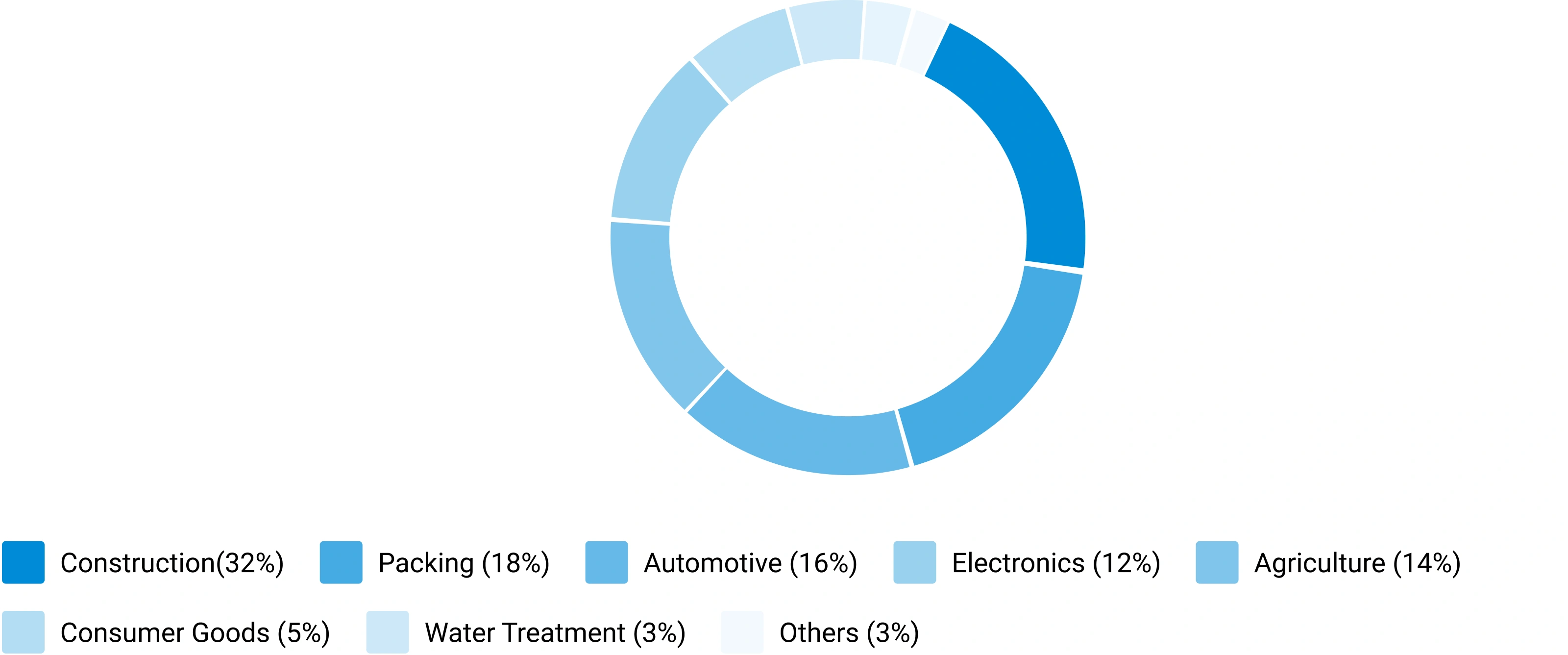
Chemical demand is evaluated across automotive, construction, packaging, electronics, agriculture, healthcare, consumer goods, industrial manufacturing, energy and utilities, and water treatment. Industry output, production trends, and consumption intensity are analyzed to determine demand patterns.
Consumption Modeling
Demand is estimated using measurable indicators: kilograms per vehicle, kilograms per square meter of construction, dosage per cubic meter of water treated, kilograms per hectare of agricultural land, and kilograms per ton of manufactured products. Consumption factors are validated through industry publications and primary interviews.
Application Analysis
The market is segmented by application area to understand product performance requirements, formulation trends, technology adoption, customer preferences, and regulatory requirements improving demand accuracy and segmentation granularity.
Demand-Side Assessment — End-Use Industry Demand Distribution
Illustrative distribution of chemical & materials demand across key end-use industries
Phase 4 - Trade Flow Analysis: Balancing Regional Supply and Demand
Trade flow analysis reconciles regional supply and demand estimates through import and export data, identifying net supply positions, regional dependencies, and market imbalances. It serves as an independent validation layer that tests the consistency of supply-side and demand-side estimates.
Import Analysis
Import data is evaluated to determine volumes, source countries, product dependency, regional supply gaps, and pricing trends — identifying markets that rely heavily on external supply and where domestic production is insufficient to meet demand.
Export Analysis
Export assessments reveal production surplus, export competitiveness, regional manufacturing strength, and global market participation. Export patterns also help validate domestic production estimates and identify net exporting regions.
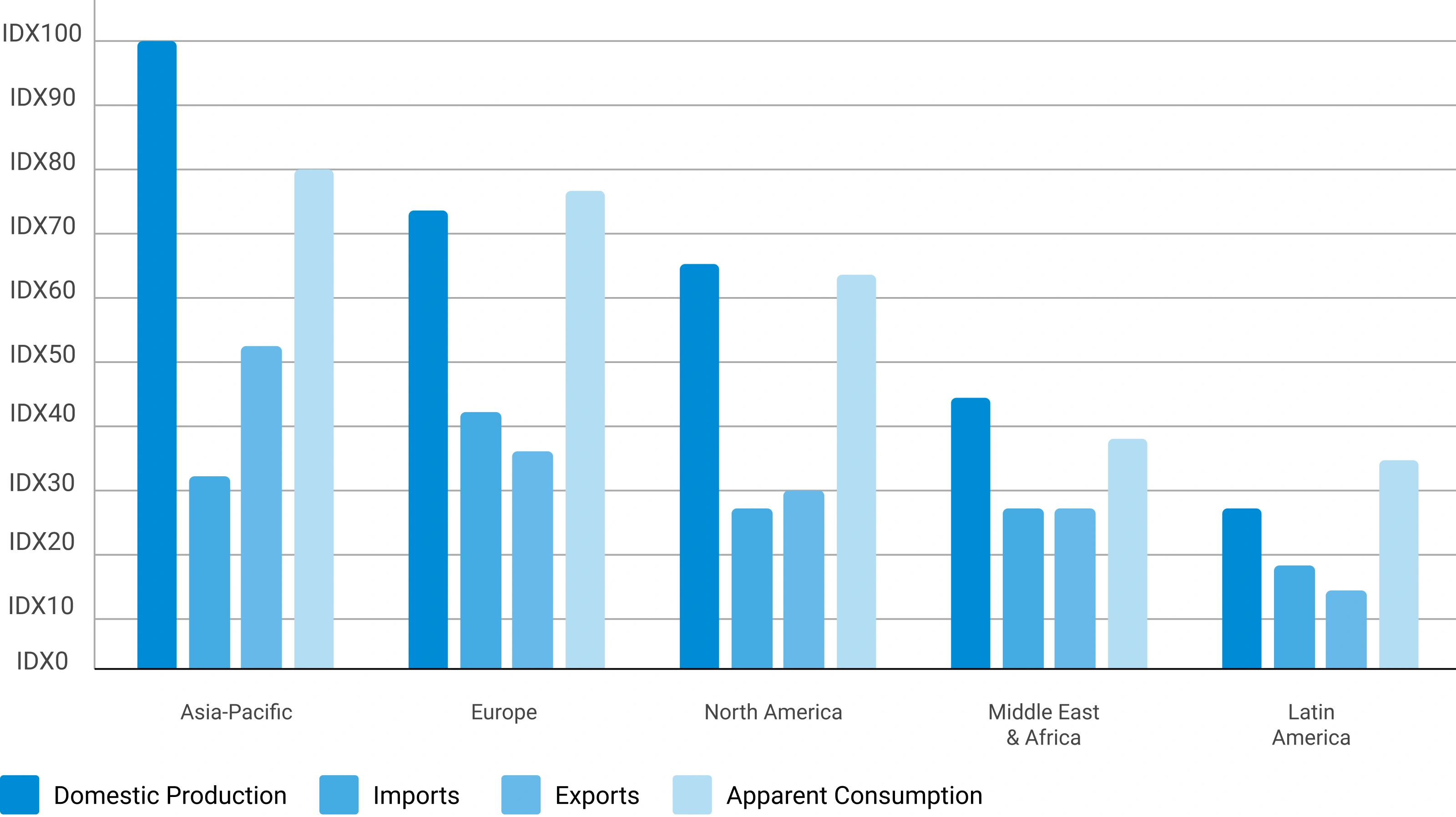
Apparent Consumption Model
Regional consumption is assessed using the standard apparent consumption formula:
Results identify net importing regions, net exporting regions, regional deficits, and surpluses — serving as an independent validation of supply and demand estimates.
Trade Flow Analysis — Net Supply Position by Region
Illustrative apparent consumption vs. domestic production across major regions — positive gap indicates net import dependency
Phase 5 — Primary Research: The Critical Validation Layer
Primary research tests and refines findings from secondary research through direct engagement with industry participants across the supply chain, demand side, and expert community. It captures intelligence that no database or published report can provide — the real-world experience of manufacturers, buyers, and specialists operating in the market.

Supply-Side Interviews
Conversations with chemical manufacturers, raw material suppliers, contract manufacturers, technology providers, and plant operators cover production trends, capacity utilization, pricing developments, technology shifts, and competitive dynamics.

Demand-Side Interviews
Engagement with OEMs, industrial consumers, procurement managers, distributors, formulators, and end-use manufacturers focuses on consumption trends, purchasing behavior, product substitution, demand outlook, and emerging applications.

Industry Expert Consultations
Additional interviews with industry consultants, independent experts, regulatory specialists, technical professionals, and research institutions provide deeper market context and validate key analytical assumptions.
Focus Areas of Primary Research:
Market Size & Forecast Validation
Revenue estimates, volume consumption, growth rates, forecast assumptions, regional demand.Supply Chain & Value Chain Assessment
Raw material sourcing, supply chain challenges, distribution networks, procurement practices.Production & Capacity Analysis
Manufacturing capacity, utilization rates, expansion projects, plant investments.Pricing & Cost Structure Analysis
Product pricing trends, feedstock costs, energy costs, margin pressures, pricing outlook.Competitive Landscape Assessment
Volume and value estimates confirmed to be fully consistent with one another before publicationInterview Volume by Market Scope
| Study Scope | Number of Interviews |
|---|---|
| Niche Market | 20 – 30 |
| Mid-Sized Market | 30 – 50 |
| Global Market | 50 – 80 |
| Highly Fragmented Market | 80 – 120 |
Interview Details:
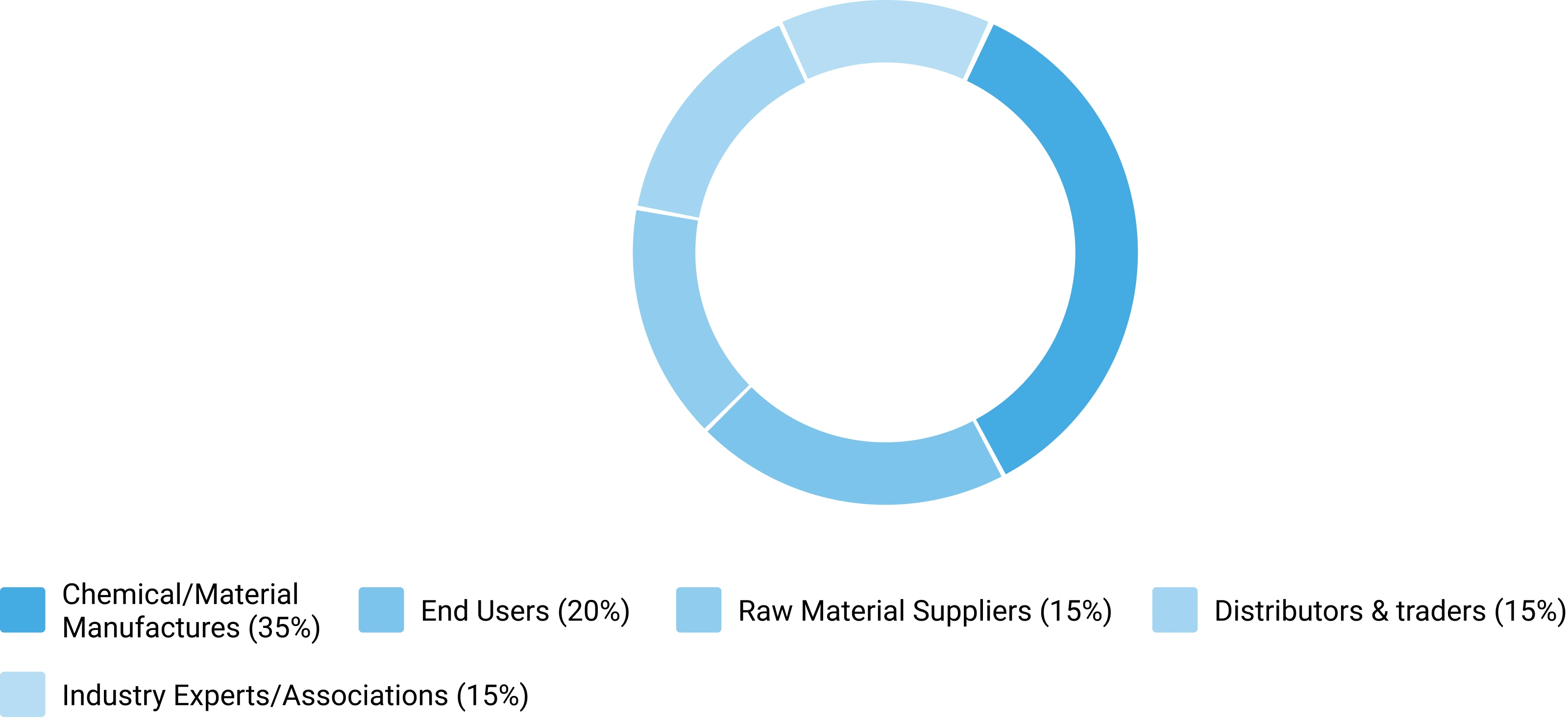
Category : Manufacturers, Suppliers, Distributors, End Users, Experts/Associations
Average Duration : 30–60 Minutes
Interview Mode : Video calls, telephonic interviews, expert consultations
Interview Format : Structured / Semi-Structured questionnaire
Focus Areas of Primary Research:
Market Size & Forecast Validation :
Revenue estimates, volume consumption, growth rates, forecast assumptions, regional demand.
Supply Chain & Value Chain Assessment :
Raw material sourcing, supply chain challenges, distribution networks, procurement practices.
Production & Capacity Analysis :
Manufacturing capacity, utilization rates, expansion projects, plant investments.
Pricing & Cost Structure Analysis :
Product pricing trends, feedstock costs, energy costs, margin pressures, pricing outlook.
Competitive Landscape Assessment :
Market share, competitor positioning, strategic initiatives, partnerships, acquisitions.
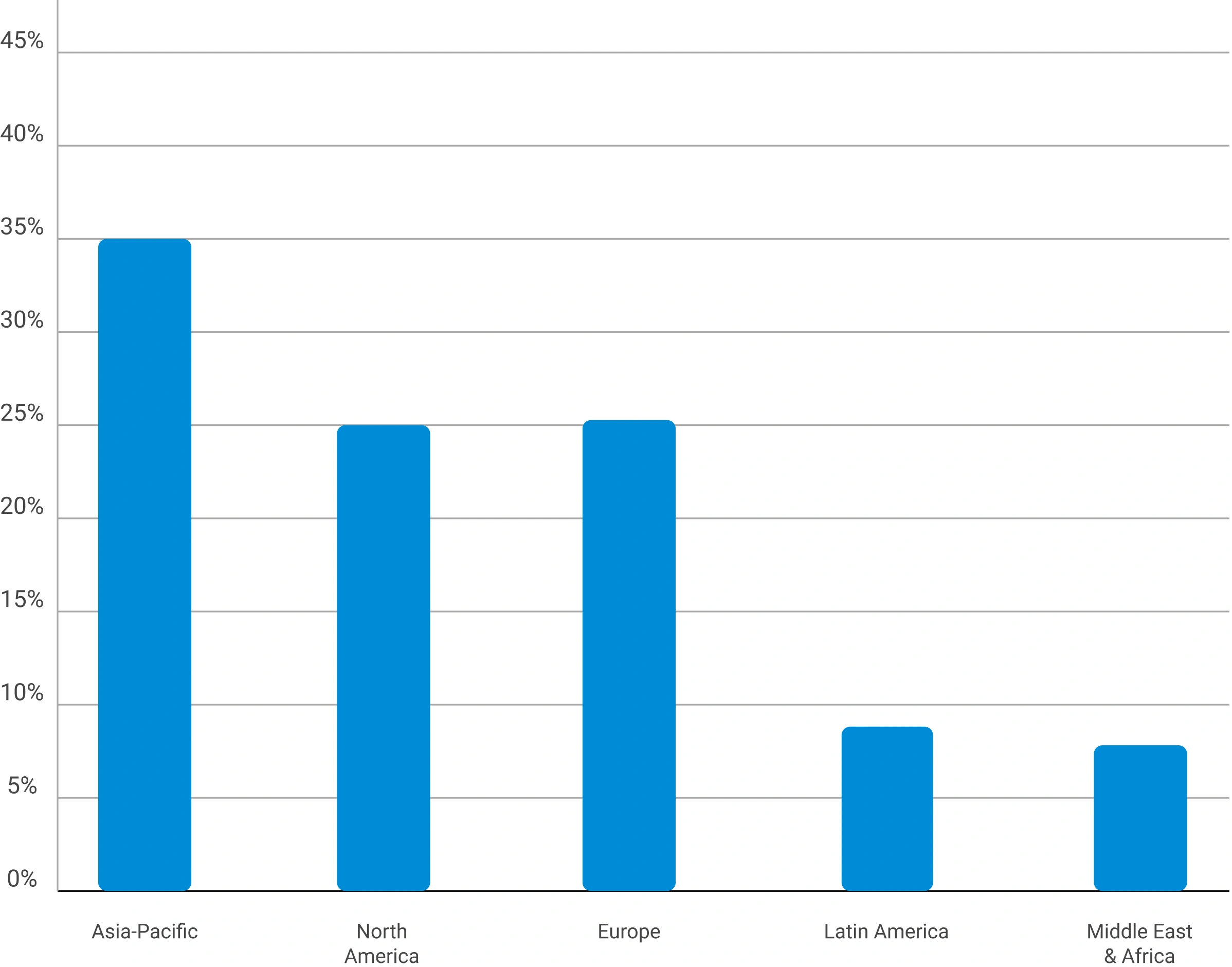
Primary Research — Stakeholder Coverage by Category
Distribution of interview respondents across stakeholder categories (% share from PPT data)
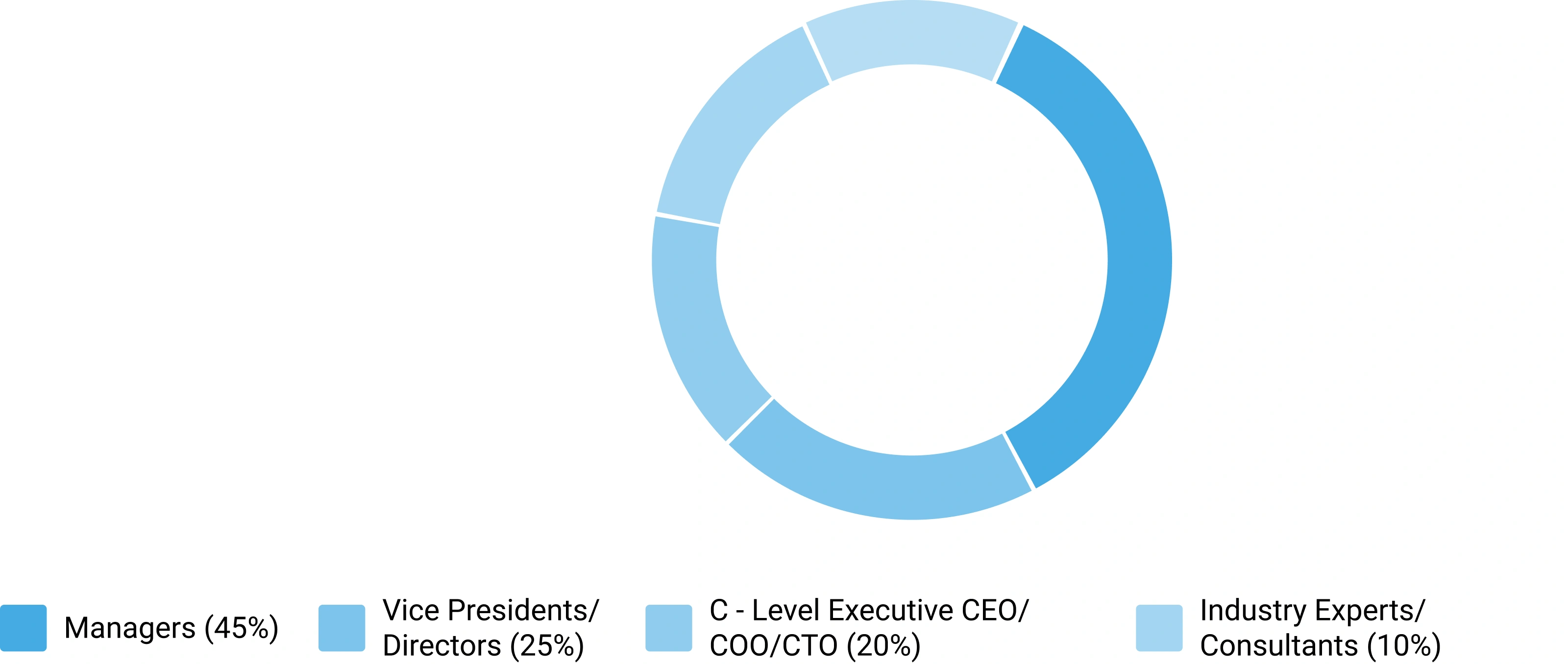
Primary Research — Respondent Designation Profile
Seniority breakdown of interview respondents (% share from PPT data)
Primary Research — Geographic Coverage of Interviews
Regional distribution of primary research engagement (% share from PPT data)
Phase 6 — Data Triangulation and Market Validation
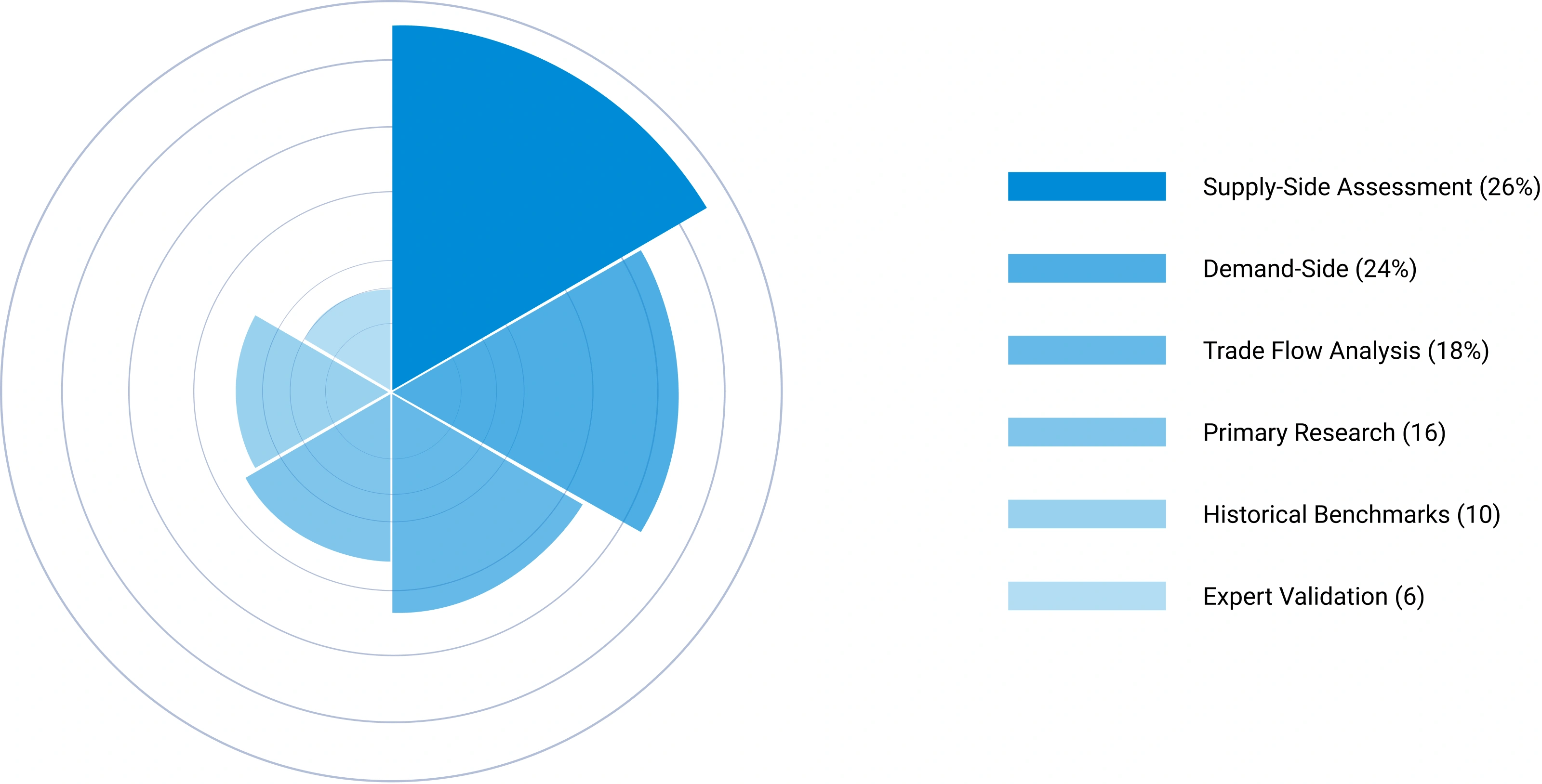
No single methodology is relied upon in isolation. Multiple independent estimation approaches are combined and reconciled to ensure consistency, accuracy, and analytical defensibility. Any material deviations between approaches are investigated and adjusted through additional validation cycles.
The final market size is derived through weighted triangulation of all validated methodologies. Any material deviations between approaches are investigated and adjusted through additional validation cycles. The outcome represents the most realistic assessment of the market based on available evidence and expert confirmation ensuring that volume and value estimates are fully consistent with one another.
Triangulation Framework — Input Contribution Weight
Relative weight each sizing input contributes to the final reconciled market estimate
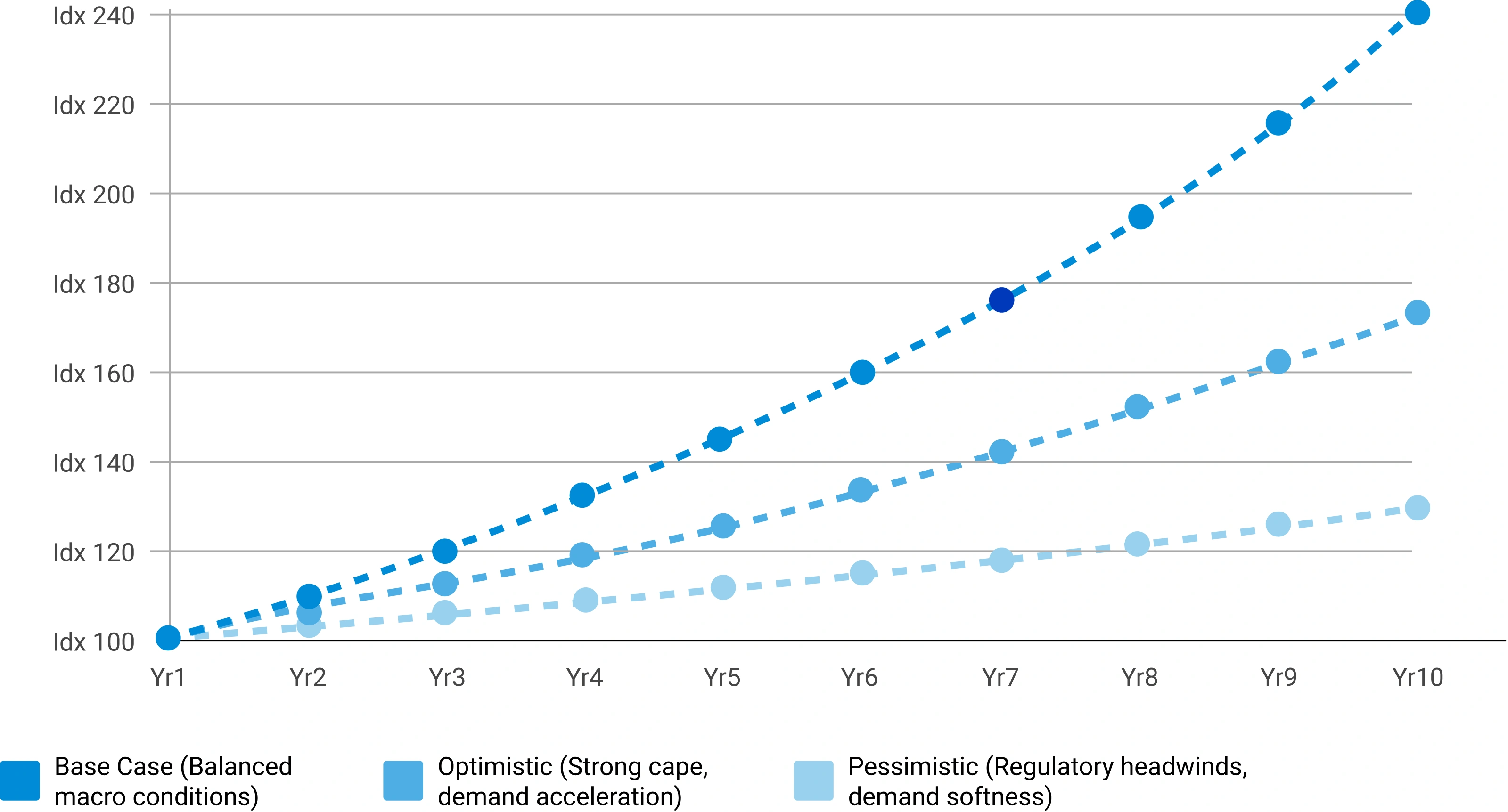
Phase 7 — Forecast Modeling: Projecting Future Market Evolution
Forecasting evaluates the future trajectory of the market using a combination of quantitative indicators and qualitative assessments across economic, industry, and regulatory dimensions. Rather than simple extrapolation, each driver is independently modeled and integrated into a composite forecast.
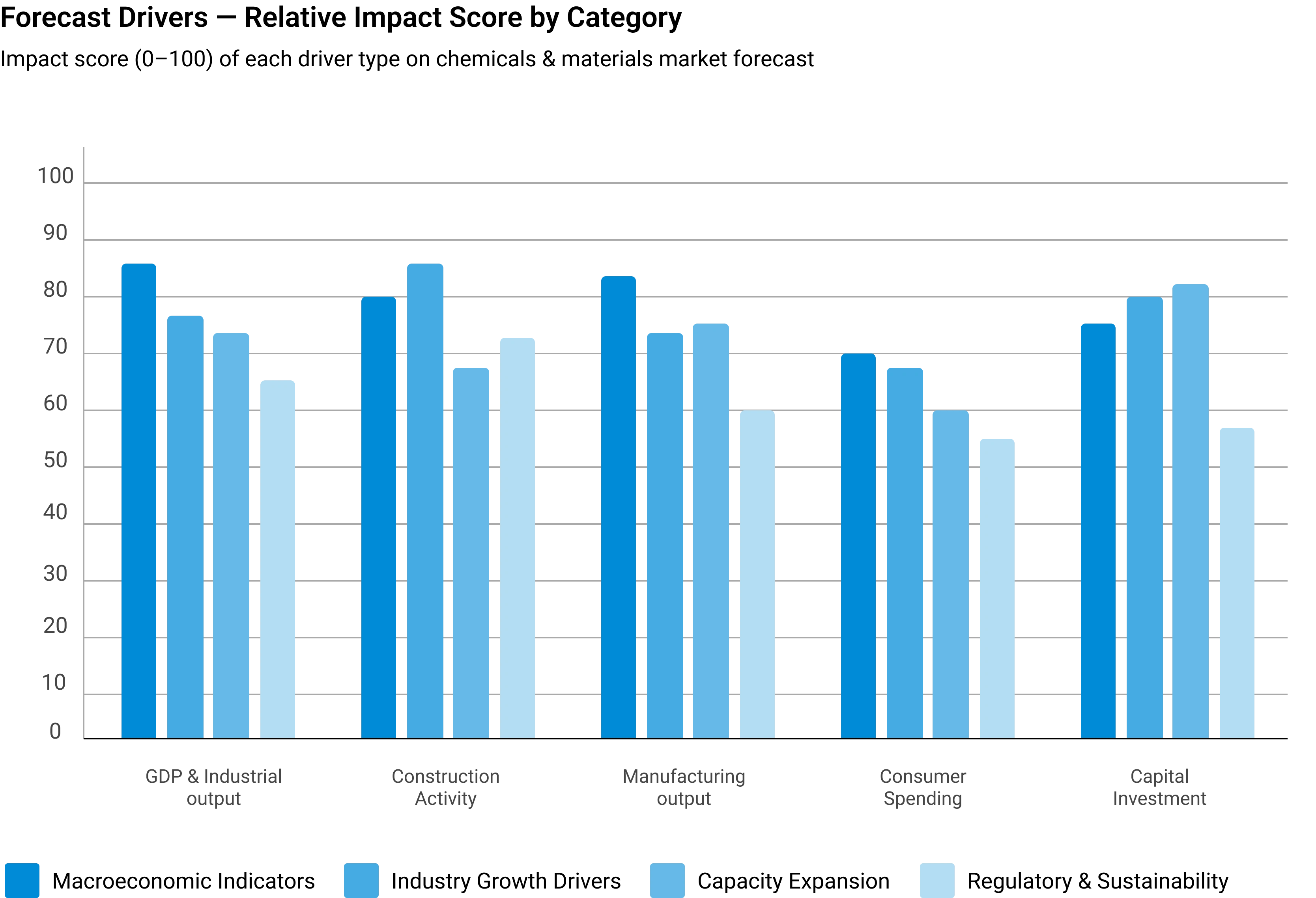
Macroeconomic Indicators
GDP growth, industrial production, manufacturing output, construction activity, consumer spending, and capital investment form the quantitative foundation of long-term demand projections. These are applied at country, regional, and global levels.
Industry Growth Drivers
Urbanization, infrastructure development, industrialization, technological innovation, sustainability initiatives, and evolving product performance requirements are assessed at regional and industry levels — capturing both structural and cyclical demand drivers.
Capacity Expansion Analysis
Announced plant expansions, new manufacturing facilities, technology upgrades, and strategic investments are evaluated to determine future supply-demand dynamics and potential market tightness or oversupply situations.
Regulatory & Sustainability
Environmental regulations, chemical safety standards, emission reduction targets, circular economy initiatives, and sustainability requirements are incorporated as they often influence product adoption rates and market growth trajectories.
Scenario Forecast Range — Indexed Market Growth (Year 1–10)
Illustrative indexed growth trajectories across Base, Optimistic, and Pessimistic scenarios over a 10-year forecast horizon
Forecast Drivers — Relative Impact Score by Category
Impact score (0–100) of each driver type on chemicals & materials market forecast



Comments
Share your thoughts, ask a question, or provide feedback about this report.