Content
Bioplastics Market Size, Share and Trends Report 2035
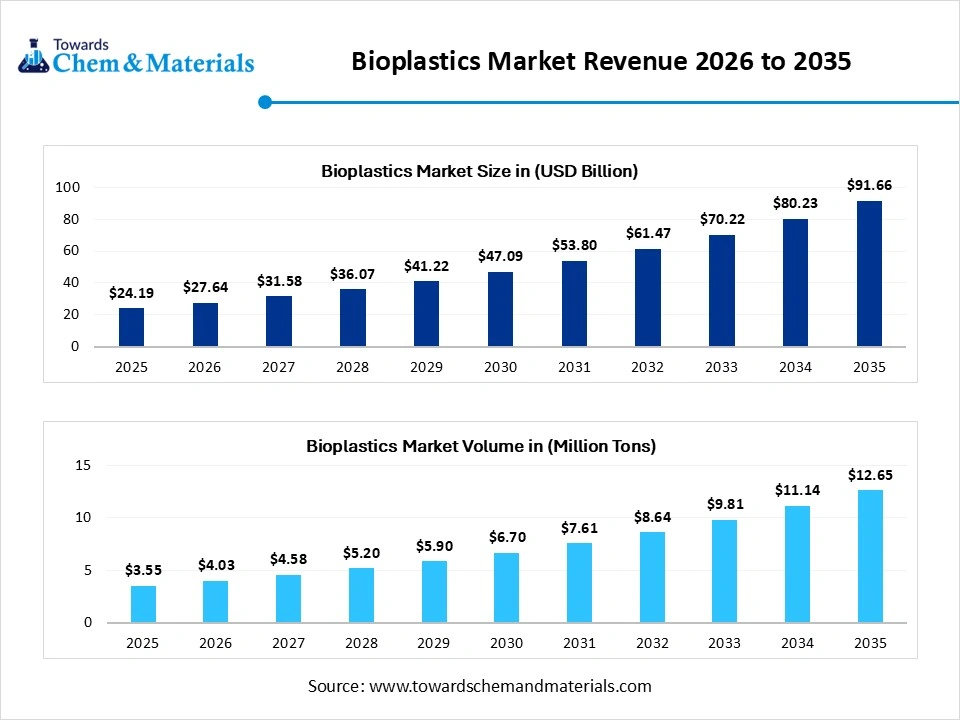
According to Towards Chemicals and Materials Analytics and Consulting, the global bioplastics market was valued at USD 24.19 billion in 2025, is estimated to reach USD 27.64 billion in 2026, and is projected to reach USD 91.66 billion by 2035, growing at a CAGR of 14.25% from 2026 to 2035. In terms of volume, the bioplastics market is projected to grow from 3.55 million tons in 2025 to 12.65 million tons by 2035. growing at a CAGR of 13.55% from 2026 to 2035.
Key Takeaways
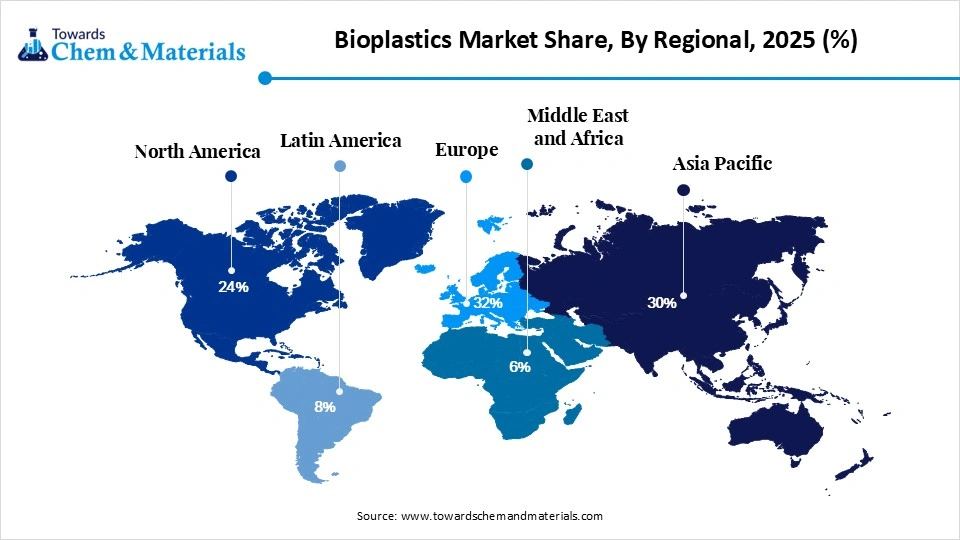
- By region, Europe dominated the market with 32% share in 2025.
- By region, Asia Pacific held the market share of 30% in 2025 and is expected to grow fastest, with a CAGR of 15.20% in the forecast period.
- By type, the biodegradable plastics segment dominated the market with 62% share in 2025 and is expected to have the fastest growth with a CAGR of 15.1% in the forecast period.
- By application, the packaging segment dominated the market with 48% share in 2025 and is expected to have the fastest growth with a CAGR of 15.3% in the forecast period.
- By processing technology, the injection molding segment dominated the market with 32% share in 2025.
- By processing technology, the extrusion segment held 27% market share in 2025 and is expected to have the fastest growth with a CAGR of 14.5% in the forecast period.
Market Size and Volume Forecast
- Market Estimated Size (2026): USD 27.64 Billion | CAGR (2026–2035): 14.25%
- Market Projected Size (2035): USD 91.66 Billion
- Market Volume (2025): 3.55 Million Tons | Volume CAGR (2026–2035): 13.55%
- Market Projected Volume (2035): 12.65 Million Tons
- Market Pricing (2025):
- Average Manufacturing Price: USD 2,210 per ton
- Average Selling Price: USD 2,820 per ton
- Pricing CAGR (2025–2035): 4.11%
Market Overview
What Is The Significance Of The Bioplastics Market?
The bioplastics market is significant for reducing dependence on fossil fuels, cutting carbon emissions by up to 70%, and alleviating plastic pollution via biodegradable, renewable-sourced materials. Driven by regulations and consumer demand, it is rapidly expanding in packaging, agriculture, and consumer goods. Key synonyms include bio-based polymers, plant-based plastics, sustainable polymers, and biodegradable plastics.
Bioplastics Market Growth Trends:
- Shift Towards PHA & PLA: Polylactic acid (PLA) and polyhydroxyalkanoates (PHA) are experiencing high growth due to their fully biodegradable nature. PHA, in particular, is noted for its high growth potential in marine and soil biodegradation.
- Regulatory Drivers: Stricter government policies regarding waste management and plastic bans are the primary drivers forcing companies to adopt bio-based alternatives.
- Technological Advancements: Innovation is focused on creating stronger, heat-resistant PLA alloys and finding, as well as optimizing, feedstock sources.
Report Scope
| Report Attribute | Details |
| Market Size and Volume in 2026 | USD 27.64 Billion / 4.58 Million Tons |
| Expected Size and Volume by 2035 | USD 91.66 Billion / 12.65 Million Tons |
| Growth Rate from 2026 to 2035 | CAGR 14.25% |
| Forecast Period | 2026 - 2035 |
| Dominant Region | Europe |
| Segment Covered | By Type, By Raw Material, By Application,By Processing Technology, By Region |
| Key companies profiled | TEIJIN LIMITED, Toray Industries, Inc., Toyota Tsusho Corporation, Avantium, PTT MCC Biochem Co., Ltd., An Phat Holdings, SABIC, BASF, Futerro, Trinseo, ECPlaza Network Inc., Solvay |
Key Technological Shifts In The Bioplastics Market:
The market is undergoing a significant transformation from a niche, sustainability-focused sector to a mainstream material option, driven by technological advancements, regulatory pressures, and corporate sustainability goals. Technology is shifting from small-scale pilot projects to large-scale, efficient manufacturing processes. Key shifts are currently focused on improving cost-effectiveness, performance, and the sustainability of raw materials.
Supply Chain Analysis of the Bioplastics Market:
Biopolymer Production & Processing
Bioplastics are produced from renewable feedstocks such as corn starch, sugarcane, cellulose, and vegetable oils through polymerization and fermentation processes, followed by compounding and shaping into final products.
- Key players: NatureWorks, BASF, TotalEnergies, Corbion, Novamont
Quality Testing and Certification
Bioplastics must meet biodegradability, compostability, and environmental safety standards along with material performance and regulatory compliance.
- Key players: International Organization for Standardization, ASTM International, European Chemicals Agency, TÜV Austria
Distribution to Industrial Users
Bioplastics are supplied to packaging manufacturers, agriculture film producers, consumer goods companies, textile industries, and automotive sectors for sustainable material solutions.
- Key players: NatureWorks, TotalEnergies Corbion, Novamont.
Bioplastics Regulatory Landscape: Global Regulations
| Country / Region | Regulatory Body | Key Regulations | Focus Areas | Notable Notes |
| U.S. | Environmental Protection Agency (EPA); Food and Drug Administration (FDA) | Toxic Substances Control Act (TSCA); USDA BioPreferred Program; FDA Food Contact Regulations (21 CFR) | Biobased certification, food contact safety, and environmental impact | The U.S. promotes bioplastics through the USDA BioPreferred labeling program while ensuring compliance for food-contact materials and environmental safety. |
| Europe | European Commission; European Chemicals Agency (ECHA) | Single-Use Plastics Directive; Packaging and Packaging Waste Directive; REACH Regulation | Biodegradability standards, circular economy, chemical safety | The EU strongly supports bioplastics through sustainability policies, but requires clear proof of biodegradability and recyclability claims. |
| China | National Development and Reform Commission (NDRC); Ministry of Ecology and Environment (MEE) | Plastic Pollution Control Policies; Circular Economy Promotion Law | Biodegradable plastics promotion, industrial compliance | China is actively promoting biodegradable plastics such as PLA and PHA to reduce plastic pollution. |
| India | Ministry of Environment, Forest and Climate Change (MoEFCC); Central Pollution Control Board (CPCB) | Plastic Waste Management Rules; EPR Guidelines | Biodegradable plastics, waste management, and extended producer responsibility | India encourages bioplastics adoption while ensuring compliance with biodegradability certification and waste management norms. |
| Japan | Ministry of Economy, Trade and Industry (METI); Ministry of the Environment | Plastic Resource Circulation Act; Green Procurement Policies | Sustainable materials, recycling, and eco-friendly alternatives | Japan promotes bioplastics through green procurement and circular economy initiatives. |
| Brazil | Brazilian Institute of Environment and Renewable Natural Resources (IBAMA); Ministry of the Environment | National Solid Waste Policy; Environmental Regulations | Waste reduction, biodegradable material regulation | Brazil supports bioplastics through waste reduction policies and sustainability-focused regulations. |
Market Dynamics
Drivers
What are the Key Growth Drivers of the Bioplastics Market?
Key growth drivers for the market include strict government regulations on single-use plastics, rising consumer demand for sustainable packaging, and a strong corporate shift toward eco-friendly materials. Technological advancements, reducing production costs, and the urgent need to lower carbon footprints are accelerating market expansion. Increasing awareness of plastic pollution drives consumer preference for biodegradable packaging.
Restrains
What are the Key Growth Restraints of the Bioplastics Market?
Key growth restraints of the market include high production costs, limited raw material availability, inadequate waste management infrastructure, and inferior material performance compared to conventional plastics. These factors limit widespread adoption, with PLA and PHA often costing up to 60% more than traditional plastics, hindering competitiveness, especially in price-sensitive regions.
Opportunities
What are the Key Growth Opportunities of the Bioplastics Market?
Key growth opportunities in the market are driven by massive demand in packaging, automotive, and consumer goods due to sustainability goals. Major opportunities include developing advanced microbial-based polymers like PHA, expanding biodegradable materials, adopting circular economy models, and increasing bioplastic use in automotive components for weight reduction. Increased government regulations prohibiting single-use plastics are driving adoption, alongside the recognition of organic recycling as a waste management strategy.
Segmental Insights
Type Insights
The Biodegradable Plastics Segment Dominated The Market With 62% Market Share In 2025
The biodegradable plastics segment dominated the market with 62% share in 2025 and is expected to have the fastest growth with a CAGR of 15.1% in the forecast period, due to stringent regulations against single-use plastics and rising consumer demand for sustainable, plant-based alternatives. Driven by expanding applications in packaging, agriculture, and consumer goods, this segment is growing rapidly, with Polylactic Acid (PLA) and Starch-based plastics leading the way.
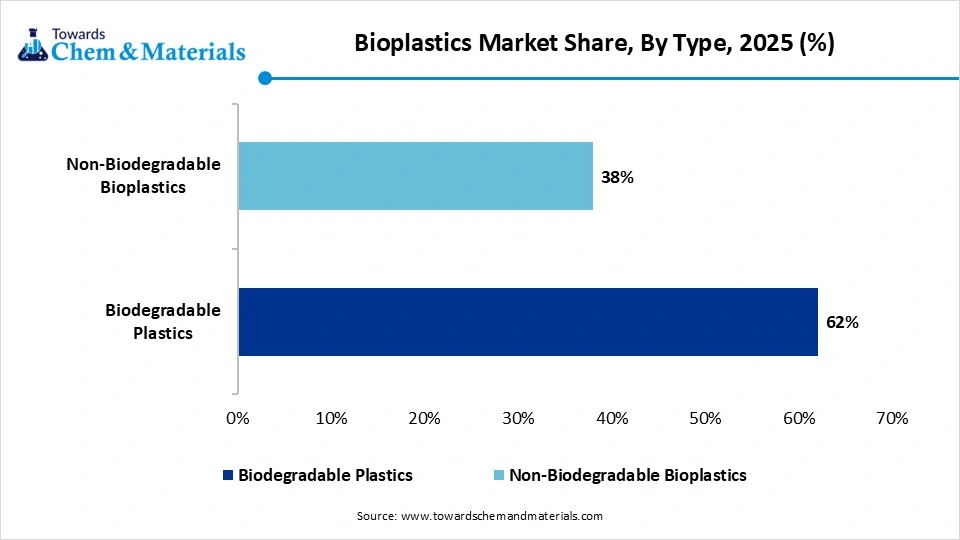
The non-biodegradable bioplastics segment held 38% market share in 2025, offering high-performance, drop-in replacements for traditional plastics like bio-based PET, PE, and PA that reduce carbon footprints without requiring new manufacturing infrastructure. Driven by corporate sustainability goals and the need for durable materials in automotive, electronics, and packaging, this segment, including bio-PP, is increasing its market share. Companies are adopting these materials to lower their fossil-fuel dependency and reduce carbon emissions.
By Raw Material Insights
The Corn Starch Segment Dominated The Market With 34% Share in 2025
The corn starch segment dominated the market with 34% share in 2025. Corn starch is a key renewable feedstock in the bioplastics market, valued for its abundance, low cost, and biodegradability. It is processed into polymers like polylactic acid (PLA), offering an alternative to petroleum-based plastics. Its use supports reduced carbon emissions and growing demand for sustainable packaging, especially in food and consumer goods sectors.
The Cellulose segment held 16% market share in 2025 and expects the fastest CAGR of 14.8% during the forecast period. Cellulose, a natural polymer from plant cell walls, plays a significant role in the bioplastics market due to its renewability and strength. It is used to produce materials like cellulose acetate and films. Its biodegradability and versatility make it attractive for packaging, textiles, and coatings, supporting the shift toward sustainable, bio-based alternatives.
Application Insights
The Packaging Segment Dominated The Market With 48% Market Share In 2025
The packaging segment dominated the market with 48% share in 2025 and is expected to have the fastest growth with a CAGR of 15.3% in the forecast period, due to strict government bans on single-use plastics, surging corporate sustainability goals, and high demand for eco-friendly food packaging. Governments worldwide are enforcing bans on conventional single-use plastics, prompting a swift shift to biodegradable and compostable alternatives like PLA and PHA.
The automotive segment held 15% market share in 2025 by adopting sustainable materials to reduce vehicle weight, improve fuel efficiency, and meet carbon-neutrality goals. High demand for sustainable materials in car interiors, such as dashboards, door panels, and seat covers, is boosting the market. Bioplastics are replacing heavy metals and traditional plastics to reduce vehicle weight, lowering carbon emissions. Automakers are shifting to eco-friendly, recyclable materials to meet global environmental regulations.
The agriculture segment held 11% market share in 2025, due to the high demand for biodegradable mulch films, greenhouse films, and nutrient-release coatings, driven by the need for sustainable farming practices. This sector is moving toward eco-friendly alternatives to manage soil health and reduce plastic waste, with the market expected to grow significantly due to regulatory pressure against conventional plastics. The development of superior starch-based and PLA polymers makes these products more durable and cost-effective.
The consumer goods segment held 9% market share in 2025 by adopting sustainable, compostable materials for everyday items, packaging, and personal care products. This surge is fueled by high consumer demand for eco-friendly alternatives to traditional plastics, stringent government bans on single-use plastics, and corporate efforts toward circular economy goals. Rising awareness about environmental issues has led customers to prefer brands using sustainable materials, urging manufacturers to redesign products with bio-based materials.
Processing Technology Insights
The Injection Molding Segment Dominated The Market With 32% Market Share In 2025
The injection molding segment dominated the market with 32% share in 2025 because these materials can now be processed on existing, conventional injection molding equipment with minimal adjustments. Driven by increasing sustainability regulations and consumer demand, the market is shifting towards bio-based alternatives like Polylactic Acid and Polyhydroxyalkanoates to replace petroleum-based plastics.
The extrusion segment held 27% market share in 2025 and is expected to have the fastest growth with a CAGR of 14.5% in the forecast period, driven primarily by the high demand for flexible packaging and the need to process biodegradable materials like Polylactic Acid and starch blends on an industrial scale. Most bioplastics, particularly PLA, can be processed on existing plastic extrusion lines with minimal adjustments to temperature and screw settings, allowing for a smoother, less costly transition for manufacturers.
The blow molding segment held 16% market share in 2025, driven by the urgent need for sustainable packaging solutions, technological advancements allowing the use of bio-resins in traditional machinery, and high demand in the food, beverage, and personal care industries. Blow molding, used to create hollow plastic parts like bottles and containers, is shifting from traditional PET/HDPE to bio-based alternatives, with bio-based non-biodegradables like bio-PET and bio-PE capturing a significant portion of the market.
The thermoforming segment held 15% market share in 2025, driven by its high compatibility with emerging sustainable materials like Polylactic Acid and recycled PET. As regulations tighten on single-use fossil-based plastics, manufacturers are turning to thermoforming to produce eco-friendly, rigid packaging, such as food trays, clamshells, and medical blister packs, at high speeds and lower costs. Stringent environmental regulations, such as the EU's plastic-use levies, are pushing companies to adopt bio-based, recyclable materials.
Regional Insights
How did Europe dominate the Bioplastics Market in 2025?
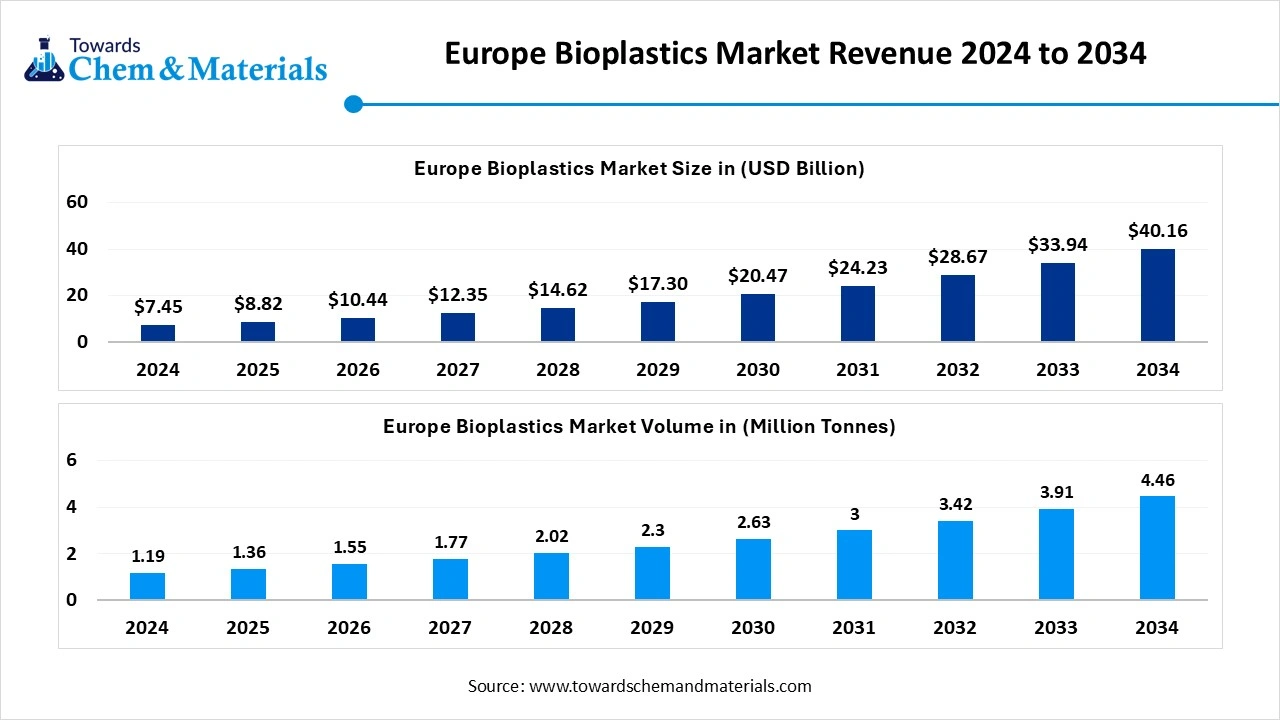
The Europe bioplastics industry is projected to grow from USD 8.84 billion in 2026 and to reach USD 29.79 billion by 2035, at a compound annual growth Rate (CAGR) of 14.43% during the forecast period. Europe dominated the market with a share of 32% in 2025 by combining strict environmental regulations, such as bans on single-use plastics, with high consumer sustainability awareness. The region leads in R&D and applications like flexible packaging, driven by strong demand for bio-based materials and advanced composting infrastructure. European Commission policies and legislative action, such as prohibitions on conventional single-use packaging, significantly accelerated the adoption of alternatives.
Germany Bioplastics Market Growth Factor
The German bioplastics market is primarily driven by strict European Union environmental regulations, high consumer demand for sustainable packaging, and the automotive sector's push for lightweight, bio-based materials. Stringent EU and German policies regarding plastic waste reduction and the circular economy drive adoption. As a major European hub for plastics production, Germany’s transition toward a "bio-economy" encourages the development of renewable feedstock-based plastics.
Asia Pacific Bioplastics Market Growth Factor
Asia Pacific held a market share of 30% in 2025 and is expected to grow fastest, with a CAGR of 15.20% in the forecast period. Primary growth drivers include stringent bans on single-use plastics in China, India, and Southeast Asia, increasing consumer awareness of environmental sustainability, and a robust, low-cost supply of feedstock. Governments in the region are adopting stricter policies against non-biodegradable plastics, forcing industries to shift to sustainable packaging and products.
India Bioplastics Market Growth Factor
India's bioplastics market is growing rapidly, driven by strict bans on single-use plastics. Major drivers include government initiatives like Swachh Bharat Mission 2.0, high consumer demand for eco-friendly packaging, and expanding local production of raw materials like sugarcane and starch. Growing environmental awareness and corporate commitments to reduce carbon footprints are significantly driving up demand. Major initiatives like Balrampur Chini Mills' investment in an industrial PLA plant and partnerships with organizations like TotalEnergies Corbion are enhancing local production capabilities.
Recent Developments
- In December 2025, Renaissance BioScience and Biome Bioplastics launched a two-year, CAD$1.5 million partnership to develop sustainable, bio-based building blocks for plastics using advanced fermentation. Backed by Canadian and UK government funding, the project aims to scale production for applications in packaging and consumer goods.
- In May 2025, Intec Bioplastics, Inc. launched EarthPlus® Hercules Bioflex™ Stretch Wrap, a sustainable, APR-certified, plant-based packaging solution designed for high-performance, temperature-tolerant wrapping with a 1,799% stretch capacity. The company reported strong initial market demand, introduced a customer buy-back program, and launched a $75 million Regulation A+ offering to expand manufacturing.
Top players in the Bioplastics Market & Their Offerings:
- NatureWorks LLC: NatureWorks is a leading producer of PLA (polylactic acid) bioplastics under the Ingeo™ brand. Its materials are widely used in packaging, food service items, and 3D printing, with a strong emphasis on compostability and renewable feedstocks.
- Braskem S.A.: Braskem is a major producer of bio-based polyethylene (Green PE) derived from sugarcane ethanol. Its products are used in packaging, consumer goods, and automotive applications, offering a lower carbon footprint compared to conventional plastics.
- TotalEnergies Corbion: TotalEnergies Corbion produces PLA bioplastics for packaging, textiles, and consumer goods. The company focuses on high-performance, compostable polymers and expanding global production capacity.
- Novamont S.p.A.: Novamont produces starch-based biodegradable plastics under the Mater-Bi® brand. Its products are used in packaging, agriculture, and compostable applications, supporting circular economy initiatives.
- Danimer Scientific: Danimer Scientific manufactures PHA-based biodegradable plastics used in packaging, straws, and single-use items, with a strong focus on marine biodegradability.
Bioplastics Market Top Players
- TEIJIN LIMITED
- Toray Industries, Inc.
- Toyota Tsusho Corporation
- Avantium
- PTT MCC Biochem Co., Ltd.
- An Phat Holdings
- SABIC
- BASF
- Futerro
- Trinseo
- ECPlaza Network Inc.
- Solvay
Bioplastics Market Segments Covered:
By Type
- Biodegradable Plastics
- Polylactic Acid (PLA)
- Polyhydroxyalkanoates (PHA)
- Starch Blends
- Polybutylene Adipate Terephthalate (PBAT)
- Others
- Non-Biodegradable Bioplastics
- Bio-based Polyethylene (Bio-PE)
- Bio-based Polyethylene Terephthalate (Bio-PET)
- Bio-based Polyamide (Bio-PA)
- Others
By Raw Material
- Corn Starch
- Sugarcane
- Cellulose
- Vegetable Oils
- Others
By Application
- Packaging
- Flexible Packaging
- Rigid Packaging
- Automotive
- Agriculture
- Consumer Goods
- Textiles
- Medical
- Electronics
By Processing Technology
- Injection Molding
- Extrusion
- Blow Molding
- Thermoforming
- Others
By Region
- North America:
- U.S.
- Canada
- Mexico
- Rest of North America
- Latin America:
- Brazil
- Argentina
- Rest of Latin America
- Europe:
- Western Europe
- Germany
- Italy
- France
- Netherlands
- Spain
- Portugal
- Belgium
- Ireland
- UK
- Iceland
- Switzerland
- Poland
- Rest of Western Europe
- Eastern Europe
- Austria
- Russia & Belarus
- Türkiye
- Albania
- Rest of Eastern Europe
- Asia Pacific:
- China
- Taiwan
- India
- Japan
- Australia and New Zealand,
- ASEAN Countries (Singapore, Malaysia)
- South Korea
- Rest of APAC
- MEA:
- GCC Countries
- Saudi Arabia
- United Arab Emirates (UAE)
- Qatar
- Kuwait
- Oman
- Bahrain
- South Africa
- Egypt
- Rest of MEA
- GCC Countries
FAQ's




Select User License to Buy
Figures (5)









 sales@towardschemandmaterials.com
 Download Sample
 Schedule a Meeting