 Request Consultation
Content
Fueling the Flow from Pipelines to Precision
According to Towards Chemicals And Materials Analytics and Consulting, the global oil and gas logistics market is projected to grow from USD 212.83 billion in 2026 to USD 386.04 billion by 2035, registering an impressive CAGR of 6.84% during the forecast period.
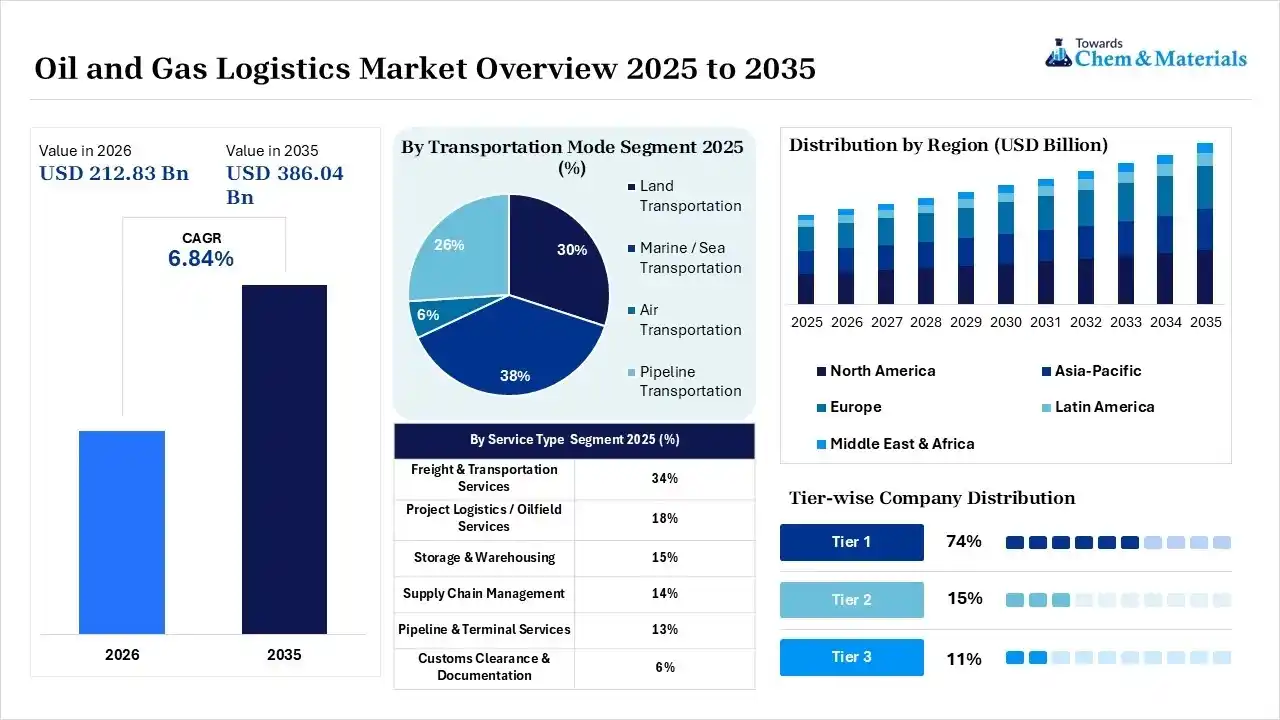
The oil and gas logistics industry plays a vital role worldwide by facilitating the transportation of petroleum products. It ensures that fuel reaches various sectors, including transportation, industry, and households. This logistical network is essential for maintaining the continuous supply of fuel for vehicles, aircraft, and ships. Additionally, petroleum is a primary source of energy for cooking and heating purposes in many homes. The efficiency of oil and gas logistics directly impacts economic stability and daily life. As global demand for energy increases, the importance of effective logistics becomes even more apparent. Overall, this industry is fundamental to supporting modern society’s energy needs.
Get Full Access of Report | Immediate Delivery: https://www.towardschemandmaterials.com/checkout/6473
Evolution of Oil & Gas Logistics
Logistics developed from a simple system of transport of goods in ancient civilisations to a complex worldwide system used for international trade and economic development. At the initial stages, it was mainly the transportation of vital commodities via land and sea trade routes, which facilitated the inter-kingdom and inter-regional exchange of commodities. The Industrial Revolution changed the nature of logistics, adding railways, steamships and mechanised production, which enabled goods to be carried faster, more efficiently and on a much greater scale. Modern logistics continues to evolve in the twentieth century, with the modernisation of logistics systems based on containerisation, multimodal transport systems and air freight, which further increased the efficiency of global trade.
Today, logistics is one part and an inseparable component of end-to-end supply chain management. It is powered by technology like artificial intelligence (AI), Internet of Things (IoT), cloud computing, big data analytics, blockchain and automation. These technologies can help shipments be tracked in real time, the demand can be predicted, the inventory can be optimised, the warehouses can be automated, and the overall operation can be seen more clearly. Meanwhile, the heightened environmental awareness of organisations has spurred the adoption of sustainable logistics practices, ranging from green transport to the use of electric delivery vehicles to fuel-efficient processes and to carbon emission reduction measures. Logistics is becoming a technology ecosystem, which is increasingly focused on efficiencies, resilience, sustainability and customer-focused supply chain management, and is a vital enabler of contemporary economic growth and global trade.
The Evolution of Logistics: From Ancient Trade to Modern Supply Chains SLM (Self Learning Material) for MBA Oil Field Characteristics
An oil field is a natural reservoir of crude oil (and often natural gas) that has formed beneath the earth's surface in porous and permeable rock. The properties of an oil field play a key role in its commercial potential, its production potential, and the technology needed for oil exploration and extraction. These geologic and reservoir characteristics are crucial for petroleum engineers, geologists, and energy companies, as they impact the drilling approach, recovery rates, operational expenses, and field lifespan.
The most significant property of an oil field is that it contains a reservoir rock that stores hydrocarbons. Reservoir rocks (usually sandstone, limestone, or carbonate rocks) have interconnected pore spaces where crude oil and natural gas can be stored for millions of years. The effectiveness of a reservoir is dependent on the volume of pore space present (porosity) and the ability of the rock to allow oil and gas to move through the reservoir to production wells (permeability). High porosity and high permeability are usually associated with high production rates and high recovery of hydrocarbons, while low permeability reservoirs may necessitate more sophisticated methods of oil recovery, including hydraulic fracturing or enhanced oil recovery.
A cap rock, a layer of impermeable rock like shale, clay, or salt, is also important. This sealing layer prevents hydrocarbons from reaching the surface, and allows commercially viable oil reservoirs to form. The oil or gas is usually found in a geological structure which has been created by natural geological processes to provide favourable conditions for the accumulation of hydrocarbons, such as an anticline, a fault trap, a stratigraphic trap or a salt dome. The size and productivity of an oil field are largely dependent on the integrity of the structure of these traps.
Reservoir depth is an important consideration for exploration and production. Creating shallow reservoirs is generally simpler and less costly than creating deepwater, ultra-deepwater, and high-pressure, high-temperature (HPHT) reservoirs, which require advanced drilling technology, specialized equipment, and a large financial investment. Another important parameter is the reservoir pressure, which is the pressure the hydrocarbons face in the reservoir and forces them towards production wells at the beginning. As production proceeds, reservoir pressure gradually decreases, and sometimes a secondary or tertiary recovery technique is used to keep production up and to maximize recovery, such as water flooding, gas injection, steam injection, or CO2 injection.
The quality of crude oil is also widely different from one oil field to another and directly affects the efficiency of the refinery and the value of the product. The light sweet crude oils have lower sulphur concentration, which makes them easier to transport, and more desirable and less costly to refine. Sour crude oils and heavy crude oils, on the other hand, have a higher percentage of sulphur and impurities, offering more complex refining operations and requiring advanced treatment technologies. Often, oil fields are also associated with natural gas, either dissolved in the crude oil or as a gas cap over the oil field. This natural gas is an extra source of energy and adds a lot to the value of the field.
Another naturally occurring constituent in most oil reservoirs is water. Water saturation, or the percentage of the total water in the system, affects production efficiency and has to be controlled in the system and throughout its operation. With the ongoing production of oil, water production is typically increasing; proper water handling, treatment, and disposal are crucial to maintaining production efficiency and reducing environmental impacts. Also, reservoir conditions, fluid properties, and rock mechanics are all factors that dictate the choice of drilling methods, completion techniques, and production strategies.
The life cycle of an oil field includes an initial exploration phase with seismic surveys, an appraisal drilling phase, a field development phase, commercial production, enhanced recovery, field abandonment, and decommissioning. During this lifecycle, there is a growing shift towards the use of continuous reservoir monitoring, digital technologies, artificial intelligence, and advanced data analytics to optimize production, improve recovery, reduce environmental impacts, and mitigate operational risks.
Government Initiatives and Industry Adaptations
- The Samudra Manthan Initiative is an initiative by the Government of India to promote offshore oil and gas exploration and boost the country's long-term energy security. The project aims to access deep and ultra-deep-water sediments of hydrocarbons in the ocean which are yet to be explored, and to boost domestic oil and natural gas production. India is looking to increase its offshore exploration efforts to lessen its reliance on imported crude oil and to guarantee a more secure and sustainable energy future.
- The program aims to foster the use of cutting-edge technologies such as high-resolution seismic imaging, artificial intelligence, digital reservoir modelling, and innovative drilling methods to enhance the efficiency of exploration efforts and optimise the recovery of resources. It also aims to encourage more investment from energy firms, both local and foreign, by providing conducive conditions for energy exploration and production offshore. Incorporation of new technology is expected to help minimize risks during exploration, optimize operations, and make offshore projects more economically viable.
- Besides its contribution to improving energy generation, the Samudra Manthan Initiative is expected to boost economic activities through job creation, support indigenous manufacturing, develop offshore infrastructure, and promote technology innovation in the energy sector. The programme is in line with India's vision of becoming more energy independent and promoting responsible resource use and environmental sustainability. The development will help unlock the country's offshore hydrocarbons potential, which will contribute to the development of a resilient, technologically advanced and internationally competitive oil and gas industry.
India's Offshore Oil and Gas Potential: The Samudra Manthan Initiative, ETEnergyworld
- India and Japan have launched an Energy Resilience Roadmap aimed at enhancing oil security amid increasing global uncertainties. This collaborative effort focuses on diversifying energy sources, improving supply chain resilience, and promoting sustainable energy practices. Key aspects of the roadmap include measures to strengthen strategic petroleum reserves and foster cooperation in areas such as technology exchange, infrastructure development, and emergency response plans. By working together, both countries aim to ensure a stable energy supply for their economies and mitigate the risks associated with geopolitical tensions and market volatility.(Source: www.moneycontrol.com)
The Rise of Sustainable Practices in Oil and Gas Extraction Around the Globe
The oil and gas sector is in a period of radical change, with more and more businesses seeking to incorporate sustainable practices to reconcile the use of energy resources with environmental stewardship. Governments and energy firms, in response to escalating worries about climate change, carbon emissions, biodiversity loss and resource conservation, have included sustainability considerations in all aspects of exploration, production, transportation and decommissioning. The industry is not only investing in hydrocarbon extraction, but also in cleaner technology, operational efficiencies and environmentally friendly management of resources.
The most important change is the use of carbon emission reduction strategies. North America, Europe, the Middle East and Asia-Pacific energy companies are investing in carbon capture, utilisation and storage (CCUS) technologies as a way to cut greenhouse gas (GHG) emissions related to oil and gas production. Other measures are also helping to reduce operational emissions, such as electrifying offshore platforms, improving energy-efficient drilling equipment and using renewable energy to power production facilities.
Increasingly, the industry is turning toward digital transformation to enhance its sustainability. The use of artificial intelligence, machine learning, digital twins, Internet of Things (IoT) sensors, and predictive analytics is optimizing drilling operations, monitoring equipment health, and minimizing energy use and operational waste. With the use of real-time monitoring systems, leaks can be detected, production efficiency can be increased, and environmental compliance can be ensured, while maintenance costs are reduced.
Marine and terrestrial ecosystems are a top priority for offshore and onshore operations all over the world. Companies are taking a holistic approach to environmental impact assessment (EIA) before project start-up, followed by biodiversity conservation programmes, after field development, and with the application of sophisticated monitoring technologies to minimise disturbance to wildlife. Environmental management plans are in effect, and strict measures are being taken to lower the exploration and production footprint in the environment.
The other key development is the increasing use of water management technologies. There is a push towards reducing freshwater use and limiting environmental contamination through the use of advanced wastewater treatment systems, produced water recycling, desalination technologies, and closed-loop drilling systems. Additionally, many operators are making efforts to enhance drilling fluid management and putting in place more stringent waste disposal procedures to minimize impact to the surrounding ecosystem.
The industry's long-term outlook is changing with the shift to less carbon-intensive energy sources. Renewable energy investment is on the rise at major oil and gas companies, together with the enhancement of the sustainability of hydrocarbons, in the sectors of hydrogen, offshore wind energy, biofuels, geothermal energy and renewable power generation. These diversifications contribute to the objectives of the global climate and help to guarantee energy security in the energy transition.
The sustainable approach to supply chain management is also on the agenda. Increasingly, companies are seeking to use materials that are more environmentally responsible, optimise logistics, cut methane emissions throughout their operations, and build environmental, social and governance (ESG) scores by working with suppliers. The transparency of sustainability reporting and corporate governance has also boosted stakeholder trust and investor interest.
Global Policies Impact on the Oil and Gas Industry
International oil and gas policies and regulations are important in influencing the global oil and gas industry. Countries are implementing increasingly stringent environmental requirements, carbon reduction targets, and policies on energy security that affect exploration, production, transportation, and refining. Governments are also promoting investments in newer exploration technologies, cleaner production processes, and carbon management options in order to ensure energy sustainability in the long-term. Countries are implementing policies that encourage energy diversification, strategic petroleum reserves, and responsible offshore development to ensure a balance between energy security and environmental protection. These policies are leading to technological development, investment, operational safety, and a more competitive dynamic in the growing global energy market while also driving companies to become more sustainable and competitive.
The Workforce's Role in the Oil and Gas Industry is a high-level overview of the industry for the Oil and Gas Workforce.
The human resource is one of the most valuable assets in the oil and gas industry, which is involved in all the activities of the value chain, starting from exploration and drilling to production, refining, transportation, and decommissioning. Geologists, petroleum engineers, drilling specialists, operators of offshore platforms, environmental scientists, health and safety specialists, and data analysts are all working partners to ensure efficient and safe operations. Employees are gaining proficiency in AI, automation, robotics, cybersecurity, and digital asset management as digital technologies become more common. There is an ongoing training and upskilling initiative, which is helping the workforce to keep up with the latest technologies and ensure quality operations. To make this a reality, the industry must have a skilled workforce that is also technologically capable to enhance productivity, ensure workplace safety, and aid in moving to a more sustainable and digitally-oriented future.
Innovations Around the Globe
The oil and gas industry is still transforming with the use of sophisticated exploration and production equipment. The use of high-resolution seismic imaging, autonomous drilling systems, intelligent completion technologies, and digital oilfield solutions is helping companies to discover resources and maximise hydrocarbon recovery. In recent years, remotely controlled vehicles (ROVs), autonomous underwater vehicles (AUVs), advanced subsea production systems, and floating production facilities have become a growing part of offshore operations to explore in deep water and ultra-deep water. Other areas of technological development which are emerging are also important, such as carbon capture and utilisation and storage (CCUS), methane emission reduction technologies, hydrogen production and renewable-powered offshore platforms. These advancements are enhancing the efficiency of energy production, mitigating environmental harm, and ensuring the sustainability and resilience of the global energy industry.
How Technology is Impacting the Oil and Gas Industry
Technology has fundamentally transformed the oil and gas industry by improving exploration accuracy, operational efficiency, safety, and sustainability. Advanced technologies such as artificial intelligence (AI), the Internet of Things (IoT), cloud computing, big data analytics, robotics, and digital twins enable companies to make data-driven decisions and optimise operations. High-resolution seismic imaging and reservoir simulation help identify hydrocarbon reserves more accurately, reducing exploration risks and costs. Automation and predictive maintenance minimise equipment failures, while drones and remotely operated vehicles (ROVs) inspect pipelines and offshore infrastructure without exposing personnel to hazardous environments. Technology is also helping companies monitor emissions, improve energy efficiency, and achieve environmental compliance, making operations more reliable and sustainable.
Technological Integrations in Logistics
Logistics has become increasingly digitalised within the oil and gas industry, enabling the seamless movement of equipment, raw materials, and petroleum products across global supply chains. Modern logistics systems incorporate GPS tracking, IoT-enabled sensors, automated warehouses, cloud-based transportation management systems, and blockchain technology to improve visibility and coordination. Real-time tracking allows companies to monitor shipments, optimise transportation routes, and respond quickly to operational disruptions. Predictive analytics assists in demand forecasting, inventory planning, and fleet management, while automation improves warehouse efficiency and reduces manual errors. These technological integrations enhance supply chain resilience, lower operational costs, and ensure timely delivery of critical resources to production facilities.
Supply Chain Management
Supply chain management is a critical component of the oil and gas industry, encompassing the procurement, transportation, storage, distribution, and delivery of equipment, materials, and petroleum products. Efficient supply chain management ensures uninterrupted production by coordinating suppliers, manufacturers, logistics providers, and end users across multiple regions. Digital technologies enable companies to monitor inventory levels, forecast demand, manage supplier relationships, and optimise procurement strategies in real time. Risk management has also become an important aspect of modern supply chains, with organisations implementing contingency planning to address geopolitical uncertainties, natural disasters, and market fluctuations. A well-managed supply chain improves operational efficiency, reduces costs, enhances customer satisfaction, and strengthens overall business resilience.
Logistics in the Oil and Gas Industry - NextBillion.ai
The Role of SAP and Its Use at Reliance Industries
SAP plays a central role in integrating business processes across the oil and gas value chain by providing a unified enterprise resource planning (ERP) platform. It enables organisations to manage finance, procurement, inventory, production planning, maintenance, logistics, human resources, and compliance through a single, integrated system. By consolidating operational data into a central platform, SAP improves decision-making, enhances transparency, and streamlines workflows across complex operations.
Reliance Industries uses SAP to support its large-scale operations in refining, petrochemicals, oil and gas, retail, and digital businesses. The platform helps the company manage procurement activities, monitor inventory, coordinate supply chain operations, oversee maintenance schedules, and analyse operational performance using real-time data. SAP also improves collaboration between departments, optimises resource utilisation, supports regulatory compliance, and enables faster strategic decision-making. The integration of SAP with digital technologies such as AI, automation, and analytics further strengthens operational efficiency across Reliance's extensive industrial network.
Future of the Oil and Gas Industry
The future of the oil and gas industry will be shaped by digital transformation, technological innovation, and the increasing emphasis on sustainability. Artificial intelligence, automation, robotics, digital twins, and advanced analytics are expected to improve exploration success, optimise production, and enhance operational safety while reducing costs. At the same time, companies will continue investing in carbon capture technologies, cleaner fuels, hydrogen, renewable energy integration, and low-carbon production methods to meet global climate objectives.
Smart supply chains, autonomous logistics, and cloud-based enterprise systems will further improve operational resilience and business agility. As energy demand continues to evolve, the industry is expected to adopt a balanced approach that combines conventional hydrocarbon production with cleaner energy solutions. Organisations that successfully integrate digital technologies, sustainable practices, and efficient resource management will be well positioned to remain competitive in the rapidly changing global energy landscape.
The Methods in which Artificial Intelligence is Being Used.
AI is playing a significant role as a catalyst for the digital transformation in the oil and gas sector. AI systems can process massive amounts of geologic and operational data to locate possible hydrocarbon deposits, optimize drilling sites, and optimize reservoir management. Predictive maintenance uses machine learning algorithms to predict equipment failures before they happen, which helps to minimize downtime and maintenance costs.
AI can also be employed to track pipeline integrity, identify methane leaks, schedule production processes, manage supply chains, and ensure safety in the workplace by dynamically assessing risks. AI is used in offshore applications to augment the use of robotics and autonomous systems for inspection of subsea infrastructure, production facility monitoring, and improving decision-making. Overall, AI is poised to drive greater efficiency and cost savings, and enhance environmental sustainability within the industry, as the technology continues to advance.
How the industry is Working Towards a Sustainable Tomorrow
The oil and gas industry is moving forward to incorporate sustainability into its business plans and satisfy the world's increasing demand for energy. Companies are making investments in cleaner production technologies, reducing greenhouse gas emissions, increasing energy efficiency, and putting carbon capture and storage technologies in place to minimise their environmental impacts.
The environmental impacts of exploration and production activities are being reduced through the use of advanced water recycling systems, monitoring of methane emissions, electrification of offshore platforms, and integration of renewable energy. In addition, greater attention is being given to biodiversity conservation, responsible waste management, environmental monitoring, and the restoration of ecosystems across the project life cycle. At the same time, numerous organisations are increasingly expanding into new, low-carbon energy technologies, like hydrogen, biofuels, offshore wind, and geothermal power, contributing to a balanced approach to a more sustainable, resilient and environmentally responsible global energy industry.
The role of SC Resilience.SC Resilience – its importance.
In today's global and complex market environment, resilience in the oil and gas supply chain is an important strategic priority for companies. Geopolitical tensions, natural disasters, pandemics, cyber-attacks, and changing energy costs have exposed the need for strong and resilient supply chains that can adapt to disruption. An effective supply chain is essential for the continuity of the supply of drilling equipment, raw materials, spare parts, refined petroleum products, and critical infrastructure elements in both domestic and international markets.
Multisourcing is becoming more widespread, logistics operations are being digitised, strategic inventories are increasingly being held, and companies are introducing real-time monitoring systems to reduce operational risk of operations. These measures ensure business continuity, minimise downtime, bolster energy security and boost the industry's capacity to quickly adapt to dynamic markets.
Investment Trends in Oil and Gas Infrastructure
The investment in oil and gas infrastructure remains geared towards modernising existing assets and continuing to build capacity to meet future energy demand globally. Offshore platforms, deepwater exploration, liquefied natural gas (LNG) terminals, cross-country pipelines, storage facilities, petrochemical complexes, and advanced refinery units are all targets for investment by companies.
Large investments are also being channeled into digital infrastructure such as smart pipeline networks, predictive maintenance systems, automation systems, and intelligent monitoring systems. The integration of renewable energy and the production of hydrogen and carbon capture and storage (CCS) are gaining traction as organisations attempt to achieve reliable energy supply along with emission reduction. Such investment trends are driving operational efficiency, enhancing the resilience of energy infrastructure, and promoting long-term energy sector sustainability.
Government policies and infrastructure.
Government policy is instrumental in influencing the growth of oil and gas infrastructure development because of its ability to allow investments to be made safely and without compromising the environment. In many countries, policies are being adopted to support exploration, offshore development, pipeline expansion, strategic petroleum reserves, and energy security programmes.
Government regulations are also promoting the use of cleaner production technologies, better environmental sstandards,and digital infrastructure to increase the efficiency of operations. Incentives for investment, PPP schemes and infrastructure development programmes are aiding to bring investments on board for large-scale energy projects. These policy actions are helping to boost national energy systems and sustain economic growth and long-term industrial development.
Digitalisation in the field of oil logistics – an intersection of ideas.
The oil and gas logistics value chain is undergoing a digital transformation by providing greater visibility, efficiency, and decision-making throughout the value chain. Artificial Intelligence, the Internet of Things (IoT), cloud computing, blockchain, digital twin, and advanced analytics enable businesses to track packages, optimize routes, manage inventory, and forecast equipment breakdowns in real-time. Automated warehouses, intelligent fleet management, and predictive logistics platforms optimize processes and enhance delivery reliability, thereby lowering operational expenses. Digital integration can also help to improve collaboration among suppliers, transportation companies, storage facilities, and production locations, fostering a more interconnected and agile supply chain.
- As the digital technologies mature, they will be set to become the backbone of smarter, resilient, and highly efficient oil and gas logistics operations.
The Pandora's box for the Industry
The future of the oil and gas industry is not only a wonderful opportunity, but an ordeal as well, and it's a Pandora's Box. The market is transforming the operating environment of the industry, driven by fast technological advancements, shifting environmental laws, and fluctuating consumer demands, as well as a global shift towards clean energy. Companies face a range of challenges, including environmental carbon emissions; security, cybersecurity; geopolitical instability; labour, workforce transformation; and investment, investment uncertainty, as well as new opportunities for efficiency and profitability through digital technologies, artificial intelligence, automation, and enhanced exploration techniques. There is a need for ongoing innovation, partnerships, and flexible business models to achieve a balance between energy security and environmental sustainability. Those that manage to overcome the risks and opportunities that are interrelated, will be more prepared to remain competitive in the evolving global energy market.
Conclusion
In conclusion, the oil and gas logistics industry serves as a critical backbone for the global economy, ensuring the seamless flow of energy resources that power various sectors of society. Its evolution from basic transportation methods to the sophisticated systems we see today highlights the importance of logistics in meeting the growing demands for energy. Modern technologies such as AI, IoT, and automation are enhancing efficiency and sustainability within the logistics framework, paving the way for a more resilient supply chain.
- Moreover, understanding the characteristics of oil fields is essential for optimizing production and developing effective extraction strategies. The interplay between reservoir properties, drilling technology, and economic viability underscores the complexity of managing oil resources.
As the world continues to grapple with energy demands and environmental challenges, the oil and gas logistics sector must adapt and innovate. Emphasizing efficiency, sustainability, and technological advancement will ensure that this critical industry not only survives but thrives in the evolving landscape of energy production and distribution.
Contact:
Towards Chemicals and Materials Analytics and Consulting
USA: +1 804 441 9344
APAC: +61 485 981 310 or +91 87933 22019
Europe: +44 7383 092 044
Email: sales@towardschemandmaterials.com
About the Experts

Aditi Shivarkar
Aditi serves as Vice President at Towards Chemical and Material and brings over 15 years of experience in research, strategy, and industry analysis. She focuses on sectors such as specialty chemicals, advanced materials, and sustainable solutions. She studies how regulations, raw materials, and industrial demand shape the market, and she uses that understanding to guide businesses in the right direction. Aditi helps companies stay prepared for change, improve their market position, and make well-informed decisions.



Aman Singh
Aman Singh has more than 13 years of experience in research and consulting, with a strong focus on the global chemicals and materials space. He tracks developments in areas like green chemistry, high-performance materials, and industrial innovation. At Towards Chemical and Material, he leads the research team and ensures every report is clear, accurate, and useful. Aman breaks down complex industry changes and helps businesses understand what they mean in practical terms.