
Content
Fueling the Future: The Rise of Bioenergy
Overview
The biofuel market has become a key part of the global shift towards cleaner and more sustainable energy systems. Biofuels are fuels derived from biological resources, including waste products, used cooking oils, algae, organic waste, forestry residues, and crops. Biofuels are renewable fuels, unlike conventional fossil fuels, so they are a good alternative for the reduction of greenhouse gas emissions and energy security. The rising need for energy sources that are environmentally friendly, the heightened awareness of climate change, and fluctuating crude oil prices have led to the growing use of biofuels in various modes of transportation, such as road, air, sea, and industrial.
There are several categories in the market, such as bioethanol, biofuel, renewable diesel, biogas, biomethane, and sustainable aviation fuel. To promote the utilization and production of biofuels, governments worldwide have adopted biofuel blending requirements, tax measures, and renewable energy goals. Technological development has also led to the development of a second and third generation of biofuels that use non-food biomass and waste materials, mitigating food security and land use issues.
Market growth is continuing as a result of the process of rapid industrialization, an increase in the number of vehicles and a desire to lessen reliance on imported petroleum products.
Prospects are further bolstered by investments in key biorefineries, feedstock diversification and carbon capture technologies. In parallel, partnerships between energy producers, farmers and biotechnology companies are driving production efficiency and supply chain resilience. With the transition to net-zero emission targets, the biofuel market could be a key contributor to decarbonizing sectors where full electrification is not feasible, making biofuels a critical part of the global energy landscape of the future.
Introduction
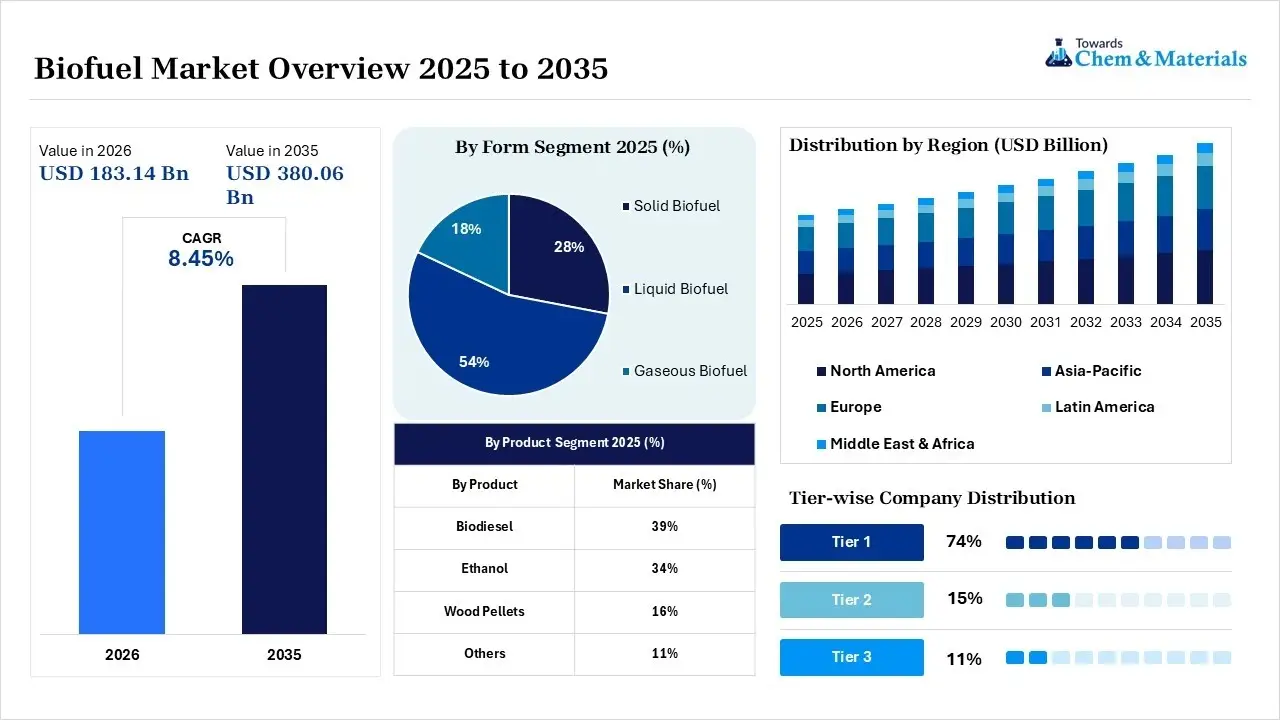
According to Towards Chemicals And Materials Analytics and Consulting, The biofuel market size was valued at USD 168.87 billion in 2025, is estimated to reach USD 183.14 billion in 2026, and is projected to reach USD 380.06 billion by 2035, exhibiting a compound annual growth rate (CAGR) of 8.45% over the forecast period from 2026 to 2035. Asia Pacific dominated the biofuel market with the largest revenue share of 36% in 2025 and is expected to grow at the fastest CAGR of 8.60% during the forecast period.
Biofuels are energy sources produced from biological materials or biomass, such as crops, agricultural residue, forestry residue, algae, MSW, and animal by-products. They are intended to be substitutes for or complementary to the use of conventional fossil fuels, and have a lower overall life cycle impact. With the rising concerns of climate change, energy security, and the exhaustion of finite fossil fuel resources, biofuels have become increasingly popular as a viable and eco-friendly option for the transportation, industrial, and electricity sectors.
Biofuel is not a novel idea, but current technology has revolutionized the efficiency of production, the quality of fuel produced, and the viability of commercial operations. There are three types of biofuels: first generation, made from food crops like sugarcane, corn, soybeans and rapeseed; second generation using agricultural and forestry residues; and third generation, made from algae and other advanced biological resources. Work is also underway on 4th generation biofuels combining carbon capture and genetically modified feedstocks to achieve even further reductions in greenhouse gas emissions.
Bioethanol is commonly used as a fuel in petrol-blending to lower emissions from passenger vehicles, and biodiesel and renewable diesel have significant applications in commercial transport, agriculture and heavy-duty machinery. Another emerging area of interest is sustainable aviation fuel (SAF), which is receiving significant attention within the aviation sector as the industry strives to decrease its carbon emissions while maintaining service levels. Likewise, biogas and biomethane are also increasingly being used to produce electricity, for industrial heating and for domestic energy supplies.
The biofuel industry provides jobs outside of energy generation in agricultural, biotechnology, engineering, logistics and manufacturing sectors. Farmers are provided with extra markets for agricultural residues and energy crops, and the rural economy gains from investments in biofuel production facilities. Ongoing advances in enzyme technology, fermentation processes, feedstock utilization and integrated biorefineries are further enhancing production efficiency and reducing manufacturing costs.
In the future, biofuels will continue to play a significant role in the global renewable energy market. Biofuels have a significant role to play in energy diversification, environmental sustainability, and long-term economic growth in the years to come, provided they are supported by the right policies, technological innovation, sustainably managed feedstocks, and greater intergovernmental cooperation among government institutions, research centres, and private companies.
Other Uses of Biogas
While biofuels are primarily used for transport, such as vehicles like cars, buses, and trucks, they have a number of lesser-known applications that are important to sustainable development in other sectors. Biofuels are increasingly being used in innovative ways beyond transportation, showcasing their potential as a versatile renewable energy source.
Aviation is one of the other under-reported uses of biofuels. Biofuels, agricultural waste, algae, and waste oils can be processed into sustainable aviation fuels that can be mixed with conventional jet fuel without significant changes to aircraft engines, which helps to lower carbon emissions.
Get Full Access of Report | Immediate Delivery:https://www.towardschemandmaterials.com/checkout/6010
This helps airlines to reduce their environmental footprint while still being efficient in their operations. Biofuels are also being increasingly used for marine transport. Fewer pollutants are emitted from ships that are fuelled with biodiesel or renewable diesel blends than from ships fuelled by HFOs and heavy fuel oil. With the introduction of increasingly stringent environmental regulations for international shipping companies, this application is gaining in significance.
A new application is in electricity generation. Food waste, sewage sludge, animal waste, and agricultural waste can be used to produce biogas, which can be used in gas engines or gas turbines to generate electricity for households, industries, and businesses in rural areas. The generated electricity heat can also be utilized in industrial processes, which will enhance energy efficiency. Biofuels also have value in the agricultural field. Farms can use biodiesel in their tractors, irrigation pumps, harvesters, and other farm equipment, reducing their reliance on petroleum diesel. Biofuel production can also produce nutrient-rich fertilisers, making biofuel production a circular agriculture process.
There are a number of industries that use biofuel boilers to produce steam to suit the manufacturing processes of their facilities. Biomass pellets, biogas, or bio-oils are increasingly being used as a process heat source by more and more food processing plants, paper mills, textile factories, and chemical manufacturers to lower greenhouse gas emissions. Lossy application is one that is often overlooked: emergency and remote power generation. When the electrical power grid is damaged by a natural disaster, used in military operations, construction projects, or in remote villages with limited electrical grid connections, portable generators fuelled by biodiesel or biogas generate electricity.
Biofuels are also being studied as feedstocks for various other renewable chemicals, biodegradable plastics, lubricants, and solvents used in industries. Bio-compounds are no longer used as fuel, but as environmentally friendly building blocks in manufacturing. Beyond the transportation sector, biofuels are poised to become increasingly relevant in other industries, like mining, railways, defence, and data centres, thus making them a key player in a more sustainable and diversified energy economy, as innovation progresses.
Types of Biogases
- Bioethanol: Bioethanol is an alcohol fuel that is obtained by fermenting sugar- and starch-rich crops like sugarcane, corn, wheat, and sugar beet. It is a common additive to petrol to help lower emissions and improve combustion efficiency.
- Biodiesel: The production of biodiesel from vegetable oils, animal fats, used cooking oils, or other lipids obtained from biological sources is done by a chemical process called transesterification. Can be used on its own or mixed with conventional diesel fuel in a diesel engine.
- Renewable Diesel: Using advanced processing technologies, vegetable oils, waste fats, and other renewable feedstocks are converted into renewable diesel. It has properties very close to petroleum diesel and can be used directly in existing engines without any modification.
- Biogas: Biogas is produced by the anaerobic digestion of organic matter like food waste, animal excrement, wastewater sludge, and biomass from agriculture. It is composed mainly of methane and carbon dioxide and is used for cooking, heating, and generation of electricity.
- Biomethane: High-methane-concentration biogas is called biomethane. It can be used as a substitute for natural gas and is renewable; it can be injected into natural gas pipelines or used as fuel for vehicles.
- Bio-oil: Bio-oil is a liquid fuel created by rapidly heating biomass in the absence of oxygen under conditions of pyrolysis. It can be upgraded to be used in industrial boilers, furnaces, and some power generation applications.
- Sustainable Aviation Fuel (SAF): SAF is produced using renewable feedstocks including algae, agricultural residues, forestry waste, and waste oils. It is specifically formulated for aircraft and designed to lower the life cycle carbon emissions while complying with the strict aviation fuel standard.
- Advanced Biofuels: Advanced biofuels are created using non-food biomass, algae, municipal solid waste, forestry residues, and industrial waste streams. They are more sustainable, energy efficient, and have less greenhouse gas emissions than first-generation biofuels.
Government Initiatives
Biofuel Industry in India and its contribution towards energy security
Biofuels have become a crucial pillar of India's long-term energy policy, thanks to their ability to lower dependence on imported fossil fuels, enable sustainable economic growth, and alleviate energy insecurity. Due to growing energy demand and fluctuations in international oil prices, the production of indigenous biofuels is a promising means of improving energy security. India is striving to develop a more sustainable and eco-friendlier energy ecosystem by transforming renewable biological resources into fuel.
Ethanol mixing with petrol is one of the industry's major initiatives.
The higher the level of blending, the more crude oil will be reduced, greenhouse gas emissions cut, and the sustainability of the fuels enhanced. The government has taken various policy and financial measures and infrastructure development programmes to promote ethanol production. Likewise, the production of biodiesel from used cooking oil, non-edible oilseeds, and organic waste is growing to diversify the fuel sources for renewable energy.
India also has a large amount of agricultural resources which can be used as feedstock for biofuels. Agricultural waste like sugarcane by-products, crop residues, rice straw, and other agricultural waste can be transformed into renewable fuel rather than burned or disposed of. This not only boosts cost savings for the environment but is also good for the farmer's livelihood and a boost for the rural economy.
Advanced biofuels made from non-food biomass and municipal waste are gaining investors' interest in the industry. The technologies are designed not to rely on food crops and to be better for the environment and better with respect to resource efficiency. New biorefineries create jobs in the field of engineering, biotechnology, agriculture, manufacturing, and logistics.
Biofuels have gained significant importance for applications where electrification is not yet feasible, such as aviation and heavy-duty transport, and for some industrial applications. Sustainable aviation fuel and now compressed biogas are slowly starting to become a part of India's clean energy story.
While there is potential for further improvement, the industry still has issues with feedstock supply, feedstock production cost, infrastructure development, and sustainable resource use. To be successful, these issues must be addressed through innovation and supportive policies.
India's biofuel industry is making significant strides in becoming a strategic sector that offers multiple benefits, including the promotion of cleaner fuels, rural development, environmental stewardship, and national energy security, and plays a crucial role in India's overall sustainable development goals.
Understanding India's biofuel industry and why it matters for energy security, ETEnergyworld.
Do You Think Biofuels are a Good Investment?
The utilization of biofuels as renewable alternative fuels to conventional fossil fuels has gained significance in the global efforts to find alternative energy sources that will not harm the environment. They have received significant investments to be developed, but their sustainability in the long term and environmental and economic impacts remain unclear. Biofuels are at present a relatively small part of the fuel used in transport, but increasingly play a role in the search for less carbon-intensive fuel supplies. One of the advantages of biofuels is the ability to diminish the reliance on petroleum products.
Biofuels derived from renewable biological feedstocks that remove carbon dioxide from the atmosphere during growth can reduce GHG emissions over the fuel life cycle. This makes them an important contributor to climate mitigation efforts, but there have been a few concerns in early generations of biofuels. The ethanol industry uses a significant amount of crops, water, and agriculture to produce the ethanol, which can lead to competition with food production. Energy crops could also cause habitat loss and land use changes on a large scale if necessary precautions are not taken.
In response to these constraints, research and investments have now increasingly turned to advanced biofuels derived from other non-food biomass feedstocks, such as agricultural residues, forestry waste, municipal waste, algae, and other biomass feedstocks. These alternatives are designed to reduce the environmental impacts and increase the fuel economy and utilization of resources.
While technology has advanced to increase production possibilities, commercialization of advanced biofuels has been slower than originally anticipated. The high production costs, lack of processing capacity, and supportive government policy remain factors with an impact on industry growth.
Still, biofuels are particularly useful for applications where electrification is challenging, such as the maritime and aviation sectors and heavy-duty commercial vehicles. Future scientific advancements, innovation, and technology developments in the processing of the feedstocks are expected to further enhance production efficiency, while lowering manufacturing costs.
Overall, biofuels continue to represent an important element of the global clean energy transition. They will be able to ensure their future success through sustainable production systems, further technological advancements, and equitable policies that work both economically and environmentally.
Are Biofuels Worth the Investment? | National Geographic
A Changing climate in Kashmir through Thajiwas glacier
The Thajiwas glacier, which has been receding in Kashmir, is a clear example of the effect of climate change in the Himalayan region and on its inhabitants. The glacier is located in the vicinity of Sonmarg and is known for its scenic beauty and significance as a freshwater source. Today, however, the glacier is seen shrinking in size, reflecting the environmental changes that are happening throughout the region. Thajiwas is a small glacier and so is very sensitive to the changing climatic conditions. The increase in temperature, decrease in snow, and shorter winters have sped up melting, revealing bare rocky surfaces once blanketed by snow and ice. These changes are apparent and reflect the general warming trend over the Himalayan range. The melting glaciers bring important implications for the water security of the region. Rivers dependent on the freshwater from Himalayan glaciers provide water for drinking, agriculture, and generation of hydroelectric power.
The continued glacier retreat may cause seasonal variations in water supply, which may cause uncertainty for people depending on glacier water. Local livelihoods are also being affected by climate change. Tourism is a major contributor to the regional economy, and numerous tourists come to see the glacier and the surrounding scenery. The reduction in snow cover and glacier retreat will create economic difficulties for tourism-related businesses, guides, and other service providers. Farmers may also be challenged if the water supply becomes more unreliable at important times in the growing season.
Environmental pressures are also driven by human activities. The causes of glacier degradation include pollution in the local area due to expanding tourism and increasing infrastructure, as well as poor waste management.
Kashmir's Thajiwas Glacier: A Climate Change Story Unfolds
How was the Industrial Revolution of Biofuel?
The continuous search for alternative energy sources to serve the growing demand for energy and to minimize environmental effects has driven the evolution of the biofuel industry as an industry. Biofuels have been used to produce energy for thousands of years, but the industrialization of biofuels started only when the science and technology of biofuel production, their large-scale production, and favorable government policies turned biomass into commercially viable fuels.
The industrial revolution of the eighteenth and nineteenth centuries led to an increased use of coal and, later, petroleum, and to a decreased use of traditional biomass. But with the rise of industrialisation, emissions of greenhouse gases, air pollution and reliance on finite fossil fuel resources also increased. The challenges spurred researchers to look again at biomass as a renewable energy source.
Ethanol was employed as a motor fuel in several countries at the beginning of the twentieth century, and the early twentieth-century pioneers realized that vegetable oils could be used to run diesel engines. But there's been a huge amount of cheap, plentiful oil to hold off commercial development of biofuels for decades.
The industry had a turning point during the oil crisis in the 1970s. However, sharp growth in crude oil prices pushed energy diversification to the fore, leading the governments to invest in ethanol and biodiesel production. Agriculturally rich countries increased production of biofuels by using crops like sugarcane, corn, soybean, and rapeseed.
The twenty-first century was marked by rapid industrial growth, related to environmental issues and commitments to the world climate. Current biomass refineries can produce renewable fuels using a variety of modern biochemical and thermochemical processes, including agricultural residues, forestry residues, municipal solid waste, algae, and used cooking oil. Production efficiency has been further enhanced with automation, digital monitoring systems, precision agriculture, and biotechnology, while also decreasing waste production.
Biofuel applications have also been diversified in industrial development beyond road transport. Biofuels are now gaining a foothold in aviation, shipping, power generation, industry, and heating. Industries are working to decrease lifecycle carbon emissions by making sustainable aviation fuel and renewable diesel.
The biofuel industry is an integral component of the worldwide renewable energy economy today. The sector is transforming with ongoing investment in advanced feedstocks, carbon capture technologies, integrated biorefinery and circular economy practices. The industry is still in the process of an industrial revolution, with the focus on innovation and development of cleaner fuels that can be produced in a more efficient, environmentally friendly, and economically sustainable way for the benefit of future generations.
Historical Revolution of Biofuel
Biofuels have a long tradition and predate the discovery of coal, petroleum, or natural gas. In the Harappan Civilisation (about 3300-1300 BCE), the main sources of biomass for the communities were dried animal dung, plant materials, agricultural waste, and firewood, which were used for cooking, pottery production, brick firing, and domestic heating. They are bioenergy resources that are naturally produced and replenished, and were the first to be utilized by humanity.
In all the ancient societies of India and elsewhere, biomass energy was the most important source of energy for most of the Vedic and early historic era. Forest and crop residues and organic wastes were invariably utilized in domestic activities, metalworking, and small industries. There was a lack of technology options, so dependence on locally available renewable resources remained for centuries.
In medieval times, biomass use increased along with the expansion of agriculture. Wood charcoal was also increasingly used for blacksmithing, metal making, and handcrafting; also, agricultural waste and manure were used as a common fuel source for rural communities.
The industrial revolution brought a change in the energy use of the world, turning from wood to coal, then to petroleum and later to natural gas. Traditional biomass was not as energy dense as fossil fuels and did not allow for the rapid industrialization that occurred, making fossil fuels more important for commercial energy production.
The scientists began to investigate alcohol fuels and vegetable oils as fuel for engines in the late 19th century. It was shown by Rudolf Diesel that vegetable oils can also be used in diesel engines, and there were also tests with ethanol-powered engines. The large-scale development of biofuels was delayed, however, due to the availability of cheap petroleum.
Interest in renewable fuels was renewed during the oil crises of the 1970s. Countries that have introduced ethanol and biodiesel policies were making efforts to enhance energy security and lessen reliance on imported oil. The commercial viability of biofuels was demonstrated in the sugarcane ethanol programme in Brazil and other similar programmes around the world.
The technology of biofuels has come a long way in the twenty-first century. Food crops are no longer the only crops being produced but are also being produced from agricultural residues, forestry waste, algae, municipal waste and industrial by-products. Today, advanced biorefineries generate sustainable aviation fuel, renewable diesel, biomethane and second-generation biofuel, with much less environmental impact.
Biofuels are today acknowledged as one of the important pillars of the global clean energy transition. The industry is constantly evolving, with innovations, government support and sustainable feedstock utilization paving the way for a more resilient and low-carbon, circular energy future.
Biofuel Innovation Report
The biofuel industry has come a long way from merely burning biomass to a modern system of renewable energy that is able to create cleaner and more efficient fuels. Rapid developments in biotechnology, engineering, chemistry, and digital technologies continue to increase production efficiency and minimize environmental impacts.
The most important new development is the production of 2nd generation biofuels using non-consumed biomass such as agricultural residues, forestry waste, crop stalks, and other biofuels from non-food biomass. These technologies minimize the competition with food production as well as the use of waste materials.
Third-generation biofuels based on algae are also being developed. Algae have fast growth rates, a relatively low footprint for resource utilization, and yield significant amounts of oil; that's ideal for biodiesel and sustainable aviation fuels. They absorb carbon dioxide during growth, which further promotes environmental sustainability.
The other big innovation is modern biorefineries. Like petroleum refineries, these processes convert a number of different biomass streams into fuels, electricity, heat, chemicals and bio-based materials in order to maximise the use of the available resources with minimum waste production.
There have been breakthroughs in enzyme technology that have greatly facilitated the conversion of cellulose and hemicellulose to fermentable sugars. Enzymes are very efficient and break down biomass, boost production rates, and reduce advanced biofuel production costs.
Anaerobic digestion technologies have become more and more advanced and efficient, allowing biogas and biomethane to be produced from food waste, sewage sludge, livestock manure, and organic waste. Enhanced digesters boost methane production and help manage waste and generate renewable energy. Biofuel production is also transforming with the help of automation and digital monitoring systems.
The Future of the Biofuel Industry
As the world continues to grapple with the challenges of climate change, energy security, and the depletion of fossil fuels, the biofuel industry stands at the forefront of a crucial transition. The future of this industry looks promising, driven by technological advancements, supportive policies, and increasing consumer demand for sustainable energy solutions.
One of the primary factors influencing the future of the biofuel industry is the ongoing innovation in production technologies. The development of second, third, and even emerging fourth-generation biofuels is set to revolutionize the landscape. Fourth-generation biofuels, which combine carbon capture technologies with genetically modified feedstocks, promise to significantly lower greenhouse gas emissions while maximizing biomass efficiency. These technologies enhance not only the sustainability but also the economic viability of biofuels, making them an attractive option for investors and policymakers alike.
Government initiatives will further propel the industry, as many countries implement mandates for biofuel blending in transportation fuels. These regulations are encouraging the production and use of biofuels to meet renewable energy targets and reduce carbon footprints. The transition to net-zero emission goals globally is providing a strong impetus for investment in biofuel production facilities and research, aiming to establish a robust and sustainable energy infrastructure.
In addition to new technological advancements and supportive policies, the shifting consumer preferences towards greener alternatives will play a pivotal role in the industry's growth. As more people become aware of environmental issues, the demand for cleaner transportation fuels is expected to rise. This trend is already evident in sectors like aviation, where sustainable aviation fuel (SAF) is gaining traction. The aviation industry’s commitment to reducing emissions forms a significant market for biofuels and reflects a broader movement towards sustainable practices across various sectors.
Partnerships and collaborations between stakeholders such as farmers, biofuel producers, and research institutions will also enhance the industry's future. By working together, these entities can optimize supply chains, improve feedstock diversification, and enhance production resilience. Integrating biotechnology with traditional agriculture can lead to more effective methods of producing energy crops and leveraging agricultural residues, providing farmers with new revenue streams while contributing to energy sustainability.
Moreover, the prospect of decarbonizing challenging sectors such as heavy-duty transportation and industrial processes positions biofuels as an essential component of a diversified energy portfolio. As full electrification remains unfeasible in certain areas, biofuels can bridge the gap, facilitating a smoother transition to a low-carbon economy.
Looking ahead, the biofuel industry is poised for transformative growth, characterized by innovation, collaboration, and commitment to sustainability. To realize this potential, it is crucial to maintain a focus on policy support, technological development, and resource management. With these elements in place, biofuels can contribute significantly to a cleaner, more sustainable energy future, solidifying their role in the global energy landscape for years to come.
Conclusion
In the early days of biofuels, biomass was utilized primarily for providing energy for domestic heating and cooking, but now the biofuel sector has grown to become one of the most promising sectors of the worldwide renewable energy transition. Historically, societies have been dependent upon using organic resources like wood, crop residues, and animal waste for basic energy needs. The latest scientific, engineering, and biotechnology developments have created the foundations for what is now viewed as a sophisticated biofuel production system that can provide cleaner fuels for the transportation, electricity generation, aviation, shipping, and industrial sectors. This extraordinary transformation is a testament to the ongoing quest for sustainable and reliable energy sources by humanity.
In today's context, biofuels play a role in the reduction of fossil fuel dependency, energy security, and environmental sustainability. Their use of renewable feedstocks and the use of the following types of waste: agricultural residues, forestry residues, municipal solid waste, algae, and used cooking oil highlights the significance of applying circular economy principles in current energy generation. Rather than addressing the problem of organic waste as a burden on the environment, biofuel technologies look at this waste and turn it into an economic asset through several industries, thereby decreasing the amount of waste produced.
The industry also has provided significant socio-economic returns. Growth of biofuel capacities has created jobs in agriculture, biotechnology, engineering, logistics, manufacturing, and research. The residual products of these crops can find new uses for farmers, and investments in biorefineries and renewable energy are possible for rural communities. These developments foster inclusive economic growth and better use of resources, but not solely on finite fossil fuel resources.
The steady development of new technology has boosted the industry's future even more. However, the production of advanced biofuels from non-food biomass, enzyme technology, modern biorefineries, digital process optimisation, artificial intelligence, and carbon capture technologies is making production processes increasingly efficient and environmentally friendly. These innovations overcome many of the concerns related to previous generations of biofuels such as food security, land use, and production efficiency.
There are still some challenges to be addressed, though. These are key factors that need to be monitored on an ongoing basis: sustainable supply of feedstocks, cost of production, infrastructure development, water usage, and supportive regulatory frameworks. Achieving long-term success will require balancing the need for energy production with environmental protection and food security and ensuring that new technologies are economically and socially sustainable.
In the future, biofuels can be considered increasingly more relevant fuel for reaching global climate targets and establishing energy systems that are resilient to climate change. They are especially relevant in areas where full electrification is not possible, such as aviation and maritime transport, heavy industry and long-distance freight. Governments, industry, research organisations and local communities are still working together, and biofuels will be part of a diversified and low-carbon fuels future.
Overall, the biofuel sector is much more than an alternative fuel source. It represents innovation, sustainability, resource efficiency and economic resilience. Biofuels, if properly implemented, will remain an important tool to produce cleaner energy and play a crucial role in the protection of the environment, in the fight for energy independence, and in the sustainable development of the future, provided that technology continues to progress and feedstock is managed sustainably.
Connect with Us
Registered Office:
Office No 707, 7th Floor, Nandan Probiz,
Laxman Nagar, Balewadi Baner, Pune,
MH - 411045 India
Client Support:
USA : +1 8044 419344
APAC : +61 4859 81310 or +91 87933 22019
Europe : +44 7383 092 044
About the Experts
Aditi Shivarkar
Aditi serves as Vice President at Towards Chemical and Material and brings over 15 years of experience in research, strategy, and industry analysis. She focuses on sectors such as specialty chemicals, advanced materials, and sustainable solutions. She studies how regulations, raw materials, and industrial demand shape the market, and she uses that understanding to guide businesses in the right direction. Aditi helps companies stay prepared for change, improve their market position, and make well-informed decisions.
Aman Singh
Aman Singh has more than 13 years of experience in research and consulting, with a strong focus on the global chemicals and materials space. He tracks developments in areas like green chemistry, high-performance materials, and industrial innovation. At Towards Chemical and Material, he leads the research team and ensures every report is clear, accurate, and useful. Aman breaks down complex industry changes and helps businesses understand what they mean in practical terms.
Request Consultation