Find the Right Market Report
Search thousands of industry reports, market insights, and research studies in one place.
Not sure where to start? Try one of these:
The global tin chloride market size was valued at USD 310 million in 2025 and is expected to reach USD 560.42 million by 2035, growing at a CAGR of 6.10% during the forecast period of 2026-2035. The tin chloride market was valued at USD 310.00 million in 2025, the base year. The tin chloride market covers stannous chloride (tin(II) chloride, SnCl2) and stannic chloride (tin(IV) chloride, SnCl4) in industrial, reagent, and electronic grades, used in tin electroplating, conductive and low-emissivity glass coatings, synthesis of organotin compounds for PVC stabilizers and catalysts, as reducing agents in chemical and pharmaceutical synthesis, in dyes, pigments and textiles, and in radiopharmaceutical kits and other uses.
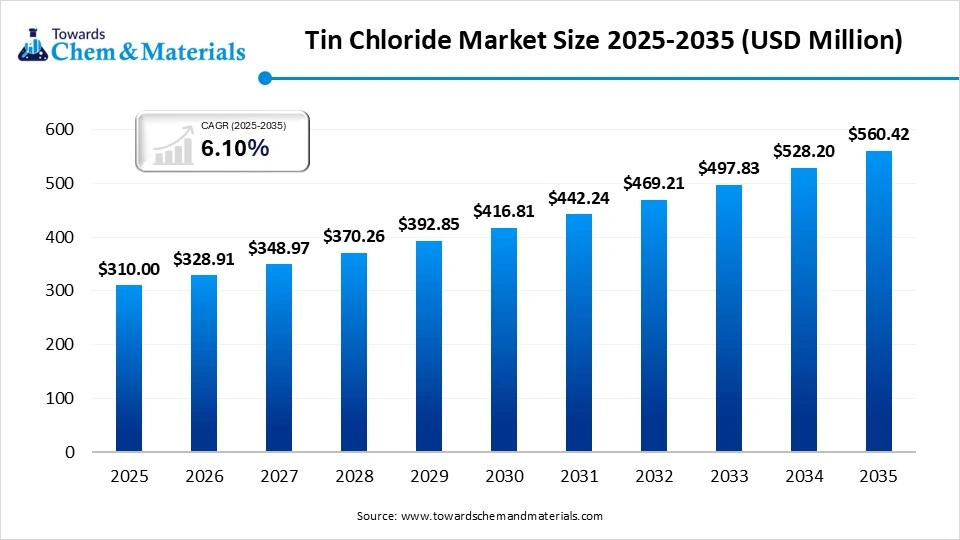
Note: 2025 is the base year; 2026–2035 values are forecasts.
Sources: Expert interviews, secondary sources, Towards Chemical and Materials database and Towards Chemical and Materials analysts
Stannous chloride accounted for the largest type share in 2025, at 64.60%, because it is widely used in plating baths, as a reducing agent and as a mordant. Asia Pacific accounted for 58.60% of revenue in 2025, supported by China's tin chemical production and large electronics, glass and PVC industries. Demand is driven by electronics plating, fluorine-doped tin oxide and low-E glass coatings for solar panels and buildings, organotin production, and higher tin prices.
The tin chloride market is projected to grow from USD 310.00 million in 2025 to USD 560.42 million by 2035 because tin chlorides are basic tin chemicals used in plating, glass coating and chemical synthesis, and electronics and solar glass demand is rising. Solar and energy-efficient glass coatings, electronics plating, organotin catalysts and stabilizers, reagent uses and higher tin prices support steady growth, lifting the market to USD 416.81 million by 2030 and sustaining a CAGR of 6.10% from 2026 to 2035.
Analyst View: We built the estimate from consumption volumes by type, application and grade in each region, multiplied by tin-linked prices, and cross-checked against producer output and published estimates, which places our base year slightly above the highest credible comparable figure. The growth rate reflects glass coating and electronics demand, which we judge supports a slightly higher rate than comparable estimates, moderated by tin price volatility.
Growing demand for electronics plating and semiconductor-related surface-finishing applications, increasing use of tin oxide coatings in solar and energy-efficient glass, continued demand for organotin intermediates in permitted industrial applications, and rising demand for high-purity tin chemicals support market growth. Higher tin prices can also increase the nominal value of the market.
Tin chloride market growth is restrained by volatile tin prices, concentrated raw material supply, environmental regulations on certain tin compounds, and competition from alternative plating chemistries. Corrosive handling requirements also increase storage, transportation, safety and compliance costs, creating operational challenges for manufacturers, and limiting market expansion.
Market opportunities arise from growing demand for high-purity electronic-grade tin salts, expanding solar glass coating applications, and increasing electronics manufacturing in emerging economies. Tin recovery from industrial waste can improve raw material availability, while the transition to lead-free soldering indirectly supports demand for tin-based chemicals across electronics manufacturing.
| Segments | 2025 Share | 2025 Value (USD Million) | 2035 Value (USD Million) | CAGR 2026–2035 |
| Stannous Chloride | 64.60% | 200.26 | 344.84 | 5.59% |
| Stannic Chloride | 35.40% | 109.74 | 215.58 | 6.99% |
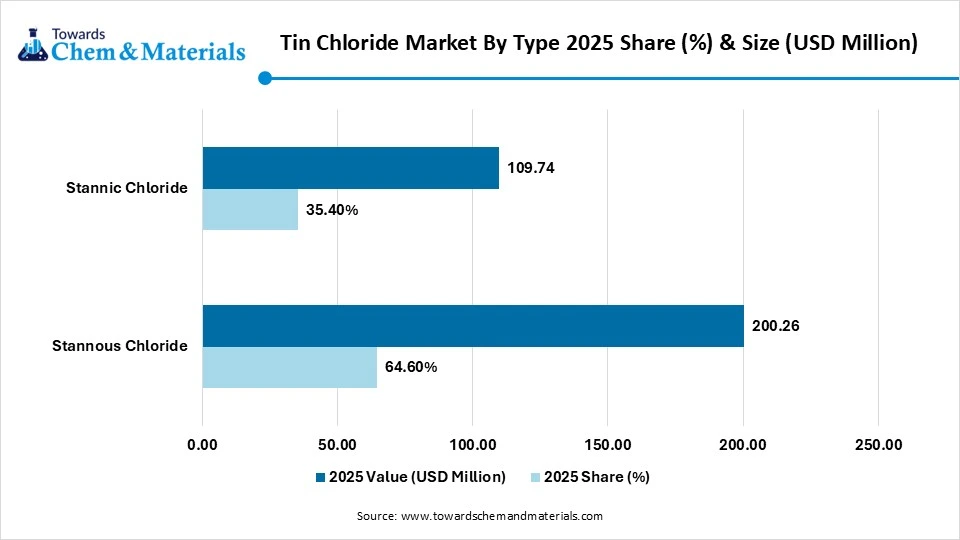
Note: 2025 is the base year; 2035 values are forecasts.
Sources: Expert interviews, secondary sources, Towards Chemical and Materials database and Towards Chemical and Materials analysts.
Stannous Chloride accounted for 64.60% (USD 200.26 million) in 2025, stannic chloride for 35.40% (USD 109.74 million).
Stannous Chloride: This segment accounted for 64.60% (USD 200.26 million) of the tin chloride market in 2025 and is projected to reach USD 344.84 million by 2035, expanding at a CAGR of 5.59% from 2026 to 2035. Stannous chloride is used in acid tin plating, as a reducing agent in chemical and pharmaceutical synthesis, as a mordant in dyeing. Also, Stannous chloride is used as a reducing agent in certain technetium-99m radiopharmaceutical preparation kits, supporting the preparation of radiolabeled diagnostic compounds.
Stannic Chloride: This segment accounted for 35.40% (USD 109.74 million) of the tin chloride market in 2025 and is projected to reach USD 215.58 million by 2035, expanding at a CAGR of 6.99% from 2026 to 2035. Stannic chloride is used to deposit tin oxide coatings on glass, to make organotin compounds and as a Lewis acid catalyst. Stannic chloride is expected to grow faster, supported by its use as a precursor in tin oxide coating processes, including applications in conductive and low-emissivity glass.
| Segments | 2025 Share | 2025 Value (USD Mn) | 2035 Value (USD Mn) | CAGR 2026-2035 |
| Electroplating | 32.40% | 100.44 | 170.34 | 5.43% |
| Glass Coating | 18.60% | 57.66 | 122.49 | 0.08 |
| Organotin & PVC Stabilizer Synthesis | 16.20% | 50.22 | 88.47 | 0.06 |
| Reducing Agents & Chemical Synthesis | 14.40% | 44.64 | 78.64 | 0.06 |
| Pharmaceuticals & Others | 9.60% | 29.76 | 52.42 | 5.83% |
| Dyes, Pigments & Textiles | 8.80% | 27.28 | 48.06 | 5.83% |
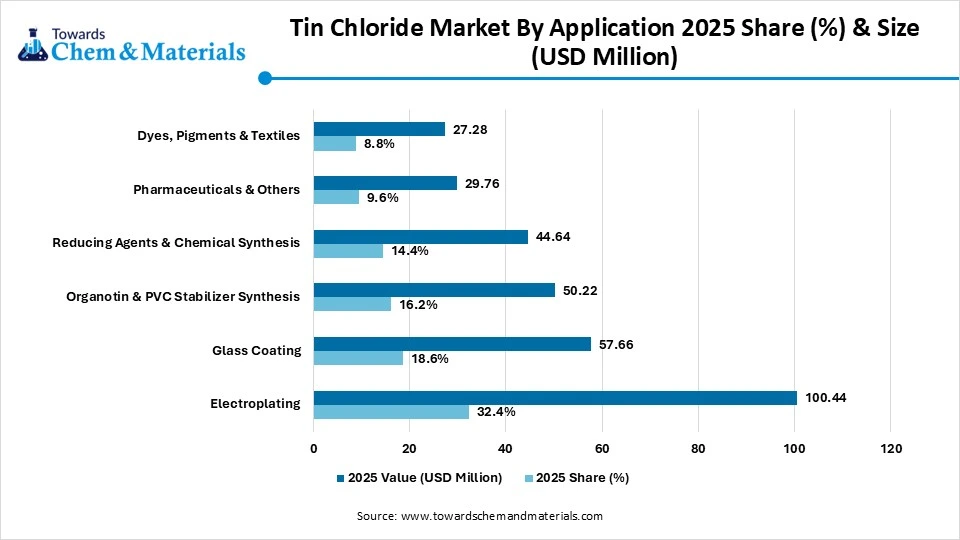
Note: 2025 is the base year; 2035 values are forecasts.
Sources: Expert interviews, secondary sources, Towards Chemical and Materials database and Towards Chemical and Materials analysts.
Electroplating accounted for 32.40% (USD 100.44 million) in 2025, glass coating for 18.60% (USD 57.66 million), organotin and PVC stabilizer synthesis for 16.20% (USD 50.22 million), reducing agents and chemical synthesis for 14.40% (USD 44.64 million), pharmaceuticals and others for 9.60% (USD 29.76 million) and dyes, pigments and textiles for 8.80% (USD 27.28 million).
Electroplating: This segment accounted for 32.40% (USD 100.44 million) of the tin chloride market in 2025 and is projected to reach USD 170.34 million by 2035, expanding at a CAGR of 5.43% from 2026 to 2035. Electroplating is the largest application, using tin chloride baths to deposit tin on electronics, steel, and other substrates.
Glass Coating: Holding an 18.60% share (USD 57.66 million) in 2025, glass coating is projected to reach USD 122.49 million by 2035, registering the fastest CAGR of 7.83%. Glass coating is the fastest-growing application, supported by the use of tin tetrachloride and other tin-based precursors in the production of tin oxide coatings. Fluorine-doped tin oxide coatings are used in selected low-emissivity architectural glass, solar-related applications, and transparent conductive surfaces.
| Segments | 2025 Share | 2025 Value (USD Million) | 2035 Value (USD Million) | CAGR 2026–2035 |
| Industrial Grade | 0.68 | 212.04 | 364.62 | 0.06 |
| Reagent & Electronic Grade | 0.32 | 97.96 | 195.80 | 0.07 |
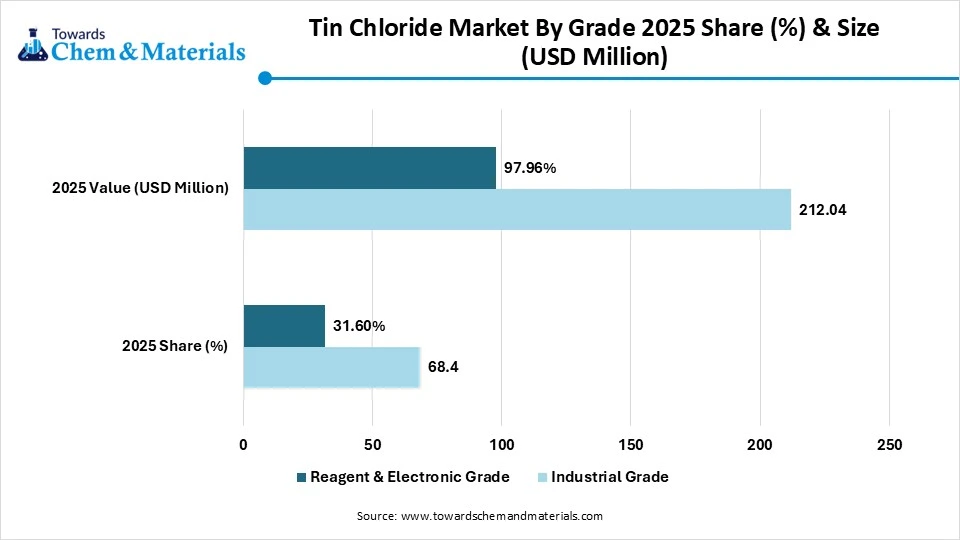
Note: 2025 is the base year; 2035 values are forecasts.
Sources: Expert interviews, secondary sources, Towards Chemical and Materials database and Towards Chemical and Materials analysts.
Industrial Grade accounted for 68.40% (USD 212.04 million) in 2025, reagent and electronic grade for 31.60% (USD 97.96 million).
Industrial Grade: This segment generated 68.40% (USD 212.04 million) of the tin chloride market share in 2025 and is projected to reach USD 364.62 million by 2035, expanding at a CAGR of 5.57% from 2026 to 2035. Industrial grades are used in plating, glass coating, organotin synthesis, and textiles.
Reagent & Electronic Grade: This segment accounted for 31.60% (USD 97.96 million) of the tin chloride market in 2025 and is projected to reach USD 195.80 million by 2035, expanding at a CAGR of 7.17% from 2026 to 2035. Reagent and electronic grades include high-purity tin chloride products used in analytical laboratories, specialized chemical synthesis, and selected electronic material applications. Their comparatively faster growth reflects demand for higher-purity materials and more specialized applications.
Analyst View: Segment values were allocated by matching consumption volumes and prices to type, application, grade, using producer's and end-use industry data. We expect the faster-growing segments identified above to gain share over the forecast period.
| Region | 2025 Share | 2025 Value (USD Million) | 2035 Value (USD Million) | CAGR 2026–2035 |
| Asia Pacific | 58.60% | 181.66 | 343.63 | 6.58% |
| Europe | 17.80% | 55.18 | 93.21 | 5.38% |
| North America | 16.40% | 50.84 | 85.88 | 0.05 |
| Latin America | 4.40% | 13.64 | 23.04 | 0.05 |
| Middle East & Africa | 2.80% | 8.68 | 14.66 | 0.05 |
Note: 2025 is the base year; 2035 values are forecasts.
Sources: Expert interviews, secondary sources, Towards Chemical and Materials database and Towards Chemical and Materials analysts.
Asia Pacific dominated the tin chloride market in 2025 with a 58.60% share (USD 181.66 million), followed by Europe at 17.80% (USD 55.18 million), North America at 16.40% (USD 50.84 million), Latin America for 4.40% (USD 13.64 million), and Middle East & Africa for 2.80% (USD 8.68 million). Asia Pacific leads and is also growing fastest.
Asia Pacific: Accounting for 58.60% (USD 181.66 million) of the global tin chloride market in 2025, Asia Pacific represents the largest regional market. Its value is expected to reach USD 343.63 million by 2035, registering the fastest CAGR of 6.58% from 2026 to 2035. China's strong position in tin mining, refining and chemical manufacturing, coupled with substantial electronics, glass-processing and PVC industries, underpins regional dominance. Japan, South Korea and India further contribute through their expanding electronics and specialty chemical sectors.
Europe: This region accounted for 17.80% (USD 55.18 million) of the tin chloride market in 2025 and is projected to reach USD 93.21 million by 2035, expanding at a CAGR of 5.38% from 2026 to 2035. Europe's tin chloride market is supported by established chemical manufacturers, including TIB Chemicals, and demand from specialty chemicals, glass coatings, and industrial applications. Regulatory requirements under REACH influence the production and use of certain organotin compounds.
North America: Valued at USD 50.84 million in 2025, North America represented 16.40% of the global market. The regional market is anticipated to reach USD 85.88 million by 2035, advancing at a CAGR of 5.38%. Consumption is driven by applications in tin electroplating, specialty chemicals, glass coating, and pharmaceutical manufacturing. Companies such as Gulbrandsen and Mason Corporation contribute to the regional supply chain through their tin chemical product portfolios.
Latin America: This region accounted for 4.40% (USD 13.64 million) of the tin chloride market in 2025 and is projected to reach USD 23.04 million by 2035, expanding at a CAGR of 5.38% from 2026 to 2035. Latin America is supported by the plating, glass, and PVC industries in Brazil and Mexico.
Middle East & Africa: With a market value of USD 8.68 million and a 2.80% share in 2025, the Middle East and Africa represent an emerging regional market. Revenue is expected to reach USD 14.66 million by 2035, reflecting a CAGR of 5.38%. Demand is associated with construction-related glass applications, industrial chemical consumption, and developing manufacturing activities. Infrastructure investment and growth in the Gulf countries are expected to create additional opportunities for tin chloride suppliers.
Analyst View: Regional shares were built from consumption by end-use industry in each region. Asia Pacific leads because it dominates production and downstream electronics and chemical manufacturing. We assign Asia Pacific the highest growth premium because downstream capacity is expanding fastest there.
| Rank | Company Name | Market-Specific Revenue (USD Million) | 2025 Share | Key Products / Business | Headquarters |
| 1 | Yunnan Tin Group | 46.00 | 14.84% | Stannous and stannic chloride | China |
| 2 | TIB Chemicals | 22.00 | 0.07 | Tin chlorides | Germany |
| 3 | Liuzhou China Tin Group | 20.00 | 0.06 | Tin chemicals | China |
| 4 | Showa Kako | 14.00 | 0.05 | Tin chlorides | Japan |
| 5 | Gulbrandsen | 12.00 | 0.04 | Tin tetrachloride | United States |
| 6 | Mason Corporation | 10.00 | 3.23% | Tin chemicals | United States |
| 7 | Nihon Kagaku Sangyo | 10.00 | 3.23% | Tin plating chemicals | Japan |
| 8 | Shreenivas Chemicals | 6.00 | 1.94% | Stannous chloride | India |
| 9 | American Elements | 5.00 | 1.61% | High-purity tin compounds | United States |
| 10 | Thermo Fisher Scientific | 5.00 | 1.61% | Alfa Aesar tin chlorides | United States |
Note: Company revenues and shares are 2025 estimates.
Sources: Company press releases, expert interviews, secondary sources, Towards Chemical and Materials database and Towards Chemical and Materials analysts.
Yunnan Tin Group led the tin chloride market with an estimated 14.84% (USD 46.00 million) of 2025 revenue, followed by TIB Chemicals at 7.10% (USD 22.00 million) and Liuzhou China Tin Group at 6.45% (USD 20.00 million). Yunnan Tin Group leads with integrated tin chloride production in China, followed by Europe's TIB Chemicals and Liuzhou China Tin Group. Showa Kako, Gulbrandsen, Mason Corporation, Nihon Kagaku Sangyo, Shreenivas Chemicals, American Elements and Thermo Fisher compete through Japanese, U.S. and Indian production, high-purity grades and laboratory supply. The top 10 companies accounted for an estimated 48.39% (USD 150.00 million) of 2025 revenue, while the remaining 51.61% (USD 160.00 million) was shared among regional tin chemical producers and distributors. The tin chloride market is fragmented, and competition focuses on purity, consistency, raw material security, price, technical service, regulatory compliance and delivery reliability. Integrated producers with access to raw materials have cost advantages.
The tin chloride ecosystem links mining and refining with chemical producers, distributors and laboratory suppliers, and downstream industrial users.
| Ecosystem Stage | Role in the Market | Key Companies |
| Tin Mining & Smelting | Supply refined tin | Yunnan Tin, Guangxi China Tin, PT Timah, Alphamin |
| Producers | Make tin salts | Yunnan Tin, TIB Chemicals, Mason Corporation, Showa Kako, Nihon Kagaku Sangyo |
| Distributors | Supply industry and laboratories | Regional distributors, laboratory suppliers |
| End Users | Use tin salts | Platers, glass coaters, PVC stabilizer makers, anodizers |
Sources: Company press releases, expert interviews, secondary sources, Towards Chemical and Materials database and Towards Chemical and Materials analysts.
The Towards Chemical and Materials Companies Quadrant positions key participants in the tin chloride market by market strength, reflecting revenue scale, market share and geographic reach, and by innovation and growth strategy, reflecting product portfolio breadth, R&D intensity and partnerships. Positions reflect each company's estimated 2025 revenue in this market and our assessment of its integration, product quality, and reach.
Sources: Company press releases, expert interviews, secondary sources, Towards Chemical and Materials database and Towards Chemical and Materials analysts.
Leaders: Yunnan Tin Group, TIB Chemicals, Liuzhou China Tin Group and Showa Kako combine large revenue with raw material integration and broad customer reach.
Challengers: Gulbrandsen has significant volumes but narrower portfolios or less product development.
Innovators: Mason, Nihon Kagaku Sangyo and American Elements bring high-purity grades and specialty applications.
Niche Players: Shreenivas Chemicals and Thermo Fisher Scientific serve smaller regional or laboratory segments.
By Type
By Application
By Grade
By Region
The global tin chloride market was defined to include stannous chloride (SnCl₂) and stannic chloride (SnCl₄) across industrial, reagent, and electronic grades, covering electroplating, glass coating, organotin synthesis, chemical reduction, textile processing, pharmaceutical applications, and other end uses.
The 2025 base-year market size was estimated using a bottom-up approach based on consumption volumes and average selling prices across product types, applications, grades and geographic regions. These estimates were cross-checked against available producer capacity, production output, industry trade data and supplier information.
Regional and segment-level estimates were allocated according to estimated consumption patterns, product mix and prevailing regional pricing. Company-specific market shares were estimated using available product portfolios, estimated tin chloride sales contributions, industry interviews and secondary research.
The 2026–2035 forecast incorporates expected changes in end-use demand, industrial production, electronics manufacturing, glass-coating applications, product-grade requirements and tin raw material prices. Forecast assumptions were reviewed against historical market developments and industry trends.
All market estimates were reconciled to the same 2025 base year. Forecast values were calculated using the respective segment and regional growth assumptions and cross-checked against the projected global market total. Company-specific revenue and market-share figures represent analyst estimates rather than audited standalone financial disclosures.
The tin chloride market is a mature tin chemical segment whose growth is increasingly linked to solar and energy-efficient glass and electronics. Our estimate links demand to consumption and tin-linked prices, so the forecast follows plating, glass coating, and chemical activity. The main upside comes from glass coatings, while the main risk is tin price volatility.
Reliable market intelligence and data-driven insights across the global chemicals and materials industry, helping businesses understand trends, competition, pricing, and emerging opportunities.
Schedule a Demo