Find the Right Market Report
Search thousands of industry reports, market insights, and research studies in one place.
Not sure where to start? Try one of these:
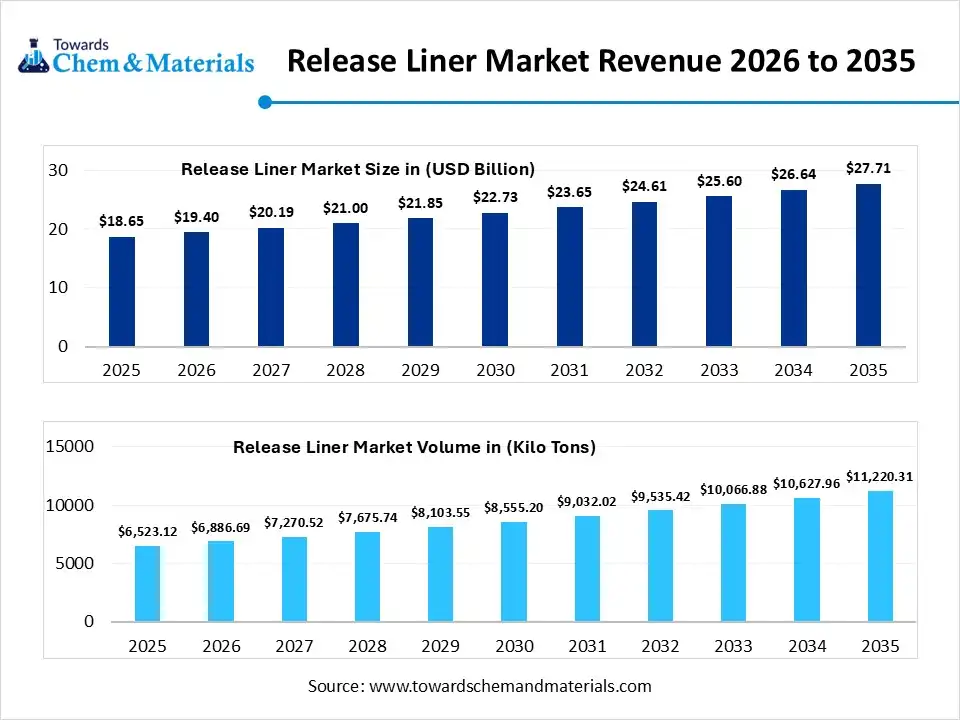
The global release liner market size was estimated at USD 18.65 billion in 2025 and is expected to increase from USD 19.40 billion in 2026 to USD 27.71 billion by 2035, growing at a CAGR of 4.04% from 2026 to 2035. In terms of volume, the market is projected to grow from 6523.12 kilo tons in 2025 to 11220.31 kilo tons by 2035. growing at a CAGR of 5.57% from 2026 to 2035. Asia Pacific dominated the release liner market with the largest volume share of 42.01% in 2025. The increased trend towards the updation of infrastructure has driven market growth in recent years.
The protective layer, which is known as the backing layer used to cover the sticky side of the pressure-sensitive products, such as adhesive film, tapes, and labels, called the release liner. Moreover, by restricting the adhesive from sticking to unwanted surfaces before use, the release liner emerges as the ideal option in major industries nowadays.
The integration of engineered surface chemistry paired with digital process control is expected to contribute to favorable market economies for the industry in the coming years. Moreover, modern release liners are formulated with precisely tuned release coatings that deliver uniform and predictable detachment forces, ensuring consistent adhesive performance across diverse substrates and application environments.
| Country / Region | Regulatory Body | Regulatory Body Key Regulations |
Focus Areas |
| United States | Food & Drug Administration (FDA) | TSCA Section 8(a)(7); 21 CFR Parts 175–178 | Mandatory data submission for any PFAS manufactured or imported since 2011 begins April 13, 2026 |
| European Union | European Commission | Packaging and Packaging Waste Regulation (PPWR) (Regulation (EU) 2025/40) | Microplastics Reporting: First annual reports for synthetic polymer microparticles (SPMs) used at industrial sites are due May 31, 2026 |
| China | State Administration for Market Regulation (SAMR) | GB 9685-2016 (Standard for Uses of Additives in Food Contact Materials) | Sustainability & VOCs: Heavy focus on reducing Volatile Organic Compounds (VOCs) in coating processes |
How did the Paper Segment Dominate the Release Liner Market in 2025?
The paper segment volume was valued at 3632.07 kilo tons in 2025 and is projected to reach 5808.75 kilo tons by 2035, expanding at a CAGR of 5.36% during the forecast period from 2025 to 2035. The paper segment dominated the market with approximately 55.68% share in 2025, due to factors such as cost-effectiveness, vast availability, and easy processing. Moreover, by providing good stiffness and making handling and die cutting more efficient at high speed, the manufacturers are heavily preferring paper liners for the tapes and labels in recent years.
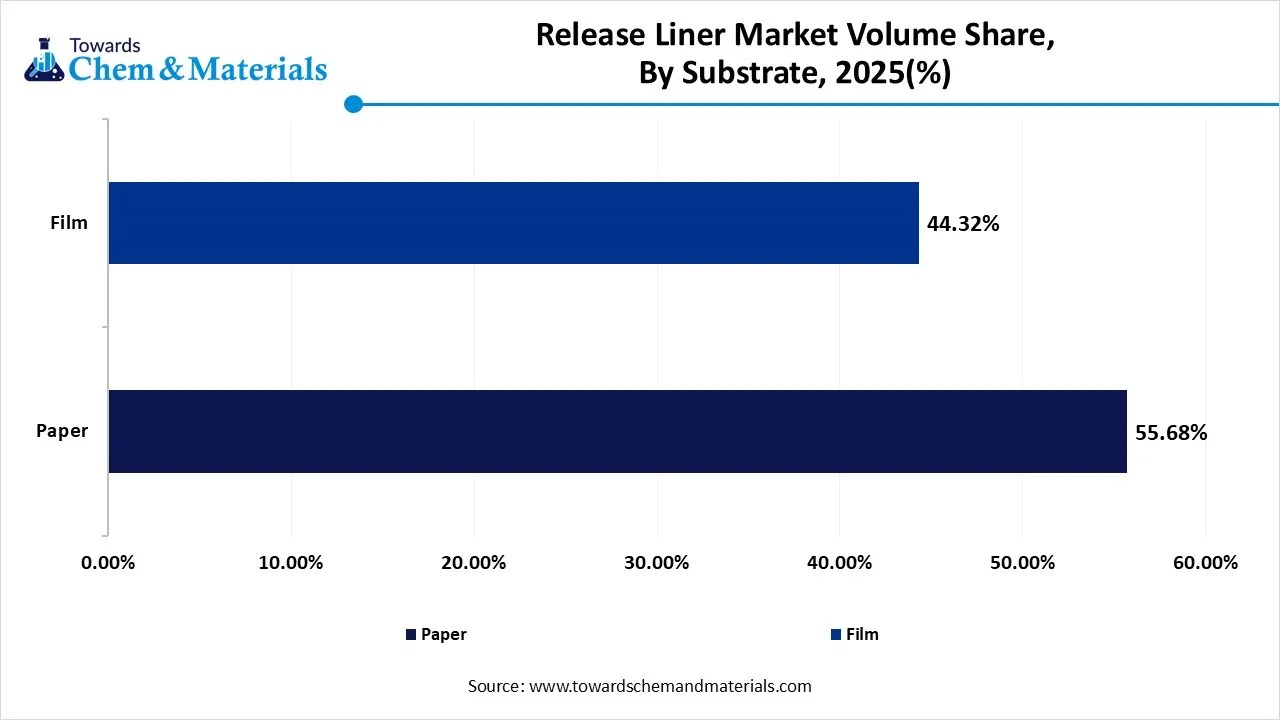
The film segment segment volume was valued at 2891.05 kilo tons in 2025 and is projected to reach 5411.56 kilo tons by 2035, expanding at a CAGR of 7.21% during the forecast period from 2025 to 2035. The film segment is expected to grow with a rapid CAGR, owing to the increasing demand for precision, thinner material, and consistency from the industries. Moreover, by offering greater dimensional stability, uniform thickness, and lower breakage at high production speeds, the film segment is expected to increase return on investment for manufacturers during the forecast period, as per future industry expectations.
Release Liner Market Volume and Share, By Substrate, 2025-2035
| By Substrate | Market Volume Share (%), 2025 | Market Volume (Kilo Tons)2025 | Market Volume (Kilo Tons)2035 | CAGR(%) 2026-2035 | Market Volume Share (%), 2035 |
| Paper | 55.68% | 3632.07 | 5808.75 | 5.36% | 51.77% |
| Film | 44.32% | 2891.05 | 5411.56 | 7.21% | 48.23% |
How did the Silicon Coated Segment Dominate the Release Liner Market in 2025?
The silicon coated segment dominated the market with approximately 63% share in 2025, due to its unmatched versatility and long-term performance reliability. Also, silicone coatings function effectively with acrylic, rubber, and silicone adhesives, allowing broad application coverage. Their durability under heat and humidity made them suitable for global distribution and storage. The coating process matured early, resulting in predictable quality and lower technical risk for manufacturers.
The non-silicon-coated segment is expected to grow, akin to evolving regulatory and brand requirements. These coatings eliminate silicone contamination, simplifying downstream recycling processes. Manufacturers benefit from reduced compliance complexity and improved environmental labeling opportunities.
How did the Solventless Segment Dominate the Release Liner Market in 2025?
The solventless segment dominated the market with approximately 51% industry share in 2025, due to its simplicity and production reliability. By removing solvents, manufacturers reduce process variability and eliminate drying stages. This shortens production cycles and increases output efficiency. Solventless coatings also improve workplace safety by minimizing exposure to hazardous vapors.
The radiation-cured segment is expected to grow, owing to increased industry demand for accuracy and scalability. This process enables real-time curing and precise surface engineering, critical for electronics and medical applications. Radiation curing eliminates solvents, improving environmental compliance. It also supports compact production layouts and reduced downtime.
How did the Labels Segment Dominate the Release Liner Market in 2025?
The labels segment dominated the market with approximately 43% share in 2025, due to its universal presence across industries. Every packaged product requires labeling for branding, compliance, and traceability. Release liners enable efficient label processing at high speeds, making them essential to modern packaging lines. The growth of private labels and logistics tracking builds up liner demand in the current period.
The medical and healthcare segment is expected to grow, owing to innovation in patient-centric products. Wearable sensors, transdermal patches, and advanced wound care solutions require high- precision liners. These applications demand clean release, minimal residue, and compatibility with sensitive adhesives. Regulatory standards further favor high-quality liner materials.
The Asia Pacific release liner market size was valued at USD 7.83 billion in 2025 and is expected to be worth around USD 11.62 billion by 2035, exhibiting at a compound annual growth rate (CAGR) of 4.03% over the forecast period from 2026 to 2035.
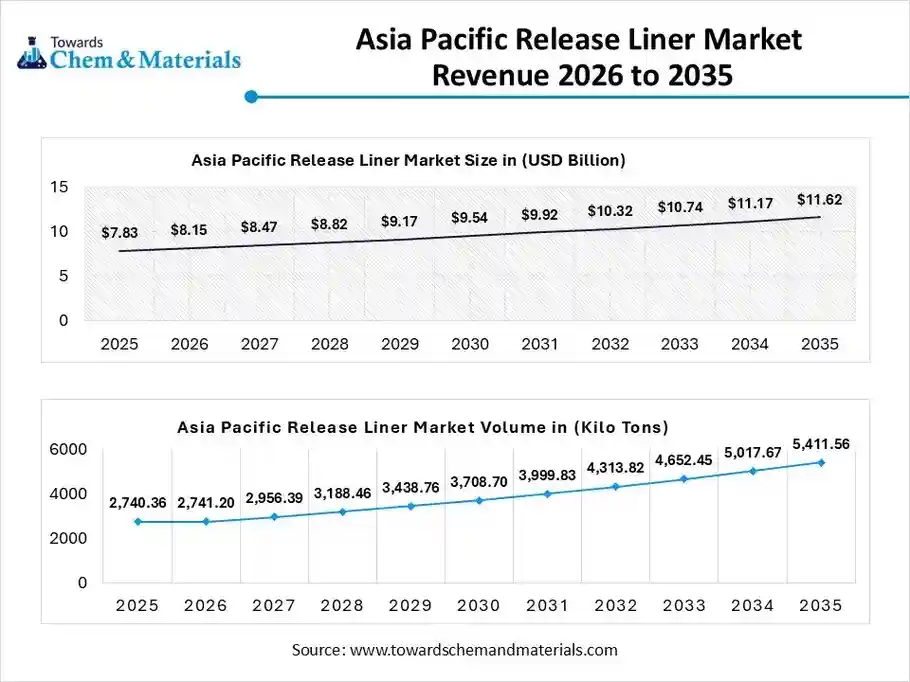
The Asia Pacific release liner volume was estimated at 2740.36 kilo tons in 2025 and is projected to reach 5411.56 kilo tons by 2035, growing at a CAGR of 7.85% from 2026 to 2035. Asia Pacific dominated the release liner market with approximately 42.01% share in 2025, due to the region being considered as one of the world's largest manufacturing bases for packaging, labels, and adhesives in the current period. Moreover, the sudden expansion of automotive and e-commerce businesses has resulted in high yield outcomes for the market players in recent years, as per the observation. Furthermore, the manufacturers have seen under the heavy adoption of both film and paper substrates to meet versatile market need.
China Lead High Volume Liner Production
China maintained its dominance in the market, owing to the country has greater producer of tapes, labels, and materials in the current period. Also, with the heavier adoption of the advanced technology while creating high volume industrial demand, the manufacturer of release liner in China has gained global attention in the past few years.
North America is expected to capture a major share of the release liner market with a rapid CAGR, owing to advanced industrial infrastructure, early adoption of automation, and sustainability-focused production. Industries like medical, automotive, electronics, and packaging require high-performance liners with precise release properties. Moreover, manufacturers in the region invest in recyclable materials and film-based liners, reducing waste and improving environmental compliance.
Precision Liners Power United States Industries
The United States is expected to emerge as a prominent country for the release liner market in the coming years due to its technology-intensive industries, including medical devices, batteries, and electronics. Also, manufacturers in the United States demand precision liners for wearable patches, flexible electronics, and high-performance adhesives. Investment in recycling infrastructure encourages sustainable liner solutions. Regulatory standards on safety and quality further increase the adoption of advanced materials.
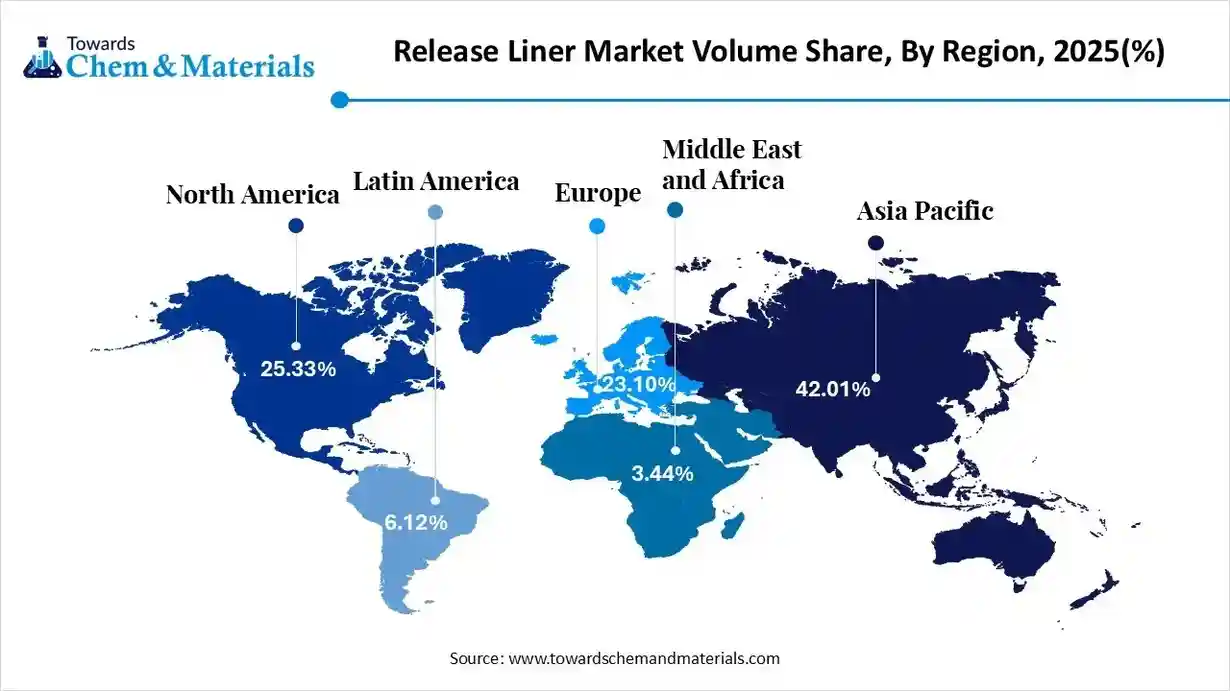
Europe is notably growing in industry, owing to sustainability-driven industrial practices and high-end packaging demands. Also, the cosmetic, food, and luxury goods sectors require advanced liners that support precision cutting, clean release, and recyclability. European manufacturers invest in film substrates, specialty coatings, and environmentally friendly processes.
Germany Drives Advanced Liner Demand
Germany is expected to gain a major industry share due to its advanced automotive, industrial, and packaging sectors. High-performance adhesives and precision applications in tapes, labels, and specialty products create strong demand for reliable liners. German manufacturers prioritize technical excellence, driving the adoption of film-based and radiation-cured liners.
Release Liner Market Volume and Share, By Region, 2025-2035
| By Region | Market Volume Share (%), 2025 | Market Volume (Kilo Tons)2025 | Market Volume (Kilo Tons)2035 | CAGR(%) 2026-2035 | Market Volume Share (%), 2035 |
| North America | 25.33% | 1652.31 | 2910.55 | 6.49% | 25.94% |
| Europe | 23.10% | 1506.84 | 2045.46 | 3.45% | 18.23% |
| Asia Pacific | 42.01% | 2740.36 | 5411.56 | 7.85% | 48.23% |
| South America | 6.12% | 399.21 | 504.91 | 2.64% | 4.50% |
| Middle East & Africa | 3.44% | 224.40 | 347.83 | 4.99% | 3.10% |
By Substrate
By Material Type
By Technology
By Application
By Region
Reliable market intelligence and data-driven insights across the global chemicals and materials industry, helping businesses understand trends, competition, pricing, and emerging opportunities.
Schedule a Demo