Find the Right Market Report
Search thousands of industry reports, market insights, and research studies in one place.
Not sure where to start? Try one of these:
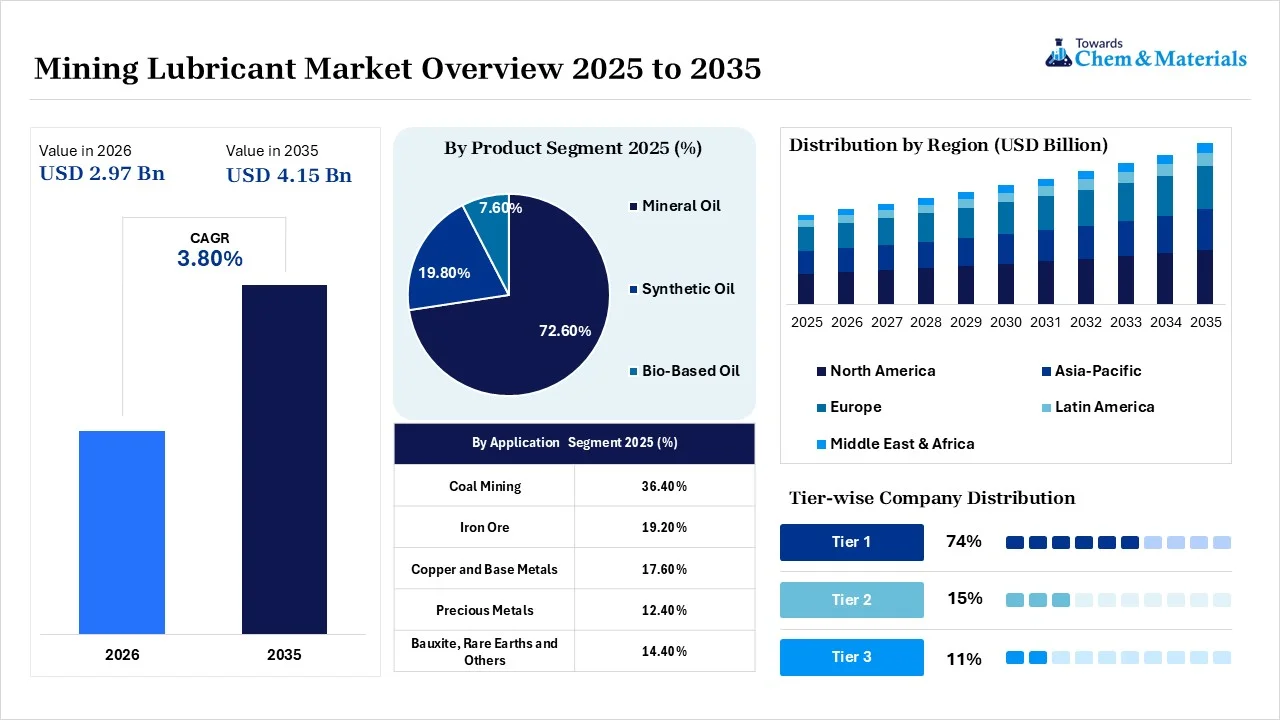
The global mining lubricant market size is valued at USD 2.97 billion in 2026 and is projected to reach USD 4.15 billion by 2035, expanding at a CAGR of 3.80% from 2026 to 2035.
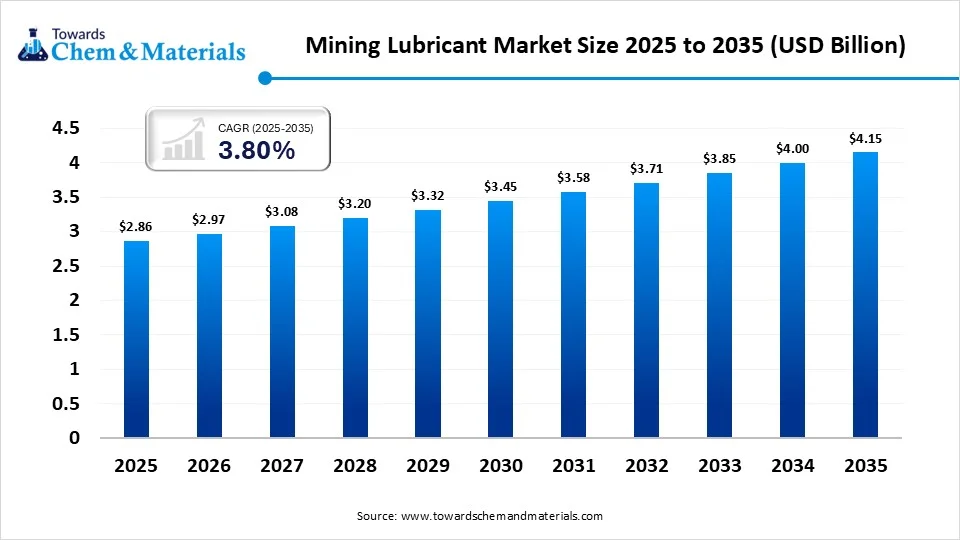 Note: 2025 is the base year
Sources: Expert interviews, secondary sources, the Towards Chem and Materials database, and Towards Chem and Materials analysts.
The market comprises heavy-duty diesel engine oils, hydraulic fluids, transmission and drivetrain oils, gear oils, open gear and specialty greases, compressor oils, and related lubrication services used in surface and underground mining equipment such as haul trucks, excavators and shovels, loaders, drills, crushers, mills, and conveyors across coal, iron ore, copper, gold, bauxite, and other mineral operations. The mineral oil lubricants segment led the product segment, as it held a 72.6% market share in 2025 because it meets equipment maker specifications for a major proportion of engine, hydraulic, and gear applications at the lowest cost per liter. Asia Pacific accounted for 41.40% of market revenue in 2025, supported by a massive coal mining ecosystem in China, India, and Indonesia and iron ore and other mining in Australia. The demand for mining lubricants is being fueled by mineral production and mine expansion, larger and more intensively used equipment, the push to extend oil drain intervals and reduce downtime, the growth of copper and battery metal mining, and environmental requirements for used oil and biodegradable lubricants. Suppliers are forming distribution and service collaborations around new mining projects and adding digital oil condition monitoring and predictive maintenance services.
Analyst View: We built the estimate from mining equipment fleets by type and region, lubricant consumption per machine and operating hour, and mean lubricant prices by product, plus processing plant and service revenue. Consumption reflects coal and metal mine output, equipment utilization, and drain intervals. The total was cross-checked against the mining-sector lubricant revenue of prominent suppliers and against published estimates, which places our base year slightly above the comparable figures. The growth rate highlights metal mining growth and premium products. The market growth is being negatively influenced by declining coal output in some regions and longer drain intervals.
Driver: Mineral production and mine expansion need large equipment fleets. Haul trucks, shovels, and loaders are continuously exposed to severe conditions, consuming large volumes of lubricant. Mines seek to minimize downtime and maintenance costs through better lubricants. Electrification is fueling demand for copper, lithium, and other battery metals. Digital monitoring creates demand for high-end lubricants and services.
Restraint: Energy transition advancement is expected to result in a decline in coal mining in some regions. Longer drain intervals cause reduction in lubricant volumes. Electric and battery-powered mining equipment reduces the demand for engine oil. Commodity price cycles affect mining activity. Remote locations raise logistics costs.
Opportunity: Copper, lithium, and nickel mining expansion can potentially add new demand. Lubricants for electric and autonomous mining equipment can create new product categories. Bio-based lubricants are expected to be increasingly preferred under new environmental rules. Integrated lubrication services can increase supplier revenue. New mining projects in Africa, South America, and Central Asia have the capability to drive market growth.
Note: 2025 is the base year.
Sources: Expert interviews, secondary sources, the Towards Chem and Materials database, and Towards Chem and Materials analysts.
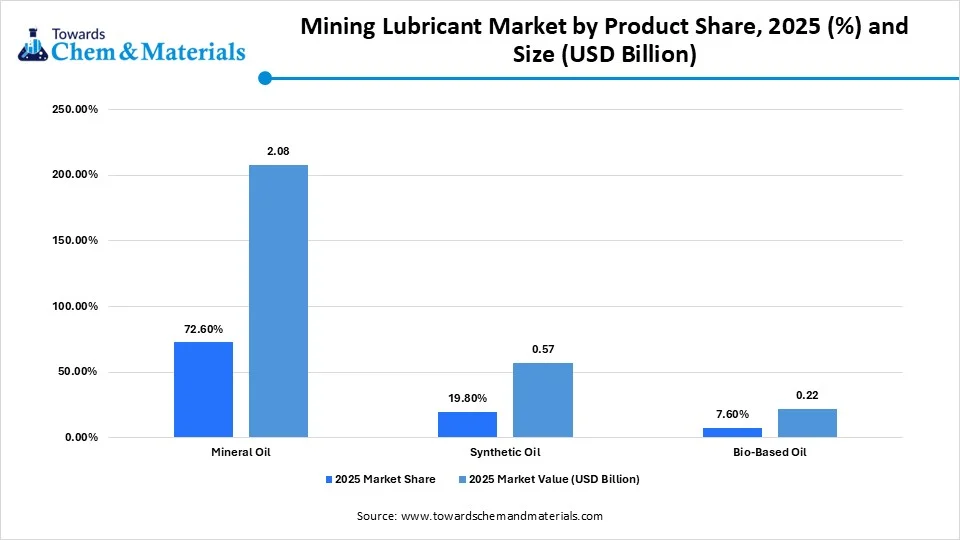
The mineral oil lubricants segment accounted for a market share of 72.60% (USD 2.08 billion) in 2025 because most mining equipment makers specify mineral-based heavy-duty engine oils, hydraulic fluids, and gear oils, and large volumes make cost per liter important. Synthetic oil held 19.80% (USD 0.57 billion) of revenue and is typically used where extended drain intervals, extreme temperatures, or high loads justify higher prices, such as in final drives and compressors. The bio-based oil segment accounted for 7.60% (USD 0.22 billion) and is the fastest-growing product and finds application where spills could affect water and soil.
 Note: 2025 is the base year.
Sources: Expert interviews, secondary sources, the Towards Chem and Materials database, and Towards Chem and Materials analysts
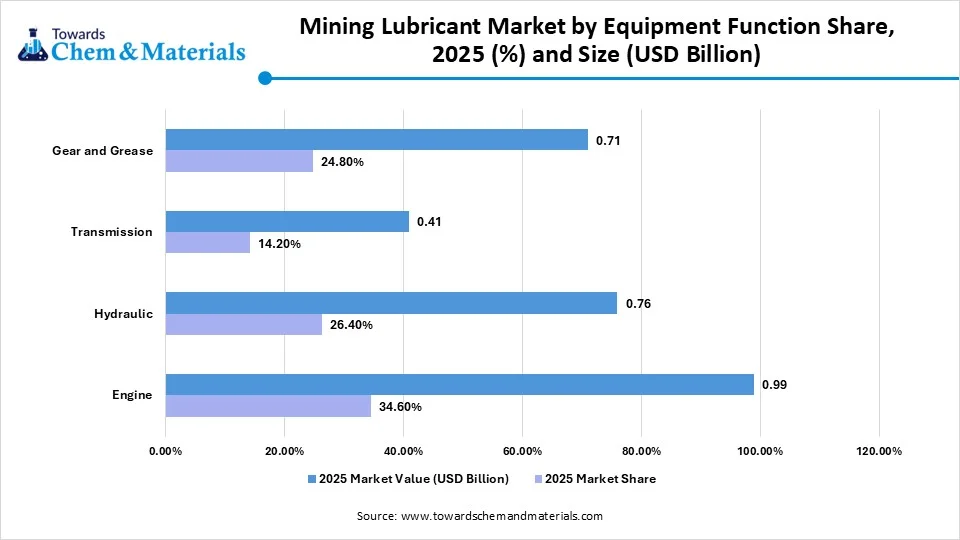
Engine lubricants accounted for 34.60% (USD 0.99 billion) of revenue in 2025 due to the fact that large haul truck and loader diesel engines consume heavy-duty engine oil continuously and require frequent changes. The hydraulic fluids segment, at 26.40% (USD 0.76 billion) share, serves excavators, shovels, and loaders. Transmission oils held a market share of 14.20% (USD 0.41 billion), and gear oils and greases account for 24.80% (USD 0.71 billion), including open gear lubricants for mills and shovels.
 Note: 2025 is the base year.
Sources: Expert interviews, secondary sources, the Towards Chem and Materials database, and Towards Chem and Materials analysts.
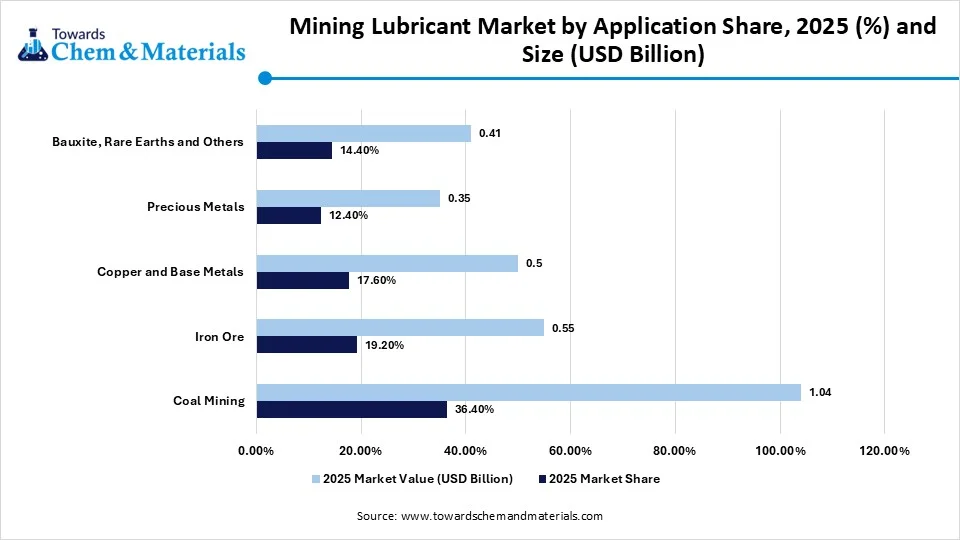
Coal mining accounted for 36.40% (USD 1.04 billion) share in 2025 because China, India, and Indonesia operate very large coal mining fleets. Iron ore held 19.20% (USD 0.55 billion) of net revenue. The copper and base metals segment accounted for 17.60% (USD 0.50 billion), precious metals for 12.40% (USD 0.35 billion), and bauxite, rare earths, and others for 14.40% (USD 0.41 billion). Copper and base metals are the fastest-growing applications as electrification boosts demand for copper and battery metals.
 Note: 2025 is the base year.
Sources: Expert interviews, secondary sources, the Towards Chem and Materials database, and Towards Chem and Materials analysts.
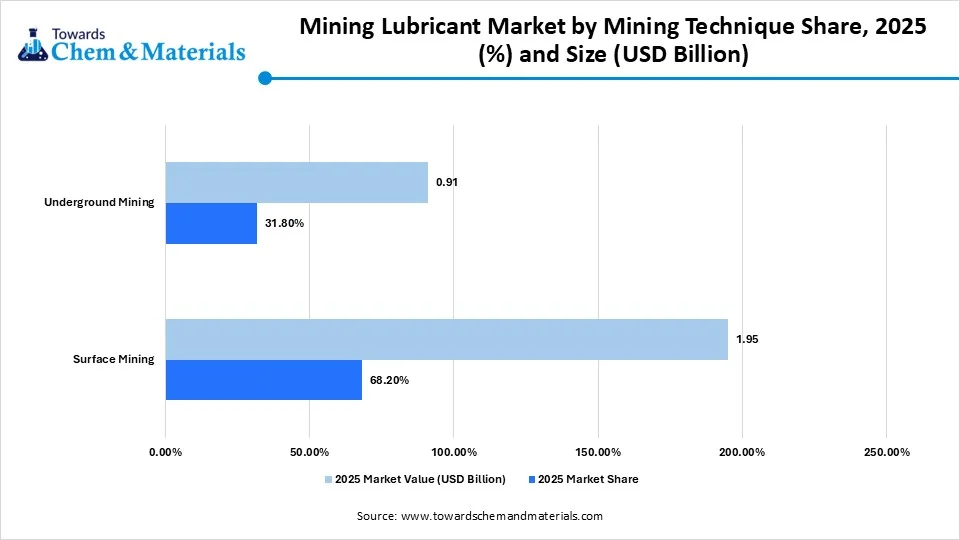
Surface mining accounted for 68.20% (USD 1.95 billion) of revenue in 2025 owing to the fact that open-pit operations use the largest trucks, shovels, and excavators. The underground mining segment held a market share of 31.80% (USD 0.91 billion) and uses smaller equipment but needs fire-resistant and low-emission lubricants and is experiencing growth as mines go deeper.
Analyst View: Segment values were allocated by matching equipment fleets, consumption and prices to products, functions, minerals, and mining techniques, using supplier revenue mixes. The domination of mineral oils can be attributed to cost, and coal leads because of fleet size in Asia. We expect synthetic and bio-based products and copper and battery metal mining to gain share.
 Note: 2025 is the base year.
Sources: Expert interviews, secondary sources, the Towards Chem and Materials database, and Towards Chem and Materials analysts.
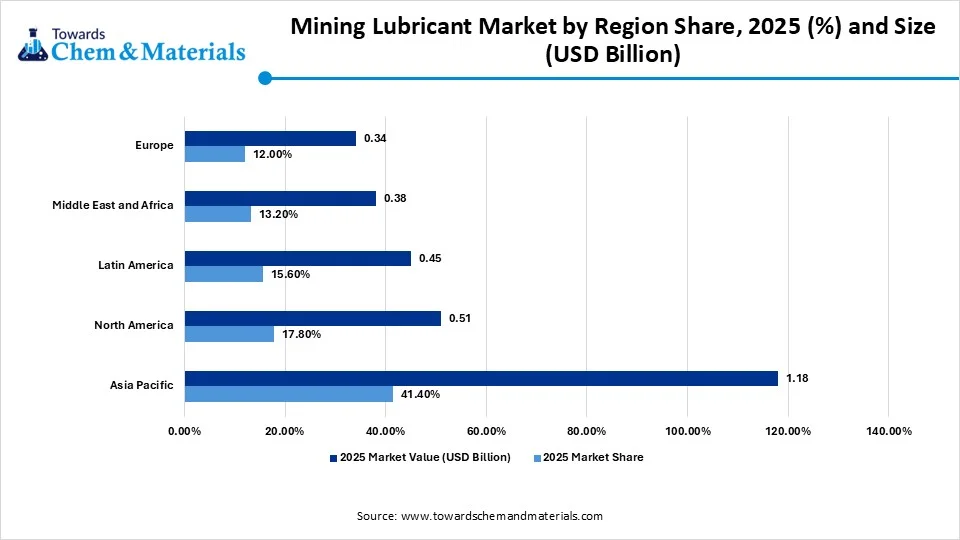
Asia Pacific accounted for 41.40% (USD 1.18 billion) of revenue in 2025, owing to coal mining in China, India, and Indonesia and iron ore, coal, gold, and lithium mining in Australia. Latin America held a market share of 15.60% (USD 0.45 billion) and is growing at the fastest rate because of copper and lithium mining activities in Chile, Peru, and Argentina and iron ore in Brazil. North America held 17.80% (USD 0.51 billion) share, with regional growth drivers being coal, metals, and oil sands mining in the United States and Canada. The Middle East and Africa, at 13.20% (USD 0.38 billion), is supported by mining in South Africa, the Democratic Republic of Congo, Ghana, and new projects such as Reko Diq in Pakistan, and Europe, at 12.00% (USD 0.34 billion), by mining in Russia, Scandinavia, and Poland.
Analyst View: Regional shares were built from mining equipment fleets, output and lubricant prices in each region. Asia Pacific leads because of coal fleet size. We assign Latin America the highest growth premium because copper and lithium mining are expanding fastest there.
| Rank | Company Name | Market-Specific Revenue (USD Billion) | 2025 Share | Key Products / Business | Headquarters |
| 1 | Shell | 0.34 | 11.89% | Rimula, Tellus and Gadus mining lubricants | United Kingdom |
| 2 | ExxonMobil | 0.3 | 10.49% | Mobil Delvac and Mobil SHC mining lubricants | United States |
| 3 | BP Castrol | 0.24 | 8.39% | Castrol mining lubricants | United Kingdom |
| 4 | Chevron | 0.2 | 6.99% | Delo and Rando lubricants | United States |
| 5 | FUCHS | 0.18 | 6.29% | Mining lubricants and open gear greases | Germany |
| 6 | TotalEnergies | 0.16 | 5.59% | Rubia and Ceran mining lubricants | France |
| 7 | Sinopec Lubricant | 0.14 | 4.90% | Great Wall heavy-duty lubricants | China |
| 8 | PetroChina Lubricant | 0.1 | 3.50% | Kunlun heavy-duty lubricants | China |
| 9 | Klüber Lubrication | 0.06 | 2.10% | Specialty gear lubricants | Germany |
| 10 | Quaker Houghton | 0.05 | 1.75% | Fire-resistant hydraulic fluids for mining | United States |
Note: Company revenues and shares are 2025 estimates.
Sources: Company press releases, expert interviews, secondary sources, Towards Chem and Materials database and Towards Chem and Materials analysts.
Shell led the mining lubricant market with an estimated 11.89% (USD 0.34 billion) of 2025 revenue, followed by ExxonMobil at 10.49% (USD 0.30 billion) and Castrol at 8.39% (USD 0.24 billion). Shell leads with Rimula engine oils, Tellus hydraulic fluids and Gadus greases supplied through mining distributors such as Enex in Chile, combined with digital oil monitoring and on-site lubrication services.
ExxonMobil competes with Mobil Delvac and synthetic Mobil SHC lubricants and partners with distributors on new mining projects, including a 2025 partnership in Pakistan for the Reko Diq mining zone, while Castrol supplies mining lubricants and condition monitoring services worldwide. Chevron, FUCHS, TotalEnergies, Sinopec, PetroChina, Klüber and Quaker Houghton compete in engine oils, hydraulics, open gear greases and fire-resistant fluids for underground mines.
The top 10 companies accounted for an estimated 61.89% (USD 1.77 billion) of 2025 revenue, while the remaining 38.11% (USD 1.09 billion) was shared among regional lubricant blenders, mining distributors and specialty grease makers. The mining lubricant market is moderately concentrated among global oil companies and specialists, and competition centres on equipment maker approvals, drain interval extension, on-site lubrication services, oil analysis, supply reliability in remote locations and price. Long-term supply contracts with mining companies and partnerships with local distributors are key to winning business.
By Product
By Equipment Function
By Application
By Mining Technique
By Region
The market is defined as engine oils, hydraulic fluids, transmission and gear oils, greases and lubrication services for surface and underground mining, across the globe. The 2025 base year was built bottom-up from mining equipment fleets by type and region, lubricant consumption per machine and average prices, and checked top-down against the mining-sector lubricant revenue of prominent suppliers. Segment, regional and company values were allocated from products, equipment functions, minerals, mining techniques and regional demand. Key estimates were verified by cross-checking company disclosures, regulatory and industry data and published third-party estimates, and inputs that could not be reconciled were excluded. All segment, regional and company figures were reconciled to the same 2025 base year, and the 2026–2035 forecast, which applies a constant CAGR from the 2026 base, was recalculated and validated.
The market is a steady market tied to mining output and equipment fleets, with growth moving from coal toward copper and battery metals. Our estimate links demand to fleets, consumption and prices, so the forecast follows commodity production, equipment trends and drain interval practices. The market benefits from metal mining growth and services, while the main risks are coal decline and equipment electrification.
Reliable market intelligence and data-driven insights across the global chemicals and materials industry, helping businesses understand trends, competition, pricing, and emerging opportunities.
Schedule a Demo