
What is the Metal Carboxylates Market Size and Share?
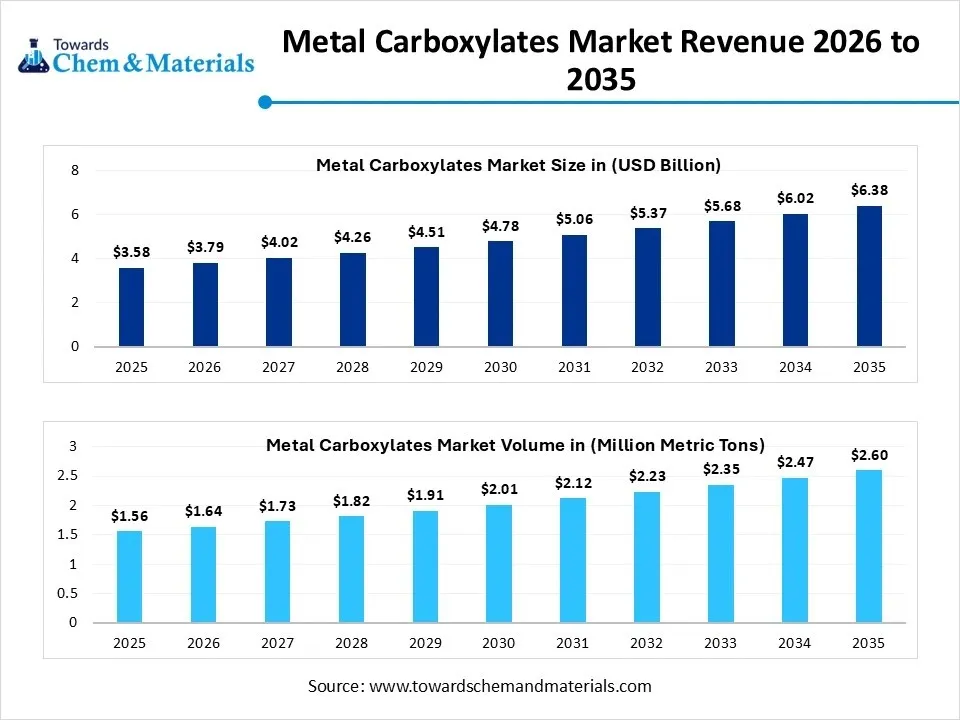
The metal carboxylates market size was valued at USD 3.58 billion in 2025, is estimated to reach USD 3.79 billion in 2026, and is projected to reach USD 6.38 billion by 2035, exhibiting a compound annual growth rate (CAGR) of 5.95%over the forecast period from 2026 to 2035.Asia Pacific dominated the metal carboxylates market with the largest revenue share of 43% in 2025 and is expected to grow at the fastest CAGR of 6.08% during the forecast period. The market is growing due to its use in paints and coatings, industrial lubricants, polymer processing, and PVC stabilization. Further driving the uptake across automotive, construction, chemical, and manufacturing applications is the rapid industrialization, expansion of infrastructure, and shift to environmentally-friendly manganese-based formulations.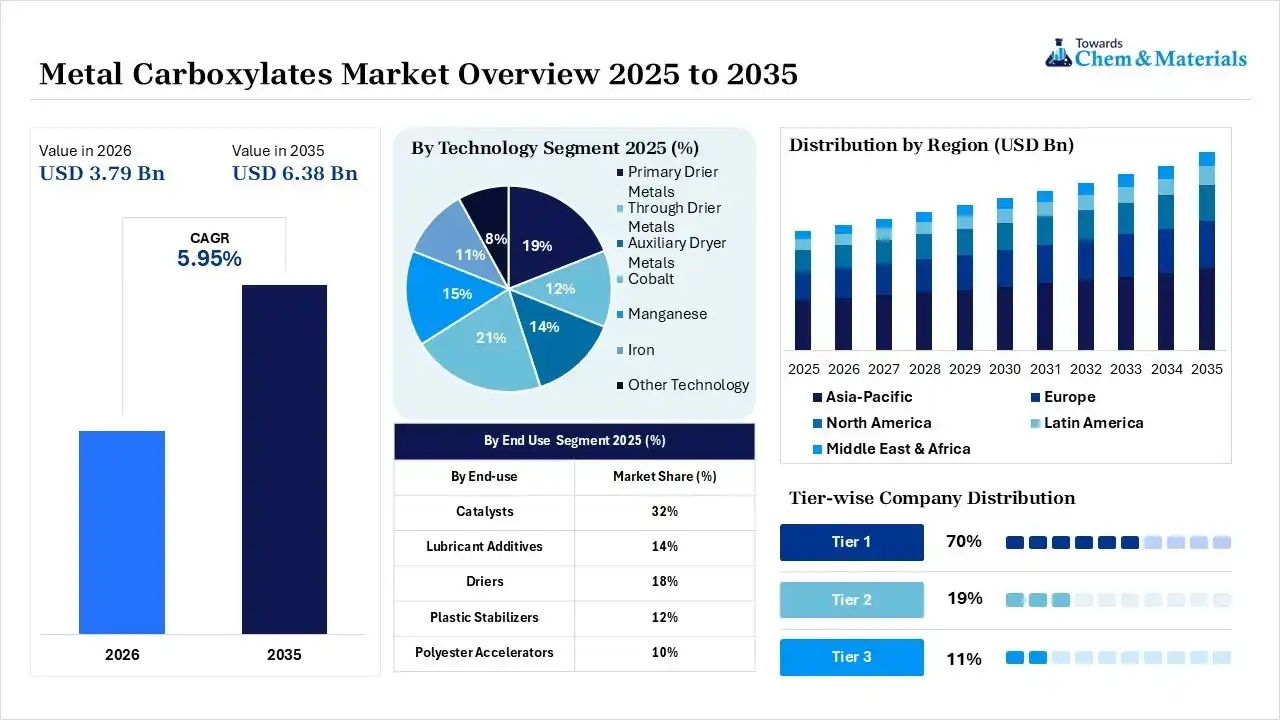
Market Highlights
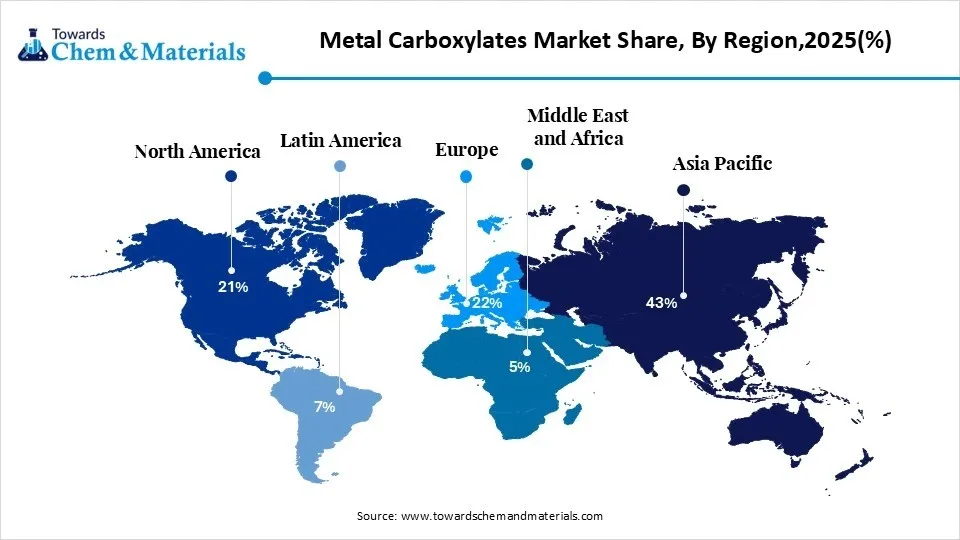
- By region, Asia Pacific dominated the metal carboxylates market by holding 43% share in 2025, driven by China and Indias expanding coatings and plastics production.
- By region, North America held 21% market share in 2025 and is expected to grow at the fastest with a CAGR of 6.8% during the forecast period as infrastructure upgrades increase coatings consumption.
- By technology, the cobalt segment dominated the market with the largest share of 21% in 2025, as specialty coating applications maintain demand.
- By technology, the manganese segment held 15% market share in 2025 and is expected to grow at the fastest CAGR of 7.1% over the forecast period due to manufacturers increasingly replacing cobalt with manganese systems.
- By end-use, the catalysts segment dominated the market with the largest share of 32% in 2025, as polymer and chemical production continue expanding globally.
- By end-use, the lubricant additives segment held 14% market share in 2025 and is expected to grow at the fastest CAGR of 6.8% over the forecast period, driven by demand increases with machinery modernization.
Metal carboxylates are seeing a steady growth in the market owing to the increased demand from the paint and coating industry, lubricants, polymer industry, and chemical processing industry. They are vital catalysts, stabilizers, driers, and performance additives for better curing efficiency, oxidation resistance, and product durability. The market continues to grow as a result of increasing production of plastics and specialty chemicals, growing industrialization, and infrastructure development around the world.
The push towards using manganese- and iron-based formulations instead of cobalt-based formulations in the production of superplasticizers is also gaining momentum due to environmental regulations. Manufacturers are actively developing more sustainable technologies, bespoke formulations, and advanced catalyst systems to meet changing regulations and standards while enhancing performance.
- In April 2026, LANXESS invested a sum of ₹150 crore in constructing a new lubricant additives blending plant at Jhagadia in Gujarat. The plant helped to reinforce the companys local manufacturing approach and helped to expand its international network of manufacturing locations for lubricant additives.
(Source: www.indianchemicalnews.com)
Report Scope
| Report Attributes | Details |
| Market Size in 2026 | USD 3.79 Billion/ 1.64 Million Metric Tons |
| Expected Size by 2035 | USD 6.38 Billion/ 2.60 Million Metric Tons |
| Growth Rate from 2025 to 2035 | CAGR 5.95% |
| Base Year of Estimation | 2025 |
| Forecast Period | 2025 - 2035 |
| High Impact Region | Asia Pacific |
| Segment Covered | By Technology, By End Use, By Region |
| Key Companies Profiled | BASF SE, Dow, Elementis plc, Organometals, Arkema Group, PMC Group, Inc., Valtris Specialty Chemicals,Penta Manufacturing Company, DIC Corporation, Ege Kimya San. ve Tic. A.S |
Supply Chain Analysis of the Metal Carboxylates Market
Feedstock Procurement
- During this step, metallic salts, cobalt, manganese, calcium, zinc, and organic carboxylic acids, like naphthenic, octoic, and neodecanoic acids, are sourced for use in the production of metal carboxylates. By using reliable sourcing, the quality of the product will be stable, and industrial production shall not be interrupted, which will also help to maintain stable prices.
- BASF SE: Integrated chemical business with the supply of specialty feedstocks and petrochemical intermediates for metal carboxylate production.
- Other Key Players: Umicore, Eastman Chemical.
Chemical Synthesis and Processing
- Metal salts react with organic acids by carefully controlled neutralization and synthesis reactions to yield highly pure metal carboxylates with consistent catalytic and stabilizing properties for use in coatings, lubricants, plastics, and specialty chemical applications.
- Umicore: A cobalt and specialty metal carbolate producer for industrial catalyst and coating uses with high-purity grades.
- Other Key Players: DIC Corporation and Shepherd Chemical
Compound Formulation and Blending
- Mixed with solvents, stabilizers, promoters, and performance additives, synthesized metal carboxylates are used to create customized driers, catalysts, lubricant additives, and polymer stabilizers for specific industrial applications.
- DIC Corporation: A developer of custom-made metal carboxylate formulations for paints, coatings, inks, adhesives, and polymer processing industries.
- Other Key Players: Valtris Specialty Chemicals, Arkema.
Market Opportunity
What is the Key Opportunity Responsible for the Growth of the Market?
The key opportunity for the growth of the metal carboxylates market lies in the growing and expanding growth in industrial coating and the need for versatile materials drives the market growth. The demand for high-performance adhesives and the need for specialized metal carboxylates to enhance adhesion, durability, and thermal stability from various industries like electronics, automotive, and construction drives the demand and growth of the market. The use of metal carboxylates as a catalyst in pharmaceutical and chemical processing for polymerization, synthesis, and oxidation creates an opportunity for the growth of the market with rising demand and helps in the expansion of the market.
Market Challenge
Raw Material Prices and High Production Costs Hinder the Growth of the Market
The rising and fluctuating raw material prices of metal salts and organic acids, which are essential components for the manufacturing and processing of metal carboxylates, impact the production costs and final cost of the product, which affects the profitability of the product which hindering the growth of the market. Strict environmental regulations and the need for eco-friendly and low-toxicity additives demand high production costs, and also, material sourcing involves high costs, which results in a high cost of the final product. These challenges hinder the growth of the market.
Regional Insights
How did the Asia Pacific Dominate the Metal Carboxylates Market in 2025?
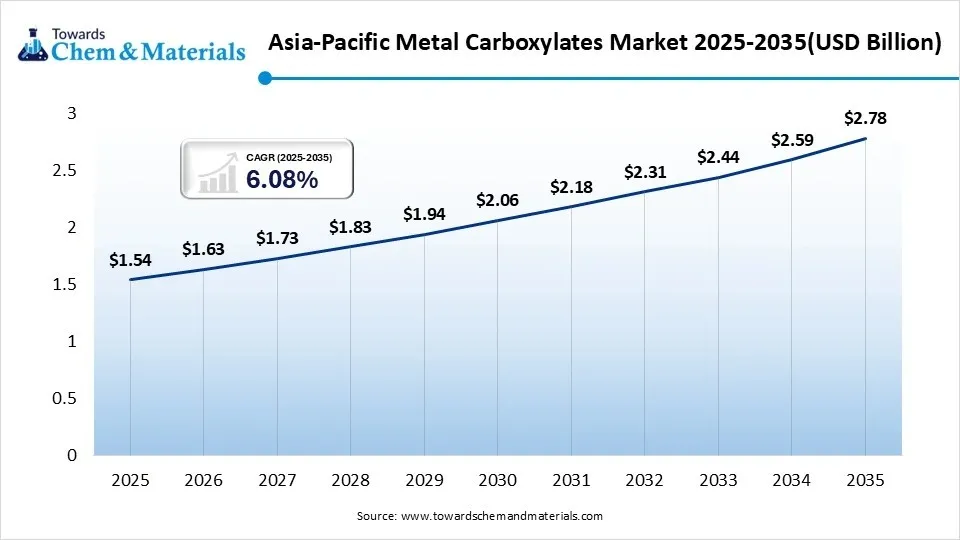
The Asia Pacific metal carboxylates market size was estimated at USD 1.54 billion in 2025 and is projected to reach USD 2.78 billion by 2035, growing at a CAGR of 6.08% from 2026 to 2035.Asia Pacific dominated the market with the largest share of 43% in 2025, owing to the flourishing coatings, plastics, lubricants, and specialty chemical manufacturing industries. Use of metal carboxylates as catalysts, paint driers, PVC stabilizers, and lubricant additives in various industrial applications rose significantly due to the rapid industrialization, growing production of automobiles, development of infrastructure, and polymer processing.
China
- Cobalt, calcium, and zinc metal carboxylate formulations were used in large amounts in massive coatings and PVC production.
- The increased production of motor vehicles stimulated the use of paint driers and industrial technologies for lubricant additives throughout the country.
- Strong specialty chemical manufacturing strengthened domestic production and exports of metal carboxylate-based industrial chemicals.
India
- Architectural coatings with high-performance metal carboxylate drying agents and catalysts saw increased demand with infrastructure development.
- With the fast growth of the lubricant manufacturing industry, the demand for calcium and barium carboxylate additive formulations has increased in different industries.
- The polymer processing industry expanded and drove quick growth in sales of PVC stabilizers and specialty catalyst technologies.
North America held 21% market share in 2025 and is expected to grow at the fastest CAGR of 6.8% during the forecast period. Demand for advanced coatings production, specialty lubricants, and additives that satisfy environmental requirements drove strong growth in North America. The manganese-based carboxylates gained increased traction in automotive, aerospace, coatings, and industrial manufacturing applications in the wake of infrastructure modernization, industrial automation, and increasing investments in sustainable chemical technologies.
United States
- Manganese-based driers were increasingly used to replace the traditional cobalt-based driers to comply with environmental regulations, especially by advanced coatings manufacturers.
- The automotive, aerospace, and industrial machinery sectors were buoying the national growth of the lubricant additives market.
- There were substantial investments in the specialty chemicals industry in sustainable catalyst and polymer additive development technologies.
Canada
- Protective industrial coatings based on advanced metal carboxylate drying technologies were used more during infrastructure renovation projects.
- An increased production of lubricants encouraged increased demand for oxidation-resistant calcium carboxylate additive formulations.
- Adoption of sustainable specialty chemicals among coatings and polymer manufacturing industries was promoted by environmental laws.
Europe held 24% market share in 2025, due to strict environmental requirements, which make cobalt-free formulations and sustainable specialty chemicals more attractive. Consumption of manganese-based and iron-based metal carboxylates in manufacturing industries was bolstered by increasing investments in advanced coatings, industrial lubricants, polymer additives, and green chemistry technologies.
Germany
- Manufacturers rapidly adopted manganese-based drying agent technologies for coatings that were environmentally friendly, with the industry undergoing a rapid pace of change.
- PVC stabilizers and specialty catalyst formulations were important for advanced polymer manufacturing.
- The investments in green chemistry stimulated sustainable production of cobalt-free industrial additive technologies.
France
- Growth of the industrial coatings industry drove up the use of advanced metal carboxylates in corrosion protection applications.
- Specialty lubricant manufacturers used high-performance additive packages to enhance oxidation performance and equipment life.
- The use of environmentally friendly catalyst technologies was stimulated by sustainable chemical manufacturing, thus expanding the commercial applications of these materials.
Latin America held 7% market share in 2025, owing to construction, coatings, plastics, and lubricant-producing sectors, which provided support to the steady growth of Latin America. Industrial investments and a growing demand for protection coatings and for PVC products and automotive parts boosted the metal carboxylates demand in the regional chemical processing and manufacturing industries.
Brazil
- Coatings industry consumption of metal carboxylate driers for residential/commercial construction work rose.
- As the number of vehicles increased, so did the demand for specialty lubricant additives and corrosion-resistant coating technologies.
- Investment in polymer processing helped metal carboxylates to become more widely used in PVC stabilisation.
Chile
- Advanced metal carboxylate additives were used with industrial lubricants for mining equipment maintenance, which led to greater consumption.
- The rising demand for durable protective coatings that employ efficient curing catalyst technologies has driven infrastructure development.
- The specialty polymer stabilizer formulation grew more popular with the growth of industrial manufacturing.
The Middle East & Africa held 5% market share in 2025, as petrochemical production, industrial coatings, lubricant manufacturing, and investments in infrastructure expanded. Growth in the construction, oil/gas, and polymer sectors contributed to the growth of metal carboxylates as catalysts, stabilizers, and specialty additives.
Saudi Arabia
- The growing petrochemical industry required more polymer catalysts and specialty metal carboxylate stabilizer technologies.
- Advanced drying agent formulations were used in the rising consumption of protective coatings for infrastructure projects.
- Domestic specialty chemical production and usage of additives continued to benefit from industrial diversification programs.
South Africa
- High-performance lubricant additive technologies are in demand for mining and industrial equipment maintenance in heavy industries.
- The growth of construction activity led to increased use of protective coatings using efficient curing catalysts.
- As chemical manufacturing grew, there was a corresponding growth in the use of specialty metal carboxylates in industry.
Segmental Insights
Technology Insights
What made the cobalt segment dominate the market in 2024?
The cobalt segment dominated the metal carboxylates market share 21% in 2025. The cobalt metal carboxylates are manufactured by the reaction between two components, cobalt and organic carboxylic acid, such as resin acids and stearic acid. The cobalt is used in various applications, like in paints as a drying and coating agent, adhesive in the tire industry, and as a catalyst in chemical reactions, which drives the demand for the market. The manufacturing process involves a reaction between cobalt and carboxylic acid in a solvent, then the product is extracted, purified, and the final desired product is formulated. The growth of the market is driven by various applications in wood preservation, printing inks, and adhesives in the tire industry to promote the bond and strength of rubber. These factors and applications drive the growth and expansion of the market.
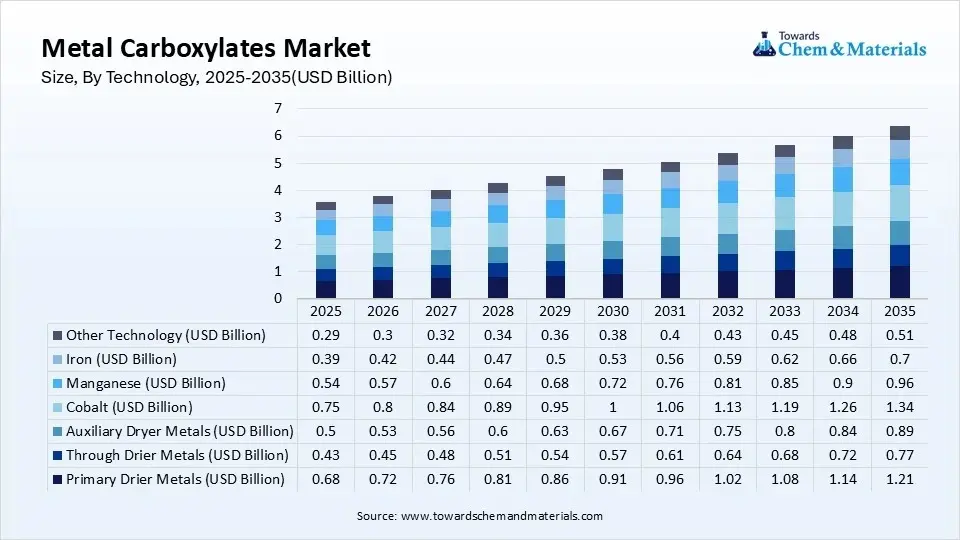
The manganese segment expects significant growth in the metal carboxylates market during the forecast period. The metal is produced by one-pot synthesis, which is a single reaction and is carried out by an initiator in a solvent, and it is also produced by thermal decomposition. The growth of the market is driven by various applications like paint driers, catalysts, rubber adhesion promoters, printing inks, construction, and other industries. The key factor responsible for the rising demand and growth of the market is the thermal stability of manganese carboxylates. The rising demand for customization in formulation and process, according to the demand and needs of the consumers and manufacturers, drives the growth of the market. The market is growing, and an increase in adoption is seen due to its effectiveness and eco-friendly properties, which drive the market and help in its expansion of the market.
Metal Carboxylates Market Share, By Technology,2025(%)
| By Technology | Market Share (%) |
| Primary Drier Metals | 19% |
| Through Drier Metals | 12% |
| Auxiliary Dryer Metals | 14% |
| Cobalt | 21% |
| Manganese | 15% |
| Iron | 11% |
| Other Technology | 8% |
End Use Insights
How did the catalyst segment dominate the market in 2024?
The catalysts segment dominated the metal carboxylates market share 32% in 2025. The metal carbonates act as a catalyst in chemical reactions in polymerization, cure acceleration, and oxidation, which increases the demand for the market due to various applications. The market growth is driven by the versatility of catalysts, low temperature precursors for metal and metal oxide nanoparticle formation, which helps the market expansion. Catalysts play an important role in reaction acceleration and the synthesis process, like the production of other chemical solutions. Its applications in various industries for the synthesis and polymerization, and lubricant enhancement to improve the overall life of the components, fuel the growth and demand for the market. It is extensively used for its high performance as adhesion, sealants, and in the petrochemical industry, which contributes to and supports the growth and expansion of the market.
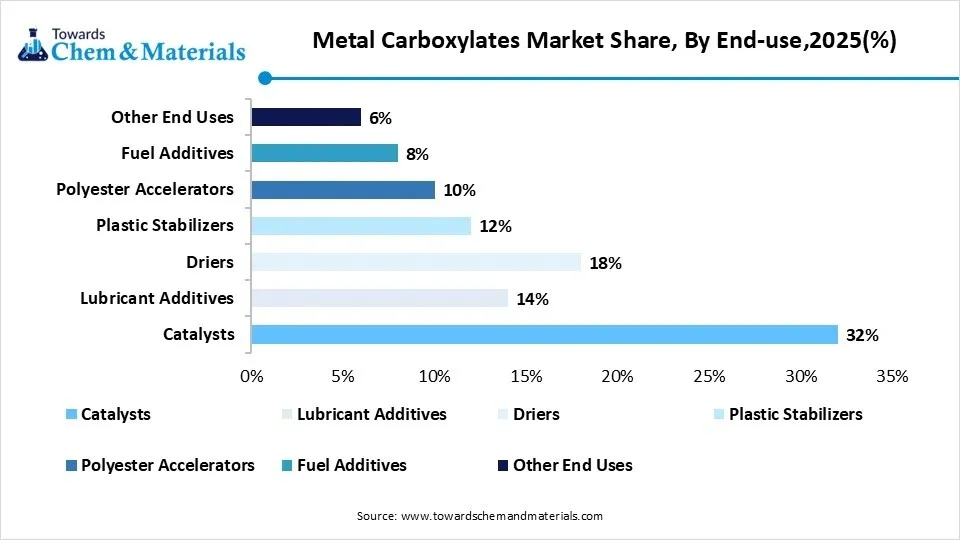
The lubricant additives segment expects significant growth in the metal carboxylates market during the forecast period. Metal carboxylates, which are derived from bismuth, act as a lubricant; they form a protective layer or film on metal surfaces. The film helps reduce the surface friction in extreme pressure and severe conditions, which increases the demand for the market. The film acts as a corrosion inhibitor and protects surfaces from degradation, which attracts consumers and manufacturers and drives the growth of the market. They are also widely used as additives in lubricants and greases for various applications in large industrial sectors due to their properties, like industrial, machinery, and automotive lubrication, which helps and supports market growth and expansion of the market.
Metal Carboxylates Market Share, By End-use,2025(%)
| By End-use | Market Share (%) |
| Catalysts | 32% |
| Lubricant Additives | 14% |
| Driers | 18% |
| Plastic Stabilizers | 12% |
| Polyester Accelerators | 10% |
| Fuel Additives | 8% |
| Other End Uses | 6% |
Recent Developments
- In November 2025, Lucas Oil introduced its first oil treatment and fuel treatment line that incorporates Hybrid Fuel Technology, under the names Hybrid Oil Treatment and Hybrid Fuel Treatment. The products were specially formulated for hybrid vehicles to enhance engine protection and performance.
(Source: www.prnewswire.com)
Top Companies List
- BASF SE
- Dow
- Elementis plc
- Organometals
- Arkema Group
- PMC Group, Inc.
- Valtris Specialty Chemicals
- Penta Manufacturing Company
- DIC Corporation
- Ege Kimya San. ve Tic. A.S
Segments Covered in The Report
By Technology
- Primary Drier Metals
- Lead-Based Primary Driers
- Zirconium-Based Primary Driers
- Calcium-Based Primary Driers
- Through Drier Metals
- Zirconium Through Driers
- Barium Through Driers
- Auxiliary Dryer Metals
- Calcium Auxiliary Driers
- Zinc Auxiliary Driers
- Cobalt
- Cobalt Octoate
- Cobalt Neodecanoate
- Manganese
- Manganese Octoate
- Manganese Neodecanoate
- Iron
- Iron Octoate
- Iron Neodecanoate
- Other Technology
- Zinc Carboxylates
- Copper Carboxylates
- Rare Earth Carboxylates
By End-use
- Catalysts
- Polymerization Catalysts
- Oxidation Catalysts
- Lubricant Additives
- Industrial Lubricants
- Automotive Lubricants
- Driers
- Paints & Coatings Driers
- Printing Ink Driers
- Plastic Stabilizers
- PVC Stabilizers
- Engineering Plastics
- Polyester Accelerators
- Unsaturated Polyester Resins
- Composite Manufacturing
- Fuel Additives
- Gasoline Additives
- Diesel Additives
- Other End Uses
- Textile Chemicals
- Adhesives & Sealants
By Region
- North America
- U.S.
- Canada
- Europe
- Germany
- UK
- France
- Italy
- Spain
- Sweden
- Denmark
- Norway
- Asia Pacific
- China
- Japan
- India
- South Korea
- Thailand
- Latin America
- Brazil
- Mexico
- Argentina
- Middle East and Africa (MEA)
- South Africa
- UAE
- Saudi Arabia
- Kuwait



Comments
Share your thoughts, ask a question, or provide feedback about this report.