
Magnetic Field-Responsive Polymers Market Size Analysis Report 2035
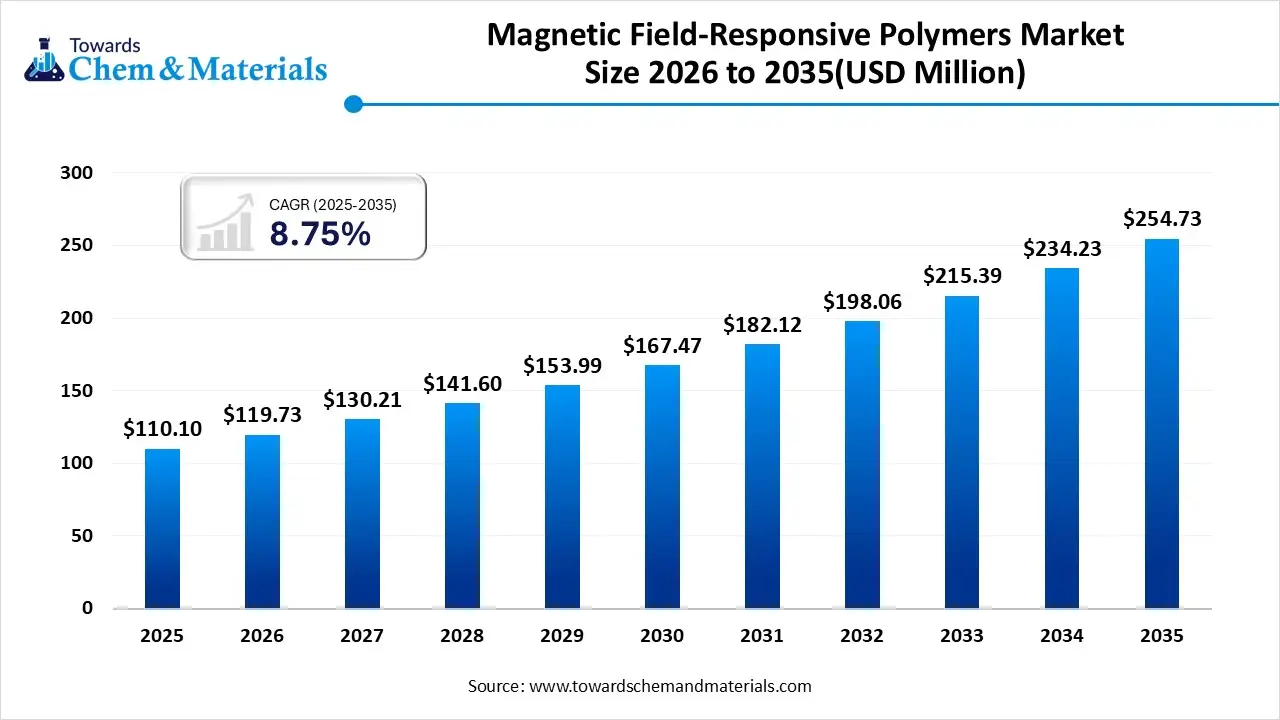
The global magnetic field-responsive polymers market size was estimated at USD 110.10 million in 2025 and is expected to increase from USD 119.73 million in 2026 to USD 254.73 million by 2035, growing at a CAGR of 8.75% from 2026 to 2035. North America dominated the magnetic field-responsive polymers market with the largest revenue share of 40.00% in 2025. The emergence of advanced technology, such as soft robotics and sensors, has fueled industry’s growth in recent years. The magnetic field-responsive polymers refer to the smart materials that are able to change shape, movement, stiffness, and even internal structure when the magnetic field is applied. Moreover, the major players in the sectors such as drug delivery, soft robotics, and sensors are seen under the heavy usage of the magnetic field-responsive polymers as per the recent industry survey. Also, these polymers contain tiny magnetic particles, which are mixed inside a flexible plastic material, as per the info.
Market Highlights
- The North America dominated magnetic field-responsive polymers market with the largest revenue share of 40.00% in 2025, due to its strong focus on advanced technology and innovation.
- By product type, the metal oxide/ferromagnetic-particle loaded segment dominated the market and accounted for the largest revenue share of 47.00% in 2025, owing to they are easy to produce and give a strong magnetic response.
- By product type, the organic/intrinsically magnetic polymer segment is expected to grow at the fastest CAGR of 9.89% from 2026 to 2035 in terms of share, because they do not need added particles.
- By application, the electronics & printed electronics segment led the market with the largest revenue share of 35.00% in 2025, owing to its need for materials that can respond quickly and precisely.
- By application, the automotive segment is expected to grow at a rapid CAGR 9.24% during the forecast period, due to vehicles becoming smarter and more advanced.
From Fillers to Nano Intelligence
The industry is moving from simple magnetic fillers to highly engineered nano-magnetic systems, which are likely to allow stakeholders to capitalize on growth opportunities in the coming years. In the past, polymers just contained basic magnetic particles, but now researchers are designing nano-sized particles with precise shapes, coatings, and alignment. This allows better control, faster response, and lower energy use. Moreover, combining magnetic response with other features like temperature sensitivity or electrical conductivity has emerged as another industry trend nowadays.
Recent Market Trends:
- The greater integration into soft robotics has attracted increased capital and investment in manufacturing. Also, by allowing robots to bend, move, and stretch via magnetic signals without any wiring, the magnetic field-responsive polymers have gained major industry attention in the modern world.
- The growing use of biomedical micro devices has strengthened the bottom line for production firms. Also, the scientists are testing these magnetic field-responsive polymers used to deliver medicine exactly where it is needed through smaller and smart devices in the current period.
- The heavy shift towards the self-healing and adaptive materials is likely to be seen as a high-margin opportunity for manufacturers during the forecast period. Moreover, polymers are observed in repairing small damages or changing structure when they are exposed to a magnetic field.
Market Report Scope
| Report Attribute | Details |
| Market Size in 2026 | USD 119.73 Million |
| Revenue Forecast in 2035 | USD 254.73 Million |
| Growth Rate | CAGR 8.75% |
| Forecast Period | 2026 - 2035 |
| Base Year | 2025 |
| Dominant Region | North America |
| Segment Covered | By Product Type, By Application, By Region |
| Key companies profiled | 3M, Arkema, BASF SE, Celanese Corporation, Dow Inc., Evonik, Heraeus, Parker Hannifin, RTP Company, Solvay S.A. |
Value Chain Analysis of the Magnetic Field-Responsive Polymers Market:
Distribution to Industrial Users
- Industrial users obtain magnetic field-responsive polymers (MRPs) through specialized chemical distributors and advanced material manufacturers. These polymers, which change properties under magnetic influence, are supplied primarily to the aerospace, automotive, and medical device sectors.
- Distribution focuses on high-performance grades for applications like soft robotics, vibration dampers, and targeted drug delivery.
Chemical Synthesis and Processing
- Chemical synthesis of magnetic field-responsive polymers (MRPs) typically involves embedding superparamagnetic nanoparticles, such as magnetite (Fe3O4), into a polymer matrix via in-situ precipitation or bulk polymerization.
- Processing techniques like injection molding or 3D printing are then used to shape the material.
Regulatory Compliance and Safety Monitoring
- Regulatory compliance for magnetic field-responsive polymers (MRPs) is governed by frameworks like REACH and TSCA, which assess the environmental and health risks of both the polymer base and metallic fillers. Safety monitoring focuses on nanoparticle leaching and electromagnetic interference.
- Specialized Material Safety Data Sheets (MSDS) are critical for handling, as the magnetic properties can pose risks in environments with sensitive electronic equipment or medical implants.
Magnetic Field-Responsive Polymers Market Regulatory Landscape: Global Regulations
| Country Region | Regulatory Body | Key Regulations | Focus Areas |
| United States | Environmental Protection Agency (EPA) | TSCA Section 5: Requires a Pre-Manufacture Notice (PMN) for "new" chemical substances. | Assessing the "newness" of nanoscale versions of existing substances, monitoring metal implant safety, and ensuring the stability of nanomaterials in drug products. |
| European Union | ECHA | MDR Rule 19: Categorises devices with nanomaterials into risk classes (IIa to III) based on internal exposure potential. | Risk management of nanoforms, identifying Substances of Very High Concern (SVHC), and standardizing nanomedicine preparation. |
| China | Ministry of Ecology and Environment (MEE). | MEE Order 12 (China REACH): Replaced MEP Order 7 in 2021; governs environmental registration of new chemical substances. | Management of PBT (Persistent, Bioaccumulative, and Toxic) substances, simplified registration for polymers of low concern, and rigorous post registration tracking. |
Segmental Insights:
Product Type Insights
How did the Metal-Oxide/Ferromagnetic-Particle-Loaded Segment Dominate the Magnetic Field-Responsive Polymers Market in 2025?
The metal-oxide/ferromagnetic-particle loaded segment dominated the market share 47.00% in 2025, because they are easy to produce and give a strong magnetic response. Also, these materials contain iron-based particles mixed inside the polymer, which react quickly when a magnetic field is applied. Industries prefer them because they are reliable, affordable, and already well-tested. They can be used in many applications like sensors, actuators, and electronic devices. Also, the manufacturers can easily control their strength and performance by adjusting particle content.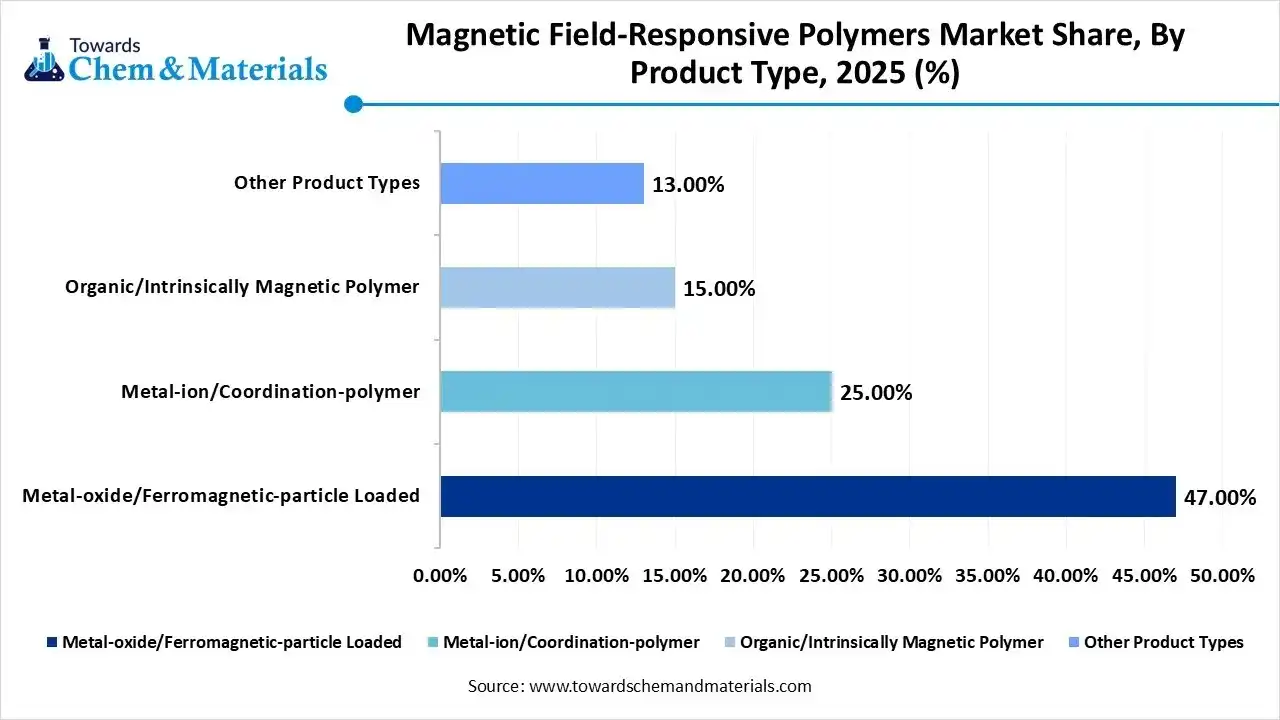
The organic/intrinsically magnetic polymer segment is expected to grow with a rapid CAGR 9.89%, owing to they do not need added particles. Also, the magnetic property comes from the polymer itself, making the material lighter and more flexible. This is important for advanced applications like wearable devices and soft robotics. These polymers also provide better uniformity and smoother performance. The trend towards miniaturization, as industries need smaller and more precise materials, is supporting the growth of segment.
Magnetic Field-Responsive Polymers Market Share, By Product Type, 2025 (%)
| By Product Type | Revenue Share, 2025 (%) |
| Metal-oxide/Ferromagnetic-particle Loaded | 47.00% |
| Metal-ion/Coordination-polymer | 25.00% |
| Organic/Intrinsically Magnetic Polymer | 15.00% |
| Other Product Types | 13.00% |
Application Insights
How did the Electronics & Printed Electronics Segment Dominate the Magnetic Field-Responsive Polymers Market in 2025?
The electronics & printed electronics segment dominated the market share 35.00% in 2025, due to it needs materials that can respond quickly and precisely. Moreover, magnetic field-responsive polymers are useful in sensors. circuits, and flexible electronics. Printed electronics require materials that can be applied in thin layers and still perform well. These polymers help in creating lightweight and flexible electronic devices. Also, the growing demand for smart devices and wearable technology is driving the growth of the segment.
The the automotive segment is expected to grow at a rapid CAGR 9.24% during the forecast period. Also, magnetic responsive polymers can be used in sensors, adaptive systems, and smart components that improve safety and performance. As electric vehicles and autonomous driving technologies increase, the demand for advanced materials also grows.
Magnetic Field-Responsive Polymers Market Share, By Application, 2025 (%)
| By Application | Revenue Share, 2025 (%) |
| Electronics & Printed Electronics | 35.00% |
| Automotive | 26.00% |
| Medical & Biomedical Device | 15.00% |
| Research & Development/Prototyping | 10.00% |
| Other Applications | 14.00% |
Regional Insights
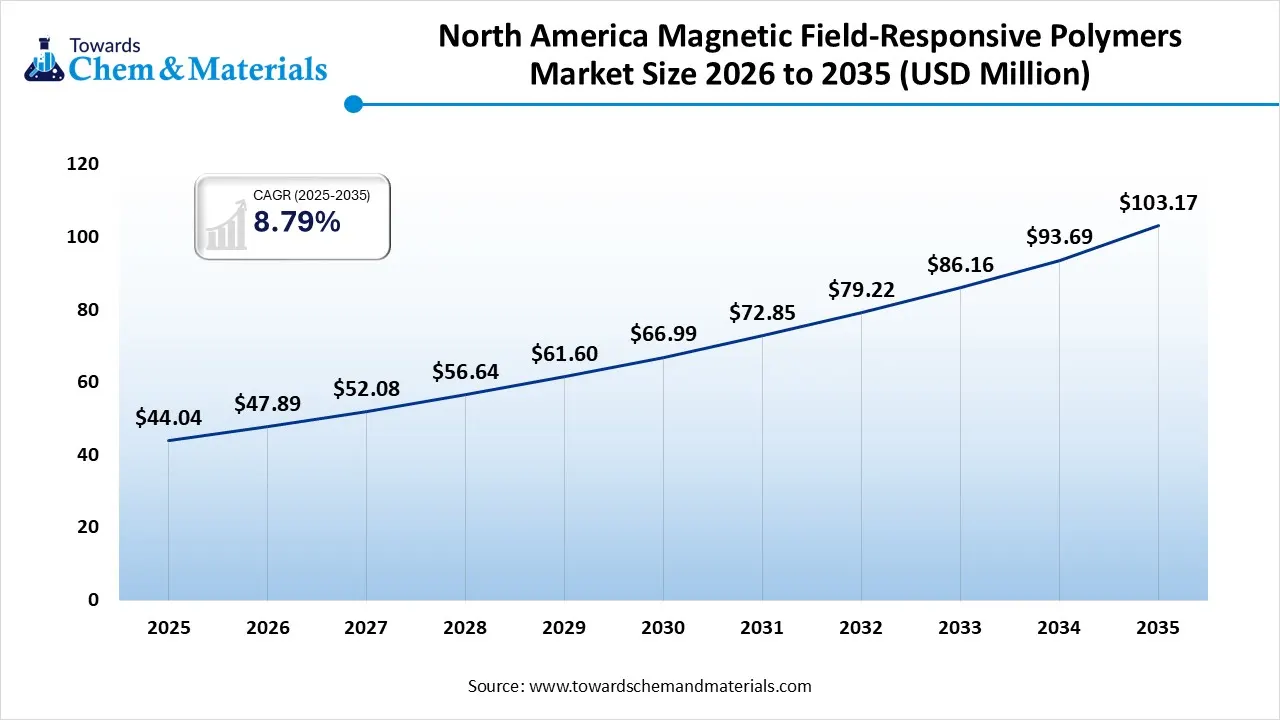
The North America magnetic field-responsive polymers market size was valued at USD 44.04 million in 2025 and is expected to be worth around USD 103.17 million by 2035, exhibiting at a compound annual growth rate (CAGR) of 8.79% over the forecast period from 2026 to 2035.
North America dominated the magnetic field-responsive polymers market share 40.00% in 2025, due to its strong focus on advanced technology and innovation. The region has many research centers and companies working on smart materials and new technologies. There is also high demand from industries like electronics, healthcare, and aerospace. Also, the release of funding, as governments and private companies invest heavily in research and development.
United States Leads Smart Materials
The United States maintained its dominance in the market, owing to its advanced research and strong industrial base. Also, many universities and companies are working on developing smart materials, including magnetic responsive polymers. The country also has a strong healthcare and electronics sector, where these materials are widely used. Also, the presence of startups and innovation hubs that focus on new technologies supports the growth. Also, government support and funding for research help in market growth.
Magnetic Field-Responsive Polymers Market Evaluation in Europe
Europe magnetic field-responsive polymers market segment accounted for the major revenue share of 25.00% in 2025. Europe is expected to capture a major share of the magnetic field-responsive polymers market with a rapid CAGR, owing to its strong focus on sustainability and high-quality manufacturing. Also, the region is investing in advanced materials that are efficient and environmentally friendly. Many industries in Europe are looking for innovative solutions, and magnetic responsive polymers can meet these needs. Moreover, the collaboration between research institutes and industries, which helps in the faster development of new technologies in the region nowadays.
Germany Advancing Smart Polymer Innovation
Germany is expected to emerge as a prominent country for the magnetic field-responsive polymers market in the coming years, due to its strong engineering and manufacturing capabilities. Also, it has a well-developed automotive and electronics industry. which requires advanced materials. German companies focus on precision and quality, which supports the use of smart polymers. The country also invests heavily in research and development, leading to new innovations.
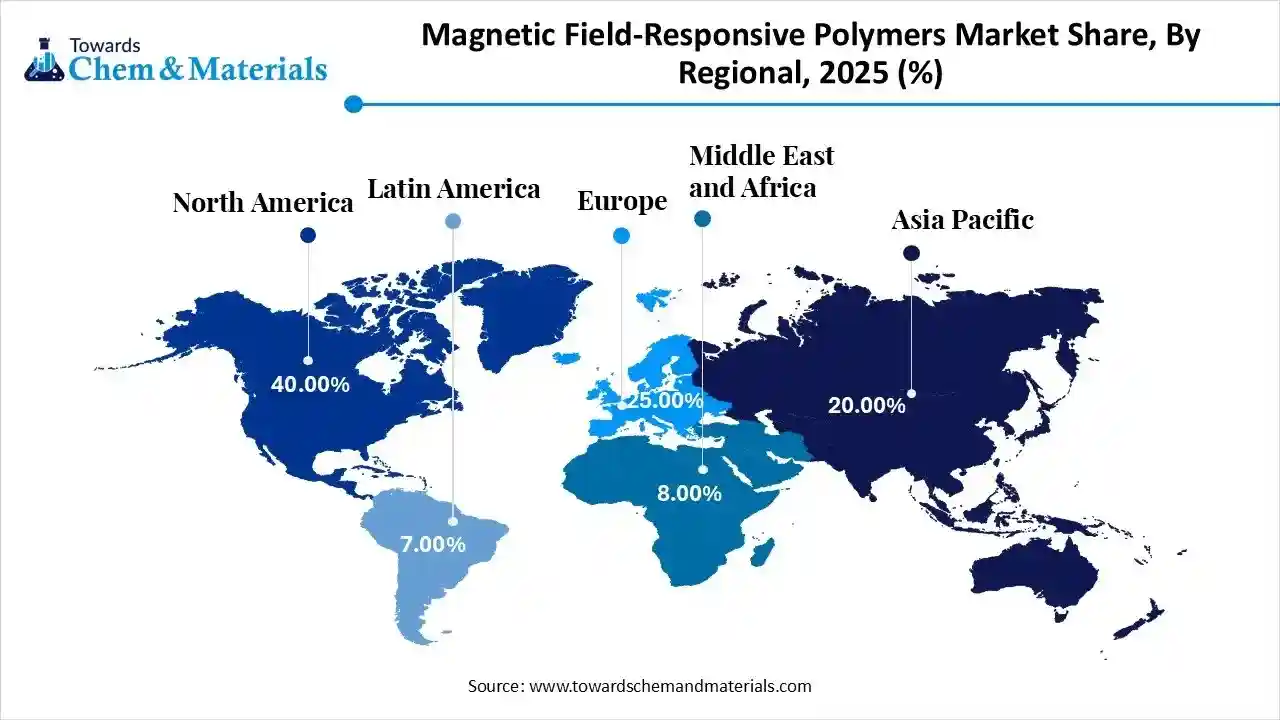
Magnetic Field-Responsive Polymers Market Share, By Regional, 2025 (%)
| Regional | Revenue Share, 2025 (%) |
| North America | 40.00% |
| Europe | 25.00% |
| Asia Pacific | 20.00% |
| Latin America | 7.00% |
| Middle East & Africa | 8.00% |
Asia Pacific Magnetic Field-Responsive Polymers Market Examination
Asia Pacific magnetic field-responsive polymers market segment accounted for the major revenue share of 20.00% in 2025. Asia Pacific is notably growing in industry, owing to increasing industrialization and manufacturing activities. Countries in this region are producing more electronics, automotive parts, and consumer goods, which increases demand for advanced materials. The region also benefits from lower production costs, which attracts companies. Governments are supporting industrial growth and technology development. The rising demand for smart devices and modern technologies is driving industry growth in the current period.
China’s Rapid Technological Industry Expansion
China is expected to gain a significant industry share owing to its large manufacturing base and fast technological growth. The country produces a wide range of electronic and industrial products, creating strong demand for advanced materials. China is also investing in research and development to improve its technological capabilities. The government's support for innovation and smart manufacturing has supported the industry growth in the country over the past few years.
Top Vendors in the Magnetic Field-Responsive Polymers Market & Their Offerings:
- 3M: 3M is a global leader in materials science, focusing on integrating magnetic functionality into high-performance components. The company leverages its expertise in adhesives and electronics to develop magnetic field-responsive polymers for printed electronics and soft robotics.
- Arkema: Arkema excels in high-value specialty polymers, particularly through its subsidiary Piezotech®, which specializes in electroactive and stimuli-responsive fluoropolymers. While known for piezoelectric materials, Arkema’s R&D extends to magnetic-field-responsive systems used in steerable surgical guides and haptic interfaces.
- BASF SE: BASF is a dominant player in the smart polymers market, developing advanced materials that respond to environmental stimuli like magnetic fields. The company focuses on metal-oxide and Ferromagnetic-Particle Loaded polymers, which are increasingly used in industrial actuators and medical sensors.
- Celanese Corporation: Celanese is a global technology leader in specialty materials, providing engineered polymers like Zenite® LCP and Fortron® PPS for demanding electronics and automotive applications. In the magnetic field-responsive market, Celanese contributes through its diverse portfolio of high-performance thermoplastics and elastomers used in smart manufacturing and Soft Robotics.
- Covestro AG
- Dow Inc.
- Evonik
- Heraeus
- Parker Hannifin
- RTP Company
- Solvay S.A.
Segments Covered in the Report
By Product Type
- Metal-oxide/Ferromagnetic-particle Loaded
- Metal-ion/Coordination-polymer
- Organic/Intrinsically Magnetic Polymer
- Other Product Types
By Application
- Electronics & Printed Electronics
- Automotive
- Medical & Biomedical Device
- Research & Development/Prototyping
- Other Applications
By Region
- North America
- U.S.
- Canada
- Mexico
- Europe
- Germany
- UK
- France
- Italy
- Spain
- Asia Pacific
- China
- India
- Japan
- South Korea
- Latin America
- Brazil
- Argentina
- Middle East & Africa
- Saudi Arabia
- South Africa



Comments
Share your thoughts, ask a question, or provide feedback about this report.