
Corrosion Inhibitors Market Size, Share & Forecast 2035
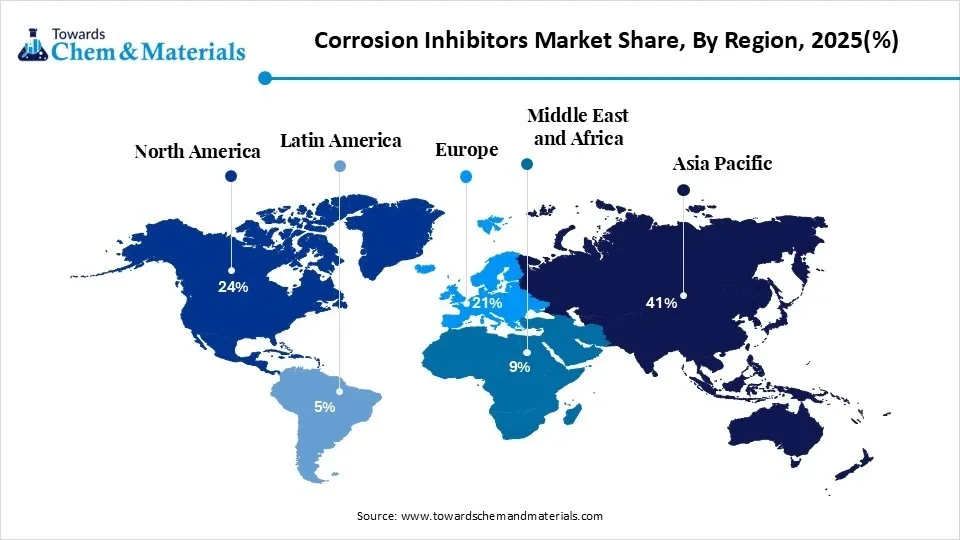
The global corrosion inhibitors market size was valued at USD 9.93 billion in 2025, is estimated to reach USD 10.55 billion in 2026, and is projected to reach USD 18.12 billion by 2035, exhibiting a compound annual growth rate (CAGR) of 6.20% over the forecast period from 2026 to 2035. Asia Pacific dominated the corrosion inhibitors market with the largest revenue share of 41% in 2025 and is expected to grow at the fastest CAGR of 6.33% during the forecast period.
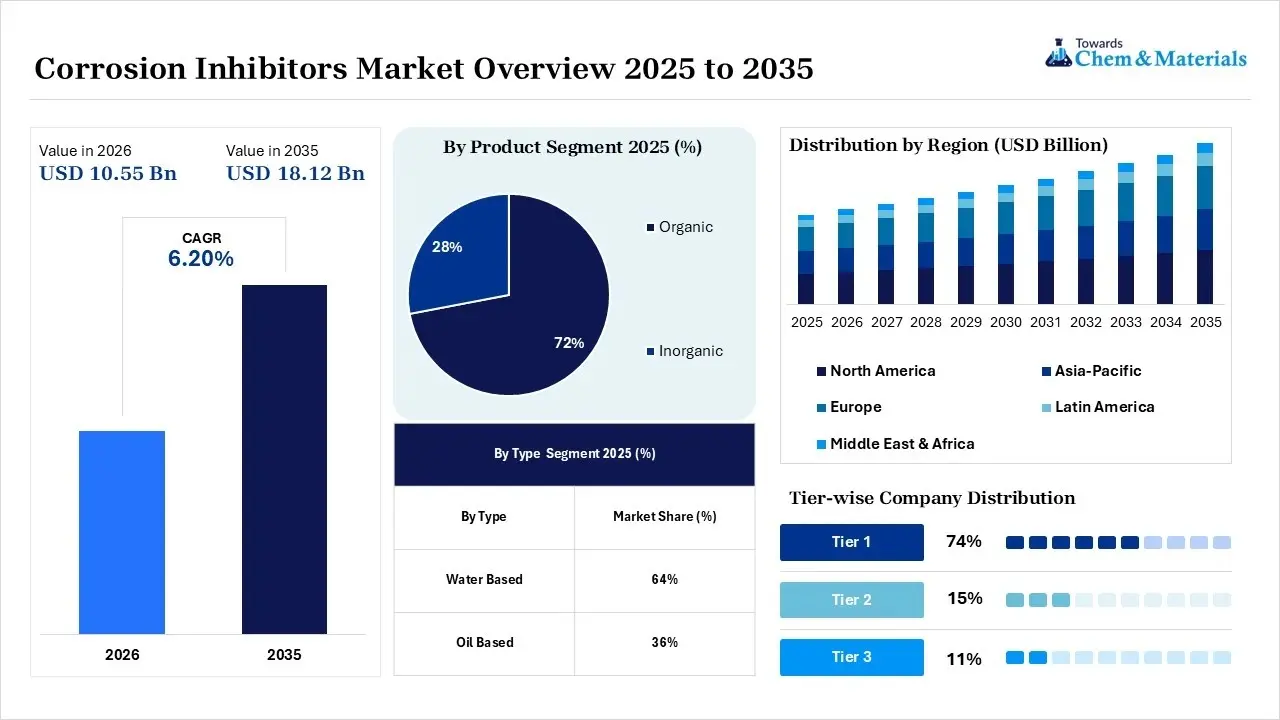
The expanding infrastructure development, rapid industrialization, and increasing demand from the oil and gas industry and water treatment sector due to protecting equipment from degradation and the shift towards eco-friendly solutions drive the growth. The strategic collaborations between players like BASF SE and Innospec for development and the demand to meet strict environmental regulations and complex performance demands support improvement in process efficiency.
Market Highlights
- By region, Asia Pacific dominated the corrosion inhibitors market with a share of 41% in 2025 and is expected to grow at a CAGR of 5.31% over the forecast period.
- By region, North America held 24% of the corrosion inhibitors market share in 2025 and is expected to experience the fastest growth with a CAGR of 6.85% in the forecast period.
- By product, the organic segment dominated the market with a 72% share in 2025 and is expected to grow at a CAGR of 5.10% over the forecast period.
- By product, the inorganic segment held 28% market share in 2025 and is expected to have the fastest growth with a CAGR of 6.20% in the forecast period.
- By type, the water-based segment dominated the market with a 64% share in 2025 and is expected to grow at a CAGR of 4.95% over the forecast period.
- By type, the oil-based segment held 36% market share in 2025 and is expected to have the fastest growth with a CAGR of 6.48% in the forecast period.
- By end use, the oil and gas segment dominated the market with a 31% share in 2025 and is expected to grow at a CAGR of 6.12% over the forecast period.
- By end use, the water treatment segment held 17% market share in 2025 and is expected to have the fastest growth with a CAGR of 6.84% in the forecast period.
Market Overview
Corrosion Inhibitors: Shift Towards Eco-friendly Formulations
According to Towards Chemicals and Materials Analytics and Consulting, the global corrosion inhibitors market volume was valued at 5.65 million metric tons in 2025 and is expected to surpass around 9.89 million metric tons by 2035, accelerating a compound annual growth rate (CAGR) of 5.76% over the forecast period from 2026 to 2035.
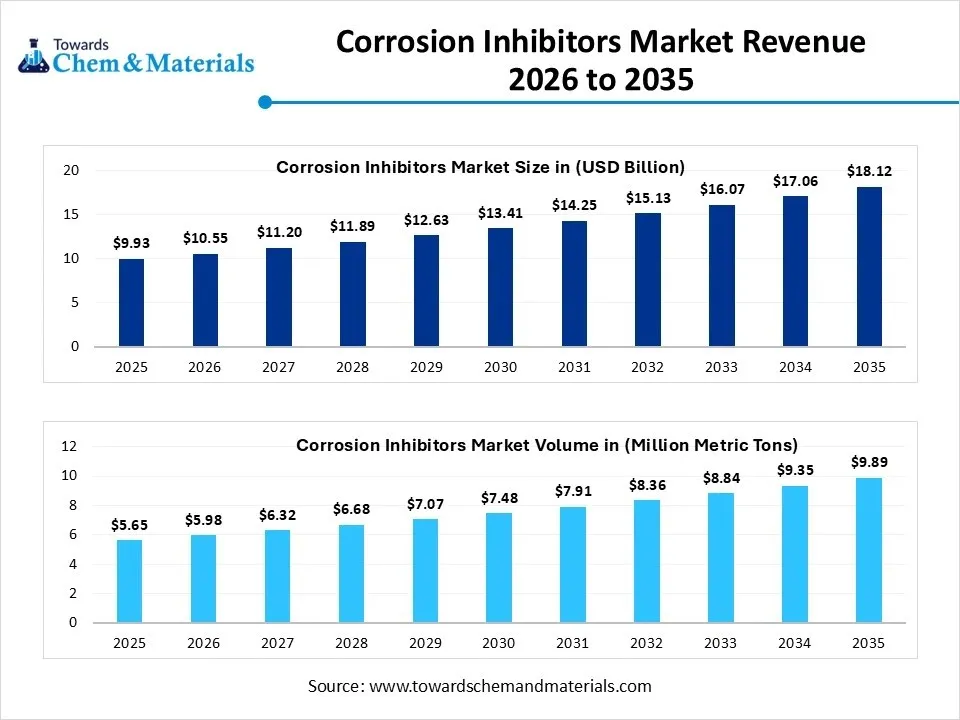
The corrosion inhibitor market is experiencing growth driven by the growing need for protection from harsh environments and degradation, creating a protective layer or film on the metal surface that helps in adsorption and protects it. It is extensively used in oil and gas, water treatment, and in automotive sectors with organic and water-based solutions, which shifts towards eco-friendly formulations, driving the growth of the market. The stringent environmental regulations and low VOC materials, using water-based and organic variants driving demand. Stricter environmental policies globally are forcing manufacturers to replace conventional toxic chemistries with eco-friendly, biodegradable, and nano-based corrosion inhibitors. The dominance of key players like BASF SE, Dow, DuPont, and Ecolab, focusing on sustainability product portfolios, research, and strategic acquisitions, drives the growth further.
Corrosion inhibitors are essential and extensively used for prolonging the lifespan of infrastructure development and the use of equipment in various sectors that demand a protective layer on the surfaces, like coatings and paints, it integrated with primers, which provide active and long-term protective layers. Oil and gas protective layers are created to prevent degradation which is caused by hydrogen and carbon dioxide. Concrete creates internal steel rebar and water systems to prevent leaching and rust in closed-loop systems. Industries are heavily using these materials to protect heavy and industrial equipment, which increases the demand.
- For instance, in July 2026, Owens Corning introduced PINK Pipe Gel FG, an H1-certified, food-grade corrosion inhibitor designed to complement their FOAMULAR XPS Pipe Insulation System. The non-drying gel protects metal pipes at temperatures ranging from -75 °F to 300 °F (-60 °C to 150 °C) while providing a high-visibility, moisture-repellent barrier.(Source: content.ampp.org)
Global Investment Flow for Corrosion Inhibitors Market 2026
The growing demand from industries like automotive, oil and gas, and infrastructure, supported by the investment and funding from the government and industries into green and bio-based inhibitors meeting the environmental regulations, drives the growth.
The development of national initiatives for funding in facilities like offshore wind, desalination, solar plants, and wastewater treatment to help manage degradation, and government funding in green pollution controls have increased investment.
Hexigone Inhibitors Ltd has secured a £1.2 million funding package to accelerate the commercial deployment and international scaling of its sustainable, smart corrosion protection technology. The package includes a £500,000 investment from the UK Innovation & Science Seed Funds (UKI2S) Defence &
- Security Seed portfolio (supported by the Ministry of Defence), £300,000 from angel investors, and a £400,000 UK Government R&D grant.(Source:www.hexigone.com)
Market Growth Trends:
- The shift towards eco-friendly formulation as strict environmental mandates, which drives a focus on the shift towards the use of bio-based and water-based inhibitors which helps in reducing the toxicity of VOC emissions, is a growing trend.
- The dominance of the use of organic compounds due to their properties and nontoxicity helps increase the efficiency of the materials, which are adopted by various industries like automotive, infrastructure, and multiple industries across.
- The regional dominance fueled by large-scale infrastructure development projects, rapid industrialization, and growing manufacturing bases, especially in countries like China, India, and Japan, increases the demand for the market.
Report Scope
| Market Size in 2026 | USD 10.55 Billion/ 5.98 Million Metric Tons |
| Expected Size in 2035 | USD 18.12 Billion/ 9.89 Million Metric Tons |
| Growth Rate | CAGR of 6.20% |
| Base Year of Estimation | 2025 |
| Forecast Period | 2025-2035 |
| Dominant Region | Asia Pacific |
| Segment Covered | By Product, By Type, By End Use, By Region |
| Key Companies Profiled | Dow Inc. (USA), Baker Hughes Company (USA), The Lubrizol Corporation (USA), Clariant AG (Switzerland), Solenis LLC (USA), AkzoNobel N.V. (Netherlands), DuPont de Nemours, Inc. (USA), Ashland Global Holdings Inc. (USA), Solvay S.A. (Belgium), LANXESS (Germany), Croda International Plc (UK), Evonik Industries AG (Germany), Halliburton Company (USA), Innospec (USA), Quaker Houghton (USA) |
Corrosion Inhibitors Market Technological Shift Through AI Manufacturing Advancements
The corrosion inhibitors market is experiencing a rapid shift towards the integration of AI in replacing traditional trial-and-error research and development with smart manufacturing and material discovery through data-driven technology. Smart manufacturing and process optimization through feedstock optimization, which helps maintain product quantity and also reduce production costs and process management, as it helps manage equipment failure through AI-powered system prediction, which helps in production compliance. It also helps in adapting automation in supply chain disruption and helps manage the anti-corrosive material in real time. The integration of AI in sustainability and eco-friendly formulations, which helps in technological advancement in the market.
Supply Chain Analysis of Corrosion Inhibitors Market
Corrosion Inhibitor Production & Processing
- Corrosion inhibitors are produced through chemical synthesis and formulation processes to develop organic and inorganic compounds that protect metal surfaces from corrosion in industrial systems, pipelines, water treatment facilities, and process equipment.
- Cortec Corporation develops corrosion inhibitors, protective coatings, and vapor-phase corrosion protection technologies for oil and gas, construction, automotive, marine, and industrial applications, helping extend equipment life and reduce maintenance costs.
- Key Players: BASF, Ecolab, Henkel, Cortec Corporation.
Quality Testing & Certification
- Corrosion inhibitors must comply with standards for corrosion resistance, chemical stability, environmental safety, material compatibility, and performance under different operating conditions before commercial use.
- Ecolab provides corrosion inhibitor technologies for industrial water treatment, energy, and manufacturing sectors. Its solutions are designed to meet global quality standards while improving asset reliability and operational efficiency.
- Key Authorities & Standards: International Organization for Standardization, ASTM International, NACE International, European Chemicals Agency.
Distribution to End-Use Industries
- Corrosion inhibitors are supplied to oil and gas companies, water treatment facilities, power generation plants, chemical manufacturers, marine operators, automotive manufacturers, and metal processing industries for corrosion protection applications.
- Henkel supplies corrosion protection chemicals and surface treatment solutions for automotive, aerospace, industrial manufacturing, and metal finishing applications, helping customers improve equipment durability, product quality, and operational performance.
- Key Suppliers: BASF, Henkel, Cortec Corporation.
Sustainability Analysis in the Corrosion Inhibitors Market
The sustainability analysis in the corrosion market lies in a critical shift towards bio-based extraction, biodegradable organic formulations, and non-engineered systems, which drives the demand for low VOC and organic materials. The strict regulation which focuses on maximizing the lifespan of infrastructure, along with minimizing environmental and toxicity risks, fuel the growth. Life cycle analysis and economic impact, as corrosion inhibitors reduce the massive resource and energy waste associated with metal replacement and repair.
What are Corrosion Inhibitors?
Corrosion inhibitors are chemical additives that are used to slow or stop the corrosion or degradation of metal in extreme, hostile, or harsh environments. Their key function is to adsorb on the metal surface, neutralize corrosion agents, and form a protective layer on the surface that helps block moisture and oxygen, which triggers the electrochemical reactions. The key types of corrosion inhibitors are anodic inhibitors, which form a thin protective oxide layer. Cathodic inhibitors, which slow down the cathodic reaction or precipitation, restricting the diffusion of corrosive elements. Volatile corrosion inhibitors, which vaporize in the atmosphere and change the internal environment, helping in the prevention of corrosion. Organic inhibitors, which adsorb directly onto the metal, creating a thick layer preventing corrosion.
What are the Key Uses of Corrosion Inhibitors?
Corrosion inhibitors are used on metal surfaces, which helps in degradation of metals from corrosion. Their key uses include protecting pipelines, preserving industrial machinery, and preventing metal degradation in closed heating systems, water treatment plants, and during the shipping and storage of metal parts.
The Primary Industry Applications Include:
- Oil and gas extraction: Inhibitors are injected directly into pipelines, drilling fluids, and wells to neutralize corrosive agents like hydrogen sulfide and dissolved oxygen, and to prevent equipment from rusting.
- Water Treatment Systems: In cooling towers, boilers, and municipal pipes, inhibitors such as orthophosphates establish a protective scale that prevents rust, mineral buildup, and leaching of metals into drinking water.
- Automotive & Manufacturing: Used in engine coolants and metal cutting fluids, they prevent fluid-induced corrosion. They are also used during surface treatments like acid pickling to shield base metals from the acid.
- Packaging and Electronics: Volatile Corrosion Inhibitors are used in packaging and shipping. The inhibitors slowly vaporize to form a protective layer over electrical contacts and sensitive machinery, without needing subsequent cleaning.
Corrosion Inhibitors Regulatory Landscape
| Country / Region | Regulatory Body | Key Regulations | Focus Areas | Notable Notes |
| United States | Environmental Protection Agency; Occupational Safety and Health Administration | Toxic Substances Control Act; OSHA Hazard Communication Standard | Chemical safety, industrial corrosion protection | The U.S. regulates corrosion inhibitors used in oil & gas, water treatment, power generation, and manufacturing while emphasizing environmental and workplace safety. |
| European Union | European Chemicals Agency; European Commission | REACH Regulation; CLP Regulation | Sustainable corrosion control, chemical compliance | Europe promotes environmentally friendly corrosion inhibitors and restricts hazardous substances in industrial applications. |
| China | Ministry of Ecology and Environment; Ministry of Industry and Information Technology | Environmental Protection Law; Chemical Industry Standards | Industrial corrosion prevention, infrastructure protection | China is expanding the use of corrosion inhibitors in oil & gas, construction, and manufacturing industries to improve asset durability. |
| India | Ministry of Chemicals and Fertilizers; Central Pollution Control Board | Chemical Safety Rules; Environmental Protection Act | Industrial equipment protection, water treatment | India is witnessing growing demand for corrosion inhibitors driven by infrastructure development and expanding industrial activities. |
| Japan | Ministry of Economy, Trade and Industry | Chemical Substances Control Law | High-performance corrosion protection, specialty chemicals | Japan focuses on advanced corrosion inhibitor technologies for automotive, electronics, and industrial equipment applications. |
| Germany | Federal Environment Agency; German Chemical Industry Association | REACH Compliance; Industrial Emissions Directive | Sustainable industrial chemicals, asset protection | Germany is a key market for specialty corrosion inhibitors used in automotive, chemical processing, and energy industries. |
Market Dynamics
Drivers: Expanding Use in Extending Lifespan of Infrastructure
The growth of the market is driven by the rising demand from sectors like oil and gas, infrastructure, aerospace, and automotive, which also helps in the expansion of water treatment facilities. This coating also helps in expanding the lifespan of aging industrial infrastructure, which drives the growth of the market. The rapid infrastructure development, stringent environmental regulations, and shift towards bio-based inhibitors drive the growth of the market. The increasing global population and rapid urbanization drive the necessity for sewage and water treatment facilities, utilizing corrosion inhibitors to prevent scale and degradation in distribution systems.
Challenges: High Costs and Economic Pressures
The key challenges in the corrosion inhibitors market that hinder the growth of the market are the high costs and economic pressure, as research and development, along with the commercialization of the products, require heavy financial investments, which slow down the production and product launch. Including the manufacturing costs of the expected and advanced formulation also contributes to the hindrance in the growth and expansion of the market.
Opportunities: Smart and Responsive Delivery Systems
The key growth opportunities that fuel the growth of the market are smart and responsive delivery systems, as research and development investments are increasing smart coatings and advanced chemical delivery systems in the market. These systems embed nanomaterials or microcapsules that actively release corrosion inhibitors only when the underlying metal surface is damaged, significantly prolonging asset lifespans. Other opportunities are the infrastructure boom, the growing oil and gas sector, the demand, and eco-friendly and green formulations that boost the growth of the market.
Segmental Insights
Product Insights
The organic segment dominated the market with a 72% share in 2025 and is expected to grow at a 5.10% CAGR over the forecast period. Organic corrosion inhibitors are chemical compounds that protect metals from corrosion. They comprise amides and amino acids, which help slow down electrochemical degradation. The most effective organic inhibitors contain nitrogen, oxygen, sulfur, and phosphorus; they chemically bind to the metal surface, which creates a barrier on the surface preventing degradation. The industry is majorly shifting towards using green inhibitors and using biodegradable organic inhibitors, which drives the growth and expansion of the market.
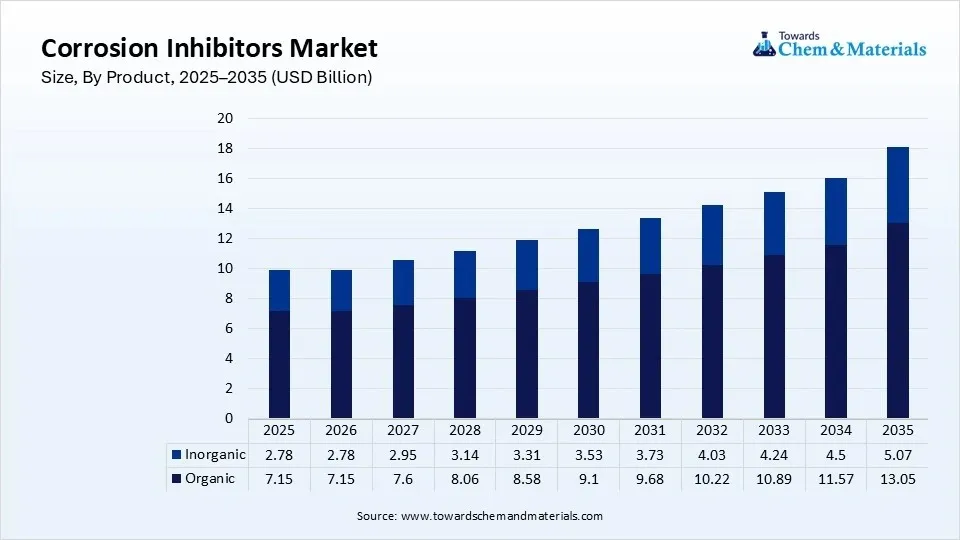
The inorganic segment held 28% market share in 2025 and is expected to grow at the fastest rate, with a CAGR of 6.20% over the forecast period. The inorganic corrosion inhibitors are non-carbon-based compounds that form a protective layer or physical barrier against corrosive agents. The commonly used inorganic inhibitors include anodic inhibitors, cathodic inhibitors, and mixed inhibitors, which form a robust and glassy barrier over the entire metal surface, supporting protection from corrosion. They are applicable in cooling systems and boilers, coatings and paints, and vapor phase protection, which increases demand.
Corrosion Inhibitors Market Share, By Product, 2025 (%)
| By Product | Market Share (%) |
| Organic | 72.00% |
| Inorganic | 28% |
Type Insights
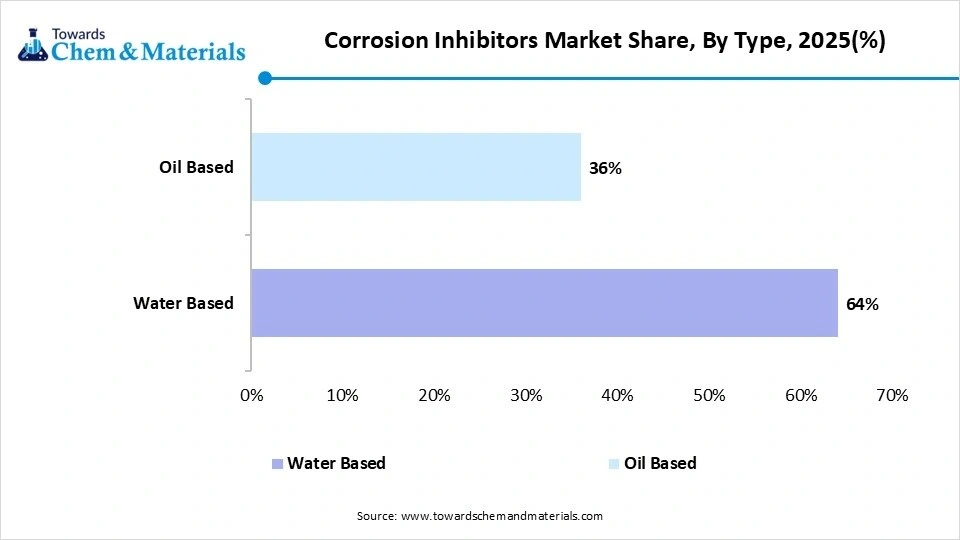
The water-based segment dominated the market with a 64% share in 2025 and is expected to grow at a CAGR of 4.95% over the forecast period. The water-based corrosion inhibitors are eco-friendly and VOC-free chemical additives that dissolve directly into aqueous systems, which help protect the metal surfaces. These inhibitors are commonly formulated using organic amines, carboxylic acids, and water-soluble imidazolines. Because of their safety and non-flammability, they are widely used across multiple industries for specific applications like metalworking and machining, industrial cleaning, and closed-loop systems, which drives growth.
- For instance, in July 2026, CleanGo Innovations Inc. launched CG-P100, a new eco-friendly, water-based pipeline cleaning solution featuring an integrated corrosion inhibitor. Replaces conventional harsh acid cleaners. It lowers interfacial tension to remove contaminants at a molecular level while protecting steel, alloy, and composite pipelines. (Source: www.chemanalyst.com)
The oil-based segment held 36% market share in 2025 and is expected to have the fastest growth with a CAGR of 6.48% in the forecast period. Oil-based corrosion inhibitors are basically oil-soluble inhibitors that are dissolved in hydrocarbons, making a protective layer on the metals. The industrial applications include lubricants, oil and gas, and metalworking, which protect against corrosive production fuels where water-based fluids cannot be used. They are formulated by combining molecules like imidazolines and amino acids; when combined with fatty acids, they form cations that bond firmly to metallic surfaces.
Corrosion Inhibitors Market Share,By Type, 2025(%)
| By Type | Market Share (%) |
| Water Based | 64% |
| Oil Based | 36% |
End Use Insights
The oil and gas segment dominated the market with a 31% share in 2025 and is expected to grow at a CAGR of 6.12% over the forecast period. The corrosion inhibitors are chemical compounds that are injected into the oil and gas system, which help protect the metal infrastructure like pipelines and downhole equipment from gases like carbon dioxide and hydrogen sulphide, the corrosive gases, and also from water produced. They are used in the oil and gas industry, where water-soluble inhibitors cannot be used due to their solubility issue.
The water treatment segment held 17% market share in 2025 and is expected to grow at the fastest rate, with a CAGR of 6.84% over the forecast period. Corrosion inhibitors are used in water treatment to protect pipes and equipment by neutralizing corrosive agents and forming a protective layer and insoluble film on the metal surface. Key types and applications include oxygen scavengers in boilers and steam systems, passivating and precipitation inhibitors in cooling and potable water, copper corrosion inhibitors in yellow metals, and pH adjusters for neutralizing amines.
Corrosion Inhibitors Market Share,By End Use, 2025(%)
| By End Use | Market Share (%) |
| Oil and Gas | 31% |
| Power Generation | 15% |
| Metal Processing | 14% |
| Water Treatment | 17% |
| Chemical Processing | 12% |
| Paper and Pulp | 6% |
| Other | 5% |
Regional Analysis
How did Asia Pacific dominate the Corrosion Inhibitors Market in 2025?
The Asia Pacific corrosion inhibitors market size was estimated at USD 4.07 billion in 2025 and is projected to reach USD 7.52 billion by 2035, growing at a CAGR of 6.33% from 2026 to 2035. Asia Pacific dominated the corrosion inhibitors market with a share of 41% in 2025 and is expected to grow at a CAGR of 5.31% over the forecast period.
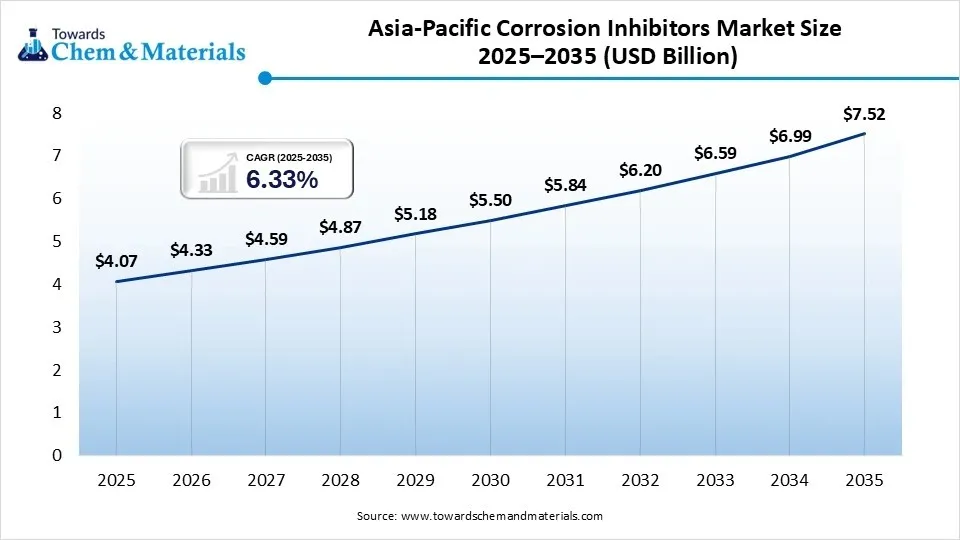
driven by the rapid industrialization in the region, which increases demand for corrosion inhibitors, helping protect heavy industrial equipment from degradation. The growth is also driven by the surging oil and gas exploration and expanding manufacturing sectors, especially in countries like India and China, which boosts the growth of the market. The presence of local manufacturers has increased exports and allowed for steady growth through cost-effective supply across the region, which boosts the growth of the market.
- For instance, in February 2025, RenewSys launched an advanced Anti-Acid Ethylene Vinyl Acetate Encapsulant designed to prevent the internal chemical corrosion that degrades solar panels over time. Unveiled by the PV component manufacturer, this technology marks a significant shift in solar panel manufacturing by addressing a long-standing industry durability issue.(Source: www.energetica-india.net)
India Growing Oil and Gas Sectors
The corrosion inhibitors market is experiencing growth driven by the rising government infrastructure investments in the country, which surge the demand for the market. The countrys surge in demand for protecting industrial equipment in the sector, especially oil nd gas, drives the growth. Major refining and petrochemical hubs in the region like Gujarat and Maharashtra essentially demand inhibitors for the inhibitors for subsea equipment, pipelines, and vessels, boosting the growth of the market in the country.
China Strict Environmental Regulations
Chinas corrosion inhibitors market is experiencing growth driven by large infrastructure spending and rapid industrialization, which demand inhibitors to increase the shelf life of the equipment. The strict environmental regulations which are driven by the Ministry of Ecology and Environment, as there is significant shift from traditional heavy metal-based formulations towards the use of eco-friendly, bio-based, and multifunctional corrosion inhibitors, which boosts the growth of the market. The growing use in municipal water and wastewater treatment, transportation, and power generation, as there is a shift towards the use of oil-based inhibitors in the market.
North America Corrosion Inhibitors Market: Aging Infrastructure Protection
North America corrosion inhibitors market size was estimated at USD 2.38 billion in 2025 and is projected to reach USD 4.44 billion by 2035, growing at a CAGR of 6.43% from 2026 to 2035.North America held 24% of the corrosion inhibitors market share in 2025 and is expected to experience the fastest growth with a CAGR of 6.85% in the forecast period, driven by strict regulations and demand for maintenance of aging infrastructure, increasing demand from sectors. The strict environmental mandates and demand for water management are pushing the industries to adopt water-based, eco-friendly, and bio-based corrosion inhibitor formulations, which drives the growth. Industrial water treatment and advanced monitoring integration bolster the demand for high-performance specialty inhibitors, supporting the growth of the market.
United States Strong Shift Towards Bio-Based Materials
The United States corrosion inhibitors market is driven by the stringent EPA environmental standards, which demand bio-based and sustainable products for growth. The stronger shift towards and heavy focus on performance to reduce environmental impacts and meet strict VOC limits is driving growth. The presence of major domestic chemical and water treatment corporations like Ecolab, Solenis, and ChemTreat also supports the expansion of the market in the country.
Canada Presence of Major Leaders and Suppliers
The growth of Canadas corrosion inhibitors market is driven by the demand for preventive solutions across the country, especially in the oil and gas sectors, driven by extensive pipeline networks in Alberta and British Columbia. Major chemical suppliers and manufacturers operating in Canada include multinational leaders like BASF SE, The Dow Chemical Company, Ecolab, and Baker Hughes, which plays a major role in the growth of the market. The extreme and harsh extraction conditions and demand for water-based and organic inhibitors are rapidly growing the demand. Stringent Canadian environmental regulations are pushing manufacturers towards bio-based, non-toxic alternatives.
Europe Corrosion Inhibitors Market Key Industry Participations
Europe corrosion inhibitors market size was estimated at USD 2.09 billion in 2025 and is projected to reach USD 3.90 billion by 2035, growing at a CAGR of 6.44% from 2026 to 2035.Europe held a market share of 21% in 2025, driven by the stringent REACH chemical regulations and the need for eco-friendly and bio-based inhibitors, especially due to rising demand from regions like Germany and France, which focus heavily on power generation and water treatment, driving growth. Major companies supplying the European market include BASF, which introduced REACH-compliant inhibitors like Protectol HT in European manufacturing plants; Dow, Ecolab, Suez, and Henkel are boosting the growth and expansion of the market.
- For instance, in May 2026, HexcelPack and Armor Protective Packaging partnered to launch ARMOR WRAP HexcelWrap VCI Paper, a dual-action industrial wrapping material that integrates protective physical cushioning with advanced rust prevention. The product is optimized for global supply chains in automotive manufacturing, heavy industrial machinery, precision aerospace components, and metal export logistics where parts are exposed to high-humidity maritime transit.(Source: www.newswire.com)
United Kingdom Domestic Manufacturing Hub for Corrosion Inhibitors
The growth of the countrys corrosion inhibitors market is driven by the push towards bio-based chemical formulations, which boosts growth. Major industry players supplying the UK include global chemical leaders such as BASF SE and Cortec Corporation, alongside specialized domestic manufacturers like Brad-Chem Ltd serving regional engineering and metal-finishing needs, due to demand from consumers. The shift toward sustainable practices remains a primary focus, with organic and water-based inhibitors experiencing high demand to comply with strict regional environmental policies.
Germany Domestic Automobile Sector Presence
The growth of the corrosion inhibitors market in Germany is driven by the robust domestic automotive and manufacturing sectors, which drive demand for corrosion inhibitors to protect vehicles from damage or degradation. The market is heavily shaped by the transition towards eco-friendly, water-based, and organic inhibitors. Stricter mandates across the European Union have accelerated the adoption of bio-based formulations that minimize environmental impact while providing robust protection for critical infrastructure, chemical processing, and renewable energy installations.
Latin America Corrosion Inhibitors Market Technological Shifts
Latin America corrosion inhibitors market size was estimated at USD 0.50 billion in 2025 and is projected to reach USD 1.00 billion by 2035, growing at a CAGR of 7.18% from 2026 to 2035.Latin America held a market share of 5% in 2025, driven by the increasing shift to digital dosage optimization platforms like ChemWatcher, which reduces consumption and maintains integrity, allowing precise chemical application. The focus of global suppliers is to invest in local blending facilities to secure major industrial contracts, driving the growth of the market. The presence of end users or industries like power generation, water treatment facilities, and petrochemicals is demanding reliable inhibitors that help ensure integrity and safety through protection layer, driving the growth.
Brazil: The Mining Network Demand
The growth of the market in Brazil is driven by robust infrastructure and industrial modernization, driving the expansion, and strict environmental regulations drive growth. The countrys expanding industrial base and investment by major giants in infrastructure development boost growth. The tropical climate and extensive pipeline and mining networks generate continuous demand for industrial-grade protection, which supports the expansion of the market in the country. There is a growing demand for organic corrosion inhibitors with high performance value without causing environmental harm, expanding the market growth.
Argentina: Consisting Local Demand
The growth of the Argentina corrosion inhibitors market is driven by industrial demand in sectors like oil and gas, water treatment, and mining, which increases production. The increased demand for maintenance and the increased need for asset integrity fuel the consistent local demand for the market. The upstream and downstream operations rely heavily on corrosion inhibitors, which helps in the prevention of degradation from harsh environmental conditions and corrosion fluids, supporting the growth and expansion of the market.
Middle East and Africa Corrosion Inhibitors Market Growth Factor
The Middle East and Africa corrosion inhibitors market size was estimated at USD 0.89 billion in 2025 and is projected to reach USD 1.72 billion by 2035, growing at a CAGR of 6.81% from 2026 to 2035.The Middle East and Africa held a market share of 5% in 2025, driven by the presence of massive oil and gas reserves, which demand corrosion inhibitors to prevent degradation, along with large-scale desalination projects and industrial diversification across countries like the UAE, South Africa, and Saudi Arabia, supporting the expansion. The rapid urbanization in MEA hubs drives the need for rebar and concrete inhibitors, which demand inhibitors driving growth. Desalination facilities are vital across the Middle East, driving substantial demand for water-treatment-specific inhibitors to protect plants against extreme marine and saline environments.
Saudi Arabia: Major Industrial Hubs
The growth of the market in Saudi Arabia is driven by the growing oil and gas, water desalination, and petrochemical industries, which demand corrosion inhibitors having high performance formulations to mitigate massive asset degradation, supporting growth. The local suppliers and major industrial hubs in the region like Dammam, Jubail, Riyadh, and Jeddah demand corrosion inhibitors to protect the instruments and equipment from degradation.
UAE Local Petroleum Operation
The growth of the UAE corrosion inhibitors market is driven by the dominance of upstream and downstream petroleum operations, which drive demand for the market. Growth is heavily driven by the regions expanding oil & gas sector, water desalination plants, and massive infrastructure investments, which demand high-performance asset integrity solutions. Local suppliers and procurement companies like DUBI CHEM, Innoveda Chemicals, and Jazeera International are the major contributors to the growth of the market.
Recent Developments
- In December 2025, Cortec Corporation launched EcoSonic VpCI-125 HP Permanent ESD Stretch Film, a specialty packaging film delivering permanent electrostatic discharge protection combined with industrial corrosion inhibition. This innovation bypasses the shelf-life limitations of traditional static-control wrap options.(Source: www.plasticstoday.com)
- In May 2025, Petron launched Petron Super Coolant, a universal, ready-to-use engine formula built with anti-rust technology specifically tailored for extreme heat, high humidity, and heavy urban traffic conditions. It utilizes a specialized chemical compound that coats all internal metal surfaces.(Source: www.carguide.ph)
- In June 2025, Daubert Cromwell launched Daubert VCI Films with BioNatur, marking a major milestone as the world’s first polyethylene volatile corrosion inhibitor films that are both 100% biodegradable and 100% recyclable. This development provides a high-performance, eco-conscious alternative to traditional industrial plastics that can persist in ecosystems for centuries.(Source: www.packagingstrategies.com)
Competitive Analysis
- The research and development sectors, especially universities, are increasingly collaborating to form advanced corrosion inhibitors, aligning with sustainability initiatives. The key players like BASF SE, Ecolab, Dow Chemical Company, and Cortec Corporation are increasingly collaborating with major giants to set up facilities and support market growth.
- In January 2026, Researchers from Nagaland University and the University of Science and Technology Beijing successfully developed an eco-friendly corrosion inhibitor synthesized from discarded apple leaves. Published in the Journal of Alloys and Compounds, this collaborative green-chemistry breakthrough offers a sustainable alternative to hazardous, synthetic industrial chemicals.(Source: assamtribune.com)
- In January 2025, Blue Seal Energy Group officially commissioned its $12.5 million ultra-modern specialty chemicals factory in February 2025. Located strategically in the Ibeju-Lekki/Epe zone of Lagos, Nigeria, the state-of-the-art hub sits adjacent to a major mega-refinery to leverage vital petrochemical byproducts as primary raw materials.(Source: www.thisdaylive.com)
Top players in the Corrosion Inhibitors Market & Their Offerings
| Company | Company Type/Position | Major Headquarters | Geographic Presence | Corrosion Inhibitors Offerings | Key Offering/Strength |
| Ecolab Inc. | Global water, hygiene, and corrosion control solutions provider | Saint Paul, Minnesota, USA | North America, Europe, Asia Pacific, Middle East | Corrosion inhibitors for industrial water treatment, oil & gas, power generation, and manufacturing | Comprehensive corrosion management solutions with advanced monitoring technologies |
| BASF SE | Global specialty chemicals manufacturer | Ludwigshafen, Germany | Europe, North America, Asia Pacific, South America | Organic and inorganic corrosion inhibitors for coatings, metalworking fluids, cooling systems, and industrial processes | Broad specialty chemicals portfolio supported by strong R&D and global production capabilities |
| Cortec Corporation | Corrosion protection technologies provider | Saint Paul, Minnesota, USA | North America, Europe, Asia Pacific, Latin America | Vapor corrosion inhibitors, water-based inhibitors, rust preventives, and protective coatings | Strong expertise in environmentally friendly corrosion protection technologies |
| Nouryon | Specialty chemicals manufacturer | Amsterdam, Netherlands | Europe, North America, Asia Pacific, Latin America | Corrosion inhibitors for industrial water treatment, lubricants, metalworking fluids, and cleaning products | Innovative specialty chemicals with a focus on sustainable industrial solutions |
| Henkel AG & Co. KGaA | Global adhesives and specialty chemicals company | Düsseldorf, Germany | Europe, North America, Asia Pacific, Middle East | Surface treatment chemicals, corrosion inhibitors, metal pretreatment solutions, and protective coatings | Advanced surface treatment technologies with strong expertise in metal protection and industrial applications |
Top Key Companies
- Dow Inc. (USA)
- Baker Hughes Company (USA)
- The Lubrizol Corporation (USA)
- Clariant AG (Switzerland)
- Solenis LLC (USA)
- AkzoNobel N.V. (Netherlands)
- DuPont de Nemours, Inc. (USA)
- Ashland Global Holdings Inc. (USA)
- Solvay S.A. (Belgium)
- LANXESS (Germany)
- Croda International Plc (UK)
- Evonik Industries AG (Germany)
- Halliburton Company (USA)
- Innospec (USA)
- Quaker Houghton (USA)
Segments Covered:
By Product
- Organic
- Amines
- Imidazolines
- Phosphonates
- Benzotriazoles
- Carboxylates
- Others
- Inorganic
- Nitrites
- Molybdates
- Silicates
- Phosphates
- Zinc-Based
- Others
By Type
- Water Based
- Neutral Water-Based
- Alkaline Water-Based
- Cooling Water Formulations
- Boiler Water Formulations
- Oil Based
- Solvent-Based
- Hydrocarbon Carrier-Based
- Grease-Based
- High-Temperature Oil Formulations
By End Use
- Oil and Gas
- Upstream
- Midstream
- Downstream
- Power Generation
- Thermal Power
- Nuclear Power
- Renewable Power Plants
- Metal Processing
- Steel Manufacturing
- Metal Finishing
- Mining Equipment
- Water Treatment
- Industrial Water
- Municipal Water
- Cooling Towers
- Chemical Processing
- Petrochemicals
- Specialty Chemicals
- Fertilizer Plants
- Paper and Pulp
- Pulp Mills
- Paper Mills
- Other
- Marine
- Construction
- Automotive
- Food & Beverage
By Regions
- North America
- Europe
- Asia Pacific
- Middle East & Africa
- Latin America



Comments
Share your thoughts, ask a question, or provide feedback about this report.