Find the Right Market Report
Search thousands of industry reports, market insights, and research studies in one place.
Not sure where to start? Try one of these:
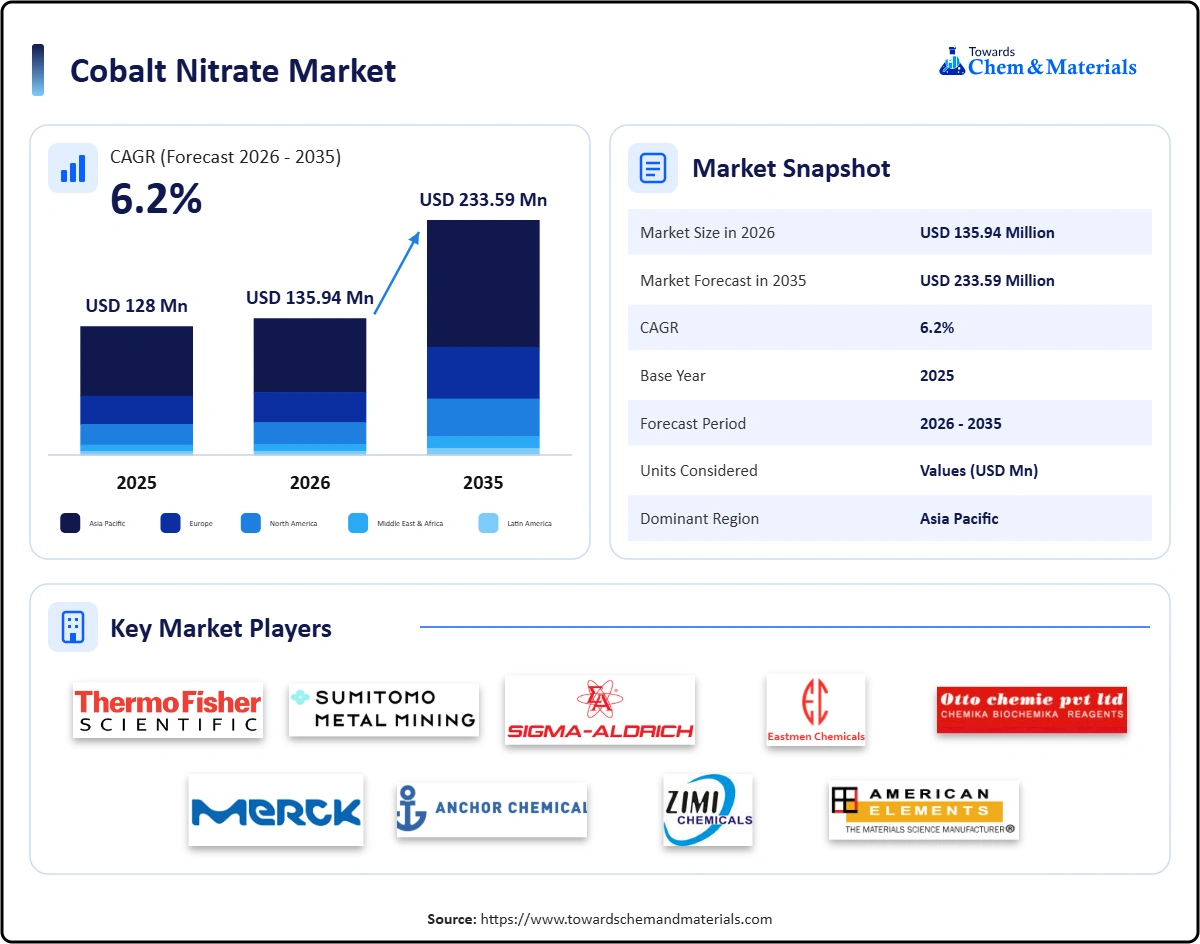
The global cobalt nitrate market size was valued at USD 128 million in 2025 and is expected to reach USD 233.59 million by 2035, growing at a CAGR of 6.2% during the forecast period of 2026-2035. The market includes cobalt(II) nitrate hexahydrate and cobalt nitrate solutions supplied in industrial, battery, and reagent grades. These products are primarily used in catalyst preparation, including Fischer-Tropsch synthesis and hydrotreating, battery materials, pigments and ceramics, and laboratory and research applications.
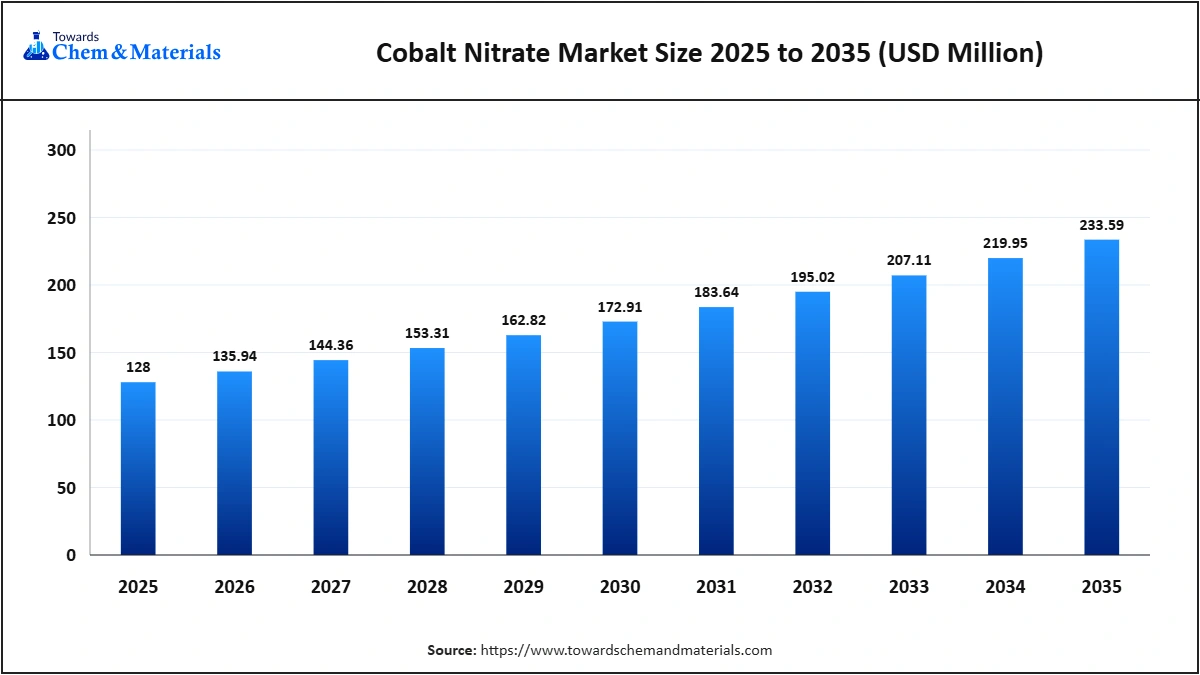
Note: 2025 is the base year; 2026-2035 values are forecasts.
Sources: Expert interviews, secondary sources, Towards Chemical and Materials database and Towards Chemical and Materials analysts.
In 2025, Industrial Grade represented the largest grade category, accounting for 50% of the global cobalt nitrate market. Its leading position is supported by the extensive use of cobalt nitrate as a precursor in cobalt-based catalysts and industrial chemical applications. Asia Pacific led the global cobalt nitrate market with a 54% revenue share in 2025, supported by China's dominant position in cobalt refining and chemical processing. Market expansion is supported by increasing demand for cobalt-based catalysts, battery materials, specialty pigments, and high-purity chemical reagents. The growing interest in sustainable fuel production, battery recycling, and advanced material development is creating additional opportunities for cobalt nitrate suppliers. However, cobalt price volatility, concentrated raw material supply, and chemical handling requirements remain significant market challenges. The DRC's cobalt export quota system, implemented from October 16, 2025 is influencing the availability and pricing of cobalt feedstock.
The global cobalt nitrate market is anticipated to grow from USD 128.00 million in 2025 to USD 233.59 million by 2035, driven by increasing demand for cobalt-based catalysts, battery materials, and specialty chemical applications. Cobalt nitrate is a key chemical precursor in catalyst manufacturing, especially for processes such as Fischer-Tropsch synthesis and hydrotreating, underpinning stable market demand due to its established industrial applications.
The utilization of cobalt compounds in battery production is enhancing opportunities for high-purity cobalt nitrate suppliers. Continued demand from pigment manufacturers, ceramics producers, and research labs sustains usage in specialized applications. Investments in sustainable fuel technologies, battery recycling, and advanced chemical processing are expected to increase market demand. These developments are projected to increase market revenue to USD 172.91 million by 2030 and sustain a CAGR of 6.2% through 2035.
Analyst View: Our market assessment covers cobalt nitrate consumption across grade, application, and regional categories. The estimate considers product demand, cobalt feedstock prices, producer activity, downstream industrial consumption, and regional supply conditions. The forecast incorporates catalyst demand, battery material production, recycling developments, and changes in cobalt trade policies.
Demand for cobalt-based catalysts across refining, petrochemical, and gas-to-liquid processes is creating opportunities for the cobalt nitrate market. Cobalt nitrate serves as an important precursor in the production of cobalt catalysts used in applications such as Fischer-Tropsch synthesis and hydrotreating. Increasing investments in alternative fuel production, synthetic fuel technologies, and advanced industrial catalysts are expected to support its consumption over the forecast period.
The growing battery materials industry, particularly across Asia Pacific, is another factor supporting market demand. Cobalt nitrate is used in the preparation of cobalt-containing compounds and selected battery material precursors. Rising investments in battery manufacturing capacity and the development of advanced energy storage technologies are creating opportunities for suppliers, particularly those offering high-purity cobalt nitrate suitable for specialized applications.
Beyond catalyst and battery-related uses, demand from pigments, ceramics, and specialty chemical manufacturers is contributing to market development. Cobalt nitrate is utilized in various material synthesis and formulation processes, while research laboratories and chemical developers require it for catalyst development and experimental applications. Increasing industrial research activities and the diversification of specialty chemical applications are expected to further support market growth during the forecast period.
Cobalt price volatility represents a significant challenge for cobalt nitrate manufacturers because cobalt is the primary feedstock influencing production costs. Changes in international cobalt prices can affect procurement expenses, product pricing, and profit margins. The concentration of cobalt mining and refining activities in a limited number of countries creates additional supply chain risks. Export restrictions, geopolitical developments, and transportation disruptions can influence raw material availability and manufacturing schedules.
Cobalt nitrate's safety requirements complicate its handling, storage, and transportation, especially for smaller firms due to compliance costs. Additionally, the rise of low-cobalt and cobalt-free battery technologies may hinder market growth in battery-related applications during the forecast period.
The development of sustainable fuel technologies and battery recycling presents significant opportunities for cobalt nitrate manufacturers. Investments in Fischer-Tropsch synthesis and gas-to-liquids facilities can increase demand for cobalt-based catalyst precursors. Additionally, recovering cobalt from end-of-life batteries enhances supply chain resilience, allowing manufacturers with access to recycled cobalt to improve their competitive positions.
Demand for high-purity cobalt nitrate is driving opportunities in specialty chemical manufacturing, advanced materials, and laboratory research. Suppliers can differentiate by creating customized grades. Along with this, growing interest in supply chain diversification allows manufacturers to explore investments in regional refining and long-term procurement agreements, enhancing supply reliability.
| Driver | Impact | ≈ CAGR Contribution | Time Horizon | Key Regions |
| Catalysts for fuels | High | +2.42 pp | Short to long term | Global, strongest in Asia Pacific |
| Battery materials | Medium | +2.04 pp | Medium to long term | Global, fastest uptake in Asia Pacific |
| Pigments | Medium | +1.74 pp | Short to medium term | Global |
| Research | Low | +1.36 pp | Long term | Developed and emerging markets |
Note: Contributions are indicative estimates of each factor's effect on annual growth.
Sources: Expert interviews, secondary sources, Towards Chemical and Materials database and Towards Chemical and Materials analysts.
The cobalt nitrate market is growing due to increased demand from industrial catalysts, battery materials, specialty pigments, and research chemicals, contributing 7.56 percentage points to annual growth. Catalyst demand is the largest contributor, particularly in Fischer-Tropsch synthesis and hydrotreating. In addition, battery materials are boosting growth as production expands. Asia Pacific is set to benefit from industrial development and investments in battery manufacturing.
| Restraint | Impact | ≈ Negative CAGR Contribution | Time Horizon | Key Regions |
| Cobalt price volatility | High | -0.61 pp | Short to medium term | Global |
| Supply concentration | High | -0.45 pp | Medium term | Price-sensitive and emerging markets |
| Toxicity and oxidiser rules | Medium | -0.30 pp | Short term | Asia Pacific and other mature markets |
Note: Contributions are indicative estimates of each factor's effect on annual growth.
Sources: Expert interviews, secondary sources, Towards Chemical and Materials database and Towards Chemical and Materials analysts.
The identified restraints are estimated to offset approximately 1.36 percentage points of annual market growth. Cobalt price fluctuations represent the primary challenge, followed by concentrated raw material supply and regulatory requirements for chemical handling and transportation. Despite these challenges, growing demand for industrial catalysts and battery materials is expected to support market expansion and sustain a CAGR of 6.2% from 2026 to 2035.
| Segments | 2025 Share | 2035 Share | CAGR 2026-2035 |
| Industrial Grade | 50.00% | 47.33% | 5.62% |
| Battery Grade | 30.00% | 33.01% | 7.22% |
| Reagent Grade | 20.00% | 19.66% | 6.02% |
Note: 2025 is the base year; 2035 shares and CAGRs are forecasts.
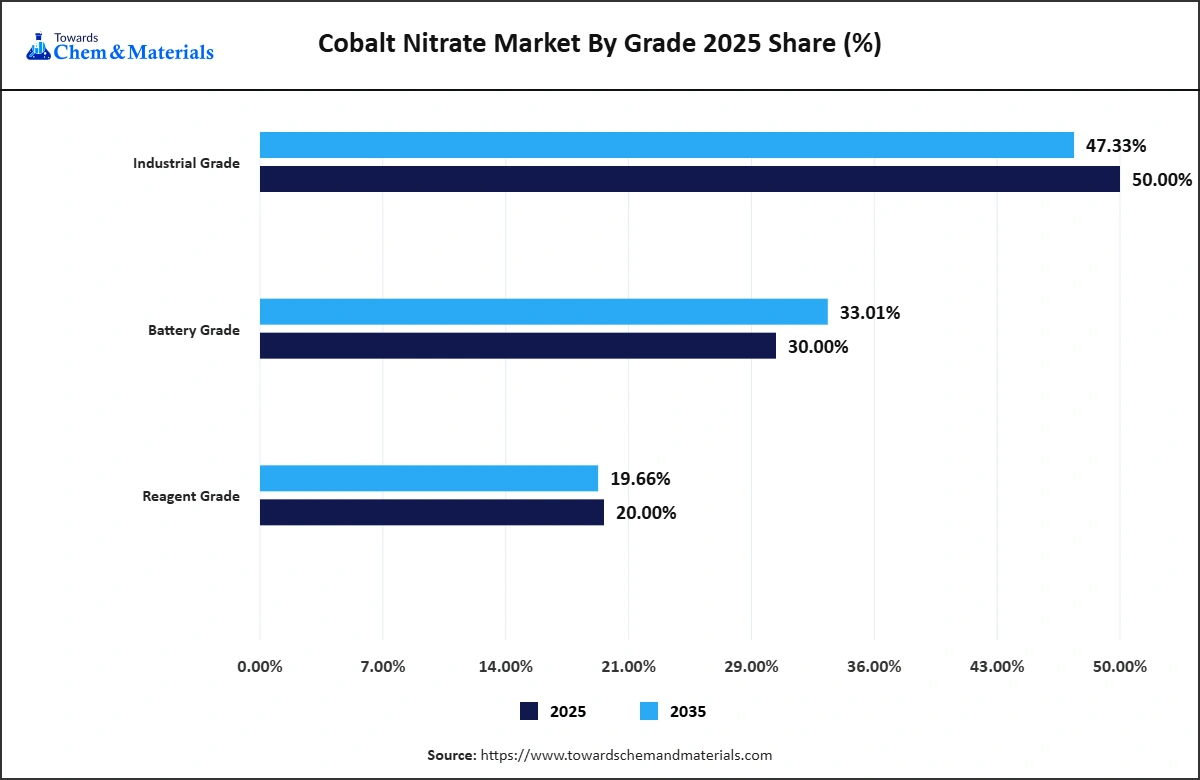
Sources: Expert interviews, secondary sources, Towards Chemical and Materials database and Towards Chemical and Materials analysts.
Industrial Grade dominated the cobalt nitrate market in 2025, accounting for 50% of total revenue. Battery Grade represented 30%, while Reagent Grade accounted for the remaining 20%. The leading position of Industrial Grade reflects its established use in catalyst preparation and industrial chemical processing. However, Battery Grade is expected to experience the fastest growth during the forecast period, supported by expanding battery material applications.
The Industrial Grade segment accounted for 50% of the market in 2025 and is projected to expand at a CAGR of 5.62% from 2026 to 2035. Industrial-grade cobalt nitrate is mainly used as a precursor for cobalt catalyst production and in pigments and ceramics, supported by steady industrial demand. However, the segment is expected to grow slower than the overall market during the forecast period.
The Battery Grade segment represented 30% of the market in 2025 and is anticipated to register the fastest CAGR of 7.22% through 2035. Battery-grade cobalt nitrate is essential for the production of cobalt-based battery materials. Increased demand for high-purity cobalt compounds, along with the expansion of battery manufacturing facilities and investments in battery recycling and advanced material processing, is expected to boost the market over the assessment period.
The Reagent Grade segment held a 20% market share in 2025 and is projected to grow at a CAGR of 6.02% by 2035. Reagent-grade cobalt nitrate is used in laboratory research, analytical chemistry, catalyst development, and material synthesis, with growing demand anticipated from universities, chemical manufacturing, and advanced material development.
Segment Outlook: During the forecast period, industrial grade is expected to maintain its leading position, although its market share is projected to decline to approximately 47.33%. Battery grade is anticipated to register the fastest growth, increasing its share to 33.01% by 2035. Reagent grade will continue serving specialized laboratory and research requirements.
| Segments | 2025 Share | 2035 Share | CAGR 2026-2035 |
| Catalysts | 44.00% | 41.67% | 5.62% |
| Battery Materials | 22.00% | 24.90% | 7.52% |
| Pigments & Ceramics | 18.00% | 17.70% | 6.02% |
| Laboratory & Others | 16.00% | 15.73% | 6.02% |
Note: 2025 is the base year; 2035 shares and CAGRs are forecasts.
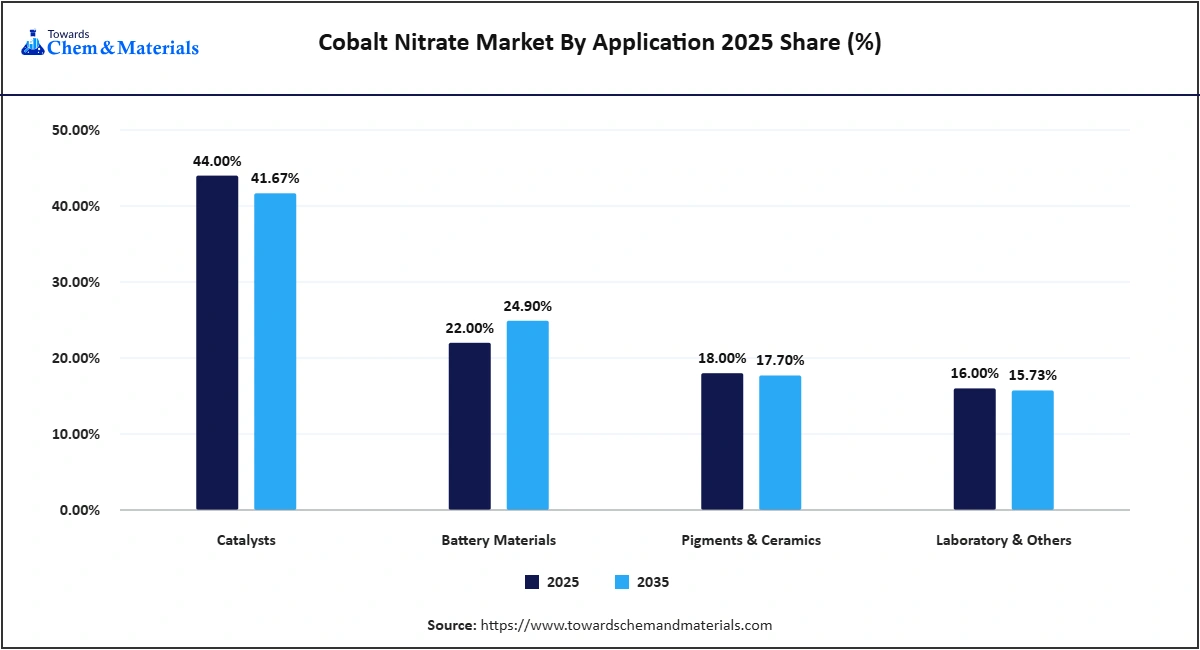
Sources: Expert interviews, secondary sources, Towards Chemical and Materials database and Towards Chemical and Materials analysts.
In 2025, Catalysts dominated the application segment with a 44% market share, followed by Battery Materials at 22%. Pigments and Ceramics represented 18%, while Laboratory and Others accounted for 16%. The leading position of catalysts reflects the established use of cobalt nitrate as a precursor for industrial cobalt catalysts. However, the battery materials segment is expected to register the fastest growth through 2035.
The Catalysts segment accounted for 44% of the market in 2025 and is projected to expand at a CAGR of 5.62% from 2026 to 2035. Cobalt nitrate is used to create cobalt-based catalysts essential for industrial processes such as Fischer-Tropsch synthesis and hydrotreating, responding to the growing demand for alternative fuels and catalyst-driven refining technologies. However, the segment is projected to grow slower than the overall market.
The Battery Materials segment represented 22% of the market in 2025 and is expected to register a CAGR of 7.52% through 2035. The production of cobalt-containing battery materials and the development of advanced battery technologies are supporting demand for high-purity cobalt compounds. Expanding battery manufacturing capacity, particularly across Asia Pacific, is expected to strengthen segment growth.
The Pigments and Ceramics segment held an 18% market share in 2025. The segment is projected to grow at a CAGR of 6.02% over the forecast period. Cobalt compounds are used in producing blue pigments, ceramic colors, and specialty inorganic materials. Demand from ceramics, decorative materials, and specialty pigment manufacturers is expected to support steady consumption.
The Laboratory and Others segment accounted for 16% of the market in 2025 and is anticipated to expand at a CAGR of 6.02% by 2035. Applications include chemical research, analytical testing, catalyst development, material synthesis, and specialty laboratory processes. Increasing research into advanced materials and inorganic chemical formulations is expected to support demand.
Segment Outlook: Catalysts are expected to remain the largest application category through 2035, although their share is projected to decline to around 41.67%. Battery Materials is anticipated to record the fastest growth, increasing its market share to 24.90% by 2035. Laboratory and Others will persist in providing specialized applications in research and chemical development.
Analyst View: In our analysis, Industrial Grade and Catalysts represent the leading categories across their respective segments because of established industrial consumption and cobalt catalyst manufacturing requirements. However, Battery Grade and Battery Materials are expected to gain market share as battery manufacturing and advanced material processing expand. Reagent Grade and Laboratory applications will continue to provide specialized demand.
| Region | 2025 Share | 2035 Share | CAGR 2026-2035 |
| Asia Pacific | 54.00% | 56.79% | 6.74% |
| Europe | 22.00% | 20.66% | 5.54% |
| North America | 16.00% | 15.03% | 5.54% |
| Middle East & Africa | 5.00% | 4.70% | 5.54% |
| Latin America | 3.00% | 2.82% | 5.54% |
Note: 2025 is the base year; 2035 shares and CAGRs are forecasts.
Sources: Expert interviews, secondary sources, Towards Chemical and Materials database and Towards Chemical and Materials analysts.
Asia Pacific dominated the global cobalt nitrate market in 2025, capturing 54% of global revenue. It is projected to be the fastest-growing region, driven by China's cobalt refining, growth in battery material production, and high demand from industrial catalyst producers. Europe came second with 22%, while North America accounted for 16%. The Middle East and Africa represented 5%, and Latin America held the remaining 3%.
Asia Pacific accounted for 54% of the market in 2025 and is projected to register a CAGR of 6.74% from 2026 to 2035. China is a major hub for refining and chemical processing, supported by a strong cobalt supply chain and industrial manufacturing. Rising demand for cobalt-based catalysts, battery materials, and specialty chemicals is expected to boost regional consumption, with Japan, India, and South Korea also contributing significantly through their industrial sectors. Asia Pacific is expected to increase its market share to 56.79% by 2035.
Europe represented 22% of the cobalt nitrate market in 2025. The region is anticipated to expand at a CAGR of 5.54% through 2035. Countries such as Germany, Belgium, France, and the United Kingdom contribute to demand through catalyst manufacturing, chemical processing, and laboratory research. Increasing attention to supply chain diversification and responsible sourcing is expected to influence regional procurement strategies.
North America captured 16% of the market in 2025 and is projected to grow at a CAGR of 5.54% from 2026 to 2035. The United States represents a major consumption market, supported by demand from industrial processing, petrochemical manufacturing, and advanced material research. Growing interest in domestic critical mineral supply chains and battery recycling is expected to support future market opportunities.
Middle East and Africa held 5% of the global market in 2025 and is likely to expand at a CAGR of 5.54% through 2035. Demand is driven by industrial catalyst applications, refining, and gas-to-liquids projects in the Middle East, while Africa, especially the Democratic Republic of Congo, is crucial for upstream cobalt supply. Regional cobalt export policies and refining investments are anticipated to affect market supply conditions.
Latin America accounted for 3% of the market in 2025 and is expected to grow at a CAGR of 5.54% over the forecast period. Brazil and Argentina represent important markets for industrial and specialty chemical consumption. Expanding battery supply chain investments may create additional opportunities over the forecast period.
Analyst View: Based on our analysis, Asia Pacific will maintain its leadership in the cobalt nitrate market due to its established cobalt refining infrastructure, strong chemical manufacturing ecosystem, and expanding battery material production. Europe and North America will remain important established markets, supported by catalyst manufacturing and specialty chemical demand. Meanwhile, the Middle East and Africa will remain strategically important because of their role in cobalt feedstock supply and industrial catalyst applications.
| Rank | Company Name | 2025 Share (%) | Key Products / Business | Headquarters |
| 1 | Huayou Cobalt | 14.00% | Cobalt salts | China |
| 2 | Umicore | 10.00% | Cobalt chemicals | Belgium |
| 3 | Shepherd Chemical | 8.00% | Cobalt nitrate | United States |
| 4 | GEM Co. | 8.00% | Cobalt salts | China |
| 5 | Nanjing Hanrui Cobalt | 6.00% | Cobalt salts | China |
| 6 | Ganzhou Tengyuan Cobalt | 5.00% | Cobalt salts | China |
| 7 | American Elements | 4.00% | Cobalt nitrate grades | United States |
| 8 | Merck KGaA | 3.00% | Reagent cobalt nitrate | Germany |
| 9 | Thermo Fisher Scientific | 3.00% | Laboratory cobalt nitrate | United States |
| 10 | Sumitomo Metal Mining | 3.00% | Cobalt products | Japan |
Note: Company shares are 2025 estimates.
Sources: Company press releases, expert interviews, secondary sources, Towards Chemical and Materials database and Towards Chemical and Materials analysts.
Huayou Cobalt led the global cobalt nitrate market in 2025 with an estimated 14% share, followed by Umicore at 10% and Shepherd Chemical and GEM Co. at 8% each. These companies maintain competitive positions through cobalt chemical portfolios, raw material sourcing capabilities, and established relationships with industrial customers.
Huayou Cobalt and GEM Co. participate in the market through their extensive cobalt salt manufacturing and refining capabilities. Umicore maintains a strong position in specialty cobalt chemicals, while Shepherd Chemical focuses on cobalt nitrate and related inorganic chemical products. Other notable participants include Nanjing Hanrui Cobalt, Ganzhou Tengyuan Cobalt, American Elements, Merck KGaA, Thermo Fisher Scientific, and Sumitomo Metal Mining. These companies participate through cobalt salts, specialty chemical grades, laboratory reagents, and broader cobalt product portfolios.
The top 10 companies accounted for an estimated 64% of global market revenue in 2025, while the remaining 36% was distributed among other cobalt chemical manufacturers and specialty suppliers. Competition is influenced by cobalt feedstock access, product purity, manufacturing capacity, catalyst qualification, supply reliability, regulatory compliance, and pricing.
Huayou Cobalt: Huayou Cobalt, part of Zhejiang Huayou Cobalt Co., Ltd., is headquartered in China and held an estimated 14% share of the cobalt nitrate market in 2025. Its business includes cobalt salts and related cobalt chemical products, supported by its integrated cobalt supply chain and refining capabilities. The company is positioned as a Leader in the Towards Chemical and Materials Companies Quadrant.
Umicore: Umicore is based in Belgium and accounted for an estimated 10% market share in 2025. The company's chemical expertise and established industrial relationships support its competitive position. The company is classified as a Leader in the Towards Chemical and Materials Companies Quadrant.
Shepherd Chemical: Shepherd Chemical, from the United States, held an estimated 8% share of the cobalt nitrate market in 2025. The company's specialty chemical capabilities and established customer relationships support its position as a Leader in the Towards Chemical and Materials Companies Quadrant.
GEM Co.: GEM Co. is headquartered in China and accounted for an estimated 8% market share in 2025. The company's business includes cobalt salts, battery material recycling, and specialty materials. GEM Co. is identified as a Leader in the Towards Chemical and Materials Companies Quadrant.
Nanjing Hanrui Cobalt: Nanjing Hanrui Cobalt is based in China and represented an estimated 6% market share in 2025. Its established presence in the Chinese cobalt processing industry supports its market position. The company is classified as a Leader according to the Towards Chemical and Materials Companies Quadrant.
Ganzhou Tengyuan Cobalt: Ganzhou Tengyuan Cobalt is based in China and accounted for an estimated 5% market share in 2025. The company participates in cobalt products and related chemical processing activities. It is categorized as a Leader in the Towards Chemical and Materials Companies Quadrant.
American Elements: American Elements is headquartered in the United States and held an estimated 4% share of the market in 2025. Its product portfolio includes cobalt nitrate grades and other advanced inorganic materials supplied to industrial and research customers. In the Towards Chemical and Materials Companies Quadrant, the company is identified as an Innovator.
Merck KGaA: Merck KGaA is headquartered in Germany and accounted for an estimated 3% market share in 2025. The company supplies reagent-grade cobalt nitrate and other laboratory chemicals used in research, analytical applications, and material development. It is positioned as an Innovator in the Towards Chemical and Materials Companies Quadrant.
Thermo Fisher Scientific: Thermo Fisher Scientific is from the United States and represented an estimated 3% market share in 2025. Its laboratory chemical portfolio includes cobalt nitrate products used in research and laboratory applications. According to the Towards Chemical and Materials Companies Quadrant, the company is classified as an Innovator.
Sumitomo Metal Mining: Sumitomo Metal Mining is headquartered in Japan and held an estimated 3% market share in 2025. The company's broader business includes cobalt-related products and materials used in industrial and battery supply chains. It is positioned as an Innovator in the Towards Chemical and Materials Companies Quadrant.
The cobalt nitrate market ecosystem connects cobalt miners, refiners, chemical manufacturers, downstream industrial users, and regulatory organizations. Each participant contributes to raw material extraction, refining, chemical conversion, product distribution, and end-use compliance.
| Ecosystem Stage | Role in the Market | Key Companies |
| Miners | Mine cobalt | DRC and Indonesian producers |
| Refiners | Refine cobalt | Huayou, GEM, Umicore |
| Salt Producers | Make cobalt nitrate | Shepherd, Huayou, Hanrui |
| End Users | Use in catalysts, batteries and pigments | Catalyst makers, battery firms |
| Regulators | Set export and chemical rules | DRC regulator ARECOMS, REACH |
Sources: Company press releases, expert interviews, secondary sources, Towards Chemical and Materials database and Towards Chemical and Materials analysts.
Miners: Supply of cobalt ore and intermediate materials for manufacturing mainly originates from the Democratic Republic of Congo and Indonesia, with mining output and export policies impacting their availability and pricing.
Refiners: Companies such as Huayou, GEM, and Umicore engage in converting cobalt-bearing materials into refined cobalt products and intermediates, with refining capabilities affecting feedstock quality and supply reliability.
Salt Producers: Manufacturers such as Shepherd Chemical, Huayou, and Nanjing Hanrui produce cobalt nitrate and various specialty cobalt chemicals from refined cobalt feedstock, leveraging their cobalt chemical portfolios and manufacturing capabilities.
End Users: Consume cobalt nitrate in catalyst preparation, battery material processing, pigments, ceramics, and laboratory research. Catalyst manufacturers, battery companies, specialty chemical producers, and research institutions represent important downstream customers.
Regulators: Establish requirements for cobalt exports, emphasizing chemical classification, environmental compliance, and safe handling. ARECOMS oversees relevant DRC strategic-mineral market controls, while REACH and other jurisdiction-specific frameworks govern chemical-product compliance in multiple markets.
The market value chain begins with cobalt extraction and refining, followed by cobalt salt production and chemical processing. Finished cobalt nitrate products are supplied to catalyst manufacturers, battery material producers, pigment manufacturers, and research organizations through direct procurement agreements and specialty chemical distributors. Suppliers with verified cobalt nitrate production capabilities, secure feedstock access, consistent product quality and qualified customer relationships may strengthen their competitive positions.
The Towards Chemical and Materials Companies Quadrant positions key participants in the cobalt nitrate market by market strength, reflecting revenue scale, market share, and geographic reach, and by innovation and growth strategy, reflecting product portfolio breadth, R&D intensity, and partnerships. Positions reflect each company's estimated 2025 share of the cobalt nitrate market and our assessment of its product innovation, portfolio breadth, and partnerships.
Sources: Company press releases, expert interviews, secondary sources, Towards Chemical and Materials database and Towards Chemical and Materials analysts.
Leaders: Huayou Cobalt, Umicore, Shepherd Chemical, GEM Co., Nanjing Hanrui Cobalt, and Ganzhou Tengyuan Cobalt combine high market share with broad portfolios and strong innovation.
Innovators: American Elements, Merck, Thermo Fisher Scientific, and Sumitomo Metal Mining bring newer technologies and specialised products.
The global cobalt nitrate market is assessed using a product-specific bottom-up model covering cobalt(II) nitrate hexahydrate and commercially supplied aqueous cobalt nitrate solutions. Market revenue is estimated from cobalt nitrate production and sales volumes multiplied by grade- and product-form-specific average selling prices. The analysis excludes revenue from other cobalt salts, cobalt intermediates, finished catalysts, and downstream battery materials. The market model distinguishes industrial, high-purity, and reagent-grade products and maps their consumption across catalyst preparation, selected battery-material synthesis routes, pigments and ceramics, and laboratory applications. Product volumes are standardized using defined physical-volume and cobalt-content conversion assumptions to ensure comparability between solid and liquid products. Regional estimates account for cobalt nitrate production, imports, exports, downstream consumption, and supplier locations. Upstream cobalt mining and refining developments, including DRC export quotas and changes in Chinese refining activity, are incorporated as feedstock availability and pricing variables rather than direct measures of regional cobalt nitrate demand. Forecasts through 2035 incorporate application growth, product specifications, cobalt prices, recycling economics, manufacturing capacity, and regulatory requirements.
The cobalt nitrate market is set for steady growth, driven by industrial catalysts, battery materials, and specialty chemicals. Catalyst precursors for selected Fischer-Tropsch and hydrotreating catalyst formulations, will remain the largest segment, although battery materials are projected to grow faster due to expanding battery manufacturing. Asia Pacific, notably China, will dominate the market, with industrial-grade cobalt nitrate leading and battery-grade gaining share through 2035. Opportunities include sustainable fuel catalysts, battery recycling, and high-purity products, but challenges such as price fluctuations and supply chain issues may impact costs. Manufacturers emphasizing reliable sourcing and product purity are likely to enhance their competitive standing.
Reliable market intelligence and data-driven insights across the global chemicals and materials industry, helping businesses understand trends, competition, pricing, and emerging opportunities.
Schedule a Demo