
Chemical Industry 4.0 Market Size, Share, Trends and Forecast 2026 to 2035
The Chemical Industry 4.0 Market covers hardware, software, services and digital technologies specifically deployed to support chemical-industry manufacturing, process optimization, connected operations, automation and digital decision-making; revenue from unrelated Industry 4.0 applications is excluded
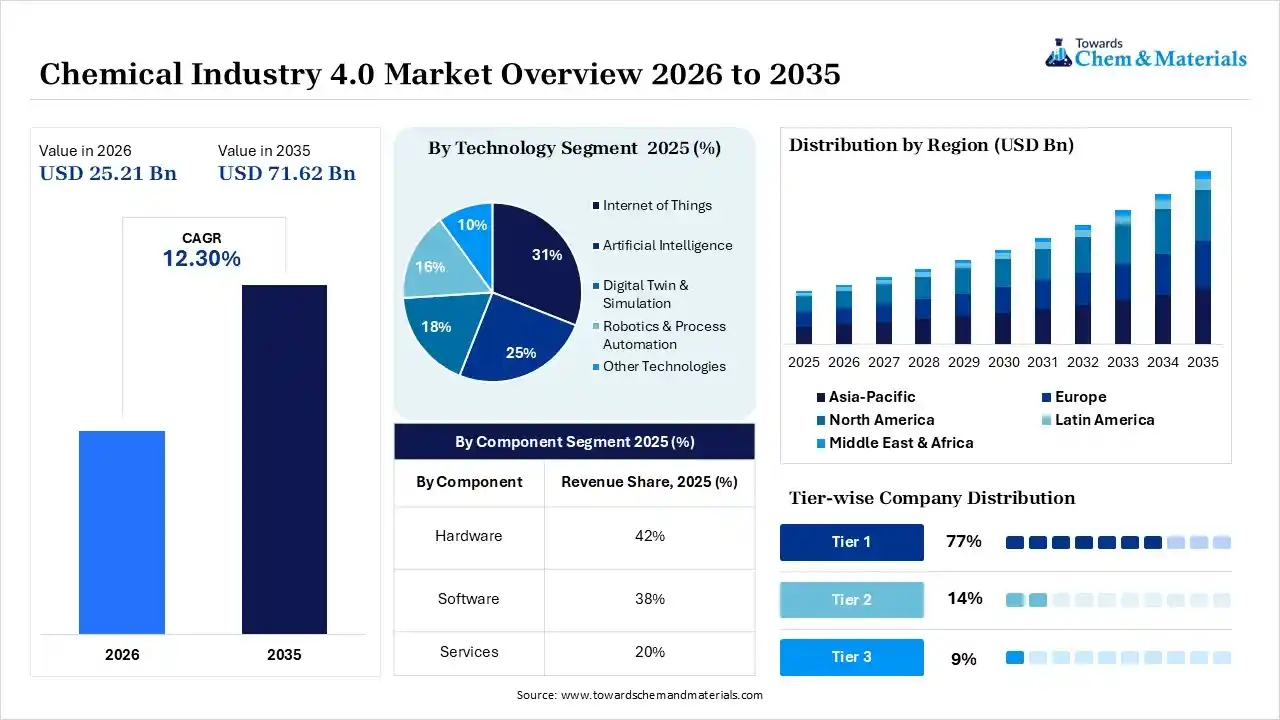
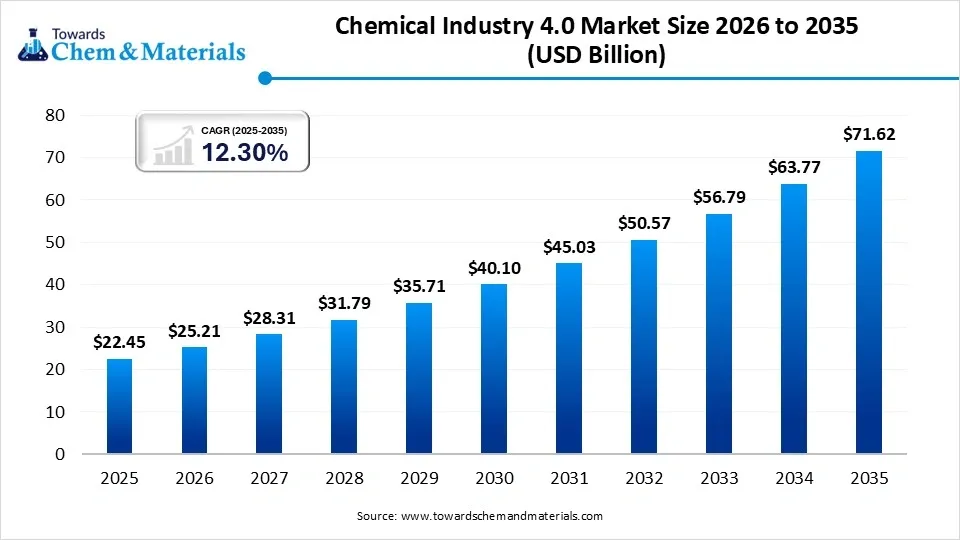
The global chemical industry 4.0 market size was valued at USD 22.45 billion in 2025, is estimated to reach USD 25.21 billion in 2026, and is projected to reach USD 71.62 billion by 2035, exhibiting a compound annual growth rate (CAGR) of 12.30% over the forecast period from 2026 to 2035.Asia Pacific dominated the chemical industry 4.0 market with the largest revenue share of 33% in 2025 and is expected to grow at the fastest CAGR of 12.47% during the forecast period.The growth of the market is driven by the need to integrate digital transformation with sustainability. This shift optimizes operations to counter high energy costs and overcapacity, while maximizing resource efficiency. The growing investments by key companies like Dow India, Reliance Industries, and tech Integrators like Siemens, ABB, and Honeywell are driving major growth, according to the latest reports.
Market Highlights
- By region, Asia Pacific dominated the market with a share of 33% in 2025. Rapid industrialization expands chemical production capacity.
- By region, Europe held 27% market share in 2025 and is expected to experience the fastest growth with a CAGR of 14.6% in the forecast period. Sustainability regulations encourage modernization.
- By component, the hardware segment dominated the market with 42% share in 2025. Expanding deployment of connected plant equipment.
- By component, the software segment held 38% market share in 2025 and is expected to have the fastest growth with a CAGR of 13.40% in the forecast period. Chemical producers prioritize predictive analytics.
- By technology, the Internet of Things segment dominated the market with 31% share in 2025. Connected assets provide real-time operational visibility.
- By technology, the artificial intelligence segment held 25% market share in 2025 and is expected to have the fastest growth with a CAGR of 15.8% in the forecast period. Companies seek productivity improvements through automation.
The Chemical Industry 4.0 market leverages intelligent digital tools in chemical manufacturing, integrating the Internet of Things (IoT), artificial intelligence (AI), and automation to connect physical equipment with digital systems. This shift is crucial as it enhances factory safety, efficiency, and environmental sustainability. Instead of repairing broken parts, companies now utilize sensors to predict failures before they occur.
AI-enabled monitoring significantly cuts down errors and waste. Digital twins, virtual replicas of actual factories, allow companies to test operations under various scenarios before implementing physical changes.
Connected technologies provide chemical manufacturers with real-time operational data that can support process monitoring, maintenance planning, quality management, and production optimization.
- For instance, Bosch Software and Digital Solutions and NxtGen have partnered to launch a sovereign industrial AI cloud tailored for Indian enterprises. This joint initiative combines Bosch SDS's manufacturing AI platforms with NxtGen's local cloud and GPU infrastructure. It aims to accelerate Industry 4.0 adoption while keeping all data workloads and compliance requirements strictly within India.(Source: manufacturingtodayindia)
- For instance, Amarak Chemicals FZC has started a In February 2026, Amarak Chemicals FZC commenced operations at a fully automated sulphur manufacturing facility in Jebel Ali Free Zone, Dubai, with capacity of up to 60,000 metric tonnes per year of sulphur bentonite and related sulphur productsThe plant is designed as Industry 4.0-ready” with “fully automated, with digital process controls designed to improve productivity, precision and operator safety, built to deliver high levels of productivity, safety, precision, and automation. (Source: aninews.in)
Global Investment Flow for Chemical Industry 4.0 Market 2026
These major technology and industrial firms, like Siemens, Honeywell, ABB and IBM participate in industrial digitalization through automation, software, AI, analytics and related technology investments, ABB, and IBM, invest heavily in research, development, and mergers and invest heavily in infrastructure development to integrate process automation, AI-driven process optimization, and virtual digital twin simulations.
- Indian industrial policy initiatives support investment and modernization across chemical and manufacturing infrastructure.Initiatives such as the Make in India program & the establishment of Petroleum, Chemicals & Petrochemicals Investment Regions (PCPIRs) target attracting over $420 billion.
- To fortify the nation’s manufacturing infrastructure, the Government of India has earmarked ₹13,000 crore (approx. US$1.56 billion) for the BioPharma SHAKTI initiative alongside ₹3,300 crore (approx. US$ 396 million) to establish three world-class chemical parks.
- India's newly launched NMP 2.0 outlines a ₹16.72 lakh crore asset-recycling framework for FY26–FY30. Announced by Finance Minister Nirmala Sitharaman, the initiative leverages existing public assets to secure ₹5.80 lakh crore in private investment, driving self-sustained infrastructure development. (Source: ibef.org)
Growth Trends:
- Smart Manufacturing & Automation:Factories use automated systems to control chemical reactors and monitor equipment in real-time. This prevents costly machine breakdowns.
- Digital Twin Technology: Companies use digital twins to build computer models of chemical products. This allows engineers to test formulas and mixtures safely before making physical trial batches.
- Sustainability & Circular Economy: Chemistry 4.0 focuses heavily on "green" practices. Companies are switching to renewable materials, creating closed-loop recycling processes, and reducing harmful emissions.
Report Scope
| Report Attributes | Details |
| Market Size and Volume in 2026 | USD 25.21 Billion |
| Revenue Forecast in 2035 | USD 71.62 Billion |
| Growth Rate | CAGR 12.30% |
| Base Year of Estimation | 2025 |
| Forecast Period | 2025 - 2035 |
| High Impact Region | Asia Pacific |
| Segment Covered | By Component, By Technology, By Regions |
| Key Companies Profiled | Schneider Electric SE, ABB ltd, Honeywell International Inc., Siemens AG, BASF, Dow, SABIC, Sinopec, INEOS, ExxonMobil Chemical, LyondellBasell, Mitsubishi Chemical Group, DuPont, LG Chem, Air Liquide, Air Products, Formosa Plastics, Evonik, Solvay, Covestro, Reliance Industries, Mitsui Chemicals, Toray Industries, Eastman Chemical, Rockwell Automation, SAP, IBM, Microsoft, Yokogawa Electric |
Key Technological Shifts in the Chemical Industry 4.0 Market:
The Chemical Industry 4.0 market uses Artificial Intelligence (AI) to revolutionize production. Key shifts include predictive maintenance to stop equipment breakdowns, digital twins for virtual testing, and advanced data modeling to create greener, highly efficient chemical manufacturing. Traditionally, companies replaced machine parts only after they broke. Now, AI systems use tiny Internet of Things (IoT) sensors to constantly check machine health. AI helps chemical companies adapt quickly when market conditions change.
Chemical Industry 4.0 Regulatory Landscape
| Country / Region | Regulatory Body | Key Regulations | Focus Areas | Notable Notes |
| United States | Department of Energy; National Institute of Standards and Technology; Environmental Protection Agency | Cybersecurity Framework; Smart Manufacturing Programs | Digitalization, automation, and industrial cybersecurity | The U.S. promotes Industry 4.0 adoption in chemical manufacturing through smart factories, AI, and advanced analytics. |
| European Union | European Commission; European Chemicals Agency | Relevant EU policies and regulations include REACH and digital/sustainability initiatives; identify each separately by legal or policy status | Smart manufacturing, sustainability, digital transformation | Europe supports digital integration and sustainable production across chemical manufacturing facilities. |
| China | Ministry of Industry and Information Technology | Made in China 2025; Intelligent Manufacturing Standards | Industrial automation, smart factories | China is rapidly implementing AI, IoT, and digital technologies across chemical production facilities. |
| India | Ministry of Chemicals and Fertilizers; Ministry of Electronics and Information Technology | Digital India Initiative; National Policy on Electronics | Process automation, digital manufacturing | India is increasingly adopting Industry 4.0 technologies to enhance operational efficiency and competitiveness in the chemical sector. |
| Japan | Ministry of Economy, Trade and Industry | Society 5.0 Initiative; Smart Manufacturing Policies | Robotics, AI-driven production, operational efficiency | Japan focuses on advanced automation and digital process optimization in chemical manufacturing. |
| Germany | Federal Ministry for Economic Affairs and Energy; Platform Industrie 4.0 | Industrie 4.0 Framework; Digital Strategy 2025 | Connected factories, predictive maintenance, industrial IoT | Germany is a global leader in Industry 4.0 implementation and digital transformation of chemical production facilities. |
Supply Chain Analysis of Chemical Industry 4.0 Market:
- Digital Solution Development & Implementation:Chemical Industry 4.0 solutions integrate artificial intelligence, industrial IoT, digital twins, advanced analytics, robotics, and cloud computing to optimize chemical manufacturing, improve operational efficiency, and enhance predictive maintenance.
- Siemens: It provides digitalization platforms, industrial IoT solutions, and digital twin technologies that help chemical manufacturers optimize production processes, improve plant efficiency, and reduce operational costs.
- Key players: Siemens, Schneider Electric, ABB, Honeywell
- Digital solutions may require cybersecurity assessment, data-integrity controls, functional validation, interoperability testing, and applicable industrial or sector-specific certification.
- Honeywell: It offers process automation systems, cybersecurity solutions, and advanced process control technologies that support regulatory compliance, operational safety, and digital transformation in chemical plants.
- Key Authorities & Standards: International Organization for Standardization, International Electrotechnical Commission, National Institute of Standards and Technology, International Society of Automation
- Technology Delivery and Implementation to Chemical Manufacturers :Chemical Industry 4.0 technologies are supplied to petrochemical companies, specialty chemical manufacturers, fertilizer producers, pharmaceutical companies, and industrial processing facilities to improve productivity and operational performance.
- Schneider Electric: It delivers smart manufacturing software, energy management systems, and industrial automation solutions that enable chemical companies to enhance productivity, sustainability, and real-time operational visibility.
- Key Suppliers: Siemens, Schneider Electric, ABB.
Chemical Industry 4.0 Market Dynamics
| Drivers | Restrains | Opportunities |
| Sustainability and Circular Economy:Governments demand greener operations. Digital tools allow companies to track the life cycle of materials, lower carbon footprints, and reuse waste. | Data and Safety Risks:Connecting all factory tools to the internet creates security gaps. Companies worry about cyber-attacks and strict laws for handling chemical data. | Smart Automation and Safety:Automated systems replace human workers in dangerous or high-risk chemical environments. Manufacturers use virtual plant models to test safety scenarios and plant upgrades before building them in real life. |
| Artificial Intelligence and Machine Learning:These tools predict equipment problems before they happen. They also design new chemical formulas much faster than the old human trial-and-error methods. | Not Enough Skilled Workers:Running smart factories requires special computer and engineering skills. There are not enough trained workers to manage these new digital tools. | Supply Chain Visibility:Using blockchain and AI Analytics helps companies track raw materials in real-time. This visibility prevents logistical delays and lowers dependency on single suppliers. |
| Internet of Things (IoT):Smart sensors placed in factories track heat, pressure, and chemical levels in real time. This continuous flow of data helps plants run perfectly and safely. | High Setup Costs:Upgrading old, traditional factories with new smart tools is very expensive. Many businesses worry about how long it will take to get their money back. | AI and Predictive Maintenance:AI Analytics fine-tunes reactor temperatures and chemical mixtures. This stops production defects and reduces waste. |
Segmental Insights
Component Insights
The hardware segment dominated the market with 42% share in 2025. This growth is supported by upgrades to existing factory infrastructure and deployment of connected equipment. Companies do this to improve safety, boost output, and track production in real-time. Hardware tools monitor machine health in real-time. Condition-monitoring data can identify abnormal equipment behavior early, allowing maintenance teams to intervene before some failures lead to unplanned downtime. Robotics is increasingly used to handle hazardous materials. Robotics can reduce human exposure to hazardous or repetitive tasks and support safer handling operations.
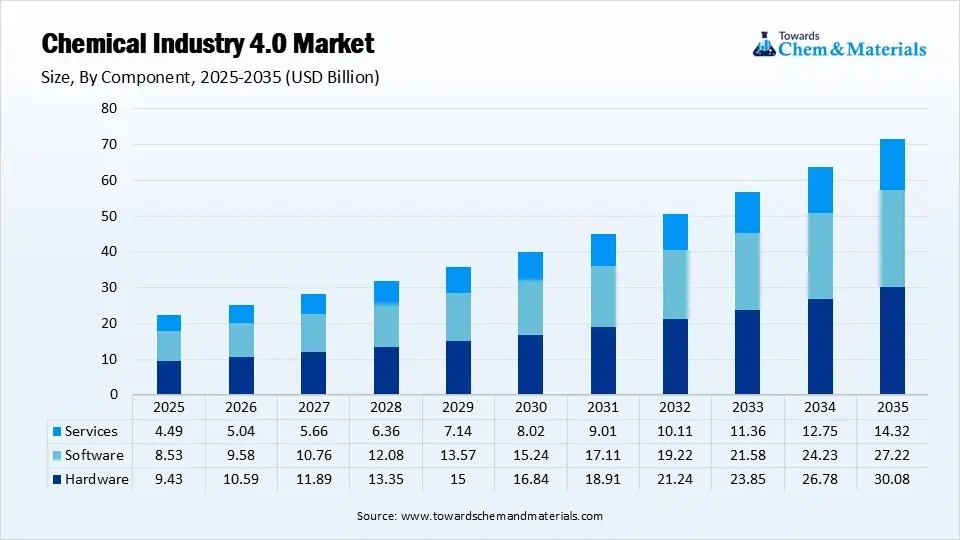
The software segment held a 38% market share in 2025 and is expected to have the fastest growth with a CAGR of 13.40% in the forecast period because companies are replacing old legacy systems with cloud-based platforms, AI, and digital analytics. Chemical makers use this technology to lower costs, track resources efficiently, and meet strict global safety laws. Software uses data from machine sensors to warn workers of equipment problems before the machines break, which prevents expensive factory shutdowns.
Chemical Industry 4.0 Market Share, By Component, 2025 (%)
| By Component | Revenue Share, 2025 (%) |
| Hardware | 42% |
| Software | 38% |
| Services | 20% |
Technology Insights
The Internet of Things segment dominated the market with 31% share in 2025. It is experiencing significant growth because connected sensors and smart devices allow factories to monitor production, prevent equipment failure,& stay competitive,IoT vibration and temperature sensors track equipment health. They predict machine failures before they happen, which cuts expensive repair downtime. IoT tracking tags monitor raw materials. IoT tracking can improve visibility into material location, inventory status, and movement across plant and supply-chain operations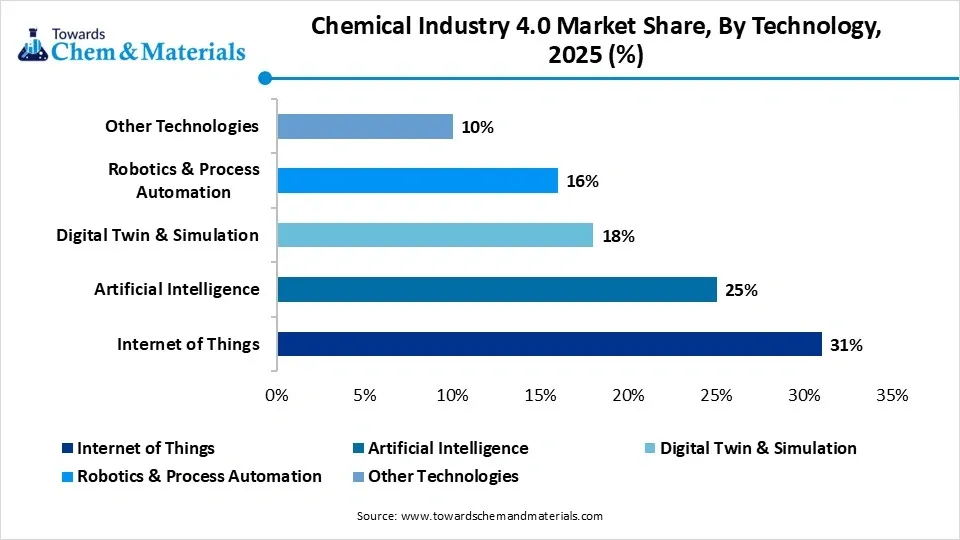
The Artificial Intelligence segment held 25% market share in 2025 and is expected to have the fastest growth with a CAGR of 15.8% in the forecast period. Driven by a shift toward smart manufacturing, this expansion is powered by the demand to accelerate R&D, lowering energy waste, prevent equipment failure, & stay competitive in volatile markets. Digital-twin platforms create virtual representations of chemical plants and processes, while AI and simulation can analyze scenarios and support operational decisions.This allows engineers to test temperature, pressure, and mixture changes safely on computers before applying them.
Chemical Industry 4.0 Market Share, By Technology, 2025 (%)
| By Technology | Revenue Share, 2025 (%) |
| Internet of Things | 31% |
| Artificial Intelligence | 25% |
| Digital Twin & Simulation | 18% |
| Robotics & Process Automation | 16% |
| Other Technologies | 10% |
Regional Analysis
How did Asia Pacific dominate the Chemical Industry 4.0 Market in 2025?
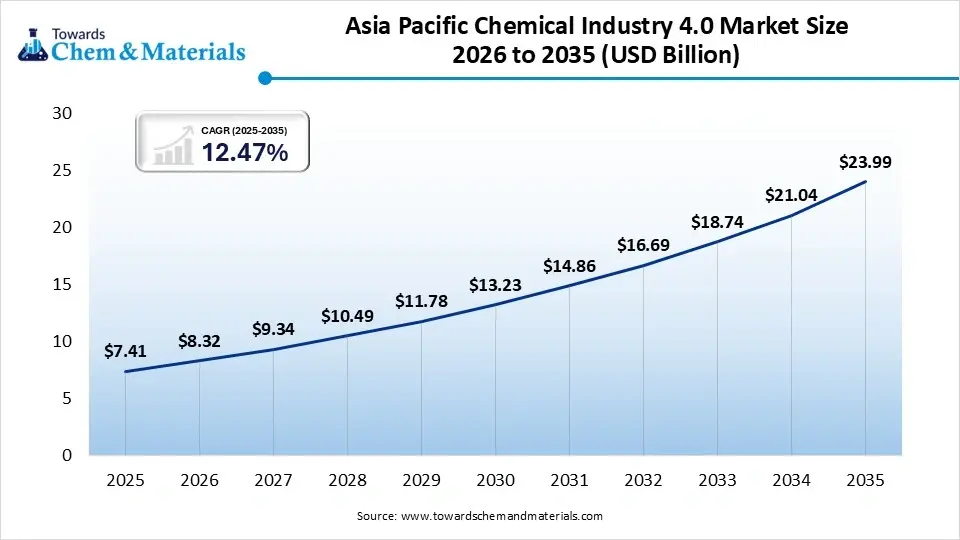
The Asia Pacific chemical industry 4.0 market size was estimated at USD 7.41 billion in 2025 and is projected to reach USD 23.99 billion by 2035, growing at a CAGR of 12.47% from 2026 to 2035.Asia Pacific dominated the market with a share of 33% in 2025. This leadership stems from massive industrial automation, surging smart-factory investments, and fast digital growth in major chemical-producing countries like China, Japan, South Korea, and India. National policies pushed the chemical industry to modernize. Examples include Made in China 2025 and Digital India. Countries like Japan and South Korea used their strong technology backgrounds to build reliable factory sensors and precision instruments. These factors support the growth and expansion of the market in the region.
 India
India
- India’s Chemical Industry 4.0 market is growing rapidly due to the adoption of the Industrial Internet of Things (IIoT), Artificial Intelligence (AI), and Digital Twins.
- Key growth factors include rising global demand for specialty chemicals, supply chain shifts, and government support for smart manufacturing. Industry 4.0 provides a clear view of the whole supply chain. This helps Indian factories meet global safety and environmental rules.
China
- China's Chemical Industry 4.0 market is expanding due to government support, sustainability mandates, and the need to reduce costs. China leads the Asia-Pacific region's digital transformation. Beijing offers strong financial backing to upgrade traditional manufacturing into digital and automated production.
- The state aims to reach zero carbon emissions by 2060. Chemical companies use AI (artificial intelligence) and IoT (internet of things) to carefully monitor energy use and lower waste.
Europe Chemical Industry 4.0 Market Growth Factor
The European chemical industry 4.0 market size was estimated at USD 6.06 billion in 2025 and is projected to reach USD 19.70 billion by 2035, growing at a CAGR of 12.51% from 2026 to 2035. Europe held the market share of 27% in 2025 and is expected to have fastest growth in the market with a CAGR of 14.6% in the forecast period. The main growth drivers are strict environmental regulations, a deep need for energy efficiency, and strong government support for smart manufacturing. Companies use advanced digital tools to stay competitive on a global scale. European governments and the EU fund digital research and smart factory projects. They give financial aid to chemical makers who upgrade their old systems. This support helps European chemical parks maintain their status as global leaders.
Germany
- Germany's market is growing rapidly due to the need for advanced automation, strict eco-friendly regulations, and the urgency to stay competitive globally. The transition upgrades basic chemical production into a modern, digital, and sustainable sector.
- Germany and the European Union have strict environmental laws. Smart factories help the chemical sector lower its carbon footprint and support the circular economy. This means using technology to recycle materials and create green, eco-friendly plastics.
Italy
- Italy's Chemical Industry 4.0 market is growing rapidly, driven by the need for cost reduction, strict European environmental rules, and a strong focus on smart manufacturing Italy follows tough European Union rules on chemical safety. Smart systems track energy use and lower pollution to meet these laws.
North America Chemical Industry 4.0 Market Growth Factor
The North American chemical industry 4.0 market size was estimated at USD 6.74 billion in 2025 and is projected to reach USD 21.84 billion by 2035, growing at a CAGR of 12.48% from 2026 to 2035. North America held the market share of 30% in 2025, due to advanced digital adoption, strict government safety rules, and the need for lower production costs. The United States leads this market due to its advanced technology and strong automation industry. Federal and local governments push for environmentally friendly manufacturing. Smart technologies help companies use less energy and lower their carbon footprint. The region is home to major technology companies like Honeywell, Emerson, and Rockwell Automation. Their presence makes it easy for chemical companies to upgrade their systems.
U.S.
- U.S. Chemical Industry 4.0 market growth is primarily driven by the need to offset rising production costs, meet stringent environmental regulations, and improve plant safety. Companies use smart technologies to reduce energy waste and maximize output. U.S. federal efforts push for better cybersecurity and advanced manufacturing.
Canada
- Canada's Chemical Industry 4.0 market is expanding rapidly, driven by the need for process efficiency and environmental compliance
- Canadian chemical and petrochemical sites use digital models of physical factories to test safety scenarios before making real-life changes. Federal and provincial funding programs encourage industrial digitization and clean technology innovation.
Latin America Chemical Industry 4.0 Market Growth Factor
The Latin America chemical industry 4.0 market size was estimated at USD 1.35 billion in 2025 and is projected to reach USD 4.66 billion by 2035, growing at a CAGR of 13.19% from 2026 to 2035.Latin America held the market share of 5% in 2025, driven by rising government digitalization policies, the need to lower operating costs, and increased investments in smart sensors and cloud monitoring. Governments are launching national roadmaps for industry. For example, Brazil's digital transformation roadmap provides public and private funds to adopt AI and IoT (Internet of Things). Local companies are upgrading their systems with the help of global automation leaders to stay competitive in the global market.
 Brazil
- Brazil has launched national plans to support smart industries. Governments are offering tax breaks and grants to help factories upgrade.
- Brazil is a global leader in food exports. This drives a massive need for advanced agrochemicals, pushing producers to adopt Industry 4.0 technologies to scale output. Brazil is a pioneer in bioethanol. Expansion into bio-based chemicals requires advanced automation and precise monitoring.
Argentina
- Chemical plants in Argentina are upgrading to "smart" factories. They use robotics and automated systems to mix, pack, and move products safely. This speeds up production and reduces human error.
- Argentina has a strong agricultural and mining sector. The demand for crop protection chemicals, herbicides, and mining chemicals like those used for copper extraction pushes companies to upgrade their facilities to meet this high market need.
Middle East and Africa Chemical Industry 4.0 Market Growth Factors
The Middle East and Africa chemical industry 4.0 market size was estimated at USD 0.90 billion in 2025 and is projected to reach USD 3.22 billion by 2035, growing at a CAGR of 13.60% from 2026 to 2035.The Middle East and Africa held the market share of 5% in 2025. This growth is driven by government economic goals, heavy investments in smart petrochemical facilities, and the need to improve plant safety and energy efficiency. National initiatives are the primary driver for digital adoption in the MEA region. Governments are pushing to modernize their industrial sectors beyond traditional oil and gas. Major regional energy and chemical companies are investing heavily in new digital tools.
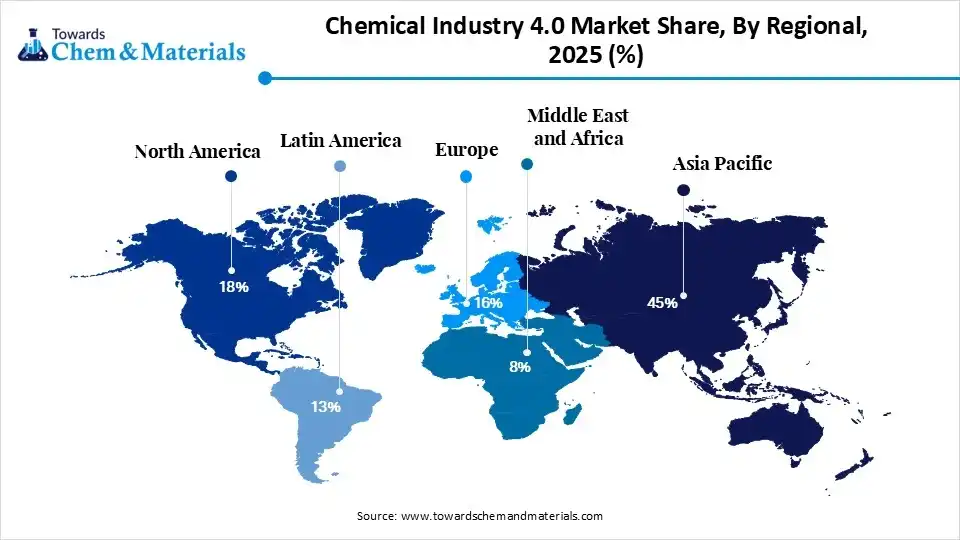
Chemical Industry 4.0 Market Share, By Regional, 2025 (%)
| Regional | Revenue Share, 2025 (%) |
| Asia-Pacific | 45% |
| North America | 18% |
| Europe | 16% |
| Latin America | 13% |
| Middle East & Africa | 8% |
Saudi Arabia
- Government programs like the National Industrial Strategy (NIS) seek to grow downstream chemical output and shift to specialty chemicals, driving a need for modern, digital operations.
- Smart cities and infrastructure projects (like NEOM) increase the need for specialty construction and industrial chemicals, pushing manufacturers to adopt smart factory tech.
UAE
- Initiatives like the UAE Industry 4.0 market and Operation 300bn push factories to use IoT, AI, and robotics.
- Companies like the Abu Dhabi National Oil Company invest heavily in digital twin platforms and smart refinery software.
- Digital transformation allows real-time monitoring and predictive maintenance, which reduces operational costs and improves safety.
Recent Developments
- In March 2026, the S.A. Niyazov Turkmenabat Chemical Plant is integrating AI and Industry 4.0 technologies to digitalize production, aiming for a In March 2026, the S.A. Niyazov Turkmenabat Chemical Plant announced plans to implement Industry 4.0 technologies, including AI, Industrial Internet technologies and Big Data analytics, at a new fertilizer complex designed for 350,000 tonnes per year of superphosphate and 100,000 tonnes per year of ammonium sulfate. The smart facility will integrate industrial internet technologies and Big Data analytics. (Source: business.com.tm)
- In August 2026, the AI for Manufacturing and Supply Chain Institute at Tecnológico de Monterrey and PerkinElmer launched the SMART–PerkinElmer laboratory at the Querétaro campus for materials characterization and industrial research.(Source: tecscience.tec.mx)
Competitive Analysis
Competitive advantage is increasingly driven by integrated digital platforms, cybersecurity capabilities, AI-powered process optimization, data-driven decision-making tools, and the ability to support sustainable and efficient chemical manufacturing operations.
- Major players in the Chemical Industry 4.0 market include Siemens, Schneider Electric, Honeywell, ABB, and Emerson, which compete through digitalization, automation, and smart manufacturing solutions for chemical plants
- Bharat Sanchar Nigam Limited (BSNL) and Numaligarh Refinery Limited (NRL) have signed a Memorandum of Understanding to increase industry 4.0 adoption to deploy India's first 5G CNPN.(Source: www.indianchemicalnews.com)
Top players in the Chemical Industry 4.0 Market & Their Offerings:
| Company | Company Type/Position | Major Headquarters | Geographic Presence | Chemical Industry 4.0 Offerings | Key Offering/Strength |
| Siemens AG | Industrial automation and digitalization leader | Munich | Europe, North America, Asia Pacific, Middle East | Industrial IoT platforms, digital twins, smart manufacturing software, process automation solutions | Comprehensive digital transformation ecosystem for chemical manufacturing facilities |
| Honeywell International Inc. | Process automation and industrial software provider | Charlotte | North America, Europe, Asia Pacific, Middle East | Advanced process control systems, industrial cybersecurity, connected plant solutions, predictive analytics | Strong expertise in process optimization and operational efficiency for chemical plants |
| ABB ltd | Automation and digital industry solutions provider | Zurich | Europe, Asia Pacific, North America, the Middle East, and Africa | Industrial automation, robotics, digital asset management, smart plant technologies | Advanced automation and real-time operational intelligence capabilities |
| Schneider Electric SE | Digital automation and energy management Specialist | Rueil-Malmaison | Europe, North America, Asia Pacific, Latin America | Industrial IoT solutions, smart manufacturing platforms, energy optimization software | Integration of sustainability, energy efficiency, and industrial digitalization |
Market Top Players Are
- BASF
- Dow
- SABIC
- Sinopec
- INEOS
- ExxonMobil Chemical
- LyondellBasell
- Mitsubishi Chemical Group
- DuPont
- LG Chem
- Air Liquide
- Air Products
- Formosa Plastics
- Evonik
- Solvay
- Covestro
- Reliance Industries
- Mitsui Chemicals
- Toray Industries
- Eastman Chemical
- Rockwell Automation
- SAP
- IBM
- Microsoft
- Yokogawa Electric
Segments Covered
By Component
- Hardware
- Sensors
- Industrial Controllers
- Edge Devices
- Networking Equipment
- Smart Monitoring Systems
- Software
- Manufacturing Execution Systems (MES)
- Asset Performance Management
- Predictive Analytics Platforms
- Supply Chain Management Software
- Process Optimization Software
- Services
- Consulting Services
- Integration & Deployment
- Managed Services
- Maintenance & Support
- Training & Workforce Enablement
By Technology
- Internet of Things
- Smart Sensors
- Connected Equipment
- Remote Monitoring Systems
- Artificial Intelligence
- Machine Learning
- Predictive Maintenance
- Process Intelligence
- Computer Vision
- Digital Twin & Simulation
- Process Simulation
- Plant Digital Twins
- Asset Modeling
- Robotics & Process Automation
- Collaborative Robots
- Autonomous Material Handling
- Automated Quality Inspection
- Other Technologies
- Augmented Reality
- Blockchain
- Advanced Cybersecurity
- Cloud Computing Platforms
By Regional
- North America
- Asia Pacific
- Europe
- Latin America
- Middle East & Africa
A Seven-Phase Framework
Our methodology is designed to be universally applicable across commodity chemicals, specialty chemicals, petrochemicals, construction chemicals, coatings, electronic chemicals, industrial gases, agrochemicals, water treatment chemicals, and performance materials. Each phase builds upon the last, creating a layered validation structure that minimizes estimation error and maximizes analytical confidence.
The framework ensures comprehensive market coverage, robust cross-validation, and reliable long-term forecasting — producing market estimates that withstand scrutiny from investors, regulators, and corporate strategy teams.

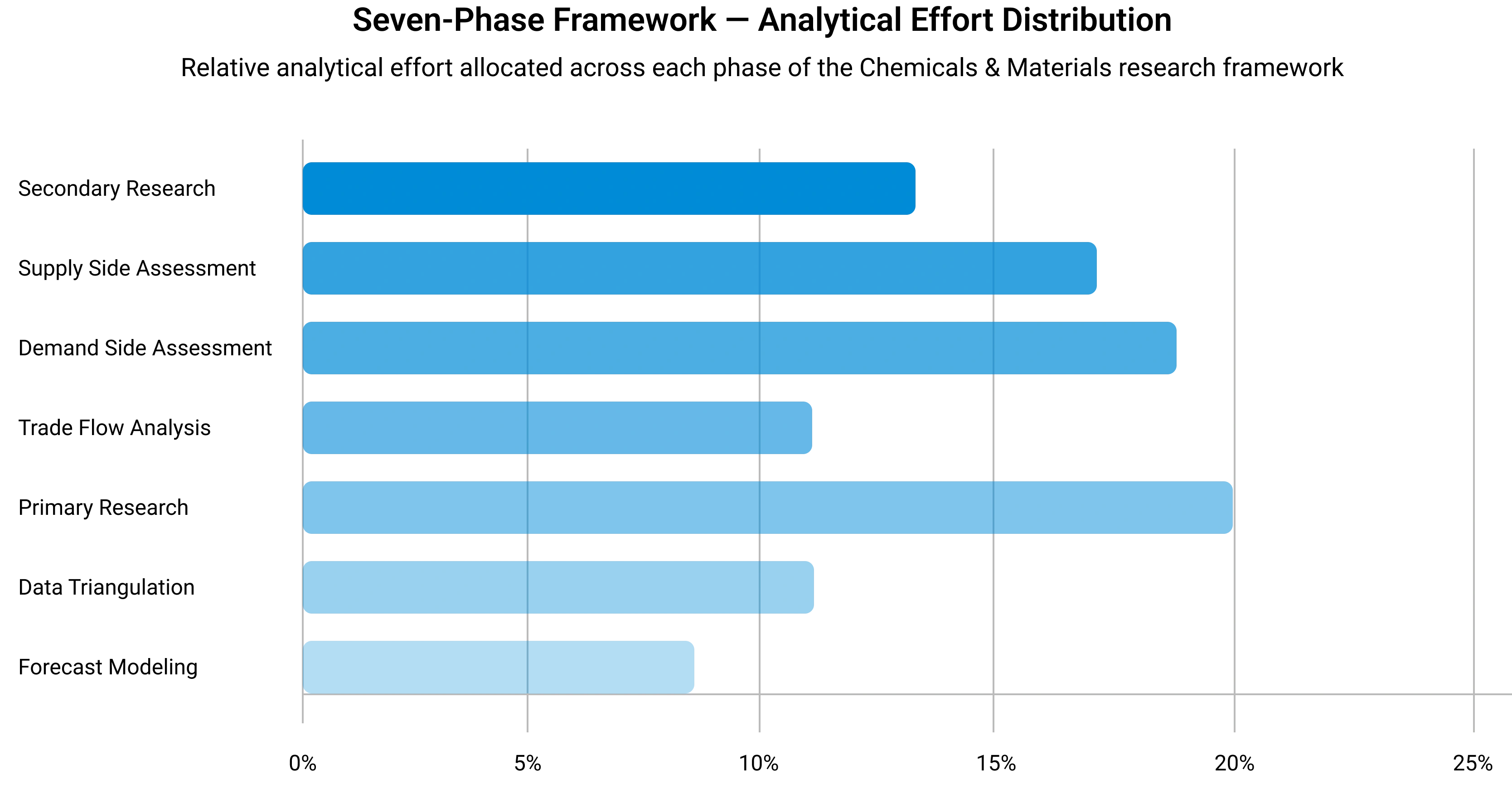
Seven-Phase Framework — Analytical Effort Distribution
Relative analytical effort allocated across each phase of the Chemicals & Materials research framework
Phase 1 - Secondary Research: Establishing the Foundation
Secondary research collects and evaluates publicly available information from authoritative sources, establishing the foundational understanding of market structure, value chain dynamics, competitive landscape, and end-use demand patterns. Every source is evaluated for credibility, recency, geographic relevance, and methodological soundness before inclusion.
Industry Associations
Sources include ACC, CEFIC, ICCA, JCIA, CPCIF, and SOCMA providing production volumes, consumption trends, capacity developments, and sustainability initiatives.
Company Disclosures
Annual reports, investor presentations, earnings transcripts, and regulatory filings reveal product portfolios, manufacturing footprints, capacity expansions, and revenue segmentation.
Government Databases
National statistical offices, customs authorities, environmental agencies, and industrial production databases provide verified statistics on output, trade flows, and regulatory compliance.
Trade Databases
UN Comtrade, ITC, Eurostat, and national customs authorities enable assessment of global product movement, import dependency, and export competitiveness across regions.
Our Secondary Research Sources
- Ministry of Chemicals and Fertilizers
- European Chemicals Agency
- United States Department of Energy
- Ministry of Industry and Information Technology
- Ministry of Economy Trade and Industry
- Ministry of Trade Industry and Energy
- National Institute of Standards and Technology
- Council of Scientific and Industrial Research
- Fraunhofer Society
- National Institute for Materials Science
Phase 2 — Supply-Side Assessment: Mapping Production Capabilities
Production Capacity Analysis
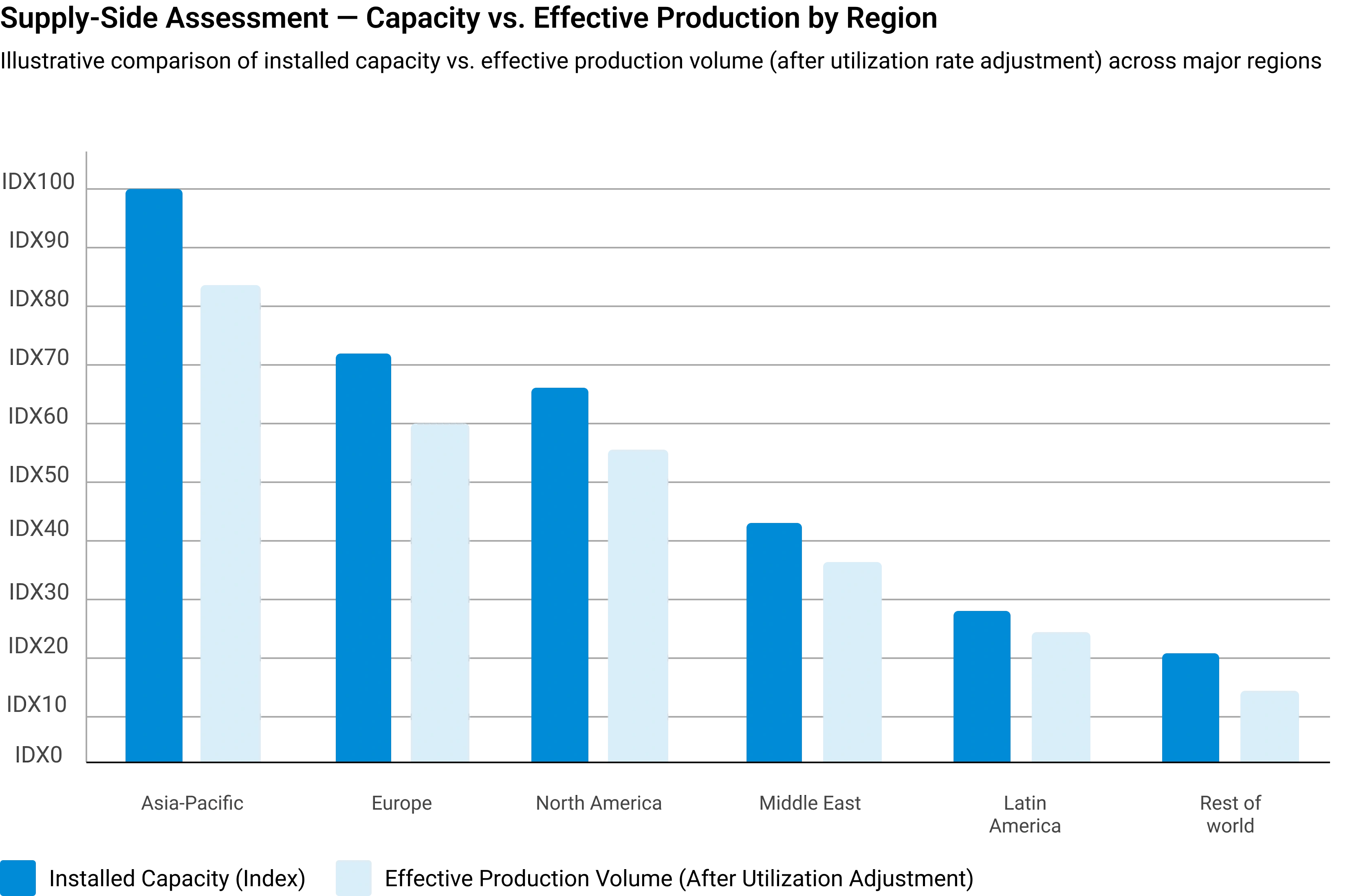
All major manufacturers are assessed for existing installed capacity, planned additions, expansions, new plant announcements, and technology adoption — mapped at global, regional, and country levels.
Capacity Utilization Adjustment
Installed capacity is adjusted using utilization rates based on demand conditions, feedstock availability, plant operating rates, maintenance schedules, and regulatory restrictions.
Manufacturer Revenue Analysis
Product-specific revenues, segment-level performance, regional distribution, average selling prices, and margin trends are evaluated to establish market value estimates.
Supply-Side Assessment — Capacity vs. Effective Production by Region
Illustrative comparison of installed capacity vs. effective production volume (after utilization rate adjustment) across major regions
Phase 3 — Demand-Side Assessment: Quantifying Chemical Consumption
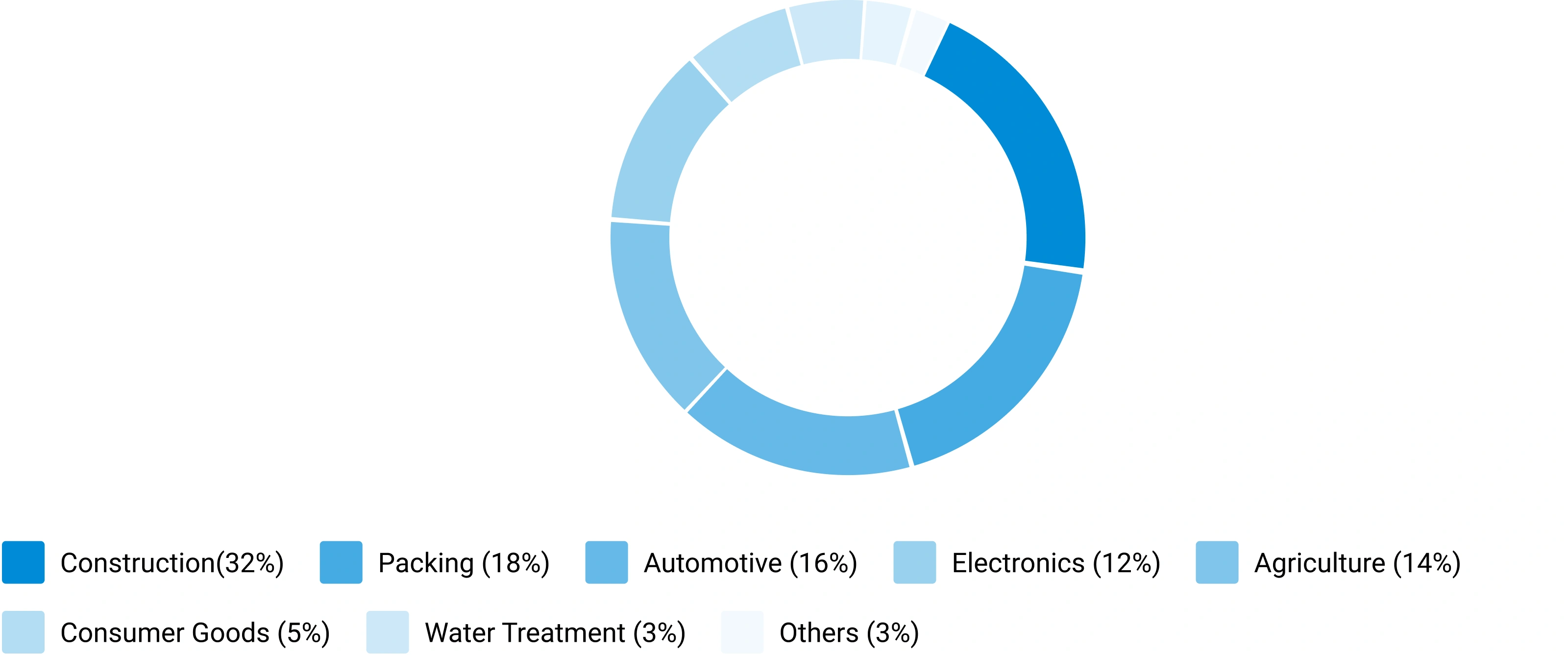
Demand-side analysis quantifies chemical consumption across industries, applications, and geographies — identifying where and how chemicals are consumed throughout the value chain with precision.
End-Use Industry Analysis
Chemical demand is evaluated across automotive, construction, packaging, electronics, agriculture, healthcare, consumer goods, industrial manufacturing, energy and utilities, and water treatment. Industry output, production trends, and consumption intensity are analyzed to determine demand patterns.
Consumption Modeling
Demand is estimated using measurable indicators: kilograms per vehicle, kilograms per square meter of construction, dosage per cubic meter of water treated, kilograms per hectare of agricultural land, and kilograms per ton of manufactured products. Consumption factors are validated through industry publications and primary interviews.
Application Analysis
The market is segmented by application area to understand product performance requirements, formulation trends, technology adoption, customer preferences, and regulatory requirements improving demand accuracy and segmentation granularity.
Demand-Side Assessment — End-Use Industry Demand Distribution
Illustrative distribution of chemical & materials demand across key end-use industries
Phase 4 - Trade Flow Analysis: Balancing Regional Supply and Demand
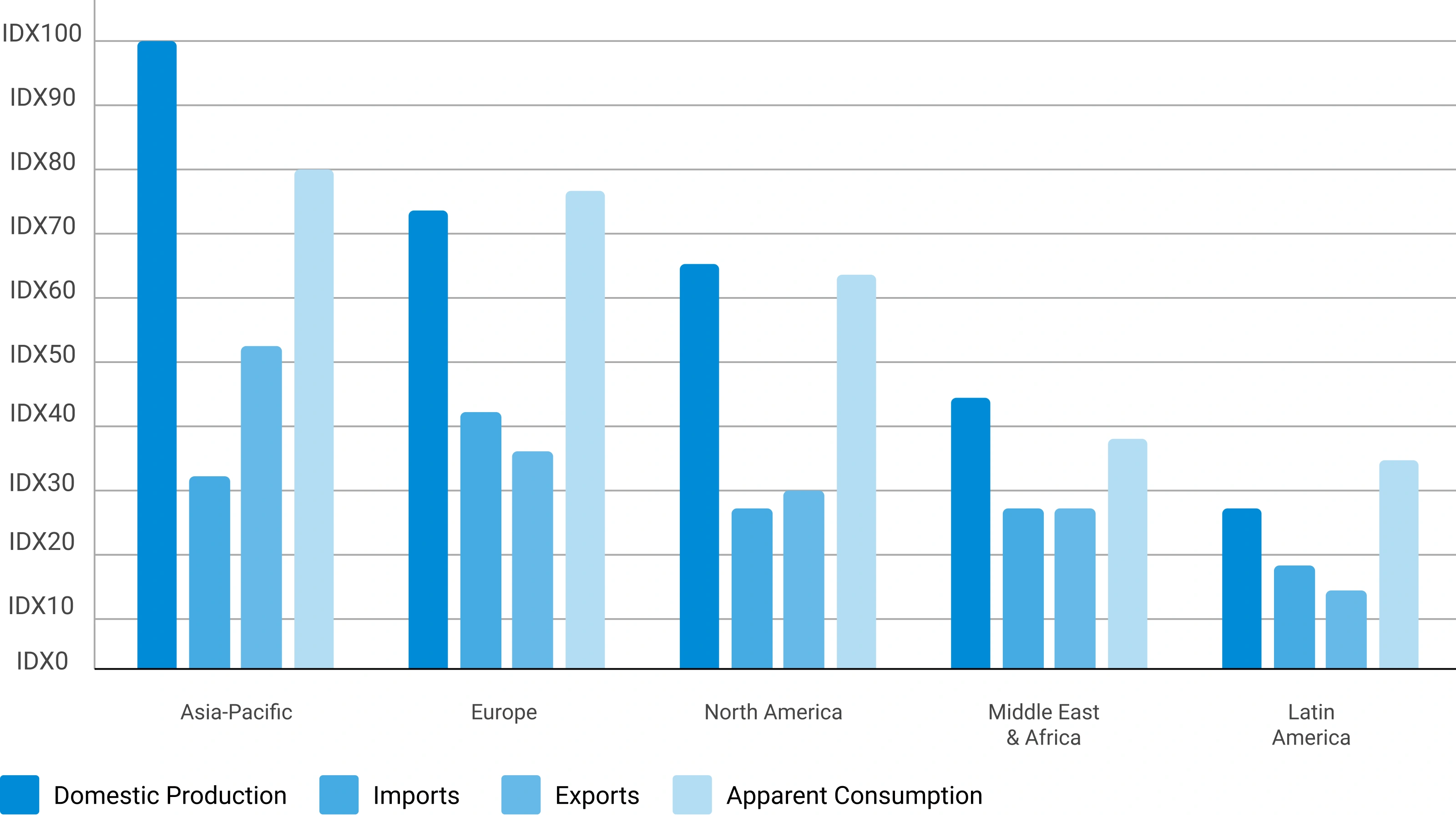
Trade flow analysis reconciles regional supply and demand estimates through import and export data, identifying net supply positions, regional dependencies, and market imbalances. It serves as an independent validation layer that tests the consistency of supply-side and demand-side estimates.
Import Analysis
Import data is evaluated to determine volumes, source countries, product dependency, regional supply gaps, and pricing trends — identifying markets that rely heavily on external supply and where domestic production is insufficient to meet demand.
Export Analysis
Export assessments reveal production surplus, export competitiveness, regional manufacturing strength, and global market participation. Export patterns also help validate domestic production estimates and identify net exporting regions.
Apparent Consumption Model
Regional consumption is assessed using the standard apparent consumption formula:
Results identify net importing regions, net exporting regions, regional deficits, and surpluses — serving as an independent validation of supply and demand estimates.
Trade Flow Analysis — Net Supply Position by Region
Illustrative apparent consumption vs. domestic production across major regions — positive gap indicates net import dependency
Phase 5 — Primary Research: The Critical Validation Layer
Primary research tests and refines findings from secondary research through direct engagement with industry participants across the supply chain, demand side, and expert community. It captures intelligence that no database or published report can provide — the real-world experience of manufacturers, buyers, and specialists operating in the market.

Supply-Side Interviews
Conversations with chemical manufacturers, raw material suppliers, contract manufacturers, technology providers, and plant operators cover production trends, capacity utilization, pricing developments, technology shifts, and competitive dynamics.

Demand-Side Interviews
Engagement with OEMs, industrial consumers, procurement managers, distributors, formulators, and end-use manufacturers focuses on consumption trends, purchasing behavior, product substitution, demand outlook, and emerging applications.

Industry Expert Consultations
Additional interviews with industry consultants, independent experts, regulatory specialists, technical professionals, and research institutions provide deeper market context and validate key analytical assumptions.
Focus Areas of Primary Research:
Market Size & Forecast Validation
Revenue estimates, volume consumption, growth rates, forecast assumptions, regional demand.Supply Chain & Value Chain Assessment
Raw material sourcing, supply chain challenges, distribution networks, procurement practices.Production & Capacity Analysis
Manufacturing capacity, utilization rates, expansion projects, plant investments.Pricing & Cost Structure Analysis
Product pricing trends, feedstock costs, energy costs, margin pressures, pricing outlook.Competitive Landscape Assessment
Volume and value estimates confirmed to be fully consistent with one another before publicationInterview Volume by Market Scope
| Study Scope | Number of Interviews |
|---|---|
| Niche Market | 20 – 30 |
| Mid-Sized Market | 30 – 50 |
| Global Market | 50 – 80 |
| Highly Fragmented Market | 80 – 120 |
Interview Details:
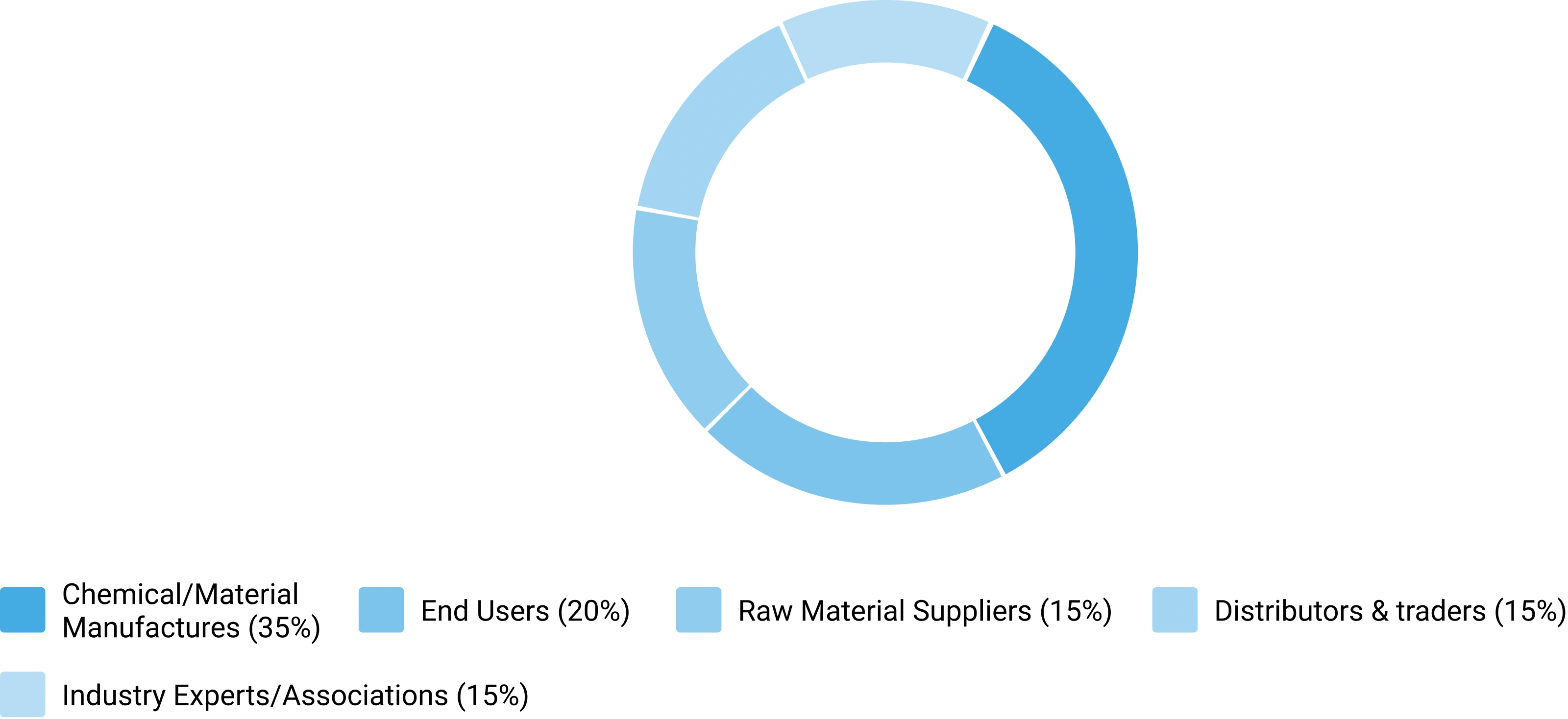
Category : Manufacturers, Suppliers, Distributors, End Users, Experts/Associations
Average Duration : 30–60 Minutes
Interview Mode : Video calls, telephonic interviews, expert consultations
Interview Format : Structured / Semi-Structured questionnaire
Focus Areas of Primary Research:
Market Size & Forecast Validation :
Revenue estimates, volume consumption, growth rates, forecast assumptions, regional demand.
Supply Chain & Value Chain Assessment :
Raw material sourcing, supply chain challenges, distribution networks, procurement practices.
Production & Capacity Analysis :
Manufacturing capacity, utilization rates, expansion projects, plant investments.
Pricing & Cost Structure Analysis :
Product pricing trends, feedstock costs, energy costs, margin pressures, pricing outlook.
Competitive Landscape Assessment :
Market share, competitor positioning, strategic initiatives, partnerships, acquisitions.
Primary Research — Stakeholder Coverage by Category
Distribution of interview respondents across stakeholder categories (% share from PPT data)
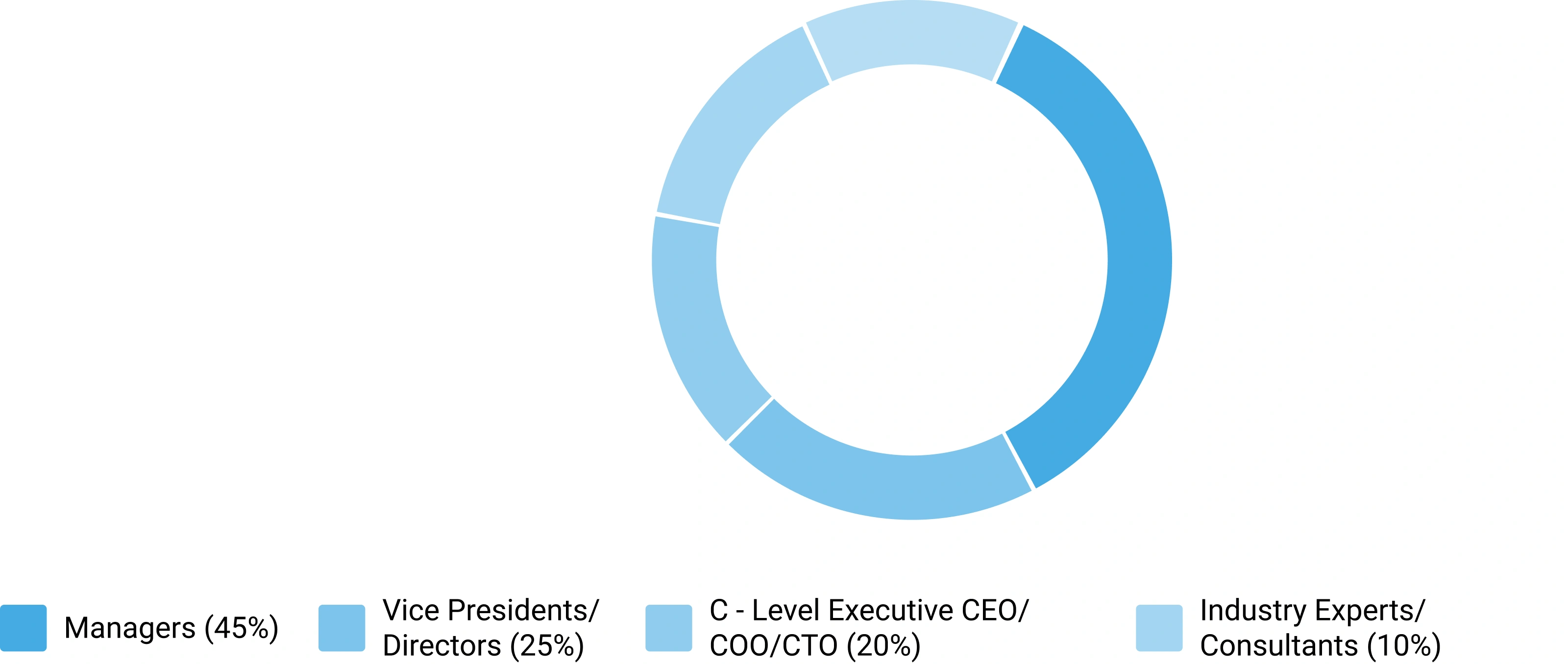
Primary Research — Respondent Designation Profile
Seniority breakdown of interview respondents (% share from PPT data)
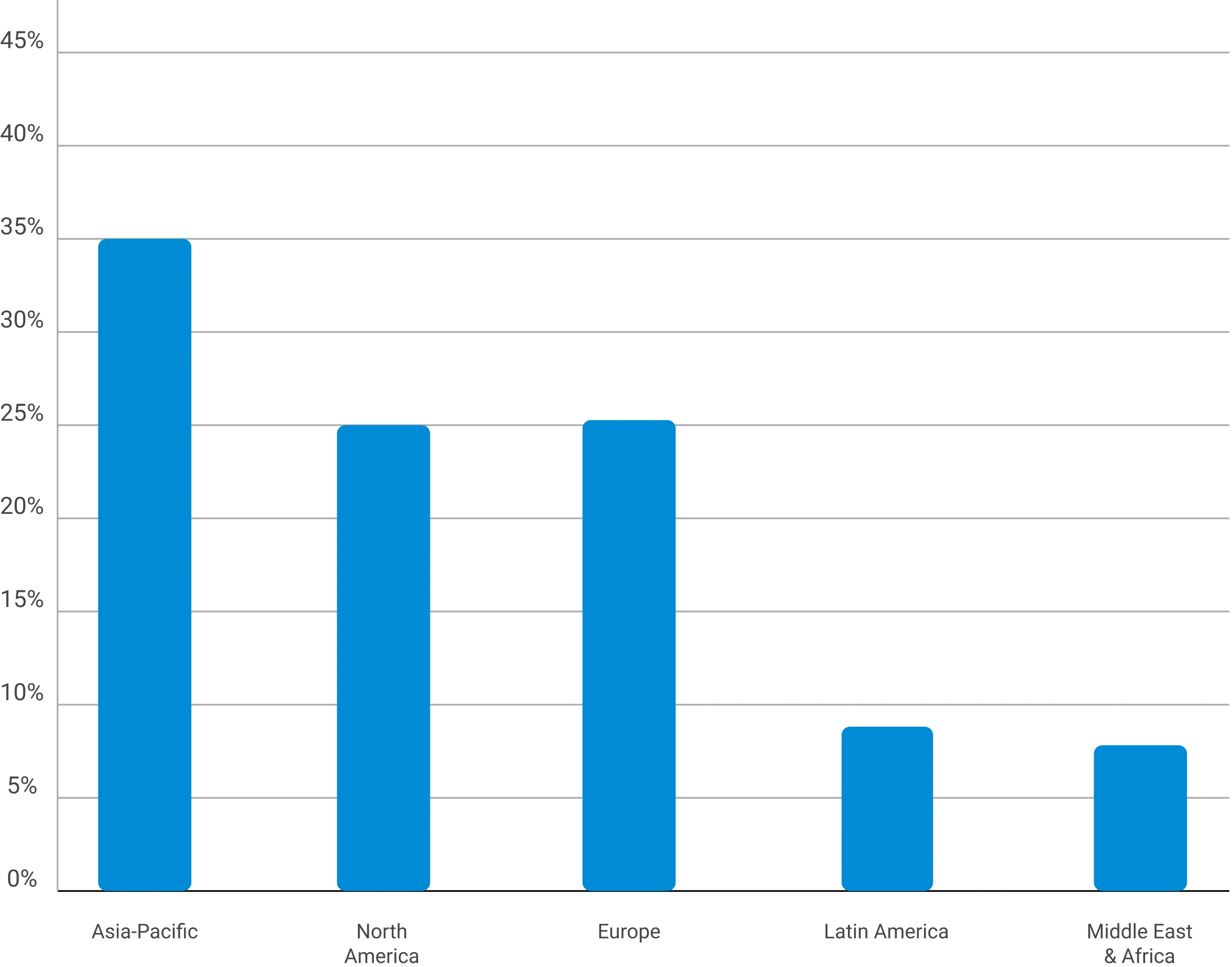
Primary Research — Geographic Coverage of Interviews
Regional distribution of primary research engagement (% share from PPT data)
Phase 6 — Data Triangulation and Market Validation
No single methodology is relied upon in isolation. Multiple independent estimation approaches are combined and reconciled to ensure consistency, accuracy, and analytical defensibility. Any material deviations between approaches are investigated and adjusted through additional validation cycles.
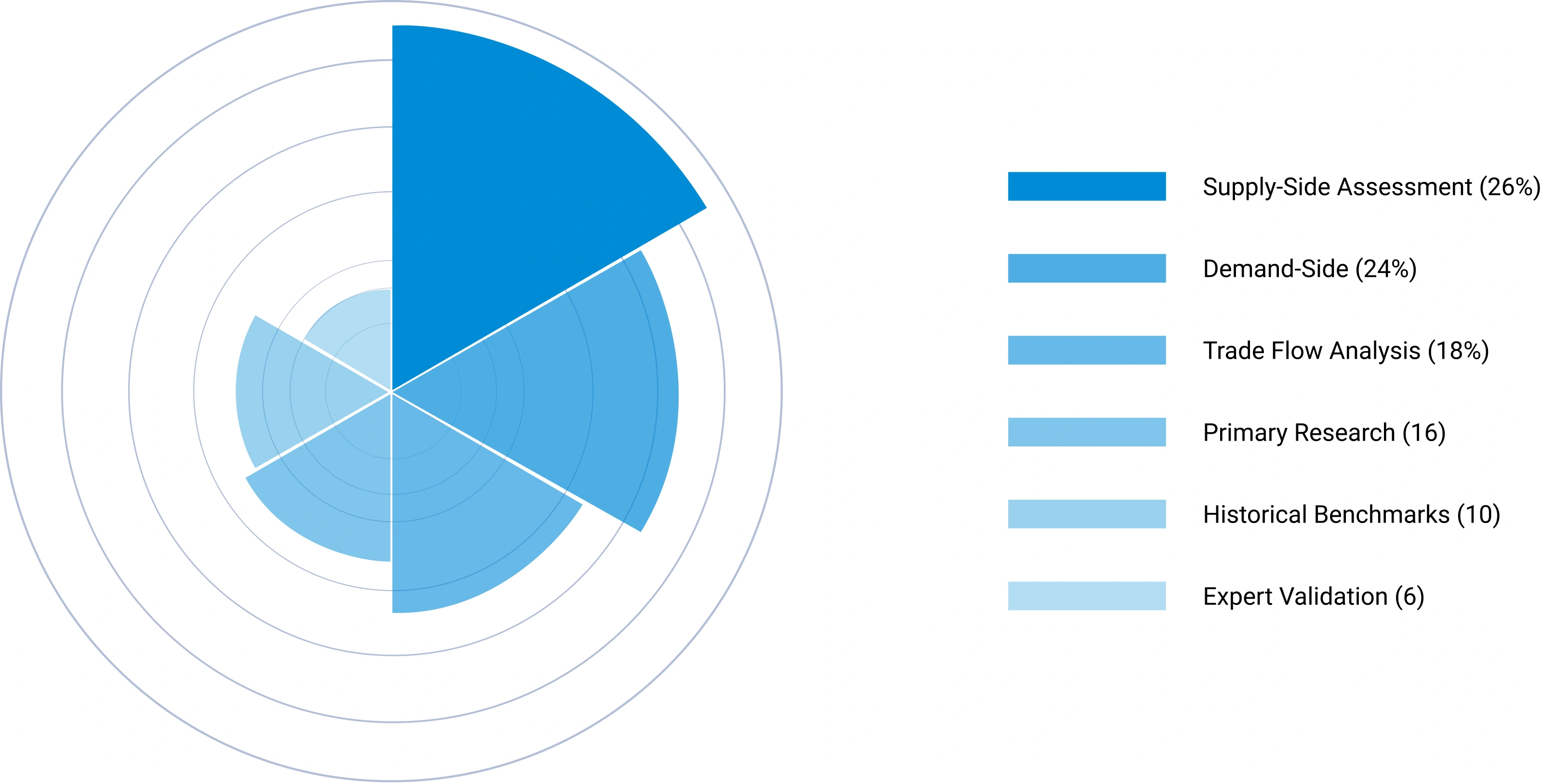
The final market size is derived through weighted triangulation of all validated methodologies. Any material deviations between approaches are investigated and adjusted through additional validation cycles. The outcome represents the most realistic assessment of the market based on available evidence and expert confirmation ensuring that volume and value estimates are fully consistent with one another.
Triangulation Framework — Input Contribution Weight
Relative weight each sizing input contributes to the final reconciled market estimate
Phase 7 — Forecast Modeling: Projecting Future Market Evolution
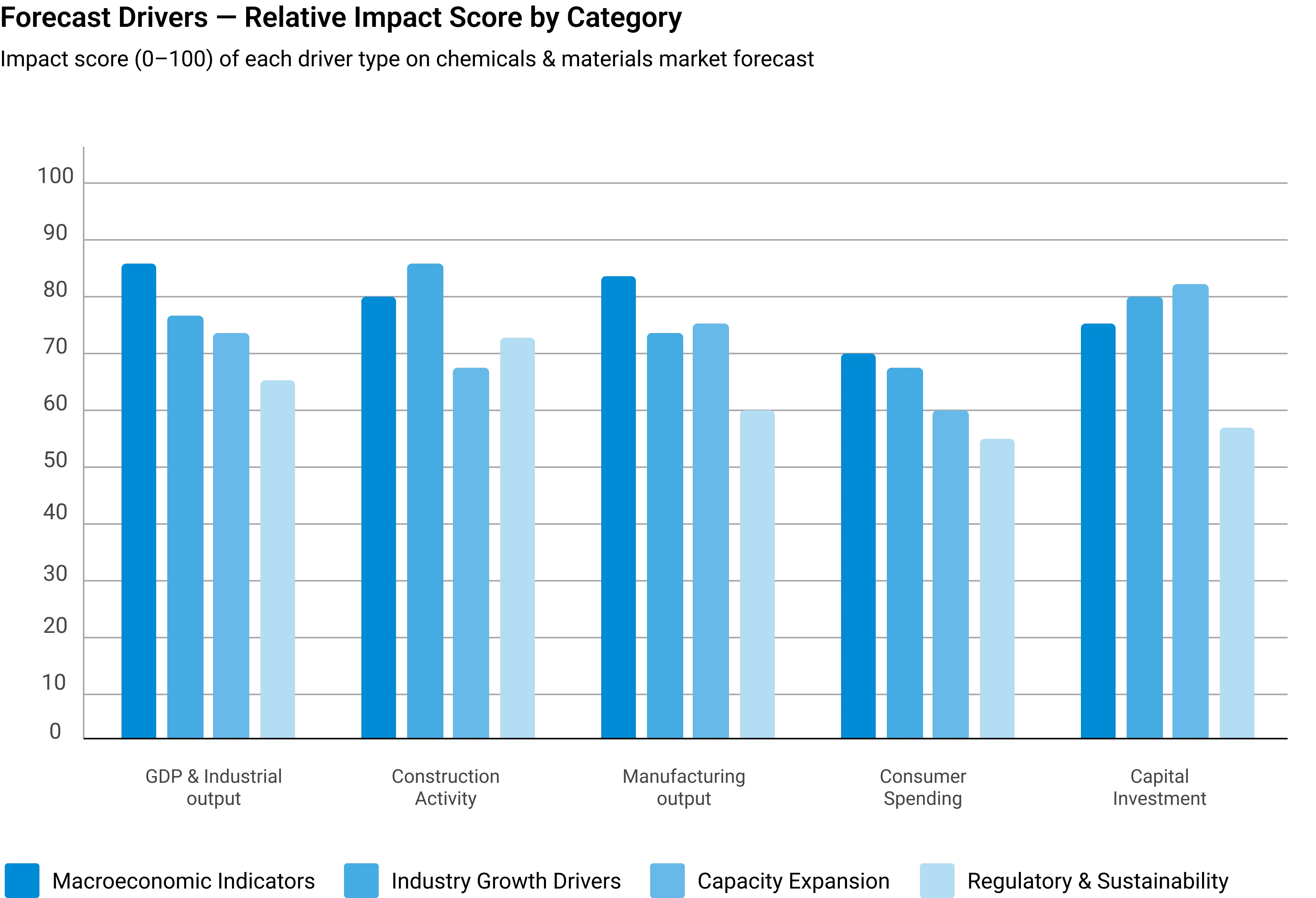
Forecasting evaluates the future trajectory of the market using a combination of quantitative indicators and qualitative assessments across economic, industry, and regulatory dimensions. Rather than simple extrapolation, each driver is independently modeled and integrated into a composite forecast.
Macroeconomic Indicators
GDP growth, industrial production, manufacturing output, construction activity, consumer spending, and capital investment form the quantitative foundation of long-term demand projections. These are applied at country, regional, and global levels.
Industry Growth Drivers
Urbanization, infrastructure development, industrialization, technological innovation, sustainability initiatives, and evolving product performance requirements are assessed at regional and industry levels — capturing both structural and cyclical demand drivers.
Capacity Expansion Analysis
Announced plant expansions, new manufacturing facilities, technology upgrades, and strategic investments are evaluated to determine future supply-demand dynamics and potential market tightness or oversupply situations.
Regulatory & Sustainability
Environmental regulations, chemical safety standards, emission reduction targets, circular economy initiatives, and sustainability requirements are incorporated as they often influence product adoption rates and market growth trajectories.
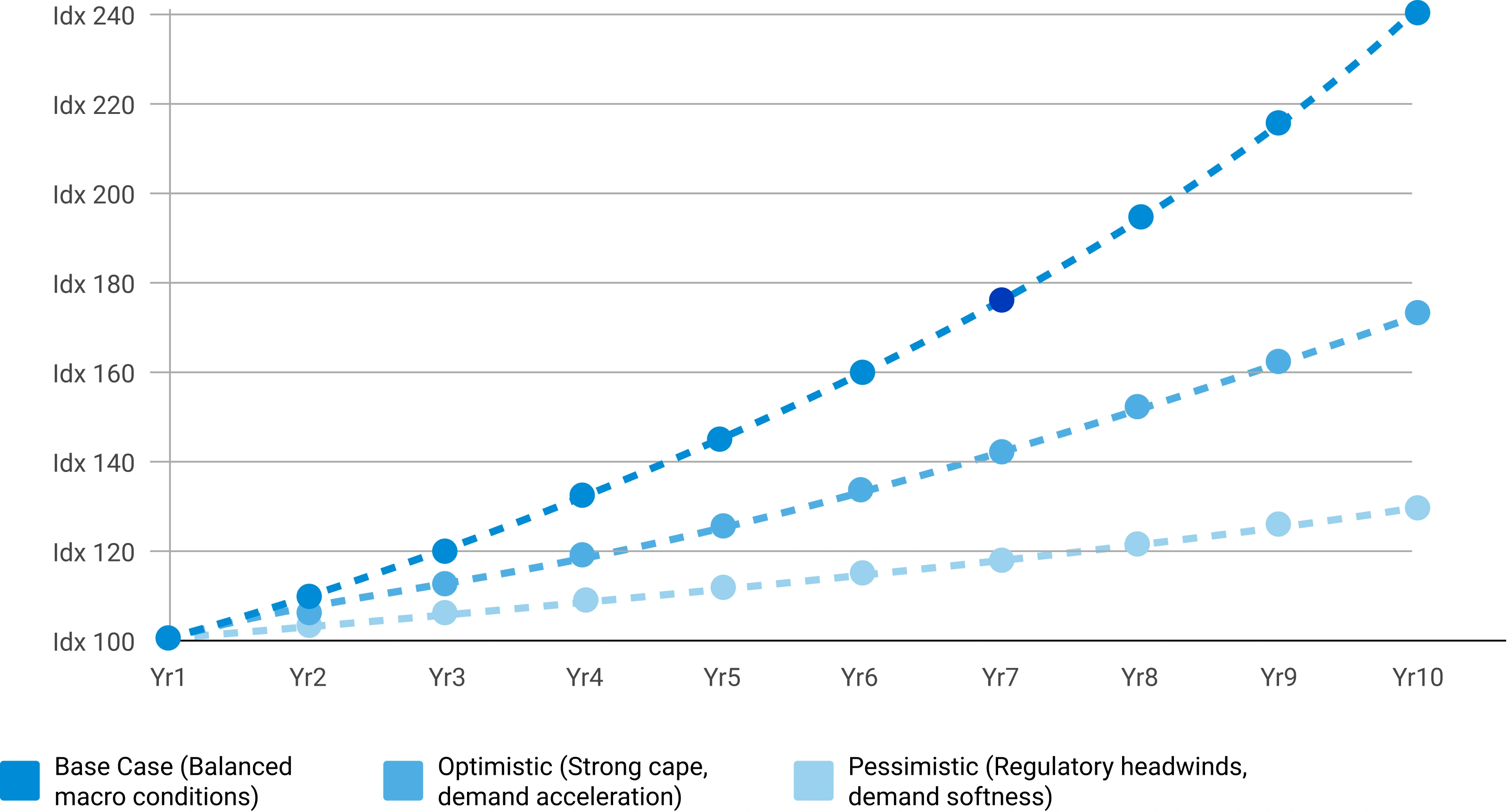
Scenario Forecast Range — Indexed Market Growth (Year 1–10)
Illustrative indexed growth trajectories across Base, Optimistic, and Pessimistic scenarios over a 10-year forecast horizon
Forecast Drivers — Relative Impact Score by Category
Impact score (0–100) of each driver type on chemicals & materials market forecast



Comments
Share your thoughts, ask a question, or provide feedback about this report.