
Antimicrobial Additives Market Size, Share Analysis Report 2035
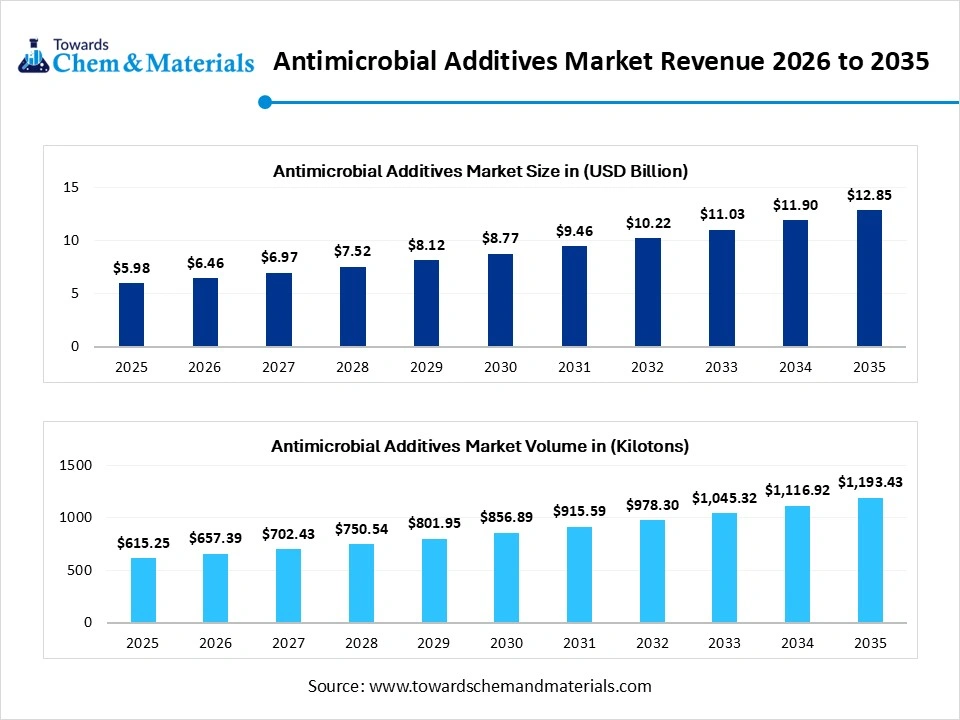
The global antimicrobial additives market was valued at USD 5.98 billion in 2025, is estimated to reach USD 6.46 billion in 2026, and is projected to reach USD 12.85 billion by 2035, growing at a CAGR of 7.95% from 2026 to 2035. In terms of volume, the antimicrobial additives market is projected to grow from 615.25 Kilotons in 2025 to 1,193.43 Kilotons by 2035. growing at a CAGR of 6.85% from 2026 to 2035.
Key Takeaways
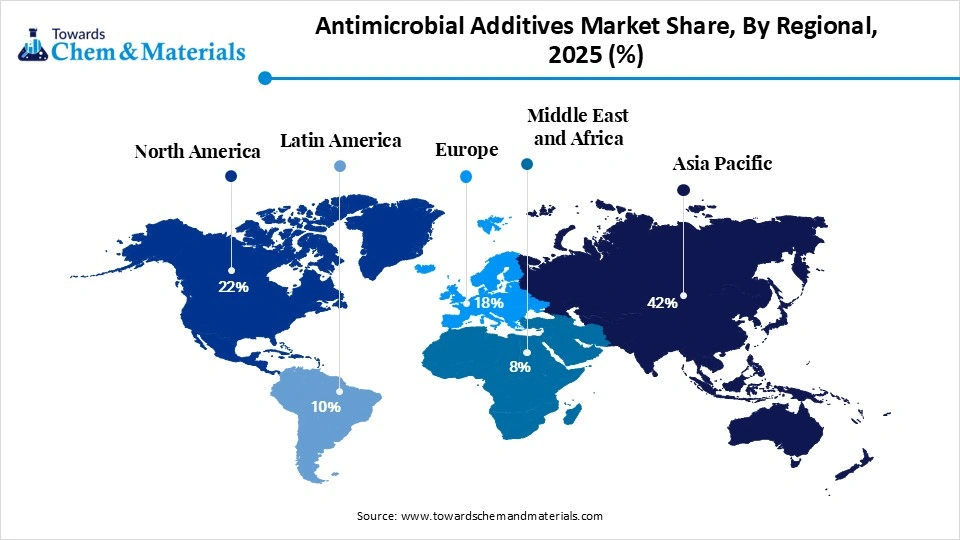
- Asia Pacific dominated the antimicrobial additives market with the largest revenue share of 42% in 2025.
- By type, the inorganic segment led the market with the largest revenue share of 65% in 2025.
- By application, the paints & coatings segment led the market with the largest revenue share of 38% in 2025.
- By end use, the healthcare segment led the market with the largest revenue share of 28% in 2025.
Market Overview
The antimicrobial additives are a hygiene-enhanced solution represented as performance chemicals that are integrated with built-in protection against microscopic organisms. The rising focus on preventing initial bacterial attachment in biofilm is driving the market expansion. It acts as a biocidal agent that prevents bad odor, stains, and physical decay and depending on their chemistry and formulation, antimicrobial additives can help limit microbial growth in selected materials; effects on transparency, mechanical performance and biocompatibility must be assessed for each application.
The stringent regulatory compliance for biocidal products and standardized lab protocols to ensure reduction in microbial rate and efficacy testing enable growth. The implementation is especially in food-grade packaging, antimicrobial textiles and medical devices that focus on hygiene and sustainability.
Antimicrobial Additives Market Trends
- Regulation for Infection Control: The rising healthcare-associated infection is a key driver for the adoption of antimicrobial additives, especially in surgical gowns and post-pandemic hygiene products.
- Developments in Antimicrobial Additive Formulations: Formulation developments target specific microorganisms and application requirements. Performance claims must be assessed against product-specific efficacy data and relevant testing standards
Key Technological Shifts and AI in the Antimicrobial Additives Market
The technological shift is defined by AI-driven molecular discovery and the integration of nanotechnology in the antimicrobial additives market. Machine learning enables the determination of minimum inhibitory concentration and determines novel antimicrobial compounds with precision-engineered performance.
The technological advancement boosts innovation in bio-based additives, biofilm-resistant surface, pH-responsive smart coating and non-leaching silver nanoparticles for intelligent healthcare and active packaging. Overall, AI enables performance and efficiency testing with high-tech protection.
Trade Analysis of the Antimicrobial Additives Market: Import and Export Statistics
- The United Kingdom exported 350 shipments of antimicrobial additives.
- The United States exported 119 shipments of antimicrobial additives.
- Russia exported 38 shipments of antimicrobial additives.
- From May 2024 to April 2025, the world exported 438 shipments of antimicrobial additives.
Supply Chain Analysis of the Antimicrobial Additives Market
Molecular Extraction and Synthesis:
The stage of high-purity chemical engineering where raw material providers focus on antimicrobial agents’ stability, where refined inorganic metals are converted into microscopic particles raw-material suppliers provide antimicrobial active ingredients, including metal-based compounds, which are processed into forms suitable for incorporation into additive formulations
- Key Players: Nouryon, Lonza, AkzoNobel, and Evonik Industries
Formulation and Masterbatching:
The stage where the formulators create a masterbatch that contains antimicrobial agents that are dispersed within carrier resin by ensuring germ-killing power, thermal stability, and operational effectiveness.
- Key Players: Sanitized AG, Avient Corporation, BASF SE and Microban International
Functional Integration:
The final stage of additives becomes a marketable feature where brand owners incorporate these masterbatches into the production line. The finished product is used in healthcare, packaging, and consumer goods.
- Key Players: DuPont, Berry Global, Milliken & Company
Regulatory Framework: Antimicrobial Additives Market
| Region | Key Regulation | Regulatory Focus |
| North America | FIFRA (Federal Insecticide, Fungicide, and Rodenticide Act), EPA Standards | Focus on the intent of the additive that protects the consumer from germs. Registration of products to protect human and environmental risk assessment |
| Asia Pacific | Food Sanitation Act, GB Standards, FSSAI Regulation, and Drug and Cosmetic Act | Standard for food-contact materials, operated a positive list system, and focused on prohibiting harmful antibiotics in the local ecosystem. Additionally, self-regulation focuses on migration limits. |
| Europe | ECHA, BPR (Biocidal Products Regulation EU 528/2012) | The standards focus on endocrine disruption and long-term environmental toxicity, especially for active substances and biocidal products. |
Antimicrobial Additives Market Dynamics
Driver
The Competitive Supply Chain
The chemical formulator, medicine producer and end-use manufacturers are increasingly shifting towards the advancement of antimicrobial additives and hygiene-maintaining criteria that driving extensive investment and strategic investment between major players for the final antimicrobial use to the consumer.
Restraints
Formulation Costs and Performance Limitations
Additive costs and application-specific performance requirements can limit adoption. Claims about concentration-dependent efficacy must be supported by product-specific test results
Opportunity
Rising Focus on Bio-based and Clean Solutions
The key opportunity driven by manufacturers that are focusing on sustainability and green chemistry, which includes bio-based organic additives and plant-derived extracts as natural alternatives, while maintaining safety and recyclability.
Segmental Insights
Type Insights
The Inorganic Segment Dominated the Antimicrobial Additives Market in 2025
The inorganic segment dominated the market with the largest share in 2025, driven by its thermal resilience and higher longevity. The demand for sustainable manufacturing inorganic system utilized metal-based ions, including copper, zinc and silver, that embed protection directly into thermoplastic polymer, preventing microbial degradation. The segment is key for food packaging, medical, and construction sectors by maintaining non-leaching and broad-spectrum efficacy to meet circular economy goals.
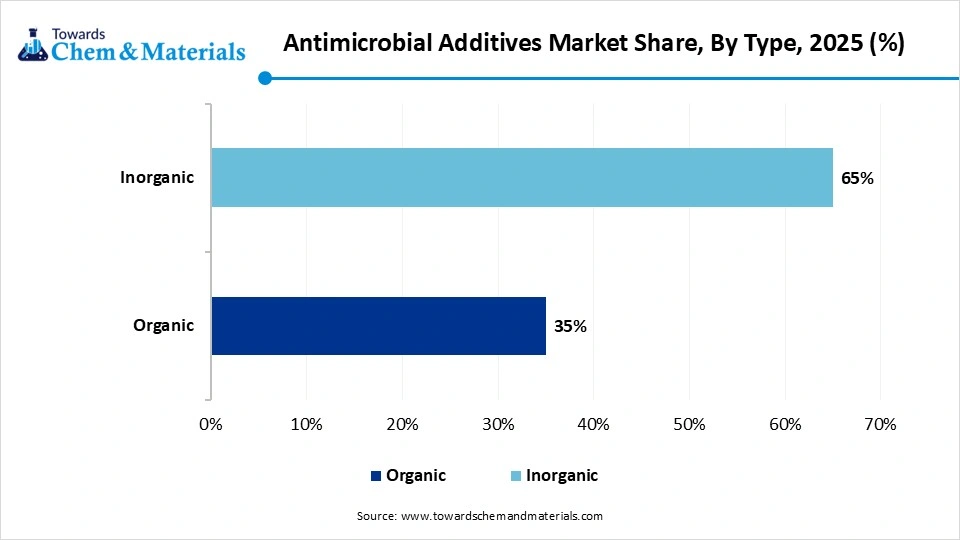
The organic segment is expected to grow at the fastest CAGR in the market over the forecast period due to its high precision, cost-effectiveness, and fast performance with operational efficiency. The organic type is a synthetic and bio-derived compound, similar to isothiazolinones, pyrithione, that is utilized in textiles, packaging, and liquid coating as a non-toxic, biodegradable alternative that kills bacteria. The stringent safety standards and consumer demand for environmental stability boost the expansion.
Application Insights
The Paints & Coatings Segment Dominated the Antimicrobial Additives Market in 2025
Paints & coatings segment dominated the market with the largest share in 2025 due to biocidal protection for residential and industrial surfaces and engineering, avoiding colonization of mold, bacteria and mildew. The paints & coatings integrate silver-ion and zinc-pyrithione technologies to form shielded industrial films and self-sanitizing coatings by ensuring long-term efficacy and color durability. Additionally, the segment focuses on low-VOC formulation and long-lasting microbial resistance to meet stringent safety standards.
Antimicrobial Additives Market Share, By Application, 2025 (%)
| By Application | Revenue Share, 2025 (%) |
| Plastics | 35% |
| Paints & Coatings | 38% |
| Pulp & Paper | 15% |
| Others | 12% |
Plastics segment expected to grow at the fastest CAGR in the market over the forecast period because of its ability to transform material into intrinsically hygienic surfaces and microbial resistance. The plastics manufacturers' focus on sustainable masterbatches and self-sanitizing polymers aligns with recycled plastic streams. The segment demand for structural durability makes it ideal for mass-volume goods by embedding inorganic ions during manufacturing.
Pulp & paper segment held the significant market share in 2025, driven by rising focus on bio-fouling inhibition and product sterility. The segment is injecting active agents into pulp slurry that resist bacterial and fungal growth by creating self-sanitizing sheets. The antimicrobial additives are essential for medical-based paper, hygiene-grade tissues and packaging by ensuring safety and microbial degradation. Additionally, the demand for biodegradability and recyclability in paper product boosting the expansion.
End Use Insights
The Healthcare Segment Dominated the Antimicrobial Additives Market in 2025
The healthcare segment dominated the market with the largest share in 2025, defined by the requirement of eliminating hospital-acquired infection using molecular-level sterility copper-based additive and silver-ion technology embedded into the healthcare sector, especially in manufacturing self-sanitizing catheters, patient equipment and surgical tools to protect against biofilms and multidrug-resistant bacteria. Additionally, the healthcare innovation focuses on the mechanical integrity of biocompatible additives and non-leaching defense to meet health safety standards.
Antimicrobial Additives Market Share, By End Use, 2025 (%)
| By End Use | Revenue Share, 2025 (%) |
| Healthcare | 28% |
| Packaging | 19% |
| Food & Beverage | 12% |
| Building & Construction | 15% |
| Automotive & Transportation | 10% |
| Textile | 9% |
| Consumer Goods | 7% |
The food and beverage segment is expected to grow at the fastest CAGR over the forecast period, driven by a rising population that demands food chain safety and food product longevity by ensuring pathogen control and hygiene barrier. The shift towards recycled food-grade plastics incorporates FDA compliance to create a shield against foodborne pathogens, and research focuses on non-migratory additives into packaging and processing hardware.
Packaging segment held the significant market share in 2025 due to innovation in the food and pharmaceutical sector to maintain product purity and protection, integrating recyclability and circular economy standards. The packaging sector focuses on active microbial shield and lowering food waste by permeating zinc and silver ion additives to avoid cross-contamination and ensuring extended shelf life, especially for fresh products and medical suppliers, ensuring hygiene.
Building & construction segment held notable market share in 2025, driven by demand for structural longevity in building and indoor air quality. The zinc and silver ion technology integrates into insulation, drywall and HVAC systems to prevent black mold and fungus growth in moisture-heavy construction. The focus on smart high-traffic public building infrastructure and built-in hygiene that offers durability, fire resistance and self-sanitizing surfaces in construction material.
Regional Insights
How Did The Asia Pacific Dominated The Antimicrobial Additives Market?
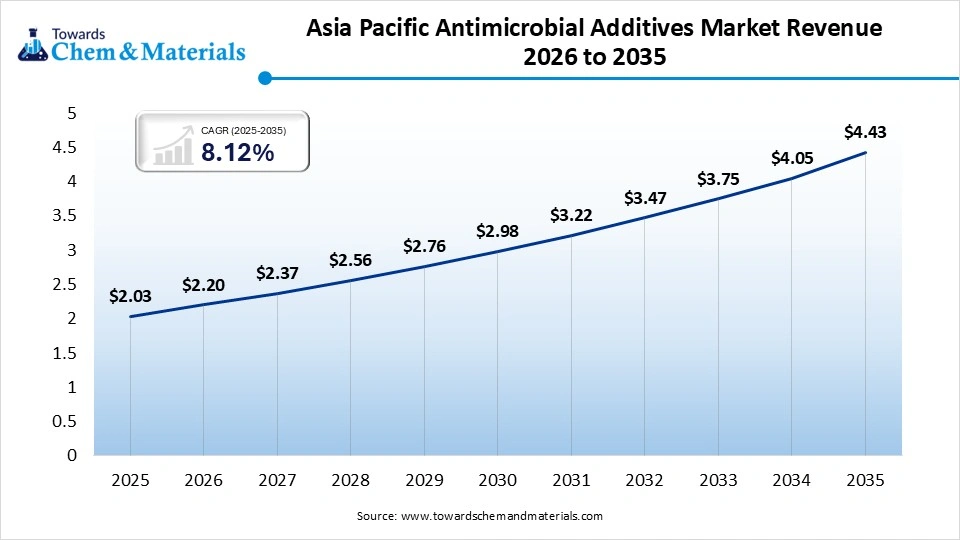
The Asia Pacific antimicrobial additives market size was estimated at USD 2.03 billion in 2025 and is projected to reach USD 4.43 billion by 2035, growing at a CAGR of approximately 8.12% from 2025 to 2035. The regional substantial investment for self-sanitizing surfaces and public demand for protection of textiles through antimicrobial additives to prevent microbial damage to meet climatic and export safety standards is accelerating the domestic growth.
China Antimicrobial Additives Market Growth Trends
China's market expansion is influenced by its diversified consumer demand for hygiene-focused material and its self-sanitizing surface hub. The rapid urbanization driving scalability and cost-effective chemical systems, driving domestic growth. The major players in China are adopting silver and zinc-based technology, driving innovation for mass-produced consumer goods by using integrated antimicrobial masterbatch, fueling the expansion.
North America Antimicrobial Additives Market Growth Trends
North America expected to grow at the fastest CAGR in the market during the forecast period, driven by a regional shift towards embedded protection and hygiene in medical, food-contact packaging and healthcare sectors. The domestic players are integrating metal-based ions and ensuring broad-spectrum efficacy. The region focuses on demand for microbial resistance in construction and bio-based additives to meet EPA and FDA compliance. Additionally, North America consumer demand for residual hygiene and sustainable solutions enables market expansion.
U.S Antimicrobial Additives Market Growth Trends
The United States market especially focuses on the integration of antimicrobial material into the molecular structure of synthetic and thermoplastic fibers. The U.S. based manufactures adopting inorganic metal ions in the medical and food-service sectors to meet stringent regulatory compliance. The regional shift towards green chemistry and recycled plastic that offer advanced infection control is driving the implementation of antimicrobial additives.
Recent Developments
- In October 2025, at K 2025, LG Electronics unveiled core product lines for LG PuroTec™, glass matrix-based antimicrobial additives in Germany. The solution targets industries including home appliances, construction, automotive, healthcare and packaging.
- In September 2025, Microban International's strategic collaboration with Curie Co to develop advanced preservation system based on organic-acid platforms cleaning products and coatings. Partnership merging Curie Co's organic acid platforms with Microban's Additive GS technology, allowing a water-soluble antimicrobial solution.
- In February 2025, Avient Corporation launched Cesa™ WithStand™ SX Low Haze additives as anti-microbial agents. The additives offer protection against fungi and bacteria growth by maintaining clarity and aesthetics for polycarbonate and plexiglass applications using recycled resin.
Antimicrobial Additives Market Competitive Landscape Analysis
Tier 1 Companies
|
Rank
|
Company Name | Headquarters | Country | Why Relevant to This Market | Key Products / Material Portfolio |
| 1 | Microban International Ltd. | Huntersville, North Carolina | United States | Global leader in antimicrobial and odor-control technologies across plastics, textiles, and consumer products | Microban®, Scentry®, antimicrobial additives |
| 2 | LANXESS AG | Cologne, North Rhine-Westphalia | Germany | Major supplier of antimicrobial active ingredients and preservation solutions | Preventol®, biocides, antimicrobial additives |
| 3 | Milliken & Company | Spartanburg, South Carolina | United States | Leading provider of antimicrobial technologies for plastics and textiles | AlphaSan®, antimicrobial masterbatches, specialty additives |
| 4 | Avient Corporation | Avon Lake, Ohio | United States | Major supplier of antimicrobial additives and masterbatch solutions for polymers | Antimicrobial masterbatches, polymer additives |
| 5 | Sanitized AG | Burgdorf | Switzerland | Globally recognized provider of antimicrobial protection technologies for textiles and polymers | Sanitized® antimicrobial additives, hygiene solutions |
Tier 2 Companies
|
Rank
|
Company Name | Headquarters | Country | Why Relevant to This Market | Key Products / Material Portfolio |
| 1 | Troy Corporation | Florham Park, New Jersey | United States | Major supplier of antimicrobial and preservation technologies for coatings and materials | Antimicrobial additives, preservatives, biocides |
| 2 | BASF SE | Ludwigshafen, Rhineland-Palatinate | Germany | Provides antimicrobial active ingredients and specialty additives for industrial applications | Biocides, antimicrobial agents, formulation additives |
| 3 | LyondellBasell Industries N.V. | Houston, Texas | United States | Offers specialty polymer compounds with antimicrobial functionality | Antimicrobial polymer compounds, additives |
| 4 | Sciessent LLC | Wakefield, Massachusetts | United States | Specialized developer of silver-based antimicrobial technologies | Agion®, antimicrobial additives, odor-control technologies |
| 5 | Nouryon Chemicals Holding B.V. | Amsterdam, North Holland | Netherlands | Supplies antimicrobial ingredients and specialty chemical solutions | Antimicrobial agents, specialty additives |
Tier 3 Companies
|
Rank
|
Company Name | Headquarters | Country | Why Relevant to This Market | Key Products / Material Portfolio |
| 1 | Addmaster (A Polygiene Company) | Stafford, England | United Kingdom | Known for antimicrobial technologies used in plastics and building materials | Biomaster® antimicrobial additives |
| 2 | Polygiene Group AB | Malmö | Sweden | Expanding antimicrobial and odor-control solutions for consumer and industrial markets | Polygiene®, antimicrobial treatments |
| 3 | BioCote Limited | Coventry, England | United Kingdom | Focused on antimicrobial surface protection technologies | BioCote® antimicrobial additives |
| 4 | Sinanen Zeomic Co., Ltd. | Osaka | Japan | Leading producer of inorganic antimicrobial additives for plastics and coatings | Zeomic® silver-based antimicrobial additives |
Top Companies in the Antimicrobial Additives Market
- NanoBioMatters Industries S.L
- BASF SE
- RTP Company
- Milliken Chemical
- BioCote Limited
- Microban International
- Clariant AG
- PolyOne Corporation
- Momentive Performance Materials Inc.
- Life Materials Technologies Limited
- SteriTouch Limited
- Sanitized AG
- Dow Inc.
- LyondellBasell Industries Holdings B.V.
- Plastics Color Corporation
- Lonza
Antimicrobial Additives Market Segment Covered in the Report
By Type
- Organic
- Inorganic
- Silver
- Copper
- Zinc
By Application
- Plastics
- Paints & Coatings
- Pulp & Paper
- Others
By End Use
- Healthcare
- Minimally Invasive Medical Products
- Endotracheal Tubes
- Wound dressing
- Surgical drapes
- Syringes
- Re-usable Medical items
- Hospital Bedding
- Dental trays
- Beds
- Hospital gowns
- Orthopedic devices
- Laparoscopic Instruments
- Medical Scrubs
- Packaging
- Food Packaging
- Active Packaging
- Controlled Release Packaging
- Non-Food Packaging
- Food Packaging
- Food & Beverage
- Bakery Food
- Beverages
- Dairy
- Meat Processing
- Building & Construction
- Insulation
- Faucets & Fixtures
- Door Hardware
- Sealants & Grouts
- Carpet
- Paints
- OSB
- Melamine
- Others
- Automotive & Transportation
- Passenger Cars
- Light Commercial Vehicles
- Heavy Commercial Vehicles
- Train
- Aeroplanes
- Textile
- Apparels
- Home Textiles
- Footwear
- Sport Textiles
- Non-woven
- Others
- Consumer Goods
- Cleaning Products
- Cosmetics
- Toys
- Others
By Regions
- North America
- U.S.
- Canada
- Mexico
- U.S.
- Europe
- Germany
- UK
- France
- Italy
- Spain
- Germany
- Asia Pacific
- China
- India
- Japan
- South Korea
- China
- Latin America
- Brazil
- Argentina
- Brazil
- Middle East & Africa
- Saudi Arabia
- South Africa
- Saudi Arabia
A Seven-Phase Framework
Our methodology is designed to be universally applicable across commodity chemicals, specialty chemicals, petrochemicals, construction chemicals, coatings, electronic chemicals, industrial gases, agrochemicals, water treatment chemicals, and performance materials. Each phase builds upon the last, creating a layered validation structure that minimizes estimation error and maximizes analytical confidence.
The framework ensures comprehensive market coverage, robust cross-validation, and reliable long-term forecasting — producing market estimates that withstand scrutiny from investors, regulators, and corporate strategy teams.

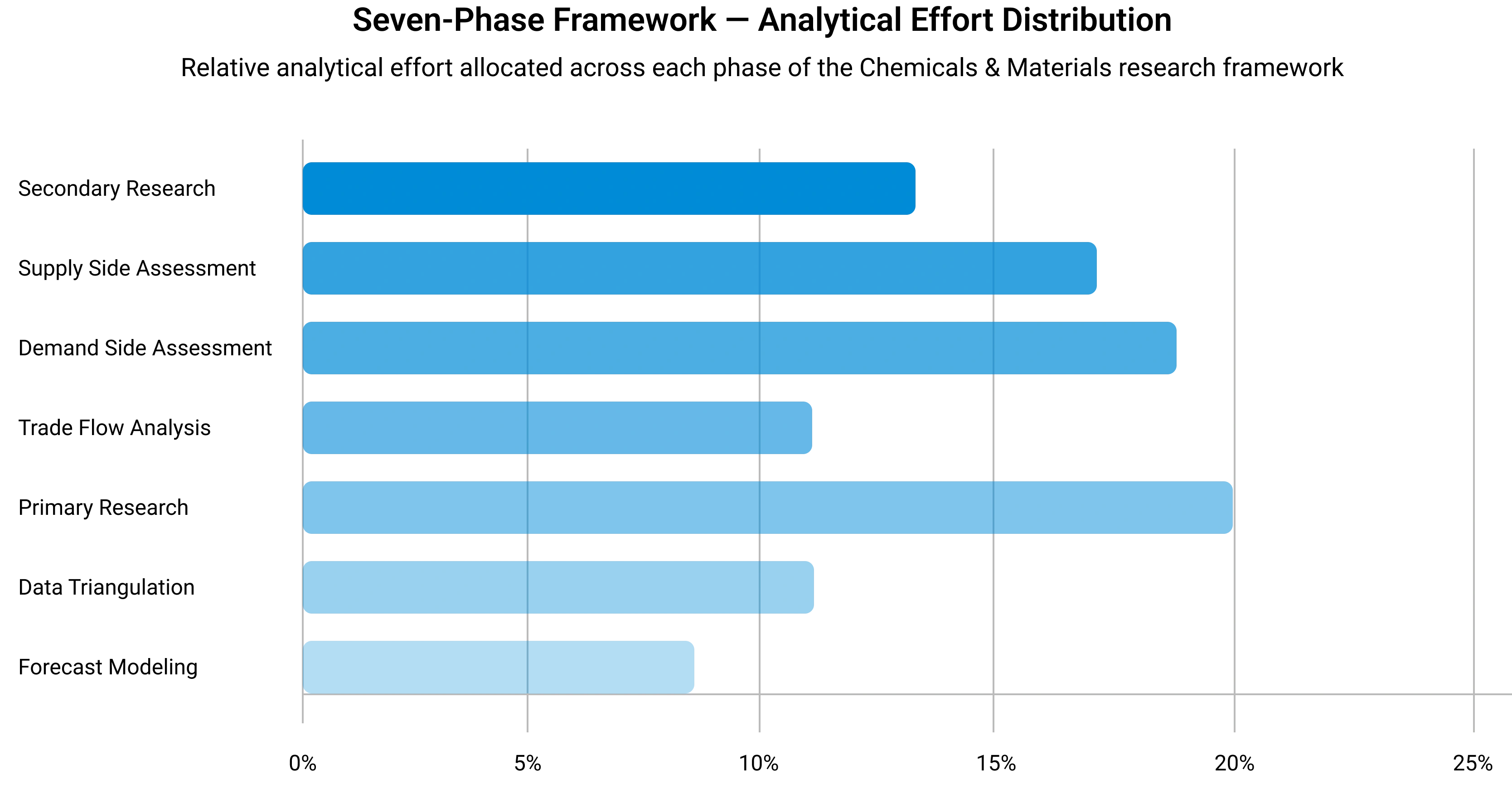
Seven-Phase Framework — Analytical Effort Distribution
Relative analytical effort allocated across each phase of the Chemicals & Materials research framework
Phase 1 - Secondary Research: Establishing the Foundation
Secondary research collects and evaluates publicly available information from authoritative sources, establishing the foundational understanding of market structure, value chain dynamics, competitive landscape, and end-use demand patterns. Every source is evaluated for credibility, recency, geographic relevance, and methodological soundness before inclusion.
Industry Associations
Sources include ACC, CEFIC, ICCA, JCIA, CPCIF, and SOCMA providing production volumes, consumption trends, capacity developments, and sustainability initiatives.
Company Disclosures
Annual reports, investor presentations, earnings transcripts, and regulatory filings reveal product portfolios, manufacturing footprints, capacity expansions, and revenue segmentation.
Government Databases
National statistical offices, customs authorities, environmental agencies, and industrial production databases provide verified statistics on output, trade flows, and regulatory compliance.
Trade Databases
UN Comtrade, ITC, Eurostat, and national customs authorities enable assessment of global product movement, import dependency, and export competitiveness across regions.
Our Secondary Research Sources
- Ministry of Chemicals and Fertilizers
- European Chemicals Agency
- United States Department of Energy
- Ministry of Industry and Information Technology
- Ministry of Economy Trade and Industry
- Ministry of Trade Industry and Energy
- National Institute of Standards and Technology
- Council of Scientific and Industrial Research
- Fraunhofer Society
- National Institute for Materials Science
Phase 2 — Supply-Side Assessment: Mapping Production Capabilities
Production Capacity Analysis
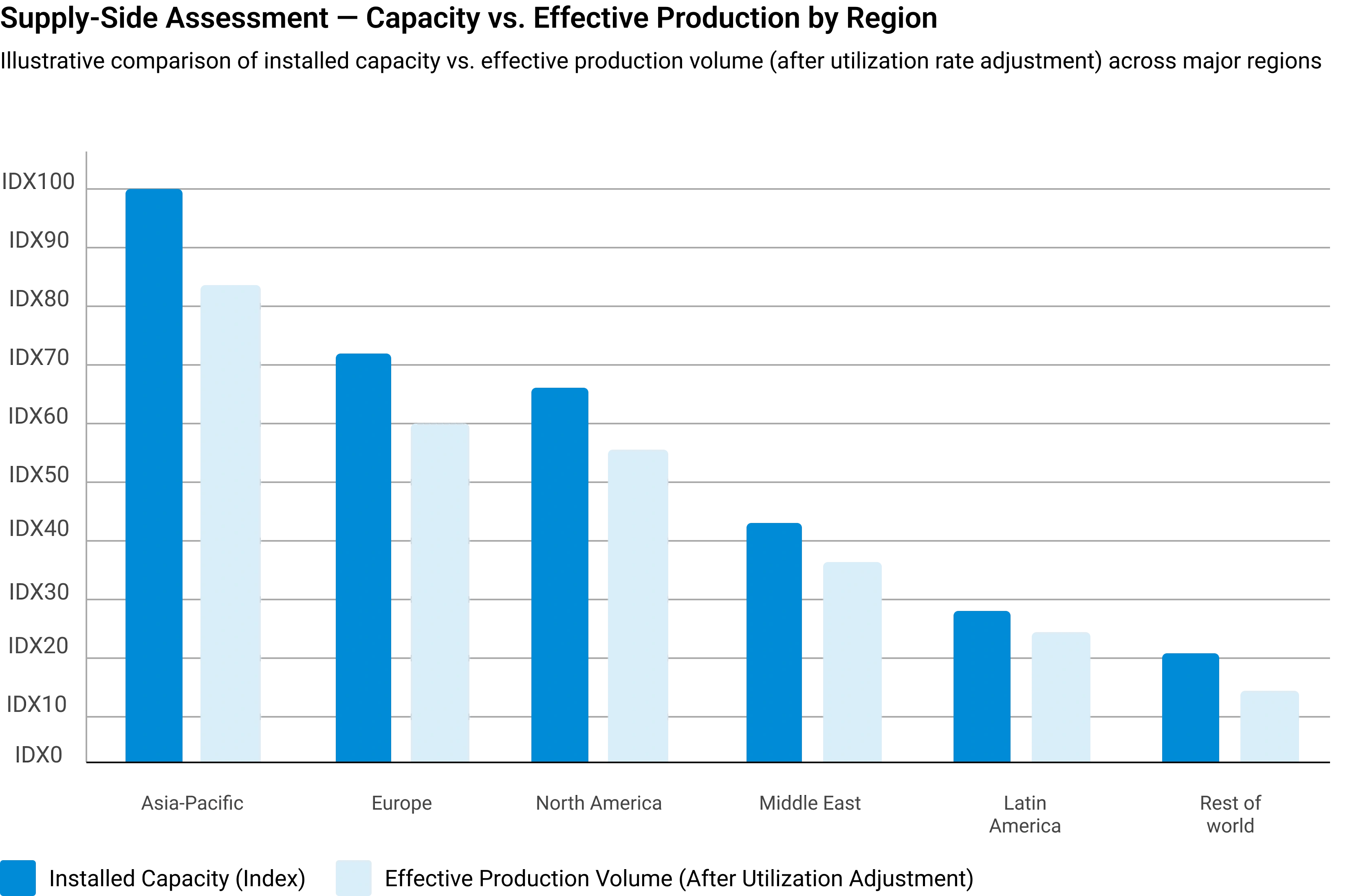
All major manufacturers are assessed for existing installed capacity, planned additions, expansions, new plant announcements, and technology adoption — mapped at global, regional, and country levels.
Capacity Utilization Adjustment
Installed capacity is adjusted using utilization rates based on demand conditions, feedstock availability, plant operating rates, maintenance schedules, and regulatory restrictions.
Manufacturer Revenue Analysis
Product-specific revenues, segment-level performance, regional distribution, average selling prices, and margin trends are evaluated to establish market value estimates.
Supply-Side Assessment — Capacity vs. Effective Production by Region
Illustrative comparison of installed capacity vs. effective production volume (after utilization rate adjustment) across major regions
Phase 3 — Demand-Side Assessment: Quantifying Chemical Consumption
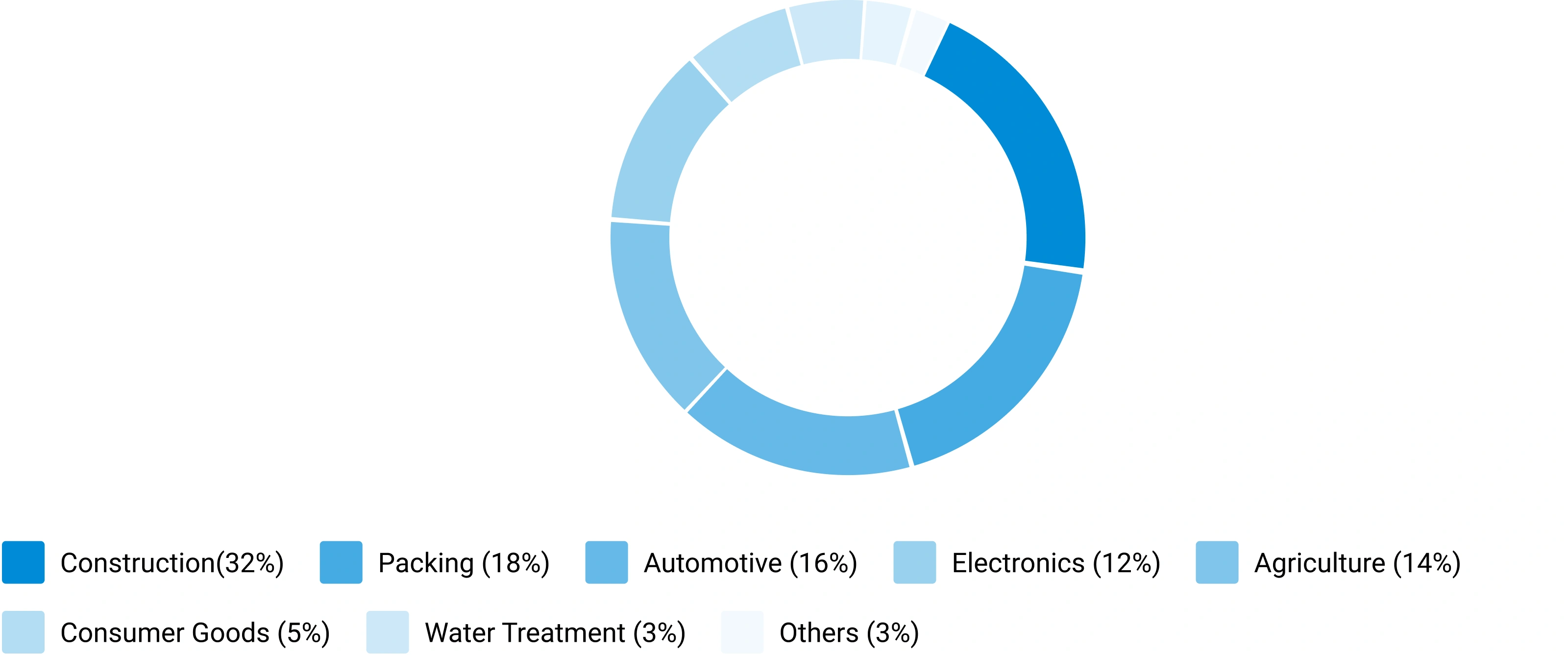
Demand-side analysis quantifies chemical consumption across industries, applications, and geographies — identifying where and how chemicals are consumed throughout the value chain with precision.
End-Use Industry Analysis
Chemical demand is evaluated across automotive, construction, packaging, electronics, agriculture, healthcare, consumer goods, industrial manufacturing, energy and utilities, and water treatment. Industry output, production trends, and consumption intensity are analyzed to determine demand patterns.
Consumption Modeling
Demand is estimated using measurable indicators: kilograms per vehicle, kilograms per square meter of construction, dosage per cubic meter of water treated, kilograms per hectare of agricultural land, and kilograms per ton of manufactured products. Consumption factors are validated through industry publications and primary interviews.
Application Analysis
The market is segmented by application area to understand product performance requirements, formulation trends, technology adoption, customer preferences, and regulatory requirements improving demand accuracy and segmentation granularity.
Demand-Side Assessment — End-Use Industry Demand Distribution
Illustrative distribution of chemical & materials demand across key end-use industries
Phase 4 - Trade Flow Analysis: Balancing Regional Supply and Demand
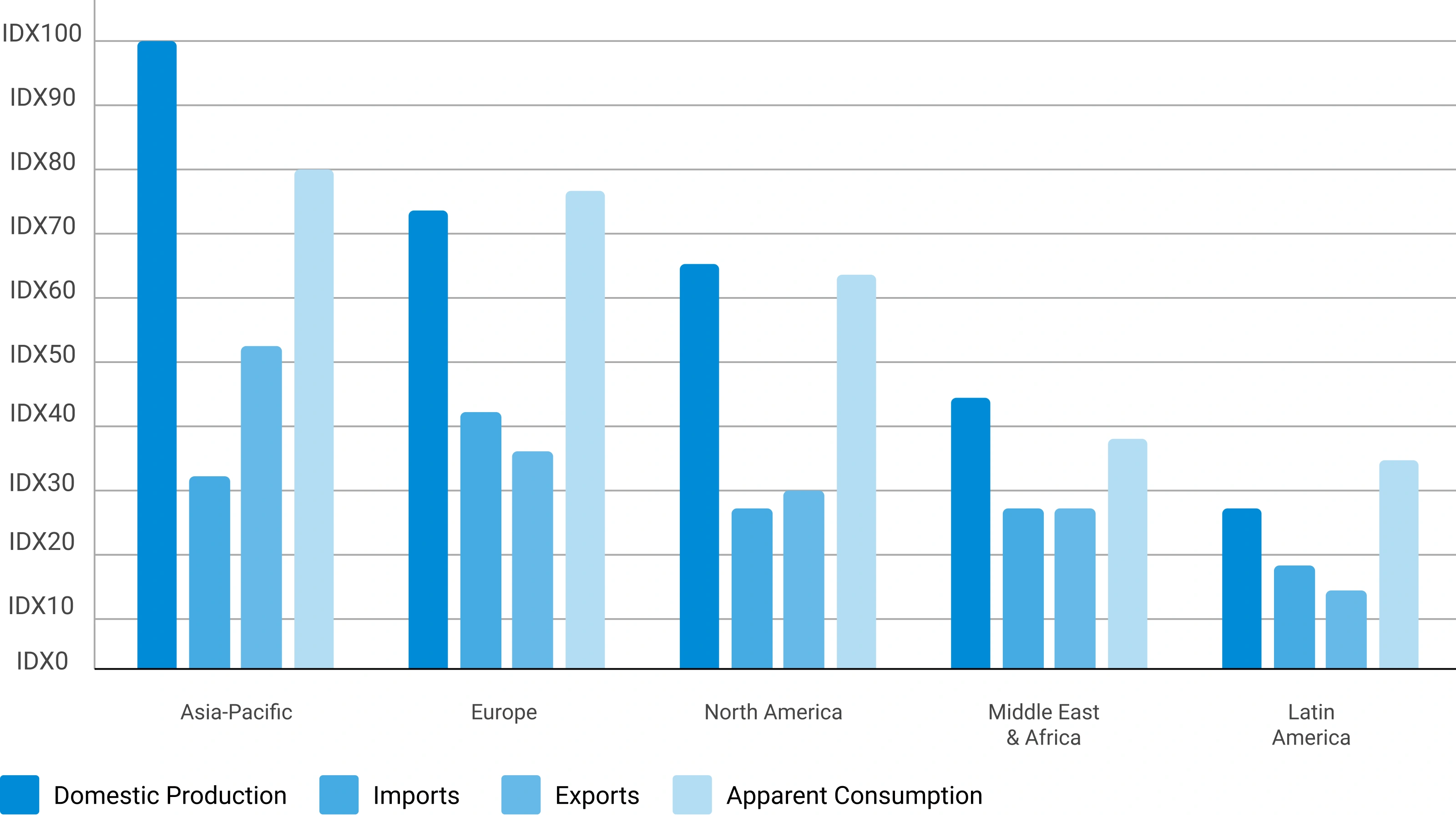
Trade flow analysis reconciles regional supply and demand estimates through import and export data, identifying net supply positions, regional dependencies, and market imbalances. It serves as an independent validation layer that tests the consistency of supply-side and demand-side estimates.
Import Analysis
Import data is evaluated to determine volumes, source countries, product dependency, regional supply gaps, and pricing trends — identifying markets that rely heavily on external supply and where domestic production is insufficient to meet demand.
Export Analysis
Export assessments reveal production surplus, export competitiveness, regional manufacturing strength, and global market participation. Export patterns also help validate domestic production estimates and identify net exporting regions.
Apparent Consumption Model
Regional consumption is assessed using the standard apparent consumption formula:
Results identify net importing regions, net exporting regions, regional deficits, and surpluses — serving as an independent validation of supply and demand estimates.
Trade Flow Analysis — Net Supply Position by Region
Illustrative apparent consumption vs. domestic production across major regions — positive gap indicates net import dependency
Phase 5 — Primary Research: The Critical Validation Layer
Primary research tests and refines findings from secondary research through direct engagement with industry participants across the supply chain, demand side, and expert community. It captures intelligence that no database or published report can provide — the real-world experience of manufacturers, buyers, and specialists operating in the market.

Supply-Side Interviews
Conversations with chemical manufacturers, raw material suppliers, contract manufacturers, technology providers, and plant operators cover production trends, capacity utilization, pricing developments, technology shifts, and competitive dynamics.

Demand-Side Interviews
Engagement with OEMs, industrial consumers, procurement managers, distributors, formulators, and end-use manufacturers focuses on consumption trends, purchasing behavior, product substitution, demand outlook, and emerging applications.

Industry Expert Consultations
Additional interviews with industry consultants, independent experts, regulatory specialists, technical professionals, and research institutions provide deeper market context and validate key analytical assumptions.
Focus Areas of Primary Research:
Market Size & Forecast Validation
Revenue estimates, volume consumption, growth rates, forecast assumptions, regional demand.Supply Chain & Value Chain Assessment
Raw material sourcing, supply chain challenges, distribution networks, procurement practices.Production & Capacity Analysis
Manufacturing capacity, utilization rates, expansion projects, plant investments.Pricing & Cost Structure Analysis
Product pricing trends, feedstock costs, energy costs, margin pressures, pricing outlook.Competitive Landscape Assessment
Volume and value estimates confirmed to be fully consistent with one another before publicationInterview Volume by Market Scope
| Study Scope | Number of Interviews |
|---|---|
| Niche Market | 20 – 30 |
| Mid-Sized Market | 30 – 50 |
| Global Market | 50 – 80 |
| Highly Fragmented Market | 80 – 120 |
Interview Details:
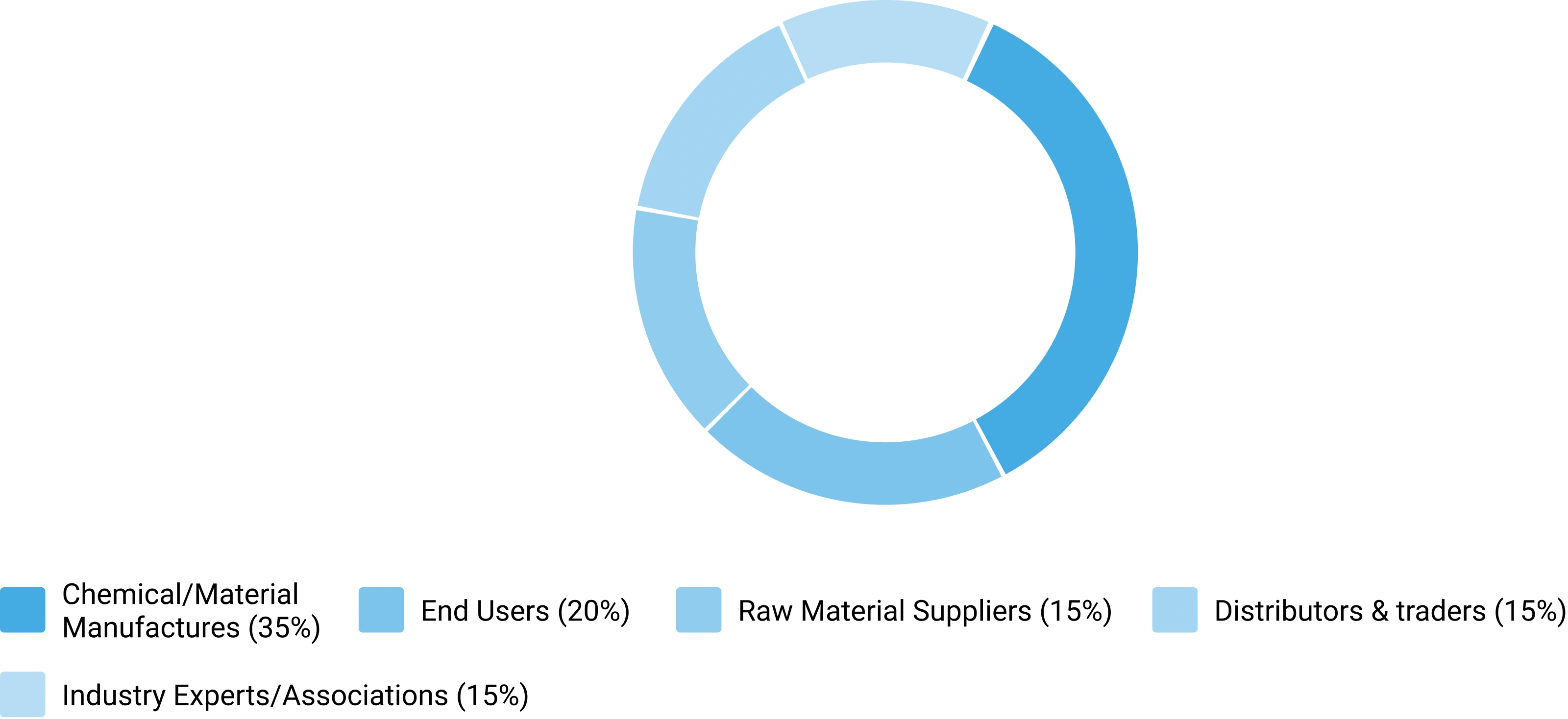
Category : Manufacturers, Suppliers, Distributors, End Users, Experts/Associations
Average Duration : 30–60 Minutes
Interview Mode : Video calls, telephonic interviews, expert consultations
Interview Format : Structured / Semi-Structured questionnaire
Focus Areas of Primary Research:
Market Size & Forecast Validation :
Revenue estimates, volume consumption, growth rates, forecast assumptions, regional demand.
Supply Chain & Value Chain Assessment :
Raw material sourcing, supply chain challenges, distribution networks, procurement practices.
Production & Capacity Analysis :
Manufacturing capacity, utilization rates, expansion projects, plant investments.
Pricing & Cost Structure Analysis :
Product pricing trends, feedstock costs, energy costs, margin pressures, pricing outlook.
Competitive Landscape Assessment :
Market share, competitor positioning, strategic initiatives, partnerships, acquisitions.
Primary Research — Stakeholder Coverage by Category
Distribution of interview respondents across stakeholder categories (% share from PPT data)
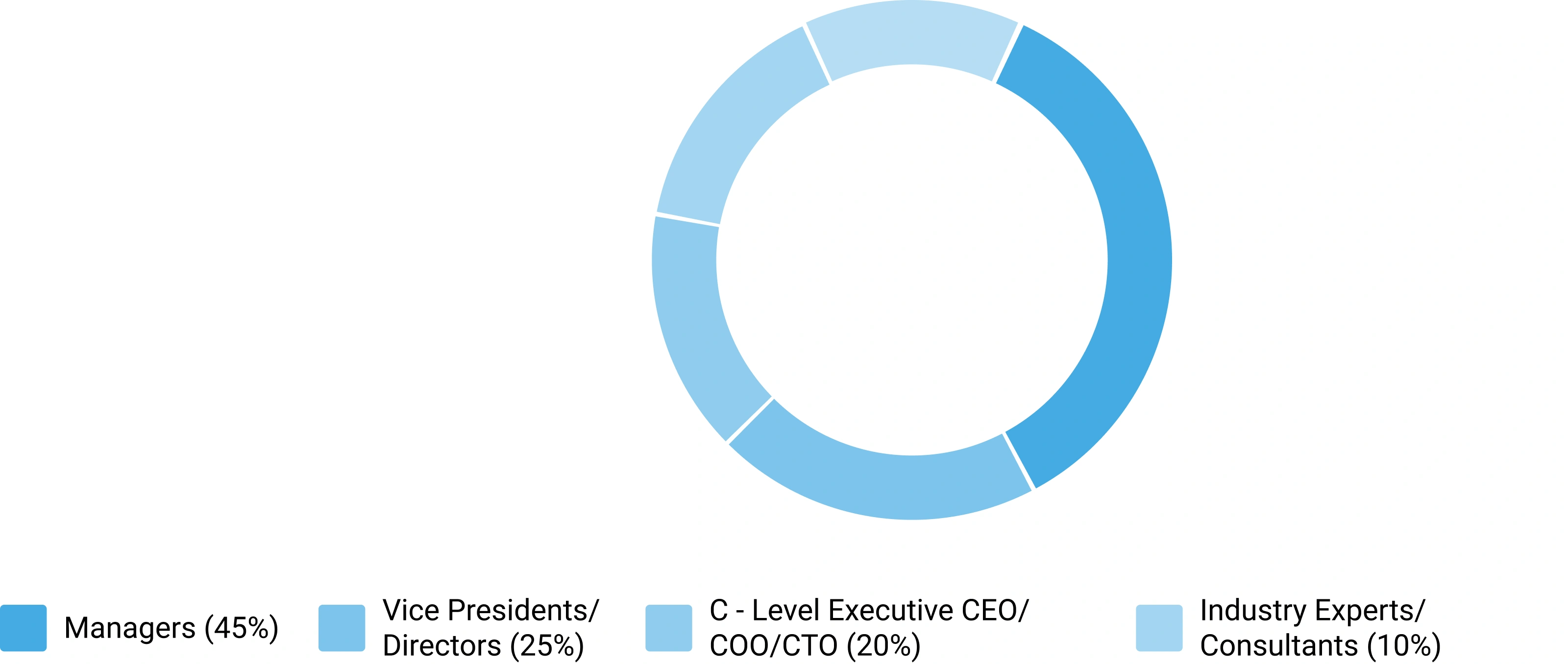
Primary Research — Respondent Designation Profile
Seniority breakdown of interview respondents (% share from PPT data)
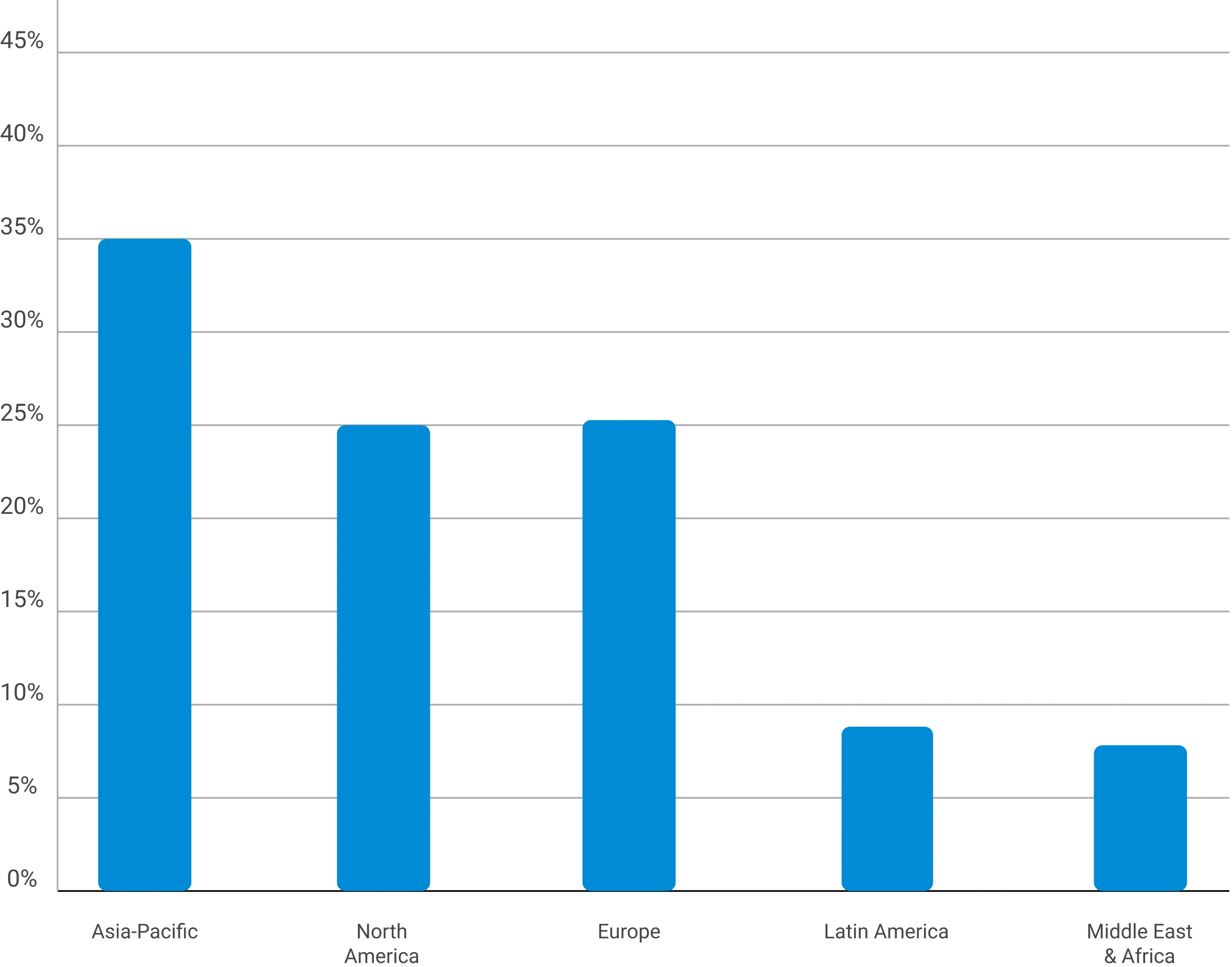
Primary Research — Geographic Coverage of Interviews
Regional distribution of primary research engagement (% share from PPT data)
Phase 6 — Data Triangulation and Market Validation
No single methodology is relied upon in isolation. Multiple independent estimation approaches are combined and reconciled to ensure consistency, accuracy, and analytical defensibility. Any material deviations between approaches are investigated and adjusted through additional validation cycles.
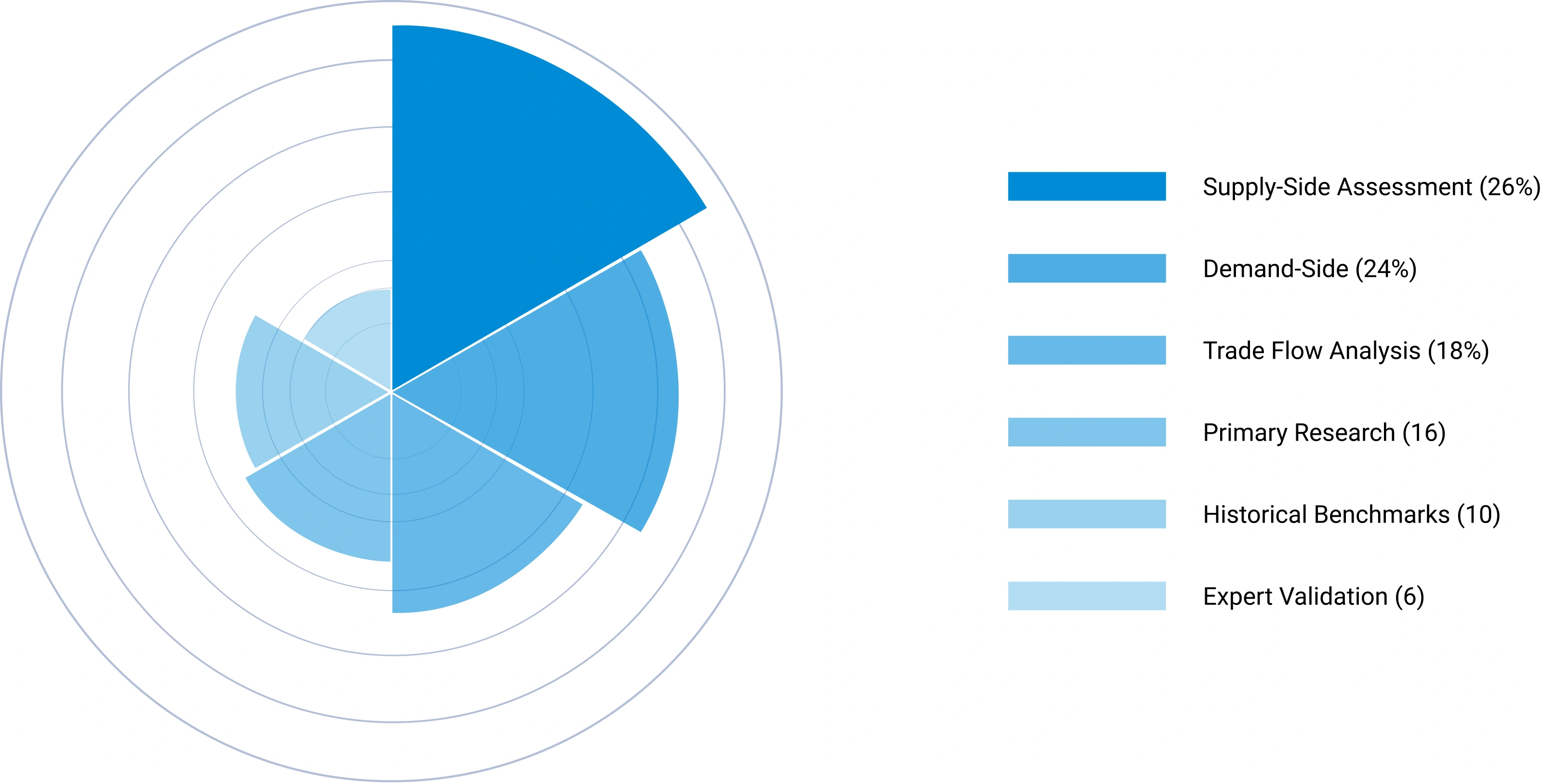
The final market size is derived through weighted triangulation of all validated methodologies. Any material deviations between approaches are investigated and adjusted through additional validation cycles. The outcome represents the most realistic assessment of the market based on available evidence and expert confirmation ensuring that volume and value estimates are fully consistent with one another.
Triangulation Framework — Input Contribution Weight
Relative weight each sizing input contributes to the final reconciled market estimate
Phase 7 — Forecast Modeling: Projecting Future Market Evolution
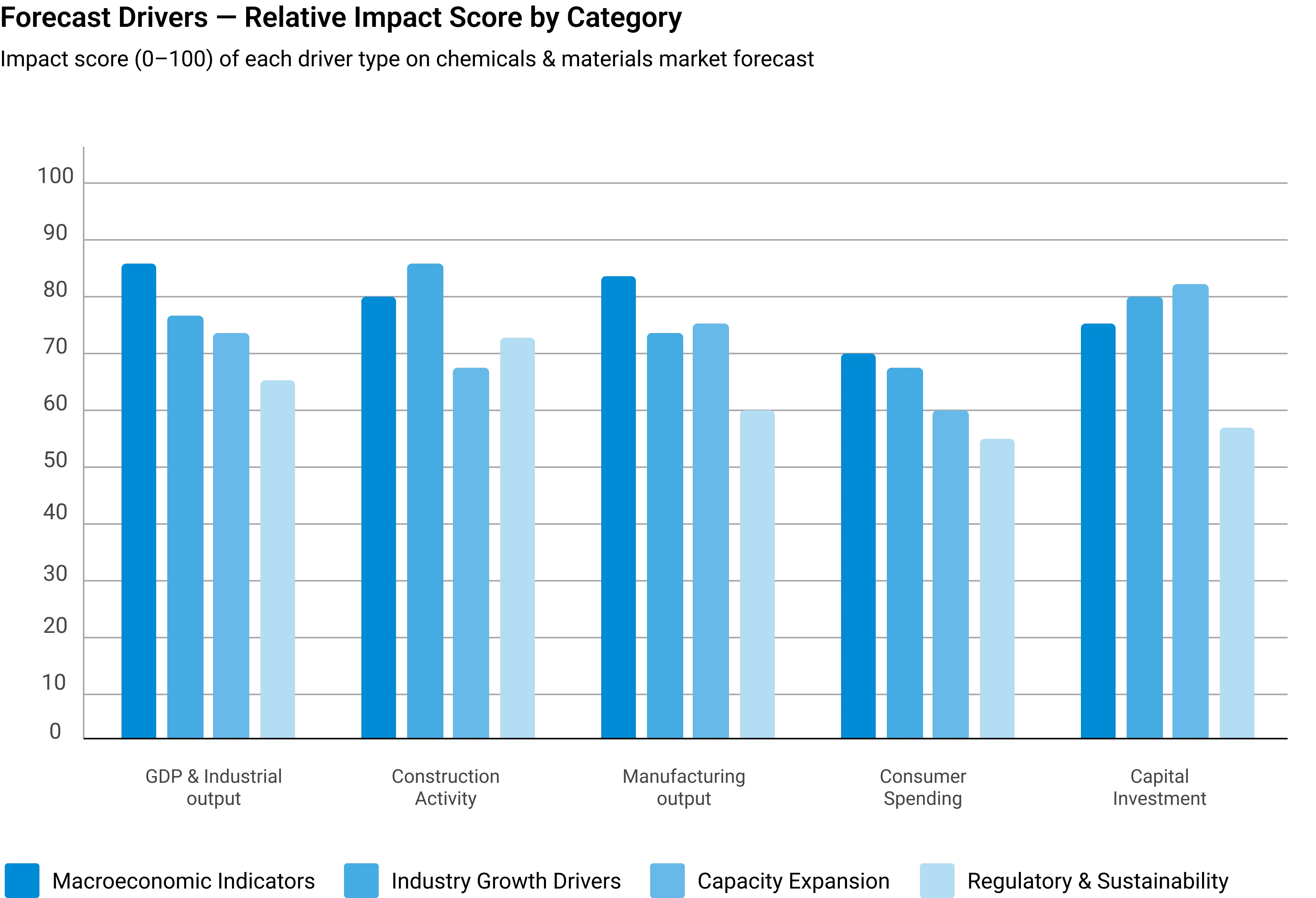
Forecasting evaluates the future trajectory of the market using a combination of quantitative indicators and qualitative assessments across economic, industry, and regulatory dimensions. Rather than simple extrapolation, each driver is independently modeled and integrated into a composite forecast.
Macroeconomic Indicators
GDP growth, industrial production, manufacturing output, construction activity, consumer spending, and capital investment form the quantitative foundation of long-term demand projections. These are applied at country, regional, and global levels.
Industry Growth Drivers
Urbanization, infrastructure development, industrialization, technological innovation, sustainability initiatives, and evolving product performance requirements are assessed at regional and industry levels — capturing both structural and cyclical demand drivers.
Capacity Expansion Analysis
Announced plant expansions, new manufacturing facilities, technology upgrades, and strategic investments are evaluated to determine future supply-demand dynamics and potential market tightness or oversupply situations.
Regulatory & Sustainability
Environmental regulations, chemical safety standards, emission reduction targets, circular economy initiatives, and sustainability requirements are incorporated as they often influence product adoption rates and market growth trajectories.
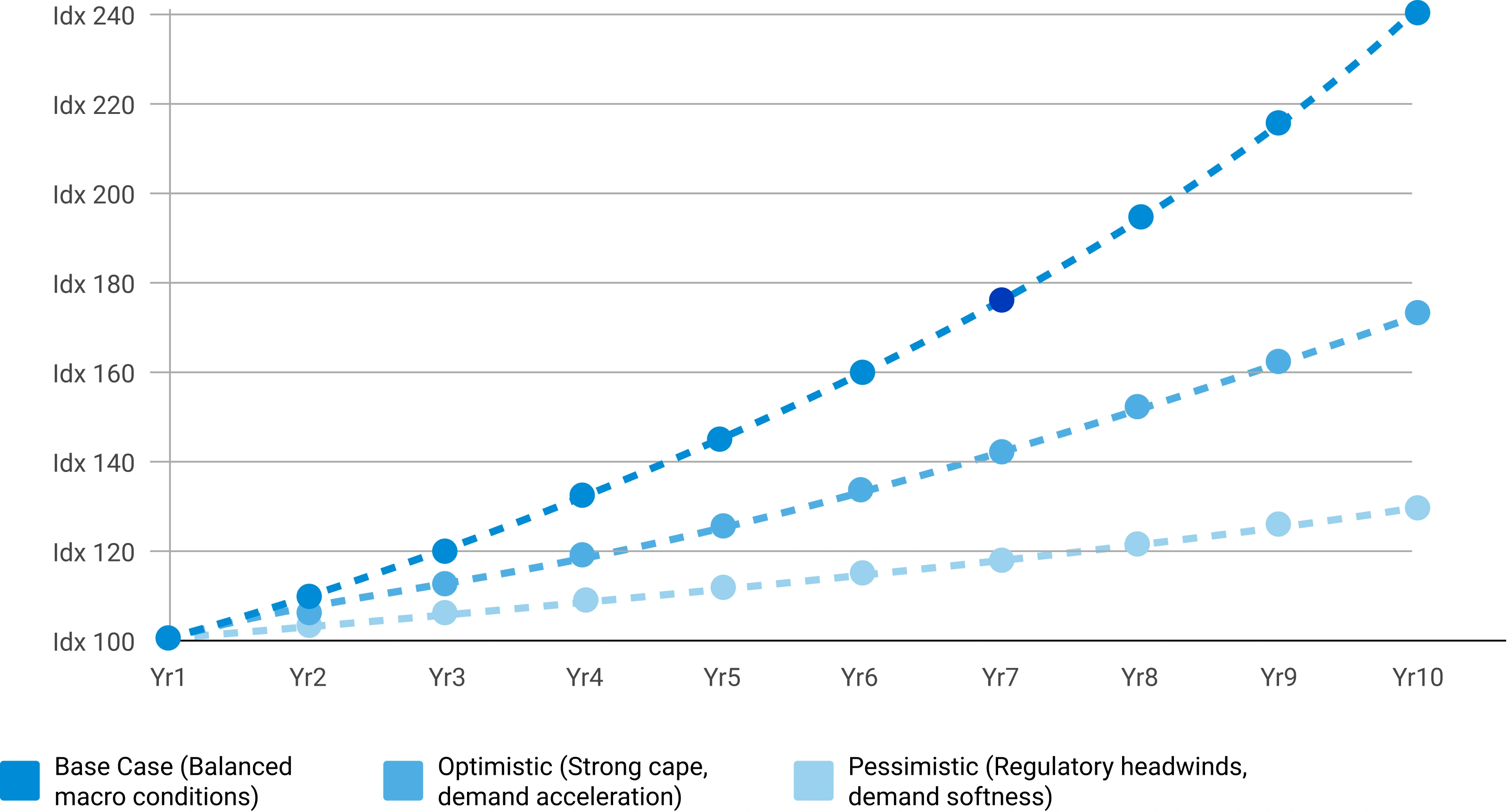
Scenario Forecast Range — Indexed Market Growth (Year 1–10)
Illustrative indexed growth trajectories across Base, Optimistic, and Pessimistic scenarios over a 10-year forecast horizon
Forecast Drivers — Relative Impact Score by Category
Impact score (0–100) of each driver type on chemicals & materials market forecast



Comments
Share your thoughts, ask a question, or provide feedback about this report.