Find the Right Market Report
Search thousands of industry reports, market insights, and research studies in one place.
Not sure where to start? Try one of these:
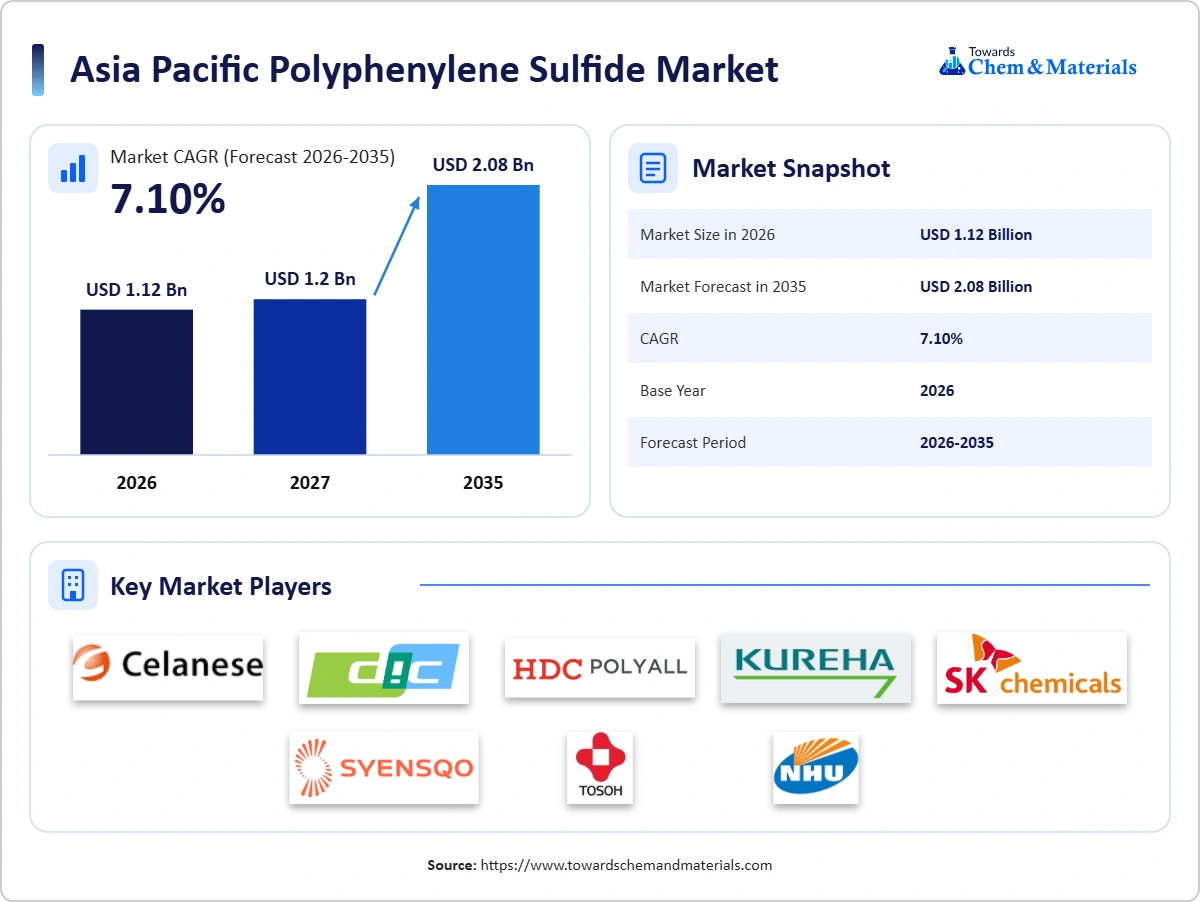
The Asia Pacific polyphenylene sulfide (PPS) market size is valued at USD 1.12 billion in 2026 and is projected to reach USD 2.08 billion by 2035, expanding at a CAGR of 7.10% from 2026 to 2035.The market covers polyphenylene sulfide (PPS) resins and compounds sold across the Asia Pacific region, including linear and cross-linked (cured) PPS, glass-fibre and mineral-filled compounds, as well as PPS fibres and films. These materials are used in automotive and electric vehicle components, electrical and electronics applications, industrial and filtration products, and coatings.
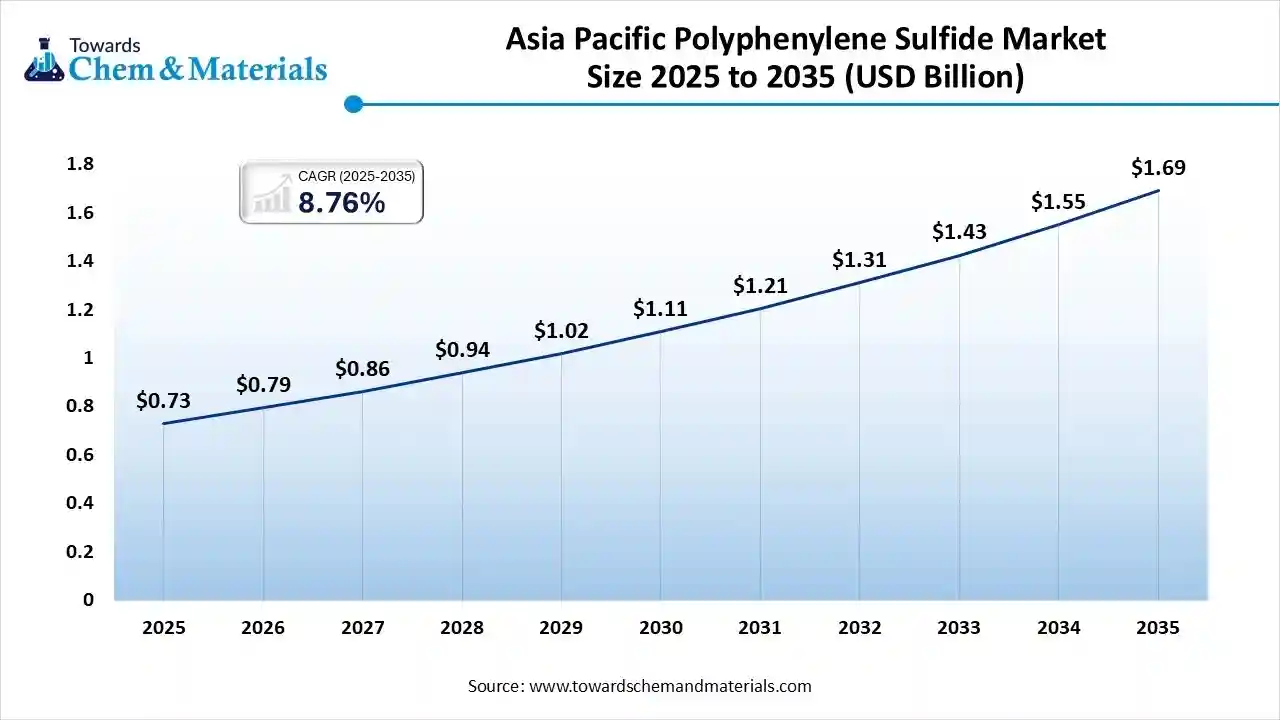
Note: 2025 is the base year; 2026-2035 values are forecasts.
Sources: Expert interviews, secondary sources, Towards Chemical and Materials database, and Towards Chemical and Materials analysts.
Glass-Fibre & Mineral-Filled Compounds dominated the product segment with a 68.00% share in 2025, driven by their widespread use in injection-moulded automotive and electrical components. China contributed 54.00% of total revenue in the base year, supported by strong EV and electronics manufacturing and the expansion of domestic PPS production capacity. The demand for polyphenylene sulfide across Asia Pacific is increasing with the growth of electric vehicles, electronics miniaturisation, metal replacement, filtration and local compounding activities. Manufacturers are also expanding production closer to emerging markets, with Toray planning to establish a PPS plant in India in June 2026.
The Asia Pacific polyphenylene sulfide market is projected to reach USD 2.08 billion by the end of the forecast period, up from USD 1.05 billion in 2025. Higher EV and electronics production and the increasing substitution of metal with PPS in heat- and chemical-resistant applications are expected to support this growth. The market is expected to expand to USD 1.48 billion by 2030, registering a CAGR of 7.10% from 2026 to 2035.
Analyst View: We built the estimate from PPS consumption by application and country and average compound prices, cross-checked against producer information.
The Asia Pacific polyphenylene sulfide market is experiencing increasing growth, supported by rising demand from the electric vehicle, electronics, and industrial filtration sectors. Chinese manufacturers are actively expanding their production capacities to meet growing regional demand, while producers in Japan and South Korea are strengthening their market presence across emerging economies, particularly India.
Market Drivers - Impact & CAGR Contribution (2026-2035)
| Driver | Impact | ≈ CAGR Contribution | Time Horizon | Key Regions |
| Electric vehicles | High | +2.77 pp | Short to long term | Asia Pacific-wide, strongest in China |
| Electronics | Medium | +2.34 pp | Medium to long term | Asia Pacific-wide, fastest uptake in India |
| Metal replacement | Medium | +1.99 pp | Short to medium term | Asia Pacific-wide |
| Filtration | Low | +1.56 pp | Long term | China and India |
Note: Contributions are indicative estimates of each factor's effect on annual growth.
Sources: Expert interviews, secondary sources, Towards Chemical and Materials database, and Towards Chemical and Materials analysts.
EVs, electronics, and metal replacement are the strongest market growth drivers, with their positive CAGR contributions being 2.77, 2.34, and 1.99 percentage points, respectively.
Market Restraints - Impact & Negative CAGR Contribution (2026-2035)
| Restraint | Impact | ≈ Negative CAGR Contribution | Time Horizon | Key Regions |
| Price competition | High | -0.70 pp | Short to medium term | Asia Pacific-wide |
| Raw material volatility | High | -0.52 pp | Medium term | Smaller and price-sensitive markets |
| Competing polymers | Medium | -0.34 pp | Short term | China and other mature markets |
Note: Contributions are indicative estimates of each factor's effect on annual growth.
Sources: Expert interviews, secondary sources, Towards Chemical and Materials database and Towards Chemical and Materials analysts.
Price competition is the main restraint, followed by raw material volatility and competing polymers.
Asia Pacific Polyphenylene Sulfide Market by Product, 2025 Share (%)
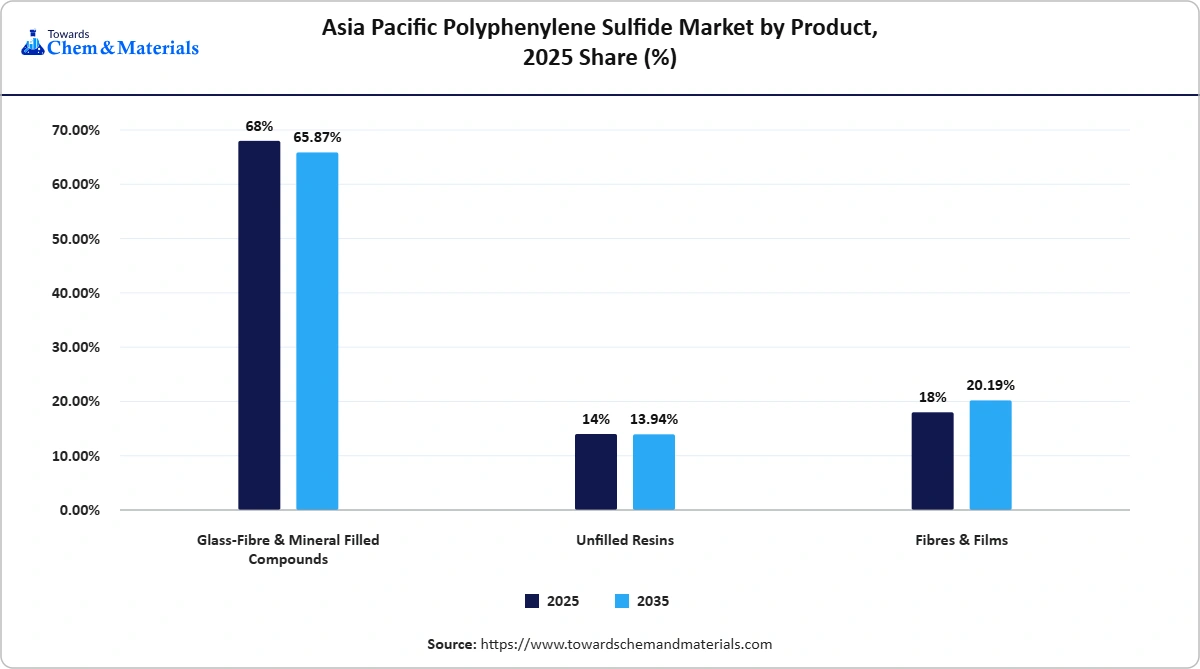
Note: 2025 is the base year; 2035 shares and CAGRs are forecasts.
Sources: Expert interviews, secondary sources, Towards Chemical and Materials database and Towards Chemical and Materials analysts.
Glass-fibre filled compounds dominated the market in 2025, owing to the fact that they are extensively used in injection-moulded automotive and electrical components. PPS fibres and films are expected to grow fastest, supported by rising demand for filtration bags and insulation materials in EV batteries and motors.
Asia Pacific Polyphenylene Sulfide Market by Application, 2025 Share (%)
| Segments | 2025 Share | 2035 Share | CAGR 2026-2035 |
| Automotive & EV | 46.00% | 48.08% | 7.63% |
| Electrical & Electronics | 30.00% | 28.85% | 6.63% |
| Industrial & Filtration | 17.00% | 16.35% | 6.63% |
| Others | 7.00% | 6.73% | 6.63% |
Note: 2025 is the base year; 2035 shares and CAGRs are forecasts.
Sources: Expert interviews, secondary sources, Towards Chemical and Materials database, and Towards Chemical and Materials analysts.
The automotive segment leads as manufacturers increasingly replace metal with PPS in under-the-hood components and EV parts. Electrical and electronics represent another major application area, while EV-specific components are expected to record the fastest growth.
Analyst View: Fibres and films and EV parts are gaining share at the fastest pace, while compounds and automotive continue to hold large shares in the market.
Asia Pacific Polyphenylene Sulfide Market by Country, 2025 Share (%)
| Country | 2025 Share | 2035 Share | CAGR 2026-2035 |
| China | 54.00% | 52.40% | 6.81% |
| Japan | 18.00% | 18.27% | 7.21% |
| South Korea | 12.00% | 12.02% | 7.21% |
| India | 8.00% | 9.13% | 8.41% |
| Southeast Asia | 5.00% | 5.29% | 7.21% |
| Rest of Asia Pacific | 3.00% | 2.88% | 7.21% |
Note: 2025 is the base year; 2035 shares and CAGRs are forecasts.
Sources: Expert interviews, secondary sources, Towards Chemical and Materials database, and Towards Chemical and Materials analysts.
In 2025, China dominated the market, supported by strong EV and electronics manufacturing and the expansion of domestic PPS production capacity. India is expected to record the fastest growth rate throughout the forecast period, driven by rising automotive production and significant investments in local compounding facilities.
Country Insights
Analyst View: China will maintain its leading position through its established manufacturing base and expanding domestic capacity, while India's growing automotive industry and new compounding investments will support the fastest regional growth.
| Rank | Company Name | 2025 Share (%) | Key Products / Business | Headquarters |
| 1 | Toray Industries | 24.00% | Torelina PPS resins and compounds | Japan |
| 2 | DIC Corporation | 14.00% | PPS compounds | Japan |
| 3 | Solvay/Syensqo | 8.00% | Ryton PPS | Belgium |
| 4 | Zhejiang NHU | 8.00% | PPS resins | China |
| 5 | Celanese | 6.00% | Fortron PPS | United States |
| 6 | Kureha | 5.00% | Fortron joint venture and PPS | Japan |
| 7 | Chongqing Glion | 5.00% | PPS | China |
| 8 | Tosoh | 4.00% | PPS resins | Japan |
| 9 | HDC Polyall | 4.00% | PPS | South Korea |
| 10 | SK Chemicals | 2.00% | PPS | South Korea |
Note: Company shares are 2025 estimates.
Sources: Company press releases, expert interviews, secondary sources, Towards Chemical and Materials database, and Towards Chemical and Materials analysts.
Toray Industries led the market with a 24.00% share in the base year, followed by DIC Corporation at 14.00% share and Solvay/Syensqo at 8.00% share. Toray Industries leads owing to its Toraylina PPS resins and compounds, whereas DIC Corporation stays competitive with its portfolio of PPS compounds, and Solvay/Syensqo offers Ryton PPS. Zhejiang NHU, Celanese, Kureha, Chongqing Glion, Tosoh, HDC Polyall and SK Chemicals compete through PPS resins, fortron PPS, fortron joint venture and PPS, PPS, PPS resins, PPS and PPS.
In 2025, the top 10 companies captured 80.00% of net market revenue, while the remaining 20.00% was shared among Chinese compounders and resin makers. The Asia Pacific polyphenylene sulfide market is moderately concentrated, and competition centres on capacity, integration into raw materials, compound performance, automotive approvals, and price.
The Asia Pacific polyphenylene sulfide value chain connects raw material suppliers, resin manufacturers, compounders, component manufacturers, OEMs and regulators. Each stage contributes to material development, processing, and product manufacturing before PPS-based components reach end users. Resin producers are also adopting material informatics and AI-driven tools to develop and optimize PPS compounds.
| Ecosystem Stage | Role in the Market | Key Companies |
| Raw Materials | Supply p-dichlorobenzene and sodium sulfide | Chemical producers |
| Resin Producers | Polymerise PPS | Toray, DIC, Zhejiang NHU |
| Compounders | Make filled grades | Toray, DIC, local compounders |
| Part Makers & OEMs | Mould parts | Auto suppliers, electronics makers |
| Regulators | Set standards | Automotive and electrical standards |
Sources: Company press releases, expert interviews, secondary sources, Towards Chemical and Materials database and Towards Chemical and Materials analysts.
Value in the market moves from raw material and technology suppliers to manufacturers and service providers, before reaching end users through distribution partners. Companies that integrate multiple stages or build long-term customer relationships will be well-positioned to capture a greater share of this value.
The Towards Chemical and Materials Companies Quadrant evaluates key participants in the market based on market strength and innovation and growth strategy. Market strength considers revenue scale, market share and geographic reach, while innovation and growth strategy assess product range, R&D investment and partnerships. Company positions reflect their market shares in 2025 and our evaluation of their product innovation, portfolio breadth and partnerships.
Sources: Company press releases, expert interviews, secondary sources, Towards Chemical and Materials database and Towards Chemical and Materials analysts.
Leaders: Toray Industries, DIC, Solvay/Syensqo, Zhejiang NHU, Celanese and Kureha combine strong market positions with broad portfolios and robust innovation pipelines.
Innovators: Chongqing Glion, Tosoh, HDC Polyall and SK Chemicals bring newer technologies and specialized products.
By Product
By Application
By Country
The Asia Pacific polyphenylene sulfide (PPS) market covers resins and compounds sold across the region. It includes linear and cross-linked (cured) PPS, glass-fibre and mineral-filled compounds, and PPS fibres and films used in automotive and EV parts, electrical and electronic components, industrial equipment, filtration and coatings.
The 2025 market estimate was built from demand volumes and average selling prices for each product type, application and country. We also compared the results with the PPS-related revenues of leading companies and available industry data to check their accuracy. Market values were then assigned across segments, countries and companies based on their respective product and application demand.
We cross-checked the estimates against company disclosures, regulatory records, industry data and published third-party research. Inputs that could not be verified or reconciled were left out. All segment, regional and company estimates were aligned with the 2025 base year. The forecast for 2026-2035 was calculated using a constant CAGR from this base and checked against the overall market estimates.
We expect the Asia Pacific polyphenylene sulfide market to grow at a significant rate due to continuous growth in the production of EV automobiles. New production capacity in China could put pressure on market prices, while Japanese producers compete through specialised, high-performance PPS grades.
Reliable market intelligence and data-driven insights across the global chemicals and materials industry, helping businesses understand trends, competition, pricing, and emerging opportunities.
Schedule a Demo