Content


What is the Asia Pacific polylactic acid market size and share?
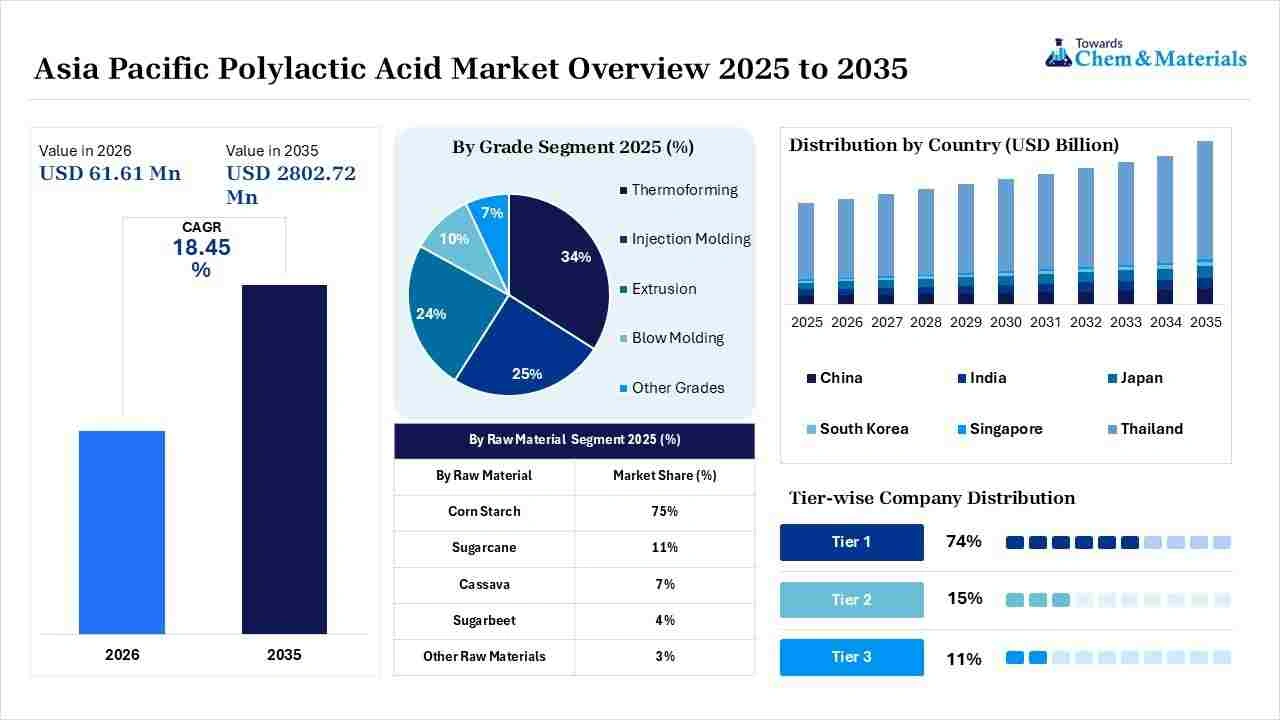
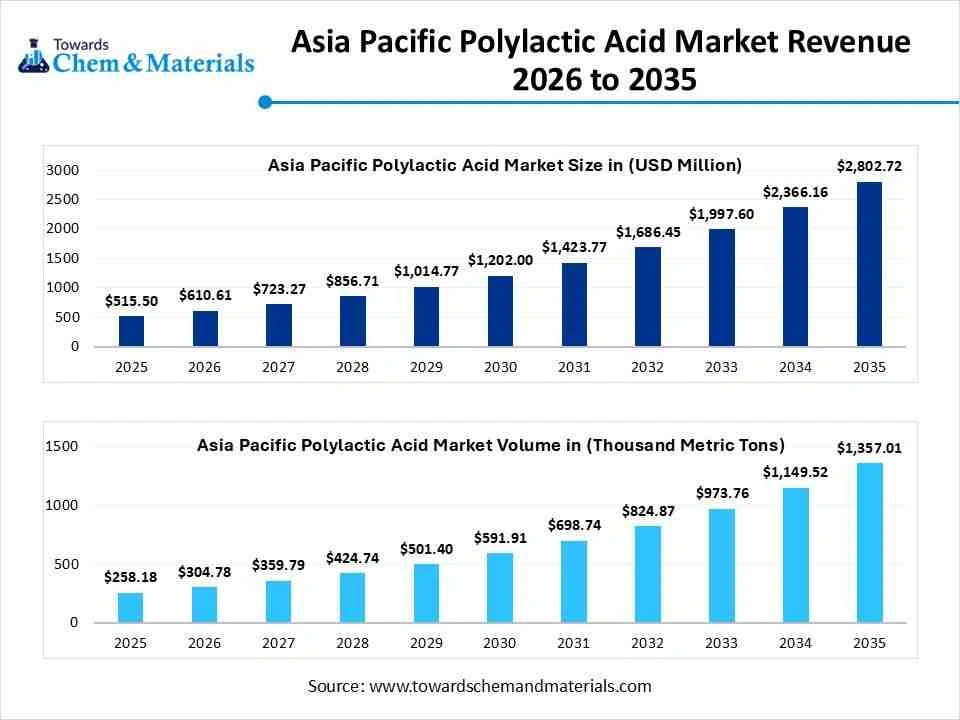
The Asia Pacific polylactic acid market size was valued at USD 515.50 million in 2025, is estimated to reach USD 610.61 million in 2026, and is projected to reach USD 2802.72 million by 2035, exhibiting a compound annual growth rate (CAGR) of 18.45% over the forecast period from 2026 to 2035. The growth is propelled by the growing demand for renewable biomass like corn stover or sugarcane, which is used to produce biodegradable polylactic acid. The rapid expansion of key sectors and demand for sustainable packaging solutions from textiles, automotive components, and electronics due to increased consumer usage increases regional adoption.
Market Highlights
- By region, China dominated the Asia Pacific polylactic acid market with a share of 34% in 2025 and is expected to grow at a CAGR of 17.8% over the forecast period.
- By grade, the thermoforming segment dominated the market with a 34% share in 2025 and is expected to grow at a CAGR of 18.10% over the forecast period.
- By grade, the extrusion segment held a 24% market share in 2025 and is expected to have the fastest growth with a CAGR of 19.60% in the forecast period.
- By raw material, the corn starch segment dominated the market with a 75% share in 2025 and is expected to grow at a CAGR of 17.70% over the forecast period.
- By raw material, the sugarcane segment held a 12% market share in 2025 and is expected to have the fastest growth with a CAGR of 20.10% in the forecast period.
- By application, the rigid thermoforms segment dominated the market with a 42% share in 2025 and is expected to grow at a CAGR of 18.70% over the forecast period.
- By application, the films and sheets segment held a 31% market share in 2025 and is expected to have the fastest growth with a CAGR of 19.80% in the forecast period.
- By end use, the packaging segment dominated the market with a 58% share in 2025 and is expected to grow at a 0CAGR of 18.30% over the forecast period.
- By end-use, the agriculture segment held 11% market share in 2025 and is expected to have the fastest growth with a CAGR of 21.20% in the forecast period.
Market Overview
According to Towards Chemicals and Materials Analytics and Consulting, the Asia Pacific polylactic acid market volume was valued at 258.18 thousand metric tons in 2025 and is expected to surpass around 1357.01 thousand metric tons by 2035, accelerating a compound annual growth rate (CAGR) of 18.05% over the forecast period from 2026 to 2035.
The Asia Pacific polylactic acid market is experiencing growth, driven by the rapid production and consumption of bio-based plastics in the region, which supports market expansion across the region. The rapid demand from sectors like textiles, packaging, consumer goods, automotive, and electronics, as they offer durability and protection, and flexible packaging also aligns with the growing regulatory and sustainability mandates, which further increases the demand. Increased processing facilities and capabilities in and across the region, which are highly driven by corporate sustainability targets and mandates and demand for innovation in packaging solutions, directly help in the adoption of bio-based solutions.
The region is a major agricultural producer; feedstock availability is a major factor in the market, such as maize, sugarcane, corn, and cassava, which in turn helps in lowering the cost of both feedstock and manufacturing costs due to abundant availability, which supports the growth of the industry. The demand for eco-friendly, biodegradable, and bio-based solutions, due to increased awareness among consumers, further increases production, and the presence of key players who focus on sustainability and regulatory compliance, like NatureWorks LLC, Futerro SA, TotalEnergies Corbion, and Zhejiang Hisun Biomaterials Co., Ltd., are aware of environmental concerns, and their adoption and focus on circular economy mandates further contribute to the growth and expansion of the industry.
- For instance, NatureWorks launched Ingeo 3D300, a new specialty engineered 3D printing grade, with high quality and performance. The benefits offered include fast speed, print clarity, high performance, pure and clean material, and cost efficiency. (Source: www.businesswire.com)
Investment Flow for Asia Pacific Polylactic Acid Market 2026
- The Asia Pacific polylactic acid production and supply market is growing rapidly, driven by major corporate investments and government sustainability mandates.
- The Asia Pacific polylactic acid production and supply market is growing rapidly, driven by major corporate investments and government sustainability mandates.
- Regional manufacturers such as Toray Industries and Unitika Ltd are investing in high-performance fiber-grade PLA for automotive components and durable textiles.
- Established leaders like NatureWorks LLC and TotalEnergies Corbion continue to shape regional supply capabilities alongside cost-competitive domestic producers like Hisun Biomaterials.
- Governments across China, India, and South Korea offer financial incentives and green chemistry mandates that support local fermentation infrastructure and reduce dependence on traditional petrochemical plastics.
- NatureWorks Asia Pacific, a joint venture between US-based Cargill and Thailand’s PTT Global Chemical, built its second global manufacturing facility at the Nakhon Sawan Biocomplex in Thailand. This 15-billion-baht (~$490 million USD) investment produces 75,000 metric tons of Ingeo PLA annually, using locally sourced Thai sugarcane. (Source: osos.boi.go.th)
Report Scope
| Report Attributes | Details |
| Market Size in 2026 | USD 610.61 Million / 304.78 Thousand Metric Tons |
| Expected Size in 2035 | USD 2802.72 Million / 1357.01 Thousand Metric Tons |
| Growth Rate | CAGR of 18.45% |
| Base Year of Estimation | 2025 |
| Forecast Period | 2025-2035 |
| Segment Covered | By Grade, By Raw Material, By Application, By End Use, |
| Key Companies Profiled | NatureWorks LLC, TotalEnergies Corbion, Zhejiang Hisun Biomaterials Co., Ltd., Shanghai Tong-Jie-Liang Biomaterials Co., Ltd., COFCO Biotechnology Co., Ltd., Anhui BBCA Biochemical Co., Ltd., Toray Industries, Inc., Unitika Ltd., Futerro SA, Mitsubishi Chemical Corporation, Teijin Limited, Kaneka Corporation, Far Eastern New Century Corporation, Wei Mon Industry Co., Ltd., Jiangxi Keyuan Bio-Material Co., Ltd., Toyobo Co., Ltd., Henan Jindan Lactic Acid Technology Co., Ltd., Shenzhen Esun Industrial Co., Ltd., Nantong Jiuding Biological Engineering Co., Ltd., Wuhan Huali Environmental Technology Co., Ltd. |
Market Growth Trends:
- Bans and restrictions on single-use plastics across China, India, and Japan are forcing industries to adopt biodegradable alternatives, which is a major trend that supports the growth of the market.
- Rising e-commerce and quick-commerce food delivery sectors are scaling up demand for eco-friendly, flexible films and food trays, further boosting the growth of the market due to growing demand.
- Beyond packaging, adoption is rising in 3D printing filaments, textiles, and biocompatible medical implants; their diverse applications and benefits offered support the growth of the market.
Key Technological Shifts in Asia Pacific Polylactic Acid Market: Manufacturing Efficiency
Artificial intelligence is accelerating production and material innovation in the Asia Pacific polylactic acid market. Machine learning models and digital tools optimize the PLA extrusion and fermentation processes, which reduce cycle times, cut production waste, and improve product consistency. AI-driven platforms combined with IoT and cloud systems streamline sustainable feedstock sourcing and track product quality across regional circular bio-economies, which helps in the growth of the market. AI algorithms and machine learning speed up bioplastic creation by optimizing polymer blends, predicting material durability, and modeling application performance; this shift is a major advancement.
Supply Chain Analysis of the Asia Pacific Polylactic Acid Market:
Chemical Synthesis and Processing
- Polylactic acid is produced from renewable feedstocks such as corn starch, sugarcane, and cassava through fermentation of sugars into lactic acid, followed by ring-opening polymerization to form PLA resin. The polymer is then processed via extrusion, injection molding, thermoforming, and blow molding into films, fibers, and packaging products.
- Key players: NatureWorks LLC, TotalEnergies Corbion, Zhejiang Hisun Biomaterials Co., Ltd., Shanghai Tong-Jie-Liang Biomaterials Co., Ltd.
Quality Testing and Certification
- PLA products are tested for biodegradability, compostability, mechanical strength, and thermal performance under standards such as ASTM D6400, EN 13432, and ISO 17088. These certifications ensure compliance with industrial and home composting requirements
- Key players: TÜV Austria, SGS, UL Solutions, Intertek
Distribution to Industrial Users
- PLA materials are supplied to packaging, textile, agriculture, medical device, and 3D printing industries through polymer distributors, converters, and OEM supply contracts.
- Key players: COFCO Biotechnology Co., Ltd., Anhui BBCA Biochemical Co., Ltd., Toray Industries, Inc., Unitika Ltd., Futerro SA
Sustainability Analysis in Asia Pacific Polylactic Acid
The Asia Pacific polylactic acid market is expanding rapidly. Strict bans on single-use plastics and governmental green chemistry mandates in nations like China and India drive large-scale adoption. The food and beverage, packaging, and textile industries lead regional consumption by shifting toward biodegradable films, sheets, and containers. Major manufacturers are investing heavily in advanced processing, supply chain integration, and industrial composting or recycling infrastructure to close resource loops.
What is Asia Pacific Polylactic Acid?
Polylactic acid is a biodegradable, thermoplastic polyester derived from renewable organic resources like corn starch, sugarcane, or cassava root. Unlike traditional petroleum-based plastics, PLA is valued as a greener alternative because its production uses less energy, and it can break down into natural byproducts under specific composting conditions. The most common uses are medical applications, packaging demand, and 3D printing.
Asia Pacific Polylactic Acid Premium Pricing Analysis
Asia Pacific polylactic acid pricing ranges between ₹250 and ₹300 per kg ($1,450 to $2,500 per ton), maintaining a steady, range-bound trend. New corn- and cane-based production lines in China and India keep export offers competitive, offsetting rising regional bioplastic packaging demand. Single-use plastic bans and e-commerce sustainability mandates continue to support high-volume offtake in food packaging and flexible films.
Asia Pacific Polylactic Acid Market Carbon Tax Analysis
The Asia Pacific polylactic acid (PLA) market is experiencing growth, and tightening carbon pricing frameworks across the region are increasingly influencing its competitive positioning against conventional petroleum plastics. Traditional plastics like polyethylene cost around $1,500 per ton, whereas PLA production can reach up to $2,500 per ton. Expanding carbon pricing mechanisms in the region helps narrow this economic gap by penalizing fossil-heavy emissions.
Asia Pacific Polylactic Acid Market Regulatory Landscape
| Country / Region | Regulatory Body | Key Regulations | Focus Areas | Notable Notes |
| Asia Pacific | Ministry of Environment (Japan), China MEE, BIS India | Japan Green Purchasing Law, China Plastic Pollution Control Action Plan, BIS standards for biodegradable plastics | Eco-labelling, plastic waste reduction, and bio-based material promotion | Countries like Japan and South Korea provide policy support for bioplastics adoption, particularly in packaging and agriculture. |
Market Dynamics
Drivers
Automotive and EV Expansion
The market is experiencing growth, primarily driven by stringent government regulations on single-use plastics, rising demand for sustainable packaging, and expanding automotive and textile manufacturing. Governments across countries like China, India, and Japan are implementing strict environmental rules and bans on single-use plastics to reduce waste, which is increasing adoption in the market. Increasing vehicle and electric vehicle (EV) production in the Asia Pacific region has boosted the use of lightweight, bio-based PLA components for interior designs, floor mats, and consoles, which is a key growth driver.
Challenges
High Production Costs
High production costs and limited feedstock availability are the primary challenges restricting the rapid growth of the polylactic acid market in the Asia Pacific region. PLA production can cost up to $2,500 per ton, while traditional plastics like polyethylene cost around $1,500 per ton. This major price gap makes cost-sensitive buyers in Asia slow to switch, even with tax perks in places like Japan and South Korea. Many areas lack the proper systems to collect, sort, and compost biodegradable plastics, which limits large-scale end-of-life handling.
Opportunities
The Asia Pacific polylactic acid market is expanding rapidly, driven by eco-friendly packaging demands and strict plastic bans. Automakers use lightweight PLA components for vehicle interiors, and the medical sector relies on it for biocompatible implants and absorbable sutures. Public-private partnerships and investments in advanced processing technologies establish regional manufacturing hubs, especially in India and Southeast Asia, which is a major growth opportunity in the market.
Segmental Insights
Grade Insights
The thermoforming segment dominated the market with a 34% share in 2025 and is expected to grow at a CAGR of 18.10% over the forecast period, driven by strong demand for sustainable rigid packaging. Thermoforming grades dominate processing demand because the material retains dimensional stability and heat resistance when heated and molded. Thermoforming PLA offers high clarity, structural strength, and rigidity, making it ideal for transparent food containers and retail packaging.
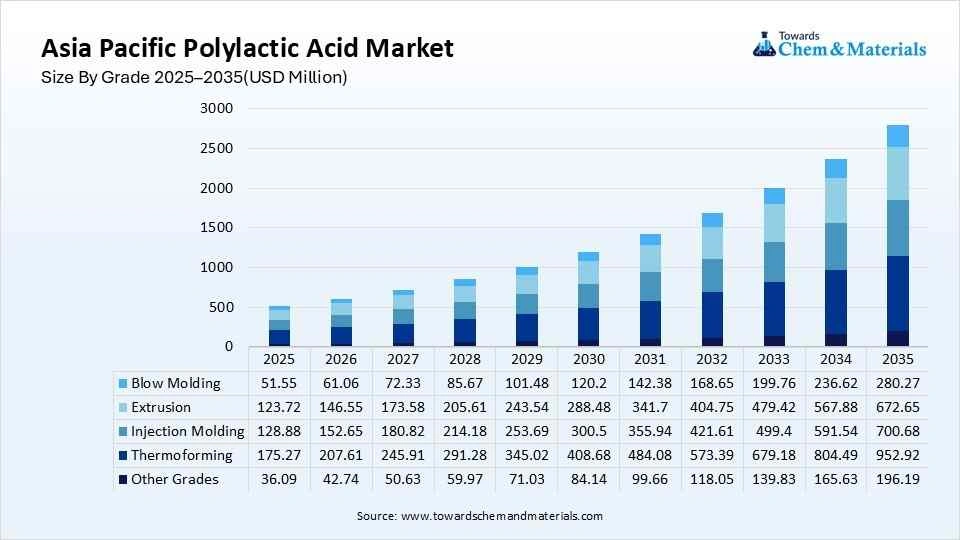
The extrusion segment held a 24% market share in 2025 and is expected to have the fastest growth with a CAGR of 19.60% in the forecast period, driven by increasing demand for biodegradable packaging, films, and extruded fibers. Extrusion methods are widely used to manufacture biodegradable PLA films, flexible packaging, and composite sheets for food packaging. Manufacturers increasingly utilize reactive extrusion techniques for continuous, solvent-free chemical modification, branching, and compatibilization of high-molecular-weight PLA.
Raw Material Insights
The corn starch segment dominated the market with a 75% share in 2025 and is expected to grow at a CAGR of 17.70% over the forecast period, driven by high crop yield, low cost, and established supply chains. Manufacturers convert cornstarch into glucose via wet milling, then ferment it into lactic acid to make PLA polymers. Rapid industrialization, e-commerce growth, and strict government policies against plastic waste in countries like China and India boost sustainable packaging needs. High availability and inexpensive processing make corn an efficient feedstock for large-scale manufacturing.
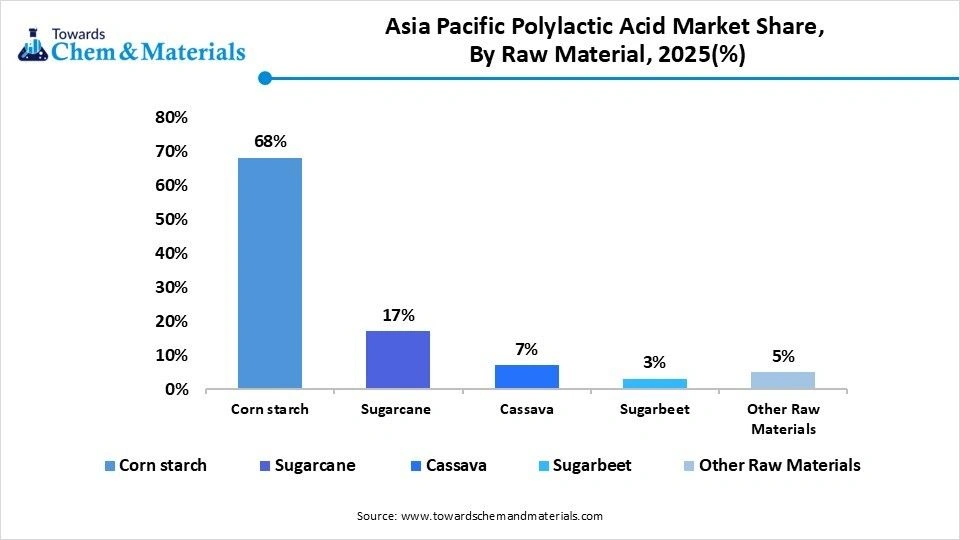
The sugarcane segment held a 12% market share in 2025 and is expected to have the fastest growth with a CAGR of 20.10% in the forecast period, driven by rapid growth in biorefinery developments and renewable feedstocks. Sugarcane is recognized as a highly lucrative raw material with growth potential in the region, supported by heavy agricultural output in countries like India, Thailand, and China. Sugarcane juice or its byproduct, bagasse, undergoes pre-hydrolysis and fermentation to produce lactic acid, which is then polymerized into PLA. Increasing regulations and corporate moves away from virgin petroleum-based plastics bolster demand for sugarcane-derived alternatives.
Application Insights
The rigid thermoforms segment dominated the market with a 42% share in 2025 and is expected to grow at a CAGR of 18.70% over the forecast period. Rigid thermoforms represent the largest share of PLA applications, utilized extensively for clamshells, blister packs, disposable food service trays, and cups. Polylactic acid is chosen for rigid thermoforming due to its high clarity, structural rigidity, and strength, which protect contents while remaining eco-friendly and compostable. Growth is further supported by scalable manufacturing and rising consumer demand for sustainable packaging alternatives.
The films and sheets segment held a 31% market share in 2025 and is expected to have the fastest growth with a CAGR of 19.80% in the forecast period, driven heavily by sustainable packaging demands in countries like Japan, South Korea, and India. Japan and South Korea lead in adopting PLA films for electronics and organic food packaging, while India represents one of the fastest-growing emerging markets. Surging online food delivery and convenience-oriented lifestyles boost the need for eco-friendly disposable items.
End Use Insights
The packaging segment dominated the market with a 58% share in 2025 and is expected to grow at a CAGR of 18.30% over the forecast period, driven by strict rules against single-use plastics and high demand for eco-friendly food and beverage containers. Rapid expansion of online retail across the region fuels demand for sustainable, eco-friendly protective and flexible packaging films. Online delivery and food distribution companies are adopting biodegradable wrappers and containers, which further boosts the growth.
The agriculture segment held an 11% market share in 2025 and is expected to have the fastest growth with a CAGR of 21.20% in the forecast period, expanding rapidly due to rising demand for biodegradable mulch films, seedling pots, and protective agricultural covers that replace traditional non-degradable plastics. Farmers use PLA-based films to cover soil, control weeds, retain moisture, and regulate soil temperature during fruit and vegetable cultivation, which increases demand and drives expansion.
Regional Analysis
How did China dominate the Asia Pacific polylactic acid market in 2025?
The China market size was estimated at USD 175.27 million in 2025 and is projected to reach USD 966.94 million by 2035, growing at a CAGR of 18.62% from 2026 to 2035. China dominated the Asia Pacific polylactic acid market with a share of 34% in 2025 and is expected to grow at a CAGR of 17.8% over the forecast period.
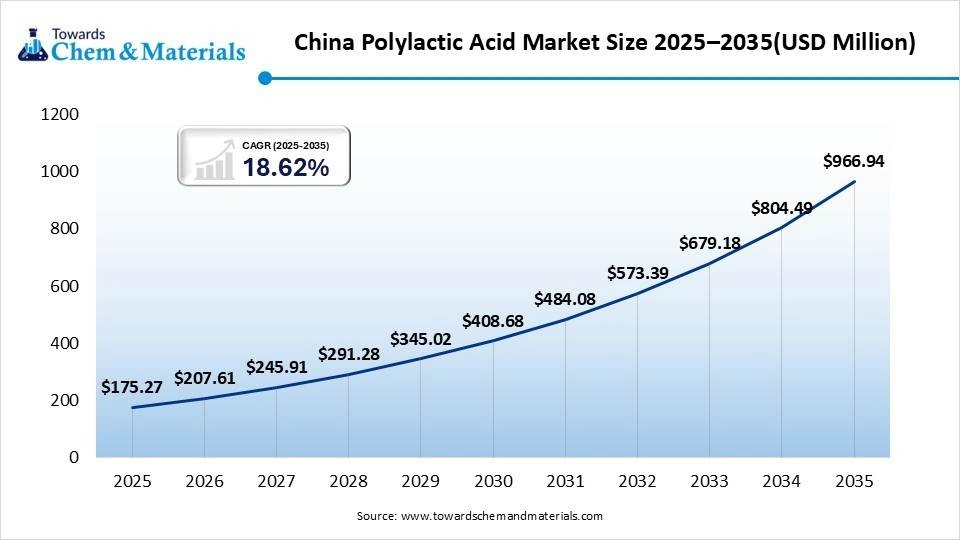
They are driven by massive manufacturing scale, cost advantages, and supportive government regulations. Strict national environmental regulations and circular economy policies pushed industries to adopt green technologies and phase out traditional plastics. China utilized its large industrial base and heavy investments from key players like Hisun Biomaterials and BBCA Biochemical to produce PLA on a massive scale. Rapid industrialization and strong consumer and industrial demand for sustainable packaging fueled high domestic consumption and export strength, supporting growth.
India Polylactic Acid Market Growth Factor
The India market size was estimated at USD 72.17 million in 2025 and is projected to reach USD 406.39 million by 2035, growing at a CAGR of 18.87% from 2026 to 2035. India held a 14.5% share in the market, as it is emerging as a high-potential market for polylactic acid due to growing restrictions on conventional plastic usage and rising adoption of compostable materials. The packaging and food service industries are major end users, driven by e-commerce and food delivery platforms. Government initiatives like the single-use plastic ban and the “Swachh Bharat” mission are encouraging industries to shift towards biodegradable polymers like PLA. Domestic manufacturing is gaining attention, supported by increasing investments in biopolymer plants and research institutions.
Japan Polylactic Acid Market Growth Factor
The Japan market size was estimated at USD 92.79 million in 2025 and is projected to reach USD 518.50 million by 2035, growing at a CAGR of 18.77% from 2026 to 2035. Japan held a market share of 18% in 2025, driven by favorable regulations, sustainability goals, and high-performance industrial applications. Corporate commitments and national policies strongly encourage the shift from traditional plastics to eco-friendly, biodegradable polymers. Japan placed PLA on its Positive List for food-contact plastics, which removed major compliance barriers for food packaging converters. Japanese domestic leaders utilize high-performance PLA for specialized fibers and films used in the demanding automotive and textile sectors, which boosts the expansion of the market.
South Korea Polylactic Acid Market Growth Factor
The South Korea market size was estimated at USD 51.55 million in 2025 and is projected to reach USD 294.29 million by 2035, growing at a CAGR of 19.03% from 2026 to 2035. South Korea held a 10% share in the market, as South Korean companies actively adopt eco-friendly packaging and sustainable supply chain initiatives to meet corporate goals. The packaging, textiles, and automotive sectors drive the highest consumption of polylactic acid in the country. South Koreas robust manufacturing infrastructure and continuous investments in research and development improve biopolymer properties for commercial uses.
Thailand Polylactic Acid Market Growth Factor
The Thailand market size was estimated at USD 20.62 million in 2025 and is projected to reach USD 126.12 million by 2035, growing at a CAGR of 19.85% from 2026 to 2035. Thailand held a 4% share in the market, due to abundant local agricultural biomass, major investments by global bioplastic producers, and rising regional demand for sustainable packaging. Global leaders like TotalEnergies Corbion operate major production facilities in Rayong, Thailand. NatureWorks also expanded operations with a fully integrated facility in Nakhon Sawan Province. These factors support the growth and expansion of the market.
Recent Developments
- In April 2026, NatureWorks, a leading producer of polylactic acid biopolymers from renewable resources, announced the opening of its new fully integrated Ingeo biopolymer plant in Nakhon Sawan, Thailand. This state-of-the-art facility combines lactic acid production from locally sourced sugarcane, lactide monomer production, and polymer manufacturing into one streamlined complex. It marks a notable achievement for NatureWorks and the broader biopolymers sector. (Source: www.businesswire.com)
- In May 2025, Balrampur Chini Mills Limited launched Balrampur Bioyug, Indias first industrial-scale polylactic acid biopolymer brand. The brand is centered around a fully integrated facility in Kumbhi, Uttar Pradesh, which will convert sugarcane derivatives directly into PLA using renewable energy and is expected to be operational by October 2026 with an annual capacity of 80,000 tonnes. (Source: agrospectrumindia.com)
Competitive Analysis
- Asia-Pacific polylactic acid production and supply growth is driven by strategic partnerships between regional governments and major chemical enterprises aligning with national single-use plastic bans and circular economy roadmaps.
- Thailand continues to solidify its status as a regional bioplastics hub; alongside NatureWorks, TotalEnergies Corbion operates a 75,000-tonne/year PLA plant in Rayong.
- Leading domestic chemical manufacturers form strategic alliances with regional agricultural sectors to secure stable non-food biomass cultivation and local biorefinery processing capacity.
- Public-private initiatives under Japans Biomass Plastic The Introduction Roadmap encourages academic-industrial partnerships to scale high-performance PLA variants for automotive and premium packaging applications.
Companies like Zhejiang Hisun Biomaterials and COFCO Biochemical scale up production capacities. - Manufacturers collaborate with academic institutions and packaging firms to create high-heat, durable PLA variants for automotive and packaging uses.
Top players in the Asia Pacific polylactic acid market & their offerings:
| Company | Company Type/Position | Major Headquarters | Geographic Presence | PLA Offerings | Key Offering/Strength |
| NatureWorks LLC | Leading PLA biopolymer manufacturer | Minnetonka, Minnesota, USA | Asia Pacific, North America, Europe, Latin America | Ingeo PLA resins, high-heat PLA, PLA for packaging, fibers, and 3D printing | Strong regional manufacturing presence through its Thailand facility and broad Ingeo portfolio |
| Total Energies Corbion | Major integrated PLA producer | Gorinchem, Netherlands | Asia Pacific, Europe, North America, Latin America | Luminy PLA, high-heat PLA, standard PLA, and PDLA | Strong Thailand-based production platform and integrated PLA technology serving packaging and consumer applications |
| Zhejiang Hisun Biomaterials Co., Ltd. | Chinese PLA producer | Zhejiang, China | China, Asia Pacific, and international markets | PLA resins for injection molding, extrusion, thermoforming, and other applications | Established Asian PLA manufacturing base and application-focused PLA grades |
| Shanghai Tong-jie-liang Biomaterials Co., Ltd. | Chinese biopolymer manufacturer | Shanghai, China | China, Asia Pacific, and international markets | Thermoforming, extrusion, and injection-molding grade PLA | Broad PLA-grade portfolio targeting packaging and molded applications |
| Futerro | Integrated PLA technology and biopolymer company | Escanaffles, Belgium | Asia Pacific, Europe, and global markets | Futeon PLA, lactide, and PLA technology solutions | Strong fermentation, lactide, and PLA polymerization technology with partnerships and licensing activity in Asia |
Other Top Players Are
- NatureWorks LLC
- TotalEnergies Corbion
- Zhejiang Hisun Biomaterials Co., Ltd.
- Shanghai Tong-Jie-Liang Biomaterials Co., Ltd.
- COFCO Biotechnology Co., Ltd.
- Anhui BBCA Biochemical Co., Ltd.
- Toray Industries, Inc.
- Unitika Ltd.
- Futerro SA
- Mitsubishi Chemical Corporation
- Teijin Limited
- Kaneka Corporation
- Far Eastern New Century Corporation
- Wei Mon Industry Co., Ltd.
- Jiangxi Keyuan Bio-Material Co., Ltd.
- Toyobo Co., Ltd.
- Henan Jindan Lactic Acid Technology Co., Ltd.
- Shenzhen Esun Industrial Co., Ltd.
- Nantong Jiuding Biological Engineering Co., Ltd.
- Wuhan Huali Environmental Technology Co., Ltd.
Segments Covered:
By Grade
- Thermoforming
- Food-service thermoforms
- Packaging trays
- Cups and containers
- Clamshells
- Injection Molding
- Rigid packaging components
- Consumer goods
- Automotive components
- Electronic components
- Extrusion
- Films
- Sheets
- Profiles
- Fiber-grade PLA
- Blow Molding
- Bottles
- Containers
- Specialty hollow packaging
- Other Grades
- 3D-printing grade
- Fiber grade
- High-heat-resistant PLA
- Modified/compound PLA
By Raw Material
- Sugarcane
- Sugarcane-derived lactic acid
- Sugarcane-derived lactide
- Corn Starch
- Corn starch fermentation
- Corn-derived dextrose
- Corn-derived lactic acid
- Cassava
- Cassava starch
- Cassava-derived glucose
- Cassava-derived lactic acid
- Sugarbeet
- Sugar beet sugar
- Sugar beet-derived lactic acid
- Other Raw Materials
- Wheat starch
- Potato starch
- Rice starch
- Cellulosic feedstocks
By Application
- Rigid Thermoforms
- Trays
- Cups
- Clamshells
- Food containers
- Films & Sheets
- Flexible packaging films
- Agricultural films
- Lamination films
- Industrial sheets
- Bottles
- Beverage bottles
- Cosmetic bottles
- Household-product bottles
- Specialty bottles
- Other Applications
- Fibers & textiles
- 3D printing
- Coatings
- Medical products
- Consumer products
By End Use
- Packaging
- Food packaging
- Beverage packaging
- Consumer packaging
- E-commerce packaging
- Agriculture
- Mulch films
- Seed coatings
- Controlled-release systems
- Automotive & Transport
- Interior components
- Trim components
- Lightweight structural components
- Electronics
- Housings
- Components
- Insulating materials
- Textile
- PLA fibers
- Nonwovens
- Apparel textiles
- Technical textiles
- Other End Uses
- Consumer goods
- Medical
- 3D printing
- Construction
- Catering and tableware
FAQ's




Select User License to Buy
Figures (5)









 sales@towardschemandmaterials.com
 Download Sample
 Schedule a Meeting