 Request Consultation
Content
Elevate Your Innovation with Specialty Chemicals
The specialty chemicals market is a very innovative area of the global chemical industry, where the product is used for a specific performance property, not for its bulk chemical properties. Manufactured for use in industries with unique requirements, including construction, automotive, electronics, pharmaceuticals, agriculture, textiles, cosmetics, and food processing. In contrast to commodity chemicals, specialty chemicals are not manufactured on such large scales but are formed into custom-made formulations and offer advanced functionalities that create higher value. The market is fueled by continuous research and development activities, technological advancements, and rising demand for sustainable and high-performance materials for industrial applications.
Increased industrialization, urbanization, and strict environmental laws have spurred industries to create specialty chemicals that are environmentally conscious and made using bio-based materials in an efficient manner. Production processes are also undergoing further changes such as digitalization, automation, and artificial intelligence, which further improve quality control, lower operating costs, and speed product innovation.
Continuing government support for industrial growth and favorable government policies are driving substantial investments in specialty chemical manufacturing in emerging economies in Asia-Pacific, Latin America, and the Middle East. Proliferating industries focus on performance, sustainability, and compliance with regulations, driving the specialty chemicals market to continue robust growth fueled by innovation, strategic collaborations, and changing end-user demands.
Evolution of Specialty Chemicals
Specialty chemicals first came on the scene in the nascent period of the Industrial Revolution when manufacturers started to create chemical formulations to enhance specific industrial processes rather than chemicals to be sold in bulk quantities. In the twentieth century, polymers, petrochemicals, and synthetic materials grew and developed in such a way that they caused a huge increase in the use of specialty chemicals for manufacturing, healthcare, agriculture, and consumer goods.
The years following World War II saw a large investment in research and development, leading to new and innovative products, including advanced coatings, adhesives, electronic chemicals, water treatment chemicals, and performance additives. During the latter half of the twentieth century, as environmental concerns and rules became more prevalent, the shift to cleaner production technologies, low-emission formulations, and sustainable chemical solutions became more driven. With the advancement of biotechnology, nanotechnology, and material science, the production of high-performance specialty chemicals to satisfy the sophisticated needs of industry was further enhanced.
The digital world of the 21st century has brought numerous advanced technologies such as Artificial Intelligence (AI), process automation, predictive analytics, and advanced manufacturing, which have greatly enhanced the efficiency, quality assurance, and product customization of production processes. Specialty chemicals are still evolving, with the incorporation of green chemistry principles, circular economy activities, renewable feedstocks, and smart manufacturing systems to deliver higher performance, increased sustainability, and operational efficiencies for industries to meet new demands in the global marketplace.
Impact of Artificial Intelligence (AI) on the Specialty Chemicals Market
AI is revolutionizing specialty chemicals by speeding up R&D, optimizing production, and enhancing product quality. Utilizing AI-driven predictive modelling techniques, scientists can discover new formulations and cut down on product development time. The machine learning algorithms track the production machinery, enabling predictive maintenance to reduce production downtime and losses. AI also improves process control by monitoring the temperature, pressure, and chemical reactions in real-time, ensuring that the products remain consistent and are safer to use.
AI can predict demand, optimize stock levels, and alert companies to potential disruptions in the supply chain. Manufacturers are also utilizing customer analytics for creating customized solutions for specialized chemical products across various industry segments. Businesses are becoming more efficient, sustainable, and competitive as they increasingly use AI.
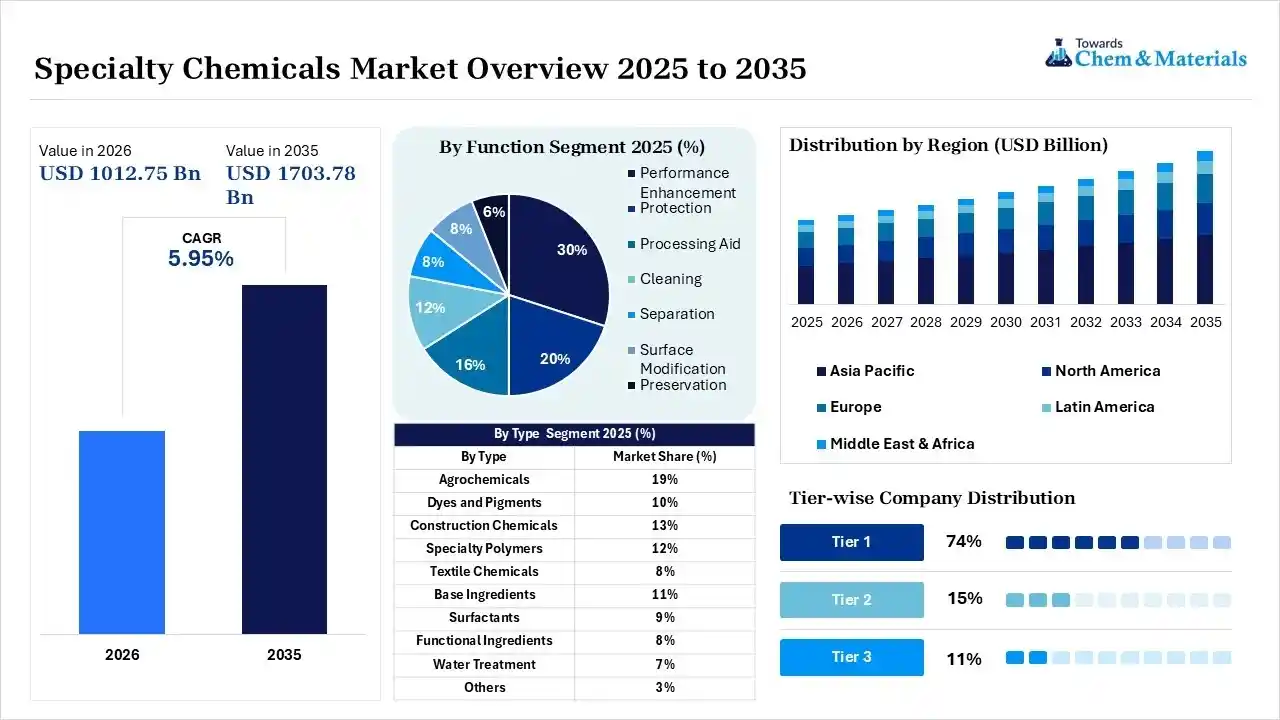
According to Towards Chemicals And Materials Analytics and Consulting, the global specialty chemicals market is projected to grow from USD 1,703.8 billion in 2026 to USD 1,703.8 billion by 2035, registering an impressive CAGR of 5.95% during the forecast period.
Get Full Access of Report | Immediate Delivery@ https://www.towardschemandmaterials.com/checkout/6473
The Specialty Chemicals Market: Supply Chain Resilience.
Geopolitical tensions, pandemics, natural disasters, and volatile raw material prices have all caused supply chain disruption, so it has become a strategic priority to create supply chain resilience. It has become commonplace for manufacturers to diversify their sources of supply rather than relying on a limited region to provide. Companies are decentralizing manufacturing, with a view to minimizing risks associated with transportation and enhancing the ability to respond to customer demand. AI and IoT-driven digital supply chain platforms are giving supply chain stakeholders real-time insights into inventory, logistics, and supplier performance. Having a strategic approach to inventory, long-term supplier relationships, and local sourcing minimizes the risk of unforeseen events.
Lower transportation emissions and responsible sourcing are also part and parcel of resilient supply chain strategies, as are considerations for sustainability. In conclusion, resilient supply chains help specialty chemical companies ensure their operations remain uninterrupted and enhance their profitability and customer satisfaction.
The Speciality Chemicals Supply Chain and the Use of Blockchain Technology.
Blockchain is proving to be a valuable technology for enhancing transparency, traceability, and security in the speciality chemicals supply chain. Speciality chemicals can also come from diverse origins, undergo various production processes, be distributed through a variety of channels, and end up in different industries and sectors, making blockchain an effective solution to track movement and transactions through a secure digital ledger.
This allows manufacturers, suppliers, distributors, and customers to trace the product back to its origin, track quality, and minimize the potential for counterfeit chemicals entering the market. Smart contracts can also streamline procurement, payment, and compliance processes, minimizing paperwork and increasing efficiency. As sustainability and regulatory requirements grow, blockchain is poised to become a crucial part of the speciality chemicals industry's efforts to create resilient and trustworthy supply chains.
The Tools and Technologies That Support Industry Policies.
Digital technologies that enable companies to meet environmental, safety, and quality regulations are being promoted by governments and regulators. Such enterprise resource planning (ERP) systems as SAP systems, laboratory information management systems (LIMS), manufacturing execution systems (MES), environmental, health, and safety (EHS) software, and product lifecycle management (PLM) systems help businesses track compliance and enhance the efficiency of processes.
AI and predictive analytics help to keep track of the environment, ensure product quality, and optimize processes; meanwhile, the Internet of Things (IoT) delivers live data on the production environment and equipment performance. Digital documentation systems make reporting to regulators easier while blockchain technology helps track and audit the supply chain. These technologies, combined, enable organizations to better enact government policies and increase productivity, transparency, and sustainability.
Will the Specialty Chemicals Industry Be Artificial Intelligence Enabled?
Over the next few years, the use of artificial intelligence (AI) is projected to be one of the biggest game-changers in the speciality chemicals industry. The implementation of AI can speed up research and development by studying large amounts of complex chemical data, discovering new molecular structures, and forecasting material properties, which can substantially streamline the product development process.
In the manufacturing industry, AI can contribute to predictive maintenance, process automation, quality control, and energy optimization, leading to more efficient processes and reduced operational expenses. It also optimizes supply chain management by better demand forecasting, inventory optimization, logistics planning, and procurement analysis.
Moreover, AI can help organizations keep track of regulatory compliance, lower emissions, and help them pursue sustainability goals. With the ongoing digital transformation, AI's role within chemical manufacturing, innovation, and business decision-making is likely to increase.
Cryptocurrency is Related to the specialty chemicals industry.
There are multiple connections between the cryptocurrency sector and the specialty chemicals sector. There is not much direct use of cryptocurrency in the production or formulation of specialty chemicals. The blockchain technology on which cryptocurrencies are built, however, can be very helpful in the chemical industry. Blockchain can enhance the transparency of a supply chain, certify the authenticity of raw materials, guarantee records of transactions, and facilitate digital contracts between manufacturers, suppliers, and consumers. Digital currencies and blockchain payment systems could potentially streamline the cross-border payment process, eliminate banking delays, and cut transaction costs in international trade where applicable. Moreover, tokenization and blockchain systems can help with financing, carbon credit trading, and sustainable supply chain efforts. Although cryptocurrencies and specialty chemicals are not intrinsically tied to chemical manufacturing, the digital technology emerging from them will help to improve efficiencies, transparency, and trust in the specialty chemicals ecosystem.
The Advantages of Blockchain for Supply Chain Managers
For supply chain managers in the specialty chemicals industry, blockchain enables them to create a secure, transparent network for managing the flow of materials and products. Each sale is recorded on an immutable digital "ledger" that lets stakeholders know where products came from, how they were made, how they were transported, their quality records, and much more, in real time.
This increased visibility mitigates against counterfeit products, increases traceability, and aids in meeting compliance/regulatory requirements. The smart contracts feature promoted by blockchain also eliminates administrative waste and human error in procurement, invoicing, and payment by automating these processes. It also enhances the ability to work together with suppliers, manufacturers, logistics partners, and customers to increase operational efficiency, speed decision-making processes, and consequently make the supply chain more resilient.
End-Market Demand: Weathering Cyclical Declines with Emerging Growth Opportunities
The speciality chemicals industry supports many end-use consumers, providing more flexibility to handle economic downturns than commodity chemicals, where a downturn usually has fewer impacts. The reduction in demand for certain chemical products due to downturns in industries like construction, automotive, and consumer goods may be short-lived, but other areas offer stable growth.
We are seeing continued demand for specialized chemicals in the healthcare, pharmaceutical, electronics, renewable energy, and electric vehicle markets, as well as in the food processing and personal care industries and in water treatment. The growing demand for advanced coatings, battery materials, biodegradable additives, and eco-friendly formulations in the global transition towards sustainability only further intensifies the need. That leaves the industry with a diverse customer base that allows manufacturers a range of flexibility to meet evolving market needs and a viable long-term growth margin.
Technological Advancements
The specialty chemicals industry is evolving and changing due to technological innovation, which results in more efficient manufacturing, high-quality products, and sustainability. AI and machine learning are driving faster research and development efforts, including attempted predictions of chemical properties, formulation optimization, and reduction of product development time. Industry can use digital twins, process simulation, and sophisticated analytics to optimize production processes and enhance operational efficiency. The automation of processes, robotics, and the Internet of Things (IoT) facilitate real-time process monitoring, preventative maintenance, and improved quality assurance.
Meanwhile, new specialty chemical applications are burgeoning on new grounds involving additive manufacturing, nanotechnology, biotechnology, and green chemistry, and helping to ensure environmentally responsible production. The technological developments are helping manufacturers become innovative in meeting the evolving demands of industries with chemical solutions that are customized and sustainable.
The Advantages of Blockchain for Supply Chain Managers
For supply chain managers in the specialty chemicals industry, blockchain allows them to create a secure and transparent network to handle the flow of materials and products. Each sale is written on an immutable digital "ledger" that lets stakeholders know where products came from, how they were made, how they were transported, the quality records, and much more in real time. This increased visibility mitigates against counterfeit products, increases traceability, and aids in meeting compliance/regulatory requirements. The smart contracts feature promoted by blockchain also eliminates administrative waste and human error in procurement, invoicing, and payment by automating these processes. It also enhances the ability to work together with suppliers, manufacturers, logistics partners, and customers to increase operational efficiency, speed decision-making processes, and consequently make the supply chain more resilient.
End-Market Demand: Weathering Cyclical Declines with Emerging Growth Opportunities
The specialty chemicals industry supports many end-use consumers, providing more flexibility to handle economic downturns than commodity chemicals, where a downturn usually has fewer impacts. The reduction in demand for certain chemical products due to downturns in industries like construction, automotive, and consumer goods may be short-lived, but there are other areas that offer stable growth. We are seeing continued demand for specialized chemicals in the healthcare, pharmaceutical, electronics, renewable energy, and electric vehicle markets, as well as in the food processing and personal care industries and in water treatment.
The growing demand for advanced coatings, battery materials, biodegradable additives, and eco-friendly formulations in the global transition towards sustainability only further intensifies the need. That leaves the industry with a diverse customer base that allows manufacturers a range of flexibility to meet evolving market needs and a viable long-term growth margin.
Types of Specialty Chemicals
Specialty chemicals are high-value chemical products tailored to serve specific purposes but not manufactured in huge commodity quantities. Usually, they're grouped based on their uses and final industries.
- Agrochemicals: Chemical products which are used in agriculture for crop defence, agricultural chemical use, including pesticides, herbicides, fungicides, and plant growth regulators.
- Construction Chemicals: Contribute to improving the strength and durability of infrastructure through concrete admixtures, waterproofing compounds, sealants, adhesives, and protective coatings.
- Electronic Chemicals: Ultra-high purity chemicals, photoresists, semiconductors, process chemicals, and electronic gases for semiconductors and electronics manufacturing.
- Water Treatment Chemicals: Coagulants, Flocculants, Corrosion Inhibitors, Disinfectants and Membrane Treatment Chemicals utilized for industrial and municipal water treatment.
- Personal Care & Cosmetic Chemicals: Surfactants, emollients, preservatives, fragrances and active substances used in skin, hair and cosmetic products.
- Pharmaceuticals: Active pharmaceutical ingredients (APIs), excipients, intermediates and fine chemicals for drug development and pharmaceutical manufacturing.
- Food and Feed Additives: Chemicals added to foods during processing or in nutrition for animals.
- Speciality Polymers and Additives: High-performance polymers, plastic additives, flame retardants, lubricants, pigments and stabilisers used to enhance the properties of plastics in various industrial sectors.
The eight categories are representative of the wide application spectrum of speciality chemicals in healthcare, agriculture, electronics, construction, automotive, consumer goods and advanced manufacturing industries and are essential for the development of modern industries.
Global Policy Impact
The government policies and international regulations are paramount in influencing manufacturing practices, trade, innovations, and compliance in the environmental aspects of the speciality chemicals industry. Governments around the globe are tightening up regulations on chemical safety, emissions, waste management, and product stewardship to promote responsible production and safeguard human health and the environment.
The policy implemented for the promotion of investment in domestic manufacturing and advanced materials has also helped to promote investment in high-value-added speciality chemicals. There are also international quality standards and sustainability trends that are driving safer chemical formulations, increased transparency in the supply chain, and better-quality products. Together, these policy instruments are fueling innovation and enabling manufacturers to compete in an increasingly regulated international marketplace.
Business Facets that Affect the Market.
Several long-term trends are significantly changing the speciality chemicals market and providing new avenues for market growth. Rising demand for sustainable and bio-based chemicals, rapid industrialisation, urbanisation, and growing applications in healthcare and electronics, renewable energy, and electric vehicles will all fuel the growth in the market.
The manufacturing process is being transformed by digitalization, automation, and Artificial Intelligence, making it more efficient and innovative. In addition, customers want bespoke chemical products that are efficient and environmentally friendly – a drive that is pushing manufacturers to research and develop more advanced formulations that meet growing demands. Meanwhile, industry capabilities to cope with global economic and geopolitical risks are bolstered by diversification within the supply chain and regionalization of manufacturing.
The Workforce's Role in the Industry
The industry's workforce plays a crucial role in the evolution of speciality chemicals, bringing knowledge and skills to R&D, product development, manufacturing, quality assurance, regulatory affairs, and supply chain management. The development of innovative products and optimization of the production process requires the cooperation of several different specialists, including chemists, chemical engineers, material scientists, specialists from environmental protection, laboratory specialists, and specialists in digital technology.
The advancements of manufacturing facilities towards sustainability and the growing reliance and importance of artificial intelligence, process engineering, robotics, data analytics, and sustainability management have created a surge in demand for professionals proficient in these areas. Ongoing education and industry-academic linkages are enabling organisations to equip their staff with a very competent and skilled skill set in response to future technological and regulatory demands. It is important to note that talent and a highly educated workforce are still key to advancing innovation, assuring product quality and sustainability, and maintaining competitiveness on the global market.
Innovations Around the Globe
The speciality chemicals sector keeps going through changes that are further revolutionizing the field through discoveries within the fields of material science, biotechnology, nanotechnology, and electronic manufacturing. New polymeric products, innovative coatings, high-performance additives, environmentally friendly products, and functional materials are being manufactured more effectively with better performance and sustainability. AI is driving the acceleration of chemical discovery and formulation development; advanced process control systems and automation of manufacturing procedures increase the precision and lower the manufacturing costs.
The emergence of nanotechnology is allowing the development of a new class of materials having superior mechanical, electrical, and thermal characteristics, promising applications in electronics, medicine, aerospace, and renewable energy. These innovations are finding expanded markets across the globe while helping to ensure more "clean production" and helping them achieve greater resource efficiency.
Protecting the biodiversity and ecosystem services of the speciality chemicals during the entire life cycle of the product is starting to be appreciated in the speciality chemicals industry. Pollution control measures, emission reduction procedures, recycling of natural resources and the management of waste are being adopted by manufacturers to become environmentally responsible.
Sourcing of raw materials is increasingly viewed as sustainable, responsible water use, chemical recycling and minimisation of those persistent pollutants which could impact terrestrial and aquatic ecosystems. In addition, firms are citing “green chemistry” workload principles to devise safer chemical compositions, with reduced environmental footprint. There are various actions taken to maintain biodiversity, ecosystem well-being and essential environmental services, in response to changing expectations of the environment, and for more sustainable industrial developments.
The Industry Already Has Much to Offer Toward a Sustainable Tomorrow.
Sustainability is now a key part of the speciality chemicals strategy. Higher utilization of renewable feedstocks, bio-based raw materials, recyclable products, and low-energy consumption of manufacturing technologies are also being increasingly incorporated by manufacturers to mitigate their environmental effects. Environmental concerns, including green chemistry, IGR (Circular Economy), reduction of CO2, and application of greener production processes, are finding their way into product development and industrial processes.
Digital technologies, including AI, Internet of Things (IoT), and advanced analytics, enable better integration of resources, reduction of waste, and increased energy efficiency within manufacturing facilities. The speciality chemicals industry is developing a more resilient, sustainable, and future-oriented chemical value chain that continues to invest in sustainable innovation, cleaner technologies, responsible resource usage, and joint research and development.
The Specialty Chemicals Industry Must Keep Pace with Emerging Innovations.
Now the specialty chemicals industry is experiencing another part of its evolution that is going beyond performance towards "intelligence, adaptability, and sustainability." Manufacturers are not just looking for higher production rates but are redesigning processes with chemicals to make them more precise and efficient and to optimize more for application.
The emerging needs in various industry sectors, including electric mobility, healthcare, electronics, aerospace, agriculture, and renewable energy, have led to the development of advanced materials with multifunctional properties. Production lines are slowly transforming into networked production facilities and setting new records in quality management, boosted by data-based decision-making and process optimization as well as intelligent quality management. At the same time, companies are spending on next-generation catalysts and advanced functional materials, precise formulations, and eco-friendly chemistries with superior performance and reduced environmental impact.
An interesting development, also, is that more and more, chemical design focuses on service life that can be increased, reduced toxicity, and recyclability, allowing products to fit in with the principles of a circular economy. These advances are redefining specialty chemicals from industrial feedstocks into innovation partners and technology enablers for sustainable industrial ecosystems and future technologies.
Benefits and Research and Development Transformation.
The process of research and development in the speciality chemicals industry has gone from a linear pathway, laboratory-oriented approach to a holistic innovation portfolio. The scientific community is also advancing the science of modelling, instrumentation, and digital experiments and bringing multidisciplinary knowledge to bear in order to speed up scientific discovery and get the formulation right. This can facilitate the discovery of more promising materials more efficiently, optimize product performance before pilot production, and decrease development costs for organisations. The speed at which we can customize chemical formulations to customer desires and industrial needs is providing additional value to customers and reducing the time it takes to bring new products to market. Today, the focus is also on lifecycle performance, regulatory readiness, resource efficiency, and sustainability of modern R&D so that innovation serves a dual purpose–the commercial and the environmental.
New Patterns of Collaboration
Co-op ecosystems, and not single research efforts, are gaining momentum as key sources for innovations within the speciality chemicals sector. This has resulted in manufacturers creating long-term partnerships with universities, research laboratories, technology developers, equipment manufacturers, and end-user industries to provide joint solutions for hard challenges to science and engineering problems. The extensive nature, possibilities, and combination of knowledge transfer within different sectors of the genome, for example, chemistry, materials science, biotechnology, digital engineering, and manufacturing, produce more complete and viable solutions. Moreover, businesses are reaching customers earlier in the product development process to develop materials that will help address new industry needs, as application-specific materials are becoming the push. Such partnerships are driving fast technology transfers, building innovation capacities, and promoting a mindset of innovation across the value chain.
More Sustainable Offerings
Making products more sustainable is a defining feature of the next generation of specialty chemical products. Increasingly, manufacturers are developing solutions that are not only technically more performant but also consider the impacts of the solutions throughout their lifecycle in order to minimize impacts to the environment. Increasing focus is being put on using renewable feedstocks, producing with less use of resources, manufacturing with less emissions, and making products that are easier to recycle or dispose of. Sustainable product innovation is also happening with chemicals that offer improved energy efficiency, reduced water usage, prolong the life of industrial equipment, and allow for cleaner manufacturing processes in related industries. Organizations are shifting towards a more integrated approach to sustainability that goes beyond regulation, integrating it into their product design, innovative strategies, and long-term business planning. This comprehensive approach is contributing to the speciality chemicals sector developing solutions that focus on industrial productivity, environmental protection, and future economic sustainability.
Future of the Industry and Conclusion
The industry of specialty chemicals is entering a time of science intelligence, manufacturing flexibility, and sustainable innovation that will dictate the industrial leaders over the longer term. New fabrications will no longer be dependent on production capacity and sales but on the capacity to create materials that address new and complex industrial requirements. Specialty chemicals will be key building blocks for next-generation technologies as industries move towards precision manufacturing and customized production systems. The use of advanced formulation will be ever more important to every major manufacturing sector to optimize performance, increase efficiency, lengthen product life, and lower environmental footprint.
A hallmark of the industry's future will be that designers will create chemical products that are not only materials but will also be utilized as performance enhancers. In the future, compositions will be able to respond to changes in the environment, increase operational durability, enhance energy transfer, prevent corrosion, control temperature, and increase mechanical properties throughout the product's life cycle. These materials, which can serve multiple purposes, will help to minimize maintenance needs and increase the reliability of the machines in industrial use.
The manufacturing environment of the future will increasingly depend on environments that are autonomous and eliminate manual procedures in production. While traditional process monitoring will use the data to perform adaptive control with manipulation of production parameters, integrated intelligent manufacturing systems translate the information acquired from operation and continuously optimize reaction paths and make suggestions to optimize the process without interrupting the manufacturing process. The change will make the production plants more flexible, so that when the customer requirements change, manufacturers will be able to quickly respond to make and deploy different specialized formulations and deliver the same quality and resource efficiency.
The power to make discoveries itself will be transformed. Instead of going through a lengthy process of experimentation in the lab, researchers will increasingly rely on computational experiments, molecular simulations, and virtual experiments to learn the chemical behavior of different entities before they make their physical counterparts. These will enable researchers to explore combinations of chemicals that were unfeasible using traditional experimental methods, while also cutting down the time taken to innovate and minimising material wastage in the process. Product innovation will, therefore, be more exact, quicker, and much more resource efficient.
High convergence of chemistry and advanced engineering shall also be observed in the future for the development of industrial ecosystems. The development of specialty chemicals will be among electronics, biotechnology, nanotechnology, materials science, environmental engineering, and computational sciences. This multidisciplinary approach will spur the creation of entirely new types of performance materials developed specifically for new industries instead of new products used in existing industries. This comprehensive approach will be of great significance for the industry to make a strong contribution to technological advances.
Resource efficiency would become more of a design principle and not an operational goal. Manufacturers will increasingly develop processes that reclaim valuable material by-products along the entire manufacturing process while minimizing material waste or losses throughout the process. There will be more and more opportunities for waste streams to act as secondary resource feedstocks for industrial processes, thereby enabling the tool of regenerative manufacturing processes that will have a significant impact on resource depletion. Future production facilities will thus be a network of material ecosystems in which the efficiency no longer just concerns the individual production processes.
Another big change will be in the decentralisation of production. Future specialty chemical production is likely to be more geographically distributed, rather than concentrated as in the past in a handful of large industrial complexes. Smaller, technologically advanced manufacturing facilities, whose location is more in line with end-user industries, will boost responsiveness, cut down on transportation complexity, and allow for greater product customisation. This regional industrial solution will enhance the resilience of the industrial fabric and simultaneously contribute to the development and growth of regional economies, as well as the rationalization of logistics.
Customers will also have very different expectations moving forward. Clients will have to rely on chemical companies that can develop an application-specific solution as opposed to buying standard formulations, especially in an industrial application. Speciality chemical companies will thus become partners in innovation, rather than suppliers of products, and bring in their competencies from product design, testing, validation, and lifecycle optimisation. There will also be strong long-term technical collaboration, which will be just as precious as manufacturing capability, fostering deepened customer bonds and continual product improvement.
This will be reflected in the future workforce. Multidisciplinary innovation teams will exist increasingly, with chemists, process engineers, data specialists, sustainability experts, automation professionals, computational scientists, and material researchers working together as a team. The next generation of professionals will need scientific knowledge and skills, digital competencies, computer-science-like systems engineering, and knowledge of sustainability. In every specialty chemical field, the use of lifelong learning seems to be crucial in the ongoing process of scientific development that accelerates in every field.
Going Green will Remain a Reality beyond the Rules and Regulations, Including Creating New Products.
The design of chemicals with efficient performance and reduced resource use in their life cycles will become a trend increasingly adopted by manufacturers. Future formulations will focus on decreased toxicity, increased biodegradability, increased ability to be recycled, decreased energy consumption, and greater compatibility with renewable manufacturing systems. Companies will see sustainability as their own responsibility and as a factor in research and product design from the beginning.
The knowledge-based approach will be even more important for securing industrial resilience. Source and production planning, technology and skills development will be increasingly flexible to meet the evolving economic context. A mixture of diverse supply chains, localised sourcing, flexible manufacturing bases and forward-looking operational planning will contribute to improving long-term stability. Companies that can quickly adapt to market fluctuations without sacrificing product quality or production continuity will secure competitive advantages.
Collaboration and innovation will continue to be more prevalent than competition over time. Universities, industrial research, technology development, equipment manufacturing, start-up companies, and end-user sectors will become sources of complementary expertise, helping us foster scientific progress even more quickly. Shared research programs, collaborative development programs, and multidisciplinary innovation networks will help to speed the commercialization of their research breakthroughs and mitigate the risks of development for individual organizations.
Hence, new opportunities are expected in specialty chemical applications as emerging industrial sectors will present new applications altogether. New rail-to-rail transport modes, advanced medical techniques, precision engineering for agriculture, renewable power systems, aerospace construction, sustainable construction, and intelligent consumer goods will demand increasingly high levels of material solutions.
The specialized functionalities required to meet a new generation of demands that demand more than the proverbial "good enough" in terms of efficiency, durability, reliability, and environmental compatibility will come from specialty chemicals. There will also be a greater level of scientific accuracy in the industry in the future.
Manufacturers will strive to make very specific formulations for a specific industrial use, instead of a range of products for the same category. This new way of precision chemistry will facilitate a greater differentiation of products, higher technical value, and enhanced customer-specific innovation. Being scientifically capable, knowledgeable about applications, and faster at transforming research to commercial solutions will become one of the key factors determining competitive advantage.
- In conclusion, the specialty chemicals industry is moving toward a forward-looking future where innovation, adaptability, and responsible resource use are becoming mandatory in industrial operations.
Contact:
Towards Chemicals and Materials Analytics and Consulting
USA: +1 804 441 9344
APAC: +61 485 981 310 or +91 87933 22019
Europe: +44 7383 092 044
Email: sales@towardschemandmaterials.com
About the Experts

Aditi Shivarkar
Aditi serves as Vice President at Towards Chemical and Material and brings over 15 years of experience in research, strategy, and industry analysis. She focuses on sectors such as specialty chemicals, advanced materials, and sustainable solutions. She studies how regulations, raw materials, and industrial demand shape the market, and she uses that understanding to guide businesses in the right direction. Aditi helps companies stay prepared for change, improve their market position, and make well-informed decisions.



Aman Singh
Aman Singh has more than 13 years of experience in research and consulting, with a strong focus on the global chemicals and materials space. He tracks developments in areas like green chemistry, high-performance materials, and industrial innovation. At Towards Chemical and Material, he leads the research team and ensures every report is clear, accurate, and useful. Aman breaks down complex industry changes and helps businesses understand what they mean in practical terms.