 Request Consultation
Marine Lubricants Strategy Plan for High Performance and Sustainable Fleets
The global marine lubricants industry connects advanced chemical synthesis, heavy-duty engineering, and global marine logistics. As maritime vessels are central to international trade, lubricants for propulsion and auxiliary machinery act as mission-critical assets. The rising industry focuses on decarbonization and a shift towards synthetic oil integrated with digital transformation, fueling the growth. It stands at a bridge where industrial power meets high-tech digital systems. As fleets become more complex, there is a requirement for cleaner, smarter, and more resilient formulations with fuel diversity driving the innovation in the maritime industry. Additionally, market leaders are emerging with a focus on striking a balance between protecting powerful propulsion systems and preserving the marine environment, making this a strategic asset linked to operational integrity, longevity, and sustainability.
The Green Revolution: Strategic Opportunity in Environmentally Acceptable Lubricants (EALs)
A key shift is the rise of green lubricants in the marine industry, which enables an emerging opportunity for the adoption of environmentally acceptable lubricants. The stringent regulations and seaside mandates highlight oil-to-sea interfaces. Lubricant leakage from stern tubes or seals drives the development of environmentally acceptable lubricants (EALs) as a green asset to prevent unnecessary shipping issues. The EALs derived from renewable resources and polyalkylene glycols are formulated to be biodegradable, minimally toxic for aquatic life, and non-bioaccumulative, which minimizes environmental impact. They protect machinery while safeguarding marine ecosystems, especially in ecologically sensitive zones, by replacing mineral oil-based lubricants to meet regulatory compliance.
What is the Current Value of The Marine Lubricants Market?
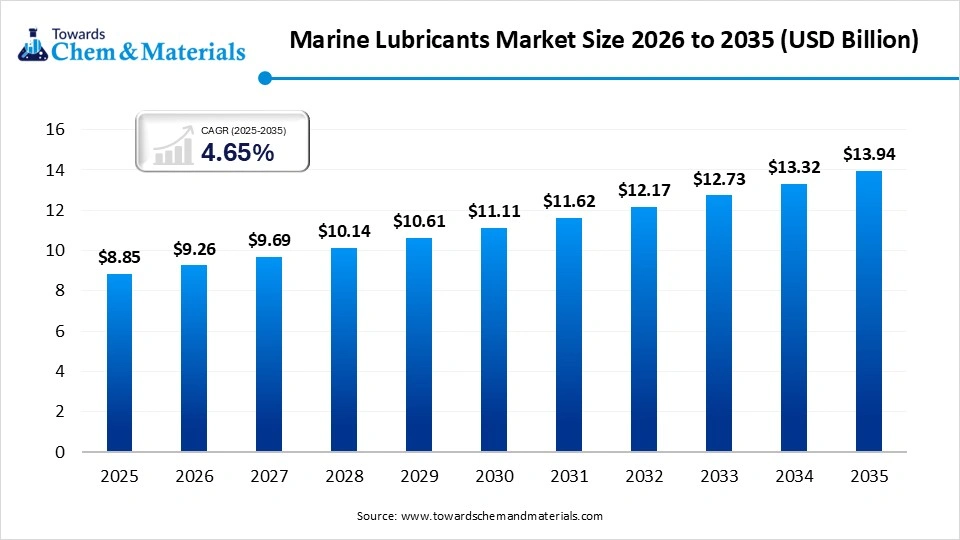
The global marine lubricants market size is expected to grow from USD 9.26 billion in 2026 to USD 13.94 billion in 2035, growing at a CAGR of 4.65% from 2026 to 2035. Asia Pacific dominated the marine lubricants market with the largest revenue share of 42.00% in 2025. Rising global shipping and maritime trade are increasing the need for efficient engine performance, which drives demand for marine lubricants. At the same time, stricter environmental regulations and the push for fuel efficiency are encouraging the use of advanced and eco-friendly lubricant solutions.
Strategic Diversification: The Multi-Functional Anatomy of Vessel Fluids
- Shift Away from Combustion Chamber: The complexity of a modern ship requires specialty lubricants to protect every part of its mechanical infrastructure. These fluids serve as high-precision equipment that remains operational under extreme environmental stress at sea.
- Advanced Hydraulic Fluids: Engineered with high viscosity index (VI), these fluids offer thermal stability for power transmission in critical systems. The fluid resists shear and oxidation at cryogenic temperatures, ensuring hydraulic response without mechanical lag and cavitation.
- Extreme Pressure Gear Oils: Used in propulsion systems like azimuth thrusters, these oils contain sulfur-phosphorus additives that form a protective layer, preventing gear damage during rotational torque and low-speed maneuvers by preventing scuffing and micro-pitting.
- Environmentally Acceptable Lubricants (EALs): As a transition towards bio-based and biodegradable, these lubricants protect stern tube and thruster seals at the oil-to-sea interface to meet EPA and Blue Economy mandates while preventing ecological damage from leaks and offering seal compatibility.
- High-Load Marine Greases: Applied on deck equipment exposed to saltwater and moisture with advanced lithium complex and calcium sulfonate, these greases resist washout and corrosion, ensuring malfunction-free operation of winches, cables, and safety gear by avoiding galvanic corrosion even after long exposure.
Role of The Thermodynamic Design and Resilience Engineering for the Modern Marine Engine Room
At the core of maritime operations, the most powerful internal combustion engine was a slow-speed two-stroke engine designed to run continuously for weeks with precise thermal performance. These engines depend on dual lubrication systems includes system oils for crankcase and bearings, and cylinder oils for liners. By maintaining a resilient hydrodynamic film across large surfaces where stable temperature is required. The key metric in this sector is the base number (BN), which indicates the lubricant's alkaline reserve, originally vital for neutralizing acids generated from high-sulfur fuels. The regulatory transition towards very low sulfur fuel oil (VLSFO), integrated with net-zero sulphur mandates driving innovation in low-alkalinity lubricants that focus on preventing calcium ash deposits. The pioneering advancement promotes detergency and dispersancy packages, ensuring engine cleanliness and oxidation resistance.
Regulatory Catalysts: Decarbonization Drive and the Blue Economy Mandates
| Regulatory Catalyst | Operational Impact and Innovation in Marine Lubricants |
| Blue Economy Mandates | Drives the sustainability in marine lubricants as an ecosystem-conscious strategy that ensures unavoidable minor leakage does not disrupt marine operations. |
| Carbon Intensity and Efficiency Standards | The relocation to low-viscosity premium synthetics to meet carbon intensity indicators and energy efficiency, the existing ship index drives the low-viscosity synthetic formulation to minimize fluid friction and power loss in maritime operations. Additionally, the development in marine engines offers oil drain intervals and operational efficiency by reducing greenhouse gas emissions through improved fuel economy. |
| Rise of Carbon-Neutral Fuels | The tribological solution of the dual-fuel system drives the innovation in gas engine oils with excellent thermal stability and specialized additive packages that provide protection whether the ship is burning carbon-neutral gas. |
| Mandates for Environmentally Acceptable Lubricants. | The rise in synthesis of high-performance bio-based fluids and EALs is driven by the EPA vessel general permit and the vessel incidental discharge act, which offers hydrolytic stability and avoids breakage of lubricants in contact with seawater |
| Transition to Lower Sulphur Fuels | The transition from high-sulphur bunkers to net-zero sulphur fuel oil and marine gas oil replaces the chemistry of the combustion chamber. Additionally, the shift towards enhanced detergency and oxidation control focuses on maintaining piston cleanliness, which has led to liner scuffing and premature engine wear in low-sulphur infrastructure. |
Maritime Efficiency is Redefining the Synthetic Revolution
The maritime industry is experiencing a surge towards a synthetic revolution towards high-performance polyalphaolefins (PAO) and synthetic esters. These synthetics are engineered at the molecular level for superior stability and a higher viscosity index at extreme thermodynamic conditions. The synthetic lubricants function effectively in Arctic navigation and engine heat as an ultra-stable hydrodynamic film. They reduce internal friction, improving fuel oil consumption (FOC) and lowering the carbon intensity indicator (CII)rating with advanced formulation. Additionally, its chemical composition extends oil drain intervals decrease sludge disposal, and total cost of ownership (TCO). With the rising stricter industrial standards for decarbonization and energy consumption, reinforcing marine operators towards switching to low-viscosity synthetics for maintaining a decarbonizing fleet.
Digital Frontiers and Real-Time Connectivity: Transforming Marine Lubricants into a Modern Fleet
The marine lubricants represent fluid chemistry that is integrated with data streams to track performance. The industry shift towards condition-based maintenance (CBM) that integrates with Internet of Things sensors and advanced onboard oil condition monitoring that changes lubricants as a biometric indicator of the engine health system. The rising modern smart lubrication programmes are strengthening the adoption of digital parameters for monitoring data like wear metal concentration, total base number depletion, and water-in-oil contamination in real-time. The fleet operators are shifting towards predictive diagnostics by leveraging artificial intelligence that identifies microscopic tribological irregularities earlier than mechanical failure. Additionally, the diagnostic tool transforms lubricants that offer high vessel uptime and shield shipowners from financial and logistical losses regarding mid-ocean mechanical breakdowns.
Global Power, Local Precision: Shaping Regional Landscape in Marine Lubricants
| Key Region | Regional Primary Countries | Regional Focus |
| Asia Pacific | China, India, South Korea, Vietnam, Japan, and Singapore |
The region is a global leader in newbuild tonnage and industrial engine rooms.
|
| Europe | Germany, UK, Norway, Greece, Netherlands |
The region is defined as a global laboratory for green shipping to meet the EU green deal and shift towards bio-based and synthetic lubricants.
|
| North America | Mexico, United States, Canada |
The regional regulatory and offshore specialty in deep-water energy exploration.
|
| Middle East and Africa | UAE, Saudi Arabia, Qatar, South Africa, Egypt, Morocco, Nigeria |
The regional vast consumer of heavy-duty propulsion lubricants for the tanker fleet and the strategic maritime gateway
|
| Latin America | Brazil, Argentina, Panama |
The key hub in the resource and transit network.
|
About the Experts

Aditi Shivarkar
Aditi serves as Vice President at Towards Chemical and Material and brings over 15 years of experience in research, strategy, and industry analysis. She focuses on sectors such as specialty chemicals, advanced materials, and sustainable solutions. She studies how regulations, raw materials, and industrial demand shape the market, and she uses that understanding to guide businesses in the right direction. Aditi helps companies stay prepared for change, improve their market position, and make well-informed decisions.



Aman Singh
Aman Singh has more than 13 years of experience in research and consulting, with a strong focus on the global chemicals and materials space. He tracks developments in areas like green chemistry, high-performance materials, and industrial innovation. At Towards Chemical and Material, he leads the research team and ensures every report is clear, accurate, and useful. Aman breaks down complex industry changes and helps businesses understand what they mean in practical terms.