Content
Marine Lubricants Market Size Analysis Report 2035
The global marine lubricants market size was estimated at USD 8.85 billion in 2025 and is expected to increase from USD 9.26 billion in 2026 to USD 13.94 billion by 2035, growing at a CAGR of 4.65% from 2026 to 2035. Asia Pacific dominated the marine lubricants market with the largest revenue share of 42.00% in 2025.
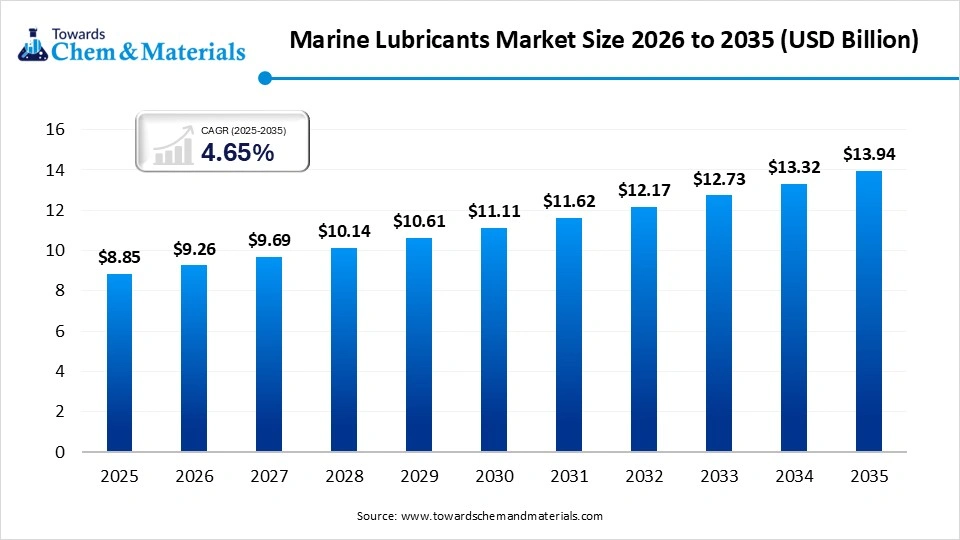
The market growth is driven by utilization of propulsion systems, stringent regulations, technological innovation and demand for EALs in marine operations. The marine lubricants market is vital for the maritime industry, providing essential engine oils and greases to keep the shipping fleet operational. It is shifting from mineral- based lubricants to high- performance synthetic oil and environmentally acceptable lubricants to meet environmental laws and IMO standards, fueling the market expansion. The focus on innovation drives advanced formulations that include complex additives for better thermal stability, corrosion resistance, and acid neutralization, especially for engines using low- sulfur fuels and alternative energy like LNG and methanol. As the focus on vessel durability and fuel efficiency grows, integrating digital monitoring and predictive maintenance offers longer drain intervals and vessel longevity.
Market Highlights
- By region, Asia Pacific dominated the marine lubricants market share 42.00% in 2025 due to its manufacturing of lubricants and export hub for port operations.
- By product, the engine oil segment dominated the market and accounted for the largest revenue share of 50.00% in 2025, due to its large stroke propulsion units and operational integrity.
- By product, the greases segment is expected to grow at the fastest CAGR during the forecast period due to its operational efficiency of deck-side hardware and demand in heavy-duty machinery.
- By base oil, the mineral oil segment dominated the market and accounted for the largest revenue share of 45.00% in 2025.
- By ship type, bulk carriers led the market with the largest revenue share of 48.00% in 2025.
Key Technological Shifts and AI in the Marine Lubricants Market
Technological advancements and AI are transforming fluid management into a data- driven ecosystem, with onboard sensors and IoT hardware enabling real-time diagnostics on oil alkalinity condition and viscosity stability. Machine learning helps optimise maintenance schedules for drain intervals, reducing waste and preventing engine failures.
The growth in digital twins simulates lubricant performance with alternative fuels, supporting the development of superior synthetic oils and smart additive packages. Overall, the technological innovations merging with automated dosing systems improve fuel efficiency and vessel longevity to meet regulatory compliance and lower environmental impact.
Trade Analysis of the Marine Lubricants Market: Import and Export Statistics
- Singapore exported 1,638 shipments of marine lubricants.
- Vietnam exported 1,201 shipments of marine lubricants.
- The United States exported 383 shipments of marine lubricants.
- From July 2024 to June 2025, the world exported 1,393 shipments of marine lubricants.
Marine Lubricants Market Trends
- Focus on Environmentally Acceptable Lubricants: The shift towards synthetic esters and polyalkylene glycols for all oil-to-sea interfaces. EALs engineered to be biodegradable and non-toxic to meet stringent environmental standards.
- Innovation on Low-Ash and Low-Sulphur Formulation: The global maritime industry operating on ultra-low-sulphur fuels and low-ash formulations offers clean engine internals.
- Shift Towards Alternative Fuel Compatibility: The transition toward reformulation of lubricants such as LNG-fueled engines, methanol and ammonia that offer combustion by-products, corrosion resistance that ensures oil film stability under varying chemical stresses.
Report Scope
| Report Attribute | Details |
| Market Size in 2026 | USD 9.26 Billion |
| Revenue Forecast in 2035 | USD 13.94 Billion |
| Growth Rate | CAGR 4.65% |
| Forecast Period | 2026 - 2035 |
| Base Year | 2025 |
| Dominant Region | Asia Pacific |
| Segment Covered | By Product, By Base Oil, By Region |
| Key companies profiled | Shell Marine, ExxonMobil, BP (Castrol), Vickers Oils, Bel-Ray Co. Inc., Quaker Chemical Corp., Zeller+Gmelin GmbH & Co. KG, Blaser Swisslube AG, Repsol, Kluber Lubrication, Pennzoil, Phillips 66, PetroChina Co. Ltd., JX Nippon Oil & Energy Corp., Petrobras, PetroFer Chemie, Buhmwoo Chemical Ind. Co. Ltd., Innospec, Gulf Oil International, UniMarine Inc., Quepet Lubricants LLC, Castrol Limited |
Marine Lubricants Market: Supply Chain Analysis
- Feedstock Procurement: The sourcing and extraction of crude oil to produce base oils and speciliazed chemical additives with molecular stability and environmental standards.
- Key Players: ExxonMobil, Chevron Oronite, Sinopec, Neste, Shell plc., Lubrizol and Saudi Aramco
- Processing and Refining: The stage of refining crude into base oils and processing with additives to produce finished marine lubricants like truck piston engine oil, grease, cylinder oil and stern-tube oils.
- Key Players: TotalEnergies, ENEOS, Gulf Oil Marine, JX Nippon, Lukoil Marine and Sinopec
- Logistics and End-Use: The distribution of finished products to vessels through direct supply networks or digital procurement platforms for end-use involve continuous lubrication for bulk carriers, container ships and tankers.
- Key Players: Maersk, ADNOC Distribution, AD Ports Group, UniMarine and Indian Oil Corporation.
Regulatory Framework: Marine Lubricants Market
| Region | Key Regulation | Regulatory Focus |
| Global | IMO MARPOL Annex VI, IMO DCS & CII, SOLAS Chapter II-2 | Mandates for fuel safety, PFOS Prohibition, and chemical safety. Focus on low-friction synthetic lubricants and lower vessel carbon intensity. |
| Europe | CLP Regulation, REACH | New classification for endocrine disruptors and persistent mobile substances. Restriction on hazardous substances in lubricant additives. |
| United States | EPA VIDA | Mandates biodegradable and environmentally acceptable lubricants for all oil-to-sea interfaces. |
| China | DECA 2.0, Hazardous Chemicals Law | Mandates for ultra-low sulphur fuel and domestic emission control that requiring low-ash lubricants. |
Segmental Insights
Product Insights
How did the Engine Oil Segment hold the Largest Share in the Marine Lubricants Market?
The engine oil segment held the largest revenue share 50.00% in the market in 2025, driven by the requirement for specialised cylinder lubricants and system oils for large stroke propulsion units essential for global shipping. The rising marine focus on sustainability enables formulation of synthetic or semi- synthetic engine oils which offer viscosity stability with robust additive packages for acid neutralization, wear protection and detergency. The industry preferred mechanical integrity to operate efficiently with low- sulfur fuels and alternative energy, boosting the expansion. Additionally, the segment supports vessel lifespan, operational uptime, and environmental standards, which make them a key choice for modern deep-sea navigation.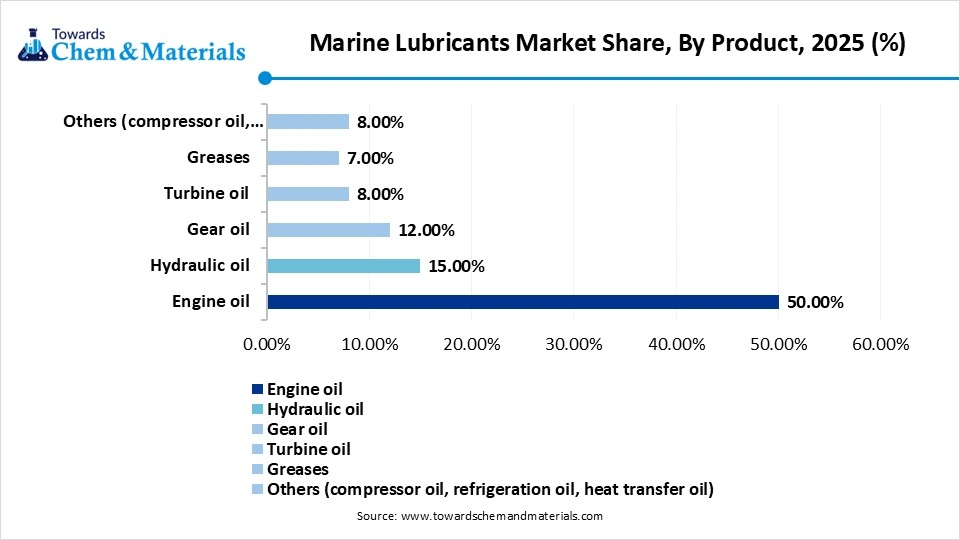
The greases segment is experiencing the fastest growth in the market during the forecast period. It serves critical functions for heavy-duty machinery exposed to harsh conditions. Greases are semi-solid lubricants that are engineered with advanced thickeners like calcium sulfonate and lithium complex that ensure stability, an adhesive environment that resists water washout and salt corrosion. As sustainability commitments grow, the segment is evolving towards environmentally acceptable lubricants and bio-based greases that offer precise biodegradability. The industry is shifting to biodegradable, bio- based greases that protect against mechanical and environmental stress, extending equipment life across maritime fleets. The grease's rising demand is due to its operational efficiency of deck-side hardware, rudder bearing and open gear systems.
Marine Lubricants Market Share, By Product, 2025 (%)
| By Product | Revenue Share, 2025 (%) |
| Engine oil | 50.00% |
| Hydraulic oil | 15.00% |
| Gear oil | 12.00% |
| Turbine oil | 8.00% |
| Greases | 7.00% |
| Others (compressor oil, refrigeration oil, heat transfer oil) | 8.00% |
- Engine Oil (50.00%) Why it dominates: "Accounts for 50.00% of the market, driven by its essential role in marine engine performance and maintenance, with continuous demand across all vessel types and high consumption volumes."
- Hydraulic Oil (15.00%) Why it is gaining momentum: "Holds 15.00% share, supported by increasing use in hydraulic systems for steering, deck machinery, and cargo handling operations."
- Gear Oil (12.00%) Why it is gaining momentum: "Represents 12.00% of the market, driven by growing demand for efficient lubrication in marine gear systems and propulsion components."
- Turbine Oil (8.00%) Why it is gaining momentum: "Accounts for 8.00% share, supported by usage in onboard power generation systems and auxiliary equipment."
- Greases (7.00%) Why it is gaining momentum: "Captures 7.00% of the market, driven by increasing application in protecting marine components exposed to harsh and corrosive environments."
- Others (8.00%) Why it is gaining momentum: "Comprises 8.00% of the market, supported by specialized applications such as compressor oil, refrigeration oil, and heat transfer fluids across diverse marine operations."
By Base Oil Insights
The mineral oil segment held the largest share of the marine lubricants market share 45.00% in 2025, driven predominantly by its cost‑effective nature, widespread availability, and longstanding application across diverse marine engines and auxiliary systems. Mineral base oils offer reliable viscosity characteristics and compatibility with a broad range of additive packages that enhance corrosion protection and thermal stability key attributes required for conventional marine propulsion units and onboard machinery. Their established supply chain and compatibility with existing engine designs make them the default choice for many ship operators focused on balancing performance with operational expenditure. As a result, mineral oils continue to dominate the base oil landscape, supporting stable market demand particularly in bulk shipping, tanker fleets, and container vessels where maintenance budgets and proven reliability are key decision factors.
The tankers segment is experiencing the fastest growth in the market during the forecast period. In contrast, the synthetic oil segment is gaining traction as the fastest‑growing base oil type due to its superior performance properties compared to conventional mineral oils. Synthetic base oils provide enhanced oxidative and thermal stability, extended drain intervals, and better low‑temperature fluidity, enabling marine engines and high‑speed auxiliary units to operate more efficiently under extreme conditions. These attributes translate into improved fuel economy, reduced lubricant change‑outs, and lower lifecycle costs — benefits increasingly prioritized in modern fleets aiming to meet stringent emissions regulations and sustainability goals. The rising adoption of high‑efficiency synthetic lubricants is further fueled by the shift toward advanced engine designs and the demand for lubricants capable of withstanding higher operating pressures and alternative fuels, positioning synthetic base oils as a key growth area in the marine lubricants market.
Marine Lubricants Market Share, By Base Oil, 2025 (%)
| By Base Oil | Revenue Share, 2025 (%) |
| Mineral Oil | 45.00% |
| Synthetic Oil | 35.00% |
| Bio-based Oil | 20.00% |
- Mineral Oil (45.00%) Why it dominates: "Accounts for 45.00% of the market, driven by its cost-effectiveness, wide availability, and extensive use across a broad range of marine lubrication applications."
- Synthetic Oil (35.00%) Why it is gaining momentum: "Holds 35.00% share, supported by increasing demand for high-performance lubricants offering superior stability, longer service intervals, and efficiency in extreme operating conditions."
- Bio-based Oil (20.00%) Why it is gaining momentum: "Represents 20.00% of the market, driven by rising environmental regulations and growing adoption of eco-friendly and biodegradable lubrication solutions in marine operations."
By Ship Type Insights
The bulk carriers segment held the largest revenue share in the marine lubricants market share 48.00% in 2025, driven by the extensive use of these vessels for transporting dry bulk commodities such as iron ore, coal and grains over long distances. Bulk carriers represent one of the largest proportions of global deadweight tonnage and operate on prolonged, high‑load voyages that demand continuous engine and machinery lubrication to maintain operational reliability and uptime.
Their large main propulsion systems and auxiliary equipment consume significant volumes of marine lubricants particularly cylinder oils, system oils and heavy‑duty greases to protect against wear, corrosion, and thermal stress under heavy and variable loads. The frequent ballasting/de‑ballasting cycles and challenging sea conditions further necessitate high‑performance lubricants that can sustain effective film strength and oxidative stability, which has cemented bulk carriers’ dominance in lubricant consumption. Additionally, their pivotal role in global seaborne trade and high fleet counts underpin steady demand growth for lubricant suppliers tailored to commercial shipping needs.
Marine Lubricants Market Share, By Ship Type, 2025 (%)
| By Ship Type | Revenue Share, 2025 (%) |
| Bulk Carriers | 48.00% |
| Tankers | 25.00% |
| Container Ships | 15.00% |
| Other Ship Types | 12.00% |
- Bulk Carriers (48.00%) Why it dominates: "Accounts for 48.00% of the market, driven by high global demand for dry bulk transportation such as coal, iron ore, and grains, resulting in extensive lubricant consumption across large fleets."
- Tankers (25.00%) Why it is gaining momentum: "Holds 25.00% share, supported by steady demand for crude oil and chemical transportation, with consistent lubricant usage in long-haul operations."
- Container Ships (15.00%) Why it is gaining momentum: "Represents 15.00% of the market, driven by expanding global trade and e-commerce, increasing the need for efficient and high-performance marine lubrication."
- Other Ship Types (12.00%) Why it is gaining momentum: "Accounts for 12.00% share, supported by diverse vessel categories including passenger ships, offshore vessels, and fishing boats with varied lubrication requirements."
Regional Insights
The Asia Pacific marine lubricants market size was valued at USD 3.72 billion in 2025 and is expected to be worth around USD 5.92 billion by 2035, exhibiting at a compound annual growth rate (CAGR) of 4.76% over the forecast period from 2026 to 2035. Asia Pacific dominated the market share 42.00% in 2025, leading hub of the marine lubricants market, driven by regional footprint for global maritime trade, shipbuilding, and port operations. The regional manufacturing and export hub is shifting toward synthetic and environmentally friendly lubricants to maintain fleet operations to meet IMO sulfur and decarbonization standards. Asia Pacific dominates the market in vessel construction and dry-dock maintenance, driving demand for innovative additive packages for alternative fuels. Overall, Asia Pacific remains the main driver of lubricant volume, and product development aligns with technological advancement, ensuring smooth global commerce through key deep-sea ports.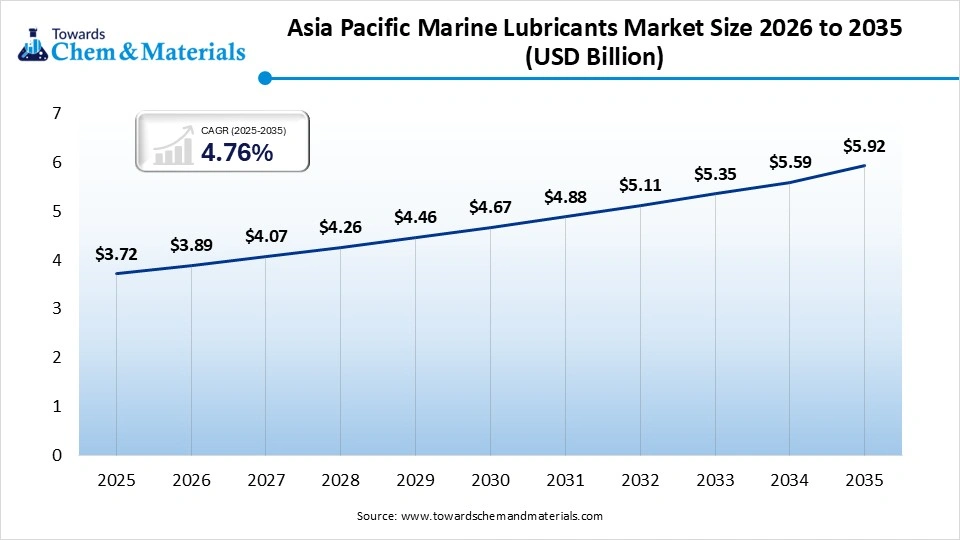
China Marine Lubricants Market Growth Trends
China maintains leadership in the market as the primary hub for vessel construction and port logistics. With the rising global demands for a constant supply of oils and lubricants for its vast fleets, the region is a key hub. Due to the stringent environmental regulations and IMO decarbonization efforts, China is transitioning to synthetic and low-sulfur lubricant formulations. Its leadership in dry-dock maintenance and marine engineering fosters demand for innovation in marine infrastructure. Overall, China is the most dominant country in lubricant capacity and innovation, maintaining global fleet reliability.
North America Lubricants Market Growth Trends
North America market segment accounted for the major revenue share of 18.00% in 2025.North America is expected to grow at the fastest CAGR in the market during the forecast period, driven by its leadership in technology and sustainability, emphasizing operational precision and environmental standards. The regional demand supports widespread port and inland waterway networks with a steady supply of high-quality oils and greases. The region leads in adopting environmentally acceptable lubricants and bio-based alternatives, driven by strict vessel general permit standards and emissions control area mandates. Additionally, the domestic shift towards premium synthetic lubricants for better stability and efficiency enables innovation integrated with advanced additives and digital monitoring to help meet decarbonization and operational goals.
U.S. Marine Lubricants Market Growth Trends
The U.S. market is a forerunner towards environmental sustainability and innovation, supporting international seaborne trade, offshore energy, and inland logistics. It requires continuous high-grade oils and greases for its ports. The U.S. leads in adopting EALs and bio-based lubricants aligns with environmental standards and permits. The shift toward synthetic oils improves durability and efficiency. The localised market players are increasingly implementing advanced technology and monitoring to ensure peak performance and decarbonization compliance across their large coastal and riverine networks.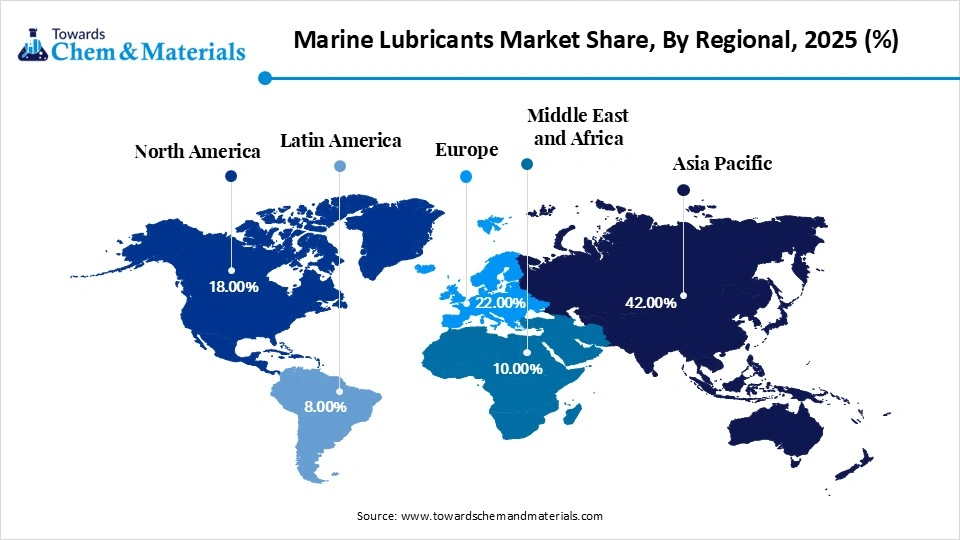
Europe Marine Lubricants Market Growth Trends
Europe market segment accounted for the major revenue share of 22.00% in 2025.Europe market is at the forefront of environmental and technological innovation, enabling decarbonization. The regulations, like the EU Green Deal and FuelEU maritime, accelerate the shift from traditional oil to synthetic and environmentally friendly lubricants. Europe dominates in net-zero sulfur formulations and alternative fuels with specialized additives. The regional infrastructure of high-tech ports and shipyards focuses on operational efficiency through digital monitoring and predictive maintenance. Additionally, Europe emphasizes bio-based oils and circular economy principles with machinery protection and pushes the region towards a net-zero maritime future.
Marine Lubricants Market Share, By Regional, 2025 (%)
| Regional | Revenue Share, 2025 (%) |
| North America | 18.00% |
| Europe | 22.00% |
| Asia Pacific | 42.00% |
| Latin America | 8.00% |
| Middle East & Africa | 10.00% |
- Asia Pacific (42.00%) Why it dominates: "Accounts for 42.00% of the market, driven by strong maritime trade activity, presence of major shipping hubs, and expanding shipbuilding and port infrastructure."
- Europe (22.00%) Why it is gaining momentum: "Holds 22.00% share, supported by established shipping routes, stringent environmental regulations, and focus on high-performance marine lubricants."
- North America (18.00%) Why it is gaining momentum: "Represents 18.00% of the market, driven by steady maritime operations, offshore activities, and demand for advanced lubrication solutions."
- Middle East & Africa (10.00%) Why it is gaining momentum: "Accounts for 10.00% share, supported by increasing oil & gas shipping activities and strategic trade routes."
- Latin America (8.00%) Why it is gaining momentum: "Captures 8.00% of the market, driven by growing seaborne trade and gradual expansion of port and shipping infrastructure."
Germany Marine Lubricants Market Growth Trends
Germany market shows significant growth due to its modern engineering and innovation within maritime lubricants, serving as the European marine functional hub. The region focuses on operational efficiency and sustainability goals through advanced synthetic and eco-friendly lubricants for next-gen propulsion through alternative fuels. Germany integrates Industry 4.0 technologies for digital transformation and predictive maintenance to extend machinery life. Germany's research-rich shipyards and well-established ports set standards for regulatory adherence and premium lubrication in a climate-neutral maritime industry.
Recent Developments
- In December 2025, TotalEnergies Lubmarine launches Aurelia NGX 40 as duel fuel engine oil that is engineered for four-stroke engines operating on gas and ultra-low-sulphur fuels. The new premium gas engine oil offers operational flexibility and reduces maintenance demands in marine operations.(Source: bunkerindex.com)
- In November 2025, Castrol launched new high-performance BioTrans GB, an environmentally acceptable lubricant engineered to be utilized in marine thrusters, deck machinery and propeller systems. The product ensures improved performance and longevity, meeting the latest U.S. VIDA requirements for oil-to-sea interfaces.(Source: www.fuelsandlubes.com)
Top Companies in the Marine Lubricants Market and Their Offerings
- Shell Marine: The global provider of cylinder and system oils that offer high-performance detergent technology to manage piston cleanliness, integrated for real-time wear analysis.
- ExxonMobil: The global leader specialized in high-efficiency synthetic lubricants that are formulated to prevent cold corrosion in modern marine engines with superior thermal stability.
- BP (Castrol): The leader in premium specialized lubricants and environmentally acceptable lubricants engineered for high-stress marine environments to meet global biodegradability standards.
- Vickers Oils: The global player offers bio-based lubricants specialized oils for stern tubes and thrusters to meet ecolabel compliance for oil-to-sea interfaces.
- Bel-Ray Co. Inc.
- Quaker Chemical Corp.
- Zeller+Gmelin GmbH & Co. KG
- Blaser Swisslube AG
- Repsol
- Kluber Lubrication
- Pennzoil
- Phillips 66
- PetroChina Co. Ltd.
- JX Nippon Oil & Energy Corp.
- Petrobras
- PetroFer Chemie
- Buhmwoo Chemical Ind. Co. Ltd.
- Innospec
- Gulf Oil International
- UniMarine Inc.
- Quepet Lubricants LLC
- Castrol Limited
Segment Covered in the Report
By Product
- Engine oil
- Hydraulic oil
- Gear oil
- Turbine oil
- Greases
- Others (compressor oil, refrigeration oil, heat transfer oil)
By Base Oil
- Mineral Oil
- Synthetic Oil
- Bio-based Oil
By Region
- North America
- U.S.
- Canada
- Mexico
- Europe
- Germany
- UK
- France
- Italy
- Spain
- Asia Pacific
- China
- India
- Japan
- South Korea
- Latin America
- Brazil
- Argentina
- Middle East & Africa
- Saudi Arabia
- South Africa
FAQ's




Select User License to Buy
Figures (4)








 sales@towardschemandmaterials.com
 Download Sample
 Schedule a Meeting