

Green Steel Driving the Future of Sustainable Manufacturing
Content
Pages are Tangled in Thoughts; Steel Entangled in Freedom
Introduction
According to Towards Chemicals And Materials Analytics and Consulting, The green steel market size was estimated at USD 78.11 billion in 2025 and is projected to grow from USD 94.63 billion in 2026 to approximately USD 532.04 billion by 2035, at a CAGR of 21.15% from 2026 to 2035. Asia Pacific dominated the steel market market with the largest revenue share of 44% in 2025 and is expected to grow at the fastest CAGR of 21.29% during the forecast period. Green steel represents a sustainable alternative in steel production, emphasizing reduced emissions and environmental impact while meeting global demand. Green steel is an element wherein the raw materials are selected very accurately; those are been contributing towards a sustainable future.
A recent study estimated that if finance is to be the gift to nature, then carbon footprint emissions will occur in 2030, in which green steel would be an essential component. As we all are well known as, steel is the cornerstone of infrastructure development and as well the industries. Green steel is being made using green hydrogen. Green steel is reshaping the steel industry worldwide and is aiming for the production of high-quality steel with a reduction in GHG emissions. Green steel is advanced steel production with less pollution, renewable energy, recycling raw materials, and a low-carbon production process, as opposed to the usual steel production process based on the blast furnace process with coal.
The goal is to make substantial emission reductions and aid global climate targets without hindering business progress. The aim is to make major emissions cuts and to support global climate targets without impacting industrial development.India has launched a specific Green Steel Scheme for promoting ‘green steel' production in the country. It is centered on decreasing the carbon intensity of steel manufacturing by using increasingly energy-efficient technologies, promoting the use of renewable energy, increasing the recycling of steel scrap, and introducing alternative reducing agents like green hydrogen. It also incentivizes resource efficiency, the circular economy, and technological innovation and provides a classification and certification system for green steel. The policy aims at improving the competitiveness of Indian steel in international markets, where environmental standards are getting tougher.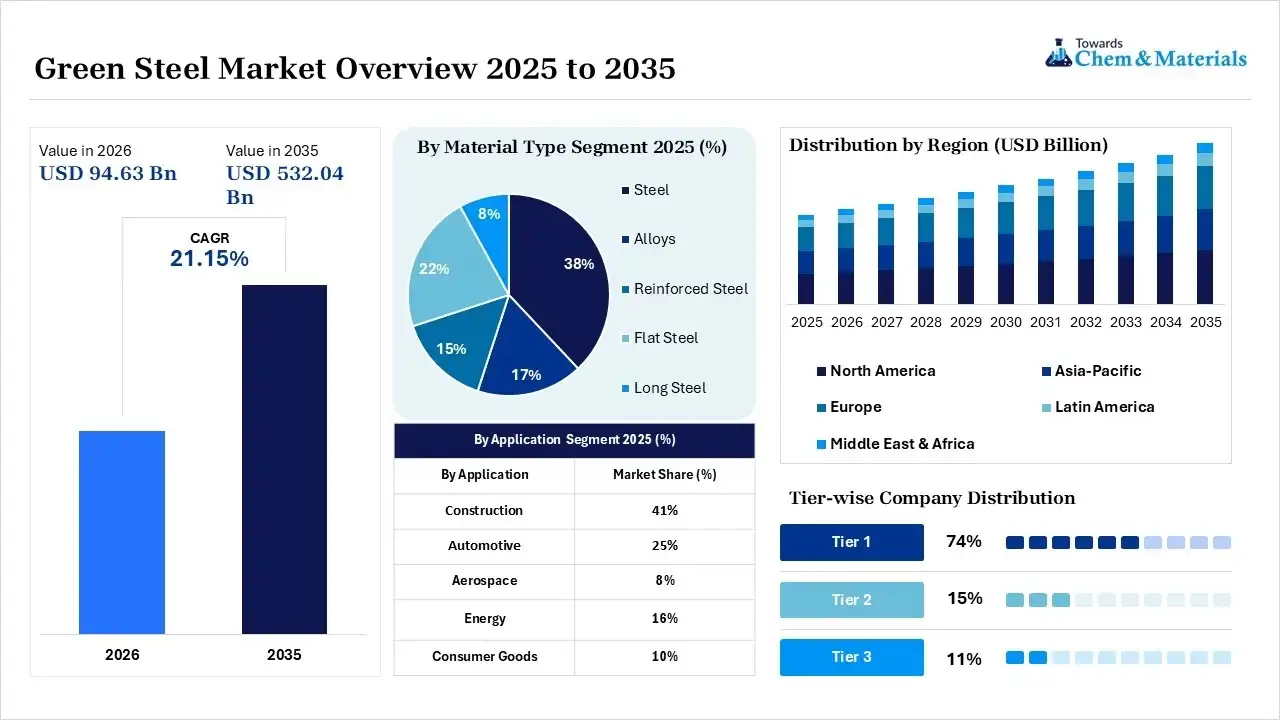
Get Full Access of Report | Immediate Delivery: https://www.towardschemandmaterials.com/checkout/5879
In the production of green steel, several technological advances are needed. Renewable electricity is used in Electric Arc Furnaces (EAFs), and they are considered to be a cleaner choice for steel than blast furnace production. Production of DRI with hydrogen rather than coal can drastically reduce carbon emissions, since water vapor is produced rather than CO2 during the reduction process. Other carbon capture, utilization and storage (CCUS) technologies, digital monitoring and enhanced recycling processes further help to reduce the carbon footprint of cleaner steel manufacturing and resource utilization.
The demand for green steel in India is anticipated to be significant over the next few decades. The demand for low-carbon steel products is high, especially due to growing infrastructure investments, booming urbanization, growing share of renewable energy investments, and growth of electric vehicle production. Meanwhile, export markets have introduced new parameters for measurement of sustainable manufacturing, encouraging India's producers to embrace new technologies for sustainable manufacturing. Such a shift will be hastened by financial support, industry cooperation, and government policies.
Although the future for green steel is promising, there are limitations and challenges in implementing this steel, including high initial investment costs, limited availability of green hydrogen, requirements for renewable energy infrastructure, and the need to upgrade technologies. But future innovation, governmental policies, and environmental concerns are anticipated to bring greater strength for the use of green steel. Green steel thus could become a key pillar of sustainable industrial development, where economic growth will be balanced with environmental responsibility, as industries globally evolve towards decarbonization.
Where and When is this Used?
Green steel works for the same set of industries as traditional steel, but is sought after by companies wishing to reduce their carbon footprint and increase eco-friendly production practices. It's gaining popularity as governments and infrastructure developers, and even more because of manufacturers, focus on sustainability. Green steel is particularly useful when projects are being pursued to align with environmental regulations and goals, to work towards a ‘zero’ emission mandate, and for long-term commitments to a viable climate future. Its utilization in many applications is projected to grow as cleaner technologies for steel production evolve.
One of the major consumer groups for green steel is the construction industry. It is embedded in houses, buildings, bridges, airports, railway stations, warehouses, and industrial plants. Green steel can be used for a variety of structural components and other parts of the building, such as reinforcement bars and roofs. Switching to low-carbon steel offers construction firms a way to optimize infrastructure development for a reduced environmental footprint, while maintaining its strength, durability, and safety.
There is another important application area: the automotive industry, which uses green steel frames, body panels, chassis, doors, roofs, and safety structures in cars. Green steel reduces emissions within the manufacturing process, especially when the production of electric vehicles is more sustainable. This is because vehicle manufacturers are transitioning to more sustainable methods for producing vehicles, including EVs, in which green steel plays a role in reducing emissions from vehicle production. This allows companies to optimise the environmental life of their vehicles from cradle to grave.
In addition, the renewable energy sector relies significantly on the use of steel, which is a material that can be easily produced with green steel. Also, green steel can be used widely for projects in sustainable energy production. Hydroelectric power plants, mounting structures for solar panels, wind turbines, and electricity transmission lines all rely on a significant amount of steel. The environmental benefits of renewable energy systems are enhanced when using green steel through the reduction of emissions produced during material manufacture.
Green steel is being used more and more in the transportation and logistics industry. It is used on railways, metros, freight wagons, ships, in port facilities, and in some aerospace applications. Green steel can play a significant role in reducing carbon emissions generated by infrastructure, which could be a significant benefit to countries investing in sustainable transport networks.
In the manufacturing sector, machines such as heavy machinery, industrial equipment, agricultural equipment, mining equipment, pipelines, storage tanks, factory infrastructure, and more utilize green steel to manufacture. Green Steel can also be used to produce consumer goods that may be marketed alongside traditionally manufactured steel of the same quality and specification to produce home appliances, furniture, packaging materials, and engineering components.
Governments are also pushing for the use of green steel in public infrastructure, such as hospital buildings, educational institutions, administrative buildings, smart city projects, and water management systems. In the future, public buildings are expected to increasingly adopt sustainable procurement policies.
To put it another way, green steel can be used in almost any application, replacing traditional steel. This is not about its end use, but its environmentally sound production process, which allows industries to achieve their sustainability goals without compromising on the quality and timeliness of the steel products they can supply.(Source: steel.gov.in), (Source: www.weforum.org), (Source:steel.gov.in), (Source: www.csiro.au)
Government Initiatives
- The Adoption to Introduce Cleaner Technology
The government will soon launch a scheme of incentives worth ₹5,000 crore for the steel industry to invest in converting into environmentally friendly technologies and minimize carbon emissions. Under the scheme, which will be submitted for Cabinet approval, power companies will be encouraged to speed up the process of improving the domestic steel industry's manufacturing processes to become cleaner and more energy efficient.
A key effort of the program is to assist secondary steel producers, large producers of steel in India. The scheme will enable the use of advanced, low-carbon technologies, enhanced energy efficiency, cleaner production, and sustainable use of raw materials, through financial support. Such actions will facilitate the modernization of factories and reduce the environmental impact of the factories.
The proposed programmer contributes to the broader approach of India's contribution towards achieving its climate obligations under the Paris Agreement and moving towards its long-term climate objective of attaining net zero emissions. Steel is a very carbon-intensive sector in the country, and emission reduction from the steel sector has been crucially prioritized. Currently, the steel sector is responsible for a significant portion of GHG pollution in the country, and this necessitates the adoption of greener technology for sustainable growth of the Indian steel sector.
Other than emission reduction, the scheme is expected to boost the competitiveness of steel industry manufacturers in India in the global market. Its goal is to increase productivity, improve resource use and help the industry meet changing international environmental regulations by making investing in innovative and sustainable production technologies more attractive. The initiative is expected to also foster technological innovations, attract private investment and drive the development of a low-carbon steel value chain in India.
In essence, the proposed scheme could pave the way for a more sustainable and cleaner steel sector in India, which is gaining international competitiveness, while supporting the growth of the industry. The overall impact of the proposed scheme is a step towards creating a more sustainable and clean steel industry in India while keeping pace with industrial development and providing a desirable balance.(Source:timesofindia.indiatimes.com)
- Government Policies Shaping the Steel Industry
In order to boost the steel sector's globalization and enhance its competitiveness, the Government has taken several policies and reforms in the country. These are based on the following: to improve domestic production, develop new technology, cut dependence on imports, boost value-added steel-making, and promote sustainable industrial development. These policy measures are contributing to the growth of the steel industry in addition to achieving future economic and environmental targets, as infrastructure and manufacturing activities are also growing.
The radically redesigned National Steel Policy 2017 is one of the policy changes that propelled the sector forward, aiming to boost the capacity of crude steel production to 300 million tonnes per annum (MTPA) by 2030–31. The policy also aims to increase per capita consumption of steel, increase the efficiency of steel operations, modernize steel plants, and give a boost to the country's market presence in the international steel market. It fosters investment in new technologies and smart use of natural resources for sustainable industrial development.
In order to encourage the production of high-value steel products, the government came out with the Production Linked Incentive (PLI) Scheme for Specialty Steel. This practice offers incentives to manufacturers to invest in R&D into advanced manufacturing capabilities, increasing domestic production, decreasing reliance on imported specialty steel, and enhancing the quality of the product. The scheme is supposed to create fresh employment opportunities and incentivize industry innovation.
The government has also taken steps to safeguard and boost local steel companies. To keep steel imports low, the Steel Import Monitoring System (SIMS) is in place, and the Domestically Manufactured Iron and Steel Products (DMI&SP) Policy has been implemented in government procurement and infrastructure projects to promote locally manufactured steel. These are measures that promote autonomy, increase domestic demand, and increase market opportunities for Indian steel producers.
Environmental sustainability has become an important aspect of government policy.
Optimising the capabilities of the steel industry by increasing energy efficiency, the use of green hydrogen, renewable energy, and implementing carbon reduction technologies are being encouraged. All of these efforts are designed to lower the carbon emissions from steelmaking and to fulfil India's long-term climate commitments and transition to a low-carbon economy.
Overall, various government policies are making an important contribution to modernizing the steel industry competitive and sustainable. These efforts promote investment, innovation, local manufacturing, and sustainable production methods, bolstering the industry's role in economic growth and anticipation of future market demands worldwide.(Source: www.ibef.org)
Note: The global push for sustainable practices is driving significant advancements in the green steel industry, resulting in a more environmentally friendly approach to manufacturing. Government initiatives aimed at increasing urbanization and supporting innovative infrastructure systems have paved the way for a transformation in how steel is produced. The rise of green steel is not just a trend; it's a crucial movement toward reducing carbon emissions and improving sustainability across various sectors. As nations recognize the importance of sustainable materials, the aviation and aerospace industries have begun to incorporate green steel into their designs. This shift reflects a broader awareness of the innovations being developed to make manufacturing processes more eco-friendly.
The journey from raw materials to finished products involves cutting-edge technologies that prioritize sustainability without compromising quality. Interestingly, the evolution of materials like green steel also harkens back to ancient civilizations, where earlier forms of metallurgy laid the groundwork for modern advancements. Even before the age of advanced technologies, societies like the Harappans utilized natural resources effectively, showcasing the historical significance of materials in urban development.
As we explore current government initiatives promoting green steel, it is essential to recognize the rich history behind these materials and their impact on our world. The ongoing commitment to sustainable practices will not only enhance accessibility and efficiency in manufacturing but also honor the legacy of innovation in our pursuit of a greener future.
Historical Evidence of Green Steel
From scarce and valuable to one of the most common engineering materials in use today, steel has had an impact on human civilization. It has a history that extends over thousands of years, and has seen constant advances in metallurgy, manufacturing methods, and industrial development. Steel is a vital material for economic and technological development, and its use in construction, transportation, industrial manufacturing, defence, and infrastructure is a major factor affecting their development.
The earliest steels were made in ancient times when iron was smelted with charcoal, a source of carbon. These early production techniques produced a tougher and harder metal than pure iron, and it was used to make tools, weapons, and farm implements. Over time, the skills of metalworking were developed by ancient civilisations in Asia, the Middle East, and Europe, and they made steel harder and more wear-resistant.
In the Medieval period, blacksmiths improved the process of making steel by learning to make better forging and heat-treating methods. Steel was more and more useful for making swords, armor, farm implements, and building tools. But the production was still labour-intensive and was limited, making steel a costly material that was used mostly in special applications.
One of the most significant changes was in the nineteenth century when the Industrial Revolution began. Steel could be manufactured in much greater quantities and at much lower costs with new manufacturing processes. This paved the way for the commercial use of steel for large-scale industrial applications. With the availability of cheap steel, railways, bridges, factories, ships and urban infrastructure quickly sprang up.
Steel production has made spectacular advances in technology throughout the twentieth century. Modern production methods increased the efficiency, quality and uniformity of the product and enabled the manufacture of specialised grades of steel to have varying mechanical and chemical compositions. To satisfy the increasing demands of automotive, aerospace, energy, construction and heavy engineering industries, three types of steels were developed: stainless steel, high strength alloy steel and corrosion resistant steels.
Over the last few decades, the steel industry has been increasingly concerned with sustainability and environmental issues. Along with this, manufacturers are upgrading their energy-efficient manufacturing technologies, expanding their steel scrap recycling operations, and incorporating renewable energy resources. Production efficiency and operational performance have been further enhanced through the use of digital technologies, automation, artificial intelligence, and sophisticated quality control systems.
Modernly, steel is one of the most versatile and recyclable materials in the world. It's found in things like buildings, transportation systems, machinery, household appliances, medical equipment, renewable energy systems, and many more industrial goods. With the global industry's efforts on sustainable development, the future of steel production is shifting to cleaner manufacturing processes and lower carbon emissions. This constant evolution guarantees that steel will remain vital to the economy, innovation, and infrastructure development, as well as to the much-needed future environmental solutions.(Source:www.servicesteel.org)
AI Usage in the Industry
The use of artificial intelligence (AI) in the green steel sector is transforming the way companies operate by enhancing their efficiency, cutting energy usage, and promoting sustainable production. AI looks through vast quantities of manufacturing data and adjusts the process in real time, helping manufacturers optimize production and cut down on carbon emissions and resource waste. This enables steel mills to have higher production rates while still meeting environmental targets.
Predictive maintenance is one of the main areas where AI can be applied. Furnaces, rolling mills, conveyors, and other equipment use sensors to continuously check the performance of the machines. The AI algorithms detect any anomalies and forecast equipment failures proactively. This mitigates unwanted downtime, maintenance costs, maintenance frequency, and unnecessary loss of energy.
AI optimizes energy usage as well by tracking the amount of electricity, fuels, water, and heat that are used during the manufacturing process. It suggests the optimum operating conditions and energy balance, and optimizes furnace efficiency. AI has a potentially significant part to play in lowering the environmental impact of the steel industry, as energy use contributes to a substantial part of the costs and emissions in the production of steel.
Another use is in quality control. Vision systems are used in conjunction with artificial intelligence to examine steel surfaces to identify cracks, dents, dimensional deviations, and other defects. Fewer human errors, less material rejection, and better product consistency are all beneficial results of automated inspections. This will reduce waste and facilitate resource use.
In the context of supply chain management, AI can predict the demand for raw materials, track inventory levels, optimise delivery routes, and schedule manufacturing processes. This capability can also cut down delays, eliminate excess inventory, and decrease logistics fuel waste. AI can also help manufacturers identify environmentally responsible suppliers and measure supply chain environmental performance.
AI plays a role in carbon emission monitoring by estimating carbon emissions across various manufacturing stages and opportunities for reducing emissions. It helps in decision-making by comparing different production techniques, fuels, and energy mixes and thus can help identify the most sustainable manufacturing approach.
In addition, AI supports digital twins and process simulations, enabling manufacturers to take a virtual "test drive" before changing their operations in actual production operations. This minimizes operational risk and promotes the rate of innovation.
AI is a valuable decision-making assistant in the green steel sector generally. AI's ability to optimize efficiencies and create more efficient manufacturing improves product quality and utility, reduces energy use, and minimizes emissions while also facilitating predictive maintenance, supporting companies' sustainability goals, and keeping them globally competitive and profitable without compromising productivity.
Technological Advancements
Technological innovation is a foundation of the evolution of the green steel industry, helping manufacturers to produce high-quality and efficient products while significantly reducing the use of carbon emissions. The emphasis of modern technologies is to find ways to use energy more efficiently, to decrease reliance on fossil fuels, to increase reuse, and to encourage efficient use of resources.
The increased use of Electric Arc Furnaces (EAFs) is one of the most noteworthy developments. EAFs are mainly planned around the electricity heat as a primary melting power, compared to the usage of coke and coal for the traditional blast furnace. These furnaces, which operate on renewable energy like solar, wind, or hydropower, contribute significantly to lower GHG emissions and participate in the circular economy.
The second major development is the reduction with hydrogen. Another significant development is hydrogen-based iron reduction. A different reducing agent from coal is used to separate oxygen from the iron ore, namely green hydrogen. This process is one of the most promising options for low carbon dioxide emissions in steel manufacturing, because it generates water vapour instead of carbon dioxide. With the increasing availability of renewable hydrogen, this technology is expected to play an increasingly important role.
Plant efficiency is also being enhanced by advanced waste heat recovery systems. In these systems, heat from steel manufacturing is recovered for the production of electricity, steam, or for the pre-heating of raw materials. Recovering waste energy helps to save fuel and operating costs.
The trend towards “digital manufacturing” in modern steel plants not only includes digital technologies, such as sensors and automation, but also technologies from the Internet of Things, or solution architectures from the cloud. By monitoring the furnace operating parameters continuously, the furnace can be optimized for performance, the product quality can be improved, material loss can be reduced, and overall plant efficiency can be achieved.
Robots and automation are now widely used in material handling, welding, inspection, and packaging, and virtually all other hazardous activities. Streamlined processes, enhanced precision in production, and better consistency in manufacturing are some of the most desirable advantages and benefits of an automated system for workers. One of the major advantages of automated systems are beneficial to workers is the improvement of operational risks while reducing workers' exposure to danger, making production more precise in production and even more consistent in manufacturing. There have been significant improvements in technology and methods available for recycling. The use of superior methods of scrap sorting, purification, and material recovery systems allows manufacturers to extract high-quality steel from recycled materials and promotes the conservation of natural resources and/or reduction in mining activities.
The innovations for carbon capture, utilization, and storage (CCUS) technology are making a significant contribution in reducing emissions from a steel plant by capturing CO₂ before it is released into the atmosphere. Sometimes the carbon can be repurposed into valuable products created by industries, with the added advantage being that the carbon is recaptured and the environmental footprint reduced.
At last, sophisticated data analytics and simulation software and digital twins can simulate production processes, explore potential enhancements before they are implemented, and uncover opportunities for ongoing optimization. These technologies cut down on experimentation costs and increase the rate at which cleaner production technologies are adopted. These organic technological innovations are transforming the green steel sector, enhancing productivity, boosting resource efficiency, cutting emissions, and contributing to a more sustainable and eco-friendly steel production ecosystem.
Where AI Shouldn’t be Used in the Industry?
Although Artificial Intelligence has become a tool in the green steel industry, it should not replace human expertise in every part of the work. Some parts of the job require judgment, ethical thinking, and creative ideas that Artificial Intelligence cannot fully copy. Using Artificial Intelligence in these places can cause problems with how things work, safety, and plans for the future.
One area where Artificial Intelligence should not work alone is in making decisions about safety. Steel factories have ovens, molten metal, big machines, and pressure systems. When something goes wrong, like a machine, gas leak, fire, or explosion, people who know what they are doing must look at the situation and decide quickly. Artificial Intelligence can warn people. Suggest what to do, but the final choice should be made by trained engineers and safety workers who can look at real-time conditions beyond just numbers.
Artificial Intelligence should also not be the one making big decisions about business plans and investments. Decisions about building plants, trying new technologies, joining with other companies, or investing in green ideas need a lot of thinking about money, rules, and how it affects people and the planet. People who lead companies need to balance money goals with what the company values and what customers and others want.
Another area where Artificial Intelligence should not have control is in checking quality and making sure rules are followed. Artificial Intelligence can help with checking and looking at data. The final decision about the quality of products should be made by trained workers. People with experience are responsible for making sure everything meets the rules and for solving problems that machines might miss.
The industry should not rely much on Artificial Intelligence for hiring and managing workers. Decisions about who to hire, how to rate performance, who to promote, and how to handle problems involve understanding people's work, behaviour, and situations. People who work in resources should make these choices while using Artificial Intelligence only to help with data and fairness.
Artificial Intelligence should not completely take over the work of research and new ideas. Creating types of steel, better ways to make it, and new methods of production need smart thinking, experiments in labs, and new ideas. Artificial Intelligence can look at data. Find patterns, but new inventions still depend on people's knowledge and creativity.
Also, dealing with customers, suppliers, and government officials needs trust, talking, and understanding. Building relationships happens through talks, agreements, and working together things that people are still better at.
Finally, Artificial Intelligence should never be seen as a replacement for skilled workers. People who have worked in the industry know the problems, how machines act, and the specific conditions on the job. Human help makes sure that what Artificial Intelligence suggests is checked before it is used.
So, the best way for the green steel industry is to use Artificial Intelligence as a helper rather than a boss. A good mix of tools and people makes sure that work is safe, production is reliable, management is fair, and the industry grows in a way that helps the planet.