
Beyond the Foam: Unpacking the Versatility of Expanded Polystyrene

Published :  7 August 2026  |  Experts :  Aditi Shivarkar, Aman Singh  | 
 |  Copy Copy   Print Print

Overview

Expanded Polystyrene (EPS) is a lightweight, rigid, closed-cell foam plastic produced from the molding and expansion of beads of polystyrene with the help of steam. EPS's combination of low weight, good thermal insulation, water-resistance, and shock-absorbing properties has made it one of the most popular polymer-based materials for a wide range of applications. The material, though made up of about 98% air and 2% polystyrene, is incredibly strong and sturdy, which makes it the perfect choice for uses that require protection as well as efficiency. 

In the construction industry, EPS is widely used for wall, roof, and floor insulation, helping to improve energy efficiency by minimizing heat transfer. EPS is also essential for the packaging of fragile electronics, medicines, hospital supplies, and other household appliances during shipping. It is impact-absorbing, which helps to prevent damage to the product and decrease the weight of the packaging as well as the costs for shipping and fuel.

Another important factor of the EPS is its dimensional stability. Stable shape under varying environmental conditions and is very resistant to moisture, mold, and microbial growth. Its properties are ideal for long-term applications for infrastructure, cold storage, and refrigerated transport applications. Additionally, EPS is chemically inert, meaning it does not emit any harmful gases during normal use, in many applications, keeping the products safe. 

The sustainability profile of EPS has also improved due to modern manufacturing processes. The ability of recycling technology to compress, reprocess, and convert used EPS to new insulation products, stationery, or plastic products is advancing, and many manufacturers use recycled EPS in their new products. The research is also targeted toward finding alternatives from the bio sector and optimizing EPS waste management for a circular economy.Expanded Polystyrene Market Snapshot
The ongoing focus on energy efficiency, lightweight materials, and affordable production methods continues to drive the demand for EPS. It has been demonstrated to be a vital material across a wide range of sectors in construction, packaging and logistics, healthcare, agriculture and industrial manufacturing because of its multiple capabilities, easy product fabrication, durability and superior protection. Its environmental performance will be further improved through ongoing technological development and recycling, and expand its use through new sectors.

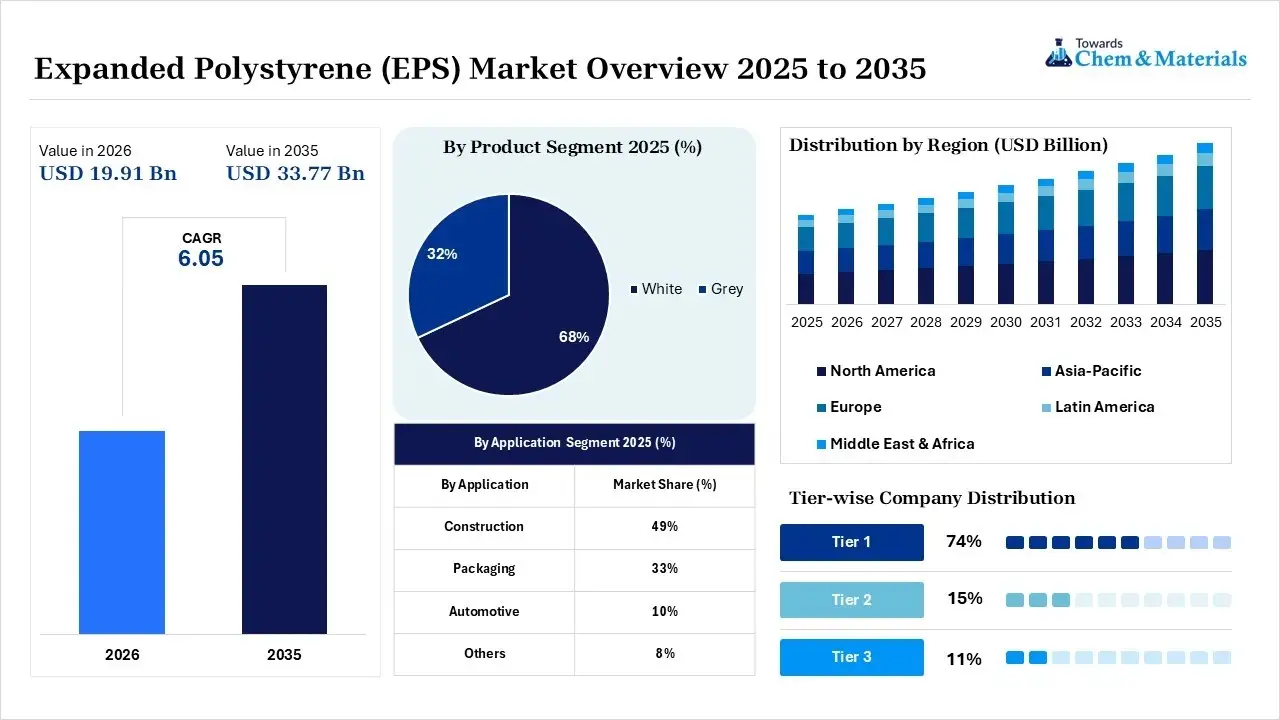
According to Towards Chemicals And Materials Analytics and Consulting The global expanded polystyrene market size was valued at USD 18.77 billion in 2025, is estimated to reach USD 19.91 billion in 2026, and is projected to reach USD 33.77 billion by 2035, exhibiting a compound annual growth rate (CAGR) of 6.05% over the forecast period from 2026 to 2035.Asia Pacific dominated the expanded polystyrene market with the largest revenue share of 46% in 2025 and is expected to grow at the fastest CAGR of 6.20% during the forecast period.

Introduction

Expanded Polystyrene (EPS) is a cellular plastic material made of the PS resin, which is expanded in steam and molded. Tiny polystyrene beads, which expand greatly as they come into contact with heat, create millions of closed cells filled with air as they are manufactured. The enlarged beads are then melted together to form blocks or shaped objects with various densities and sizes. This unique cell structure offers EPS its exceptional strength, insulation, cushioning, and durability.
 
Since its commercial introduction in the middle of the 20th century, EPS has revolutionized several industries by offering an economical, versatile, reliable material to be manufactured. It was originally used for protective packaging and thermal insulation, but has grown to many uses as a result of advancing polymer science and manufacturing processes. In today's day and age, EPS is known as one of the most efficient insulating materials, which can help maintain comfortable temperatures in buildings and save energy during its lifespan.

A key characteristic of EPS is that it is extremely lightweight. It is lightweight due to its high air content. This feature makes transportation flexible and reduces handling costs and loads on structures in construction projects. EPS is light, yet has a high compression resistance and will not lose shape with continuous use.

Additionally, EPS has great moisture resistance, and it maintains its insulating properties even when exposed to moisture. It is dimensionally stable and does not deform during use, and has resistance to fungi, bacteria, and decay, which lasts for a long time. The above properties make EPS applicable to residential, commercial, industrial, and infrastructure applications.

The material has also developed in reaction to the environment, in addition to the functional benefits. Sustainable manufacturing practices, waste reduction, and recycling systems are improving, along with material recovery processes, to reduce waste and increase the life of EPS products. Many programs and initiatives in place enable the reuse of EPS waste as raw material in the production of new goods, thereby conserving resources and encouraging circular manufacturing processes.

In today's market, where industries around the world are looking for lightweight, energy-efficient, cost-effective materials, Expanded Polystyrene still has an important role to play in the construction, protective packaging, refrigeration, transportation, and many specialized industrial applications.

What are the Other Uses of Expanded Polystyrene

In addition to its use as a building material for insulation and protective packaging, Expanded Polystyrene has a variety of special applications in many branches of industry. In the agriculture industry, EPS is applied to seedling trays, hydroponics, plant trays, and protection covers. Lightweight, moisture-resistant qualities provide ideal growing conditions and facilitate handling and transport. 

EPS boxes are used in the fisheries and food industry for transport of fresh seafood, meat, dairy, fruit and vegetables as well as frozen foods. The excellent thermal insulation of the material maintains the temperature, ensuring freshness and minimizing the spoilage rate in storage and distribution. Likewise, the pharmaceutical and healthcare industry uses insulated EPS containers to transport vaccines, laboratory samples, temperature-sensitive medications, and biological materials that must be maintained under controlled environmental conditions.
 
In civil engineering, EPS geofoam is an emerging construction material for lightweight embankment, bridge approach, road widening, railway foundation, retaining wall, and slope stabilization. It has a low density, which provides low pressure beneath the soil, especially useful in weak ground conditions. In addition, Geofoam enhances construction speed and helps to reduce settlement issues in infrastructure projects.

The automotive sector uses EPS in the interior of vehicles, seating systems, child safety seats, energy-absorbing structures for improved passenger safety, and crash protection components. Because of its easy shaping and high resistance to impacts, EPS is used in sports helmets, protective equipment, display models, decorative products, exhibition materials, and craft applications by manufacturers of consumer goods.

In the field of cold chain logistics, insulated containers made with EPS are also gaining popularity to ensure the safe transportation of perishable goods over long distances. During disasters, the lightweight EPS panels are used to build temporary shelters and emergency housing due to their fast installation and excellent thermal insulation.

Several innovations are taking place in Expanded Polystyrene.

The demand for sustainable materials, high product performance, and efficiency in manufacturing processes has propelled the Expanded Polystyrene (EPS) industry to great technological developments in recent years. Manufacturers are always spending time and money on research and development, ensuring that EPS products are increasingly effective at providing insulation, delivering a higher performance in terms of strength and cushioning, and having a lower environmental impact, while meeting the changing needs of different industries, including construction, packaging, healthcare, and logistics.

One of the most significant innovations is the creation of high-performance graphite-enhanced EPS. The addition of very fine graphite particles has greatly enhanced the material's thermal insulation capabilities. These products have better insulating properties than traditional EPS and can help buildings use less energy to maintain temperatures. These are just some of the advancements that are helping to push the trend of building environmentally-friendly and energy-efficient structures.

The manufacturing of EPS has also undergone a change in technology. Product consistency and reduction of production waste have been improved, thanks to automated molding systems, computer-controlled steam expansion, and precision cutting equipment. Digital monitoring systems allow for the efficient management of steam usage, molding temperatures, and production cycles, contributing to better efficiency and reduced costs. In addition, the use of automation has enhanced the safety of the work environment by minimizing manual handling in the manufacturing process.

Another promising field of innovation is in recycling technology. These mechanical recycling processes enable the breaking down of used EPS products into raw materials that can be used to produce insulation boards, packaging products, plastic components, etc. again. Chemical recycling technologies are also being investigated to recover EPS from its waste back to its original polymer constituents, opening the doors for the possibility of a more circular manufacturing system with minimal material loss. 

The use of EPS geofoam in the construction industry has created innovations. This lightweight engineering material is a replacement for traditional soil in road construction, bridge approaches, railway embankments, and retaining wall projects. The lightness of geofoam decreases transportation costs and reduces settlement, weak soil pressure, and construction schedules.

The applications of EPS have been further broadened with product design innovations. However, molded packaging is now being produced by manufacturers to protect electronics, medical devices, and industrial equipment, especially when impacts are a concern. Fire-retardant EPS grades have provided increased safety in building insulation by reducing the ability of the EPS to propagate flames.

Future innovations remain influenced by environmental sustainability. Bio-based additives are under development, recycling compatibility is being enhanced, and the use of renewable feedstocks is being investigated to reduce the reliance on fossil resources. Moreover, the adoption of smart manufacturing systems with integrated data analytics and predictive maintenance is enhancing production reliability and resource efficiency. These innovations are shaping the future of the EPS industry, making it more sustainable, energy-efficient, and capable of providing high-performance material solutions.

Government Initiatives 

The Government of India has implemented various policies and schemes to promote the expanded polystyrene industry. The Government of India has put in place several policies and schemes to promote the expanded polystyrene industry. Governments around the world are creating policies and initiatives to promote responsible production, effective use, and waste management of Expanded Polystyrene (EPS). Although environmental restrictions have been toughened because of plastic waste concerns, many governments are promoting innovation, recycling, and sustainable manufacturing techniques to make EPS an economically worthwhile material in a circular economy.

One of the key areas of government support is to encourage recycling facilities. Some countries have introduced collection initiatives to promote the separation of EPS waste in households, commercial buildings, and industries for recycling, which reduces its contribution to landfill. Public-private partnerships are also being worked out to upgrade recycling systems, set up material recovery facilities, and create awareness about the recyclability of EPS products.

Energy efficiency policies have also enhanced the need for EPS insulation. Building energy codes and green building codes promote high-performance insulation materials in buildings, both at the commercial and residential scales. Because of its energy-saving benefits, EPS helps the country meet energy-saving, greenhouse gas emission, and building performance goals.
 
Another key research and development funding program that benefits the industry is the NSF Research and Development for Engineering Education Program. Governments, research institutes and universities work with manufacturers on innovations in materials, production technologies and sustainable solutions. Companies are supported to invest in sustainable manufacturing processes and better recycling technologies through financial incentives, grants and innovation programmes.

Extended Producer Responsibility (EPR) schemes are being adopted in many countries, which mandate the involvement of manufacturers in the collection, recycling and responsible disposal of post-consumer EPS products. These regulations aim to encourage product stewardship and encourage businesses to develop products which are easier to recycle and reuse. These efforts play a role in building a circular economy, minimizing waste from materials and maximizing their efficiency in being used.

The demand for EPS products also increases significantly with infrastructure development programs. The use of EPS insulation and geofoam has grown because of the use of these lightweight, durable, and energy-efficient products in affordable housing, transportation infrastructure, cold storage facilities, and public buildings. EPS is often used in disaster-resistant buildings due to its high thermal insulation properties and structural benefits.

Moreover, numerous governments organize educational campaigns for responsible plastic consumption, waste separation, and awareness of plastic recycling to increase awareness among citizens and businesses. Environmental certification programs can help manufacturers implement sustainable production techniques and reduce carbon emissions from the beginning to the end of the product lifecycle.

All of these government efforts are designed to strike a balance between economic development and environmental stewardship. Governments can contribute to the development of the Expanded Polystyrene industry as a more resource-efficient and environmentally-friendly sector by supporting recycling, innovation, the construction of buildings using recycled EPS, sustainable manufacturing processes, and ecological economy concepts.

History of Expanded Polystyrene

The Expanded Polystyrene (EPS) industry has a long history and has developed together with the science of polymers and the need for lightweight, durable, and insulating materials. Polystyrene production started with the discovery of a chemical compound in natural tree resin called styrene during the nineteenth century. In the early years of the last century, scientists were able to polymerise styrene into polystyrene, a versatile thermoplastic material with good moulding properties. While originally manufactured in solid form, scientists quickly realised that they could expand the substance with gas to make a light foam.

Commercial success was achieved in the 1950s when manufacturers were able to successfully create expandable polystyrene beads with a blowing agent. The beads swelled several times their original size when boiled in steam, and bonded together to create cells composed of millions of individual cells filled with air and creating hard foam blocks. This novel manufacturing technique gave rise to a material which not only possessed outstanding insulating properties, but was also extremely lightweight and was therefore applicable in a variety of industrial applications.

In the 1960's, EPS was quickly being used as a building insulation material in walls, roofs, floors and cold rooms in the building industry. The growing awareness of energy conservation led to architects and builders using thermal insulation in their designs, resulting in a growing demand for EPS. Meanwhile, packaging professionals were aware of its superb cushioning capabilities and employed moulded EPS to keep delicate electronics, household appliances, glassware and industrial equipment safe while in transit.

The 1970's and 1980's saw significant growth in the EPS industry with the advances of manufacturing technologies. The use of automated moulding systems, better steam expanding and precision cutting machinery improved the efficiency of production and the quality of the product. EPS also demonstrated its utility in other fields such as fisheries, food transportation, pharmaceutical packaging, agriculture, and refrigerated logistics during this time due to its stable temperature-maintaining properties and protection capabilities for sensitive products.

The industry expanded further in the 1990s by introducing EPS geofoam that was used in civil engineering. Using lightweight EPS blocks in embankments for roads, bridge approaches, retaining walls, and railway construction to alleviate pressure on soft soils and enhance structural stability was started by engineers. This innovation proved that EPS could be applied to other engineering applications besides insulation and packaging.

The notion of sustainability and environmental responsibility has been growing in importance in the twenty-first century. Manufacturers have adopted the technology of recycling, optimized production efficiency, and created graphite-reinforced EPS that has better insulation performance. Today, recycled EPS products are converted into new EPS insulation products, packaging products, and plastic products, which helps to advance the circular economy.

The EPS industry is still evolving with new technology, sustainable production methods, and new application areas in construction, healthcare, agriculture, logistics, infrastructure, and industrial manufacturing. With all the problems surrounding plastic pollution in the environment, continued research on recycling, alternative materials, and using renewable resources and resource-efficient production methods makes Expanded Polystyrene a material that continues to play an important role in today's economic growth and energy-efficient infrastructure.

Types Of Expanded Polystyrene

  • Standard White EPS: This is the most commonly used type of Expanded Polystyrene. It offers great thermal insulation, lightweight construction, and impact resistance. White EPS material is widely used for packaging, building insulation, food packaging, etc., because it is cheap and has excellent properties. 
  • Graphite-Enhanced EPS (Grey EPS): In graphite-enhanced EPS, the graphite is incorporated in the form of micro-sized particles, which help the product to reflect and absorb the radiant heat to enhance the thermal insulation property. It has a higher energy efficiency compared to conventional white EPS and has been applied in energy-saving buildings and green constructions.
  • Fire-Retardant EPS: Flame-retardant EPS is created with additives that inhibit the spread of flames and increase the level of fire safety. It is widely employed in commercial and residential insulation systems, industrial facilities, and infrastructure in compliance with fire safety codes.
  • High-Density EPS: High-density EPS has a higher compressive strength and durability than common density grades. It can be used for flooring insulation, heavy-duty packaging, road construction, cold storage floors, and applications that require higher load-bearing capacity.
  • Low-Density EPS: Low-density EPS has a very high float and is mainly applied to items of protective packaging, single-use items in the food service industry, display items, and insulation where heavier structural loads are not anticipated.
  • EPS Geofoam: EPS geofoam is a range of large, lightweight blocks specially designed for civil engineering/infrastructure applications. It is applied for slope stabilization, retaining walls, railway construction, highway embankments, bridge approaches, and airport runways due to its ability to decrease soil pressure and preserve structural stability.
  • Moulded EPS: Customised shapes are created using moulded EPS to ensure that products are safely transported. It is frequently used to package delicate goods such as electronic devices, medical equipment, automotive parts, household appliances and fragile industrial products.
  • Block EPS: Block EPS can be manufactured in large rectangular blocks, which can then be slashed into insulation boards, architectural shapes and tailored construction products. It is used in a wide range of applications including buildings, cold storage and industrial insulation.

The diverse applications of Expanded Polystyrene in the construction, packaging, transport, healthcare, agriculture, infrastructure and manufacturing sectors are achieved by designing each type of Expanded Polystyrene with a unique set of benefits.

Technology in the Expanded Polystyrene (EPS) industry

Technology innovation has been a key factor in the Expanded Polystyrene (EPS) industry that has helped the manufacturers to enhance the product quality, operational efficiency, eco-friendliness, and material performance. The industry needs lightweight, durable, and eco-friendly materials, and ongoing improvements in production technologies are revolutionising EPS manufacturing and use. 

A major advancement is the use of advanced steam moulding technology. The modern moulding systems allow for the control of the temperature, pressure and steam distribution by computer, thus making sure that each bead expands and fuses uniformly. This accuracy improves the product uniformity, defect rate, production time and energy usage. Automated moulding equipment also greatly reduces material waste and improves manufacturing productivity.

One of the significant improvements is the introduction of graphite-enhanced EPS insulation. The addition of microscopic particles of graphite to the polystyrene matrix has greatly enhanced the thermal insulating properties of the material. This innovation allows buildings to more effectively regulate their indoor temperatures while conserving energy from heating or cooling. Graphite EPS is gaining more and more ground in the building industry, especially in sustainable construction and energy-efficient construction projects.

There has also been a significant advancement in precision cutting technologies. Insulation board, architectural products, and bespoke packaging can be manufactured with greater accuracy using Computer Numerical Control (CNC) machines, hot-wire cutting systems, or robotic trimming machines. These technologies minimise the waste of raw materials and still maintain the perfect dimensions of a product for special industrial purposes.

There have been significant advances in recycling technology. Today, mechanical recycling systems exist that compress, shred and granulate post-consumer EPS and make it into reusable raw material for the manufacture of new EPS insulation panels, packaging and plastic products. Chemical recycling processes are also being developed, where the waste EPS can be converted into the original chemicals, which can be used for the production of virgin-quality polystyrene. These innovations play a role in the Circular Economy programs and help to minimize landfill disposal.

EPS geofoam technology has improved the construction industry. High-quality manufacturing processes result in high-strength, lightweight geofoam blocks with higher load-bearing capacity for roads, railway embankments, bridge approaches, retaining walls, and airport construction. These materials can minimize soil settlement, shorten construction timelines, and help decrease transportation expenses.

Further modernisation of the industry is due to digital manufacturing technologies. Temperature, steam pressure, moisture, and machine performance are monitored at all times in the production lines with sensors to optimise production and minimise downtime. Predictive maintenance systems detect potential equipment problems before they fail, thereby increasing the life of machines and reducing maintenance costs.

As well as being dedicated to the development of environmentally friendly innovations such as bio-based additives, low-emission blowing agents and better fire-resistant formulations, their research is concentrated. Researchers are investigating renewable raw materials and innovative recycling methods to reduce reliance on fossil fuel-derived raw materials without compromising material properties and performance. All these technological advancements are contributing to an efficient, sustainable, and future-proof industry for EPS.

The AI applications in the Expanded Polystyrene (EPS) Industry

The Expanded Polystyrene (EPS) industry is undergoing significant transformation with the advent of Artificial Intelligence (AI), which has made significant contributions to the various aspects of manufacturing, product quality, supply chain management, and sustainability. As production facilities become increasingly connected and digitized, AI can help manufacturers to process vast amounts of operational data, automate decision-making, and fine-tune every aspect of the production workflow.

One of the most significant applications of AI is in smart manufacturing. Production parameters are continuously monitored by the AI-powered systems, including the steam pressure, the mould temperature, expansion time, bead density, and cooling. AI can use this information in real time to make automatic adjustments to the machine's settings to ensure the product is always of the same quality, defects in production are minimised, and energy is conserved. This results in improved manufacturing efficiency and lower operating costs.

Another benefit of AI is predictive maintenance. Machine learning algorithms are used to study the sensor data from moulding machines, boilers, compressors, and cutting machines, and detect early indications of wear before equipment fails. Early warnings are given to the maintenance teams, enabling repair schedules to be planned, thus minimizing downtime and maximizing the life of costly machinery.

Computer vision systems are also an excellent addition to AI's quality control capabilities. High-resolution cameras and image recognition software are used to check EPS products for cracks, incomplete bead fusion, dimensional errors, and defects on the surface. The defective product is automatically detected and eliminated in the production line, which helps to ensure consistent product standards and also lowers manual inspection efforts.

Supply chain optimisation has become more efficient with AI-driven forecasting models. By analysing historical sales, seasonal demand, customer orders, and inventory levels, AI helps manufacturers accurately predict future demand for EPS products. This helps to improve production planning, effective inventory control, minimise raw material waste, and ensure timely delivery of the product.

AI helps in the sorting and identification of various grades of polystyrene waste in recycling activities. The use of intelligent recognition systems helps in the efficient separation of recyclable EPS from mixed plastic waste, aiding in the circular economy and recycling efforts. AI can also track material recovery operations to ensure the best possible quality of the recycled raw materials.

AI can be used for material simulation and performance analysis in research and product development. Various formulations, densities, and additives are tested using machine learning models to find formulations with better insulation, compressive strength, fire resistance, and environmental performance. This will substantially shorten the laboratory testing and product development time.

Additionally, AI-driven energy management solutions track electricity and steam usage across manufacturing facilities, suggesting energy management strategies to lower carbon emissions and energy usage. For the global industry to become more competitive, AI will be vital to support the manufacturing of smarter, more sustainable, and extremely efficient EPS in the context of digital transformation.

How Expanded Polystyrene is contributing towards Sustainability?

The Expanded Polystyrene (EPS) industry is making significant strides towards sustainability by enhancing energy efficiency, encouraging recycling, minimizing material use, and promoting the circular economy. While EPS has been criticized in the past for being a plastic-based material, it has now been made much more environmentally friendly through ongoing innovations and responsible manufacturing.

One of the most valuable EPS contributions is those aiming to increase energy efficiency in buildings. EPS insulation prevents excessive heating and cooling by minimising heat transfer through walls, roofs and floors. The buildings thus use less electricity and fossil fuels, resulting in reduced greenhouse gas emissions during their lifespan. The long-term energy savings can outweigh the environmental impact of the production of the material.

In addition to being lightweight, EPS also helps to keep transportation-related emissions low, which helps to make the product more sustainable. Due to the high amount of air, packaged goods and construction materials containing EPS are very lightweight. The result is increased vehicle load, reduced fuel use, and reduced carbon emissions through supply chains.

Recycling is one more large sustainability project in the EPS industry. In the recycling process of used EPS products, they are collected, cleaned, compressed, and converted into raw materials, which can be reused to produce new boards of insulation, packaging, and plastic products. In addition, many manufacturers are incorporating more recycled material into new EPS products, which helps conserve resources and eliminates the need for virgin raw materials.

The construction industry is benefiting from EPS by using sustainable building practices. It is both hard-wearing and weatherproof, and has a long service life, making it less frequently replaced in comparison to other products and helping to save natural resources and maintenance time. EPS geofoam is used to reduce excavation and use less construction material in infrastructure projects to achieve low environmental impact.

Manufacturers are also investing in cleaner production technologies that include higher energy efficiency, less manufacturing waste, and fewer emissions during manufacturing. Research on bio-based raw materials, the development of advanced recycling technologies, and eco-friendly additives further enhance the sustainability of EPS. 

The EPS industry is gradually transforming to become a more environmentally responsible industry that supports global sustainable industrial development and climate resilience via energy-conserving, recycling, efficient resource use, and constant technological innovation.

The Future of the Industry

The future of the Expanded Polystyrene (EPS) industry in terms of its future is a great concern. The future of the Expanded Polystyrene (EPS) industry is a great concern in terms of the future. Sustainability, technological innovation, circular economy, and growing demand for energy-efficient materials are predicted to be key factors influencing the future of the Expanded Polystyrene (EPS) industry. With governments, industries, and consumers increasingly focusing on green issues to minimise environmental impacts, the EPS industry is responding by creating products that preserve the material's superior properties while being more easily recyclable, resource-efficient, and environmentally friendly.

The construction industry will be one of the best growth leaders to remain. The use of EPS insulation in residential, commercial and industrial buildings is expected to rise as a result of the rapid urbanisation process, infrastructure development and the strengthening of building energy regulations. The high performance of insulation products will continue to be vital in reducing energy use, reducing carbon emissions and maintaining thermal comfort within buildings. The high thermal performance of advanced graphite-enhanced EPS will probably make it more popular.

The importance of recycling and the circular economy will only grow. Manufacturers invest in enhancing collection systems, mechanical recycling technologies and chemical recycling processes that transform used EPS into high-quality raw materials. This will help to reduce the reliance on virgin resources, help minimise landfill waste and enhance the overall sustainability of the industry. Focusing on more cooperation between manufacturing, governments and waste management companies will further solidify the recycling infrastructure.

Automation, digital manufacturing and Artificial Intelligence are going to continue changing production facilities. Smart factories with smart sensors, predictive maintenance systems, robot factories, and data-driven quality control will enhance production efficiency and minimize waste, energy usage and operating costs. The technologies will also allow manufacturers to create more precise customised EPS based on customer requirements.

The packaging industry is likely to continue to be a major market for EPS, especially in terms of protecting electronics, medical equipment, pharmaceuticals, and temperature-sensitive products. Enhancements to cushioning performance and lightweight packaging will lower transportation and product damage costs, and enable efficient global logistics.

In the coming years, research into environmentally friendly innovations will be sped up. Researchers are developing bio-based feedstocks, new and more fire-resistant formulations, methods for minimizing emissions during production, and more sophisticated material recovery systems, to further minimize the environmental impact of EPS. New applications such as in the field of cold chain logistics, renewable energy infrastructure, lightweight engineering, and disaster-resistant construction should also bring in further growth potential. But there are also challenges in the industry such as tougher environmental regulations, growing public awareness about plastic waste, and the rising availability of other packaging and insulation options. For manufacturers to stay competitive, they need to focus on sustainability, innovation, product quality, and responsible waste management.

 In general, the outlook for the Expanded Polystyrene industry is good. The industry is now poised to make a major contribution to sustainable industrial development and the global shift to a low-carbon economy through technological innovation, increased recycling opportunities, environmental improvements, and choices in the way in which buildings and packaging are constructed.

Conclusion

Expanded Polystyrene (EPS) has established itself as a cornerstone material in various industries due to its exceptional properties and versatility. From its origins as an effective protective packaging solution to its current applications in thermal insulation and beyond, EPS has continually evolved to meet the demands of modern-day applications. Its lightweight nature and high compression resistance make it an ideal choice for construction, logistics, and packaging, significantly reducing transportation costs while providing reliable protection for products.

The energy efficiency that EPS offers is particularly noteworthy, especially in the construction sector, where minimizing heat transfer is crucial for maintaining comfortable indoor environments. As a result, buildings utilizing EPS in their insulation have lower energy consumption, contributing to reduced greenhouse gas emissions and operating costs. This aligns perfectly with the global push for sustainability and energy efficiency, making EPS a key player in the pursuit of eco-friendly building practices.

Moreover, the durability and moisture resistance of EPS further enhance its appeal in various applications. Its ability to maintain integrity and performance under different environmental conditions ensures longevity and reliability, which is vital for infrastructure projects and cold storage applications. The material's dimensional stability means that it retains its shape and functionality over time, making it an indispensable resource for sectors that rely on precision and consistency.

As the global landscape shifts towards sustainable practices, the innovations in recycling technology for EPS cannot be overlooked. Modern manufacturing processes are continually improving, allowing for the recovery and reuse of EPS waste, thus contributing to a circular economy. Manufacturers are increasingly incorporating recycled EPS into their new products, which not only reduces waste but also conserves resources. This progress is essential, given the growing awareness of environmental issues and the need for industries to adapt and implement sustainable practices.

Looking ahead, the future of EPS appears bright. The ongoing research aimed at finding bio-based alternatives and optimizing EPS waste management will likely open new avenues for its application. As new sectors explore the benefits of EPS, its market potential will only expand, driven by the continuous demand for lightweight, efficient, and cost-effective materials.

In summary, expanded polystyrene stands out as a multifaceted material that not only addresses immediate industrial needs but also aligns with broader environmental goals. Its ability to balance performance with sustainability makes it indispensable across various fields, including construction, packaging, healthcare, and industrial manufacturing. As technology advances and the push for eco-friendliness continues, EPS’s role is likely to evolve further, solidifying its position as an essential resource in the quest for innovation and sustainability. Whether it’s enhancing energy efficiency in buildings or safeguarding fragile products during transit, EPS proves that it is more than just foam; it is a vital component of modern industry that looks toward a sustainable future.

About Us

Towards Chemicals And Materials Analytics and Consulting is a leading global consulting firm specializing in providing comprehensive and strategic research solutions across the chemical and materials industries. With a highly skilled and experienced consultant team, we offer a wide range of services designed to empower businesses with valuable insights and actionable recommendations.

Connect with Us

Registered Office:

Office No 707, 7th Floor, Nandan Probiz,Laxman Nagar, Balewadi Baner, Pune,
MH - 411045 India

Client Support:

USA : +1 8044 419344
APAC : +65 3106 5601 or +91 87933 22019
Europe : +44 7383 092 044

sales@towardschemandmaterials.com
 

About the Experts

Aditi Shivarkar

Aditi Shivarkar

Aditi serves as Vice President at Towards Chemical and Material and brings over 15 years of experience in research, strategy, and industry analysis. She focuses on sectors such as specialty chemicals, advanced materials, and sustainable solutions. She studies how regulations, raw materials, and industrial demand shape the market, and she uses that understanding to guide businesses in the right direction. Aditi helps companies stay prepared for change, improve their market position, and make well-informed decisions.

Aman Singh

Aman Singh

Aman Singh has more than 13 years of experience in research and consulting, with a strong focus on the global chemicals and materials space. He tracks developments in areas like green chemistry, high-performance materials, and industrial innovation. At Towards Chemical and Material, he leads the research team and ensures every report is clear, accurate, and useful. Aman breaks down complex industry changes and helps businesses understand what they mean in practical terms.