 Request Consultation
Content
Unleashing the Future: The Power of Electroactive Polymers
According to Towards Chemicals And Materials Analytics and Consulting, the global electroactive polymer market is projected to grow from USD 7.82 billion in 2026 to USD 18.48 billion by 2035, registering an impressive CAGR of 10.02% during the forecast period.
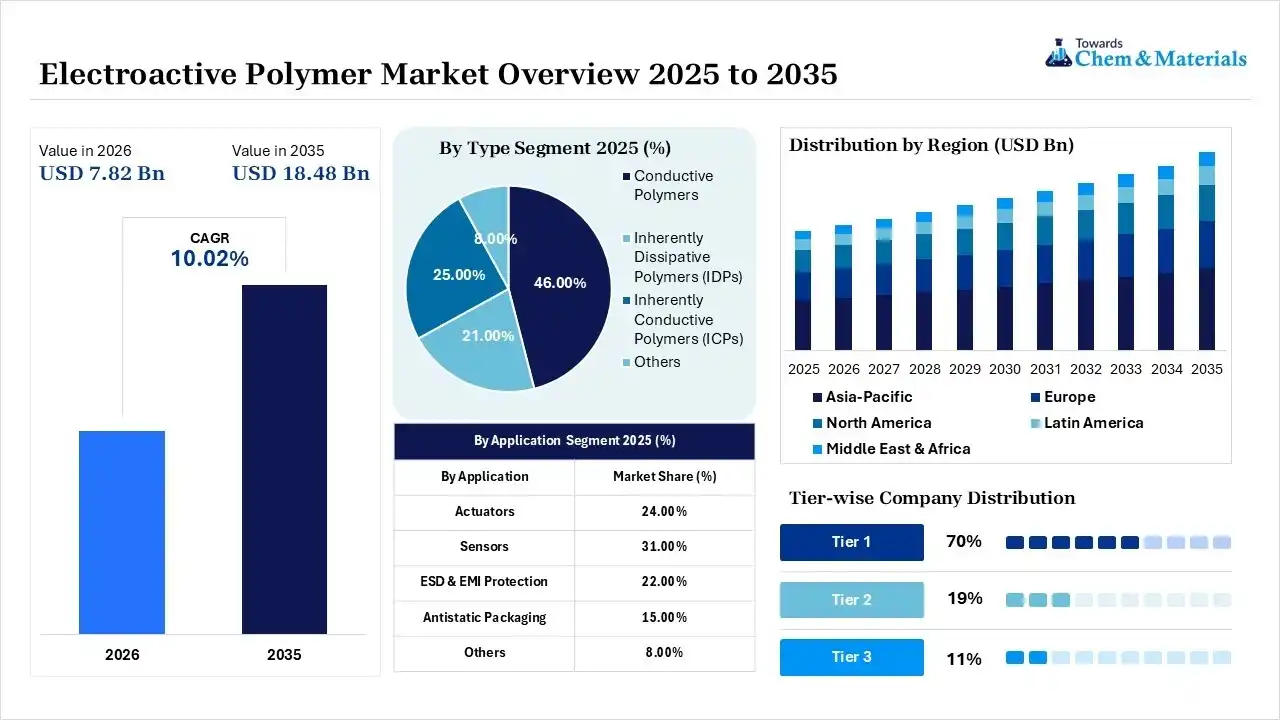
Electroactive polymers (EAPs) are smart materials with electricity-controlled reversible shape, size, or mechanical property changes. They are lightweight, flexible, consume less power, and can mimic the movement of natural muscles; they are therefore called "artificial muscles. The implementation of electroactive polymers in various fields, like healthcare, robotics, automotive, aerospace, consumer electronics, and wearable electronics, has been the subject of great interest because of the need to provide accurate sensing and actuation performance.
The ongoing progress of material science, nanotechnology, and flexible electronics is improving the performance, durability, and efficiency of EAPs, allowing them to be incorporated into the next generation of intelligent systems. The global electroactive polymer market is projected to experience significant growth over the next few years as the demand for soft robotics, biomedical devices, human–machine interfaces, and energy-efficient smart materials grows and research continues, along with growing industrial use and technological innovation.
Get Full Access of Report | Immediate Delivery: https://www.towardschemandmaterials.com/checkout/6470
Evolution of Electroactive Polymers
The history of electroactive polymers (EAPs) is as old as the late 19th century, when scientists noticed that some polymeric materials were able to change their shape when exposed to an electric field. German physicist Wilhelm Röntgen was one of the first to record an observation of the property of natural rubber in 1880 when he found that rubber could be measurably stretched by electrical stimulation. This pioneering observation laid the scientific basis for the creation of electroactive materials. A second breakthrough came in 1925 when electret materials, which could hold a permanent electric charge, were discovered, and this stimulated further interest in electrically responsive polymers and their use.
In the second half of the twentieth century, research on electroactive polymers has been greatly expanded, following the discovery of their special electromechanical characteristics by advances in polymer chemistry and materials science. The piezoelectric property of polyvinylidene fluoride (PVDF) found in the late 1960s was a breakthrough, which inspired the investigation of high-performance electroactive materials. As new classes of electroactive polymers with large and reversible deformations were developed in the 1990s, they started to be used as artificial muscles for applications such as precision actuation and motion control.
Electroactive polymers are now considered to be one of the most promising smart material technologies and are typically divided into electronic and ionic electroactive polymers, depending on their mechanism of actuation. They are now much more responsive, durable, and energy efficient thanks to ongoing innovations in nanotechnology, flexible electronics, artificial intelligence, and advanced manufacturing techniques. The developments have made a wide range of applications in robotics, biomedical engineering, aerospace, wearable electronics, smart sensors, and human–machine interfaces possible. The continued research to improve the properties of materials and the commercial viability of these materials will make their involvement in intelligent and adaptive technologies of the future increasingly important.
Classical Laminate Theory (CLT)
Classical Laminate Theory (CLT) is one of the most popular analytical techniques used for studying the behavior of multilayered composite materials. It assumes that each layer of a laminate is a "homogeneous material" with its own mechanical properties and can predict the response of the laminate to external forces or electrical actuation. The theory is based on the assumptions that the material is elastic, there is no sliding between the layers, the thickness of each layer is invariant, and the deformations are sufficiently small. These assumptions allow for mathematical analysis to be simplified and are valid for many engineering applications.
CLT is applied in the case of cantilever-based electroactive polymer actuators to model the bending behavior resulting from the coupling between the layers of active dielectric elastomer and the passive layers of the structural part. When an electric voltage is applied to the active layers, they are deformed and internal stresses in the active layers bend the laminated structure. The beam is typically broken down into fixed, active, and free sections, with the active section producing the bending force. From the material properties, layer thicknesses, elastic moduli, and the actuator dimensions, the theory determines the curvature of the beam, and hence the displacement of its free end, also called the tip displacement.
One of the benefits of the CLT model is that, when the same PRE-stretch is applied to the two active dielectric elastomer (DE) layers, it does not directly contribute to bending, but rather it cancels out. However, it is still necessary to apply a prestretch since it decreases the membrane thickness and therefore makes the electric field stronger when a voltage is applied. This makes the actuator deform electromechanically larger, and better in terms of actuation performance. The degree of deformation is a function of applied voltage, dielectric properties of the elastomer, membrane thickness, and stiffness of the laminate materials.
The electrical stimulation first pushes the dielectric elastomer material “thick” and expands it “long” and “wide”. The resulting mechanical strain is the one that causes the bending of the structure of the cantilever. These electromechanical relationships, along with the principles of Classical Laminate Theory, enable the engineer to estimate the tip displacement and analyse the results in comparison to experimental results. The comparison of the results validates the analytical model and can aid in the design of electroactive polymer actuators.
Classical Laminate Theory is an efficient and relatively simple method of analysing laminated composite structures, but it is mostly valid for structures that are not undergoing large deformations. When operating, electroactive polymers can suffer large, nonlinear strains, and three-dimensional numerical analysis, using finite element models, would be more appropriate to accurately model the full mechanical behaviour. However,
CLT is still a useful design tool as it provides insight into the most important material and structural parameters that affect the performance of the actuator and provides a useful starting point for the development of more sophisticated electromechanical models.
Government Initiatives and Industry Adaptations
The Government of India has sanctioned the first seven projects of the Electronics Component Manufacturing Scheme (ECMS) with a total investment of more than ₹5,500 crore. The main objectives of the initiative are to boost the indigenous manufacturing of critical electronic components in India and bring down the reliance on imports of electronics from abroad, thereby improving India's contribution in the global electronics supply chain. The approved projects will help develop the manufacturing of important parts for consumer electronics, automotive electronics, industrial equipment, and telecommunication industries.
The scheme is expected to attract additional private investments, encourage technology transfer, create job opportunities, and encourage innovation in advanced electronics manufacturing. The government wants to strengthen the value addition of domestically produced components, the resiliency of the supply chain, and the export of electronic products.
The approval comes in line with the Digital India and Make in India initiatives, thereby strengthening India's Make in India aspirations for being a manufacturing hub for electronics globally. It is also anticipated that the program will help drive the growth of the semiconductor and electronics industry, raise industrial competitiveness, and play a major role in the long-term economic development digitalizationtion of the country. Government of India approves first batch of 7 projects with investment of over ₹5500 crores under Electronics Manufacturing Component Scheme - Digital India | Leading the transformation in India for ease of living and digital economy | MeitY, Government of India (Source: www.digitalindia.gov.in)
India is building a robust polymer innovation ecosystem through financial and institutional backing to startups with cutting-edge materials research and manufacturing capabilities. Rising businesses developing speciality polymers, biodegradable materials, advanced composite materials, recycling technologies, and high-performance plastics are getting help to drive innovation and commercialization via various government grants and funding programs. It is aimed at promoting technology development among the local people, the development of entrepreneurship based on research, and the reduction of reliance on imported polymer technologies.
Apart from funding, startups are given access to incubation centers, research labs, technical expertise, IP guidance, industry partnerships, and more, helping them turn innovative ideas into market-ready products. The programs are expected to drive innovations in various areas such as automotive, healthcare, electronics, aerospace, packaging, and renewable energy. The initiatives foster innovation in manufacturing, fortify the Indian polymer value chain, and help India make strides towards being a global leader in advanced materials production, thereby playing a vital role in sustainable industrial development and improving its technological standing.
Summary of the News
The Government of India has sanctioned the first seven projects of the Electronics Component Manufacturing Scheme (ECMS) with a total investment of more than ₹5,500 crore. The main objectives of the initiative are to boost the indigenous manufacturing of critical electronic components in India and bring down the reliance on imports of electronics from abroad, thereby improving Indias contribution in the global electronics supply chain.
The approved projects will help develop manufacturing of important parts for the consumer electronics, automotive electronics, industrial equipment, and telecommunication industries. The scheme is expected to attract additional private investments, encourage technology transfer, create job opportunities, and encourage innovation in advanced electronics manufacturing. The government wants to strengthen the value addition of domestically produced components, the resiliency of the supply chain, and the export of electronic products.
The approval comes in line with the Digital India and Make in India initiatives, thereby strengthening India's Make in India aspirations for being a manufacturing hub for electronics globally. It is also anticipated that the program will help drive the growth of the semiconductor and electronics industry, raise industrial competitiveness, and play a major role in the long-term economic development and digitalisation of the country.
- Government of India approves first batch of 7 projects with investment of over ₹5500 crores under Electronics Manufacturing Component Scheme - Digital India | Leading the transformation in India for ease of living and digital economy | MeitY, Government of India (Source: www.digitalindia.gov.in)
India is building a robust polymer innovation ecosystem through financial and institutional backing to startups with cutting-edge materials research and manufacturing capabilities.
Rising businesses developing speciality polymers, biodegradable materials, advanced composite materials, recycling technologies, and high-performance plastics are getting help to drive innovation and commercialization via various government grants and funding programmes. It is aimed at promoting technology development among the local people, the development of entrepreneurship based on research, and the reduction of reliance on imported polymer technologies.
Apart from funding, startups are given access to incubation centers, research labs, technical expertise, IP guidance, industry partnerships, and more, helping them turn innovative ideas into market-ready products. The programs are expected to drive innovations in various areas such as automotive, healthcare, electronics, aerospace, packaging, and renewable energy. The initiatives foster innovation in manufacturing, fortify the Indian polymer value chain, and help India make strides towards being a global leader in advanced materials production, thereby playing a vital role in sustainable industrial development and improving its technological standing.
Will AI and Electroactive Polymers Be the Next Technological Revolution?
Artificial Intelligence (AI) combined with electroactive polymers (EAPs) could mark a paradigm shift in the future of smart materials and adaptive systems. Electroactive polymers, or artificial muscles, have the special property of changing shape or of moving when stimulated by an electrical current. These can be combined with AI to be self-monitoring, self-regulating, and self-deciding based on the surrounding environment.
These intelligent systems hold great potential for soft robotics, wearable electronics, biomedical devices, aerospace, automotive engineering, and human–machine interfaces. By leveraging AI algorithms, electroactive polymers can now be optimized for better actuator performance, predicted material fatigue, improved precision, and improved energy efficiency, leading to greater reliability and autonomy. The potential for AI and electroactive polymers to create smart materials, machine learning, and flexible electronics systems continues to grow as research progresses, promising a future where AI is integrated into the intelligent manufacturing and automation landscape.
When AI Shouldn't Be Used
While AI can provide a lot of benefits to electroactive polymer system design and operation, it isn't for all systems. AI should not be a substitute for human judgment and expertise in critical safety contexts where reliability and accountability are paramount, such as medical implants, aerospace control systems, and defense applications without proper validation or human oversight. AI might not be useful in applications where the data is small or the process is very predictable, as traditional control mechanisms can be more straightforward and economical.
In cases of limited data sets or predictable processes, conventional control mechanisms may be simpler and more cost-effective than AI. In addition, AI models can generate incorrect predictions if the data used for training is biased or incomplete, which can affect the performance of the system. Ethical, privacy, and cybersecurity issues should also be taken into account in the application of AI in connected wearable devices or healthcare technologies. Thus, AI should only be used when it can lead to tangible improvements in performance, efficiency, or decision-making and ensure transparency, safety, and regulatory compliance.
Technological Advancements
Electroactive polymer technology has developed a great deal due to ongoing research and progress in the fields of materials science and digital technologies. Advances in nanotechnology have enhanced electrical conductivity, flexibility, and mechanical strength, making EAPs more appropriate for applications where they are subjected to extreme conditions. The use of artificial intelligence and machine learning allows predictive control, adaptive actuation, and real-time optimization of polymer-based devices.
The introduction of flexible electronics, printed electronics, and microfabrication has made it possible to incorporate electroactive polymers into lightweight and wearable systems. Self-healing polymers, biodegradable electroactive materials, energy harvesting technologies, and multifunctional composites are also under investigation for enhanced sustainability and longevity of devices. Furthermore, novel manufacturing methods such as 3D printing and additive manufacturing (AM) are allowing for the creation of more complex and complex electroactive polymer shapes with customized geometries and performance properties.
Types of Electroactive Polymers Market
Based on the mechanism of actuation, electroactive polymers can be divided into two main groups:
- Electronic Electroactive Polymers: Electronic electroactive polymers require relatively high operating voltage and are activated by an electric field. They have fast response time, high energy density, and good mechanical stability, which are suitable for applications like artificial muscles, precision actuators, soft robots, aerospace parts, and adaptive optical systems. They can be classified as a class of materials, such as dielectric elastomers, ferroelectric polymers, electrostrictive polymers, liquid crystal elastomers, etc. These include, but are not limited to, dielectric elastomers, ferroelectric polymers, electrostrictive polymers, and liquid crystal elastomers.
- Ionic Electroactive Polymers: Ionic electroactive polymers work by moving ions through the polymer itself and are usually operated at lower voltages than electronic EAPs. These materials have high bending deformability, flexibility, and biocompatibility and are suitable for biomedical devices, drug delivery systems, soft robotic systems and wearable electronics, and microactuators. These are represented by ionic polymer–metal composites (IPMCs), conductive polymers, ionic gels, and carbon nanotube-based ionic actuators. Both are in continuous development as a result of current research and are now finding use in various areas of healthcare, robotics, aerospace, consumer electronics, automotive engineering and next-generation intelligent systems.
Emergent innovations are sustainable and conductive polymers.
The field of polymer science is in a state of flux, with material scientists creating new, high-performance and environmentally friendly materials. The properties of modern polymers are no longer restricted to structural applications, but they are being engineered to have electrical conductivity, flexibility, and multifunctional properties for next-generation electronic devices. These innovations are helping manufacturers to create energy-efficient, durable and lightweight parts, while also meeting the demand for sustainable materials and lowering the environmental footprint of traditional plastics.
One of the major research areas at present is the development of conductive and environmentally friendly polymers to aid in the move to eco-friendly electronics. Innovations in polymer chemistry, nanotechnology and material engineering are leading to the development of recyclable, biodegradable, and bio-derived polymers which can exhibit excellent electrical properties with no sacrifice in mechanical strength and flexibility. The materials are expected to have a significant impact on the development of wearable electronics, medical devices, flexible displays, smart packaging, energy storage and intelligent sensing. Industries are increasingly moving toward digitalisation and more sustainable approaches to making products, and conductive polymers are starting to play a key role in the development of the electronic and smart materials of the future.
Key Developments
Scientists are working on eco-friendly polymers that curtail e-waste and promote green production methods.
Conductive polymers such as polyaniline (PANI), polypyrrole (PPy), and PEDOT are being increasingly used due to their high conductivity, flexibility, and lightness. Flexible electronic devices, wearable healthcare systems, smart sensors, electronic textiles, and implantable biomedical technologies are all possible with polymer-based materials.
The electrical, thermal, and mechanical properties of advanced polymer materials are continuously enhanced with the development of nanotechnology and molecular engineering. The use of innovative manufacturing techniques like 3D printing, printed electronics, and roll-to-roll printing is helping to make polymer electronics more scalable, cost-effective, and suitable for mass production.
Biodegradable and recyclable polymers are used increasingly to advance circular economy efforts, which help to lessen reliance on petroleum-based materials and pollution in the environment. The use of conductive polymers in energy storage devices, soft robotics, biosensors, Internet of Things (IoT) systems, human–machine interfaces, and flexible consumer electronics is becoming more common.
Ongoing research is directed at increasing the durability of the material, commercial scalability, and incorporating A.I., flexible electronics, and smart manufacturing technologies to enable smart and sustainable electronic systems.(Source: pubs.rsc.org ), (Source: www.nature.com ), (Source: www.innovationnewsnetwork.com)
Global Government Policies Impact
Government policies fostering innovation, advanced manufacturing, environmental sustainability, and technological development play a substantial influence on the growth of the electroactive polymer (EAP) market. Electroactive polymers are gaining in significance in various industries including healthcare, robotics, aerospace, automotive and flexible electronics, so policymakers have been creating guidelines for research, product quality and responsible manufacturing. These policies have the effect of both encouraging investment in smart materials and promoting the commercialisation of next-generation polymer technologies.
Trends that Impacted the Industry
Governments worldwide, both in developed and emerging economies, are stepping up their efforts on advanced materials and smart polymer innovation by allocating more resources to R&D. Government regulations are promoting the production of recyclable, biodegradable, and energy-efficient polymer materials, which helps the industry to grow sustainably. The government regulations are supporting the sustainable growth of the industry by encouraging the development of recyclable, biodegradable, and energy-efficient polymer materials.
Electroactive polymers are being used in flexible circuits, sensors, actuators, and wearable electronic devices as a result of policies to encourage domestic electronics manufacturing. Safety and quality requirements for products and production are pushing manufacturers to follow internationally accepted manufacturing practices and enhance the reliability of electroactive polymer products.
Collaborative projects between universities, research institutions and private industry are being supported through public funding and incentive programmes, with a view to developing and commercialising innovative new polymer technologies.
The adoption of electroactive polymers in intelligent manufacturing systems is driving the national initiatives on Industry 4.0, artificial intelligence, automation, and robotics. In the electronics industry, the use of environmentally friendly polymer materials is growing due to sustainability policies that promote the reduction of electronic waste and carbon emissions. Protecting IP rights and technology transfers are helping companies to invest in research with confidence and speeding up the global adoption of advanced electroactive polymer technologies.
The governments supportive policies remain conducive to the electroactive polymer market by promoting technological advancements, eco-friendly production processes, and partnerships among industries. With a growing emphasis on digital transformation, clean technologies, and high-value manufacturing in countries, electroactive polymers are poised to be adopted in a broader range of applications. Long-term future market growth is expected to be fuelled by continued research investment and favourable regulatory frameworks, making electroactive polymers a vital element in future smart material technologies.
The Workforces role in the Electroactive Polymer industry.
The key role of a skilled workforce in the advancement of electroactive polymer (EAP) is in the areas of innovation, research, product development, and commercialization. Researchers from multiple disciplines, such as scientists, material engineers, chemists, electrical engineers, robotics experts, and manufacturing workers, work together to create high-performance electroactive materials that are better in terms of durability, flexibility, and efficiency.
A rapidly growing demand for professionals with engineering skills and knowledge in polymer science, nanotechnology, electronics, and data analytics is growing as the industry embraces automation, artificial intelligence, and advanced manufacturing. In addition to that, specialized training programs and interdisciplinary research in academic institutions, research organizations, and industrial partnerships are helping to shape the workforce. The development of a highly skilled workforce will continue to be critical to speeding up innovation and growth of commercial applications of electroactive polymers in healthcare, robotics, aerospace, automotive, and consumer electronics.
Innovations Around the Globe
Advances in material science, nanotechnology, and flexible electronics are driving global research to fast-track the development of electroactive polymers. High-performance dielectric elastomers, Conductive Polymers, and Ionic Electroactive Polymers with higher mechanical strength, better response time, and more energy efficiency are being developed. Recently developed innovations include self-healing polymers, stretchable electronic materials, smart sensors, artificial muscles, soft robot actuators, and wearable healthcare devices. The use of artificial intelligence, additive manufacturing, and digital design tools is facilitating closer control of the electroactive polymer systems and cutting costs. The technological developments are expanding the applications of electroactive polymers in the biomedical field, energy harvesting, intelligent manufacturing, and future human-machine interfaces.
Protection of Biodiversity and Ecosystem Services.
As electroactive polymer manufacturers strive to reduce environmental damage from the production and disposal of materials, environmental responsibility is becoming an integral component of the industry. The use of biodegradable polymers, recyclable materials, and environmentally friendly manufacturing processes is among the initiatives being undertaken by companies to minimise waste production and promote the sustainable use of natural resources. Environmental concerns of reducing greenhouse gas emissions, hazardous chemical use, and energy consumption are emphasised throughout the production life cycle. The use of sustainable raw materials and responsible waste management are also assisting in reducing the effects on terrestrial and aquatic ecosystems. These efforts not only help conserve biodiversity but also promote the broader shift towards eco-friendly advanced material production.
How Industry is Moving Towards a Sustainable Tomorrow?
Overall, the electroactive polymer industry is moving towards sustainability while continuing to advance technologically. Manufacturers are working to reduce energy use in production processes, use renewable and bio-based raw materials, and design products for easier recycling at end-of-life. There is an ongoing drive for greater manufacturing efficiency, which is decreasing the amount of material, energy and industrial emissions required, while keeping product performance unchanged. The growth of cooperation among research institutions, industry and governments is driving the creation of more environmentally friendly materials and clean production methods. The industry is incorporating sustainability into research, design, manufacturing, and product lifecycle management to pave the way towards environmental, economic, and technological sustainability in the long run.
Newer advancements in the Electroactive Polymer Industry
Over the years, many advances have been made in dielectric elastomers that have improved their actuation performance, flexibility, and durability. The electroactive polymers are being developed to repair minor mechanical damage and to prolong the life of various products.
The developments in 3D printing and additive manufacturing offer the potential to create customized electroactive polymer components that can be complex, highly functional, and more durable. This can be seen in the use of electroactive polymers, which are now utilized in soft robotics to enable robots to make fine, adaptive motions that more closely simulate biological muscles.
The electroactive polymer has found applications in the healthcare industry for wearable medical devices, rehabilitation technologies, artificial muscles, and implantable biomedical systems. AI and machine learning technologies are being combined with electroactive polymer technologies to facilitate predictive control, adaptive actuation, and real-time performance optimization. Electroactive polymers continue to evolve to be more reliable and commercially available, further developing the field of flexible electronic devices, electronic skin, smart textiles, and human–machine interfaces. Research is underway on biodegradable and recyclable electroactive polymers, which is helping to pave the way for sustainable manufacturing and minimizing the environmental impact of next-generation electronic materials.
Future of the Electroactive Polymer Industry
As smart materials, flexible electronics, artificial intelligence, and sustainable manufacturing gain significance, the future of the electroactive polymer (EAP) industry is poised to be defined by ongoing innovations and developments. Electroactive polymers are poised to play a vital role in future technologies in a wide variety of fields, including healthcare, robotics, aerospace, automotive, defense, and consumer electronics, as the need for lightweight, energy-efficient, and adaptive materials grows.
Their softness and ability to act as artificial muscles, sensors, and intelligent actuators make them a prime candidate for any of the innovations in soft robotics, wearable medical devices, electronic skin, and human–machine interfaces. Research is currently underway to improve the mechanical, electrical, response time, and long-term durability of electroactive polymers to make them better suited to commercialization on a large scale. The performance of these materials is likely to be further enhanced with developments in nanotechnology, multifunctional composites, and bio-inspired materials at a lower cost.
Meanwhile, growing focus on sustainability is also driving the development of recyclable, biodegradable, and bio-based electroactive polymers in line with the global environmental goals. The use of electroactive polymers in mainstream industrial applications is anticipated, as the manufacturing technologies become mature and manufacturing becomes cost-effective.
They will unlock innovative possibilities across several industries as they are brought into a new range of applications, including the Internet of Things (IoT), autonomous systems, digital healthcare, and intelligent infrastructure. The continued growth of the boundaries of electroactive material science will be further pushed by continued interdisciplinary collaboration, with growing investments from government, research institutions, and the private sector, anticipating that product development and commercialization are going to be faster. Given their flexibility, responsiveness, and multifunctionality, electroactive polymers hold great potential for revolutionizing the field of intelligent materials and advanced engineering solutions.
How will Technology Be the Centre of the Industry?
Technology will become the epicenter of the industry. In the near future, technology will be the major factor for the industry's development to ensure continuous improvements in the performance of the materials, manufacturing efficiency, and functionality of the products. AI, machine learning, and advanced material simulation capabilities will help to speed up finding materials, design the most efficient actuators, and predict how an electroactive polymer system will behave over time.
Precision and low costs of manufacturing highly customized and complex polymer components will be enhanced by digital manufacturing technologies such as 3D printing and automated fabrication. Electroactive polymers will be combined with flexible electronics, smart sensors, Internet of Things (IoT) platforms, and cloud-based monitoring systems to develop intelligent products that will respond to changing environments in real time. Future advancements in electroactive polymer devices will also benefit from emerging technologies like nanotechnology, self-healing materials, and digital twins, which will further improve the durability, reliability, and efficiency of these devices. Commercialization of electroactive polymer materials and integration in various applications will be driven by technological development.
Conclusion: Of the various categories of smart materials, electroactive polymers are one of the most promising, being highly flexible, lightweight, and capable of controlling mechanical motion in response to electrical energy. Advancements in material science, nanotechnology, artificial intelligence, and manufacturing have resulted in a wide range of uses in the fields of healthcare, robotics, aerospace, automotive, consumer electronics, and wearable technology. R&D investments and the need for sustainable and intelligent materials are driving innovation and commercialization across the globe.
The industry's dedication to environmentally friendly manufacturing, recyclable materials, and energy-friendly technologies makes it an even better candidate for future growth. With the increasing adoption of digital transformation and automation in industries, electroactive polymers can be considered as one of the key technologies that will be crucial for the future of intelligent systems and advanced engineering applications. The electroactive polymer industry has the potential to make a significant contribution to a smarter, more sustainable, and technologically advanced future through innovation, interdisciplinary cooperation, and technology advancements.
Contact:
Towards Chemicals and Materials Analytics and Consulting
USA: +1 804 441 9344
APAC: +61 485 981 310 or +91 87933 22019
Europe: +44 7383 092 044
Email: sales@towardschemandmaterials.com
About the Experts

Aditi Shivarkar
Aditi serves as Vice President at Towards Chemical and Material and brings over 15 years of experience in research, strategy, and industry analysis. She focuses on sectors such as specialty chemicals, advanced materials, and sustainable solutions. She studies how regulations, raw materials, and industrial demand shape the market, and she uses that understanding to guide businesses in the right direction. Aditi helps companies stay prepared for change, improve their market position, and make well-informed decisions.



Aman Singh
Aman Singh has more than 13 years of experience in research and consulting, with a strong focus on the global chemicals and materials space. He tracks developments in areas like green chemistry, high-performance materials, and industrial innovation. At Towards Chemical and Material, he leads the research team and ensures every report is clear, accurate, and useful. Aman breaks down complex industry changes and helps businesses understand what they mean in practical terms.