Content
Ultra Lightweight Cement Composite Market Size Analysis Report 2035
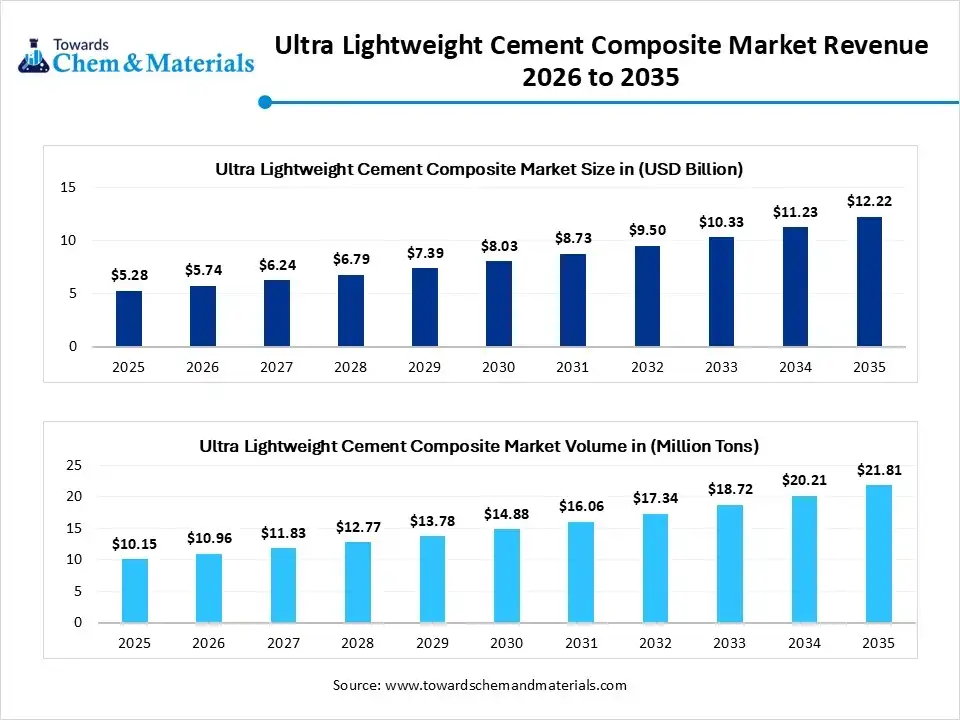
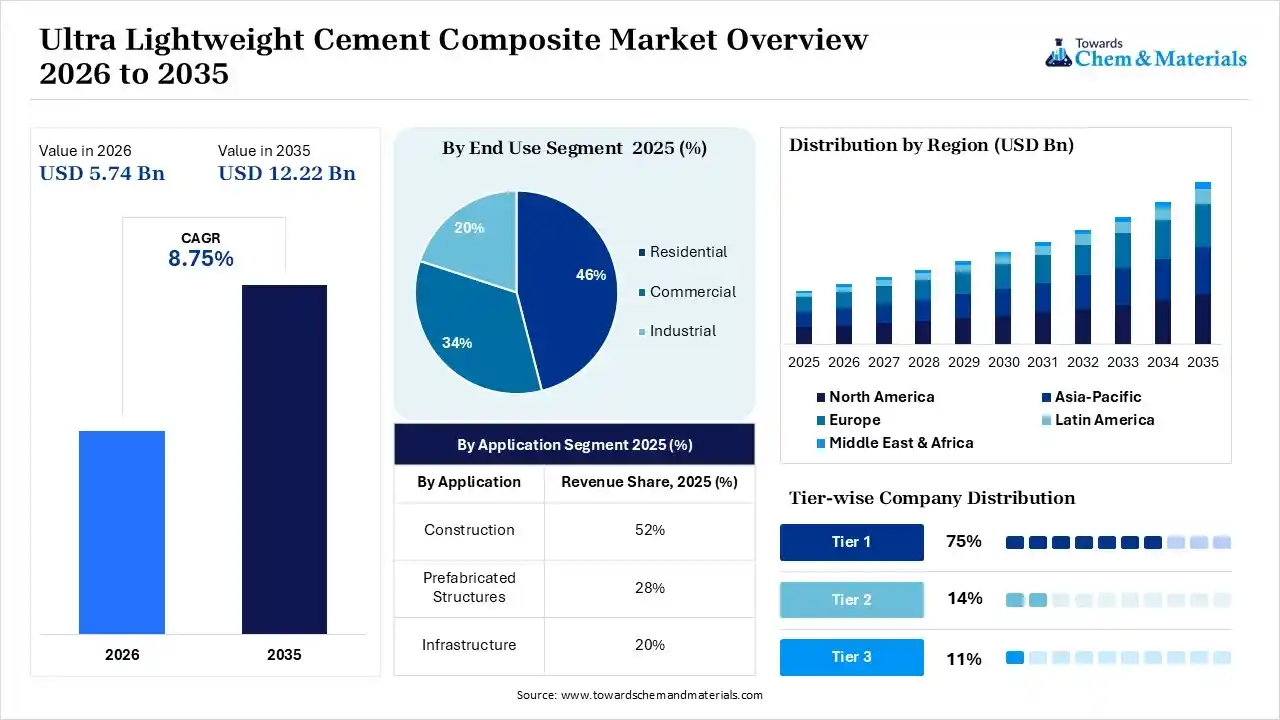
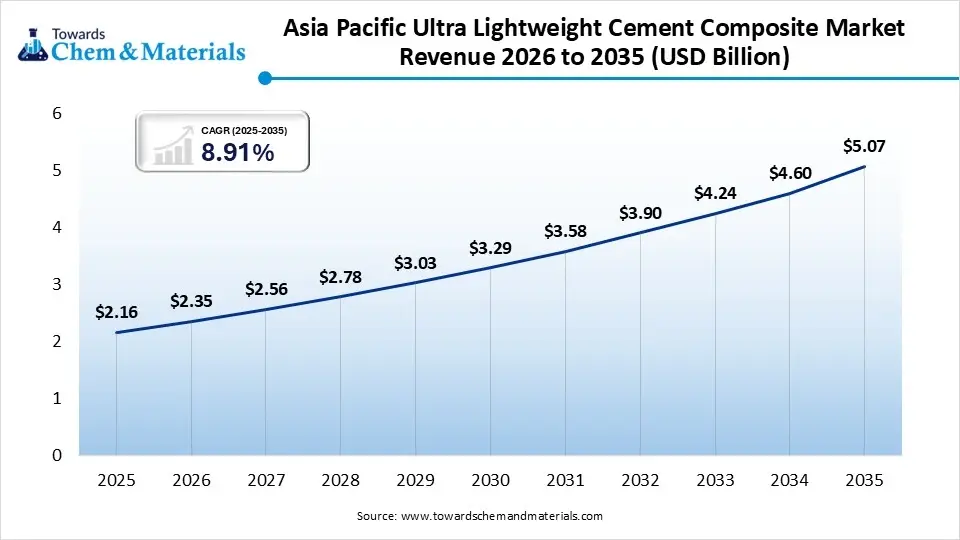
The global ultra lightweight cement composite market size was valued at USD 5.28 billion in 2025, is estimated to reach USD 5.74 billion in 2026, and is projected to reach USD 12.22 billion by 2035, exhibiting a compound annual growth rate (CAGR) of 8.75% over the forecast period from 2026 to 2035.Asia Pacific dominated the ultra lightweight cement composite market with the largest revenue share of 41% in 2025 and is expected to grow at the fastest CAGR of 8.91% during the forecast period. The market is gaining traction as construction and infrastructure players seek materials that reduce structural dead load while still delivering high strength, durability, design flexibility and better long-term efficiency in modern building applications. Further, the market growth is driven by the rising demand for sustainable products and green buildings by consumers.
Ultra Lightweight Cement Composite Market Key Takeaways
- By region, North America dominated the market in 2024. The increasing demand for eco-friendly and sustainable products drives the market to grow in the region.
- By region, Asia Pacific is anticipated to have significant growth in the ultra-lightweight cement composite market in the forecasted period. The increasing disposable income and growing middle-class population, and the increasing construction in the region drive the growth.
- By application, the construction segment dominated the market in 2024. The demand for lightweight construction material and innovation in practices drives the market growth.
- By application, the prefabricated segment is anticipated to grow significantly in the market during the forecasted period. the demand for modern construction practice helps the market to grow.
- By end use, the industrial segment dominated the market in 2024. The demand for advancement in the application and emphasis on lightweight characteristics drives the growth.
- By end use, the residential segment is anticipated to grow in the market during the forecasted period. The growing residential construction and demand for sustainable alternatives drive the demand.
- By formulation type, the ready-mix segment dominated the ultra-lightweight cement composite market in 2024. The growth is driven by convenience and time-saving benefits offered by the product.
- By formulation type, the precast segment is anticipated to grow in the forecasted period. The efficiency and quality of the precast drives the growth of the market.
- By cement type, the portland cement dominated the market in 2024. The durability and reliability of the Portland cement and the trust of consumers drive the growth of the market.
- By cement type, the blended cement is anticipated to grow in the forecasted period. The increasing sustainable construction demand will drive the growth of the market.
The ultra lightweight cement composite market is steadily gaining momentum as the construction industry shifts toward lighter, lower-carbon and more energy-efficient building materials without compromising structural performance. These composites are designed to reduce the dead load of buildings and infrastructure while still offering the durability, thermal efficiency and workability needed for modern construction, making them increasingly relevant in applications such as lightweight blocks, prefabricated building elements, wall systems, flooring solutions and energy-efficient structures.
A major factor behind the market is the broader push toward sustainable and green construction. Builders and developers are under pressure to lower embodied carbon, improve thermal performance and meet tighter building-efficiency standards. Ultra lightweight cement composites fit well into this transition since they can enable the reduction of material consumption, ease transportation and handling and support better insulation performance at the building-envelope level. Additionally, innovation in low-density aggregates, advanced binders, recycled inputs and digitally optimized production processes is improving the performance profile of these materials and widening their use beyond niche applications.
The market is being reshaped by the need for faster and smarter construction methods. Lightweight cement-based blocks and composite systems are attractive in both residential and commercial projects because they can simplify installation, reduce labor strain and support modern methods of construction. Moreover, producers are investing in formulations that balance lightness, strength, moisture resistance and thermal efficiency.
- For instance, in September 2025, CEMEX UK launched ReadyBlock Lite, an ultra-lightweight concrete block with a density of 950 kg/m3, positioned to enable customers to meet energy-efficiency requirements under evolving UK building regulations. (Source: https://www.cemex.co.uk/)
The Shift Towards Sustainability and Green Construction
Ultra-lightweight cement composites are a construction material that integrates cement with innovative additives, yielding a remarkably light yet robust product. Its unique properties enhance energy efficiency, reduce weight, and increase durability. The demand for low-carbon, energy-efficient materials is increasing the demand for ultra-lightweight cement composite, leading towards sustainability and the green construction goal.
The ultra-lightweight cement composites market is increasing due to sustainability goals, urbanization, and technology advancements. The use of recycled materials, advanced fibres, 3D printing, and multi-functional composites drives the market ultra-lightweight cement composite market.
The focus on R&D and partnerships to develop next-generation materials increases the demand for the market. The market is growing significantly, driven by increasing demand for energy-efficient and sustainable building solutions. As the industry is evolving, ultra-lightweight cement composites are playing a crucial role in shaping the future of construction with their innovation and advancement. Innovation and adoption will drive the growth of the ultra-lightweight cement composites market.
Market Trends
- The increasing adoption of sustainable materials by consumers due to their durability and performance of cement-like low-carbon cement alternatives is an emerging option for reducing the industrys environmental footprint, driving the market.
- The integration of digital technologies in cement manufacturing processes enables manufacturers to optimize production, reduce waste, and enhance energy efficiency, which helps in the growth of the market.
- Integration of nano technology improves strength, durability, and sustainability of the product, which helps in the expansion of the market.
- Advancement in technology and processes like 3D printing, which enables the construction of complex, customized structures with reduced material waste.
Ultra Lighweight Cement Composite Market Report Scope
| Report Attributes | Details |
| Market Size in 2026 | USD 5.74 Billion |
| Expected Size in 2035 | USD 12.22 Billion |
| Growth Rate | CAGR of 8.75% |
| Base Year of Estimation | 2025 |
| Forecast Period | 2025-2035 |
| Dominant Region | North America |
| Segment Covered | By Application, By End Use, By Formulation Type, By Cement Type, By Region |
| Key Companies Profile | Westside Concrete Accessories,Saint-Gobain,GCP Applied Technologies,Ferro Corporation,Sika,LafargeHolcim,Boral Limited,Neumann Cement,BASF,Kryton International,Synaxis,UltraTech Cement,CRH,HeidelbergCement |
Ultra Lightweight Cement Composite Market Opportunity
The Shift Towards the Use of Sustainable Materials Like Carbon-Neutral Construction Materials
Carbon-neutral construction materials are essential for reducing the environmental impact of the construction industry, which is a major source of global carbon emissions. These materials produce minimal COâ‚‚, which increases the demand for the material by consumers. The use of advances in manufacturing materials, such as using industrial by-products, renewable resources, and carbon capture technologies, makes them ideal for sustainable solutions.
These materials support sustainable construction practices and help meet green building initiatives standards like LEED and BREEAM. As climate goals become more urgent, carbon-neutral construction materials are playing a key role in the transition to greener infrastructure. These factors create a great opportunity for the growth and help achieve sustainable goals without hampering the quality and performance of the product, which expands the ultra-lightweight cement composite market rapidly.
Ultra Lightweight Cement Composite Market Challenge
The High Production and Raw Material Costs
One of the primary challenges in the adoption of ultra-lightweight cement composites (ULCCs) is their high initial cost. The materials are incorporated with specialized components such as lightweight aggregates, high-performance fibers, foaming agents, and nanomaterials, which contribute to increased production costs compared to traditional concrete.
The manufacturing process also requires precise control and advanced equipment, which results in a rise in overall cost. Limited availability of raw materials and lack of widespread expertise in mix design and application further inflate costs.
While life-cycle savings and environmental benefits make ultra-lightweight cement composites a smart investment in the long run, the high initial investment remains a significant barrier to their widespread adoption in mainstream construction projects.
Supply Chain Analysis
- Raw Material Sourcing and Procurement: it includes cement, lime, gypsum, fly ash, sand, water, aluminum powder, foaming agents and recycled or performance-enhancing additives. Cement and mineral inputs are sourced from cement producers and regional bulk suppliers; specialized additives are procured from technology vendors or chemical partners.
- Key Companies: UltraTech Cement, Iyantra Industries, Blockolite, Ultra AAC Blocks, Ecogreen Bricks
- Chemical Synthesis and Processing: Raw materials are converted into a designed lightweight composite slurry or mix. Then it is converted into a usable building product such as blocks, panels, wall units or specialty lightweight elements. It includes pre-curing, wire cutting, autoclaving, density stabilization, dimensional finishing and palletization.
- Key Companies: BigBloc Construction, ECOBLOOC, Ultra AAC Blocks, Conecc Industries, Ace Eco Blocks
- Quality Testing and Certification: testing for comprehensive strength, density, moisture absorption, thermal conductivity, dimensional tolerance, fire resistance and acoustic performance. Manufacturers check batch consistency and verify whether the product meets IS/ASTM/EN-type requirements.
- Key Companies: Ultra AAC Blocks, Blockolite, Ecogreen Bricks, ECOBLOOC, Clavecon India.
- Packaging and Distribution: it includes palletization, protective packaging, storage, dealer/distributor management, transport to project sites, and provides technical support during installation.
- Key Companies: UltraTech Cement, BigBloc Construction, Ultra AAC Blocks, Blockolite, ECOBLOOC
Segmental Insights
By Application Insghts
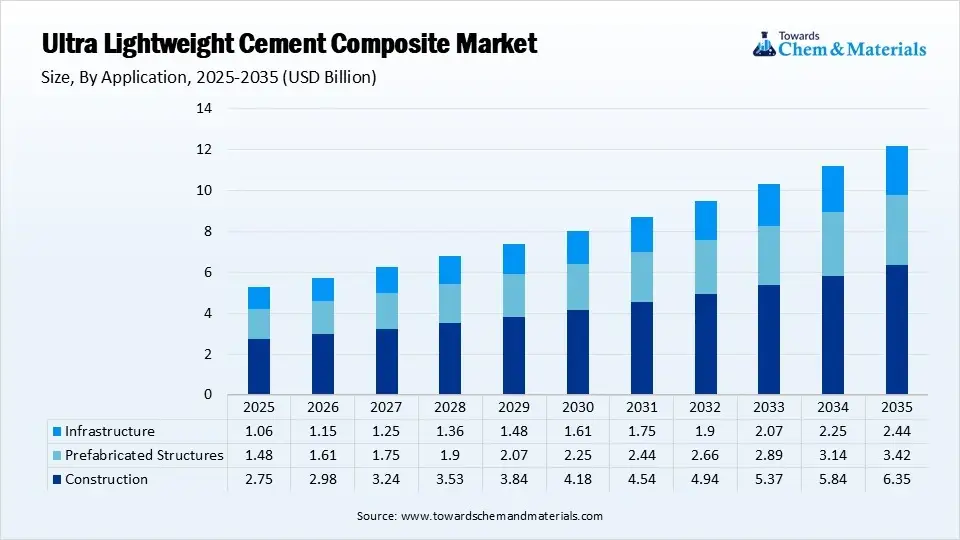
The construction segment dominated the market in 2024. In the construction sector, the ultra-lightweight cement composite is gaining the attention of consumers due to its low density, high strength, and superior thermal and acoustic insulation. They also offer consumers reduced structural load, enhanced energy efficiency, and easier handling during construction.
 The ultra-lightweight cement composite is also ideal for the construction of green buildings, supporting the initiatives that align with sustainable goals. They offer the consumers long-term advantages in terms of maintenance, durability, and operational efficiency, which makes them ideal and a preferred choice in both residential and commercial construction. This results in the expansion and growth of the ultra-lightweight cement composite market.
The prefabricated segment expects significant growth in the ultra-lightweight cement composite market during the forecast period. The ultra-lightweight cement composite is a key component in the prefabricated construction sector, where speed, efficiency, and material performance a crucial and critical.
The low weight and high strength-to-weight ratio of the product, the ultra-lightweight cement composite, are ideal for manufacturing modular panels, wall systems, floor slabs, and insulated blocks off-site. This also helps reduce the transportation cost, simplifies installations, and minimizes the on-site labor. The ultra-lightweight cement composite also helps in sustainable and eco-friendly usage of the products and helps achieve goals as they use recycled content and reduce material waste during production. The growing demand for affordable, fast building, and eco-friendly structures increases the demand for the market and helps in the expansion of the ultra-lightweight cement composite market.
Ultra Lightweight Cement Composite Market Share,By Application, 2025 (%)
| By Application | Revenue Share, 2025 (%) |
| Construction | 52% |
| Prefabricated Structures | 28% |
| Infrastructure | 20% |
By End Use Insights
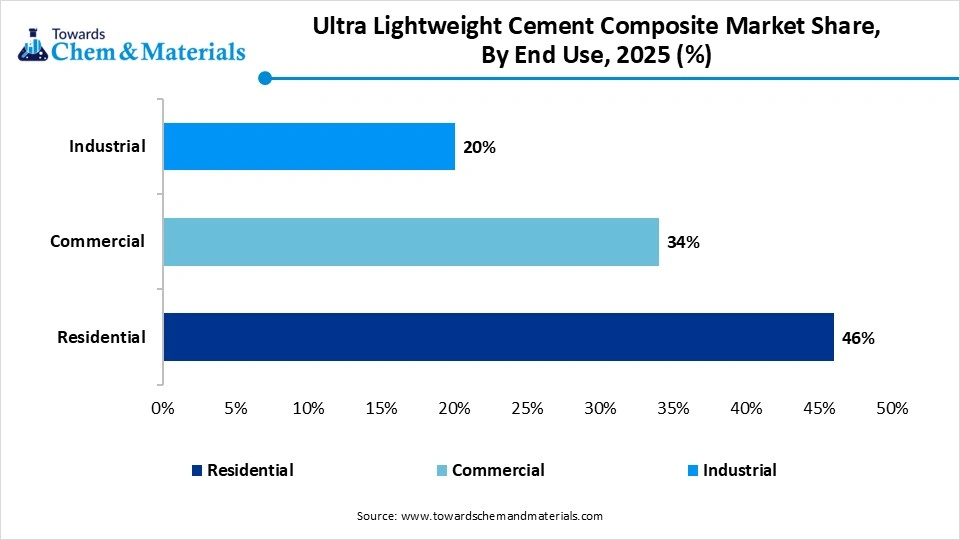
The industrial segment dominated the market in 2024. In industrial construction, the ultra-lightweight cement composite is emerging as a valuable material as it offers consumers properties such as durability, reduced dead load, and resistance to environmental stressors.
 They also offer high chemical resistance, which makes them suitable for the industrial sector that deals with corrosive substances or in harsh operational conditions. The materials adaptability for precast and modular systems supports faster construction timelines and reduces downtime, which is important in an industrial setting.
The soundproofing, fire resistance, and thermal insulation qualities also enhance the safety and comfort in the industrial environment. Increasing trend towards green industry development attracts many consumers, which helps the ultra-lightweight cement composite market to grow significantly.
The residential segment expects significant growth in the ultra-lightweight cement composite market during the forecast period. The ultra-lightweight cement composite is gaining attention in residential construction because of its structural strength, thermal efficiency, and because it helps in reducing building weight. The ultra-lightweight cement composite helps lower the structural load, which makes it ideal for multi-story housing and retrofitting older buildings.
The thermal and acoustic insulations help improve the indoor comfort and reduce energy cost, aligning with the rising demand for energy-efficient and sustainable homes. The use of recycled material in the ultra-lightweight cement composite supports green building initiatives and attracts the environmentally conscious consumers, which helps the market to grow.Long-term savings on energy, maintenance, and durability make the ultra-lightweight cement composite a smart investment for residential consumers these factors the ultra-lightweight cement composite market growth steadily.
Ultra Lightweight Cement Composite Market Share, By End Use, 2025 (%)
| By End Use | Revenue Share, 2025 (%) |
| Residential | 46% |
| Commercial | 34% |
| Industrial | 20% |
By Formulation Type
The ready-mix segment dominated the market in 2024. The ultra-lightweight cement composite is increasingly used in ready mix concrete applications, which offers a convenient and efficient solution for projects that demand high performance with reduced weight. The ready mix is produced in controlled batches, ensuring consistency in quality and time-saving benefits. The ready mix is used mostly for residential, commercial, and infrastructural projects, where real-time mixing is not possible and is time sensitive.
The integration of the ultra-lightweight cement composite into the ready-mix enhances the thermal insulation, low density, and improves flowability, which makes them ideal for lightweight floor screeds, roof decks, non-loading, and void fills. The use of ready mix helps and supports sustainable construction as the ultra-lightweight cement composite mix contains industrial by-products and recycled aggregates, which are steps in the sustainable development. These factors influence the market expansion and help in the ultra-lightweight cement composite market growth.
The precast segment expects significant growth in the ultra-lightweight cement composite market during the forecast period. The precast offers significant benefits in terms of ease of handling, reduced transportation cost, and faster installation. In precast installation, the ultra-lightweight cement composite is used to manufacture wall panels, cladding elements, floor slabs, partition systems, and modular components.
The properties, such as low density, help reduce the structural load, making them ideal for high-rise and modular construction. The ultra-lightweight cement composite also provides thermal and acoustic insulation, increasing the demand for energy-efficient buildings.
The ultra-lightweight cement composite-based precast components are particularly beneficial in urban construction, where site space and logistics are limited. The steady increase in both residential and commercial sector demands for the segment helps the ultra-lightweight cement composite market to grow.
By Cement Type Insights
The portland cement segment dominated the market in 2024. The Portland cement is a primary binder in the ultra-lightweight cement composites. Which provides strength, durability, and setting characteristics. In the formulation of the cement, Portland cement is combined with lightweight aggregate and fibers to reduce density while maintaining the structural integrity of the product.
The advancement in nano-engineering and carbon-cured concrete aims to enhance the efficiency and sustainability of the Portland cement in the ultra-lightweight cement composite applications, Portland cement remains the foundational material due to its reliability; these factors help the market growth and expansion of the ultra-lightweight cement composite market rapidly.
The blended cement segment expects significant growth in the ultra-lightweight cement composite market during the forecast period. The blended cement plays a key role in the formulation of the ultra-lightweight cement, as it offers consumers a more sustainable and performance-enhancing alternative to the traditional cement.
The blended cement uses supplementary cementitious materials, which help to reduce the carbon footprint and improve durability, workability, and thermal resistance. The blended cement has low density, which helps in maintaining the structural strength and enhances the long-term performance.
They are mostly used in the application of precast panels, insulating blocks, and lightweight flooring systems, as they also support lower heat of hydration, which makes them ideal for large ultra-lightweight cement composite elements where cracking due to temperature rise is a problem and a matter of concern. As the demand for eco-friendly and sustainable products grows, the demand for the ultra-lightweight cement composite market also increases, which drives the market.
Regional Analysis
How is the Asia Pacific Ultra Lightweight Cement Composite Market Growing?
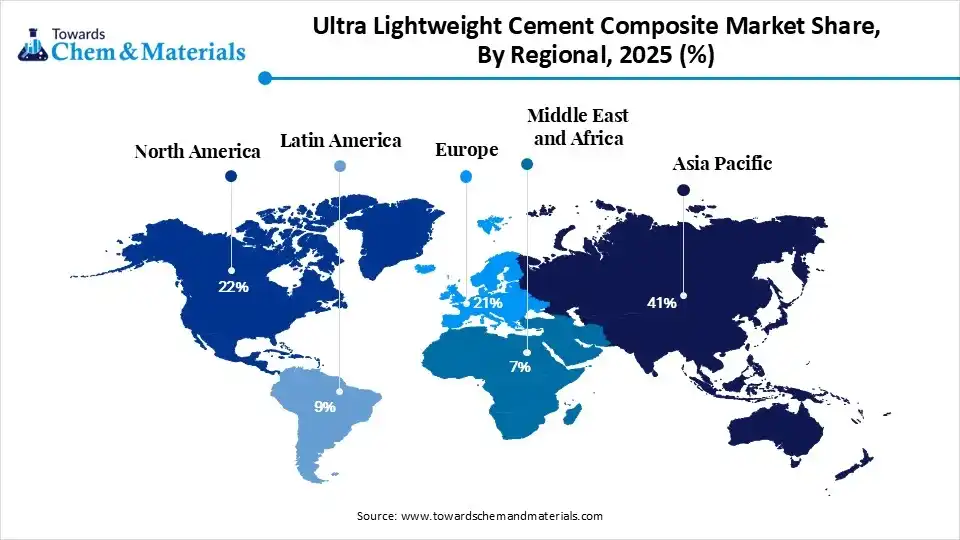
Asia Pacific dominated the market with the largest share of 41% in 2025. The dominance of the region can be attributed to rapid urbanization, which drives construction demand. Infrastructure investments increase material consumption. Prefabricated construction expands significantly. The region is witnessing a push for high-volume urban housing and infrastructure. Developers are focusing on building faster, managing structural loads and improving energy performance in buildings. The shift toward greener building materials is increasing in the region. The region is experiencing rapid adoption of the market by offering a product that supports lower embodied carbon, reduced transport weight, improved building-envelope efficiency and compatibility with modern construction methods. Fast urban development and climate-sensitive building design are supporting lightweight wall systems that reduce structural burden and improve thermal comfort.
 China
China
- The country has huge construction volumes, strong industrial materials capacity and a rising policy focus on greener and efficient buildings.
- Lightweight walling materials remain closely tied to prefabrication and building industrialization.
- Energy efficiency and thermal performance are becoming more important buying factors.
- Low-carbon cement innovation supports the broader lightweight composite opportunity.
- The market is likely to favor integrated wall systems rather than standalone materials.
India
- The country is witnessing the shift from standard AAC blocks toward larger-format lightweight wall systems and panels.
- The rapid scaling of domestic manufacturing capacity is driving market growth.
- The country is witnessing the growing preference for lightweight materials in high-rise urban and speed-sensitive construction.
What are the Advancements in the Ultra Lightweight Cement Composite Market in North America?
North America held a market share of 22% in 2025 and was expected to grow at the fastest CAGR of 10.10% over the forecast period. The growth of the region can be credited to sustainable construction practices supporting adoption. Commercial building upgrades increase demand. Infrastructure renewal programs drive growth. The region is witnessing a growing need for better-performing building envelopes and lighter wall systems. The market is supported by the region’s broader focus on sustainable and resilient construction. The regional market is being shaped by the rising demand for easier-to-handle walling materials and the rise of AAC panel/block systems.
United States
- U.S. combines large-scale residential and commercial construction, stricter performance expectations for buildings and a growing need for alternative wall systems.
- AAC and lightweight wall systems are gaining attention as energy-efficient alternatives. Performance in heat, fire, and resilience-driven construction is becoming a stronger selling point.
- Lightweight materials are increasingly tied to faster and more industrialized construction.
Canada
- The country is witnessing the rising adoption of AAC and ALC as high-performance walling systems rather than just alternative masonry products.
- The growing role of lightweight cement composites in floor systems, underlayments and thermal/acoustic insulation layers is creating demand for the market.
- The country is witnessing a push toward prefabricated lightweight concrete panels and project-speed solutions.
How is the Europe Ultra Lightweight Cement Composite Market Expanding?
Europe held a market share of 21% in 2025. The growth of the region can be credited to energy-efficient building regulations that support lightweight materials. Green construction initiatives boost demand. Modernization projects increase usage. The region is witnessing steady growth due to decarbonization, energy-efficient refurbishment and faster modern construction methods. The market is moving toward integrated, high-value walling and refurbishment solutions. The region’s strong focus on lower-carbon construction materials, where the ultra lightweight cement composite market overlaps with broader trends in CO2-reduced cement, recycled aggregates, prefabricated concrete components and circular building materials.
 Germany
- The country combines a strong AAC/walling tradition, a major building-refurbishment opportunity and a high focus on energy efficiency and industrialized construction methods.
- Germany remains a core market for AAC and lightweight wall systems. Refurbishment and energy-efficiency upgrades are becoming a major demand engine.
- Low-carbon and circular construction trends are strengthening the case for lightweight systems. Germany is moving toward more integrated, digitally supported walling systems.
France
- The country is witnessing the growing push toward low-carbon lightweight concrete blocks and cement-free masonry solutions.
- The rise of clinker-free and decarbonized cement systems that can feed into lightweight or precast concrete applications is creating growth opportunities.
- The expansion of bio-based and hybrid lightweight block systems, especially in the low-rise and energy-efficient building segment, is driving the market growth.
What are the Key Trends in the Ultra Lightweight Cement Composite Market in Latin America?
Latin America held a market share of 9% in 2025. The growth of the region can be credited to urban housing development, which supports market growth. Infrastructure investments encourage adoption. Cost-effective construction solutions gain traction. The region seeks materials that can reduce structural weight, improve thermal comfort, shorten construction time and support more efficient building methods. The region has the presence of AAC and lightweight walling brands with long-standing operations.
Brazil
- AAC has an established local presence through various companies. Thermal comfort and lighter wall systems are a practical advantage in Brazilian construction.
- The market is likely to grow through wall systems and not just standalone blocks. Sustainability and construction efficiency are becoming more connected.
Chile
- The country expresses the continued relevance of cellular concrete as a high-performance lightweight walling material.
- The growing use of lightweight prefabricated panel systems to shorten construction timelines and reduce on-site complexity is driving market adoption.
- The country is witnessing the emergence of sustainability-led concrete innovation, which could influence the future of ultra lightweight cement composites.
How is the Middle East and Africa Region Growing in the Ultra Lightweight Cement Composite Market?
The Middle East and Africa held a market share of 7% in 2025. The growth of the region can be credited to the mega infrastructure projects, which drive demand. Smart city developments increase usage. Construction diversification supports growth. Companies in the region consistently position these products around lower structural weight, faster installation, better insulation and fire resistance. Developers across the region are under pressure to deliver large housing, mixed-use, logistics and commercial projects on strict schedules. Lightweight cement materials are closely tied to the region’s green building and efficiency demands.
Ultra Lightweight Cement Composite Market Share, By Regional, 2025 (%)
| Regional | Revenue Share, 2025 (%) |
| Asia-Pacific | 41% |
| North America | 22% |
| Europe | 21% |
| Latin America | 9% |
| Middle East & Africa | 7% |
Saudi Arabia
- AAC and lightweight walling systems are already well established in the country.
- Thermal insulation is one of the strongest demand drivers. The market is shifting toward broader systems and not just individual blocks.
- Vision 2030 construction activity supports long-term demand.
South Africa
- The growing use of recycled polystyrene-based lightweight concrete systems as a practical green-building solution is creating growth opportunities.
- The continued use of AAC as a high-performance lightweight walling option for modern construction projects is accelerating market growth.
- The country’s rising interest in lightweight panelized construction for affordable housing, partitioning and faster project delivery is boosting market adoption.
Recent Developments
- In October 2025, Aircrete Europe unveiled a new-generation U-block and lintel production line designed for AAC producers. Technology allows manufacturers to convert standard or waste AAC blocks into higher-value U-blocks and lintels, while preserving AAC’s lightweight and insulating properties. (Source: https://www.aircrete.com/)
Top Companies List in Ultra Lightweight Cement Composite Market
- Westside Concrete Accessories
- Saint-Gobain
- GCP Applied Technologies
- Ferro Corporation
- Sika
- LafargeHolcim
- Boral Limited
- Neumann Cement
- BASF
- Kryton International
- Synaxis
- UltraTech Cement
- CRH
- HeidelbergCement
Segments Covered in the report
By Application
- Construction
- Building Walls
- Roofing Systems
- Flooring Systems
- Facade Elements
- Prefabricated Structures
- Modular Buildings
- Prefabricated Panels
- Volumetric Modules
- Infrastructure
- Bridges
- Tunnels
- Transportation Structures
- Utility Structures
By End Use
- Residential
- Single-Family Housing
- Multi-Family Housing
- Affordable Housing
- Commercial
- Offices
- Retail Buildings
- Hospitality Facilities
- Institutional Buildings
- Industrial
- Manufacturing Facilities
- Warehouses
- Logistics Centers
By Formulation Type
- Ready-Mix
- Lightweight Concrete Mixes
- Pumpable Composites
- Precast
- Structural Panels
- Lightweight Blocks
- Architectural Components
- On-Site Mixing
- Custom Mix Designs
- Small-Scale Construction Mixes
By Cement Type
- Portland Cement
- Ordinary Portland Cement
- Rapid Hardening Portland Cement
- Blended Cement
- Fly Ash Blended Cement
- Slag Blended Cement
- Pozzolanic Cement
- Specialty Cement
- Calcium Aluminate Cement
- Sulfoaluminate Cement
- High-Performance Cement
By Regional
- North America
- Europe
- Asia Pacific
- Middle East & Africa
- Latin America




Select User License to Buy
Figures (7)











 sales@towardschemandmaterials.com
 Download Sample
 Schedule a Meeting