Find the Right Market Report
Search thousands of industry reports, market insights, and research studies in one place.
Not sure where to start? Try one of these:
The U.S. chemicals digitalization market size was valued at USD 3.62 billion in 2025 and is expected to reach USD 13.19 billion by 2035, growing at a CAGR of 13.80% during the forecast period of 2026-2035. The market covers digital technologies and services used by chemical companies in the United States, including industrial IoT and sensors, advanced process control and automation software, digital twins and simulation, AI and analytics, cloud and ERP platforms, and cybersecurity, applied to production and operations, supply chain and logistics, R&D and product development, and sales and customer engagement in basic and petrochemicals, specialty chemicals and agrochemicals and fertilisers.
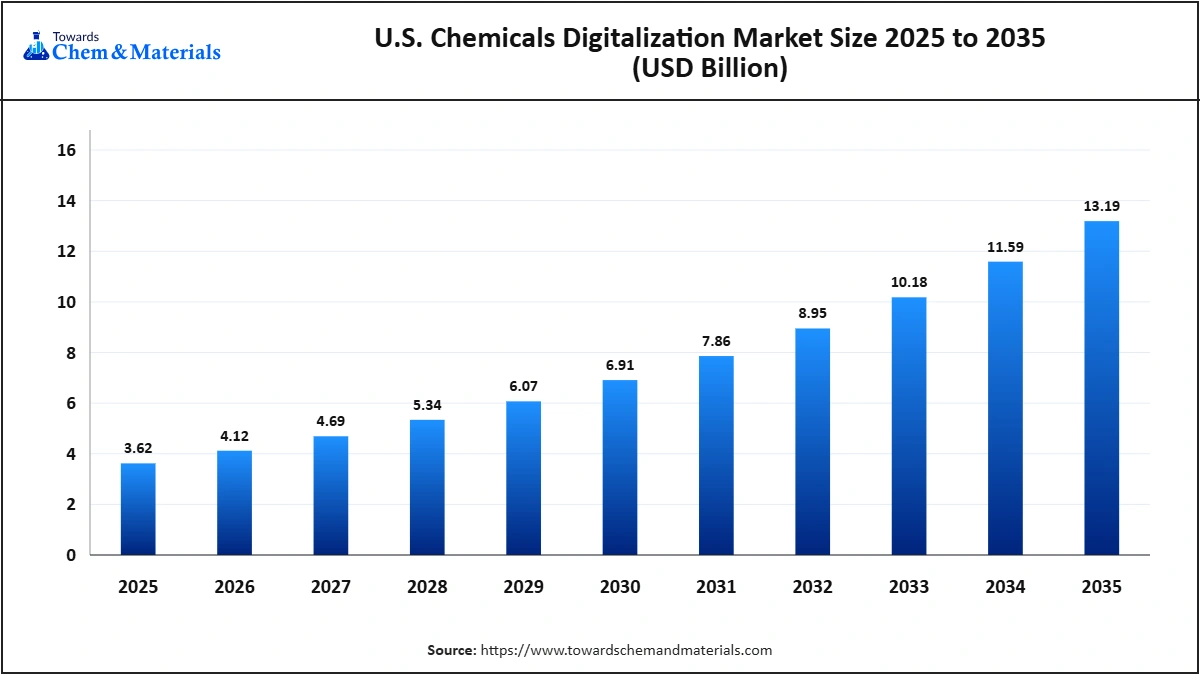
Note: 2025 is the base year; 2026-2035 values are forecasts.
Sources: Expert interviews, secondary sources, Towards Chemical and Materials database, and Towards Chemical and Materials analysts.
Advanced Process Control & Automation Software accounted for the largest share in 2025, at 24.00%, as these solutions improve production yields and energy efficiency. On a regional basis, the South accounted for 56.00% of revenue in 2025, supported by the largest petrochemical complexes on the Gulf Coast. Demand is driven by margin pressure, AI maturity, workforce change, and emissions goals. Large producers are putting AI at the centre of operations, as shown by Dow's AI-driven restructuring plan announced in January 2026.
The U.S. chemicals digitalization market is projected to grow from USD 3.62 billion in 2025 to USD 13.19 billion by 2035 because U.S. chemical makers face margin pressure and an ageing workforce, and digital tools raise yield, uptime, and safety. Margin pressure, AI maturity, workforce change, and emissions goals support very strong growth, lifting the market to USD 6.91 billion by 2030 and sustaining a CAGR of 13.80% by 2035. Digitalization includes AI in chemicals and materials informatics for new polyolefin and polypropylene compound grades.
Analyst View: We built the estimate from digital and automation spending by U.S. chemical plants and companies by technology and region, cross-checked against U.S. chemical industry revenues of leading automation and software vendors. Published estimates for this U.S. scope are limited, so our value is evidence-based.
Increasing margin pressure, competition, and the need for operational efficiency are encouraging U.S. chemical manufacturers to adopt AI and digital technologies. Growing AI maturity, an ageing industrial workforce, and skilled labour shortages are accelerating automation. Additionally, rising energy costs, decarbonization targets, emissions reduction commitments, and stringent industrial safety requirements are driving investments in digital monitoring, process optimization, and intelligent manufacturing solutions.
Dependence on legacy control systems and outdated manufacturing infrastructure creates integration challenges for digital technology adoption. Increasing connectivity between IT and OT networks raises cybersecurity concerns, particularly for critical chemical manufacturing operations. Additionally, high implementation costs associated with AI, cloud platforms, sensors, and system integration, coupled with shortages of skilled professionals in AI, analytics, and industrial automation, restrict widespread adoption.
Growing adoption of AI-driven materials discovery creates opportunities to accelerate specialty chemical, polymer, and advanced material development. Predictive maintenance offers potential to reduce equipment failures and downtime. Increasing demand for emissions monitoring supports digital sustainability solutions. Additionally, AI-powered specialty chemical formulation and supply chain optimization can improve product development, raw material utilization, demand forecasting, inventory management, and operational efficiency.
Market Drivers - Impact & CAGR Contribution (2026-2035)
| Driver | Impact | ≈ CAGR Contribution | Time Horizon | Key Regions |
| Margin pressure needs efficiency | High | +5.39 pp | Short to long term | U.S.-wide, strongest in South |
| AI tools mature | Medium | +4.55 pp | Medium to long term | U.S.-wide, fastest uptake in West |
| Ageing workforce | Medium | +3.87 pp | Short to medium term | U.S.-wide |
| Energy and emissions goals | Low | +3.03 pp | Long term | South and West |
Note: Contributions are indicative estimates of each factor's effect on annual growth.
Sources: Expert interviews, secondary sources, Towards Chemical and Materials database, and Towards Chemical and Materials analysts.
Taken together, these drivers add about 16.84 percentage points to the annual growth of the U.S. chemicals digitalization market, with margin pressure and efficiency requirements having the largest impact. Their influence is strongest in the South, while uptake grows fastest in the West.
Market Restraints - Impact & Negative CAGR Contribution (2026-2035)
| Restraint | Impact | ≈ Negative CAGR Contribution | Time Horizon | Key Regions |
| Legacy control systems | High | -1.37 pp | Short to medium term | U.S.-wide |
| Cybersecurity risks | High | -1.00 pp | Medium term | Smaller and price-sensitive markets |
| High implementation costs | Medium | -0.67 pp | Short term | South and other mature markets |
Note: Contributions are indicative estimates of each factor's effect on annual growth.
Sources: Expert interviews, secondary sources, Towards Chemical and Materials database and Towards Chemical and Materials analysts.
These restraints are expected to reduce annual growth of the U.S. chemicals digitalization market by about 3.04 percentage points, led by legacy control systems. Their effect eases over the forecast period as suppliers, buyers, and regulators adapt, leaving a net CAGR of 13.80% from 2026 to 2035.
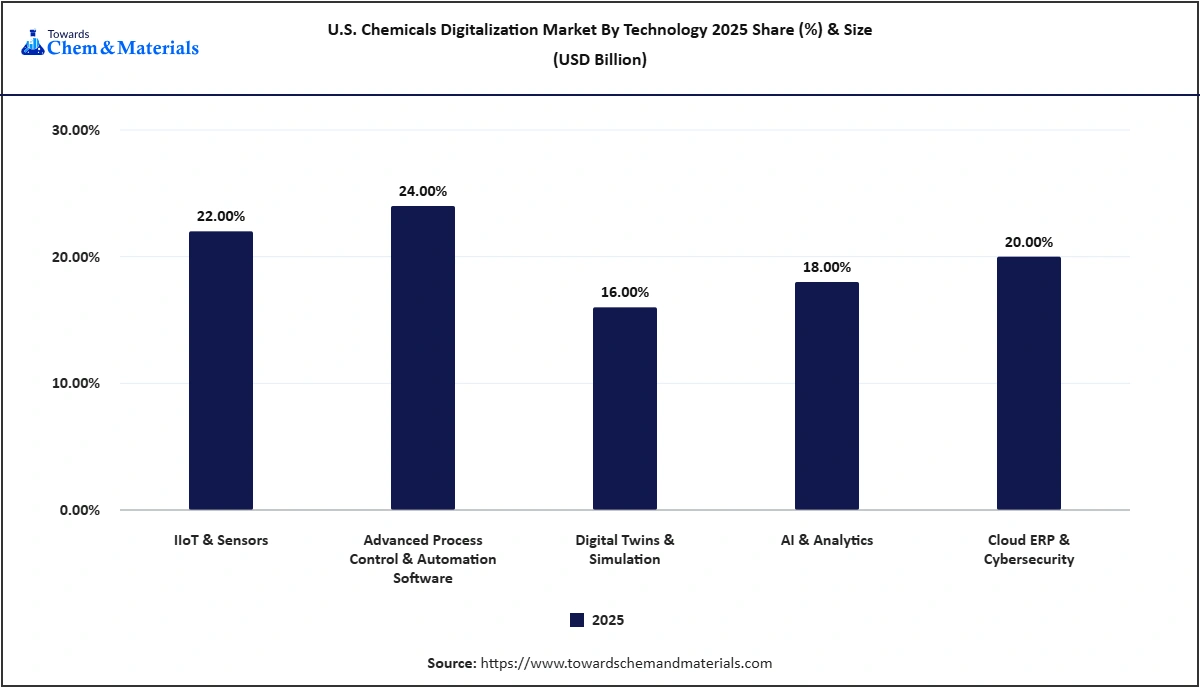
| Segments | 2025 Share | 2035 Share | CAGR 2026-2035 |
| IIoT & Sensors | 22.00% | 21.00% | 13.30% |
| Advanced Process Control & Automation Software | 24.00% | 22.21% | 12.90% |
| Digital Twins & Simulation | 16.00% | 15.31% | 13.30% |
| AI & Analytics | 18.00% | 22.37% | 16.30% |
| Cloud, ERP & Cybersecurity | 20.00% | 19.11% | 13.30% |
Note: 2025 is the base year; 2035 shares and CAGRs are forecasts.
Sources: Expert interviews, secondary sources, Towards Chemical and Materials database, and Towards Chemical and Materials analysts.
IIoT & Sensors accounted for 22.00% in 2025, Advanced Process Control & Automation Software for 24.00%, Digital Twins & Simulation for 16.00%, AI & Analytics for 18.00%, and Cloud, ERP & Cybersecurity for 20.00%. Advanced Process Control & Automation Software leads, while AI & Analytics is growing fastest.
IIoT & Sensors: Accounting for a 22.00% share of the U.S. chemicals digitalization market in 2025, this segment is projected to expand at a CAGR of 13.30% from 2026 to 2035. IIoT and sensors lead because plants need real-time data from equipment. The segment is expected to grow slower than the overall market over the forecast period.
Advanced Process Control & Automation Software: Holding a 24.00% market share in 2025, this segment is projected to register a CAGR of 12.90% by 2035. Advanced process control and automation software leads in value because they optimize yield and energy. The segment is expected to grow slower than the overall market over the forecast period.
Digital Twins & Simulation: Representing 16.00% of the U.S. chemicals digitalization market in 2025, this segment is anticipated to grow at a CAGR of 13.30% during 2026-2035. Digital twins and simulation support design and operations. The segment is expected to grow slower than the overall market over the forecast period.
AI & Analytics: With an 18.00% market share in 2025, this segment is forecast to expand at the highest CAGR of 16.30% from 2026 to 2035. AI and analytics are gaining traction due to increasing demand for predictive maintenance and process optimization. The segment is expected to grow faster than the overall market over the forecast period.
Cloud, ERP & Cybersecurity: Contributing 20.00% to the U.S. chemicals digitalization market in 2025, this segment is projected to record a CAGR of 13.30% over 2026-2035. Cloud, ERP, and cybersecurity connect business and plant systems. The segment is expected to grow slower than the overall market over the forecast period.
Segment Outlook: Advanced Process Control & Automation Software is expected to maintain its dominance through 2035, accounting for approximately 22.21% of the market. Meanwhile, AI & Analytics is projected to register the fastest growth, with a CAGR of 16.30% during 2026-2035. Digital Twins & Simulation represents the smallest market segment, primarily addressing specialized applications across the U.S. chemicals digitalization industry.
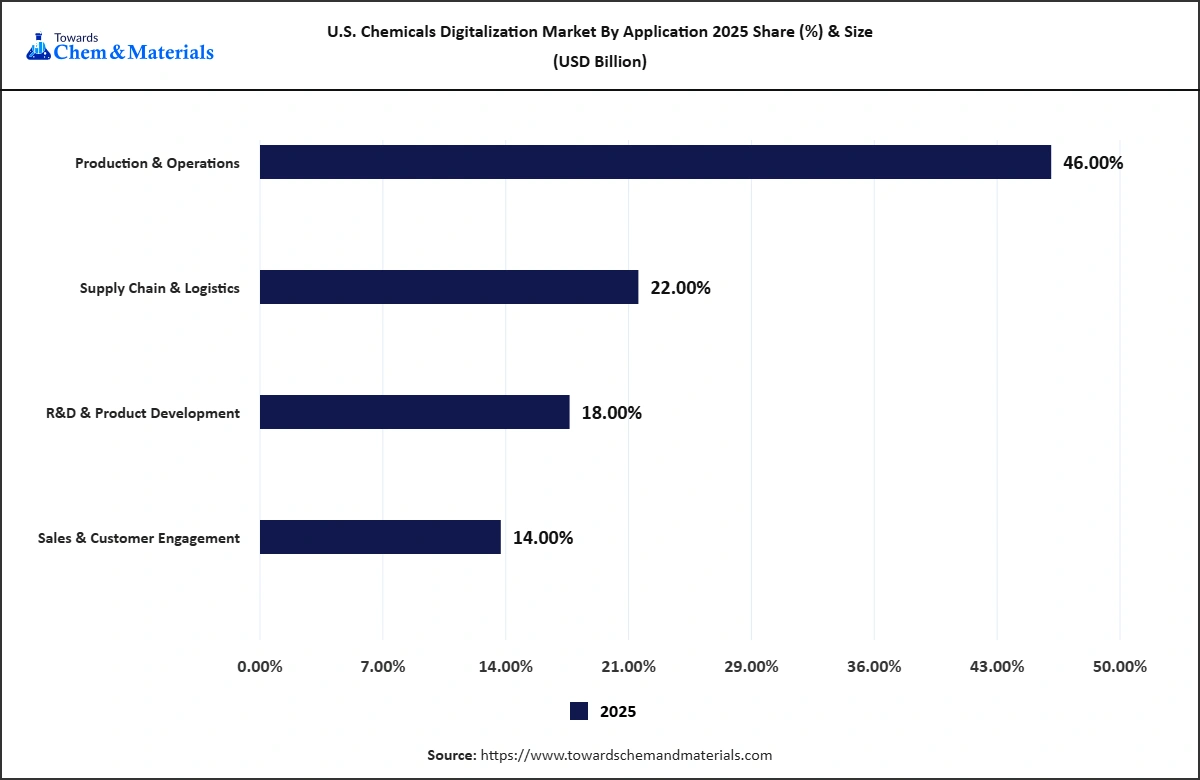
| Segments | 2025 Share | 2035 Share | CAGR 2026-2035 |
| Production & Operations | 46.00% | 43.59% | 13.19% |
| Supply Chain & Logistics | 22.00% | 21.61% | 13.59% |
| R&D & Product Development | 18.00% | 21.08% | 15.59% |
| Sales & Customer Engagement | 14.00% | 13.72% | 13.59% |
Note: 2025 is the base year; 2035 shares and CAGRs are forecasts.
Sources: Expert interviews, secondary sources, Towards Chemical and Materials database, and Towards Chemical and Materials analysts.
Production & Operations accounted for 46.00% in 2025, Supply Chain & Logistics for 22.00%, R&D & Product Development for 18.00%, and Sales & Customer Engagement for 14.00%. Production & Operations leads, while R&D & Product Development is growing fastest.
Production & Operations: Representing 46.00% of the U.S. chemicals digitalization market in 2025, this segment is projected to expand at a CAGR of 13.19% from 2026 to 2035. Digital tools improve equipment uptime, production yield, and operational efficiency. The segment is expected to grow slower than the overall market over the forecast period.
Supply Chain & Logistics: Holding a 22.00% market share in 2025, this segment is anticipated to register a CAGR of 13.59% during 2026-2035. Digital planning and logistics software helps optimize inventory, procurement, transportation, and distribution activities. The segment is expected to grow broadly in line with the overall market.
R&D & Product Development: With an 18.00% share in 2025, this segment is forecast to record a CAGR of 15.59% by 2035. Increasing adoption of AI-driven materials discovery, formulation optimization, and digital experimentation is accelerating R&D digitalization. The segment is expected to grow faster than the overall market.
Sales & Customer Engagement: Contributing 14.00% to the market in 2025, this segment is projected to grow at a CAGR of 13.59% over 2026-2035. Digital commerce platforms, customer analytics, and CRM solutions are improving customer interactions and sales efficiency. The segment is expected to grow broadly in line with the overall market.
Segment Outlook: Production & Operations remains the largest application segment through 2035, holding about 43.59% of the market in 2035, while R&D & Product Development records the highest CAGR of 15.59% from 2026 to 2035. Sales & Customer Engagement holds the smallest share today and serves more specialised needs within the U.S. chemicals digitalization market.
| Segments | 2025 Share | 2035 Share | CAGR 2026-2035 |
| Basic & Petrochemicals | 48.00% | 45.34% | 13.14% |
| Specialty Chemicals | 36.00% | 39.04% | 14.74% |
| Agrochemicals & Fertilisers | 16.00% | 15.62% | 13.54% |
Note: 2025 is the base year; 2035 shares and CAGRs are forecasts.
Sources: Expert interviews, secondary sources, Towards Chemical and Materials database and Towards Chemical and Materials analysts.
Basic & Petrochemicals accounted for 48.00% in 2025, Specialty Chemicals for 36.00% and Agrochemicals & Fertilisers for 16.00%. Basic & Petrochemicals leads, while Specialty Chemicals is growing fastest.
Basic & Petrochemicals: Representing 48.00% of the U.S. chemicals digitalization market in 2025, this segment is projected to grow at a CAGR of 13.14% from 2026 to 2035. Large-scale manufacturing facilities, particularly along the Gulf Coast, drive adoption through investments in process automation, operational optimization, and plant digitalization. The segment is expected to grow slower than the overall market.
Specialty Chemicals: Holding a 36.00% market share in 2025, this segment is anticipated to register the fastest CAGR of 14.74% during 2026-2035. Increasing adoption of AI-powered formulation, material informatics, and digital R&D solutions is accelerating digitalization among specialty chemical manufacturers. The segment is expected to grow faster than the overall market.
Agrochemicals & Fertilisers: Accounting for 16.00% of the market in 2025, this segment is forecast to expand at a CAGR of 13.54% throughout the forecast timeframe. Growing adoption of digital process monitoring, production automation, precision analytics, and supply chain management solutions is supporting digital transformation. The segment is expected to grow broadly in line with the overall market.
Segment Outlook: Basic & Petrochemicals remains the largest segment segment through 2035, holding about 45.34% of the market in 2035, while Specialty Chemicals records the highest CAGR of 14.74% from 2026 to 2035. Agrochemicals & Fertilisers holds the smallest share today and serves more specialised needs within the U.S. chemicals digitalization market.
Analyst View: Segment shares were allocated from demand, product portfolios and pricing in each category. Advanced Process Control & Automation Software, Production & Operations and Basic & Petrochemicals lead their categories because they meet the core needs of today's buyers. We expect AI & Analytics, R&D & Product Development and Specialty Chemicals to gain share as newer technologies, users and applications grow faster.
| Region | 2025 Share | 2035 Share | CAGR 2026-2035 |
| South | 56.00% | 54.51% | 13.49% |
| Midwest | 20.00% | 20.17% | 13.89% |
| Northeast | 14.00% | 14.10% | 13.89% |
| West | 10.00% | 11.22% | 15.09% |
Note: 2025 is the base year; 2035 shares and CAGRs are forecasts.
Sources: Expert interviews, secondary sources, Towards Chemical and Materials database and Towards Chemical and Materials analysts.
South accounted for 56.00% in 2025, Midwest for 20.00%, Northeast for 14.00% and West for 10.00%. South leads, while West is growing fastest.
South: Dominating the U.S. chemicals digitalization market with a 56.00% share in 2025, the region is projected to expand at a CAGR of 13.49% by 2035. Texas and Louisiana drive regional dominance, hosting some of the country's largest petrochemical complexes along the Gulf Coast. The region is expected to grow slower than the overall market during the forecast period.
Midwest: Holding a 20.00% market share in 2025, the region is anticipated to register a CAGR of 13.89% during 2026-2035. Its established chemical manufacturing base, including Dow's Michigan headquarters and production facilities across Illinois and Ohio, supports digital technology adoption. The region is expected to grow broadly in line with the overall market.
Northeast: Representing 14.00% of the market in 2025, the region is forecast to expand at a CAGR of 13.89% from 2026 to 2035. The presence of specialty chemical manufacturers in New Jersey and Pennsylvania supports demand for advanced process automation, digital R&D, and analytics solutions. The region is expected to grow broadly in line with the overall market.
West: With a 10.00% share in 2025, the region is projected to record the fastest CAGR of 15.09% during 2026-2035. Growing investments in specialty chemicals, battery materials, and advanced manufacturing, particularly in California, are accelerating digital technology adoption. The region is expected to grow faster than the overall market during the forecast period.
Analyst View: Regional shares were built from demand, installed base, spending and supplier presence in each region. South leads because of its mature demand base and strong suppliers. We assign West the highest growth premium because investment, adoption and capacity are expanding fastest there.
| Rank | Company Name | 2025 Share (%) | Key Products / Business | Headquarters |
| 1 | Emerson (AspenTech) | 13.00% | Process automation and AspenTech software | United States |
| 2 | Honeywell | 11.00% | Process control and Experion | United States |
| 3 | Siemens | 9.00% | Automation and digital twins | Germany |
| 4 | Schneider Electric (AVEVA) | 8.00% | AVEVA industrial software | France |
| 5 | Rockwell Automation | 7.00% | Automation and analytics | United States |
| 6 | Yokogawa | 5.00% | Process control systems | Japan |
| 7 | ABB | 5.00% | Process automation | Switzerland |
| 8 | Microsoft | 5.00% | Cloud and AI platforms | United States |
| 9 | SAP | 5.00% | ERP for chemicals | Germany |
| 10 | Accenture | 4.00% | Digital transformation services | Ireland |
Note: Company shares are 2025 estimates.
Sources: Company press releases, expert interviews, secondary sources, Towards Chemical and Materials database and Towards Chemical and Materials analysts.
Emerson (AspenTech) led the U.S. chemicals digitalization market with an estimated 13.00% share of 2025 revenue, followed by Honeywell at 11.00% share and Siemens at 9.00% share. Emerson (AspenTech) leads with process automation and AspenTech software, Honeywell competes with process control and Experion, and Siemens offers automation and digital twins. Schneider Electric (AVEVA), Rockwell Automation, Yokogawa, ABB, Microsoft, SAP and Accenture compete through AVEVA industrial software, automation and analytics, process control systems, process automation, cloud and AI platforms, ERP for chemicals and digital transformation services.
The top 10 companies accounted for an estimated 72.10% of 2025 revenue, while the remaining 27.90% was shared among many system integrators, AI start-ups and consultancies. The U.S. chemicals digitalization market is moderately concentrated among automation and software leaders, and competition centres on process expertise, integration with existing control systems, AI capabilities, cybersecurity, implementation services and measurable return on investment.
Emerson (AspenTech): Emerson (AspenTech) is headquartered in the United States. It held an estimated 13.00% share of the U.S. chemicals digitalization market in 2025. Its offering centres on Process automation and AspenTech software. In the Towards Chemical and Materials Companies Quadrant it is positioned as a Leader.
Honeywell: Headquartered in the United States, Honeywell captured an estimated 11.00% of the U.S. chemicals digitalization market in 2025. The company focuses on process control solutions and its Experion platform, supporting industrial automation and process optimization. Towards Chemical and Materials positions Honeywell as a Leader in its Companies Quadrant.
Siemens: Based in Germany, Siemens accounted for an estimated 9.00% market share in 2025. Its key offerings include industrial automation solutions and digital twin technologies that enable process simulation, operational efficiency, and intelligent manufacturing. The company is classified as a Leader in the Towards Chemical and Materials Companies Quadrant.
Schneider Electric (AVEVA): With its headquarters in France, Schneider Electric (AVEVA) secured an estimated 8.00% share of the U.S. market in 2025. Its competitive portfolio includes AVEVA industrial software for process optimization, engineering, simulation, and industrial data management. Towards Chemical and Materials identifies the company as a Leader.
Rockwell Automation: The U.S.-based company held an estimated 7.00% market share in 2025, supported by its industrial automation, process control, and analytics solutions. Its technologies help chemical manufacturers improve production performance and operational visibility. Rockwell Automation is positioned as a Leader in the Towards Chemical and Materials Companies Quadrant.
Yokogawa: Headquartered in Japan, Yokogawa represented approximately 5.00% of the U.S. chemicals digitalization market in 2025. The company specializes in process control systems and industrial automation technologies that support reliable and efficient chemical plant operations. It is categorized as a Leader in the Towards Chemical and Materials Companies Quadrant.
ABB: Switzerland-based ABB accounted for an estimated 5.00% market share in 2025. Its portfolio encompasses process automation technologies designed to enhance plant productivity, operational reliability, and energy efficiency. Towards Chemical and Materials positions ABB as an Innovator in its Companies Quadrant.
Microsoft: Headquartered in the United States, Microsoft held an estimated 5.00% share of the market in 2025. Its cloud computing and AI platforms support industrial data integration, advanced analytics, and digital transformation across chemical manufacturing operations. The company is classified as an Innovator in the Towards Chemical and Materials Companies Quadrant.
SAP: Germany-based SAP captured approximately 5.00% of the U.S. chemicals digitalization market in 2025. Its ERP solutions address chemical industry requirements, including production planning, supply chain management, procurement, and enterprise resource optimization. Towards Chemical and Materials categorizes SAP as an Innovator.
Accenture: Operating from its headquarters in Ireland, Accenture held an estimated 4.00% market share in 2025. The company provides digital transformation services that help chemical manufacturers implement cloud technologies, AI, data analytics, and enterprise-wide digital solutions. It is positioned as an Innovator in the Towards Chemical and Materials Companies Quadrant.
The U.S. chemicals digitalization ecosystem links hardware & sensor suppliers, software & AI providers, integrators & consultants, chemical companies, and regulators & standards, with each stage adding value before products reach end users.
| Ecosystem Stage | Role in the Market | Key Companies |
| Hardware & Sensor Suppliers | Supply sensors and controllers | Emerson, Honeywell, Rockwell |
| Software & AI Providers | Provide APC, twins and AI | AspenTech, AVEVA, Siemens, Microsoft |
| Integrators & Consultants | Implement solutions | Accenture, system integrators |
| Chemical Companies | Use digital tools | Dow, ExxonMobil Chemical, LyondellBasell, Eastman |
| Regulators & Standards | Set safety and cyber rules | OSHA PSM, CISA, ISA/IEC 62443 |
Sources: Company press releases, expert interviews, secondary sources, Towards Chemical and Materials database and Towards Chemical and Materials analysts.
Hardware & Sensor Suppliers: Supply sensors and controllers. Key participants include Emerson, Honeywell, Rockwell.
Software & AI Providers: Provide APC, twins, and AI. Key participants include AspenTech, AVEVA, Siemens, Microsoft.
Integrators & Consultants: Implement solutions. Key participants include Accenture and system integrators.
Chemical Companies: Use digital tools. Key participants include Dow, ExxonMobil Chemical, LyondellBasell, Eastman.
Regulators & Standards: Set safety and cyber rules. Key participants include OSHA PSM, CISA, ISA/IEC 62443.
Value in the U.S. chemicals digitalization market flows from upstream material and technology suppliers to manufacturers and service providers, then through distribution partners to end users. Companies that integrate several stages or build long-term relationships with end users capture a larger share of this value.
The Towards Chemical and Materials Companies Quadrant positions key participants in the U.S. chemicals digitalization market based on their market strength. This assessment considers factors such as revenue scale, market share, and geographic reach. It also evaluates innovation and growth strategies, including product portfolio breadth, R&D intensity, and strategic partnerships. Positions reflect each company's estimated 2025 share of the U.S. chemicals digitalization market and our assessment of its product innovation, portfolio breadth, and partnerships.
Sources: Company press releases, expert interviews, secondary sources, Towards Chemical and Materials database, and Towards Chemical and Materials analysts.
Leaders: Emerson (AspenTech), Honeywell, Siemens, Schneider Electric (AVEVA), Rockwell Automation and Yokogawa combine high market share with broad portfolios and strong innovation.
Innovators: ABB, Microsoft, SAP and Accenture bring newer technologies and specialised products.
By Technology
By Application
By Segment
By Region
The U.S. chemicals digitalization market covers digital technologies and services adopted by U.S. chemical manufacturers, including IIoT and sensors, advanced process control and automation software, digital twins and simulation, AI and analytics, cloud and ERP platforms, and cybersecurity. These technologies are applied across production and operations, supply chain and logistics, R&D and product development, and sales and customer engagement within basic and petrochemicals, specialty chemicals, and agrochemicals and fertilizers. The 2025 market size was estimated using a bottom-up approach based on demand volumes and average prices across technology, application, industry, and regional segments. The estimates were cross-validated through a top-down assessment of leading companies' market-specific revenues and published industry estimates. Segment, regional, and company-level estimates were reconciled against company disclosures, regulatory information, industry data, and third-party sources. The 2026-2035 forecast was derived by applying the respective projected growth rates to the validated 2025 base year.
The U.S. chemicals digitalization market is set for steady expansion as margin pressure and related demand keep growing. Our estimate links value to underlying demand, installed base, and pricing, so the forecast follows real adoption rather than headline hype. The main upside comes from AI materials discovery and predictive maintenance, while the main risks are legacy systems and cybersecurity risks.
Reliable market intelligence and data-driven insights across the global chemicals and materials industry, helping businesses understand trends, competition, pricing, and emerging opportunities.
Schedule a Demo