
What is the Polyurethane Adhesives Market Size and Share?
The global polyurethane adhesives market size was valued at USD 12.04 billion in 2025, is estimated to reach USD 12.89 billion in 2026, and is projected to reach USD 23.77 billion by 2035, exhibiting a compound annual growth rate (CAGR) of 7.04% over the forecast period from 2026 to 2035.Asia Pacific dominated the polyurethane adhesives market with the largest revenue share of 47% in 2025 and is expected to grow at the fastest CAGR of 7.15% during the forecast period. Growing sectors like building and construction, packaging, and automotive demand for polyurethane adhesive due to the lightweight vehicle trend to improve fuel efficiency, which drives growth. The key industry players like Henkel, Sika, and 3M are shaping the competitive landscape, contributing through new and advanced infrastructure projects with heavy investments, which is a major factor contributing to the growth in the coming years.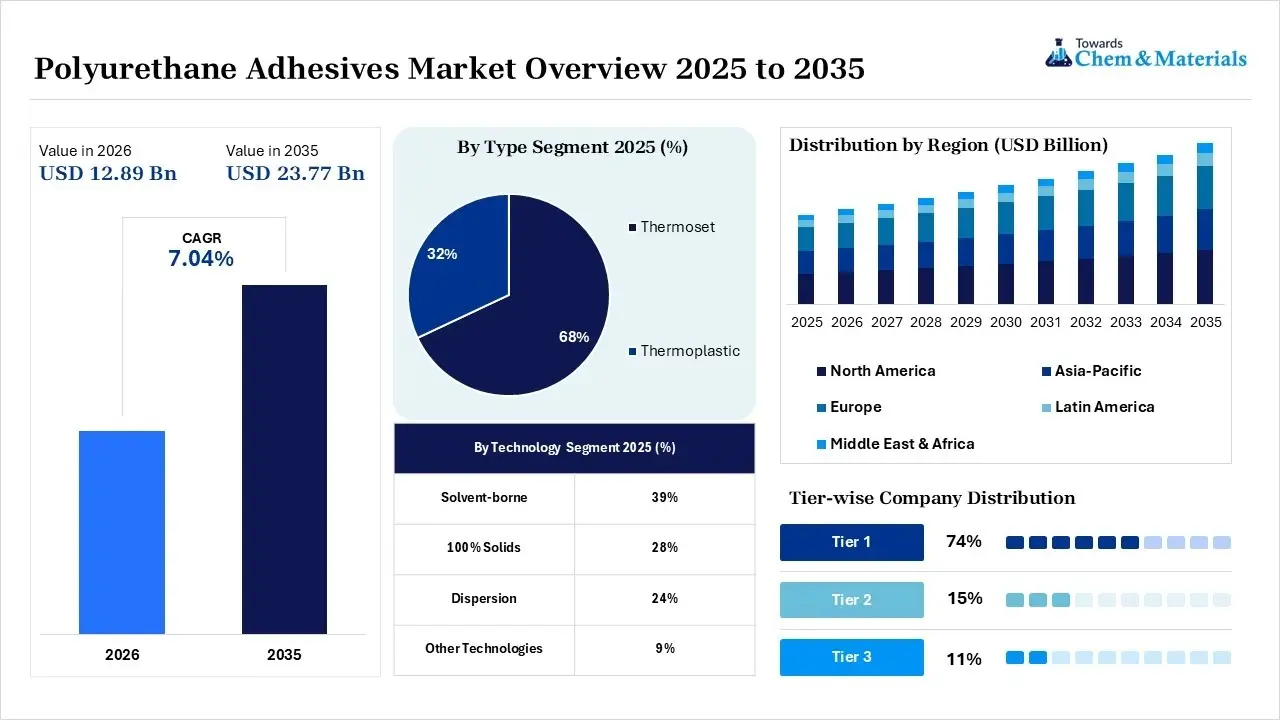
Key Takeaway
- By region, Asia Pacific dominated the polyurethane adhesives market with a share of 47% in 2025 and is expected to experience the fastest growth with a CAGR of 7.15%in the forecast period.
- By type, the thermoset segment dominated the market with a 68% share in 2025 and is expected to grow at a CAGR of 6.10% over the forecast period.
- By type, the thermoplastic segment held 32% market share in 2025 and is expected to have the fastest growth with a CAGR of 7.20% in the forecast period.
- By technology, the solvent-borne segment dominated the market with a 39% share in 2025 and is expected to grow at a CAGR of 4.90% over the forecast period.
- By technology, the dispersion segment held 24% market share in 2025 and is expected to have the fastest growth with a CAGR of 8.10% in the forecast period.
- By end-use industry, the automotive segment dominated the market with a 27% share in 2025 and is expected to grow at a CAGR of 6.80% over the forecast period.
- By end-use industry, the packaging segment held 17% market share in 2025 and is expected to have the fastest growth with a CAGR of 7.60% in the forecast period.
According to Towards Chemicals and Materials Analytics and Consulting, the global polyurethane adhesives volume was valued at 4.05 million metric tons in 2025 and is expected to surpass around 7.11 million metric tons by 2035, accelerating a compound annual growth rate (CAGR) of 5.79% over the forecast period from 2026 to 2035.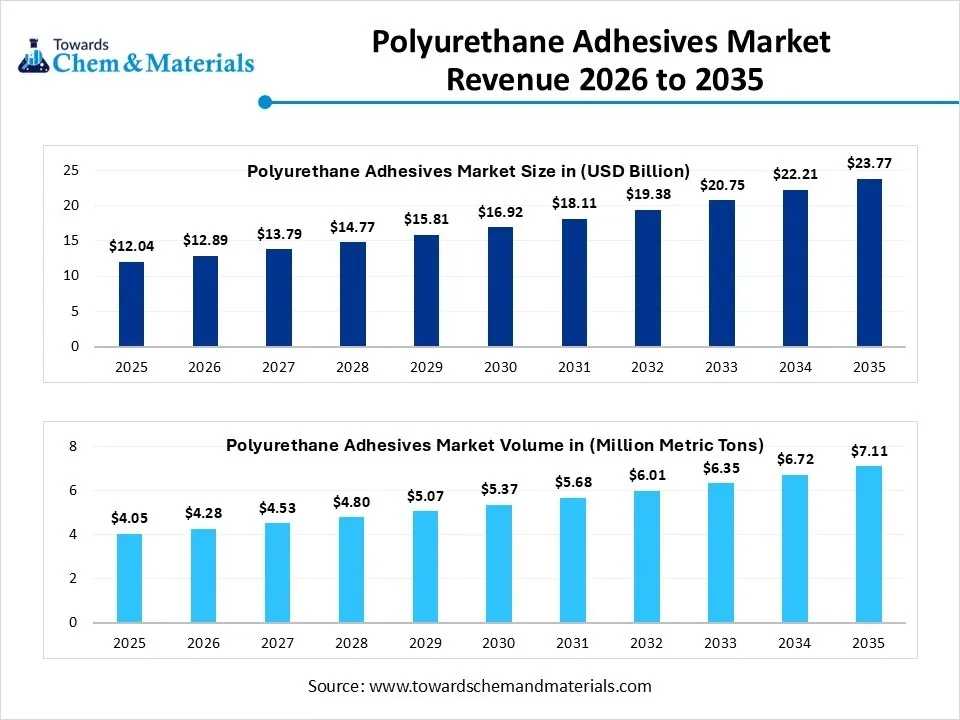
Polyurethane Adhesives: High-Performance and Lightweight Material
The polyurethane adhesive market is experiencing growth driven by growing sectors like automotive, building and construction, demanding lightweight materials to increase fuel efficiency, and increased adoption of EVs, aligning with environmental regulations to use low-VOC compounds due to growing environmental conditions. The growing demand from automotive and transportation growth due to weight reduction, which helps improve battery efficiency and drive range in EVs, also helps in maintaining safety and rigidity. The environmental and regulatory shifts to maintain sustainability compliance by encouraging the production of bio-based and ultra-low monomer adhesive grades are driving growth.
The construction and building infrastructure spending due to rapid urbanization and commercial construction, and high-performance sealing material to offer superior flexibility, environmental durability, and thermal expansion accommodation fuels the growth. The key players have joint research for eco-friendly formulations and regional distribution alliances, and major industry leaders are driving strategic partnerships, which help in rising investments through players like Henkel AG & Co. KGaA, 3M Company, and H.B. Fuller Company, supporting the growth.
- For instance, in February 2026, the strategic partnership between Henkel and Sekab focuses on substituting conventional, fossil-based ethyl acetate with a sustainable, bio-based alternative in industrial adhesive production. Driven largely by Henkels Packaging division, the initiative creates scalable, climate-conscious raw material supply chains to lower the product carbon footprint for consumer goods brands.(Source: www.european-coatings.com)
Report Scope
| Report Attributes | Details |
| Market Size in 2026 | USD 12.89 Billion/ 4.28 Million Metric Tons |
| Expected Size in 2035 | USD 23.77 Billion/ 7.11 Million Metric Tons |
| Growth Rate | CAGR of 7.04% |
| Base Year of Estimation | 2025 |
| Forecast Period | 2025-2035 |
| Dominant Region | Asia Pacific |
| Segment Covered | By Type, By Technology, By End-use Industry, By Region |
| Key Companies Profiled | Dow Inc. (US), Huntsman International LLC (US), Arkema S.A. (France), Illinois Tool Works Inc. (US), Jowat SE (Germany) |
Global Investment Flow for Polyurethane Adhesives Market 2026
The investment in polyurethane adhesives is driven by growth in private and public funding for eco-friendly formulations, infrastructure development, and advanced manufacturing technologies. Henkel AG & Co., Sika AG, and H.B. Fuller Company are continuously investing in facility development.
- Major firms such as Henkel AG & Co. KGaA and 3M Company invest heavily in advanced conductive and high-performance polyurethane adhesives for wearable electronics and EV components.
Earlier, Henkel Adhesive Technologies India expanded its polyurethane, sealant, and functional coating capabilities by completing the Phase III expansion of its Kurkumbh manufacturing facility near Pune, Maharashtra. This specialized plant focuses entirely on the high-performance manufacturing of industrial adhesives, structural sealants, and surface treatment technologies.(Source: www.henkel.in) - In February 2026, automotive interior trim supplier Kasai UK secured a £100,000 grant from the Business Growth Fund to transition its manufacturing operations away from carbon-heavy formulations. At its plant in Washington, Tyne and Wear, Kasai UK is replacing traditional solvent-borne adhesives with solvent-free, water-based alternatives.(Source: www.bbc.com)
Market Growth Trends:
- The growing demand for eco-friendly formulations, which shifts towards waterborne, reactive, and ultra-low-monomer options from traditional solvent-borne systems due to tighter limits on VOC, is accelerating the growth of sustainable and green adhesives.
- Increased demand for the adoption of multi-material bonding and lightweight structures in automotive and electrical vehicles to increase fuel efficiency is a growing trend in the market growth.
- High demand for thermoplastics and hot melt polyurethane adhesives for flexible packaging to laminate the high barrier plastics films and foils securely drives the demand for the market.
Key Shifts in the Polyurethane Adhesives Manufacturing Through AI Integration
The shift in adhesives manufacturing is moving through the integration of AI for formulation and research and development through machine learning models like Loctite Solve, which is virtual prototyping. Multi-objective optimization includes high tensile strength, rapid cure time, and strict low-VOC or PFAS-free environmental support in manufacturing. This integration cuts research timelines, improves eco-friendly compliance, and stabilizes factory throughput. Smart factory integration like process control, computer vision quality checks, and predictive maintenance helps in production lines.
Sustainability Analysis in Polyurethane Adhesives?
The sustainability analysis of polyurethane adhesives focuses on replacing fossil-based raw materials, supporting improved end-of-life circularity, and eliminating toxic solvents, thereby increasing sustainability standards. Innovation in renewable feedstocks and bio-based content like vegetable oils, lignin, cellulose, and CO2-based polyols replaces traditional feedstocks. Improvements in formulations and processing through solvent-free systems, non-isocyanate polyurethanes, and energy reduction by lowering processing temperature and manufacturing energy demand are shifting towards sustainability integration.
What are Polyurethane Adhesives?
Polyurethane adhesives are high-strength, flexible polymer glues that are created by the reaction of isocyanates with polyols, which are extensively used and in demand. They are demanded extensively from sectors as they provide exceptional elasticity, durable bonding, and weather resistance across diverse materials. Their core properties, like flexibility, absorbing shocks, handling extreme natural material expansion or contraction, durability, help in resisting water, extreme temperature, UV light, and chemicals; versatility helps bond dissimilar surfaces. They are extensively used in sectors like construction, automotive, and woodworking.
What are the Key Uses of Polyurethane Adhesives?
Polyurethane adhesives are used in various industries due to their properties and applications, like in automotive manufacturing, construction assembly, and furniture production.
- Automotive and Transportation:They are used for windshield bonding for security and sealing, panel and rim assembly for fixing interior dashboards and body panels, and vibration dampening for absorbing constant mechanical stress.
- Construction and Building:They are used for insulation and sandwich panels for bonding composites and foam panels; in outdoor structural joints helps in resisting severe weather and extreme temperatures, as a substrate versatile in gluing wood, concrete, and metal together.
- Furniture and Woodworking:Used extensively for wood joining and lamination, as it helps deliver wood-to-wood and wood-to-metal bonds strongly and also helps in assembling profile wrapping and decorative foils on the surface.
- Footwear and Packaging :It is used for sole bonding and flexible packaging as it attaches the shoe sole, enduring high impact and blending, along with laminating plastic films and foils for consumer goods.
Supply Chain Analysis of Polyurethane Adhesives Market
Polyurethane Adhesive Production & Processing
- Polyurethane adhesives are produced through the reaction of polyols and isocyanates, followed by formulation and blending processes to manufacture high-performance adhesives with excellent bonding strength, flexibility, and chemical resistance for industrial applications.
- Henkel manufactures polyurethane adhesives for automotive, construction, packaging, woodworking, and electronics applications. Its adhesive solutions provide high bond strength, durability, and resistance to moisture, heat, and chemicals.
- Key Players: Henkel, H.B. Fuller, Sika, 3M.
Quality Testing & Certification
- Polyurethane adhesives must comply with standards for bonding strength, curing performance, chemical resistance, durability, and environmental safety before commercial use.
- Sika develops polyurethane adhesive technologies that meet international quality and performance standards for structural bonding, sealing, and assembly applications across multiple industries.
- Key Authorities & Standards: International Organization for Standardization, ASTM International, European Chemicals Agency, Underwriters Laboratories.
Distribution to End-Use Industries
- Polyurethane adhesives are supplied to automotive manufacturers, construction companies, furniture producers, packaging manufacturers, electronics companies, and footwear manufacturers for structural and assembly bonding applications.
- H.B. Fuller supplies a comprehensive range of polyurethane adhesives for industrial assembly, construction, automotive, and packaging applications, helping customers improve product performance, manufacturing efficiency, and long-term bond reliability.
- Key Suppliers: Henkel, H.B. Fuller, Sika.
Polyurethane Adhesives Regulatory Landscape
| Country / Region | Regulatory Body | Key Regulations | Focus Areas | Notable Notes |
| United States | Environmental Protection Agency; Occupational Safety and Health Administration | Toxic Substances Control Act; OSHA Hazard Communication Standard | Adhesive safety, VOC emissions, industrial applications | The U.S. regulates polyurethane adhesives used in construction, automotive, packaging, woodworking, and electronics with emphasis on chemical safety and environmental compliance. |
| European Union | European Chemicals Agency; European Commission | REACH Regulation; CLP Regulation; Industrial Emissions Directive | Chemical registration, worker safety, sustainable adhesives | Europe promotes low-VOC and safer polyurethane adhesive formulations while ensuring compliance with stringent chemical regulations. |
| China | Ministry of Industry and Information Technology; Ministry of Ecology and Environment | Environmental Protection Law; Chemical Industry Standards | Industrial adhesives, manufacturing | China is a major producer and consumer of polyurethane adhesives, driven by strong demand from construction, automotive, and furniture industries. |
| India | Ministry of Chemicals and Fertilizers; Central Pollution Control Board | Chemical Safety Rules; Environmental Protection Act | Construction adhesives, industrial manufacturing | India is witnessing rising demand for polyurethane adhesives due to infrastructure development and expanding manufacturing activities. |
| Japan | Ministry of Economy, Trade and Industry | Chemical Substances Control Law | High-performance adhesives, advanced manufacturing | Japan focuses on specialty polyurethane adhesives for automotive, electronics, and precision industrial applications. |
| Germany | Federal Environment Agency; German Chemical Industry Association | REACH Compliance; Industrial Emissions Directive | Sustainable adhesives, lightweight manufacturing | Germany is a leading market for polyurethane adhesives, supported by advanced automotive, construction, and industrial manufacturing sectors. |
Market Dynamics
Drivers: Polyurethane Adhesives: Renewable Energy Feedstock
The growth of the polyurethane adhesives market is driven by the growing use of adhesives that are advanced and lightweight adhesives by major companies due to their durability and flexibility, which increases demand. The ability to absorb harsh mechanical stress drives the demand for the product from major sectors. The sustainability shift towards the use of materials having lower carbon footprints and materials with high biomass content further propels the growth of the market. The ability to implement chemical or enzymatic breakdown mechanisms to recover raw monomers from bonded assemblies without toxic residues.
Challenges: Environmental Regulations and Compliance
The polyurethane adhesives market faces many challenges in its growth, which hinder expansion, such as volatile raw material prices, strict environmental and recycling hurdles due to tight rules and materials being strong it makes recycling difficult, which hinders the growth making the recycling costly and insufficient. Environmental and regulatory compliance, like VOC emission limits and recycling difficulties, is a major hindrance.
Opportunities : Integration of AI in Maintenance and Monitoring
The key growth opportunities of the polyurethane adhesives market are the integration of AI in predictive maintenance, which helps in maintaining the requirements algorithm and cuts down the expense of the factory. The deep learning and scanning system helps adhesive layers and bind lines for micro-voids detection much faster, which is a growing opportunity for the market. The real-time monitoring of the reaction, temperature, and adjustment in mixing ratio further helps in the formation of reliable, efficient, and advanced products.
Segmental Insights
Type Insights
The thermoset segment dominated the market with a 68% share in 2025 and is expected to grow at a CAGR of 6.10% over the forecast period. They are high-performance crosslinked polymers that are formed by the reaction of polyols with isocyanates, which offer exceptional flexibility and resistance to high temperatures and also help in maintaining strong structural bonding, which drives demand. Common types and applications are one-component moisture curing, which is used for woodworking, and two-component systems, which are used in automotive and marine manufacturing, driving growth and demand.
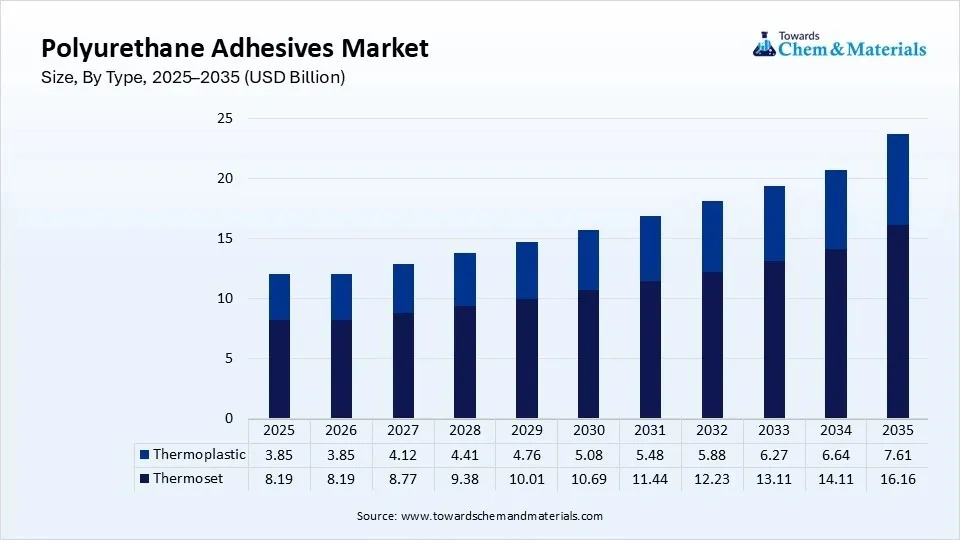
The thermoplastic segment held 32% market share in 2025 and is expected to have the fastest growth with a CAGR of 7.20% in the forecast period, driven by the need for flexible packaging and sustainability initiatives, which drive demand, as it also offers reworkability and fast processing. It stands apart from the dominant thermoset segment due to its ability to melt and reshape. Fully remeltable and easier to recycle than permanent thermoset cross-linked bonds, aligning with eco-friendly manufacturing goals.
Polyurethane Adhesives Market Share, By Type, 2025(%)
| By Type | Market Share (%) |
| Thermoset | 68% |
| Thermoplastic | 32% |
Technology Insights
The solvent-borne segment dominated the market with a 39% share in 2025 and is expected to grow at a CAGR of 4.90% over the forecast period. They are high-performance bonding solutions made of polyurethane polymers dissolved in organic solvents like ethyl acetate or MEK, offering fast drying, strong initial grab, and high flexibility. They are widely used for footwear, automotive interiors, and lamination. They are commonly used for footwear, automotive and woodworking, and lamination, driving growth.
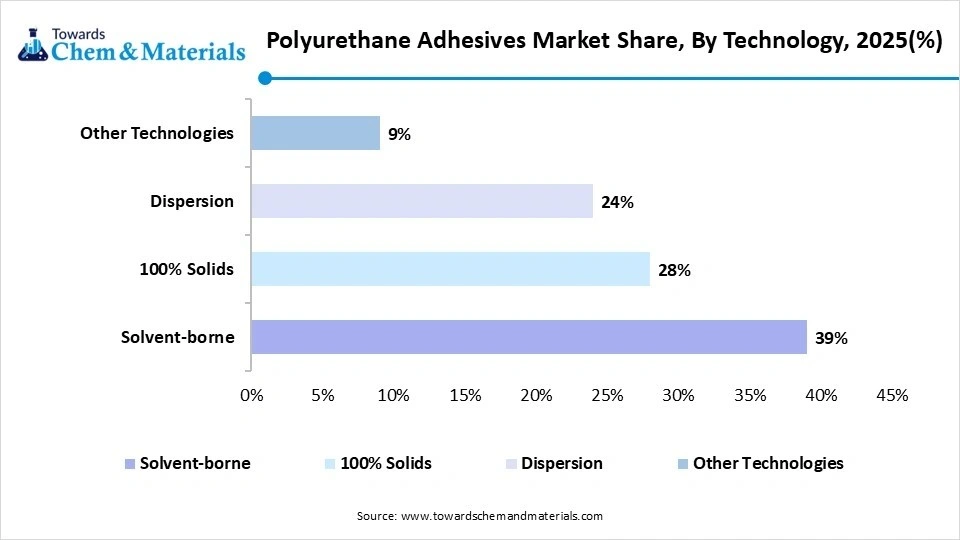
The dispersion segment held 24% market share in 2025 and is expected to have the fastest growth with a CAGR of 8.10% in the forecast period. Commonly known as polyurethane dispersions (PUDs), are water-based systems made of tough polyurethane polymer particles mixed in water. They offer high bonding strength, great flexibility, and low volatile organic compound (VOC) emissions, making them safe and eco-friendly replacements for old solvent glues.
Polyurethane Adhesives Market Share, By Technology, 2025(%)
| By Technology | Market Share (%) |
| Solvent-borne | 39% |
| 100% Solids | 28% |
| Dispersion | 24% |
| Other Technologies | 9% |
End Use Industry Insights
The automotive segment dominated the market with a 27% share in 2025 and is expected to grow at a CAGR of 6.80% over the forecast period, due to demand and adoption of multi-material bonding materials due to their properties like durability and flexibility, which are used in panels, interiors, and the body of vehicles. The lightweight structural design of the product and the extensive use of electric vehicles maximize energy efficiency, contributing to its growth.
The packaging segment held 17% market share in 2025 and is expected to have the fastest growth with a CAGR of 7.60% in the forecast period, due to demand for flexible packaging and eco-friendly materials driving demand. The demand for high-value specialty-grade packaging materials, which have high durability and flexibility to enhance efficiency, drives the growth of the market, supporting expansion.
Polyurethane Adhesives Market Share, By End-use Industry, 2025(%)
| By End-use Industry | Market Share (%) |
| Automotive | 27% |
| Building & Construction | 23% |
| Packaging | 17% |
| Leather & Footwear | 10% |
| General Industrial | 12% |
| Furniture & Decoration | 7% |
| Other End-use Industries | 4% |
Regional Analysis
How did Asia Pacific dominate the Polyurethane Adhesives Market in 2025?
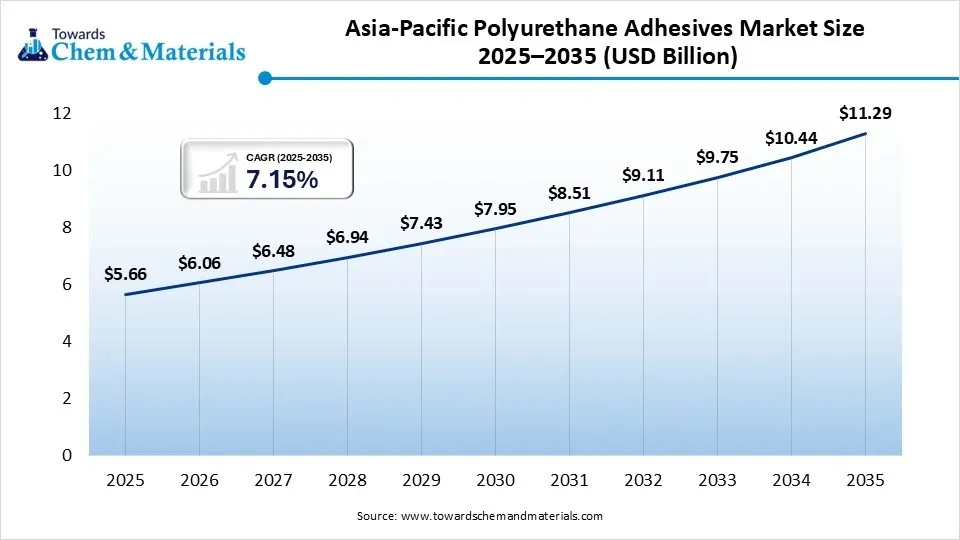
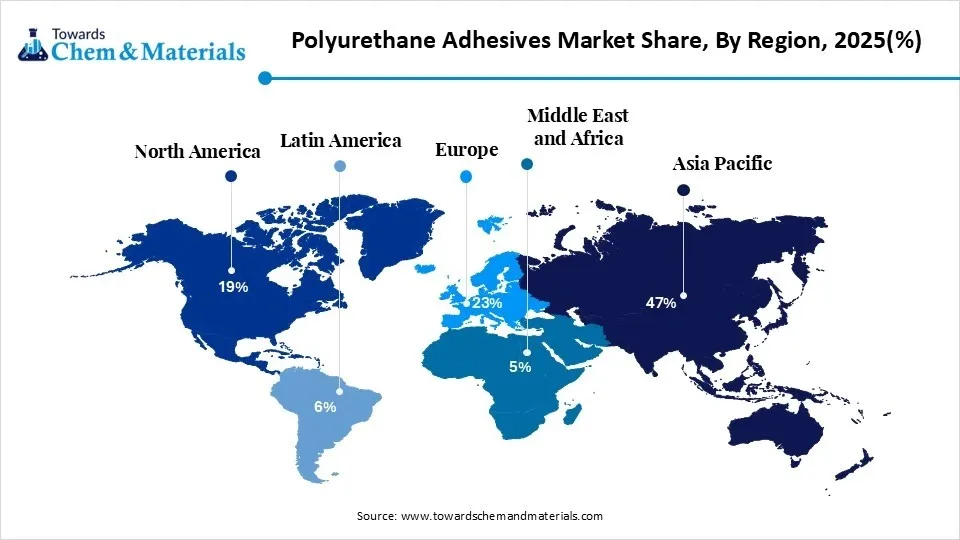
The Asia Pacific polyurethane adhesives market size was estimated at USD 5.66 billion in 2025 and is projected to reach USD 11.29 billion by 2035, growing at a CAGR of 7.15% from 2026 to 2035. Asia Pacific dominated the polyurethane adhesives market with a share of 47% in 2025 and is expected to experience the fastest growth with a CAGR of 7.30% in the forecast period, driven by the large and advanced infrastructure projects in the region through private and government organizations, which demand reliable and efficient products. The growth is also supported by the presence of major manufacturing hubs in India and China, which produce the materials according to demand. The key players and their expansion of facilities through large investments in the region are major growth factors for the market for its expansion.
- For instance, in March 2026, chemical specialist Wevo announced a major expansion of its global footprint by establishing a new polyurethane manufacturing facility in Singapore’s Tuas industrial zone. Production will center entirely on Wevo’s established polyurethane-based systems, specifically potting compounds, specialized adhesives, and durable sealants engineered for electronics manufacturing.(Source: www.chemanalyst.com)
India Domestic Production Initiatives
Indias polyurethane adhesive market is experiencing significant growth due to government schemes and initiatives like Make in India and PLI schemes, which encourage the domestic manufacturing and production of materials, reducing the reliance on foreign adhesive imports, which supports the growth. The spending by the government on infrastructure development like roads, railways, and urban housing drives demand for polyurethane adhesives, contributing to the growth of the market.
- For instance, in June 2026, Knauf India introduced Knauf Drystar, a specialized, fiber-reinforced gypsum board designed to enhance durability in moisture-prone and high-humidity environments. Certified to European standards (GM-FH1IR), this 12.5mm board features a high-density core with glass-fleece surfacing that provides superior resistance to water absorption, mould, and termites.(Source: www.constructionworld.in)
China Sustainability Pressure
The polyurethane adhesive market in China is driven by the rapid adoption and growth of electric vehicle manufacturing, which demands advanced and sustainable polyurethane adhesives, along with e-commerce flexible packaging and electronics assembly, which propels the growth in the country. The domestic competitiveness in the country, like Wanhua Chemical and Huafon Group, which focus on aggressive investments driving growth of the market.
- For instance, in January 2026, Guangdong Ever Ray Environmental Material Co., Ltd. announced the successful commercial launch of its latest ultra-fast UV-curable polyurethane acrylate oligomer solutions.(Source: www.einpresswire.com)
Europe Polyurethane Adhesives Market: Strict Environmental Regulation
The Europe polyurethane adhesives market size was estimated at USD 2.77 billion in 2025 and is projected to reach USD 5.59 billion by 2035, growing at a CAGR of 7.27% from 2026 to 2035. Europe held a market share of 23% in 2025, driven by strict environmental rules, automotive lightweighting, and green building demand. Strict EU rules and the Registration, Evaluation, Authorization and Restriction of Chemicals (REACH) limits push manufacturers toward low-VOC, water-borne, and solvent-free reactive formulations. Electric vehicle battery pack bonding and lightweight structural parts drive heavy adoption, particularly in Germany. The efficient building insulation and smart city projects in the region demand increased structural adhesive material, increasing consumption and exploring the market demand.
- In May 2026, specialty chemical distributor Azelis and microbial control leader Arxada officially expanded their strategic partnership into France. The rollout directly targets heavy industrial sectors, including the CASE segment (Coatings, Adhesives, Sealants, and Elastomers) and general chemicals.(Source: www.european-coatings.com)
Germany Smart Infrastructure Projects
Germanys polyurethane adhesives market growth is primarily driven by rising electric vehicle manufacturing, lightweight material adoption, and sustainable low-VOC product innovations. Shift toward bio-based, solvent-free, and reactive polyurethane dispersions that meet strict European environmental regulations. High demand for electric vehicle battery pack assembly, thermal management systems, and structural bonding in the country drives the demand for the market.
- For instance, in January 2026, German chemical multinational Henkel announced the commercial launch of Loctite MS 9650. Published via the Indian Chemical News (ICN) Bureau, this next-generation adhesive and sealant is designed for highly demanding automotive electronic and structural applications.(Source: www.indianchemicalnews.com)
France Energy Efficiency Material Demand
The French polyurethane adhesives market grows due to key factors including electric vehicle lightweighting, stricter eco-regulations favoring low-VOC formulations, and rising performance demand in construction and packaging. Energy-efficiency retrofitting and sustainable building standards raise the adoption of durable, weather-resistant polyurethane sealants and structural adhesives.
- For instance, in July 2026, German self-adhesive technology specialist HERMA announced the rollout of its new Essential Line. Published on Labels & Labeling, this portfolio provides label printers with an economical alternative for price-sensitive, high-volume standard applications.(Source: www.labelsandlabeling.com)
North America Polyurethane Adhesives Market Infrastructure Development
The North America polyurethane adhesives market size was estimated at USD 2.29 billion in 2025 and is projected to reach USD 4.64 billion by 2035, growing at a CAGR of 7.32% from 2026 to 2035. North America held a market share of 19% in 2025, primarily driven by construction expansion, automotive lightweighting, and strict environmental regulations. Large public funding programs, like the U.S. Infrastructure Investment and Jobs Act, boost demand for structural and bridge adhesives. A shift toward electric and lightweight vehicles requires advanced adhesives for multi-material bonding and noise reduction. Rules limiting volatile organic compounds (VOCs) drive innovation toward eco-friendly, water-borne, and solvent-free polyurethane options.
- In November 2025, Johns Manville (JM), a Berkshire Hathaway company, announced the commercial launch of JM QuickFoam Adhesive. This low-rise polyurethane foam adhesive introduces specialized curing behavior to the commercial roofing and building insulation sectors.(Source: www.sprayfoammagazine.com)
United States Growing Investments in Market
- The United States polyurethane adhesives market is driven primarily by automotive lightweighting, building and construction expansion, and eco-friendly regulatory shifts. Increasing investments in residential and commercial infrastructure, alongside structural-glazing applications, boost product adoption. Environmental rules limiting volatile organic compounds compel a transition toward eco-friendly, low-VOC, and bio-based formulations.
For instance, in June 2026, UPM Raflatac announced the commercial launch of three specialized, purpose-built adhesive solutions designed to replace general-purpose options in highly demanding labeling environments.(Source: www.packaginginsights.com)
Canada Sustainable Construction Demand
Canadas polyurethane adhesives market growth is driven by rising electric-vehicle manufacturing in Ontario and Quebec, increased mass-timber sustainable construction, and strict federal low-VOC environmental rules. Rising assembly operations for electric vehicles in Ontario and Quebec increase the need for high-strength bonding and lightweight materials. A shift toward mass-timber building projects and advanced sawmill automation creates steady demand for structural polyurethane formulations.
- For instance, in September 2025, ATP Adhesives launched its North American division, ATP North America, backed by a $70 million investment to construct its first U.S. manufacturing facility in Columbia, South Carolina.(Source: www.indianchemicalnews.com)
Latin America Polyurethane Adhesives Accelerated Demand
The Latin America polyurethane adhesives market size was estimated at USD 0.72 billion in 2025 and is projected to reach USD 1.55 billion by 2035, growing at a CAGR of 7.97% from 2026 to 2035. Latin America held a market share of 6% in 2025, driven by expanding construction activities, rising automotive manufacturing, and increasing infrastructure investments. Growth in vehicle production across major hubs such as Brazil and Argentina is accelerating demand for high-performance, lightweight bonding materials. Rising disposable incomes boost manufacturing in footwear, furniture, and flexible packaging sectors, which rely heavily on polyurethane adhesives.
Brazil Presence of Major Footwear Brands in Brazil
The Brazilian polyurethane adhesives market Rising urbanization and large-scale residential and commercial building projects, which drive strong demand for high-performance polyurethane adhesives that offer exceptional durability and structural integrity. The presence of major global footwear brands and expanding e-commerce packaging requirements consistently fuel the demand for polyurethane hot-melt and reactive adhesive systems. Tighter solvent-emission regulations and stricter Volatile Organic Compound caps by regulatory bodies like ANVISA push formulators toward eco-friendly, reactive, and water-borne polyurethane alternatives.
Argentina Rising Industrialization
The Argentina polyurethane adhesives market is driven by rising industrialization, construction activity, and automotive manufacturing demand in key economic hubs like Buenos Aires, Santa Fe, and Córdoba. Local manufacturing relies heavily on raw material imports from regions like Brazil and the United States, as domestic chemical production remains constrained. Manufacturers face increasing shifts toward eco-friendly, low volatile organic compound formulations to match evolving regional and global standards.
Middle East and Africa Polyurethane Adhesives Market Sustainability Mandates
The Middle East and Africa polyurethane adhesives market size was estimated at USD 0.60 billion in 2025 and is projected to reach USD 1.31 billion by 2035, growing at a CAGR of 8.12% from 2026 to 2035. The Middle East and Africa held a market share of 5% in 2025, driven by massive construction giga-projects, rapid automotive sector expansion, and strict sustainability mandates. Urban development initiatives and government housing schemes in Saudi Arabia, such as Vision 2030 developments like NEOM and the UAE, heavily utilize structural glazing, insulated panels, and prefabricated modules that require high-performance polyurethane joints. The regional automotive assembly sector is accelerating, fueled by new electric vehicle manufacturing plants and local capacity expansions requiring lightweight bonding and thermal-interface solutions.
Saudi Arabia: Massive Urban Development
The growth of the polyurethane adhesives market in Saudi Arabia is primarily driven by massive infrastructure giga-projects, expanding automotive manufacturing, and a booming packaging sector. Massive urban developments like NEOM, Red Sea Global, and Qiddiya create high demand for durable, weather-resistant construction adhesives. Rapid e-commerce growth drives the need for high-performance, durable packaging materials that rely on strong adhesive integrity. Increasing preference for eco-friendly, water-based, and reactive polyurethane formulations improves performance while meeting sustainability goals.
UAE Ongoing Investments in Development
The UAE polyurethane adhesives market is primarily driven by massive construction and infrastructure mega-projects, rapid expansion in flexible packaging, and growing manufacturing applications in automotive and aerospace. Ongoing investments in residential, commercial, and industrial developments across major hubs like Dubai and Abu Dhabi drive high consumption of structural and bonding adhesives for tiling, plumbing, and insulation. Government strategies aimed at reducing oil dependency and boosting localized manufacturing, aerospace, and composite sectors continue to attract foreign investments and drive industrial adoption.
Recent Developments
- In June 2026, Navi Mumbai-based manufacturer Walplast Products Pvt. Ltd. announced the commercial launch of HomeSure TileEx EX-566 PU. This next-generation product marks a major shift into heavy-duty structural flooring and installation compounds. The product is engineered as a two-component polyurethane–epoxy hybrid adhesive.(Source: www.passionateinmarketing.com)
- In September 2025, Italian chemical multinational Coim Group announced its sustainable product portfolio for the K 2025 trade fair in Düsseldorf. The showcase emphasized circular economy innovations, high-performance packaging recyclability, and processing optimization.(Source:www.plasticstoday.com)
In January 2026, Sun Chemical launched a new solvent-free ultra-low monomer (ULM) laminating adhesive under the commercial name SunLam QA-8000+HA450. Published on Labels & Labeling, the launch provides a highly sustainable alternative to traditional solvent-based adhesives for flexible packaging producers(Source:www.labelsandlabeling.com) - In April 2026, Borchers, a global coating additives manufacturer and a Milliken brand, announced the launch of Borchi® Gen 0311. Published across industry outlets like Coatings World, this high-molecular-weight wetting and dispersing agent is specifically engineered to streamline the pigment dispersion process within polyurethane coating systems.(Source: coatingsworld)
Competitive Analysis
The key players collaborations to fulfill demand and manage the supply chain and export/import of the materials, there is competition for growth, which supports the development of new and advanced material manufacturing in various regions.
- In October 2025 at the K Show in Düsseldorf, U.S. circular technology pioneer Novoloop and Shanghai Huide Science & Technology Co., Ltd. announced a strategic partnership to scale the commercial production of Novoloops Lifecycled thermoplastic polyurethane. The collaboration is formalized through a five-year Contract Manufacturing Agreement that establishes long-term clarity on supply volumes, competitive pricing structures, and consistent quality standards.(Source: www.businesswire.com)
- In August 2025, Univar Solutions USA LLC and its affiliate Univar Solutions Canada Ltd. signed an exclusive distribution agreement with chemical giant BASF Corporation. The deal positions Univar as the sole distributor for select specialty chemical building blocks across the United States and Canada.(Source: www.prnewswire.com)
- In March 2026, Milliken & Company and specialty chemicals distributor Azelis signed a strategic distribution agreement to accelerate the commercial growth of polyurethane colourant solutions across India. The partnership combines Millikens deep chemical formulation history with Azelis vast localized supply chain footprints and technical application laboratories in India.(Source: www.indianchemicalnews.com)
Top players in the Polyurethane Adhesives Market & Their Offerings
| Company | Company Type/Position | Major Headquarters | Geographic Presence | Polyurethane Adhesives Offerings | Key Offering/Strength |
| Henkel AG & Co. KGaA | Global adhesives and specialty chemicals manufacturer | Düsseldorf, Germany | Europe, North America, Asia Pacific, Latin America | Polyurethane structural adhesives, reactive hot melt adhesives, and industrial bonding solutions | Broad adhesive portfolio with strong innovation for automotive, packaging, and construction applications |
| Sika AG | Specialty chemicals and construction materials company | Baar, Switzerland | Europe, North America, Asia Pacific, Middle East | One-component and two-component polyurethane adhesives for construction, automotive, and industrial applications | High-performance bonding solutions with expertise in construction and transportation industries |
| H.B. Fuller Company | Global adhesives manufacturer | Saint Paul, Minnesota, USA | North America, Europe, Asia Pacific, Latin America | Polyurethane adhesives for packaging, woodworking, automotive, electronics, and footwear applications | Diverse adhesive portfolio supported by customized formulation capabilities |
| Arkema S.A. | Specialty materials and adhesives producer | Colombes, France | Europe, North America, Asia Pacific | Polyurethane hot melt adhesives, structural adhesives, and industrial bonding systems | Advanced adhesive technologies focused on high performance and sustainability |
| 3M Company | Diversified technology and industrial products manufacturer | Saint Paul, Minnesota, USA | North America, Europe, Asia Pacific, Middle East | Polyurethane structural adhesives, sealants, and bonding solutions for automotive, aerospace, and industrial markets | Strong expertise in high-strength bonding technologies and innovative adhesive solutions |
Other Top Players Are
- Dow Inc. (US)
- Huntsman International LLC (US)
- Arkema S.A. (France)
- Illinois Tool Works Inc. (US)
- Jowat SE (Germany)
Segments Covered
By Type
- Thermoset
- One-component (1K)
- Two-component (2K)
- Reactive Hot Melt
- Thermoplastic
- TPU-based Adhesives
- Hot Melt Polyurethane
- Solvent-based Thermoplastic PU
By Technology
- Solvent-borne
- One-component
- Two-component
- 100% Solids
- Reactive Hot Melt
- Moisture-curing
- Dispersion
- Water-based Polyurethane Dispersion (PUD)
- Hybrid Dispersion
- Other Technologies
- UV-curable
- Bio-based
- Sprayable Systems
By End-use Industry
- Automotive
- Interior Assembly
- Exterior Components
- Structural Bonding
- EV Battery Assembly
- Building & Construction
- Flooring
- Insulation Panels
- Roofing
- Doors & Windows
- Packaging
- Flexible Packaging
- Food Packaging
- Industrial Packaging
- Leather & Footwear
- Footwear Assembly
- Leather Lamination
- General Industrial
- Composite Bonding
- Electronics Assembly
- Textile Lamination
- Furniture & Decoration
- Wood Bonding
- Decorative Laminates
- Upholstery
- Other End-use Industries
- Marine
- Aerospace
- Medical Devices
- Renewable Energy
By Regions
- North America
- Europe
- Asia Pacific
- Middle East & Africa
- Latin America



Comments
Share your thoughts, ask a question, or provide feedback about this report.