
What is the Copper Wire Market Size and Share?
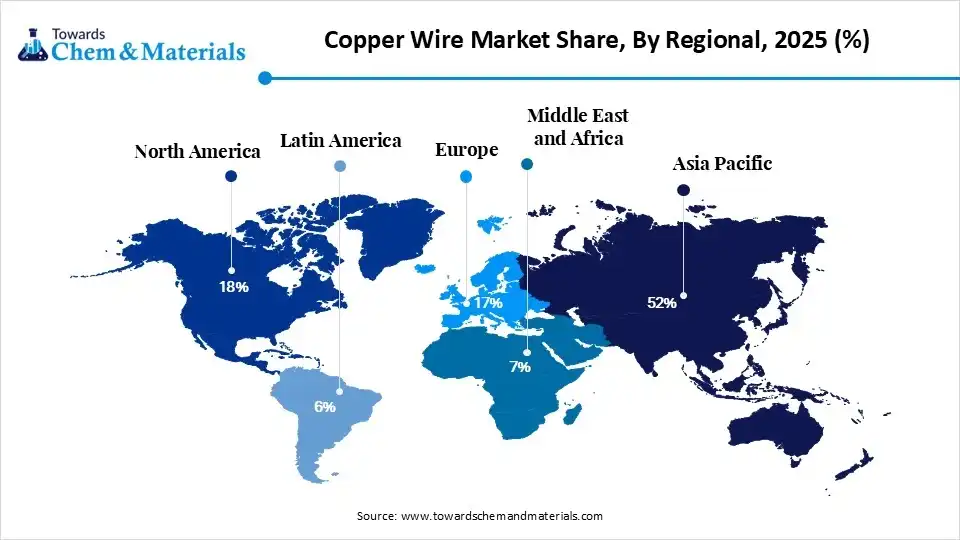
The copper wire market size was valued at USD 187.15 billion in 2025, is estimated to reach USD 198.10 billion in 2026, and is projected to reach USD 330.44 billion by 2035, exhibiting a compound annual growth rate (CAGR) of 5.85% over the forecast period from 2026 to 2035.Asia Pacific dominated the copper wire market with the largest revenue share of 52% in 2025 and is expected to grow at the fastest CAGR of 5.95% during the forecast period. In terms of volume, the copper wire market is projected to grow from 32.14 million metric tons in 2025 to 56.86 million metric tons by 2035. growing at a CAGR of 5.87% from 2026 to 2035. Factors like expanding renewable energy installations, fast adoption of electric vehicles, rising infrastructure development, and growing investments in digital connectivity are fueling the market. As the power transmission, telecommunications, smart grid, and advanced manufacturing markets continue to grow, as well as constant developments in high-performance conductive materials, the market's long-term growth potential remains strong.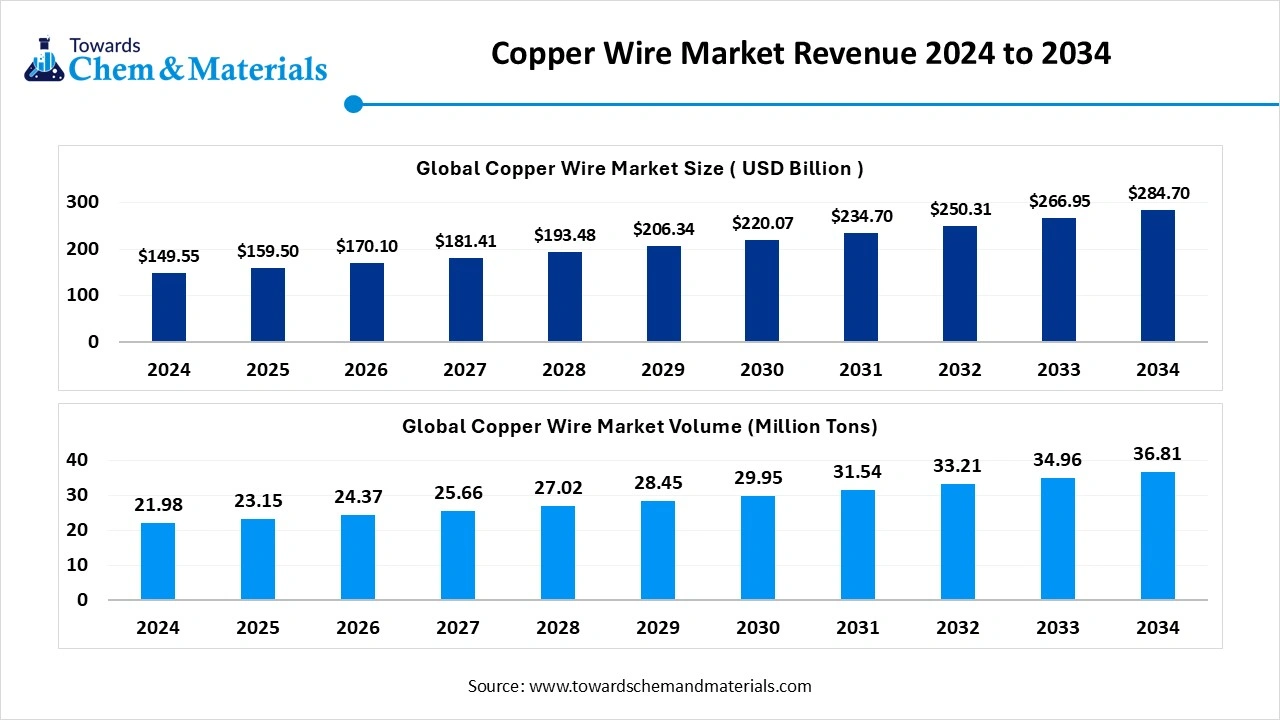
Key Takeaways
- By region, Asia Pacific dominated the copper wire market by holding 52% share in 2025, as manufacturing expansion strengthens regional production.
- By region, North America held 18% market share in 2025 and is expected to grow at the fastest with a CAGR of 6.7% during the forecast period because grid modernization increases replacement demand.
- By voltage, the low segment dominated the market with the largest share of 63% in 2025, as strong residential and commercial construction activity increases wiring demand.
- By voltage, the high segment held 13% market share in 2025 and is expected to grow at the fastest CAGR of 6.8% over the forecast period due to cross-border power infrastructure that boosts installations.
- By application, the building wire segment dominated the market with the largest share of 38% in 2025, as renovation projects replace aging electrical systems.
- By application, the renewable energy segment held 12% market share in 2025 and is expected to grow at the fastest CAGR of 8.1% over the forecast period, as solar and wind installations consume significant copper wire.
Market Overview
The growth of the copper wire market is steady as investments are being made in the field of renewable energy, power transmission, electric vehicles, and digital infrastructure. Demand for building wires and power cables is expected to grow with the expansion of construction activities, rural electrification, and smart cities. The expansion of high-voltage direct current transmission, offshore wind, reusing copper, and data centers are all contributing to market growth. Technological advances in active copper cables, high-conductivity copper alloys, continuous casting, annealing, and sustainable copper recycling are enhancing electrical performance, manufacturing efficiency, and resource use. The market is continuing to expand due to rising demand for dependable wiring options in residential, industrial, automotive, and telecommunication applications.
- For instance, in February 2026, Bajaj Electricals introduced Bajaj Secura Wires, a new product offering to its portfolio of electrical solutions with high-purity copper and advanced insulation technology.(Source:bsmedia.business-standard.com)
Which Factor is Driving the Growth of the Copper wire market?
The increased adoption of electric vehicles is spearheading the industry growth in the current period, as EV automakers are actively seen under the heavy usage of copper wire than traditional vehicles for vehicle batteries, motors, and charging systems. Moreover, the regional governments are actively playing a major role in the market expansion as a form of the implementation of green initiatives and providing attractive benefits of adopting the sustainability standards in the past few years. Also, copper's high conductivity and effectiveness are pushing its market potential in wide applications.
Market Trends
- The sudden establishment of renewable energy projects has driven the industry's growth in recent years. Moreover, the developers are increasingly demanding copper wire due to its flexibility and excellent conductivity.
- The sudden focus on recyclability and sustainability practices is contributing to the industry's growth in the current period. Moreover, having a 100% recycling quality made it the ideal material for industrial use in recent years.
Report Scope
| Report Attributes | Details |
| Market Size in 2026 | USD 198.10 Billion/ 34.03 Million Metric Tons |
| Market Size by 2035 | USD 330.44 Billion/ 56.86 Million Metric Tons |
| Growth rate from 2025 to 2035 | CAGR 5.85% |
| Base Year of Estimation | 2025 |
| Forecast Period | 2025 - 2035 |
| Dominant Region | Asia Pacific |
| Segment Covered | By Type, By Form, By Grade, By Voltage Range, By Application, By End User, By Region |
| Key Companies Profiled | Southwire Company, LLC, Prysmian Group , Nexans S.A. , LS Cable & System Ltd. , Sumitomo Electric Industries, Ltd. , Encore Wire Corporation , General Cable (a Prysmian brand), Rea Magnet Wire Company, Inc. , Belden Inc. , Furukawa Electric Co., Ltd. , KEI Industries Ltd. , Polycab India Ltd. ,RR Kabel , Finolex Cables Ltd., Leoni AG , Amphenol Corporation , LAPP Group , Saudi Cable Company , TPC Wire & Cable Corp. Gupta Power Infrastructure Ltd. |
Market Opportunity
Wire Producers Capitalize Sustainable Energy Momentum
The sudden expansion of the solar wind energy projects is expected to create a lucrative opportunity for the copper wire market in the coming years, as the copper wires are better conductive and flexible is actively encouraging the manufacturers to use them for the power storage and energy transmission in recent years. Also, wire producers are likely to offer innovative solutions for this sector, like specialized, high-efficacy, and weather-resistant wire solutions during the forecast period.
Market Challenge
Production Delays Loom Amid Rising Copper Costs
The price fluctuations of raw copper are anticipated to hinder the industry's growth in the upcoming years, as the supply of copper can face challenges like mining disruptions and global demand, which can slow down the global supply. Moreover, due to these issues, when the copper price increases, it can affect the profit margins and production delays from the small and mid-size producers in the coming years. However, advances in modern technology can play an ideal role in solving these problems, which is anticipated to drive the industry growth during the projected period, as per expectations.
Supply Chain Analysis of the Copper Wire Market
Feedstock Procurement
- These copper ores and recycled copper scrap are sourced and then processed into high-purity copper cathodes, which are used for the production of electrical wire and cable products.
- BHP Group: BHP Group provides a reliable source of copper wire raw material in the form of copper concentrate from its worldwide mining activities.
- Other Key Players: Codelco, Glencore.
Chemical synthesis and processing
- The high-conductivity copper wire rods with excellent electrical and mechanical properties are continuously cast, rolled, drawn, annealed, and refined from copper cathodes.
- Hindalco Industries: Has an integrated Copper Smelter-CC Plant to produce high quality Copper wire rods for electrical and industrial uses.
- Other Key Players: Nexans, Southwire.
Compound formulation and blending
- PVC, XLPE, rubber, flame-retardant compounds, and other specialty materials are used in the insulation of copper conductors to provide enhanced durability, safety, flexibility, and environmental resistance.
- Polycab India Limited: A developer of the next generation insulation compounds and manufacturer of high-performance copper wires and cables for residential, commercial, and industrial applications.
- Other Key Players: Prysmian Group, Havells India.
Segmental Insights
Voltage Insights
The low voltage segment accounts for a major share of the copper wire market, supported by its widespread use in residential, commercial, and light industrial applications. These wires are commonly used in electrical systems operating below 1,000 volts, including building wiring, lighting, household appliances, and control circuits. Growing urbanization, rising demand for housing, and improving living standards have accelerated residential and commercial construction across Asia Pacific, the Middle East, and Africa, increasing the need for low voltage copper wiring. In addition, renovation and modernization of older buildings in Europe and North America with energy-efficient electrical systems continue to create steady demand for this segment.
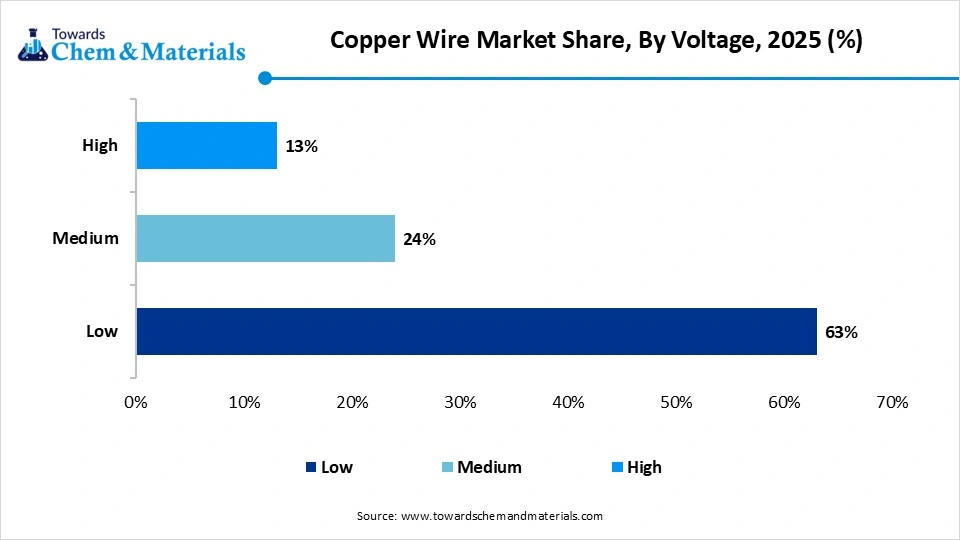 The high voltage segment is expected to record the fastest growth during the forecast period. Rising investments in power transmission networks and grid modernization are driving the demand for high voltage copper wires used in systems above 35 kV. These wires play a critical role in transmitting electricity from power generation facilities to substations and major industrial users. Ongoing expansion of utility infrastructure and cross-border electricity interconnection projects, particularly across Europe, North America, and China, is further supporting market growth. Copper's excellent electrical conductivity, long-term reliability, and ability to reduce transmission losses make it a preferred material for high voltage applications as global electricity consumption continues to rise.
Application Insights
The building wire segment represents one of the largest application areas in the copper wire market, driven by rapid urban development, increasing residential and commercial construction, and the replacement of aging electrical infrastructure. Copper wires are widely used for power distribution, lighting, HVAC systems, and control wiring because of their high conductivity, durability, and fire-resistant properties. Demand remains particularly strong in emerging economies such as India, China, Indonesia, and Vietnam, where government initiatives promoting affordable housing, smart cities, and infrastructure development are creating substantial opportunities for copper building wires.
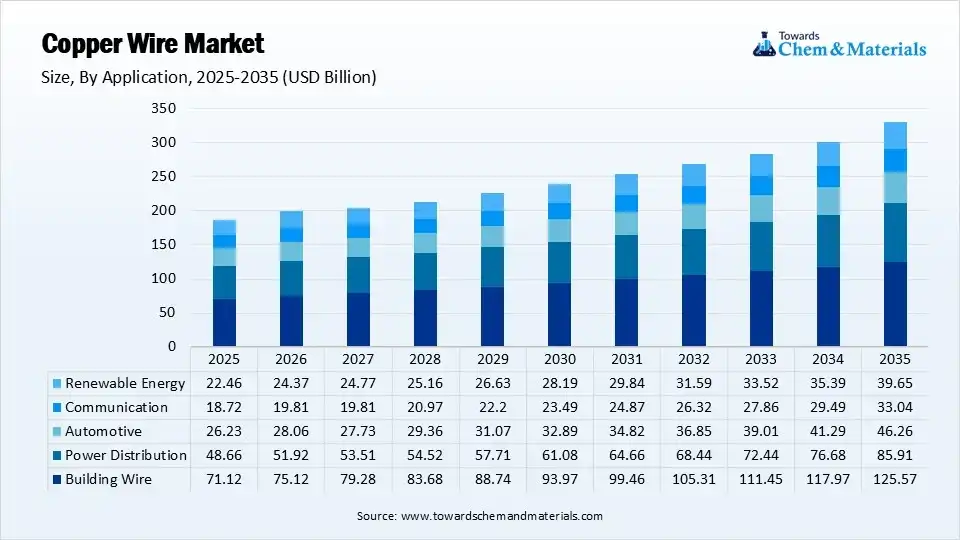 The renewable energy segment is projected to witness the fastest growth over the forecast period. The increasing adoption of solar and wind energy projects is significantly boosting demand for copper wire due to its outstanding electrical and thermal conductivity. In solar power installations, copper is extensively used in cables, inverters, transformers, and grounding systems, while wind turbines rely on copper for generator windings, power cables, and control equipment. Renewable energy systems generally require much larger quantities of copper than conventional power plants because of their distributed infrastructure and the extensive wiring needed to connect multiple components, making copper an essential material for the global transition toward clean energy.
Regional Insights
How did the Asia Pacific Dominate the Copper Wire Market in 2025?
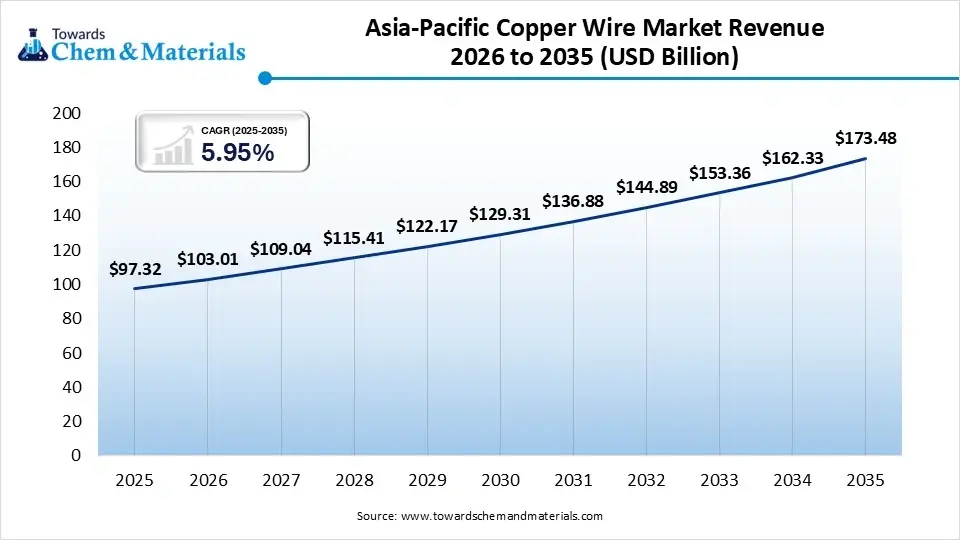
The Asia Pacific copper wire market size was estimated at USD 97.32 billion in 2025 and is projected to reach USD 173.48 billion by 2035, growing at a CAGR of 5.95% from 2026 to 2035.Asia Pacific dominated the market with the largest share of 52% in 2025, driven by the rapid industrialization, expansion in renewable energy projects, rising production of electric vehicles, and investment in power transmission infrastructure. The region continues to see a growing demand for copper wiring solutions as a result of expanding manufacturing operations and government electrification programmes.
- Copper wire is still the biggest producer and consumer in China, which is backed by robust manufacturing and infrastructure development.
- The demand for high-conductivity copper products is still on the rise as the renewable energy and EV markets continue to grow.
- Ultra-high-voltage transmission networks will reinforce the use of sophisticated copper cables.
India
- The demand for power cables and building wires remains strong due to government electrification and infrastructure projects.
- Expansion of renewables leads to a growth of electrical systems based on copper.
- Domestic industry expanding in wire and cable production boosts supply capacity in the region.
The North America copper wire market size was estimated at USD 33.69 billion in 2025 and is projected to reach USD 61.13 billion by 2035, growing at a CAGR of 5.88% from 2026 to 2035.North America held 18% market share in 2025 and is expected to grow at the fastest CAGR of 6.7% during the forecast period, as a result of the growth in data centers, modernization of the power grid, investments in renewable energy, and rising electric vehicle penetration. Investments in digital infrastructure, industrial automation, and sustainable electrical systems remain a key contributor to the market growth in the region.
United States
- The trend of grid modernization is driving a growing need for high-performance copper transmission and distribution lines.
- As automotive EV production expands, so will the consumption of automotive copper wiring.
- As data centers grow, they require more advanced copper connectivity solutions to meet their needs.
Canada
- Demand for copper power transmission infrastructure remains strong for renewable energy projects.
- However, the copper raw materials are reliably available in the country due to mining activities.
- Industrial modernization boosts demand for electrical wiring products.
The Europe copper wire market size was estimated at USD 31.82 billion in 2025 and is projected to reach USD 57.83 billion by 2035, growing at a CAGR of 6.16% from 2026 to 2035.Europe held 17% market share in 2025, due to the growth of smart grids and electric mobility projects. The customer demand for advanced copper wiring solutions in various industries is still being met by strong sustainability standards and investments in smart infrastructure.
Germany
- The growing demand for high-performance copper wiring systems is fuelled by strong automotive manufacturing.
- The growth of renewable energy is continuing to fuel the installation of sophisticated electrical infrastructure.
- The specialized copper conductors are more consumed with industrial automation.
France
- With increasing demand for power transmission cables, grid modernization projects come to the rescue.
- Energy-efficient electrical systems are promoted as a result of sustainable construction practices.
- Electric mobility continues to increase the use of copper wire.
The Latin America copper wire market size was estimated at USD 11.23 billion in 2025 and is projected to reach USD 21.48 billion by 2035, growing at a CAGR of 6.70% from 2026 to 2035.Latin America held 6% market share in 2025, owing to the growth of power infrastructure, mining activities, investments in renewable energy, and industrial development. The rising electrification projects and manufacturing growth are still creating growth prospects for copper wire manufacturers throughout the region.
Brazil
- The demand for electrical wiring products is increasing in both construction and utilities, which is supported by infrastructure modernization.
- Investments in renewable energy drives installation of copper electrical systems.
- Growth in manufacturing underpins the consumption of copper wire products in the region.
Chile
- The copper mining industry provides a reliable supply of raw material for downstream processing.
- The deployment of power infrastructure keeps growing the demand for power transmission cables.
- The expansion of industries leads to the rise in electrical equipment manufacturing.
The Middle East & Africa copper wire market size was estimated at USD 13.10 billion in 2025 and is projected to reach USD 24.78 billion by 2035, growing at a CAGR of 6.58% from 2026 to 2035.The Middle East & Africa held 7% market share in 2025, owing to rising infrastructure investments, greater funds in renewable energy, and growing industrial development. The Government's efforts in power generation and electrification continue to help demand for copper wire in both residential and industrial use.
Saudi Arabia
- Demand for electrical wiring and power transmission products is ongoing as a result of infrastructure development projects.
- Increased investment in renewable energy leads to increased deployment of copper cable networks.
- The restructuring of industries facilitates the growth of electrical equipment production.
South Africa
- The electrical products sector is still largely supported by the mining and industrial sectors.
- Advanced copper conductor is encouraged through grid infrastructure improvements.
- Construction activities boost building wire products consumption.
Recent Developments
- In March 2026, Hind Rectifiers Limited started commercially producing transposed conductors, paper-insulated copper conductors continuously, and enameled paper-insulated copper conductors at its new copper processing plant. The products help provide support for transformers, railway electrification, industrial power systems, and power grid infrastructure, and enhance the company's global market presence.(Source:thehindubusinessline)
- In February 2026, Dynamic Cables Limited took a step into the building wires market by launching advanced flame-retardant building wires, both FR-LSH and HR-FRLSH, using high-conductivity electrolytic-grade copper. The products complement the company's residential, commercial, and institutional electrical product offering.(Source:dynamiccables.co.in)
Top Companies list

- Southwire Company, LLC
- Prysmian Group
- Nexans S.A.
- LS Cable & System Ltd.
- Sumitomo Electric Industries, Ltd.
- Encore Wire Corporation
- General Cable (a Prysmian brand)
- Rea Magnet Wire Company, Inc.
- Belden Inc.
- Furukawa Electric Co., Ltd.
- KEI Industries Ltd.
- Polycab India Ltd.
- RR Kabel
- Finolex Cables Ltd.
- Leoni AG
- Amphenol Corporation
- LAPP Group
- Saudi Cable Company
- TPC Wire & Cable Corp.
- Gupta Power Infrastructure Ltd.
Segment covered
By Voltage
- Low
- Residential Building Wire
- Commercial Building Wire
- Industrial Control Wiring
- Appliance Wiring
- Low-Voltage Power Cables
- Medium
- Industrial Distribution Cables
- Utility Distribution Networks
- Underground Distribution Cables
- Overhead Distribution Conductors
- Substation Connections
- High
- High-Voltage Transmission Cables
- Extra High Voltage (EHV) Cables
- Grid Interconnection Cables
- Offshore Power Transmission Cables
- HVDC Transmission Cables
By Application
- Building Wire
- Residential Buildings
- Commercial Buildings
- Industrial Buildings
- Institutional Buildings
- Power Distribution
- Transmission Networks
- Distribution Networks
- Substations
- Smart Grid Infrastructure
- Automotive
- Internal Combustion Engine (ICE) Vehicles
- Hybrid Electric Vehicles (HEVs)
- Battery Electric Vehicles (BEVs)
- Commercial Vehicles
- Communication
- Telecommunication Networks
- Data Centers
- LAN & Enterprise Networks
- Broadband Infrastructure
- Renewable Energy
- Solar Power Systems
- Wind Energy Systems
- Hydropower Plants
- Energy Storage Systems
- Electric Vehicle Charging Infrastructure
By Region
- North America
- U.S.
- Mexico
- Canada
- Europe
- Germany
- UK
- France
- Italy
- Asia Pacific
- China
- India
- Japan
- South Korea
- Central & South America
- Brazil
- Argentina
- Middle East & Africa
- Saudi Arabia
- UAE



Comments
Share your thoughts, ask a question, or provide feedback about this report.