
Concrete Floor Coatings Market Size Analysis Report 2035
The global concrete floor coatings market size was valued at USD 5.34 billion in 2025 and is expected to hit around USD 8.99 billion by 2035, exhibiting at a compound annual growth rate (CAGR) of 5.35% over the forecast period from 2026 to 2035. Asia Pacific dominated the Concrete Floor Coatings market with the largest revenue share of 42.77% in 2025.The growing industrialization and civilization increased the demand for construction activity in various regions, which drives the growth of the market.

Concrete Floor Coatings Market Key Takeaways
- The Asia Pacific dominated the concrete floor coatings market share of 42.77% in 2025..
- By product, the epoxy segment dominated the market with the largest share of 64.54% in 2025.
- By application, the indoor segment dominated the market share of 71.32% in 2025.
Concrete Floor Coatings Market Overview
Concrete floor coating is a coating applied to concrete surfaces to boost durability & aesthetics. It is a protective and decorative layer that is in the form of a liquid or semi-liquid to reduce maintenance of residential and commercial spaces. It is widely used in various applications such as homes, garages, basements, patios, warehouses, hospitals, industries, and food processing plants.
There are various types of concrete coating available, including epoxy, polyurethanes, acrylics, and polyaspartic. Concrete floor coatings offer protection against damage and are easy to clean. It has high chemical resistance and protects from stains. It consists of a variety of colors, finishes, & textures and provides a smooth and seamless surface.
Concrete floor coating maintains hygiene in areas like kitchens, bathrooms, and healthcare facilities. The rising demand for durable and aesthetically pleasing floors and growing infrastructure projects such as roads, bridges, and public buildings help in the growth of the market. The rising construction in commercial, residential, and educational sectors drives the growth of the concrete floor coatings market.
Rising construction activity accelerates growth of concrete floor coatings.
The growing construction activities in the residential, commercial, and industrial sectors increase the demand for concrete floor coatings. The growing government infrastructure projects like roads, bridges, and airports demand durable and aesthetically pleasant coating solutions. The rising demand for durable and easy maintenance options from offices, retail stores, supermarkets, and warehouses increase the use of concrete floor coatings. The rapid growth in population and growing civilization propels the growth of construction projects in residential and commercial buildings, increasing demand for concrete floor coatings. The growing demand for highly durable, wear & tear protection, and easy to clean surfaces helps the concrete floor coatings market.
Concrete Floor Coatings Market Trends
- Rising demand for matte look: The rising consumer demand for a matte finish look in the commercial and residential sector drives the growth of the market.
- Customization availability: Concrete floor coatings provide customization options like different patterns & logos. These coatings provide various colors, finishes, and texture options to consumers. The commercial and residential structure presents their unique style using concrete floor coating.
- Aesthetic pleasant appearance and versatility: Concrete floor coatings provide a modern aesthetic look to residential and commercial spaces. They consist of decorative options like staining & etching and also have a wide range of colors and finishes.
- Rising urbanization: The growing urbanization amplified the growth of construction activities in various sectors like educational institutes, offices, and many more, which increases the demand for concrete floor coating.
- Growing renovation: The growing renovation trend in the residential sector to create aesthetically pleasant environments in houses promotes the growth of the market.
Concrete Floor Coatings Market Report Scope
| Report Attributes | Details |
| Market Size in 2026 | USD 5.63 Billion |
| Expected Size in 2035 | USD 8.99 Billion |
| Growth rate | CAGR of 5.35% |
| Base Year Of Estmation | 2025 |
| Forecast Period | 2025-2035 |
| High Impact of Region | Asia Pacific |
| Segment Covered | By Product,Application,Region |
| Key Companies Profiled | BASF SE,Tennant Coatings,Rust-Oleum,Trucrete Surfacing Systems,The Sherwin-Williams Company,North American Coating Solutions,Vanguard Concrete Coatings, Jotun,Axalta Coating Systems,Elite Crete Systems,PPG Pittsburgh Paints,Stonhard,Key Resin Company,BEHR Process Corp.,Epmar Corp.,Pratt & Lambert, RPM International Inc,Sika AG,Belzona International Limited,Arkema S.A.,3M Company,Master Builders Solutions |
Concrete Floor Coatings Market Opportunity
The Growing Innovations in the Technology
The growing number of innovations in the concrete floor coating creates a powerful opportunity for market growth. The rising innovation to create sustainable, more durable, and pleasant aesthetics helps in market growth. Consumers are more aware of environmental concerns, and they are giving preference to coatings that reduce environmental impact. Manufacturers are focusing on creating eco-friendly options. Companies are working on creating advanced materials and application techniques to increase durability and performance. Manufacturers are innovating techniques that avoid cracks and stains and improve the curing time of coating. The growing innovations in concrete floor coating enhance the growth of the market.
Concrete Floor Coatings Market Challenge
High Costs Hinder the Concrete floor coatings market Growth
With the several advantages of concrete floor coating, the high cost of specialized coating may hamper the growth of the market. Coatings like polyurethane with 100% solids require extensive preparation of concrete, which increases the cost of the process. These coatings are more expensive than simple coating. If cracks, stains, spalling, or any other problem occurs on the concrete floor, then it needs repairing due to this cost of the process increases. Larger floors and higher quality coatings require additional materials, labor, and highly trained professionals, which lead to higher cost. Rising urbanization and construction activities in healthcare, residential, commercial, and educational areas increase demand for concrete floor coating due to these costs of coating also increase. Smaller industries and less developed areas can’t afford this coating, which hampers the growth of the concrete floor coatings market.
Value Chain Analysis
Research & Development (R&D)
- This focuses on developing new formulations for epoxy, polyaspartic, and polyurethane coatings to improve durability, curing speed, and environmental safety.
- Key Players: BASF SE, The Sherwin-Williams Company, Akzo Nobel N.V., PPG Industries, Inc., Sika AG, RPM International Inc.
Raw Material Sourcing and Processing
- This involves procurement of raw materials, including epoxy resins, pigments, additives, solvents, and binders.
- Key Players: The Lubrizol Corporation, Covestro Group, Evonik Industries, and BASF SE.
Manufacturing and Packaging
- This focuses on the production of coatings, involving mixing, grinding, and formulating resins, hardeners, and colors.
- Key Players: The Sherwin-Williams Company, PPG Industries, Sika AG, Jotun, RPM International, and Tremco.
Logistics, Distribution, and Channel Management
- This involves transportation and warehousing of heavy, sometimes hazardous, liquids.
- Key Players: The Sherwin-Williams Company, PPG Industries, Inc., and Sika AG.
Application and End-User Commercialization
- This involves the application of the coating by professional contractors to concrete surfaces in residential garages, commercial spaces, and industrial facilities.
- Key Players: Stonhard, Tennant Coatings, and Elite Crete Systems.
Segmental Insights In Concrete Floor Coatings Market
By Product Insights
The epoxy segment dominated the concrete floor coatings market in 2025. The rising demand from industrial, commercial, and residential applications due to high adhesion, chemical resistance, and flexibility drives the growth of the market. It provides exceptional durability and withstands harsh conditions. The long-lasting property helps to reduce maintenance cost of surfaces.
The rising demand for protection against moisture, chemicals, and abrasion drives the growth of the market. The availability of epoxy coating in various colors and finishes makes it customizable. The ability to transform dull and worn surfaces into an attractive environment drives the growth of the market. Furthermore, the cost-effectiveness, lower labour requirement, and ease of maintenance promote the growth of the market.
- In February 2025, Concrete Shield Coating launched a slip-resistant epoxy concrete coating for safer workplaces. These coatings enhance traction and minimize the risk of slips and falls in workplaces & high-traffic areas.
These coatings are applicable for warehouses, industrial settings, healthcare facilities, and commercial spaces and help to minimize slippage in areas exposed to oils, water, and other liquids.
The polyaspartic segment expects the significant growth in the concrete floor coatings market during the forecast period. The growing productivity and lower project durations in the construction and manufacturing sectors drive the growth of the market. Higher flexibility, higher UV stability, and lower emission of volatile organic compounds promote the growth of the market.
These coatings complete projects faster, and it is not sensitive to moisture. Additionally, increased adoption and versatile applications in various sectors like building & construction, power generation, aerospace, and marine drive the growth of the market.
By Application Insights
The indoor segment dominated the concrete floor coatings market in 2025. The rising population and increased demand for residential construction drive the growth of the market. Growing demand from industrial and commercial sectors, such as warehouses, factories, offices, and other facilities to secure floors from chemicals and harsh conditions, fuels the growth of the market. The rising demand for renovations due to increases in disposable income is increasing the demand for concrete floor coatings in homes, bungalows, and apartments. The growing demand from garages, retail outlets, the food & beverage industry, educational buildings, and hospitals & healthcare facilities supports the growth of the market.
Concrete Floor Coating Market Share, By Application , 2025 (%)
| By Application | Revenue Share |
| Indoor | 71.32% |
| Outdoor | 29.02% |
The outdoor segment expects the fastest-growth in the concrete floor coatings market during the predicted period. The rising demand for durable, harsh-weather-resistant, and aesthetically pleasant environments drives the growth of the market. Concrete floor coatings sustain harsh conditions like UV exposure, temperature fluctuation, and moisture. The growing boom of decorative aesthetics in outdoor areas like patios, balconies, parking, and walkways fuels the market growth. The rising demand from sports sectors like tennis courts, basketball courts, athletic tracks, walking paths, outdoor gyms, and multi-purpose sports areas promotes the growth of the market. Furthermore, growing demand from public spaces, transportation hubs, infrastructure projects, and residential industrial & commercial applications drives the growth of the market.
Regional Insights
Asia Pacific Leads the Concrete Floor Coatings Market
The concrete floor coatings market size was valued at USD 2.24 billion in 2025 and is expected to be worth around USD 3.78 billion by 2035, exhibiting at a compound annual growth rate (CAGR) of 5.36% over the forecast period from 2026 to 2035.The growing commercial and residential construction increases the demand for concrete floor coatings.

The rapid growth in economies in Asia Pacific countries and strong infrastructure development in the region drive the growth of the market. The growing civilization and initiatives by the government increase construction in the regions, which supports the growth of the market. The availability of cheap coat labor and the expansion of industrial, manufacturing, and infrastructural sectors increases the demand for concrete floor coatings. Additionally, the growing middle-class population increases the demand for durable, aesthetically pleasant, and safe flooring options, driving the growth of the market.
China is observed to be the largest contributor to the market. China is a key player in the construction industry, which increases the demand for concrete floor coatings. The Chinese government highly invests in the manufacturing sector, and the increased population in the country promotes the growth of the market. The easily available raw materials and low labor costs support the growth of the market. The rapid civilization and strong investment in transportation, energy, and water systems increased the demand for concrete floor coating.
- In February 2024, Sika China’s flooring and coating revenue exceeded 1 billion yuan. The sales of the company reached 1.053 billion yuan in 2023, with a year-on-year increase of 39%. It is first company in China’s floor industry with sales increased 1 billion yuan.
India seems to be growing at a notable rate in the concrete floor coatings market. The rising demand for high-rise buildings and townships and growing infrastructure development in the country drive the growth of the market. The growing urbanization and rapid development of commercial buildings and industrial facilities increase the demand for concrete floor coating. The rapid growth in technological advancement to enhance durability, performance, and versatility drives the growth of the market. Strong government initiatives for infrastructure development support market growth.
- For instance, in September 2024, the government initiative Pradhan Mantri Awas Yojana-Urban sanctioned 1.18 Cr houses, with 86.6 lakh completed and 1.15 Cr balanced for construction.
Concrete Floor Coating Market Share, By Region, 2025 (%)
| By Region | Revenue Share 2025 (%) |
| Asia Pacific | 42.77% |
| North America | 25.10% |
| Europe | 15.46% |
| Latin America | 11.33% |
| Middle East and Africa | 5.34% |
North America’s Rapid Growth in Concrete Floor Coatings Market
North America expects the significant growth in the concrete floor coatings market during the forecast period. The growing need for hygiene and safety and rapid growth in construction activity drive the growth of the market. The rising demand from industries like logistics hubs, warehouses, food processing factors, and healthcare facilities drives the growth of the market. The growing adoption of decorative concrete flooring in the residential and commercial sectors supports the growth of the market. The rising need from educational facilities, retail stores, offices, restaurants, supermarkets, and cafes drive the growth of the market in the region.
The United States Dominated the Market in 2025.
The strong economy and growing number of commercial buildings, warehouses, industrial facilities, and infrastructure projects in the country drive the growth of the market. The growing technological development in concrete floor coating and stringent government regulations regarding water supply system increases demand for concrete floor that propels the growth of the market. The growing trend of polished concrete flooring and increased DIY home improvement activities promote the growth of the market in the country.
Canada is growing at a significant rate in the concrete floor coatings market. The rapid growth in the industrial sector and the growing demand for residential and commercial building drive the growth of the market. Rising disposable income and growing immigration rates support the market growth. The growing demand from the oil and gas industry for extensive coatings helps in the growth of the market.
Recent Developments In Concrete Floor Coatings Market
Home and Soul
- Launch: In March 2025, Home and Soul Furniture launched concrete floor lamps and side tables. They are designed to combine modern aesthetics with sustainable craftsmanship. The concrete floor lamps are available in black and white finishes and offer minimalist yet bold designs. Lamps are suitable for residential or commercial settings, and it is crafted from durable concrete. All pieces are constructed from high-quality concrete and eco-friendly material that enhances durability and longevity.
Revival Concrete Coatings
- Contribution: In June 2024, Revival Concrete Coatings extends into multiple Nebraska markets to introduce premier concrete flooring solutions. They are offering state-of-the-art polyaspartic and polyurea floor coating systems to meet consumer demands in residential and commercial businesses. They provide durable, stylish, and long-lasting flooring in Omaha & Lincoln. The polyurea and polyaspartic floor coatings are installed rapidly, are highly durable, enhance aesthetic appeal, and are easy to maintain.
BAM
- Launch: In May 2024, BAM! Coatings introduced their toughest concrete floor coatings in the Appleton and Wisconsin area. The company's focus is on revolutionizing the flooring industry by supplying durable and long-lasting coatings to various spaces like garage floors, basement floors, patios, and commercial areas. The expansion of the company creates opportunities for 15-20 new jobs and contributes to local economic growth and development.
Tri Lakes Epoxy
- Launch: In December 2024, Tri Lakes Epoxy launched garage floor coatings Springfield for winter protection. The coating is durable, requires minimal upkeep, and offers homeowner protection from moisture, cracks, and seasonal wear and tear.
Concrete Floor Coatings Market Top Companies List

- BASF SE
- Tennant Coatings
- Rust-Oleum
- Trucrete Surfacing Systems
- The Sherwin-Williams Company
- North American Coating Solutions
- Vanguard Concrete Coatings
- Jotun
- Axalta Coating Systems
- Elite Crete Systems
- PPG Pittsburgh Paints
- Stonhard
- Key Resin Company
- BEHR Process Corp.
- Epmar Corp.
- Pratt & Lambert
- RPM International Inc
- Sika AG
- Belzona International Limited
- Arkema S.A.
- 3M Company
- Master Builders Solutions
Segments Covered In The Report
By Product
- Epoxy
- Polyaspartic
- Polyurethanes
- Others
By Application
- Outdoor
- Indoor
By Regional
- Asia Pacific
- North America
- Europe
- Middle East & Africa
- Latin America
A Seven-Phase Framework
Our methodology is designed to be universally applicable across commodity chemicals, specialty chemicals, petrochemicals, construction chemicals, coatings, electronic chemicals, industrial gases, agrochemicals, water treatment chemicals, and performance materials. Each phase builds upon the last, creating a layered validation structure that minimizes estimation error and maximizes analytical confidence.
The framework ensures comprehensive market coverage, robust cross-validation, and reliable long-term forecasting — producing market estimates that withstand scrutiny from investors, regulators, and corporate strategy teams.

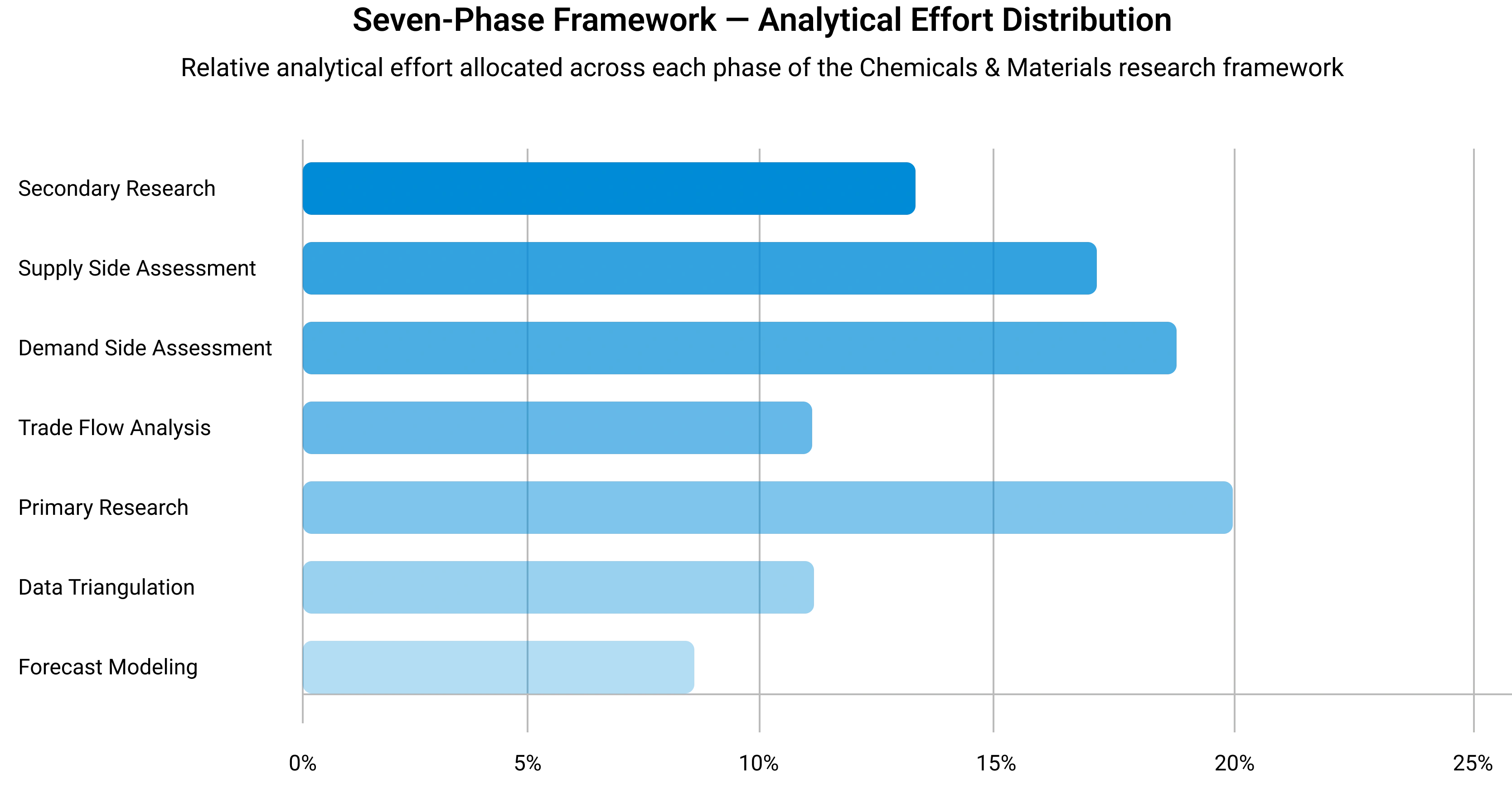
Seven-Phase Framework — Analytical Effort Distribution
Relative analytical effort allocated across each phase of the Chemicals & Materials research framework
Phase 1 - Secondary Research: Establishing the Foundation
Secondary research collects and evaluates publicly available information from authoritative sources, establishing the foundational understanding of market structure, value chain dynamics, competitive landscape, and end-use demand patterns. Every source is evaluated for credibility, recency, geographic relevance, and methodological soundness before inclusion.
Industry Associations
Sources include ACC, CEFIC, ICCA, JCIA, CPCIF, and SOCMA providing production volumes, consumption trends, capacity developments, and sustainability initiatives.
Company Disclosures
Annual reports, investor presentations, earnings transcripts, and regulatory filings reveal product portfolios, manufacturing footprints, capacity expansions, and revenue segmentation.
Government Databases
National statistical offices, customs authorities, environmental agencies, and industrial production databases provide verified statistics on output, trade flows, and regulatory compliance.
Trade Databases
UN Comtrade, ITC, Eurostat, and national customs authorities enable assessment of global product movement, import dependency, and export competitiveness across regions.
Our Secondary Research Sources
- Ministry of Chemicals and Fertilizers
- European Chemicals Agency
- United States Department of Energy
- Ministry of Industry and Information Technology
- Ministry of Economy Trade and Industry
- Ministry of Trade Industry and Energy
- National Institute of Standards and Technology
- Council of Scientific and Industrial Research
- Fraunhofer Society
- National Institute for Materials Science
Phase 2 — Supply-Side Assessment: Mapping Production Capabilities
Production Capacity Analysis
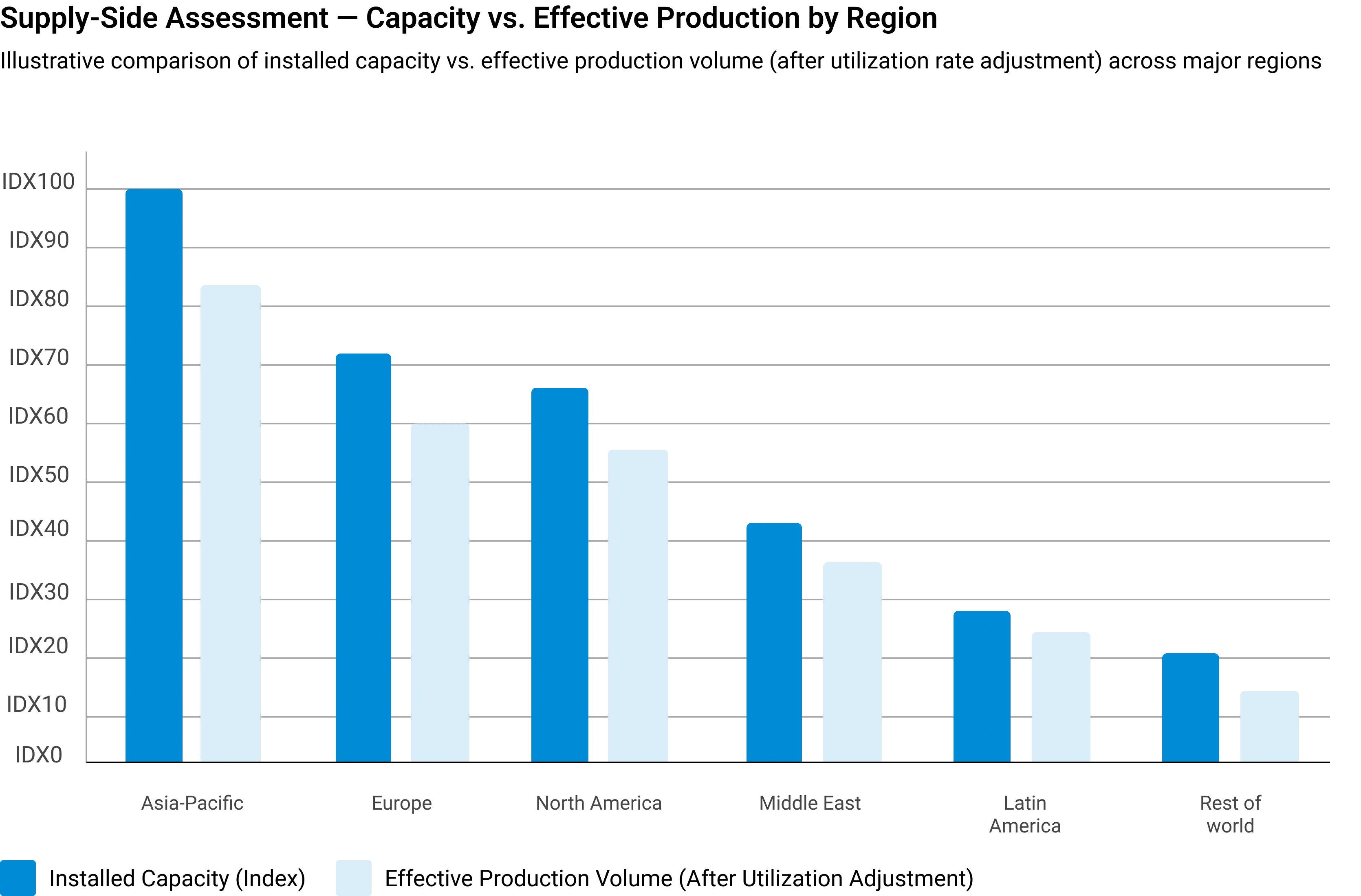
All major manufacturers are assessed for existing installed capacity, planned additions, expansions, new plant announcements, and technology adoption — mapped at global, regional, and country levels.
Capacity Utilization Adjustment
Installed capacity is adjusted using utilization rates based on demand conditions, feedstock availability, plant operating rates, maintenance schedules, and regulatory restrictions.
Manufacturer Revenue Analysis
Product-specific revenues, segment-level performance, regional distribution, average selling prices, and margin trends are evaluated to establish market value estimates.
Supply-Side Assessment — Capacity vs. Effective Production by Region
Illustrative comparison of installed capacity vs. effective production volume (after utilization rate adjustment) across major regions
Phase 3 — Demand-Side Assessment: Quantifying Chemical Consumption
Demand-side analysis quantifies chemical consumption across industries, applications, and geographies — identifying where and how chemicals are consumed throughout the value chain with precision.
End-Use Industry Analysis
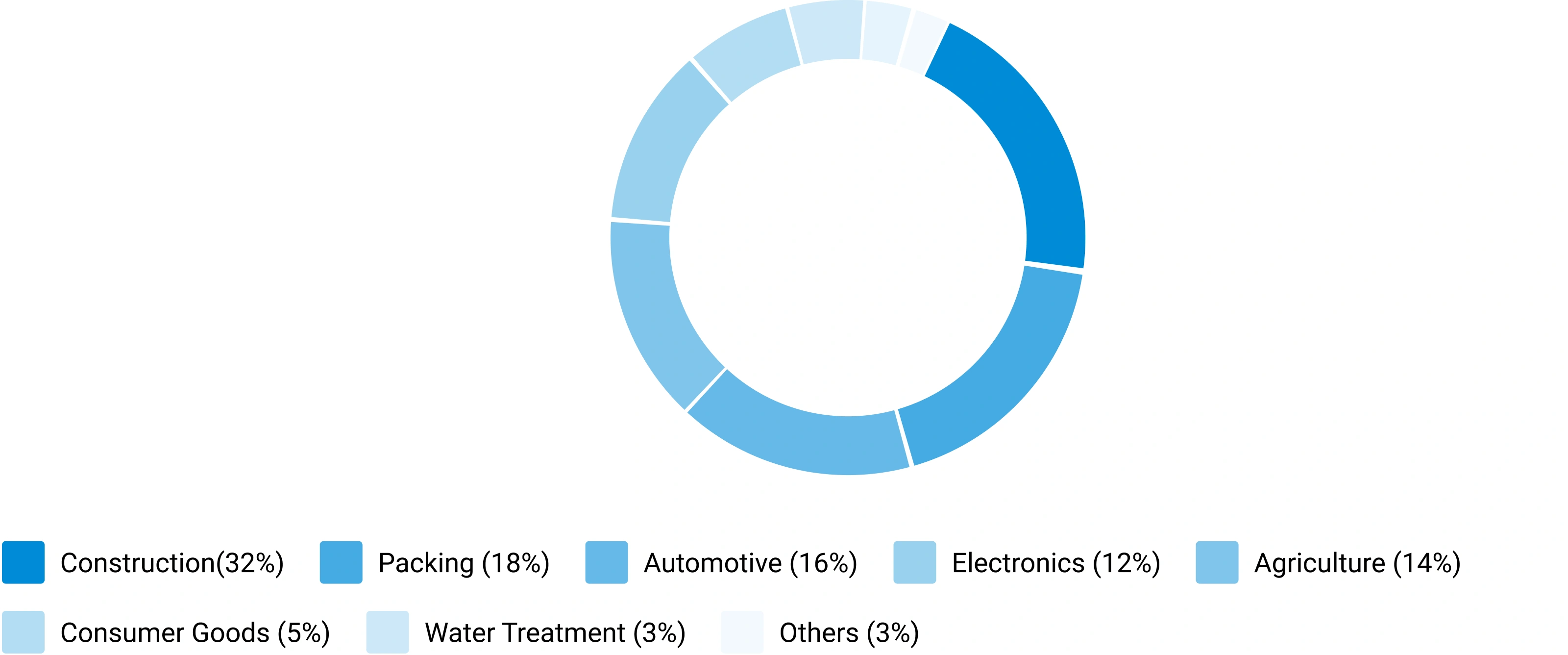
Chemical demand is evaluated across automotive, construction, packaging, electronics, agriculture, healthcare, consumer goods, industrial manufacturing, energy and utilities, and water treatment. Industry output, production trends, and consumption intensity are analyzed to determine demand patterns.
Consumption Modeling
Demand is estimated using measurable indicators: kilograms per vehicle, kilograms per square meter of construction, dosage per cubic meter of water treated, kilograms per hectare of agricultural land, and kilograms per ton of manufactured products. Consumption factors are validated through industry publications and primary interviews.
Application Analysis
The market is segmented by application area to understand product performance requirements, formulation trends, technology adoption, customer preferences, and regulatory requirements improving demand accuracy and segmentation granularity.
Demand-Side Assessment — End-Use Industry Demand Distribution
Illustrative distribution of chemical & materials demand across key end-use industries
Phase 4 - Trade Flow Analysis: Balancing Regional Supply and Demand
Trade flow analysis reconciles regional supply and demand estimates through import and export data, identifying net supply positions, regional dependencies, and market imbalances. It serves as an independent validation layer that tests the consistency of supply-side and demand-side estimates.
Import Analysis
Import data is evaluated to determine volumes, source countries, product dependency, regional supply gaps, and pricing trends — identifying markets that rely heavily on external supply and where domestic production is insufficient to meet demand.
Export Analysis
Export assessments reveal production surplus, export competitiveness, regional manufacturing strength, and global market participation. Export patterns also help validate domestic production estimates and identify net exporting regions.
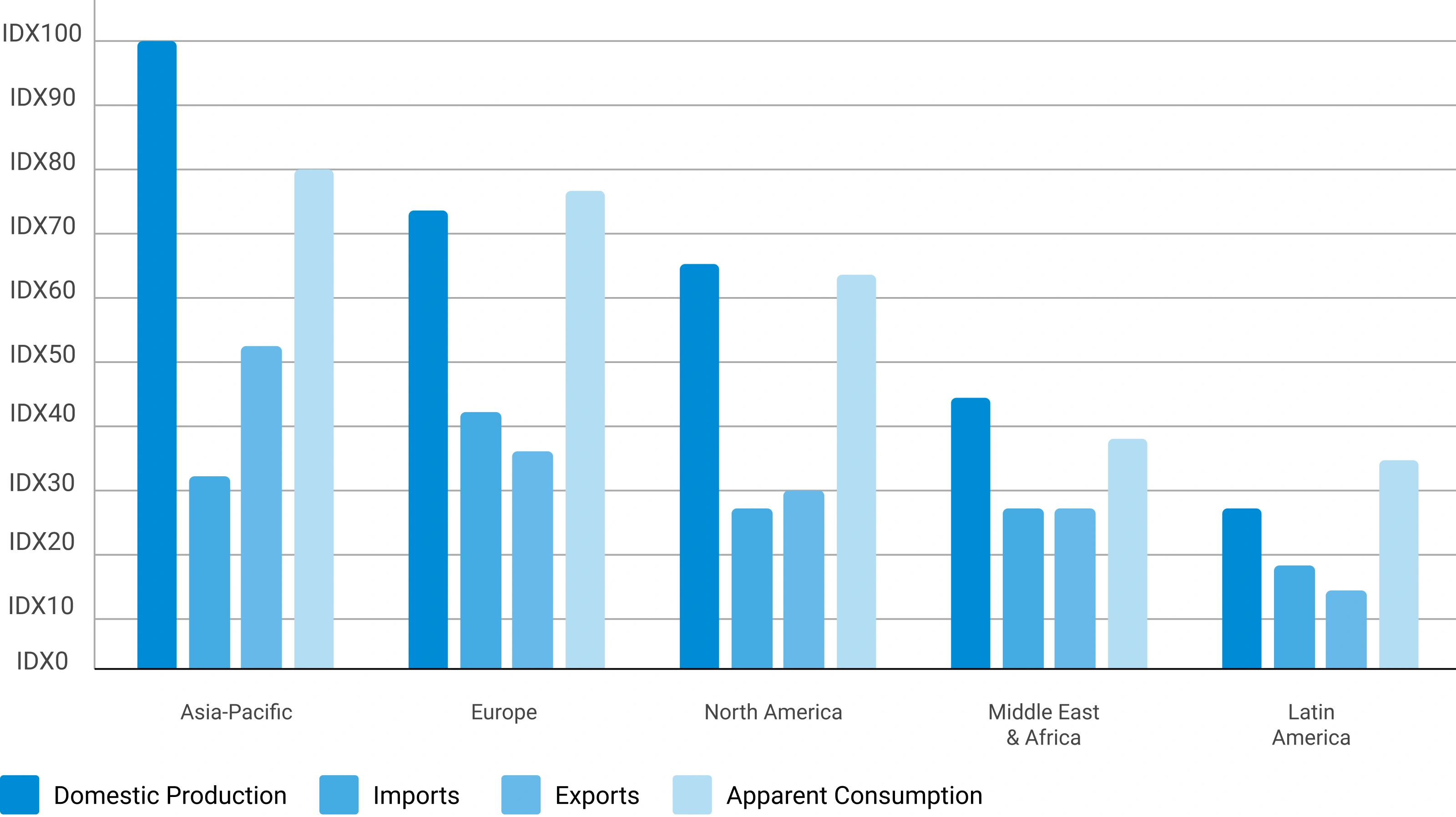
Apparent Consumption Model
Regional consumption is assessed using the standard apparent consumption formula:
Results identify net importing regions, net exporting regions, regional deficits, and surpluses — serving as an independent validation of supply and demand estimates.
Trade Flow Analysis — Net Supply Position by Region
Illustrative apparent consumption vs. domestic production across major regions — positive gap indicates net import dependency
Phase 5 — Primary Research: The Critical Validation Layer
Primary research tests and refines findings from secondary research through direct engagement with industry participants across the supply chain, demand side, and expert community. It captures intelligence that no database or published report can provide — the real-world experience of manufacturers, buyers, and specialists operating in the market.

Supply-Side Interviews
Conversations with chemical manufacturers, raw material suppliers, contract manufacturers, technology providers, and plant operators cover production trends, capacity utilization, pricing developments, technology shifts, and competitive dynamics.

Demand-Side Interviews
Engagement with OEMs, industrial consumers, procurement managers, distributors, formulators, and end-use manufacturers focuses on consumption trends, purchasing behavior, product substitution, demand outlook, and emerging applications.

Industry Expert Consultations
Additional interviews with industry consultants, independent experts, regulatory specialists, technical professionals, and research institutions provide deeper market context and validate key analytical assumptions.
Focus Areas of Primary Research:
Market Size & Forecast Validation
Revenue estimates, volume consumption, growth rates, forecast assumptions, regional demand.Supply Chain & Value Chain Assessment
Raw material sourcing, supply chain challenges, distribution networks, procurement practices.Production & Capacity Analysis
Manufacturing capacity, utilization rates, expansion projects, plant investments.Pricing & Cost Structure Analysis
Product pricing trends, feedstock costs, energy costs, margin pressures, pricing outlook.Competitive Landscape Assessment
Volume and value estimates confirmed to be fully consistent with one another before publicationInterview Volume by Market Scope
| Study Scope | Number of Interviews |
|---|---|
| Niche Market | 20 – 30 |
| Mid-Sized Market | 30 – 50 |
| Global Market | 50 – 80 |
| Highly Fragmented Market | 80 – 120 |
Interview Details:
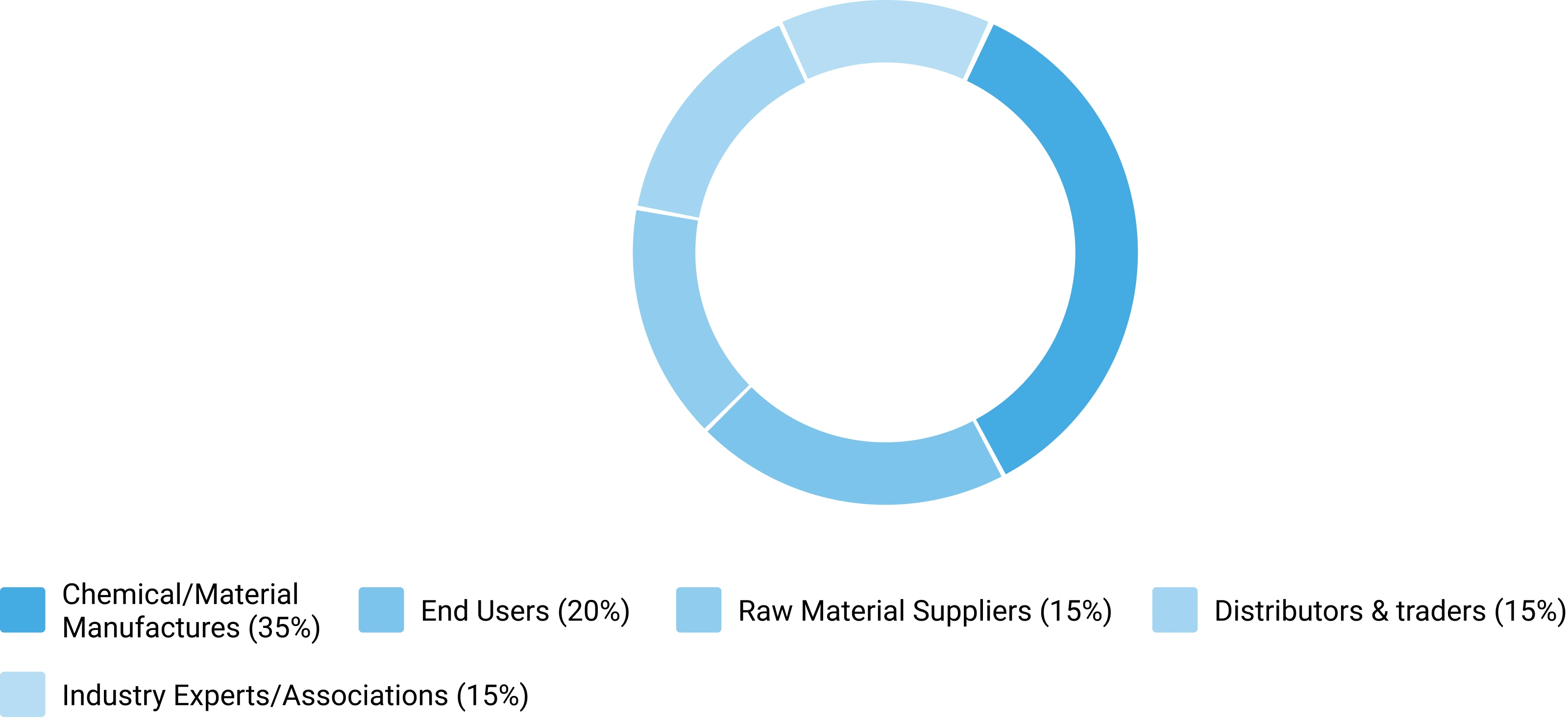
Category : Manufacturers, Suppliers, Distributors, End Users, Experts/Associations
Average Duration : 30–60 Minutes
Interview Mode : Video calls, telephonic interviews, expert consultations
Interview Format : Structured / Semi-Structured questionnaire
Focus Areas of Primary Research:
Market Size & Forecast Validation :
Revenue estimates, volume consumption, growth rates, forecast assumptions, regional demand.
Supply Chain & Value Chain Assessment :
Raw material sourcing, supply chain challenges, distribution networks, procurement practices.
Production & Capacity Analysis :
Manufacturing capacity, utilization rates, expansion projects, plant investments.
Pricing & Cost Structure Analysis :
Product pricing trends, feedstock costs, energy costs, margin pressures, pricing outlook.
Competitive Landscape Assessment :
Market share, competitor positioning, strategic initiatives, partnerships, acquisitions.
Primary Research — Stakeholder Coverage by Category
Distribution of interview respondents across stakeholder categories (% share from PPT data)
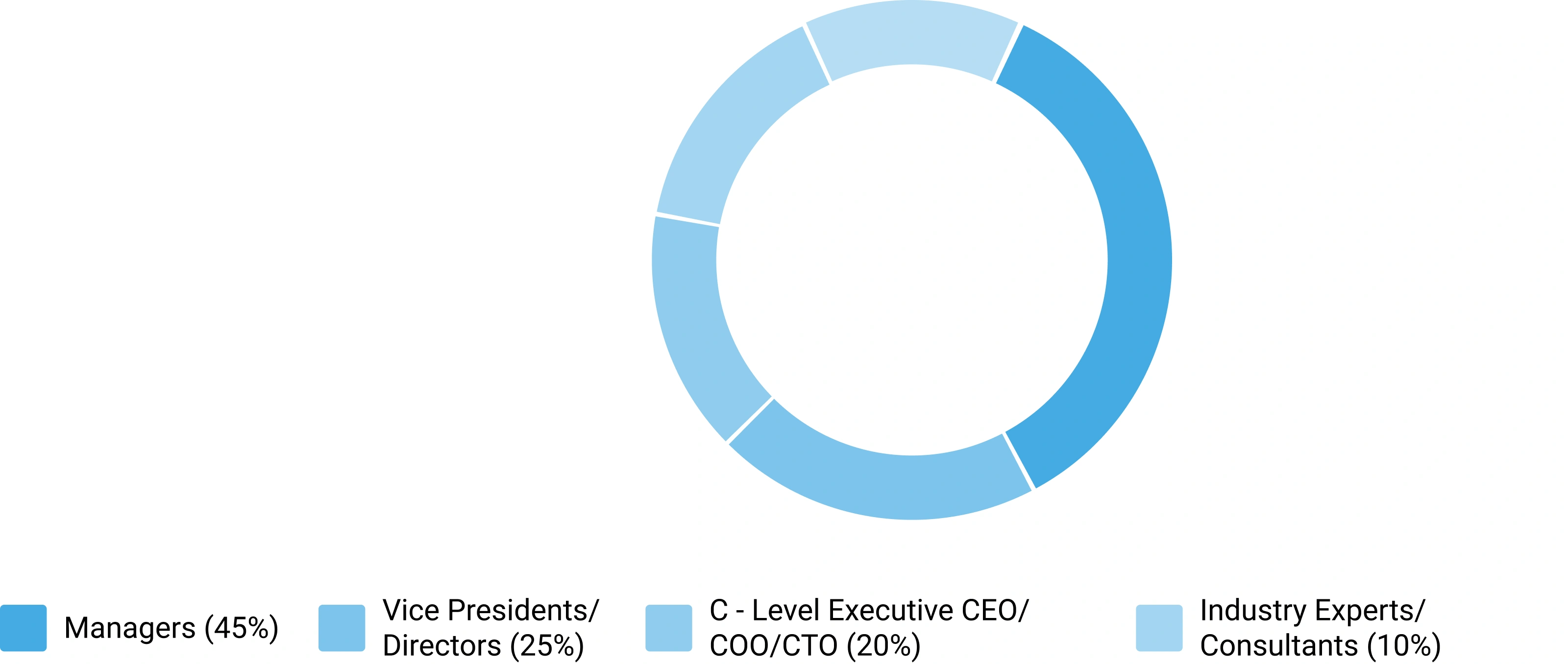
Primary Research — Respondent Designation Profile
Seniority breakdown of interview respondents (% share from PPT data)
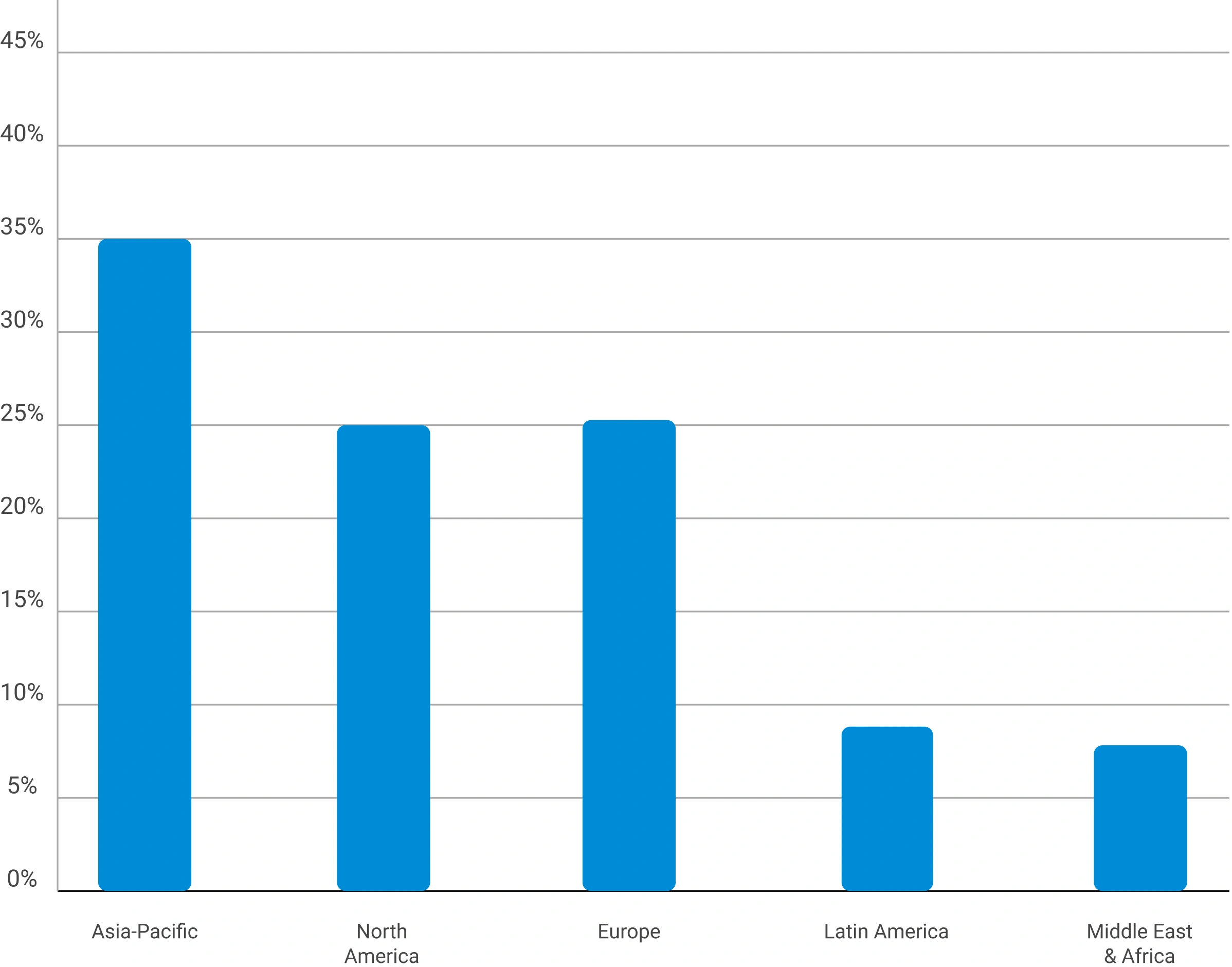
Primary Research — Geographic Coverage of Interviews
Regional distribution of primary research engagement (% share from PPT data)
Phase 6 — Data Triangulation and Market Validation
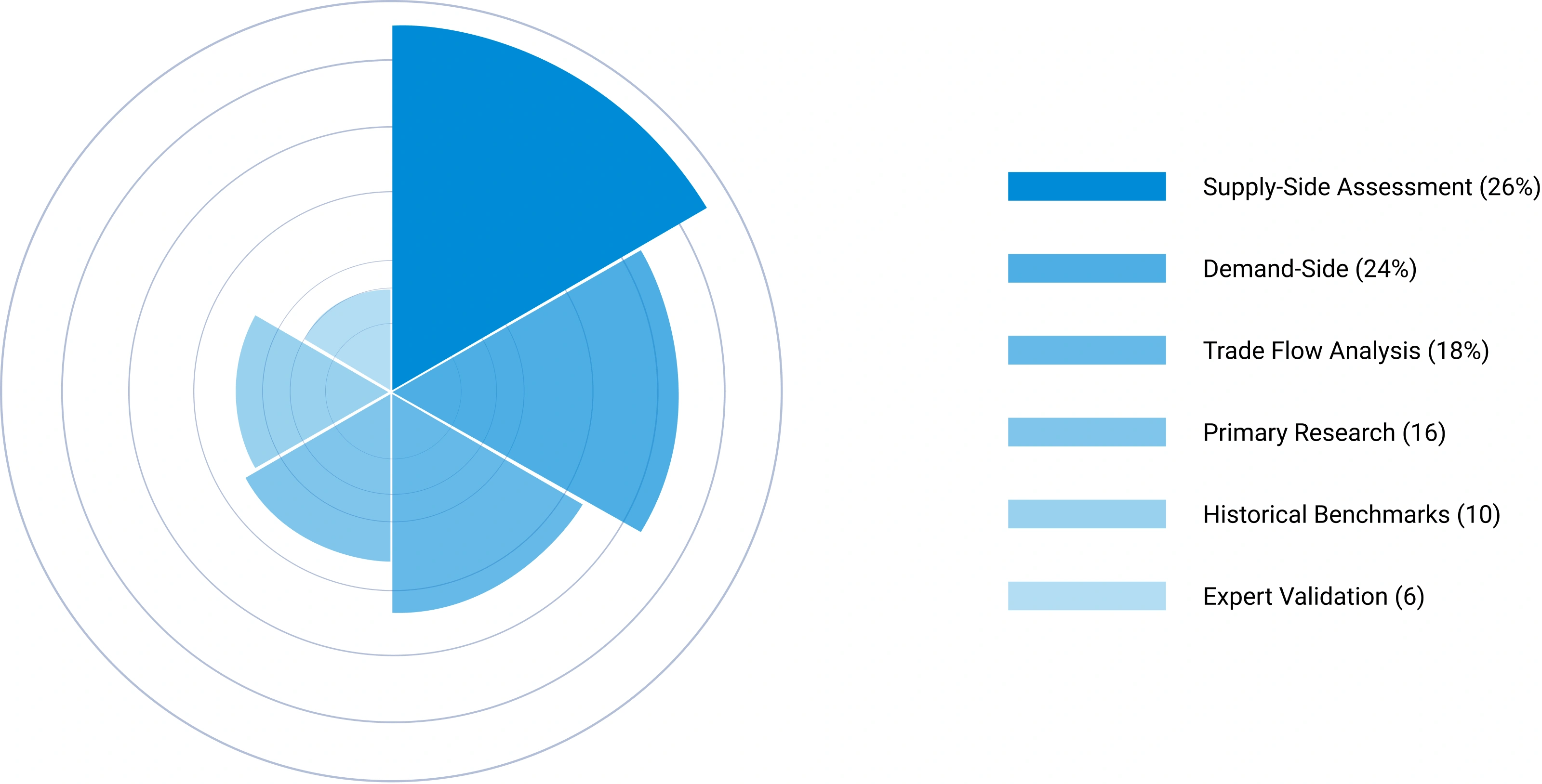
No single methodology is relied upon in isolation. Multiple independent estimation approaches are combined and reconciled to ensure consistency, accuracy, and analytical defensibility. Any material deviations between approaches are investigated and adjusted through additional validation cycles.
The final market size is derived through weighted triangulation of all validated methodologies. Any material deviations between approaches are investigated and adjusted through additional validation cycles. The outcome represents the most realistic assessment of the market based on available evidence and expert confirmation ensuring that volume and value estimates are fully consistent with one another.
Triangulation Framework — Input Contribution Weight
Relative weight each sizing input contributes to the final reconciled market estimate
Phase 7 — Forecast Modeling: Projecting Future Market Evolution
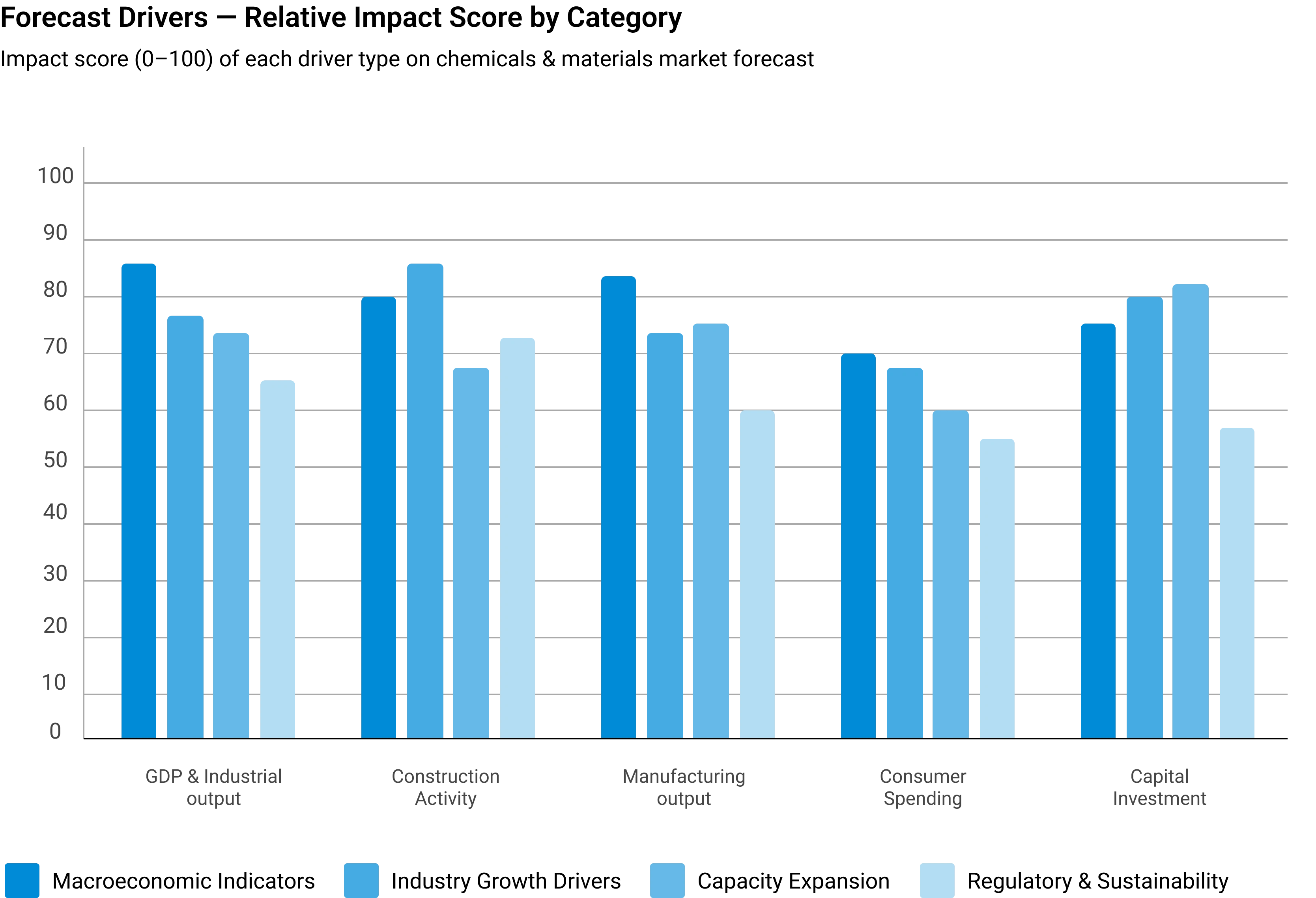
Forecasting evaluates the future trajectory of the market using a combination of quantitative indicators and qualitative assessments across economic, industry, and regulatory dimensions. Rather than simple extrapolation, each driver is independently modeled and integrated into a composite forecast.
Macroeconomic Indicators
GDP growth, industrial production, manufacturing output, construction activity, consumer spending, and capital investment form the quantitative foundation of long-term demand projections. These are applied at country, regional, and global levels.
Industry Growth Drivers
Urbanization, infrastructure development, industrialization, technological innovation, sustainability initiatives, and evolving product performance requirements are assessed at regional and industry levels — capturing both structural and cyclical demand drivers.
Capacity Expansion Analysis
Announced plant expansions, new manufacturing facilities, technology upgrades, and strategic investments are evaluated to determine future supply-demand dynamics and potential market tightness or oversupply situations.
Regulatory & Sustainability
Environmental regulations, chemical safety standards, emission reduction targets, circular economy initiatives, and sustainability requirements are incorporated as they often influence product adoption rates and market growth trajectories.
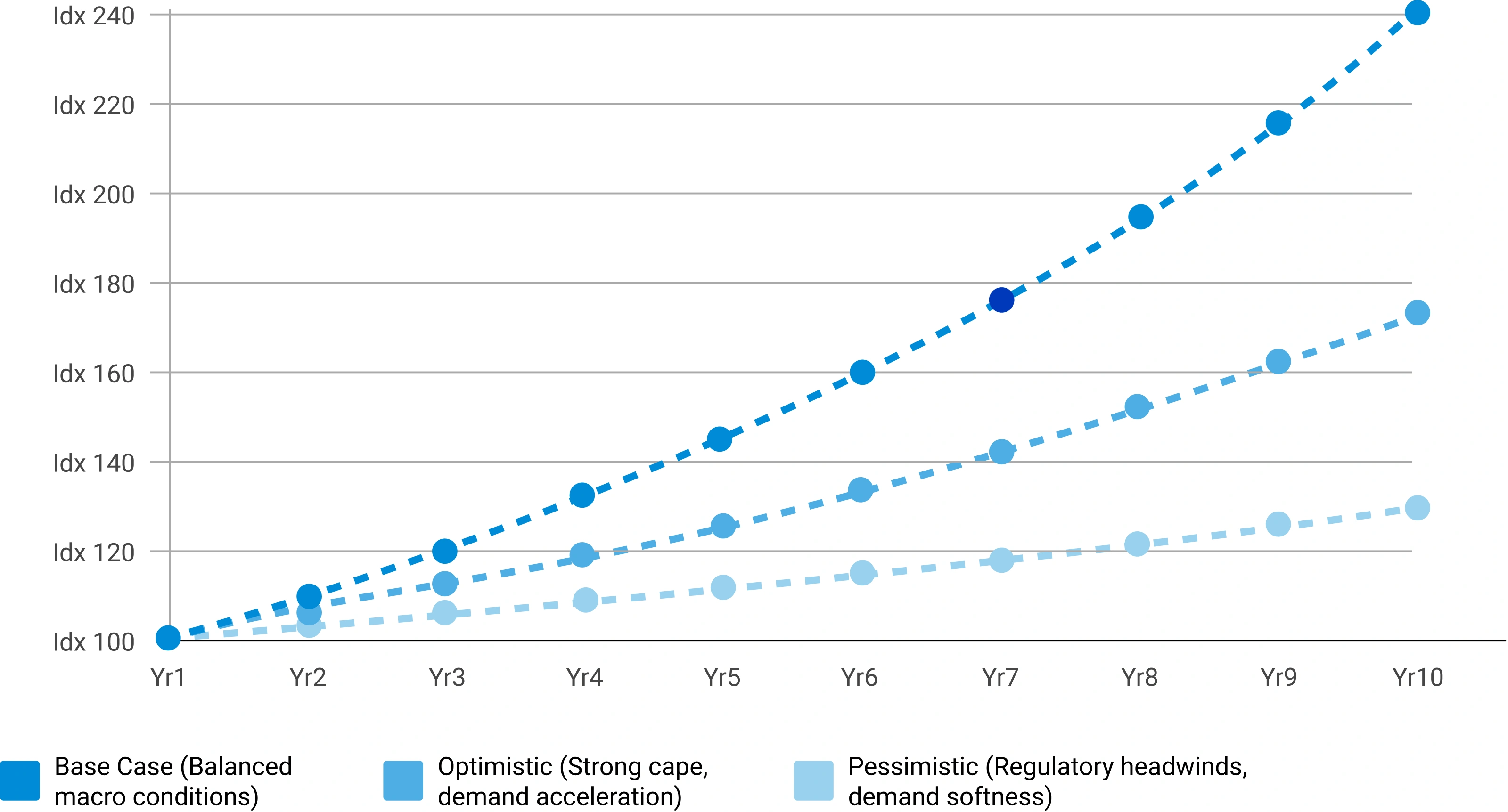
Scenario Forecast Range — Indexed Market Growth (Year 1–10)
Illustrative indexed growth trajectories across Base, Optimistic, and Pessimistic scenarios over a 10-year forecast horizon
Forecast Drivers — Relative Impact Score by Category
Impact score (0–100) of each driver type on chemicals & materials market forecast



Comments
Share your thoughts, ask a question, or provide feedback about this report.