Find the Right Market Report
Search thousands of industry reports, market insights, and research studies in one place.
Not sure where to start? Try one of these:
The global chromium chloride market size was valued at USD 118 million in 2025 and is expected to reach USD 181.5 million by 2035, growing at a CAGR of 4.40% during the forecast period of 2026-2035. The market was valued at USD 118.00 million in 2025, the base year. The product range covers chromium (III) chloride hexahydrate and anhydrous forms in industrial, reagent, pharmaceutical, and food grades. It is used in trivalent chromium plating, catalyst preparation, textile mordants and leather, nutritional supplements and animal feed, and laboratory uses.
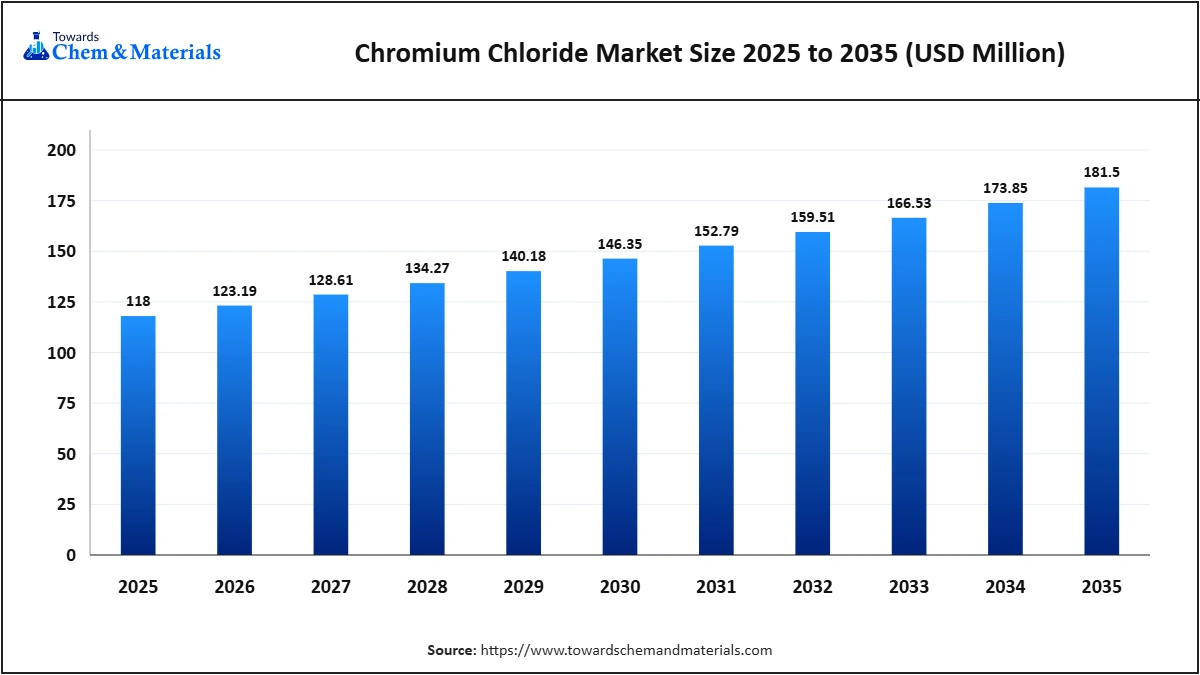
On the basis of form, Hexahydrate accounted for the largest form share in 2025, at 71.00%, because it dissolves easily for plating baths and supplements. On a regional basis, Asia Pacific accounted for 45.00% of revenue in 2025, supported by Chinese and Indian chromium chemical production and large plating and textile industries. Trivalent plating adoption, supplements, catalysts, and Asian industrial growth support the market expansion.
Note: 2025 is the base year; 2026-2035 values are forecasts.
Sources: Expert interviews, secondary sources, Towards Chemical and Materials database, and Towards Chemical and Materials analysts.
The chromium chloride market is projected to grow from USD 118.00 million in 2025 to USD 181.50 million by 2035 because chromium(III) chloride is the main salt for trivalent chrome plating as industry moves away from hexavalent chromium. Trivalent plating adoption, supplements, catalysts, and Asian industrial growth support steady growth, boosting the market revenue to USD 146.35 million by 2030 and registering a CAGR of 4.40% from 2026 to 2035.
Analyst View: We built the estimate from chromium chloride consumption by application and region and prices, cross-checked against chromium chemical producer activities. Published estimates are limited, so our value is evidence-based.
The chromium chloride market is driven by increasing restrictions on hexavalent chromium, encouraging manufacturers to shift toward trivalent chromium-based plating solutions. Growing adoption of trivalent plating in automotive and decorative applications is further supporting demand. Rising consumption of chromium-based nutritional supplements, increasing demand for catalyst precursors, and expanding chemical and automotive industries across Asia are also contributing to market growth.
The market faces challenges from stricter regulations governing chromium compounds, higher compliance requirements, and rising production costs. The adoption of trivalent plating is also constrained by specialized bath formulations and technical expertise requirements. Additionally, intense price competition from alternative chromium compounds and established suppliers, along with limited demand volumes in certain specialized applications, may restrict market expansion.
The market presents opportunities through the growing adoption of trivalent plating in automotive applications, driven by demand for corrosion-resistant and environmentally compliant finishes. Increasing demand for high-purity pharmaceutical-grade chromium compounds is creating opportunities for specialized product development. Furthermore, expanding production capacity in India, rising demand for industrial catalyst precursors, and growing use of chromium-based minerals in animal feed formulations are expected to create additional growth opportunities.
Market Drivers - Impact & CAGR Contribution (2026-2035)
| Driver | Impact | ≈ CAGR Contribution | Time Horizon | Key Regions |
| Hexavalent chrome is restricted | High | +1.72 pp | Short to long term | Global, strongest in Asia Pacific |
| Trivalent plating spreads | Medium | +1.45 pp | Medium to long term | Global, fastest uptake in Europe |
| Supplements use chromium | Medium | +1.23 pp | Short to medium term | Global |
| Catalysts need precursors | Low | +0.97 pp | Long term | Developed and emerging markets |
Note: Contributions are indicative estimates of each factor's effect on annual growth.
Sources: Expert interviews, secondary sources, Towards Chemical and Materials database and Towards Chemical and Materials analysts.
Taken together, these drivers add about 5.37 percentage points to the annual growth of the chromium chloride market, with hexavalent chrome restricted having the largest effect. Their influence is strongest in Asia Pacific, while uptake grows fastest in Europe.
Market Restraints - Impact & Negative CAGR Contribution (2026-2035)
| Restraint | Impact | ≈ Negative CAGR Contribution | Time Horizon | Key Regions |
| Chromium rules tighten | High | -0.44 pp | Short to medium term | Global |
| Trivalent baths need know-how | High | -0.32 pp | Medium term | Price-sensitive and emerging markets |
| Price competition | Medium | -0.21 pp | Short term | Asia Pacific and other mature markets |
Note: Contributions are indicative estimates of each factor's effect on annual growth.
Sources: Expert interviews, secondary sources, Towards Chemical and Materials database and Towards Chemical and Materials analysts.
These restraints are expected to reduce annual growth of the chromium chloride market by about 0.97 percentage points, led by tighter chromium rules. Their effect eases over the forecast period as suppliers, buyers, and regulators adapt, leaving a net CAGR of 4.40% from 2026 to 2035.
| Segments | 2025 Share | 2035 Share | CAGR 2026-2035 |
| Hexahydrate | 71.00% | 71.79% | 4.51% |
| Anhydrous | 29.00% | 28.21% | 4.11% |
Note: 2025 is the base year; 2035 shares and CAGRs are forecasts.
Sources: Expert interviews, secondary sources, Towards Chemical and Materials database, and Towards Chemical and Materials analysts.
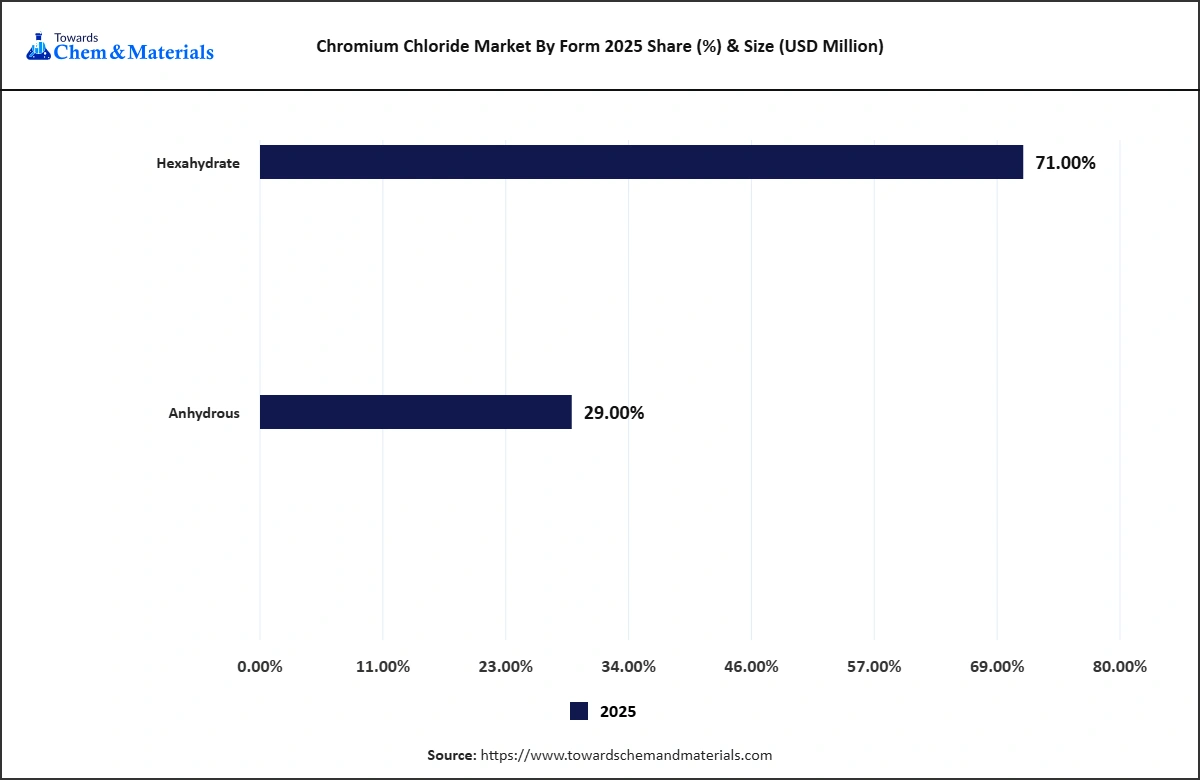
Hexahydrate accounted for 71.00% in 2025 and Anhydrous for 29.00%. Hexahydrate leads and is also growing the fastest.
Hexahydrate: This segment accounted for 71.00% of the chromium chloride market in 2025 and is projected to expand at a CAGR of 4.51% from 2026 to 2035. Hexahydrate leads because it dissolves easily for plating baths and supplements. The hexahydrate segment is expected to grow broadly in line with the overall market over the forecast period.
Anhydrous: Representing 29.00% of the chromium chloride market in 2025, the segment is projected to expand at a CAGR of 4.11% from 2026 to 2035. Anhydrous chromium chloride is primarily used in catalyst production and organometallic synthesis. The segment is expected to grow broadly in line with the overall market over the forecast period.
Segment Outlook: Hexahydrate remains the largest form segment through 2035, holding about 71.79% of the market in 2035, and records the highest CAGR of 4.51% from 2026 to 2035, strengthening its lead in the chromium chloride market.
| Segments | 2025 Share | 2035 Share | CAGR 2026-2035 |
| Industrial Grade | 58.00% | 54.99% | 3.84% |
| Pharmaceutical & Food Grade | 24.00% | 27.28% | 5.74% |
| Reagent Grade | 18.00% | 17.74% | 4.24% |
Note: 2025 is the base year; 2035 shares and CAGRs are forecasts.
Sources: Expert interviews, secondary sources, Towards Chemical and Materials database, and Towards Chemical and Materials analysts.
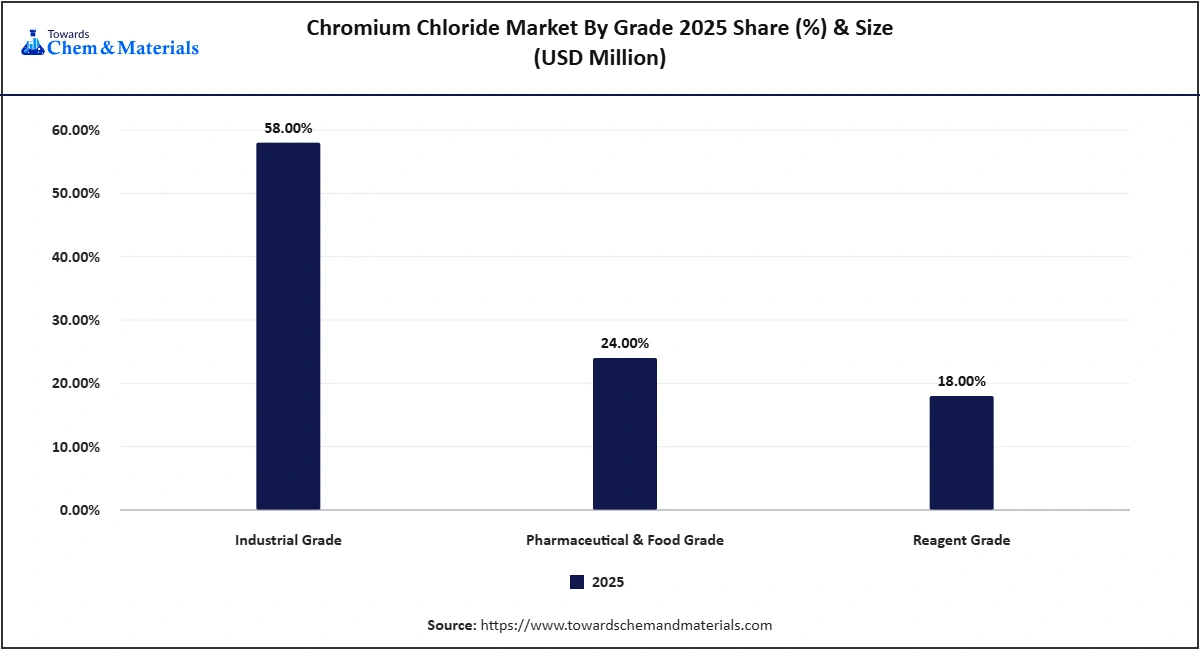
Industrial Grade accounted for 58.00% in 2025, Pharmaceutical & Food Grade for 24.00%, and Reagent Grade for 18.00%. Industrial Grade leads, while Pharmaceutical & Food Grade is growing fastest.
Industrial Grade: This segment accounted for 58.00% of the chromium chloride market in 2025 and is projected to expand at a CAGR of 3.84% from 2026 to 2035. Industrial grade leads for plating and catalysts. The industrial grade segment is expected to grow slower than the overall market over the forecast period.
Pharmaceutical & Food Grade: Representing 24.00% of the chromium chloride market in 2025, the segment is projected to expand at a CAGR of 5.74% from 2026 to 2035. Growth is driven by rising demand for chromium chloride in nutritional supplements and animal feed formulations. The segment is expected to grow faster than the overall market over the forecast period.
Reagent Grade: The segment captured an 18.00% share of the chromium chloride market in 2025 and is projected to expand at a CAGR of 4.24% from 2026 to 2035. Reagent grade primarily serves laboratory research, analytical testing, and chemical synthesis applications. The segment is expected to grow broadly in line with the overall market over the forecast period.
Segment Outlook: Industrial Grade is expected to maintain its dominance through 2035, accounting for approximately 54.99% of the market, while Pharmaceutical & Food Grade is projected to register the fastest growth at a CAGR of 5.74% from 2026 to 2035. Reagent Grade represents the smallest market segment, catering primarily to specialized laboratory and research applications.
| Segments | 2025 Share | 2035 Share | CAGR 2026-2035 |
| Trivalent Chrome Plating | 39.00% | 41.76% | 5.12% |
| Catalysts | 18.00% | 17.18% | 3.92% |
| Textiles & Leather | 14.00% | 13.37% | 3.92% |
| Supplements & Feed | 17.00% | 16.23% | 3.92% |
| Laboratory & Others | 12.00% | 11.45% | 3.92% |
Note: 2025 is the base year; 2035 shares and CAGRs are forecasts.
Sources: Expert interviews, secondary sources, Towards Chemical and Materials database, and Towards Chemical and Materials analysts.
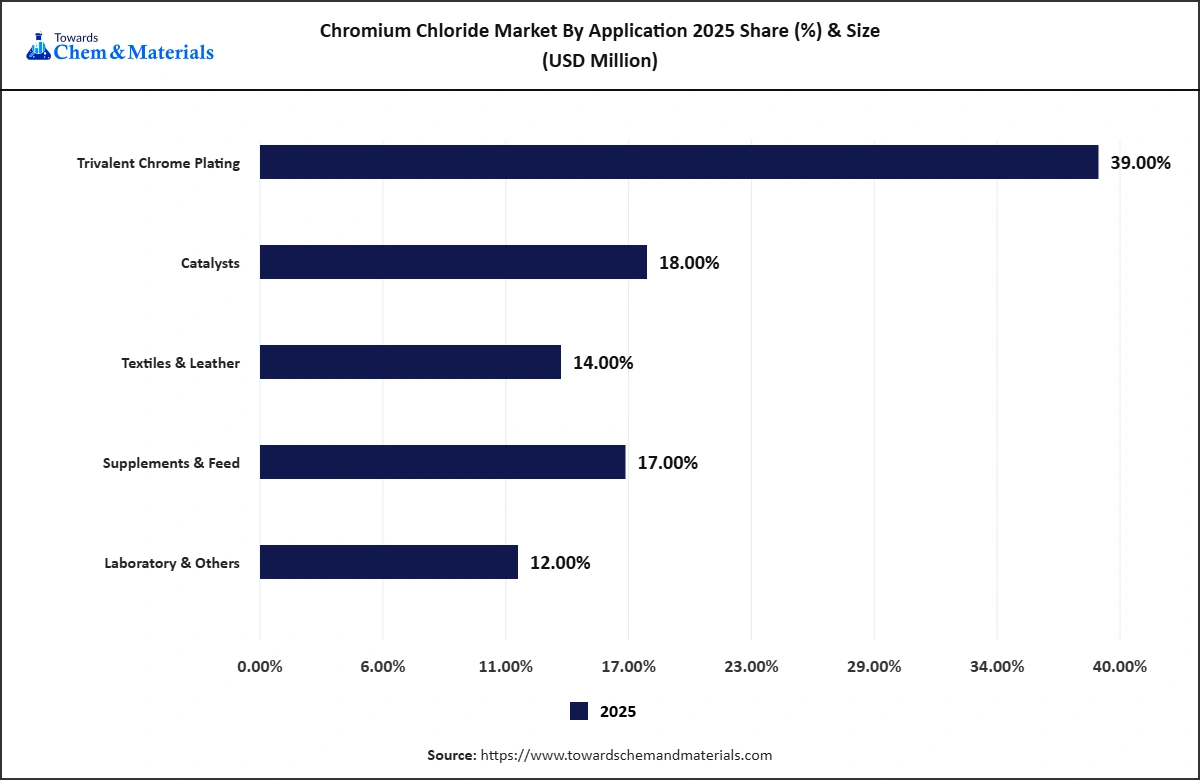
Trivalent Chrome Plating accounted for 39.00% in 2025, Catalysts for 18.00%, Textiles & Leather for 14.00%, Supplements & Feed for 17.00%, and Laboratory & Others for 12.00%. Trivalent Chrome Plating leads and is also growing the fastest. Chromium catalysts are used in polyolefin production.
Trivalent Chrome Plating: Holding the largest share of 39.00% in the chromium chloride market in 2025, trivalent chrome plating is projected to grow at a CAGR of 5.12% from 2026 to 2035. Its dominance is driven by increasing restrictions on hexavalent chromium, encouraging plating manufacturers to transition toward trivalent chromium-based baths. This application is expected to grow faster than the overall market over the forecast period.
Catalysts: This segment accounted for 18.00% of the chromium chloride market in 2025 and is projected to expand at a CAGR of 3.92% from 2026 to 2035. Catalysts use chromium chloride. The catalysts segment is expected to grow slower than the overall market over the forecast period.
Textiles & Leather: Accounting for 14.00% of the market in 2025, textiles and leather applications are projected to register a CAGR of 3.92% from 2026 to 2035. Chromium chloride is used as a mordant in textile dyeing and leather processing, supporting color fixation and treatment processes. Growth is expected to remain slower than the overall market.
Supplements & Feed: This segment accounted for 17.00% of the chromium chloride market in 2025 and is projected to expand at a CAGR of 3.92% from 2026 to 2035. Supplements and feed use chromium as a trace mineral. The supplements & feed segment is expected to grow slower than the overall market over the forecast period.
Laboratory & Others: Contributing 12.00% to the market in 2025, laboratory and other specialized applications are projected to expand at a CAGR of 3.92% from 2026 to 2035. Key uses include laboratory research, analytical testing, and chemical synthesis. Demand is expected to grow slower than the overall market over the forecast period.
Segment Outlook: Trivalent Chrome Plating remains the largest application segment through 2035, holding about 41.76% of the market in 2035, and records the highest CAGR of 5.12% from 2026 to 2035, strengthening its lead in the chromium chloride market.
Analyst View: Segment shares were allocated on the basis of demand, product portfolios, and pricing in each category. Hexahydrate, Industrial Grade, and Trivalent Chrome Plating lead their categories because they meet the core needs of today's buyers. We expect Pharmaceutical & Food Grade to gain share as newer technologies, users, and applications grow faster.
| Region | 2025 Share | 2035 Share | CAGR 2026-2035 |
| Asia Pacific | 45.00% | 42.91% | 3.91% |
| Europe | 26.00% | 28.35% | 5.31% |
| North America | 22.00% | 21.80% | 4.31% |
| Latin America | 4.00% | 3.96% | 4.31% |
| Middle East & Africa | 3.00% | 2.98% | 4.31% |
Note: 2025 is the base year; 2035 shares and CAGRs are forecasts.
Sources: Expert interviews, secondary sources, Towards Chemical and Materials database and Towards Chemical and Materials analysts.
Asia Pacific accounted for 45.00% in 2025, Europe for 26.00%, North America for 22.00%, Latin America for 4.00%, and the Middle East & Africa for 3.00%. Asia Pacific leads, while Europe is growing fastest.
Asia Pacific: Dominating the chromium chloride market with a 45.00% share in 2025, Asia Pacific is projected to expand at a CAGR of 3.91% from 2026 to 2035. Regional leadership is supported by chromium chemical production in China and India, alongside large plating and textile industries. Growth is expected to remain slower than the overall market over the forecast period.
Europe: This region accounted for 26.00% of the chromium chloride market in 2025 and is projected to expand at a CAGR of 5.31% from 2026 to 2035. Europe leads the shift to trivalent chrome under REACH restrictions. Europe is expected to grow faster than the overall market between 2026 and 2035.
North America: Representing 22.00% of the global market in 2025, North America is projected to expand at a CAGR of 4.31% from 2026 to 2035. Demand is supported by the adoption of trivalent plating technologies and the use of chromium chloride in nutritional supplements. Regional growth is expected to remain broadly in line with the overall market.
Latin America: This region accounted for 4.00% of the chromium chloride market in 2025 and is projected to expand at a CAGR of 4.31% from 2026 to 2035. Latin America has leather and plating demand. Latin America is expected to grow broadly in line with the overall market between 2026 and 2035.
Middle East & Africa: Contributing 3.00% to the global market in 2025, the Middle East & Africa region is projected to expand at a CAGR of 4.31% from 2026 to 2035. Relatively limited industrial demand and a smaller chemical manufacturing base characterize the regional market. Growth is expected to remain broadly in line with the overall market over the forecast period.
Analyst View: Regional shares were built from demand, installed base, spending, and supplier presence in each region. Asia Pacific leads because of its mature demand base and strong suppliers. We project Europe with the highest growth premium because investment, adoption, and capacity are expanding fastest there.
| Rank | Company Name | 2025 Share (%) | Key Products / Business | Headquarters |
| 1 | Vishnu Chemicals | 10.17% | Chromium chemicals | India |
| 2 | Brother Enterprises | 9.32% | Chromium salts | China |
| 3 | Elementis | 6.78% | Chromium chemicals | United Kingdom |
| 4 | Atotech (MKS) | 5.93% | Trivalent chrome plating processes | Germany |
| 5 | Merck KGaA | 5.08% | Reagent chromium chloride | Germany |
| 6 | MacDermid Enthone | 5.08% | Trivalent chrome plating chemistry | United States |
| 7 | Thermo Fisher Scientific | 4.24% | Laboratory chromium chloride | United States |
| 8 | Hunan Jiayu Chemical | 3.39% | Chromium salts | China |
| 9 | American Elements | 2.54% | Chromium chloride in multiple grades | United States |
| 10 | Jost Chemical | 2.54% | Chromium chloride for nutrition | United States |
Note: Company shares are 2025 estimates.
Sources: Company press releases, expert interviews, secondary sources, Towards Chemical and Materials database, and Towards Chemical and Materials analysts.
Vishnu Chemicals led the chromium chloride market with an estimated 10.17% share of 2025 revenue, followed by Brother Enterprises at 9.32% share and Elementis at 6.78% share. Vishnu Chemicals leads with chromium chemicals; Brother Enterprises competes with chromium salts, and Elementis offers chromium chemicals. Atotech (MKS), Merck KGaA, MacDermid Enthone, Thermo Fisher Scientific, Hunan Jiayu Chemical, American Elements and Jost Chemical compete through trivalent chrome plating processes, reagent chromium chloride, trivalent chrome plating chemistry, laboratory chromium chloride, chromium salts, chromium chloride in multiple grades, and chromium chloride for nutrition.
The top companies accounted for an estimated 55.08% of 2025 revenue, while the remaining 44.92% was shared among many Asian chromium salt producers. The chromium chloride market is fragmented, and competition focuses on chromium raw material access, purity, plating performance, regulatory compliance, and price.
Vishnu Chemicals: Vishnu Chemicals is headquartered in India. It held an estimated 10.17% share of the chromium chloride market in 2025. Its offering centres on Chromium chemicals. In the Towards Chemical and Materials Companies Quadrant, it is positioned as a Leader.
Brother Enterprises: Based in China, Brother Enterprises captured an estimated 9.32% of the global chromium chloride market in 2025. Its business portfolio includes a range of chromium salts for industrial applications. The company holds a Leader position in the Towards Chemical and Materials Companies Quadrant.
Elementis: With its headquarters in the United Kingdom, Elementis accounted for an estimated 6.78% market share in 2025. Its chromium chemical offerings support various specialty and industrial applications. In the Towards Chemical and Materials Companies Quadrant, the company is positioned as a Leader.
Atotech (MKS): Headquartered in Germany, Atotech (MKS) secured an estimated 5.93% share of the chromium chloride market in 2025. Its portfolio emphasizes trivalent chrome plating processes and related surface treatment technologies. The company is recognized as a Leader in the Towards Chemical and Materials Companies Quadrant.
Merck KGaA: Germany-based Merck KGaA represented approximately 5.08% of the market in 2025. Its product range includes reagent-grade chromium chloride for laboratory research and chemical applications. The company occupies a Leader position in the Towards Chemical and Materials Companies Quadrant.
MacDermid Enthone: Operating under Element Solutions Inc. and headquartered in the United States, MacDermid Enthone held an estimated 5.08% market share in 2025. Its core offerings include trivalent chrome plating chemistry for surface finishing applications. The company is categorized as a Leader in the Towards Chemical and Materials Companies Quadrant.
Thermo Fisher Scientific: Based in the United States, Thermo Fisher Scientific captured an estimated 4.24% share of the chromium chloride market in 2025. Its portfolio includes laboratory-grade chromium chloride for research and analytical applications. The company is positioned as an Innovator in the Towards Chemical and Materials Companies Quadrant.
Hunan Jiayu Chemical: Headquartered in China, Hunan Jiayu Chemical held approximately 3.39% of the chromium chloride market in 2025. Its product offerings are primarily focused on chromium salts for industrial and chemical applications. The company is classified as an Innovator in the Towards Chemical and Materials Companies Quadrant.
American Elements: The United States-based American Elements held an estimated 2.54% market share in 2025. Its portfolio covers chromium chloride in multiple grades, serving diverse research and industrial requirements. The company features an Innovator in the Towards Chemical and Materials Companies Quadrant.
Jost Chemical: Jost Chemical is headquartered in the United States. It held an estimated 2.54% share of the chromium chloride market in 2025. Its offering centres on Chromium chloride for nutrition. In the Towards Chemical and Materials Companies Quadrant, it is positioned as an Innovator.
The chromium chloride ecosystem links chromite & chromium chemicals, plating chemistry firms, distributors, end users and regulators, with each stage adding value before products reach end users. Chromium producers also serve aluminum refractory material makers.
| Ecosystem Stage | Role in the Market | Key Companies |
| Chromite & Chromium Chemicals | Mine chromite and make salts | Vishnu Chemicals, Brother Enterprises, Elementis |
| Plating Chemistry Firms | Formulate trivalent baths | Atotech, MacDermid Enthone |
| Distributors | Supply smaller users | Chemical distributors |
| End Users | Plate, dye and supplement | Platers, textile and feed makers |
| Regulators | Restrict hexavalent chromium | REACH, EPA, OSHA |
Sources: Company press releases, expert interviews, secondary sources, Towards Chemical and Materials database and Towards Chemical and Materials analysts.
Chromite & Chromium Chemicals: Mine chromite and make salts. Key participants include Vishnu Chemicals, Brother Enterprises, and Elementis.
Plating Chemistry Firms: Formulate trivalent baths. Key participants include Atotech and MacDermid Enthone.
Distributors: Supply smaller users. Key participants include Chemical distributors.
End Users: Plate, dye, and supplement. Key participants include Platers, textile and feed makers.
Regulators: Restrict hexavalent chromium. Key participants include REACH, EPA, and OSHA.
Value in the chromium chloride market flows from upstream material and technology suppliers to manufacturers and service providers, then through distribution partners to end users. Companies that integrate several stages or build long-term relationships with end users capture a larger share of this value.
The Towards Chemical and Materials Companies Quadrant positions key participants in the chromium chloride market by market strength, reflecting revenue scale, market share, and geographic reach, and by innovation and growth strategy, reflecting product portfolio breadth, R&D intensity, and partnerships. Positions reflect each company's estimated 2025 share of the chromium chloride market and our assessment of its product innovation, portfolio breadth, and partnerships.
Sources: Company press releases, expert interviews, secondary sources, Towards Chemical and Materials database and Towards Chemical and Materials analysts.
Leaders: Vishnu Chemicals, Brother Enterprises, Elementis, Atotech (MKS), Merck and MacDermid Enthone combine high market share with broad portfolios and strong innovation.
Innovators: Thermo Fisher Scientific, Hunan Jiayu Chemical, American Elements and Jost Chemical bring newer technologies and specialized products.
By Form
By Grade
By Application
By Region
The chromium chloride market was defined as chromium (III) chloride hexahydrate and anhydrous forms in industrial, reagent, pharmaceutical, and food grades, used in trivalent chromium plating, catalyst preparation, textile mordants and leather, nutritional supplements and animal feed, and laboratory uses. The 2025 base year was estimated using demand volumes and average prices across form, grade, application, and regional segments, with the results cross-validated against market-specific revenues of leading companies and published industry estimates. We allocated segment, regional, and company values from form, grade, application, and regional demand. Key estimates were verified by cross-checking company disclosures, regulatory and industry data, and published third-party estimates, and inputs that could not be reconciled were excluded. All segment, regional and company figures were reconciled to the same 2025 base year, and the 2026-2035 forecast, which applies a constant CAGR from the 2025 base, was recalculated and validated.
The chromium chloride market is set for steady expansion as trivalent plating adoption and related demand keep growing. Our estimate links value to underlying demand, installed base and pricing, so the forecast follows real adoption rather than headline hype. The main upside comes from trivalent plating and pharma grades, while the main risks are tightening chromium rules.
Reliable market intelligence and data-driven insights across the global chemicals and materials industry, helping businesses understand trends, competition, pricing, and emerging opportunities.
Schedule a Demo