Find the Right Market Report
Search thousands of industry reports, market insights, and research studies in one place.
Not sure where to start? Try one of these:
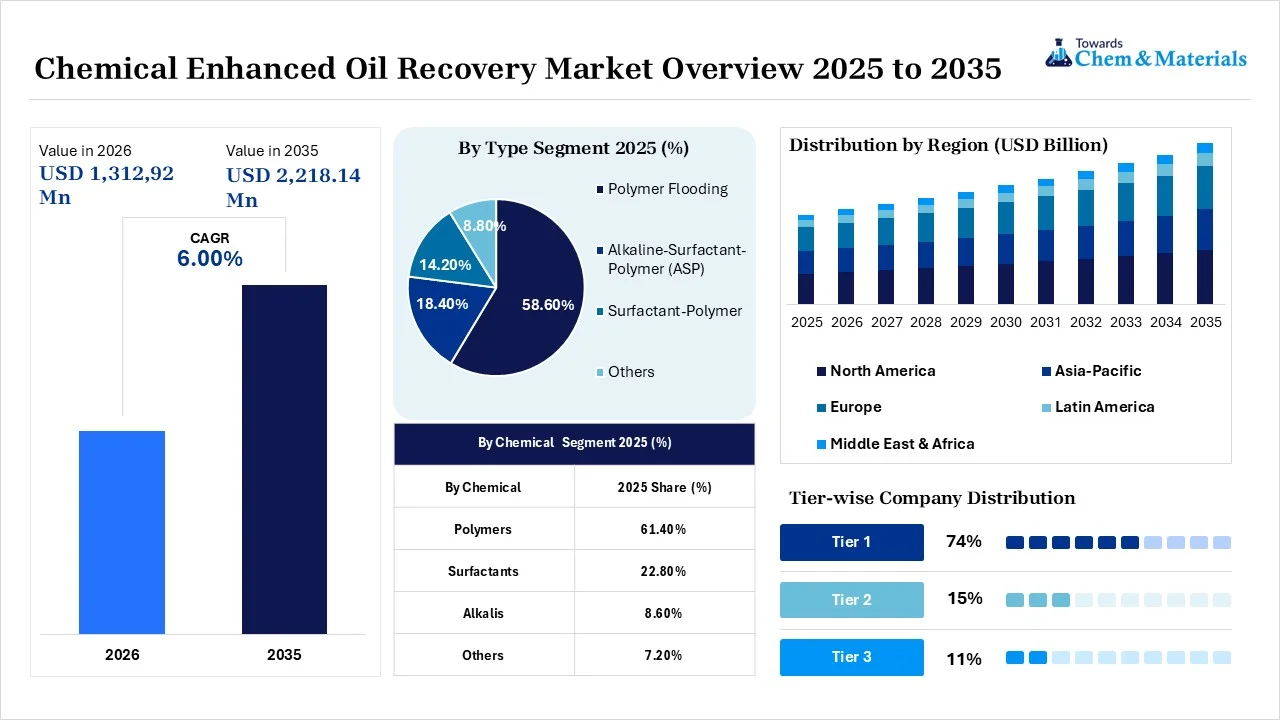
The global chemical enhanced oil recovery market is expected to grow from USD 1,312.92 million in 2026 to USD 2,218.14 million by 2035. The market is forecast to grow at a CAGR of 6.00% from 2026 to 2035.
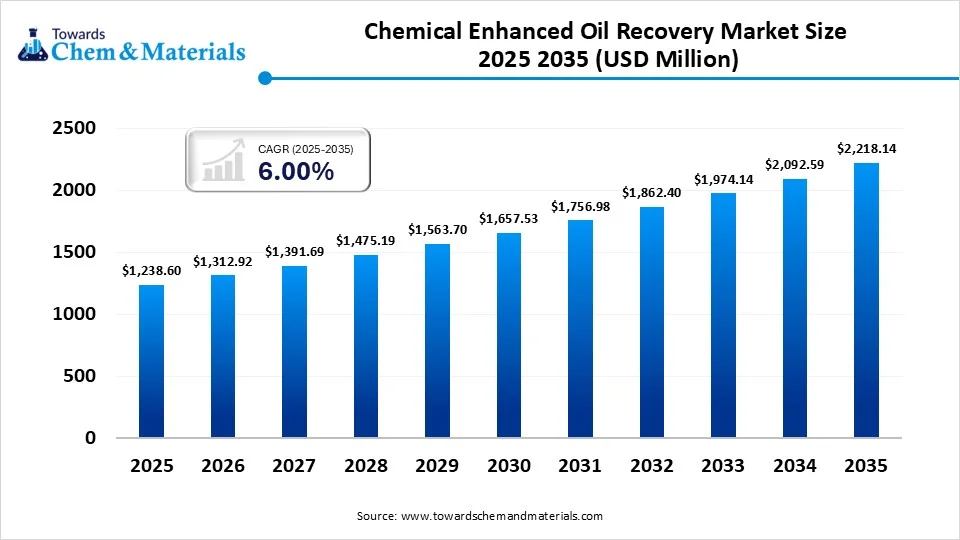
Note: 2025 is the base year; 2026–2035 values are forecasts.
Sources: Expert interviews, secondary sources, Towards Chem and Materials database and Towards Chem and Materials analysts.
The market comprises polymers, surfactants, alkalis and other chemicals injected into oil reservoirs to push out oil that remains after primary and waterflood recovery, via polymer flooding, alkaline-surfactant-polymer (ASP), surfactant-polymer and other chemical methods. Polymer flooding held the largest share in the type segment in 2025, at 58.60%, due to the fact that partially hydrolyzed polyacrylamide improves sweep efficiency at relatively low cost and has been proven in many fields. Asia Pacific held 34.60% of market revenue in 2025, supported by large chemical flooding programs in China's well-mature fields and growing polymer projects in India. The market demand is being driven by national oil companies who want to raise recovery from mature fields, full-field polymer projects in Oman, India and the UAE and local production of EOR polymers in the Middle East. Chemical suppliers are signing long-term field contracts and building polymer plants in proximity to oil fields.
Analyst View: We have developed the estimate from active and planned chemical flooding projects by field, multiplied by injection volumes, chemical concentrations and average costs for polymers, surfactants, and alkalis. Project activity highlights announced pilots, final investment decisions and full-field programs by national and international oil companies, weighted by expected start dates. The total was cross-checked against the EOR chemical revenue of prominent polymer and surfactant suppliers and against published estimates, which places our base year slightly above the comparable figures. Various factors contribute towards the growth rate such as new polymer projects in the Middle East and India and steady programs in China. Volatility of oil prices negatively affects the growth rate.
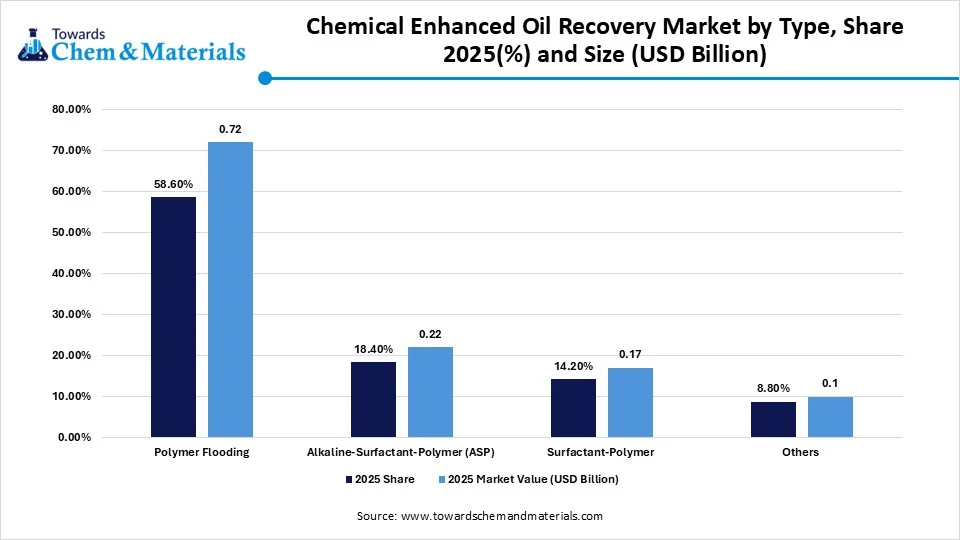
Note: 2025 is the base year.
Sources: Expert interviews, secondary sources, Towards Chem and Materials database and Towards Chem and Materials analysts.
The polymer flooding segment accounted for 58.60% of market revenue (USD 725.82 million) in 2025 and is the fastest-growing type owing to the fact that thickened water improves sweep in heterogeneous reservoirs cost-effectively, and many national oil companies are transitioning to full-field programs. ASP flooding held 18.40% (USD 227.90 million) of the market, and it recovers more oil by decreasing interfacial tension but involves significant intricacies and is used mainly in China, while the surfactant-polymer flooding segment held a market share of 14.20% (USD 175.88 million) and other methods for 8.80% (USD 109.00 million).
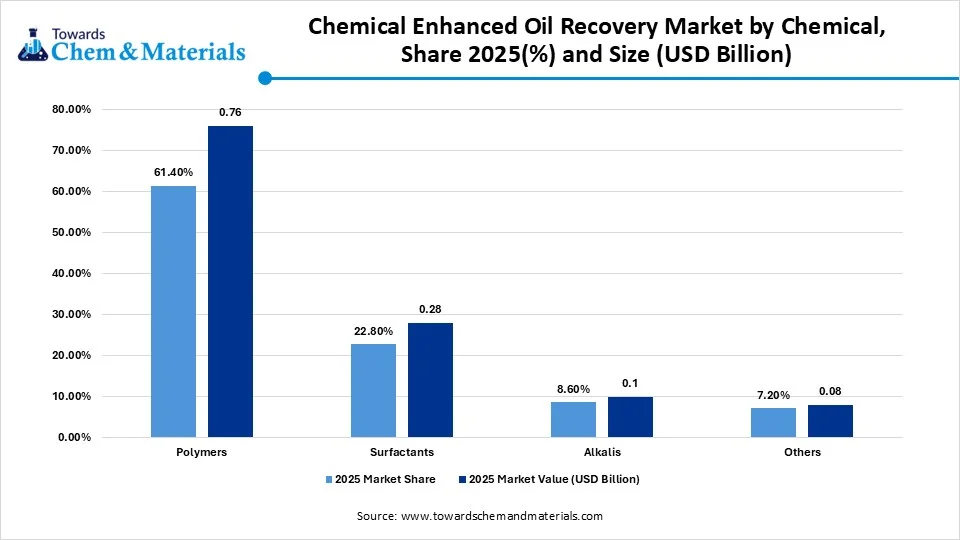
Note: 2025 is the base year.
Sources: Expert interviews, secondary sources, Towards Chem and Materials database and Towards Chem and Materials analysts.
Polymers, especially partially hydrolyzed polyacrylamide, accounted for a market share of 61.40% (USD 760.50 million) in 2025. The surfactants segment, held 22.80% (USD 282.40 million) revenue, finds applications in ASP and surfactant-polymer floods. Alkalis account for a market share of 8.60% (USD 106.52 million) and other chemicals such as co-solvents and biocides account for 7.20% (USD 89.18 million).
Note: 2025 is the base year.
Sources: Expert interviews, secondary sources, Towards Chem and Materials database and Towards Chem and Materials analysts.
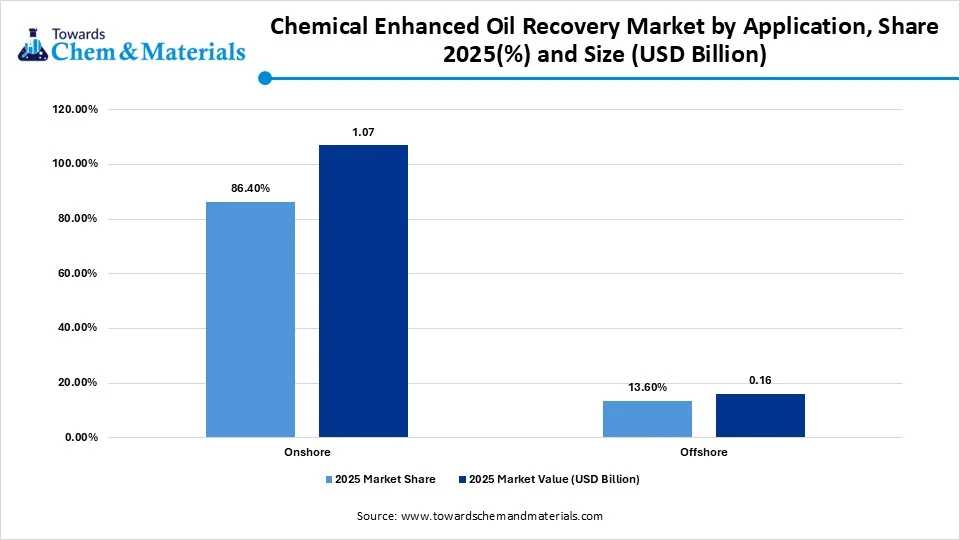
Onshore fields held a market revenue of 86.40% (USD 1,070.15 million) in 2025 owing to the fact that the application of chemical flooding is easier with dense well patterns and onshore water handling. The offshore fields segment account for 13.60% (USD 168.45 million) market share and is growing at a significant rate as polymer flooding is tested in offshore heavy oil and mature fields.
Note: 2025 is the base year.
Sources: Expert interviews, secondary sources, Towards Chem and Materials database and Towards Chem and Materials analysts.
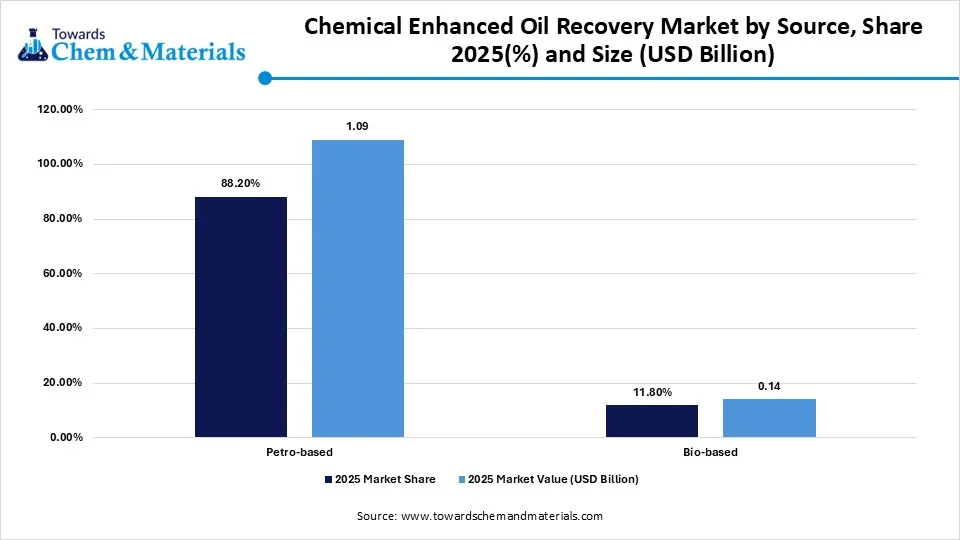
Petro-based chemicals accounted for a market share of 88.20% (USD 1,092.45 million) in 2025 because of the domination of synthetic polyacrylamide and petroleum sulphonates. Bio-based chemicals, including biopolymers and bio-surfactants, held a market share of 11.80% (USD 146.15 million) and is being increasingly considered for high-temperature and high-salinity reservoirs and to decrease environmental impact.
Analyst View: Segment values have been allocated by mapping each flooding project to its method, chemical mix, location, and source, by making use of injection volumes and prices. The domination of polymer flooding can be attributed to the fact that it has the widest application base and lowest-cost chemical method. We expect the market share of polymer flooding and Middle East onshore projects to increase, while ASP continues to be concentrated in China.
Note: 2025 is the base year.
Sources: Expert interviews, secondary sources, the Towards Chem and Materials database, and Towards Chem and Materials analysts.
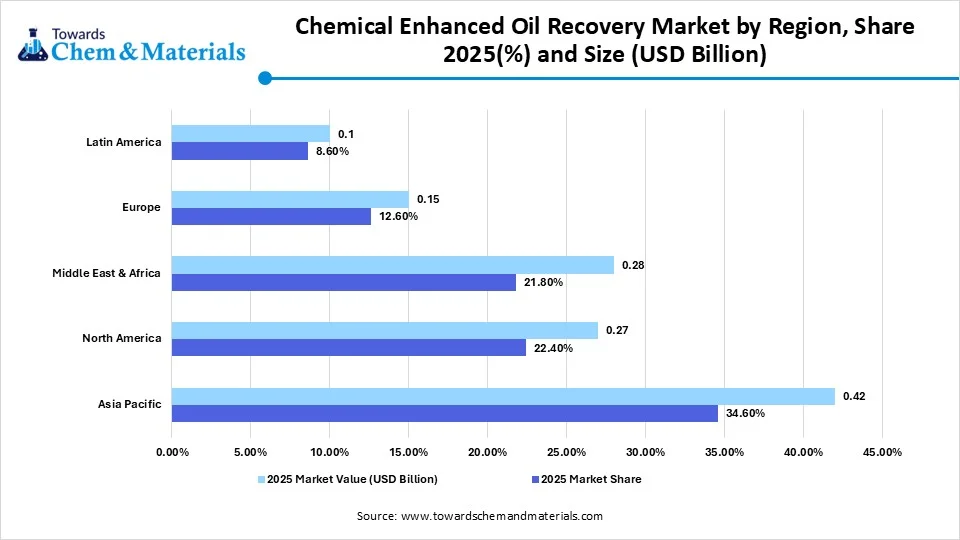
Asia Pacific accounted for a market share of 34.60% (USD 428.56 million) in 2025, owing to long-running polymer and ASP flooding in China's mature fields and full-field polymer projects in India. North America held 22.40% (USD 277.45 million) of revenue due to polymer flooding of heavy oil in Canada and mature fields in the United States, while the Middle East and Africa, at 21.80% (USD 270.01 million), is the fastest-growing region, because of polymer projects in Oman, the UAE, and Kuwait. Europe accounted for 12.60% (USD 156.06 million) of the market share, owing to chemical flooding in Russia, Kazakhstan, and Central Europe, and Latin America, at 8.60% (USD 106.52 million), is growing with polymer projects in Argentina, Colombia, and Brazil.
Analyst View: Regional shares have been built from active and planned chemical flooding projects in each region, weighted by injection volumes and chemical costs. The domination of Asia Pacific is because China operates the largest chemical flooding programs. We assign the Middle East and Africa the highest growth rate due to the fact that Oman, the UAE, and Kuwait are moving several polymer projects from pilot to full-field scale.
| Rank | Company Name | Market-Specific Revenue (USD Million) | 2025 Share | Key Products / Business | Headquarters |
| 1 | SNF | 310 | 25.03% | FLOPAAM EOR polymers and injection services | France |
| 2 | Beijing Hengju Chemical Group | 78 | 6.30% | Polyacrylamide for EOR | China |
| 3 | BASF | 64 | 5.17% | EOR polymers and surfactants | Germany |
| 4 | Dow | 52 | 4.20% | EOR surfactants and chemicals | United States |
| 5 | SLB (ChampionX) | 46 | 3.71% | Production and EOR chemicals | United States |
| 6 | Kemira | 44 | 3.55% | Polyacrylamide EOR polymers | Finland |
| 7 | Syensqo | 40 | 3.23% | EOR surfactants | Belgium |
| 8 | Stepan | 38 | 3.07% | EOR surfactants | United States |
| 9 | Shell | 30 | 2.42% | ENORDET EOR surfactants | United Kingdom |
| 10 | ZL EOR Chemicals | 28 | 2.26% | Polyacrylamide EOR polymers | Canada |
Note: Company revenues and shares are 2025 estimates.
Sources: Company press releases, expert interviews, secondary sources, Towards Chem and Materials database and Towards Chem and Materials analysts.
SNF dominated the market as it held 25.03% (USD 310.00 million) of 2025 revenue, Beijing Hengju ranked second at 6.30% (USD 78.00 million) and BASF at 5.17% (USD 64.00 million). SNF ranks first in the production of EOR polyacrylamide with field injection services, Beijing Hengju through its large supply to Chinese oil fields, and BASF through EOR polymers and surfactants. The top 10 companies held 58.94% (USD 730.00 million) of the total market revenue in 2025, whereas the remaining 41.06% (USD 508.60 million) was shared among Chinese polyacrylamide producers, regional surfactant producers and oilfield service companies. The market is concentrated in polymers, where SNF holds a strong position, and competition centers on polymer performance in harsh reservoirs, field support, local production and long-term contracts with national oil companies.
By Type
By Chemical
By Application
By Source
By Region
The chemical enhanced oil recovery market was defined as polymers, surfactants, alkalis and other chemicals used in chemical enhanced oil recovery worldwide, including polymer, ASP and surfactant-polymer flooding. The 2025 base year was built bottom-up from active and planned flooding projects, injection volumes, chemical concentrations and chemical prices, and checked top-down against the EOR chemical revenue of leading polymer and surfactant suppliers.
Segment, regional and company values were allocated from flooding methods, chemical types, onshore and offshore fields, chemical sources and regional project activity. Key estimates were verified by cross-checking company disclosures, regulatory and industry data and published third-party estimates, and inputs that could not be reconciled were excluded. All segment, regional and company figures were reconciled to the same 2025 base year, and the 2026–2035 forecast, which applies a constant CAGR from the 2025 base, was recalculated and validated.
The chemical enhanced oil recovery market depends on national oil companies' efforts to extend mature fields, with polymer flooding as the main method. Our estimate links demand to project activity, injection volumes and chemical prices, so the forecast follows the pace of pilot-to-field expansion. The main upside comes from Middle East and Indian polymer projects, while the main risks are oil price volatility and reservoir performance.
Reliable market intelligence and data-driven insights across the global chemicals and materials industry, helping businesses understand trends, competition, pricing, and emerging opportunities.
Schedule a Demo