Find the Right Market Report
Search thousands of industry reports, market insights, and research studies in one place.
Not sure where to start? Try one of these:
The global charcoal Pini-Kay briquettes market size was valued at USD 565 million in 2025 and is expected to reach USD 1208.55 million by 2035, growing at a CAGR of 7.90% during the forecast period of 2026-2035. The market was valued at USD 565.00 million in 2025, the base year. The charcoal Pini-Kay briquettes market covers carbonized briquettes made by compressing sawdust and other biomass at high pressure and temperature into hexagonal or square logs with a central hole, which are then carbonized into charcoal. These briquettes are made from hardwood sawdust, softwood sawdust, mixed biomass, and coconut and agricultural residues, and are used for restaurant and food service grilling, household barbecue, shisha and hookah, industrial and metallurgical applications, and other uses, with sales through offline and online channels.
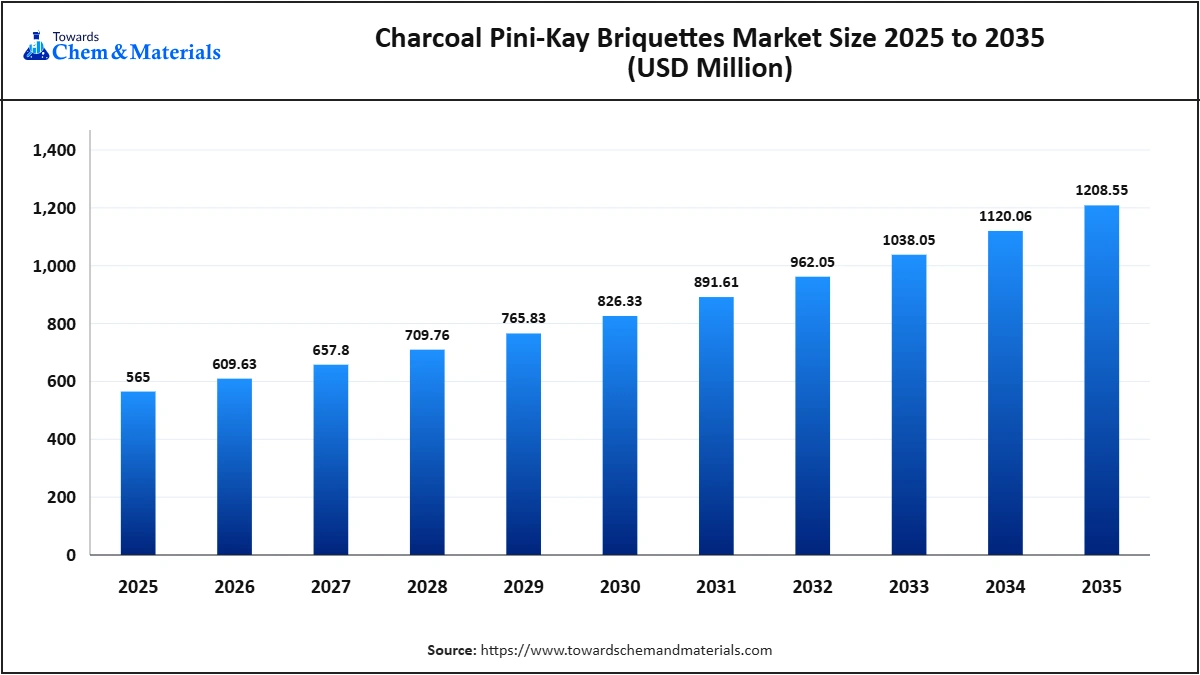
Note: 2025 is the base year; 2026-2035 values are forecasts.
Sources: Expert interviews, secondary sources, Towards Chemical and Materials database, and Towards Chemical and Materials analysts.
Hardwood sawdust accounted for the largest share in 2025, at 46.00%, because it produces dense, long-burning charcoal with high heat and little smoke, preferred by restaurants and exporters. Asia Pacific accounted for 42.00% of revenue in 2025, supported by large production in Indonesia, Vietnam, India and China, strong demand from South Korean, Japanese and other barbecue restaurants, and export-oriented manufacturing. Demand is driven by the growth of barbecue and grill restaurants, consumer preference for long-burning, low-smoke and uniform fuel, use of sawdust and wood waste instead of logs, interest in sustainable charcoal, and online sales of grilling and hookah fuel. Regulation is shaping trade, as the EU Deforestation Regulation, which covers wood products including charcoal, is scheduled to apply from December 30, 2026, requiring proof that products are deforestation-free.
The charcoal Pini-Kay briquettes market is projected to grow from USD 565.00 million in 2025 to USD 1,208.55 million by 2035 because restaurants and consumers want long-burning, uniform, and low-smoke charcoal, and Pini-Kay briquettes made from sawdust offer this while using wood waste. Growth of barbecue and grill restaurants, household grilling, hookah culture, export demand from Asia, and the shift from lump charcoal to sustainable waste-based briquettes support steady growth, lifting the market to USD 826.33 million by 2030 and sustaining a CAGR of 7.90% from 2026 to 2035.
Analyst View: The market is set for steady growth, driven by rising demand for cleaner, longer-burning charcoal across restaurants, households, and hookah users. Increasing preference for sustainable, waste-based alternatives to traditional lump charcoal, coupled with growing barbecue culture and export opportunities, will further support market expansion.
Driver: The growth of barbecue restaurants and increasing consumer preference for long-burning, low-smoke fuel are driving demand for Pini-Kay briquettes. The availability of low-cost sawdust and expanding hookah culture further support market growth, while rising interest in sustainable charcoal alternatives strengthens adoption.
Restraint: Strict air quality regulations may limit charcoal use in certain markets. High transportation costs, inconsistent product quality, and additional compliance expenses related to deforestation regulations also pose challenges. Moreover, competition from gas and electric grills may restrict market expansion.
Opportunity: Manufacturers can capitalize on growing demand by developing certified sustainable supply chains and using alternative feedstocks such as coconut shells and agricultural waste. Premium branded products, expanding demand across the Middle East and Asia, and the growth of online direct-to-consumer sales offer further opportunities for market expansion.
| Segments | 2025 Share | 2025 Value (USD Million) | 2035 Value (USD Million) | CAGR 2026-2035 |
| Hardwood Sawdust | 46.00% | 259.90 | 529.58 | 7.38% |
| Softwood Sawdust | 22.00% | 124.30 | 262.86 | 7.78% |
| Mixed Biomass | 18.00% | 101.70 | 215.07 | 7.78% |
| Coconut & Agricultural Residue | 14.00% | 79.10 | 201.04 | 9.78% |
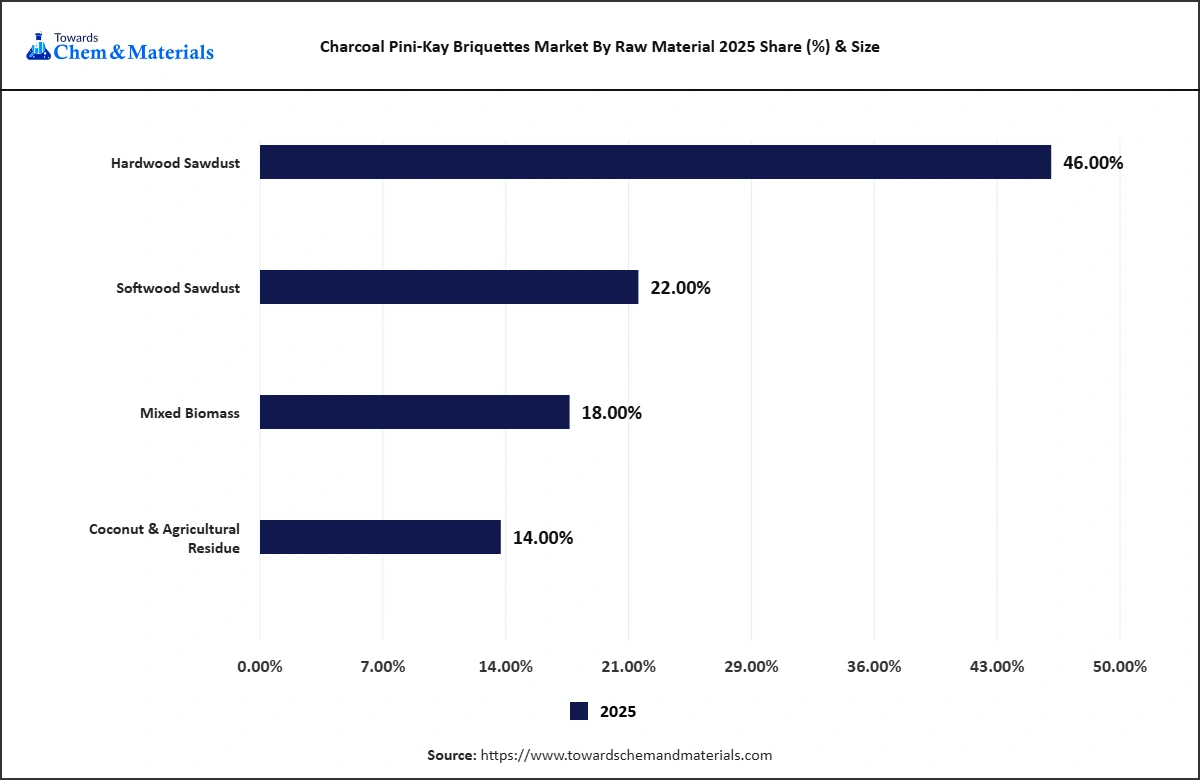
Note: 2025 is the base year; 2035 values are forecasts.
Sources: Expert interviews, secondary sources, Towards Chemical and Materials database, and Towards Chemical and Materials analysts.
Hardwood sawdust accounted for a 46.00% share (USD 259.90 million) in 2025, softwood sawdust for 22.00% (USD 124.30 million), mixed biomass for 18.00% (USD 101.70 million), and coconut & agricultural residue for 14.00% (USD 79.10 million).
Hardwood Sawdust: The segment dominates the market with a 46.00% share and reached USD 259.90 million in 2025 and is projected to reach USD 529.58 million by 2035, at a CAGR of 7.38% from 2026 to 2035. Hardwood sawdust, from species such as oak, beech, acacia, and tropical hardwoods, is the largest raw material because it makes dense charcoal that burns long and hot with little smoke and ash.
Coconut & Agricultural Residue: In 2025, this segment generated USD 79.10 million, representing a 14.00% share. Its value is anticipated to increase to USD 201.04 million by 2035, registering a CAGR of 9.78% over the forecast period. Coconut & agricultural residues such as rice husk and bamboo are the fastest-growing raw materials because they are abundant in Asia, renewable, and produce high-quality, low-smoke charcoal.
| Segments | 2025 Share | 2025 Value (USD Million) | 2035 Value (USD Million) | CAGR 2026-2035 |
| Restaurants & Food Service | 40.00% | 226.00 | 461.90 | 7.41% |
| Household Barbecue | 30.00% | 169.50 | 387.12 | 8.61% |
| Shisha & Hookah | 12.00% | 67.80 | 143.81 | 7.81% |
| Industrial & Metallurgical | 10.00% | 56.50 | 119.84 | 7.81% |
| Others | 8.00% | 45.20 | 95.88 | 7.81% |
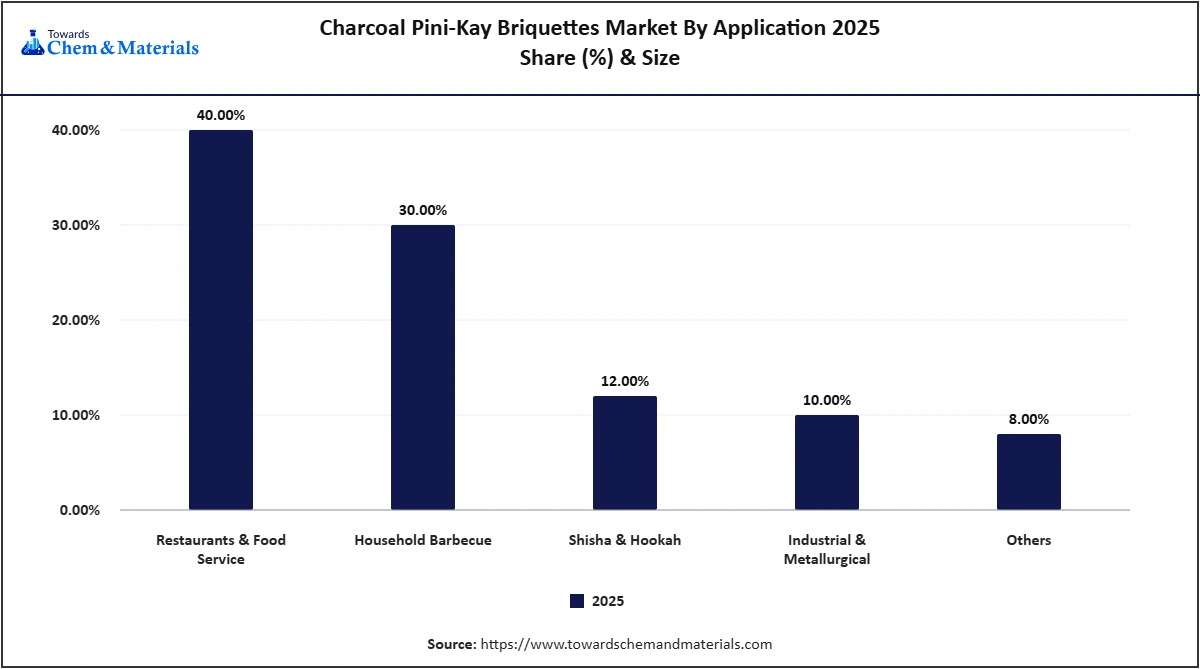
Note: 2025 is the base year; 2035 values are forecasts.
Sources: Expert interviews, secondary sources, Towards Chemical and Materials database, and Towards Chemical and Materials analysts.
Restaurants & food service dominate the market with a 40.00% share and reached USD 226.00 million in 2025; household barbecue held 30.00% (USD 169.50 million), shisha & hookah captured 12.00% (USD 67.80 million), industrial & metallurgical uses accounted for 10.00% (USD 56.50 million), and other applications contributed 8.00% (USD 45.20 million).
Restaurants & Food Service: This segment represented a significant portion of the market in 2025, with a valuation of USD 226.00 million. It is forecast to grow at an annual rate of 7.41%, reaching USD 461.90 million by 2035. Restaurants and food service are the largest application because barbecue, yakiniku, Korean barbecue, kebab, and grill restaurants need consistent, long-burning, low-smoke charcoal that cooks evenly.
Household Barbecue: Accounting for a 30.00% share in 2025, this segment was valued at USD 169.50 million. It is projected to witness steady growth, reaching USD 387.12 million by 2035 at a CAGR of 8.61% over the forecast period. Household barbecue is growing faster as consumers buy premium, long-burning charcoal for home grilling through supermarkets and online stores.
| Segments | 2025 Share | 2025 Value (USD Million) | 2035 Value (USD Million) | CAGR 2026-2035 |
| Offline | 74.00% | 418.10 | 828.35 | 7.08% |
| Online | 26.00% | 146.90 | 380.20 | 9.98% |
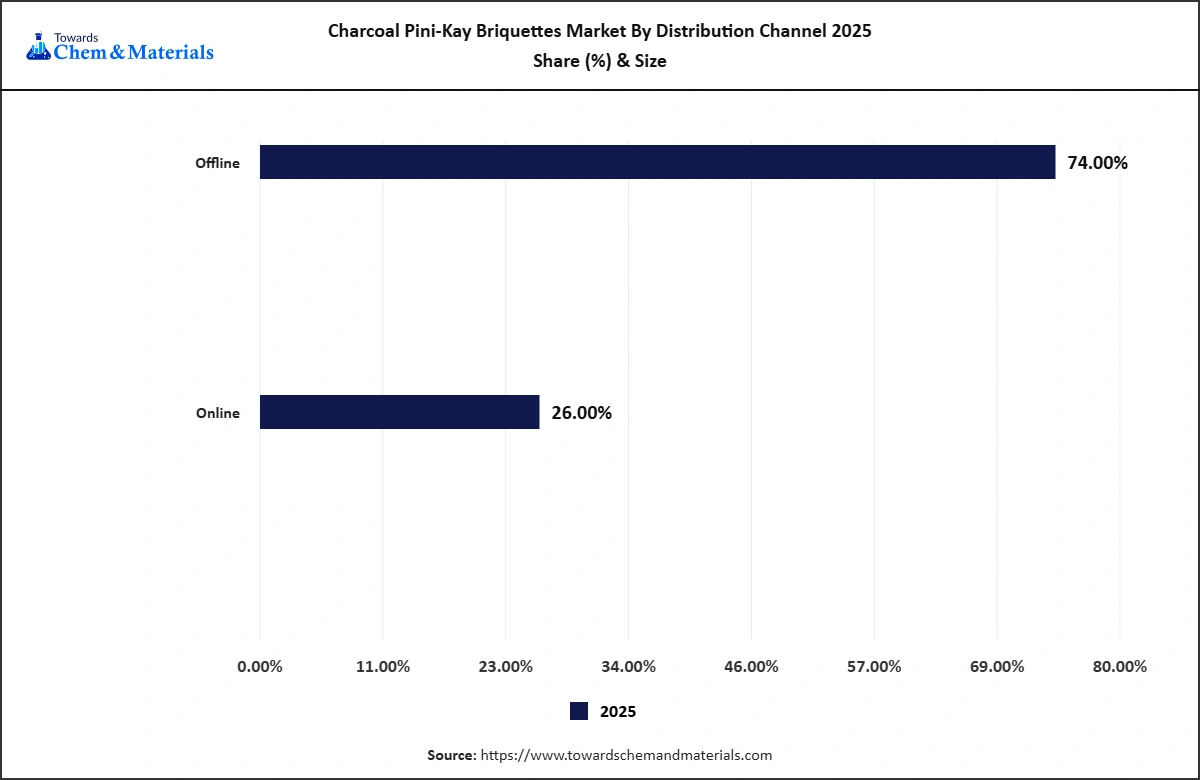
Note: 2025 is the base year; 2035 values are forecasts.
Sources: Expert interviews, secondary sources, Towards Chemical and Materials database, and Towards Chemical and Materials analysts.
Offline channels accounted for 74.00% (USD 418.10 million) in 2025, and online channels for 26.00% (USD 146.90 million).
Offline: The segment was valued at USD 418.10 million in 2025, contributing 74.00% market share. It is expected to reach USD 828.35 million by 2035, growing at a CAGR of 7.08% from 2026 to 2035. Offline channels, including importers, wholesalers, restaurant suppliers, and supermarkets, lead because most volume is sold in bulk to restaurants and retailers.
Online: Valued at USD 146.90 million in 2025, this segment represents a 26.00% share in 2025. It is estimated to grow to USD 380.20 million by 2035, at a CAGR of 9.98% over the forecast period. Online channels are growing faster as consumers and small restaurants buy charcoal through e-commerce marketplaces and brand websites.
Analyst View: Hardwood sawdust leads the raw material segment due to its high heat output, longer burn time, and low ash generation, while coconut and agricultural residues are gaining traction as sustainable alternatives. Restaurants and food service dominate applications, supported by rising demand for consistent, low-smoke grilling fuel, whereas household barbecue is growing faster with increasing home-grilling adoption. Offline distribution remains dominant due to bulk commercial purchases, but online sales are expanding rapidly, driven by e-commerce adoption and convenient direct-to-consumer access.
| Region | 2025 Share | 2025 Value (USD Million) | 2035 Value (USD Million) | CAGR 2026-2035 |
| Asia Pacific | 42.00% | 237.30 | 540.57 | 8.58% |
| Europe | 24.00% | 135.60 | 276.41 | 7.38% |
| North America | 18.00% | 101.70 | 207.30 | 7.38% |
| Middle East & Africa | 10.00% | 56.50 | 115.17 | 7.38% |
| Latin America | 6.00% | 33.90 | 69.10 | 7.38% |
Note: 2025 is the base year; 2035 values are forecasts.
Sources: Expert interviews, secondary sources, Towards Chemical and Materials database, and Towards Chemical and Materials analysts.
Asia Pacific accounted for 42.00% (USD 237.30 million) in 2025, Europe for 24.00% (USD 135.60 million), North America for 18.00% (USD 101.70 million), the Middle East and Africa for 10.00% (USD 56.50 million), and Latin America for 6.00% (USD 33.90 million). Asia Pacific held the largest regional share in 2025 and is projected to record the fastest growth through 2035.
Asia Pacific: This region dominates the market with a 42.00% share and reached USD 237.30 million in 2025 and is expected to reach USD 540.57 million by 2035, at a CAGR of 8.58% from 2026 to 2035. Asia Pacific is the largest and fastest-growing region because Indonesia, Vietnam, India, and China produce and export large volumes of sawdust and coconut charcoal briquettes, and Korea, Japan, and China have strong barbecue restaurant demand.
Europe: In 2025, this region generated USD 135.60 million, representing a 24.00% share. Its value is anticipated to increase to USD 276.41 million by 2035, registering a CAGR of 7.38% over the forecast period. Europe imports large volumes of charcoal briquettes for barbecue, restaurants, and shisha, and has producers in Eastern Europe, with sustainability and deforestation rules shaping supply.
North America: North America accounted for USD 101.70 million in 2025, representing 18% of the global market. The regional market is projected to reach USD 207.30 million by 2035, registering a CAGR of 7.38%. Strong household and restaurant barbecue culture, coupled with rising demand for premium and hookah charcoal, supports regional market growth.
Analyst View: Asia Pacific dominates the market and is expected to maintain its lead, driven by strong production and export capabilities, abundant biomass availability, and established barbecue culture. Europe remains a key market, supported by charcoal imports and restaurant and shisha demand, while sustainability regulations increasingly influence sourcing. North America is set for steady growth, driven by strong household grilling habits and rising demand for premium barbecue and hookah charcoal.
| Rank | Company Name | Market-Specific Revenue (USD Million) | 2025 Share | Key Products / Business | Headquarters |
| 1 | Wood Energo | 14.00 | 2.48% | Pini-Kay and wood fuel briquettes | Ukraine |
| 2 | Lignetics | 12.00 | 2.12% | Wood fuel briquettes and pellets | United States |
| 3 | BALT WOOD | 9.00 | 1.59% | Pini-Kay and fuel briquettes | Latvia |
| 4 | Global Woods Group | 7.00 | 1.24% | Wood briquettes and charcoal | Estonia |
| 5 | Green Biocoal | 6.00 | 1.06% | Biomass charcoal briquettes | India |
| 6 | Real Tech Engineering | 5.00 | 0.88% | Briquettes and briquetting systems | India |
| 7 | Chardust | 4.00 | 0.71% | Charcoal briquettes from waste | Kenya |
| 8 | Košal | 4.00 | 0.71% | Wood briquettes | Slovenia |
| 9 | Well Seasoned Wood | 3.00 | 0.53% | Wood fuel products | United Kingdom |
Note: Company revenues and shares are 2025 estimates.
Sources: Company press releases, expert interviews, secondary sources, Towards Chemical and Materials database, and Towards Chemical and Materials analysts.
Wood Energo led the charcoal Pini-Kay briquettes market with 2.48% share (USD 14.00 million) of 2025 revenue, followed by Lignetics at 2.12% (USD 12.00 million) and BALT WOOD at 1.59% (USD 9.00 million). Wood Energo leads with wide distribution and consistent quality of Pini-Kay and other wood fuel briquettes. Lignetics supplies wood fuel briquettes and pellets in North America, and BALT WOOD produces Pini-Kay and fuel briquettes for European buyers. Global Woods Group, Green Biocoal, Real Tech Engineering, Chardust, Košal, and Well Seasoned Wood compete through wood briquettes and charcoal, biomass charcoal briquettes, briquetting systems, waste-based charcoal, and wood fuel products.
The top players accounted for an estimated 11.33% (USD 64.00 million) of 2025 revenue, while the remaining 88.67% (USD 501.00 million) was shared among many small producers and exporters in Indonesia, Vietnam, India, Africa, and Eastern Europe. The charcoal Pini-Kay briquettes market is highly fragmented, with many small and medium producers, and competition centers on burn time, heat, ash and smoke levels, consistency, packaging, export certifications, sustainability proof, and price. Traceability requirements under deforestation rules are becoming a competitive factor for exporters to Europe.
The charcoal Pini-Kay briquettes ecosystem links sawmills and biomass suppliers with briquette and charcoal producers, machinery makers, traders and importers, retailers and end users.
| Ecosystem Stage | Role in the Market | Key Companies |
| Raw Material Suppliers | Supply sawdust and residues | Sawmills, coconut and agricultural processors |
| Machinery Makers | Supply presses and kilns | Briquette press and carbonization kiln makers |
| Producers | Make and carbonize briquettes | Wood Energo, BALT WOOD, Green Biocoal, Chardust |
| Traders & Retailers | Import and sell | Importers, restaurant suppliers, supermarkets, e-commerce |
| End Users | Burn charcoal | Restaurants, households, hookah lounges, industry |
Sources: Company press releases, expert interviews, secondary sources, Towards Chemical and Materials database, and Towards Chemical and Materials analysts.
The Towards Chemical and Materials Companies Quadrant positions key participants in the charcoal Pini-Kay briquettes market by market strength, reflecting revenue scale, market share and geographic reach, and by innovation and growth strategy, reflecting product portfolio breadth, R&D intensity and partnerships. Positions reflect each company's estimated 2025 briquette revenue and our assessment of its product quality, sustainability, and innovation.
Sources: Company press releases, expert interviews, secondary sources, Towards Chemical and Materials database and Towards Chemical and Materials analysts.
Leaders: Wood Energo, Lignetics, BALT WOOD, Global Woods Group, and Green Biocoal combine larger briquette revenue with wide distribution and consistent quality.
Innovators: Real Tech Engineering, Chardust, and Košal bring waste-based and sustainable charcoal production.
Niche Players: Well Seasoned Wood serves narrower segments.
By Raw Material
By Application
By Distribution Channel
By Region
The charcoal Pini-Kay briquettes market was defined as carbonized Pini-Kay briquettes made from compressed sawdust and biomass. The 2025 base year was built bottom-up from production and export volumes of charcoal Pini-Kay briquettes by raw material, application, distribution channel, region, average prices, and checked top-down against producer capacity, trade flows, and published estimates of all Pini-Kay briquettes. Segment, regional, and company values were allocated from raw materials, applications, distribution channels, and regional consumption. Key estimates were verified by cross-checking company disclosures, regulatory and industry data and published third-party estimates, and inputs that could not be reconciled were excluded. All segment, regional, and company figures were reconciled to the same 2025 base year, and the 2026-2035 forecast, which applies a constant CAGR from the 2025 base, was recalculated and validated.
The charcoal Pini-Kay briquettes market is gaining traction as demand for long-burning, low-smoke, and sustainable charcoal increases across restaurants, households, and hookah applications. Market growth is driven by expanding barbecue culture, growing exports, and the increasing use of sawdust and agricultural waste as feedstocks. Asia Pacific remains the key growth engine because of its strong production base and consumption demand, while stricter air quality regulations, transportation costs, and deforestation compliance requirements remain key challenges.
Reliable market intelligence and data-driven insights across the global chemicals and materials industry, helping businesses understand trends, competition, pricing, and emerging opportunities.
Schedule a Demo