Find the Right Market Report
Search thousands of industry reports, market insights, and research studies in one place.
Not sure where to start? Try one of these:
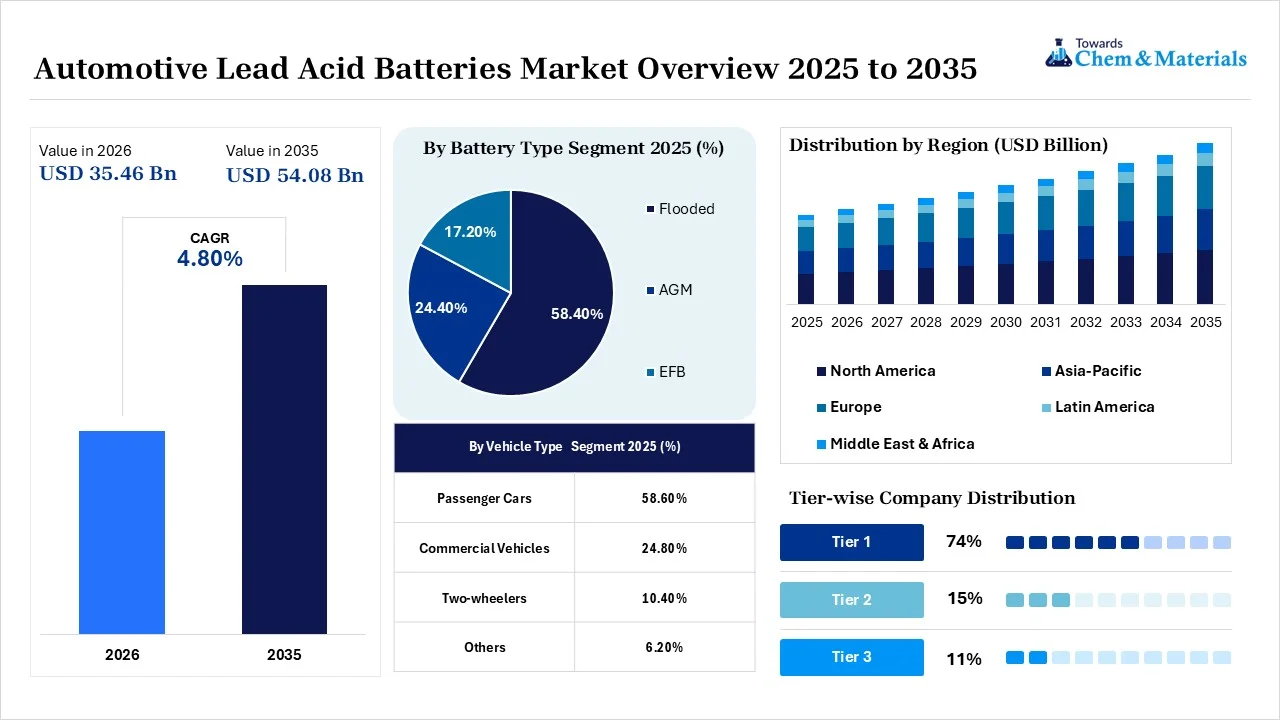
The global automotive lead-acid battery market is expected to grow from USD 35.46 billion in 2026 to USD 54.08 billion by 2035. The market is forecast to grow at a CAGR of 4.80% from 2026 to 2035.
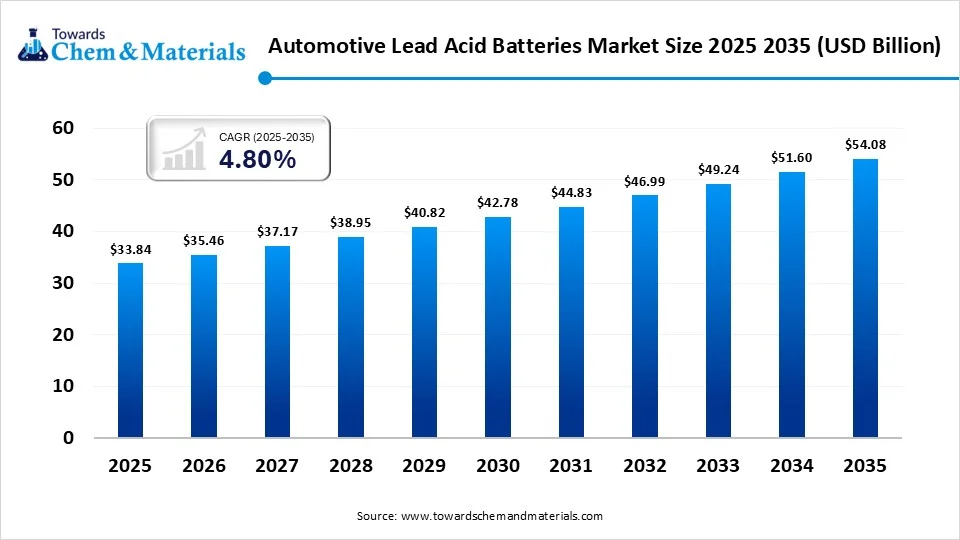
Note: 2025 is the base year; 2026-2035 values are forecasts.
Sources: Expert interviews, secondary sources, Towards Chem and Materials database and Towards Chem and Materials analysts.
The automotive lead-acid battery market covers flooded, enhanced flooded (EFB), and absorbent glass mat (AGM) batteries used for starting, lighting, ignition, start-stop systems, and 12-volt auxiliary power across passenger cars, commercial vehicles, two-wheelers, and other vehicle categories. Sales serve both vehicle manufacturers and the replacement market. Flooded batteries held the largest type share in 2025 at 58.40%, driven by their low cost and widespread use as standard starter batteries.
Asia Pacific accounted for 46.80% of market revenue in 2025, supported by high vehicle production and large vehicle fleets in China, India, Japan, and Southeast Asia. Market growth is driven by the expanding global vehicle fleet, recurring battery replacements, rising adoption of AGM and EFB batteries in start-stop vehicles, and continued demand for 12-volt auxiliary batteries in hybrid and electric vehicles. Leading manufacturers are also investing in AGM production capacity, battery recycling, and domestic supply chains across the United States and Europe.
The automotive lead-acid battery market is projected to grow from USD 33.84 billion in 2025 to USD 54.08 billion by 2035. Key growth drivers include the expanding global vehicle fleet, battery replacement cycles of three to five years, and rising adoption of higher-value AGM and EFB batteries for start-stop systems and advanced electrical applications. Hybrid and electric vehicles also use 12-volt auxiliary batteries, including AGM types. The market is projected to reach USD 42.78 billion by 2030, with a CAGR of 4.80% from 2026 to 2035.
Analyst View: The market estimate is based on regional vehicle production and fleet size, battery fitment rates, replacement cycles and average prices for flooded, EFB and AGM batteries.
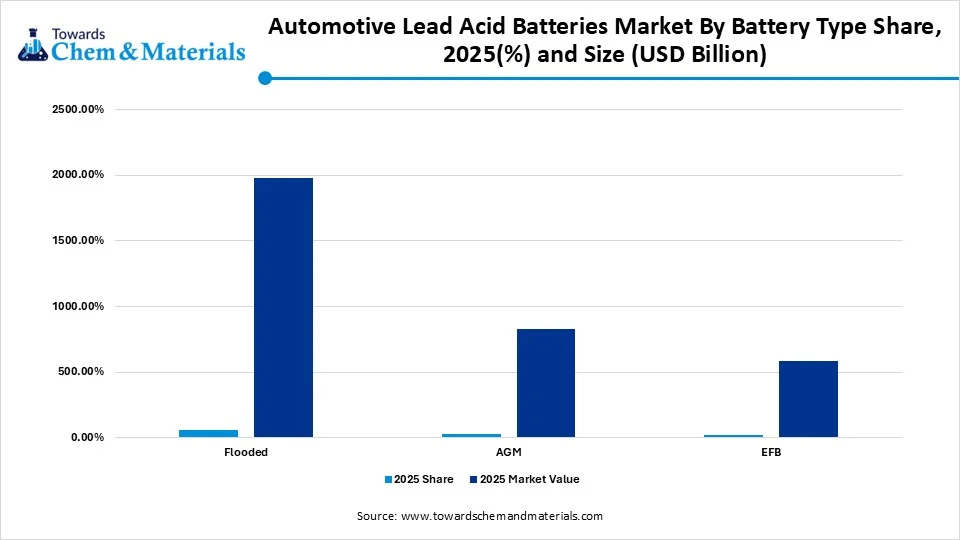
Note: 2025 is the base year.
Sources: Expert interviews, secondary sources, Towards Chem and Materials database and Towards Chem and Materials analysts.
Flooded batteries accounted for 58.40% (USD 19.76 billion) in 2025 because they remain the low-cost standard for conventional vehicles and the replacement market, especially in Asia, Latin America and Africa. AGM batteries, at 24.40% (USD 8.26 billion), are the fastest-growing type, used in premium vehicles, advanced start-stop systems and as auxiliary batteries in hybrid and electric vehicles. EFB batteries account for 17.20% (USD 5.82 billion) and serve entry-level start-stop vehicles at a lower cost than AGM.
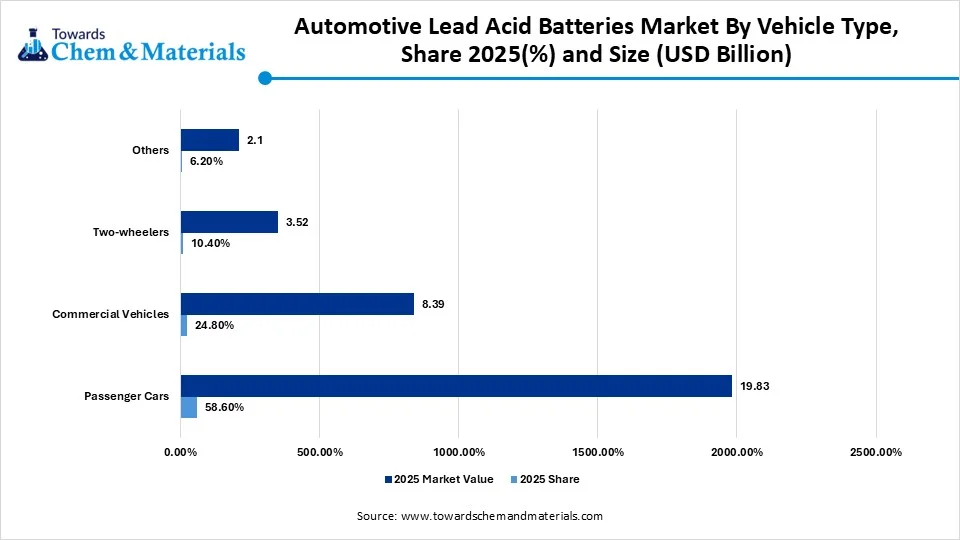
Note: 2025 is the base year.
Sources: Expert interviews, secondary sources, Towards Chem and Materials database and Towards Chem and Materials analysts
Passenger cars dominated the automotive lead-acid battery market in 2025, accounting for 58.60% (USD 19.83 billion), driven by the large global vehicle fleet and increasing adoption of start-stop systems. Commercial vehicles represented 24.80% (USD 8.39 billion), supported by demand for larger, heavy-duty batteries in trucks and buses. Two-wheelers accounted for 10.40% (USD 3.52 billion), with demand concentrated mainly in Asia. Other vehicles, including off-road, agricultural, and specialty vehicles, represented the remaining 6.20% (USD 2.10 billion).
Note: 2025 is the base year.
Sources: Expert interviews, secondary sources, Towards Chem and Materials database and Towards Chem and Materials analysts.
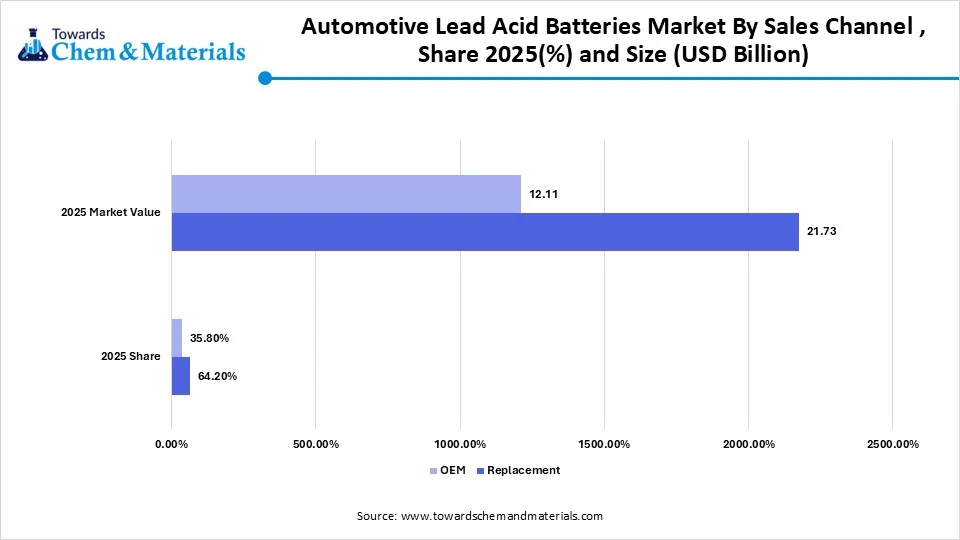
The replacement channel accounted for 64.20% (USD 21.73 billion) in 2025 because the global vehicle fleet is far larger than annual vehicle production and batteries wear out every few years. The OEM channel accounts for 35.80% (USD 12.11 billion) and is shifting toward AGM and EFB batteries as vehicle makers add start-stop systems and electrification.
Analyst View: Segment values were allocated by matching vehicle production and fleet volumes to battery types, vehicle types and channels, using average prices for each. Flooded batteries lead in value because of their very large volumes, while AGM batteries carry much higher prices per unit. We expect AGM batteries and the OEM share of AGM to grow, while flooded batteries lose share gradually as vehicle makers upgrade electrical systems.
Note: 2025 is the base year.
Sources: Expert interviews, secondary sources, the Towards Chem and Materials database, and Towards Chem and Materials analysts.
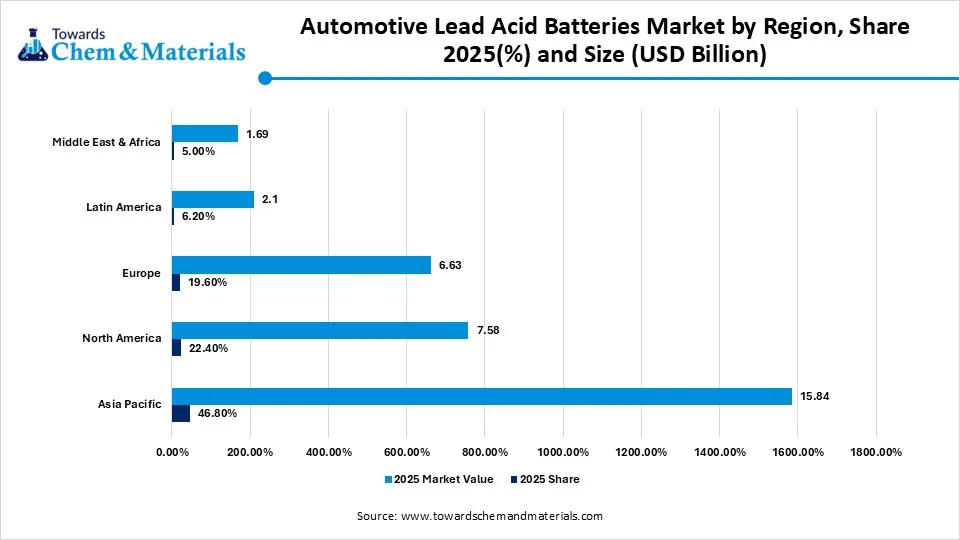
Asia Pacific led the automotive lead-acid battery market in 2025, accounting for 46.80% (USD 15.84 billion), and is the fastest-growing region, driven by vehicle production, fleet expansion, and strong two-wheeler demand across China, India, Japan, South Korea, and Southeast Asia. North America held a 22.40% share (USD 7.58 billion), supported by its large vehicle fleet, high replacement demand, and investment in AGM battery production. Europe accounted for 19.60% (USD 6.63 billion) and has the highest adoption of AGM and EFB batteries, driven by widespread use of start-stop systems. Latin America represented 6.20% (USD 2.10 billion), supported by vehicle fleet growth in Brazil and Mexico. The Middle East and Africa accounted for 5.00% (USD 1.69 billion), with demand driven by fleet expansion and hot climatic conditions that shorten battery life.
Analyst View: Regional shares were built from vehicle production, fleet size, replacement rates, and battery type mix in each region, weighted by price. Asia Pacific leads because it has the largest vehicle production and fleet. We assign Asia Pacific the highest growth premium because fleet growth in India and Southeast Asia continues to outpace mature markets.
| Rank | Company Name | Market-Specific Revenue (USD Billion) | 2025 Share | Key Products / Business | Headquarters |
| 1 | Clarios | 7.8 | 23.05% | VARTA, Optima and private-label AGM, EFB and flooded batteries | United States |
| 2 | Camel Group | 2.8 | 8.27% | Automotive starter and start-stop batteries | China |
| 3 | Exide Technologies | 2.4 | 7.09% | Automotive AGM, EFB and flooded batteries | France |
| 4 | GS Yuasa | 1.9 | 5.61% | Automotive lead acid batteries | Japan |
| 5 | East Penn Manufacturing | 1.8 | 5.32% | Deka automotive and AGM batteries | United States |
| 6 | Exide Industries | 1.6 | 4.73% | Automotive and two-wheeler batteries | India |
| 7 | Amara Raja Energy & Mobility | 1.1 | 3.25% | Amaron automotive and two-wheeler batteries | India |
| 8 | Hankook & Company | 0.95 | 2.81% | Automotive batteries (Hankook, AtlasBX) | South Korea |
| 9 | Fengfan | 0.85 | 2.51% | Automotive starter batteries | China |
| 10 | Banner Batteries | 0.45 | 1.33% | Automotive AGM, EFB and starter batteries | Austria |
Note: Company revenues and shares are 2025 estimates.
Sources: Company press releases, expert interviews, secondary sources, Towards Chem and Materials database and Towards Chem and Materials analysts.
Clarios led the automotive lead-acid battery market in 2025, accounting for an estimated 23.05% of revenue (USD 7.80 billion), followed by Camel Group at 8.27% (USD 2.80 billion) and Exide Technologies at 7.09% (USD 2.40 billion). Clarios maintains its leading position through a strong global presence across OEM and aftermarket channels and extensive AGM production capacity. Camel Group benefits from its strong position in China, while Exide Technologies maintains an established presence in European OEM and aftermarket markets.
The top 10 companies accounted for an estimated 63.98% of market revenue (USD 21.65 billion), while the remaining 36.02% (USD 12.19 billion) was distributed among regional battery manufacturers across China, India, Southeast Asia, Latin America, and Europe. The market is moderately concentrated, with competition centred on AGM technology, OEM approvals, distribution networks, recycling integration, and cost efficiency. Global leaders compete with established regional manufacturers across major automotive markets.
By Battery Type
By Vehicle Type
By Sales Channel
By Region
The automotive lead acid batteries market was defined as flooded, EFB and AGM lead acid batteries used in passenger cars, commercial vehicles, two-wheelers and other vehicles worldwide, sold through OEM and replacement channels. The 2025 base year was built bottom-up from vehicle production, fleet size, replacement rates and battery prices by type, and checked top-down against the automotive battery revenue of leading producers.
Segment, regional and company values were allocated from battery types, vehicle types, sales channels and regional fleets. Key estimates were verified by cross-checking company disclosures, regulatory and industry data and published third-party estimates, and inputs that could not be reconciled were excluded. All segment, regional and company figures were reconciled to the same 2025 base year, and the 2026-2035 forecast, which applies a constant CAGR from the 2025 base, was recalculated and validated.
The automotive lead-acid battery market is mature in terms of volume but continues to grow in value as automakers adopt AGM and EFB batteries. The market forecast is based on vehicle production, fleet size, replacement rates, and battery type mix, reflecting changes in vehicle fleets and AGM adoption. Key growth opportunities include rising demand for AGM batteries in start-stop and electric vehicles, along with expanding vehicle fleets in emerging markets. The main risk is the gradual replacement of lead-acid auxiliary batteries with lithium-based alternatives.
Reliable market intelligence and data-driven insights across the global chemicals and materials industry, helping businesses understand trends, competition, pricing, and emerging opportunities.
Schedule a Demo