
Asia Pacific Liquefied Natural Gas Market Size, Competitive Landscape Analysis Report 2035
The Asia Pacific liquefied natural gas market size was valued at USD 108.85 billion in 2025, is estimated to reach USD 116.42 billion in 2026, and is projected to reach USD 213.13 billion by 2035, exhibiting a compound annual growth rate (CAGR) of 6.95% over the forecast period from 2026 to 2035. In terms of volume, the Asia Pacific liquefied natural gas market is projected to grow from 289.85 million tons in 2025 to 513.23 million tons by 2035. growing at a CAGR of 5.88% from 2026 to 2035.Increasing demand for cleaner energy is the key factor driving market growth. Also, ongoing infrastructure investment, coupled with the surge in dependence on power generation, can fuel market growth further.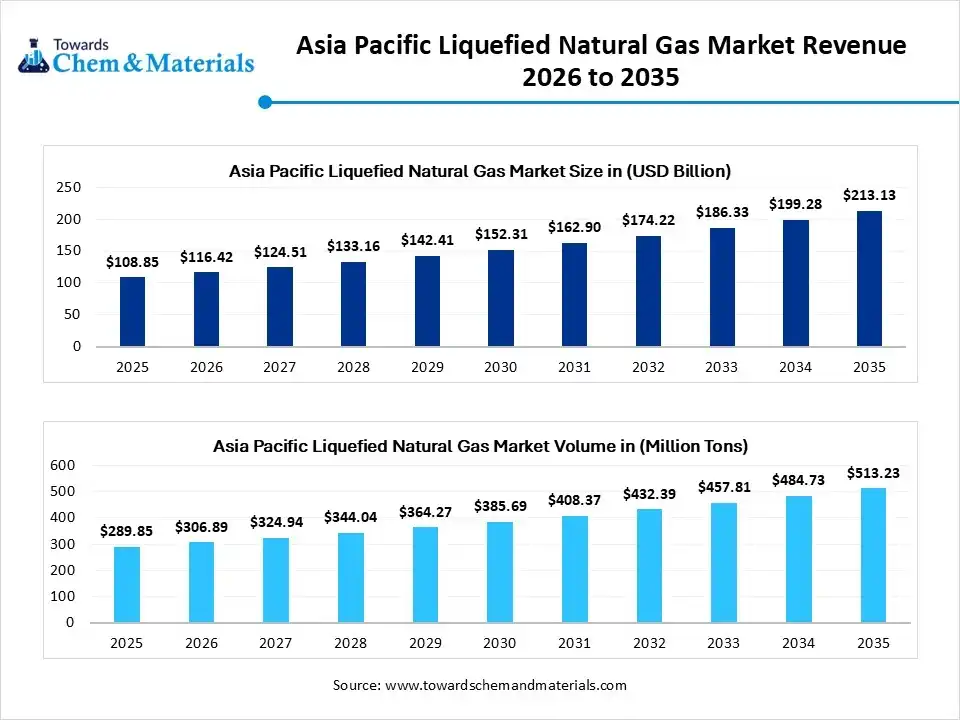
Market Highlights
- By country, China dominated the market with the largest share in 2025. The dominance of the country can be attributed to the growing usage of LNG in transportation.
- By country, India is expected to grow at the fastest CAGR over the forecast period. The growth of the country can be credited to the ongoing urbanization in the major states.
- By country, Japan is expected to grow at a notable CAGR over the forecast period. The growth of the country can be driven by increasing demand for power generation.
- By application, the power generation segment dominated the market with the largest share 46.00% in 2025. The dominance of the segment can be attributed to the ongoing investment in infrastructure developments.
- By application, the transportation fuel segment is expected to grow at the fastest CAGR over the forecast period. The growth of the segment can be credited to the growing LNG bunkering for ships.
- By Source, the conventional LNG segment dominated the market and accounted for the largest revenue share of 72.00% in 2025.
- By Infrastructure, the liquefaction terminals segment led the market with the largest revenue share of 38.00% in 2025.
- By End-User, the utilities segment dominated the market and accounted for the largest revenue share of 42.00% in 2025.
- By Contract Type, long-term contracts segment led the market with the largest revenue share of 58.00% in 2025.
At a Glance
- Market Estimated Size (2025): USD 108.85 Billion | CAGR (2026–2035): 6.95%
- Market Projected Size (2035): USD 213.13 Billion
- Market Estimated Volume (2025): 289.85 Million Tons | Volume CAGR (2026–2035): 6.95%
- Market Projected Volume (2035): 513.23 Million Tons
- Market Pricing (2025):
- Average Manufacturing Price (2025): USD 8.10/MMBtu
- Average Selling Price (2025): USD 11.90/MMBtu
- Pricing CAGR (2025–2035): 3.76%
Market Overview
Liquefied natural gas refers to the manufacturing, trade, and infrastructure of natural gas which has been cooled to nearly -162`0 C to - 260 °C to reach a liquid state for transport across the region. It is transported through specialized tankers and regasified at import terminals before being reached via pipeline to consumers. The Asia Pacific region depends on LNG for energy security because of its decreasing domestic reserves.
Market Trends
- The ongoing innovations in Floating Storage and Regasification Units (FSRUs) are the latest trend in the market, shaping positive market growth. This allows countries to import LNG without building expensive onshore terminals, reducing overall deployment times.
- The growing demand for electric power through sustainable energy sources is boosting the growth of the market further. Countries across the globe are adopting LNG to meet clean energy demand because of its lower carbon emissions compared to oil and coal, and its capability to enable power plants to ramp up quick energy production.
- Environmental concerns are impelling market players towards sustainable manufacturing processes. There is an increasing focus on minimizing the carbon intensity of LNG supply chains, as companies are rapidly adopting innovative technologies such as carbon capture and storage, combining renewable energy into LNG production.
Report Scope
| Report Attribute | Details |
| Market Size in 2026 | USD 116.42 Billion / 306.89 Million Tons |
| Revenue Forecast in 2035 | USD 213.13 Billion / 513.23 Million Tons |
| Growth Rate | CAGR 6.95% |
| Forecast Period | 2026 - 2035 |
| Base Year | 2025 |
| Segment Covered | By Source, By Infrastructure, By Application, By End-User, By Contract Type, By Country |
| Key companies profiled | British Petroleum (BP) p.l.c, Chevron Corporation, China Petroleum & Chemical Corporation, Eni SpA, Equinor ASA, Exxon Mobil Corporation, Gazprom Energy, PetroChina Company Limited, Royal Dutch Shell PLC, Total |
How Cutting-Edge Technologies Are Revolutionizing the Asia Pacific Liquefied Natural Gas Market?
Advanced technologies such as modular LNG facilities, AI-driven optimization, and innovative floating storage regasification units (FSRUs) are revolutionizing the market. These advancements enhance energy efficiency, minimize costs, improve safety via IoT, and propel project deployment. Furthermore, heavy investments in hydrogen-ready infrastructure and carbon capture and storage (CCS) systems are minimizing the carbon footprints, aligning with regional decarbonization goals.
Trade Analysis of Asia Pacific Liquefied Natural Gas Market Import & Export Statistics:
- In 2024, the leading global importers of liquefied natural gas (LNG) were China ($44,057,222.72K, 76,572,100,000 Kg), Japan ($41,180,083.63K, 65,890,700,000 Kg), the European Union ($39,639,572.73K, 72,758,900,000 Kg), Korea, Rep. ($29,272,042.86K, 46,317,900,000 Kg), and India ($14,984,892.38K, 27,793,900,000 Kg).
- In 2024, India's imports of Liquefied Natural Gas (LNG) reached a total value of $14,984,892.38K and quantity 27,793,900,000Kg.
- India's liquefied natural gas imports are led by Qatar ($6,404,937.30K, 11,304,400,000 Kg), the United States ($2,540,336.91K, 5,420,300,000 Kg), the United Arab Emirates ($1,714,880.39K, 3,163,710,000 Kg), Angola ($1,055,106.09K, 1,968,150,000 Kg), and Oman ($800,832.36K, 1,458,910,000 Kg).
- By mid-2024, India's operational natural gas network reached about 23,500 km. To realize the "One Nation, One Gas Grid" vision, the PNGRB (Petroleum and Natural Gas Regulatory Board) has authorized a massive expansion, aiming for a total of roughly 33,600 km to connect the entire country.
Asia Pacific Liquefied Natural Gas Market Supply Chain Analysis
Feedstock Procurement
- It refers to the sourcing, contracting, and acquisition of natural gas necessary to feed liquefaction terminals and the procurement of LNG by importers for regasification.
- Major Players: Shell PLC, TotalEnergies SE.
Chemical Synthesis and Processing
- It refers to the use of regasified LNG and natural gas liquids as a raw feedstock to manufacture crucial chemicals, polymers, and fertilizers.
- Major Players: Linde plc, BASF SE
Packaging and Labelling
- It refers to the technical standards and safety communications needed for the containment and detection of LNG during transport and storage.
- Major Players: Technip Energies & JGC Holdings, Petronet LNG
Regulatory Compliance and Safety Monitoring
- It involves adhering to strict international standards (IMO) and local regulations for logistics, storing, and regasifying LNG to manage harmful risk, methane emissions, and environmental impacts.
- Major Players: ABS Group, Honeywell
Asia Pacific Liquefied Natural Gas Market's Regulatory Landscape: Country-wise Regulations
| Country/Region | Key Regulations |
| China | Under the 14th (and upcoming 15th) Five-Year Plans, China has implemented market-oriented pricing mechanisms to boost domestic production, aiming for a "structural anchor" to reduce spot LNG reliance. |
| India | LNG Terminal Regulations 2025: The Petroleum and Natural Gas Regulatory Board (PNGRB) now requires terminal developers to inform the regulator before final investment to ensure pipeline connectivity and avoid underutilization. |
| Japan | Starting January 2026, Japan will mandate monthly LNG purchases for emergency reserves, expanding from the previous winter-only requirement. JERA will secure at least one SBL cargo per month to hedge against disruptions. |
Segmental Insights
Application Insights
Power Generation Segment Dominated the Market in 2025 with the Largest
The power generation segment dominated the market with the largest share 46.00% in 2025. The dominance of the segment can be attributed to the ongoing investment in infrastructure developments and rising electricity demand from the emerging economies such as China and India. In addition, rapid innovations in high-efficiency Combined-Cycle Gas Turbines (CCGT) are enabling gas -based power to be more cost-efficient and reliable, leading to segment growth soon.
The transportation fuel segment is expected to grow at the fastest CAGR over the forecast period. The growth of the segment can be credited to the growing LNG bunkering for ships, coupled with the strict environmental regulations necessitating lower emissions in heavy-duty trucking. Furthermore, LNG often offers a cost-effective solution for transportation, especially for long-haul transport, contributing to segment expansion shortly.
Asia Pacific Liquefied Natural Gas Market Share, By Application, 2025 (%)
| By Application | Revenue Share, 2025 (%) |
| Power Generation | 46.00% |
| Industrial Use | 27.00% |
| Residential & Commercial | 12.00% |
| Transportation Fuel | 15.00% |
- Power Generation dominates the Asia Pacific Liquefied Natural Gas (LNG) market due to the region's growing demand for energy, with LNG being a cleaner alternative to traditional fuels for electricity generation, securing 46.00% share in 2025.
- Industrial Use gains momentum as LNG is increasingly used in industrial processes, particularly in sectors like manufacturing and chemical production, where it serves as an efficient energy source with 27.00% share in 2025.
- Transportation Fuel holds a moderate share, driven by the growing adoption of LNG as an eco-friendly fuel for trucks and ships, reducing carbon emissions in the transportation sector with 15.00% share in 2025.
- Residential & Commercial contributes to the market with a focus on using LNG for heating and cooking in urban areas, but its share remains smaller compared to other applications with 12.00% share in 2025.
By Source
Conventional LNG Segment Dominated the Market in 2025 with the Largest
The Conventional LNG segment is derived from natural gas fields and is further divided into associated gas and non-associated gas. Associated gas refers to natural gas found alongside crude oil deposits, while non-associated gas is extracted from natural gas fields independent of oil reserves. In 2025, Conventional LNG is expected to dominate the market, capturing the largest share, due to its established infrastructure and reliable production processes.
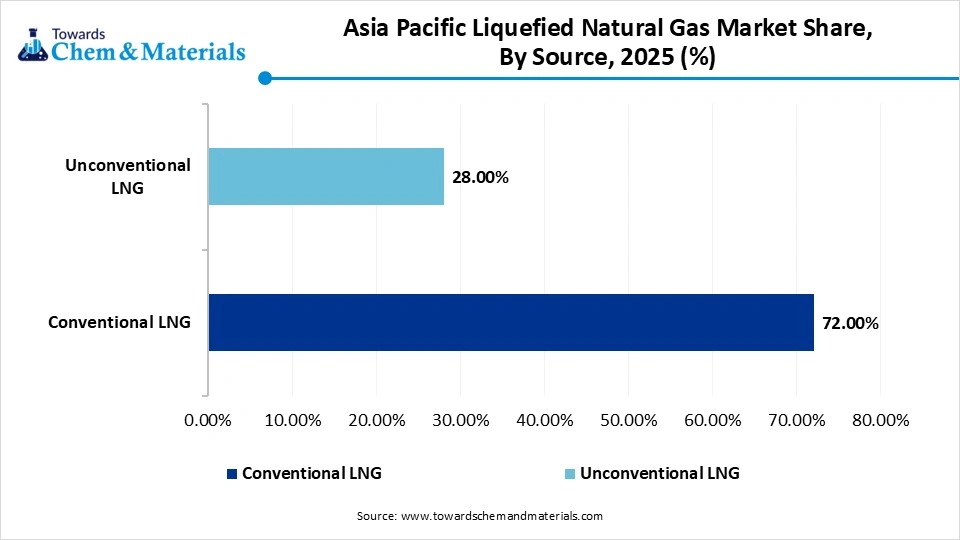
Unconventional LNG segment is expected to grow at the fastest CAGR over the forecast period is sourced from non-traditional natural gas reserves, which include shale gas, coal bed methane (CBM), and tight gas. Shale gas is extracted from fine-grained sedimentary rocks, while CBM is gas trapped in coal seams, and tight gas is found in low-permeability rock formations. driven by advances in hydraulic fracturing and horizontal drilling technologies, which are enhancing its extraction efficiency.
Asia Pacific Liquefied Natural Gas Market Share, By Source , 2025 (%)
| By Source | Revenue Share, 2025 (%) |
| Conventional LNG | 72.00% |
| Unconventional LNG | 28.00% |
- Conventional LNG dominates the Asia Pacific Liquefied Natural Gas (LNG) market due to its well-established production infrastructure, large-scale availability, and reliability in meeting the region's growing energy demands with 72.00% share in 2025.
- Unconventional LNG gains momentum as technological advancements make it more viable, offering alternative sources of LNG, particularly in areas with untapped resources, securing 28.00% share in 2025.
By End User
The Utilities segments are expected to dominate the market, holding the largest share, driven by the increasing demand for cleaner and more reliable energy sources for power generation. The transition to LNG in power plants and utilities, which are significant energy consumers, supports this dominance.
On the other hand, the Industrial Sector is anticipated to grow at the fastest compound annual growth rate (CAGR) over the forecast period. This growth is attributed to the rising adoption of LNG as a more sustainable and cost-efficient fuel for industries such as manufacturing, chemicals, and transportation. As industrial operations increasingly focus on reducing their carbon footprint, LNG presents an attractive alternative to traditional fuels.
Asia Pacific Liquefied Natural Gas Market Share, By End-User, 2025 (%)
| By End-User | Revenue Share, 2025 (%) |
| Utilities | 42.00% |
| Industrial Sector | 25.00% |
| Commercial Sector | 11.00% |
| Residential Sector | 9.00% |
| Transportation Sector | 13.00% |
- Utilities dominates the Asia Pacific Liquefied Natural Gas (LNG) market due to the significant demand from power plants and the growing shift towards LNG for cleaner energy production, securing 42.00% share in 2025.
- Industrial Sector gains momentum as LNG is increasingly adopted in manufacturing, chemical production, and other heavy industries where energy efficiency and lower emissions are key with 25.00% share in 2025.
- Transportation Sector holds a moderate share, driven by the growing use of LNG as a cleaner fuel for vehicles, including trucks and ships, helping reduce transportation emissions with 13.00% share in 2025.
- Commercial Sector is not dominating but remains important, driven by the use of LNG in heating and cooking applications, particularly in large-scale commercial buildings, with 11.00% share in 2025.
- Residential Sector holds a smaller share, primarily driven by the use of LNG for cooking and heating in urban residential areas, contributing 9.00% share in 2025.
By Contract Type
The Asia Pacific Liquefied Natural Gas (LNG) segment market is segmented by contract type into Long-Term Contracts and Short-Term Contracts. In 2025, Long-Term Contracts are expected to dominate the market, capturing the largest share. This dominance is primarily due to the stability and predictability they offer both suppliers and buyers, which is crucial for meeting long-term energy demands and ensuring continuous LNG supply.
The Short-Term Contracts segments are anticipated to grow at the fastest compound annual growth rate (CAGR) over the forecast period. The increasing need for flexibility in energy procurement, driven by market volatility and shifting energy dynamics, is contributing to this growth. Short-term contracts allow buyers to adjust quickly to market conditions, making them an attractive option for many stakeholders in the region.
Asia Pacific Liquefied Natural Gas Market Share, By Contract Type, 2025 (%)
| By Contract Type | Revenue Share, 2025 (%) |
| Long-Term Contracts | 58.00% |
| Short-Term Contracts | 24.00% |
| Spot Market | 18.00% |
- Long-Term Contracts dominates the Asia Pacific Liquefied Natural Gas (LNG) market due to the stability, long-term pricing, and secure supply they offer, particularly for large-scale infrastructure projects and power generation needs, with 58.00% share in 2025.
- Short-Term Contracts gains momentum as companies seek flexibility in LNG procurement, enabling them to adjust to fluctuating demand and prices, securing 24.00% share in 2025.
- Spot Market holds a smaller share, driven by opportunistic buying and selling based on immediate availability and price fluctuations, with 18.00% share in 2025.
By Infrastructure
Liquefied Natural Gas (LNG) market is segmented by infrastructure into two key categories: Liquefaction Terminals and Regasification Terminals. In 2025, Liquefaction Terminals are expected to dominate the market, holding the largest share due to their crucial role in converting natural gas into LNG for export. These terminals are vital in ensuring the smooth supply of LNG to meet the growing energy demand in the region.
On the other hand, Regasification Terminals are anticipated to grow at the fastest compound annual growth rate (CAGR) over the forecast period. This growth is driven by the increasing demand for LNG imports in countries like India, China, and Japan, where regasification terminals are essential for converting LNG back into gas to be distributed for domestic consumption. The rise in infrastructure development and import capacity is fueling this growth.
Asia Pacific Liquefied Natural Gas Market Share, By Infrastructure, 2025 (%)
| By Infrastructure | Revenue Share, 2025 (%) |
| Liquefaction Terminals | 38.00% |
| Regasification Terminals | 34.00% |
| Storage & Transportation | 28.00% |
- Liquefaction Terminals dominates the Asia Pacific Liquefied Natural Gas (LNG) market due to the growing need for facilities to convert natural gas into liquid form for efficient transport, securing 38.00% share in 2025.
- Regasification Terminals gains momentum as the region expands its infrastructure to convert LNG back into gaseous form for distribution and use in power generation, industrial, and residential sectors, with 34.00% share in 2025.
- Storage & Transportation holds a smaller share, essential for the safe and efficient storage and movement of LNG, particularly in key markets with 28.00% share in 2025.
Country Insights
How did the China Thrive in the Asia Pacific Liquefied Natural Gas Market in 2025?
China dominated the market with the largest share in 2025. China's dominance is driven by the expanding use of LNG in transport and power generation. The country is rapidly scaling up its regasification terminals, storage, and pipelines to manage record-breaking imports, solidifying its status as a top global buyer. This transitions is part of a broader push to replace coal with cleaner energy sources.
India is expected to grow at the fastest CAGR over the forecast period. The country's growth is being driven by rapid urbanization and the enforcement of stricter government emission policies. Furthermore, the market is expanding as liquefied natural gas (LNG) establishes itself as a sustainable, cleaner alternative for long-haul trucking and marine shipping.
Japan is expected to grow at a notable CAGR over the forecast period. The growth of the country can be fuelled by rising power demand and the transition to lower-carbon energy. Furthermore, key industry players are strengthening their market position by securing long-term contracts and increasing high-volume trading throughout the region.
Recent Developments
- In March 2026, amid energy instability from the Middle East conflict, Korea and Japan established a regular communication channel and a Supply Chain Partnership Arrangement (SCPA). The ministries agreed to prioritize cooperation in the LNG sector to secure stable energy supplies and improve supply chain resilience against global disruptions.(Source: biz.chosun.com)
Asia Pacific Liquefied Natural Gas (LNG) Market Competitive Landscape Analysis
Tier 1 Companies
|
Rank
|
Company Name | Headquarters | Country | Why Relevant to This Market | Key Products / Services |
| 1 | Petronas | Kuala Lumpur | Malaysia | One of Asia Pacific's largest LNG producers and exporters with an extensive global LNG portfolio | LNG production, liquefaction, exports, floating LNG (FLNG), LNG trading |
| 2 | Woodside Energy Group Ltd | Perth, Western Australia | Australia | Australia's largest independent LNG producer with major export projects | LNG production, liquefaction, LNG exports, offshore gas |
| 3 | Shell plc | London, England | United Kingdom | Operates major LNG projects and maintains a leading LNG trading presence across Asia Pacific | LNG production, trading, shipping, regasification |
Tier 2 Companies
|
Rank
|
Company Name | Headquarters | Country | Why Relevant to This Market | Key Products / Services |
| 1 | Santos Limited | Adelaide, South Australia | Australia | Major Australian LNG producer with integrated upstream and LNG operations | LNG production, gas processing, LNG exports |
| 2 | INPEX Corporation | Tokyo | Japan | Operates major LNG production projects serving Asia-Pacific markets | LNG production, natural gas development, exports |
| 3 | Mitsubishi Corporation | Tokyo | Japan | Strategic investor in LNG production, shipping, and global LNG trading | LNG investments, trading, LNG infrastructure |
| 4 | China National Offshore Oil Corporation | Beijing | China | Major LNG importer, terminal operator, and upstream producer in China | LNG imports, regasification terminals, LNG trading |
Tier 3 Companies
|
Rank
|
Company Name | Headquarters | Country | Why Relevant to This Market | Key Products / Services |
| 1 | China Petroleum & Chemical Corporation (Sinopec) | Beijing | China | Expanding LNG import terminals and natural gas distribution network | LNG imports, regasification, natural gas marketing |
| 2 | PetroChina Company Limited | Beijing | China | Operates LNG terminals and natural gas infrastructure across China | LNG imports, storage, pipelines, gas distribution |
| 3 | Korea Gas Corporation | Daegu | South Korea | One of the world's largest LNG importers and terminal operators | LNG imports, regasification, gas transmission |
| 4 | PTT Public Company Limited | Bangkok | Thailand | Thailand's leading LNG importer and developer of LNG infrastructure | LNG imports, regasification terminals, LNG distribution |
Asia Pacific Liquefied Natural Gas Market Companies
- British Petroleum (BP) p.l.c: BP p.l.c. maintains a commanding role in the Asia Pacific LNG market, leveraging a diversified portfolio to operate as a leading supplier, trader, and infrastructure developer. BP's strategy in the region is heavily focused on long-term supply contracts.
- Chevron Corporation: Chevron Corporation is a major player in the Asia-Pacific (APAC) liquefied natural gas (LNG) market, anchored by its operated Gorgon and Wheatstone projects in Australia, which represent one of the region's largest resource holdings.
- China Petroleum & Chemical Corporation: China Petroleum & Chemical Corporation (Sinopec) is a dominant, integrated energy player in the Asia-Pacific LNG market, focused on upstream exploration, massive import infrastructure, and expanding domestic distribution.
- Eni SpA
- Equinor ASA
- Exxon Mobil Corporation
- Gazprom Energy
- PetroChina Company Limited
- Royal Dutch Shell PLC
- Total S.A
Segments Covered in the Report
By Source
- Conventional LNG
- Associated Gas
- Non-associated Gas
- Unconventional LNG
- Shale Gas
- Coal Bed Methane (CBM)
- Tight Gas
By Infrastructure
- Liquefaction Terminals
- Onshore Liquefaction
- Floating LNG (FLNG)
- Regasification Terminals
- Onshore Terminals
- Floating Storage and Regasification Units (FSRU)
- Storage & Transportation
- LNG Carriers
- Storage Tanks
By Application
- Power Generation
- Base Load Power
- Peak Shaving Plants
- Industrial Use
- Chemicals & Petrochemicals
- Steel & Metal Processing
- Cement Industry
- Residential & Commercial
- Cooking & Heating
- Transportation Fuel
- Marine Fuel (Bunkering)
- Heavy-Duty Vehicles
- Rail
By End-User
- Utilities
- Industrial Sector
- Commercial Sector
- Residential Sector
- Transportation Sector
By Contract Type
- Long-Term Contracts
- Short-Term Contracts
- Spot Market
By Country
- Japan
- China
- Australia
- India
- South Korea
- Rest of APAC



Comments
Share your thoughts, ask a question, or provide feedback about this report.