Content


Advanced Polymer Market Size Analysis Report 2035
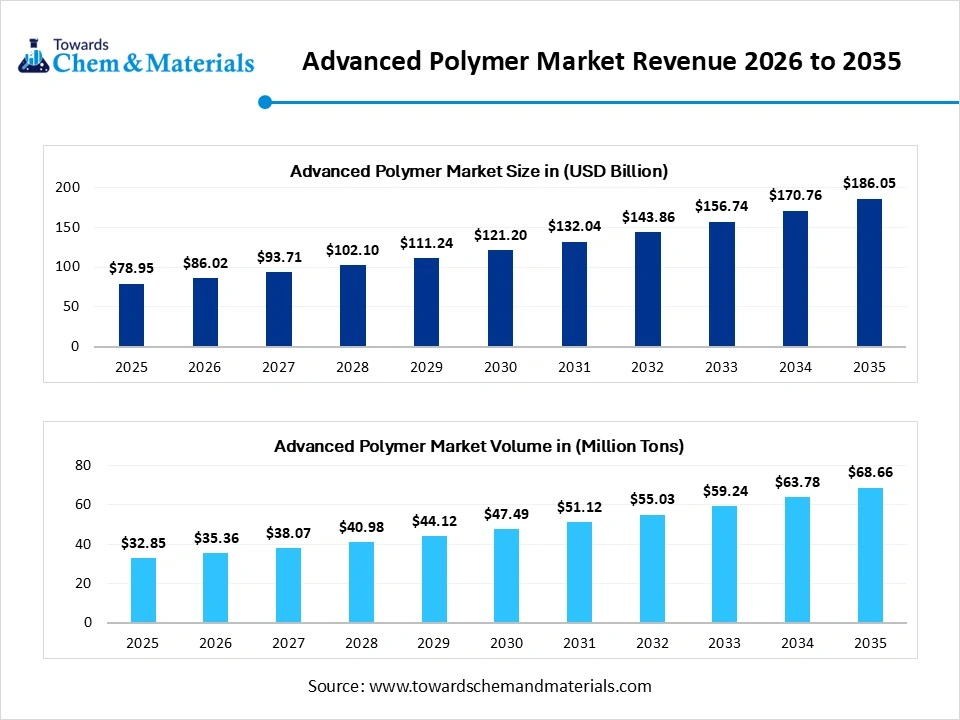
- Market Estimated Size (2025): USD 78.95 Billion | CAGR (2026–2035): 8.95%
- Market Projected Size (2035): USD 186.05 Billion
- Market Volume (2025): 32.85 Million Tons | Volume CAGR (2026–2035): 7.65%
- Market Projected Volume (2035): 68.66 Million Tons
- Market Pricing (2025):
- Average Manufacturing Price: USD 2,459/Ton
- Average Selling Price: USD 3,128/Ton
- Pricing CAGR (2026–2035): 3.11%
The global advanced polymer market was valued at USD 78.95 billion in 2025, is estimated to reach USD 86.02 billion in 2026, and is projected to reach USD 186.05 billion by 2035, growing at a CAGR of 8.95% from 2026 to 2035. In terms of volume, the advanced polymer market is projected to grow from 32.85 million tons in 2025 to 68.66 million tons by 2035. growing at a CAGR of 7.65% from 2026 to 2035.
Advanced polymers are a technological differentiator that offers ultra-high thermal resistance, superior dielectric strength, and excellent strength-to-weight ratio. The demand for high-performance thermoplastics and specialty grades in industrial modernization is driving the market expansion. As innovation focuses on functional intelligence and metal-to-plastic substitution.
The researcher focuses on achieving aerospace-grade lightweighting and structural optimization to meet decarbonization and circular economy goals, accelerating growth. Additionally, the surge for bio-based feedstocks, thermoplastic elastomers, and fluoropolymers is engineered for miniaturization in electronics and biocompatibility in medical applications through specialized processing technology, fueling the adoption of advanced polymers.
Key Takeaways
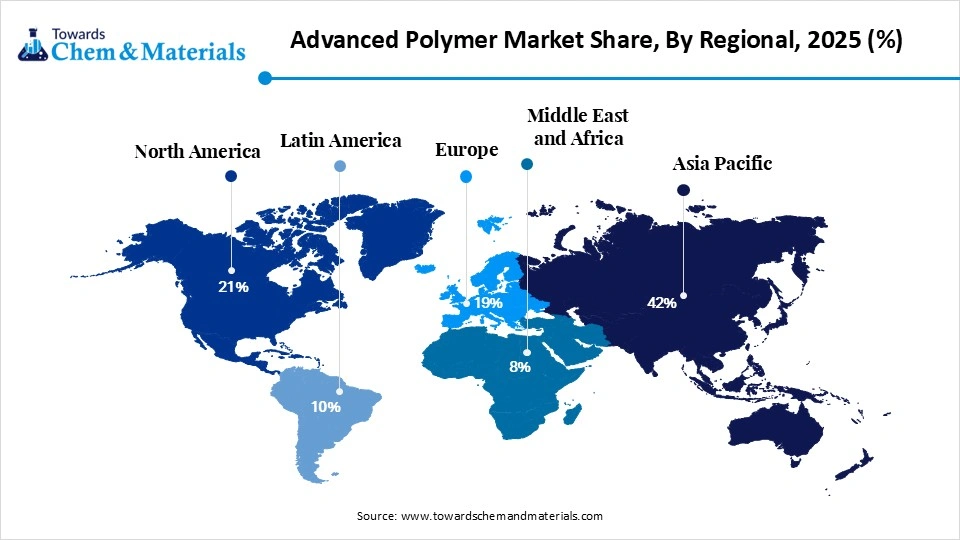
- By region,Asia Pacific dominated the advanced polymer market by holding a 42% share in 2025.
- By region, the Middle East & Africa held the 8% market share in 2025 and is expected to grow at the fastest CAGR of 9.90% during the forecast period.
- By type,the high-performance polymers segment dominated the market with the largest share of 34% in 2025
- By type, the specialty polymers segment held 20% market share in 2025 and is expected to grow at the fastest CAGR of 10.40% over the forecast period.
- By form, the resins segment dominated the market with the largest share of 38% in 2025
- By form, the coatings segment held 10% market share in 2025 and is expected to grow at the fastest CAGR of 9.80% over the forecast period.
- By processing technology, the injection molding segment dominated the market with the largest share of 36% in 2025
- By processing technology, the additive manufacturing segment held 14% market share in 2025 and is expected to grow at the fastest CAGR of 11.60% over the forecast period.
- By end-use industry, the automotive segment dominated the market with the largest share of 27% in 2025
- By end-use industry, the healthcare segment held 14% market share in 2025 and is expected to grow at the fastest CAGR of 10.80% over the forecast period.
Advanced Polymer Market Trends
- Focus on Bio-Based Feedstock: The industry focuses on replacing heavy metals with advanced polymers to meet decarbonization goals, that driving the adoption of bio-sourced polymers.
- Technological Integration with Innovation: The rising advancement in additive manufacturing and automated polymerization processes to enhance manufacturing scalability and complex geometries, shaping market growth.
Report Scope
| Report Attribute | Details |
| Market Size and Volume in 2026 | USD 86.02 Billion / 35.36 Million Tons |
| Expected Size and Volume by 2035 | USD 186.05 Billion / 68.66 Million Tons |
| Growth Rate from 2026 to 2035 | CAGR 8.95% |
| Forecast Period | 2026 - 2035 |
| Dominant Region | Asia-Pacific |
| Segment Covered | By Type, By Form, By Processing Technology, By End-Use Industry and By Regions |
| Key companies profiled | Owens Corning, Toray Advanced Composites, SGL Group, Cytec Industries Inc., BASF SE, Koninklijke Ten Cate NV, Arkema S.A., Mitsubishi Rayon Co. Ltd., Hexcel Corporation, 3B - the fibreglass company |
Key Technological Shifts and AI in the Advanced Polymer Market
Macromolecular science and AI are renovating the advanced polymer market from traditional chemistry to predictive material intelligence by allowing the manufacturing of smart polymers. The integration of autonomous laboratory and technological recycling improves purity, adjusts polymerization consistency, and energy efficiency by generating precise, high-performance polymers that align with optimising manufacturing.
Predictive modelling simulates polymer assets, reducing manufacturing time and enabling their large-scale production. Additionally, digital twin technology ensures dimensional accuracy in miniaturized components. Machine learning makes these polymers approachable to environmental impact, supporting advanced autonomous and high-frequency systems for future evolution.
Supply Chain Analysis of the Advanced Polymer Market
Feedstock Procurement: The key stage of the extraction of hydrocarbons and pre-synthesis of specialized monomers like Bisphenol A, Caprolactam, and Phenol through steam cracking and refining processes.
- Key Players: SABIC, Reliance Industries, BASF SE, and Dow Inc.
Polymer Processing and Compounding: The stage of raw polymer transformation into high-performance PEEK, PPS, and LCP, and reinforced with fibers through extrusion, compounding, and masterbatch manufacturing. The stage focuses on improving thermal stability, tensile strength, and chemical resistance.
- Key Players: Toray Industries, Evonik Industries, Victrex PLC, Solvay S.A., and Celenese Corporation
End-Use Integration: The stage where finished polymers are utilized in diversified industrial applications like aerospace, semiconductors, EV, and medical sectors through precision machining.
- Key Players: Tesla, Foxconn, Boeing, and Stryker
Regulatory Framework: Advanced Polymer Market
| Region | Key Regulations | Regulatory Focus |
| European Union | REACH, CLP regulation, and Medical Device Regulation | Focus on the elimination of hazardous chemicals and standardized packaging of hazardous polymers. Mandates for track material composition and recyclability for PEEK and biopolymers |
| United States | FDA Biocompatibility, PFAS Strategic Roadmap, and TSCA | Focus on the toxicity profile of new polymers and stringent restrictions for high-performance fluoropolymers |
| China | MEE Order and GB Standards, Dual Control Policy | Focus on industrial polymers and safety requirements for food and medical polymers. Advanced polymer plants to meet carbon limits. |
| India | BIS Quality Control Orders, Plastic Waste Management Rules, and ICSR | Mandatory certification for specialized polyamides and polycarbonates for low-quality imports. Focus on phasing out non-recyclable polymers |
Advanced Polymer Market Dynamics
Driver
Regulatory Compliance in the Industrial Sector
The stringent emission standards are driving the adoption of advanced polymers in electric mobility, aerospace, defence, and renewable energy infrastructure and modernization. The demand for lightweight high-performance polymers and dimensional stability enables expansion and investment.
Restraints
High Production Cost and Processing Complexities
The advanced polymers’ high production cost and sophisticated manufacturing processes, which require skilled labor and high speed for high-volume production, limit the adoption to meet zero-waste goals.
Opportunity
Rising Demand in Medical and Electronics Sectors
The medical solution increasingly focuses on metal replacement in biocompatible surgical tools, implantation, and medical packaging that boosts the demand for high-performance polymers, while the 5G and IoT infrastructure creates a surge for dielectric stable polymer in sensor and circuit board by maintaining temperature performance.
Segmental Insights
Type Insights
The High-Performance Polymers Segment Dominated the Advanced Polymer Market with 34% of Market Share in 2025
The high-performance polymers segment dominated the market with the largest share of 34% in 2025, driven by demand for structural integrity and chemical inertness at high temperatures for continuous operations. The segment is categorized into fluoropolymers, polyamide, polyphenylene sulfide, and liquid crystal polymers, which drive metal-to-plastic conversion. The high-performance polymers are ideal for biocompatibility in medical, automotive, lightweighting, and miniaturization in modern electronics.
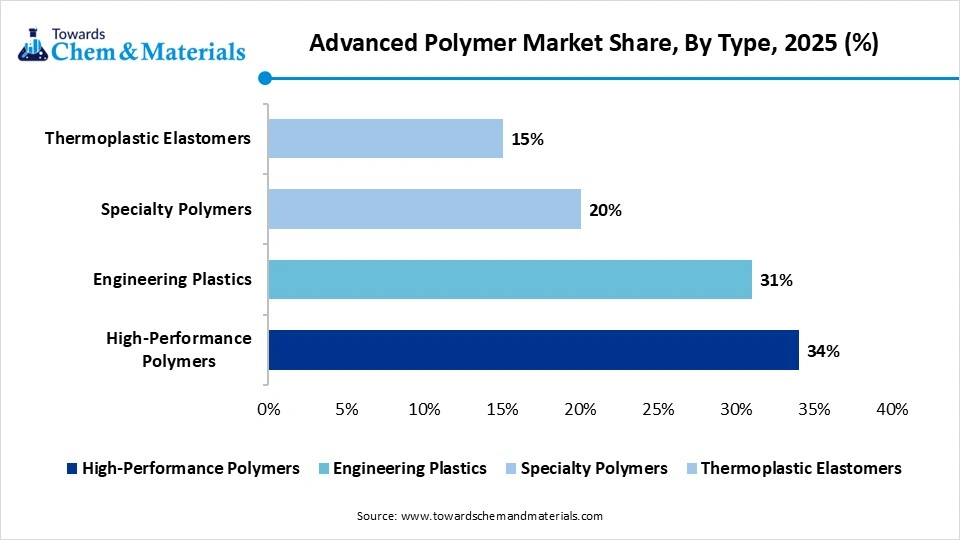
The specialty polymers segment held the 20% market share in 2025 and is expected to grow at the fastest CAGR of 10.40% over the forecast period. The segment is valued for its superior chemical properties, superior ionic conductivity, and advanced biocompatibility of polymers. The innovation in precision-driven biodegradable medicine, conductive and organic electronics, and shape memory polymers to meet performance standards is accelerating the segment expansion.
The engineering plastics segment held the 31% market share in 2025, serving as a balanced type of cost-effectiveness and high-end durability for large-scale manufacturing. The rising focus on excellent mechanical strength, dimensional strength, and impact resistance enables the adoption of polycarbonate, ABS, polyoxymethylene, and polybutylene terephthalate. The segment is key for structural metal replacement in consumer goods, automotive lightweighting, and industrial tools.
The thermoplastic elastomers segment held 15% market share in 2025, driven by its ability to combine elastic recovery with thermoplastic efficiency. These elastomers function as zero-waste, recyclable, and high-efficient material that offer vibration damping, impact absorption, and ergonomic flexibility. Thermoplastic elastomers are preferred in overmolding applications as eco-friendly alternatives.
Form Insights
The Resins Segment Dominated the Advanced Polymer Market with 38% of Market Share in 2025
The resins segment dominated the market with the largest share of 38% in 2025. It acts as a key feedstock for molecular engineering, a key form for injection molding, and additive manufacturing. The innovation focuses on viscosity optimization, matrix compatibility, and curing kinetics for advanced manufacturing, especially in liquid composites and precision pellets. The resins set a standard for tracking chemical purity and formulation innovation in aerospace and medical applications.
Advanced Polymer Market Share, By Form, 2025 (%)
| By Form | Revenue Share, 2025 (%) |
| Resins | 38% |
| Films | 22% |
| Fibers | 16% |
| Foams | 14% |
| Coatings | 10% |
The films segment held the 22% market share in 2025, valued for their barrier excellence, superior dielectric strength, and thermal stability. The advanced film such as polyimide and PEEK are critical for space-grade insulation, fuel cell membrane and flexible electronics, where high-grade resins are processed into high-strength, high-clarity films. Additionally, these films also maintain superior moisture protection and optical clarity.
The coatings segment held the 10% market share in 2025 and is expected to grow at the fastest CAGR of 9.80% over the forecast period, driven by demand for high-performance finishes in high-velocity aerospace and surgical applications. The advanced polymer is deployed as ultra-thin layers to protect the substrate from environmental degradation and anti-microbial action. The advancement in coating offers surface-level intelligence and superior corrosion resistance that make it critical for extending asset life.
The fibers segment held 16% market share in 2025, serving as a key form in composite matrices and structural reinforcement for aerospace airframes, high-performance cables, and heavy-duty industrial textiles. The advanced polymers are drawn into fine filaments in the form of fibers that offer excellent tensile strength and impact toughness that make them key for lightweighting and ballistic protection.
Processing Technology Insights
The Injection Molding Segment Dominated the Advanced Polymer Market with 36% of Market Share in 2025
The injection molding segment dominated the market with the largest share of 36% in 2025, driven by a rising focus on precise, high-speed, and near-net-shape manufacturing. The injection molding can deliver repetitive dimensional accuracy and structural complexity that set standard for industrial scalability. These technologies enable mass production of high-strength and lightweight components, especially for microelectronic and automotive electrification.
Advanced Polymer Market Share, By Processing Technology, 2025 (%)
| By Processing Technology | Revenue Share, 2025 (%) |
| Injection Molding | 36% |
| Extrusion | 26% |
| Blow Molding | 14% |
| Compression Molding | 10% |
| Additive Manufacturing | 14% |
The additive manufacturing segment held the 14% market share in 2025 and is expected to grow at the fastest CAGR of 11.60% over the forecast period. It acts as a key technology that unlocking shape of polymers, such as high-temperature thermoplastics, into complex, topology-optimized engineering. The additive manufacturing enables rapid prototyping and tool-less production for end-use parts. The segment serves as a key for aerospace and personalized medical implants by facilitating rapid iterative design and on-demand fabrication.
The extrusion segment held the 26% market share in 2025, acting as a key technology for the manufacturing of flexible conduits, insulating wraps, and medical catheters by maintaining uniformity and long-run cost-effectiveness. Extrusion set a standard for high-velocity fabrication and steady-state thermal control in industrial tubing, barrier films, and high-performance filament, which strengthens the adoption of this processing technology.
The blow molding segment held 14% market share in 2025, driven by its volumetric efficiency in the manufacturing of complex fluid-handling systems in chemical reservoirs, medical canisters, and automotive fuel tanks using advanced polymers. Blow molding provides structural integrity and leak-proof containment that make it crucial for large-scale industrial applications.
End-Use Industry Insights
The Automotive Segment Dominated the Advanced Polymer Market with 27% of Market Share in 2025
The automotive segment dominated the market with the largest share of 27% in 2025, accelerated by manufacturers focus on maximizing fuel efficiency, lightweighting, and EV range. The automotive industry transitioned towards under-the-hood thermal management and high-voltage electrical system where advanced polymers offer heat resistance and structural integrity. The innovation focuses on metal-to-plastic replacement and NVH reduction, and sensor-integrated interiors that drive autonomous and electric fleets.
The electrical & electronics segment held the 23% market share in 2025, due to its excellent thermal stability and dielectric strength for consumer electronics, semiconductor, and insulation. The rising reliance on liquid crystal polymers and polyimides offers high-speed signal integrity and heat dissipation. The advanced polymers are key enablers of miniaturization, flexible printed circuits, and ultra-fine connectors by preventing signal loss and structural warping.
Advanced Polymer Market Share, By End-Use Industry, 2025 (%)
| By End-Use Industry | Revenue Share, 2025 (%) |
| Automotive | 27% |
| Electrical & Electronics | 23% |
| Healthcare | 14% |
| Aerospace & Defense | 12% |
| Packaging | 16% |
| Industrial Equipment | 8% |
The healthcare segment held the 14% market share in 2025 and is expected to grow at the fastest CAGR of 10.80% over the forecast period. The advanced polymers act as bioresorbable polymers that offer human-tissue compatibility and sterilization stability. The healthcare innovation boosted the shift towards minimally invasive devices and patient-centric implants. The advanced polymer also enables precision drug delivery and a metal-replacement orthopedic tool by maintaining chemical purity and safety.
The packaging segment held 16% market share in 2025, driven by the transition towards active packaging and high-precision medical-grade films. The packaging industry focuses on extending shelf life and product integrity through advanced moisture and oxygen blockers. The industry focuses on circular economy mandates and the advancement of mono-material recyclables and high-barrier biopolymers as a biodegradable alternative, which enables market growth.
Regional Insights
How Did the Asia Pacific Dominated the Advanced Polymer Market in 2025?
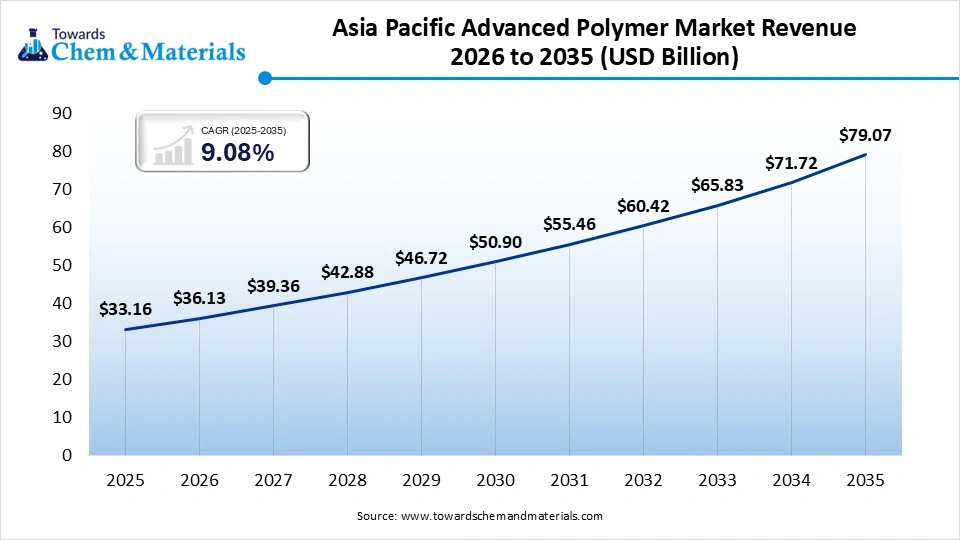
The Asia Pacific advanced polymer market size was estimated at USD 33.16 billion in 2025 and is projected to reach USD 79.07 billion by 2035, growing at a CAGR of 9.08% from 2026 to 2035. The region is implementing high-performance engineering grades, which are essential for the adoption of 5G infrastructure and electric vehicle battery systems. Asia Pacifics rapid industrialization and chemical supply chain drive its high-volume consumption for PEEK, LCP, and fluoropolymers through strategic partnerships.
China Advanced Polymer Market Growth Trends
China market is functioning as a key consumer and an emerging manufacturer of high-end advanced polymers. The region focuses on self-sufficiency, especially in semiconductor, EV battery components, and 5G infrastructure. Chinas strong competitive landscape and its focus on capacity expansion making them key hub for large-scale automotive infrastructure.
The Middle East & Africa held 8% market share in 2025 and is expected to grow at the fastest with a CAGR of 9.90% during the forecast period, due to a regional shift towards material exporting and downstream manufacturing infrastructure. The Middle East diversification strategies enable investment in the manufacturing of engineering polymers for energy and construction. The African market set standards for infrastructure-grade polymer and durable packaging through rapid urbanization and industrialization.
Saudi Arabia Advanced Polymer Market Growth Trends
The Saudi Arabia market is characterized by a regional shift towards high-value downstream chemicals. The domestic players focus on localized manufacturing of high-performance polymers align with government diversification goals. Saudi Arabia is a key manufacturing hub for the construction and automotive sectors. Additionally, the region focuses on 3D printing adoption and sustainable material adoption.
Recent Developments
- In April 2026, Poly Precision Technology joined its global ROBOZE advanced manufacturing network to accelerate distributed manufacturing in industrial sectors. The global partnership focused on bolstering advanced manufacturing capacity across the U.S. and a distributed production ecosystem through standardized digital workflows.
- In October 2025, BASF and International Flavors & Fragrances (IFF) announced a strategic bioscience collaboration to accelerate the development of the designed Enzymatic Biomaterials platforms. This collaboration focuses on innovation in next-generation enzymes and sustainable polymers for industrial applications.
Advanced Polymer Market Competitive Landscape Analysis
Tier 1 Companies
|
Rank
|
Company Name | Headquarters | Country | Why Relevant to This Market | Key Products / Material Portfolio |
| 1 | BASF SE | Ludwigshafen, Rhineland-Palatinate | Germany | Global leader in engineering and high-performance polymers | Ultramid®, Ultradur®, specialty polymers, advanced materials |
| 2 | DuPont de Nemours, Inc. | Wilmington, Delaware | United States | Major supplier of advanced polymers for automotive, electronics, and industrial markets | Delrin®, Zytel®, Vespel®, Kevlar® |
| 3 | Celanese Corporation | Irving, Texas | United States | Leading producer of engineered thermoplastics and specialty polymers | Acetal polymers, LCPs, PBT, nylon compounds |
| 4 | Covestro AG | Leverkusen, North Rhine-Westphalia | Germany | Global leader in high-performance polymer materials | Polycarbonates, TPU, specialty films, advanced composites |
| 5 | SABIC | Riyadh | Saudi Arabia | One of the largest advanced polymer manufacturers worldwide | Engineering thermoplastics, ULTEM™ PEI, LNP compounds |
Tier 2 Companies
|
Rank
|
Company Name | Headquarters | Country | Why Relevant to This Market | Key Products / Material Portfolio |
| 1 | Arkema S.A. | Colombes, Île-de-France | France | Strong position in specialty and high-performance polymers | Pebax®, Rilsan® PA11, Kynar® PVDF |
| 2 | Evonik Industries AG | Essen, North Rhine-Westphalia | Germany | Major supplier of specialty polymers and additives | PEEK alternatives, polyamides, PMMA materials |
| 3 | Solvay S.A. | Brussels | Belgium | Leading supplier of advanced polymers for aerospace and electronics | PEEK, PPSU, PSU, fluoropolymers |
| 4 | Victrex plc | Thornton-Cleveleys, England | United Kingdom | Global leader in PEEK polymers | PEEK resins, films, composites |
| 5 | Mitsubishi Chemical Group Corporation | Tokyo | Japan | Significant producer of advanced engineering plastics | Engineering polymers, composites, specialty materials |
Tier 3 Companies
|
Rank
|
Company Name | Headquarters | Country | Why Relevant to This Market | Key Products / Material Portfolio |
| 1 | Avient Corporation | Avon Lake, Ohio | United States | Specialty polymer formulations and advanced compounds | High-performance compounds, conductive polymers |
| 2 | Röchling SE & Co. KG | Mannheim, Baden-Württemberg | Germany | Advanced polymer solutions for industrial and medical markets | Engineering plastics, polymer components |
| 3 | Ensinger GmbH | Nufringen, Baden-Württemberg | Germany | Specialist in high-performance engineering plastics | PEEK, PPS, PI, fluoropolymer products |
| 4 | Kuraray Co., Ltd. | Tokyo | Japan | Advanced polymer and specialty resin manufacturer | Liquid crystal polymers, specialty elastomers |
| 5 | Teknor Apex Company | Pawtucket, Rhode Island | United States | Growing supplier of specialty and engineered polymer compounds | TPEs, engineering compounds, custom polymer solutions |
Top Companies in the Advanced Polymer Market
- Owens Corning
- Toray Advanced Composites
- SGL Group
- Cytec Industries Inc.
- BASF SE
- Koninklijke Ten Cate NV
- Arkema S.A.
- Mitsubishi Rayon Co. Ltd.
- Hexcel Corporation
- 3B - the fibreglass company
Advanced Polymer Market Segment Covered in the Report
By Type
- High-Performance Polymers
- Fluoropolymers
- Polyamide (Nylon)
- Polyphenylene Sulfide (PPS)
- Liquid Crystal Polymers (LCP)
- Engineering Plastics
- Polycarbonate (PC)
- Acrylonitrile Butadiene Styrene (ABS)
- Polyoxymethylene (POM)
- Polybutylene Terephthalate (PBT)
- Specialty Polymers
- Conductive Polymers
- Biodegradable Polymers
- Shape Memory Polymers
- Thermoplastic Elastomers (TPE)
- Styrenic Block Copolymers (SBC)
- Thermoplastic Polyurethanes (TPU)
- Thermoplastic Vulcanizates (TPV)
By Form
- Films
- Fibers
- Foams
- Resins
- Coatings
By Processing Technology
- Injection Molding
- Extrusion
- Blow Molding
- Compression Molding
- Additive Manufacturing (3D Printing)
By End-Use Industry
- Automotive
- Interior Components
- Exterior Components
- Under-the-Hood Applications
- Electrical & Electronics
- Semiconductors
- Consumer Electronics
- Insulation Materials
- Healthcare
- Medical Devices
- Drug Delivery Systems
- Implants
- Aerospace & Defense
- Packaging
- Flexible Packaging
- Rigid Packaging
- Industrial Equipment
By Regions
- North America:
- U.S.
- Canada
- Mexico
- Rest of North America
- Latin America:
- Brazil
- Argentina
- Rest of Latin America
- Europe:
- Western Europe
- Germany
- Italy
- France
- Netherlands
- Spain
- Portugal
- Belgium
- Ireland
- UK
- Iceland
- Switzerland
- Poland
- Rest of Western Europe
- Eastern Europe
- Austria
- Russia & Belarus
- Türkiye
- Albania
- Rest of Eastern Europe
- Asia Pacific:
- China
- Taiwan
- India
- Japan
- Australia and New Zealand,
- ASEAN Countries (Singapore, Malaysia)
- South Korea
- Rest of APAC
- MEA:
- GCC Countries
- Saudi Arabia
- United Arab Emirates (UAE)
- Qatar
- Kuwait
- Oman
- Bahrain
- South Africa
- Egypt
- Rest of MEA
- MEA:
FAQ's




Select User License to Buy
Figures (4)






 sales@towardschemandmaterials.com
 Download Sample
 Schedule a Meeting