

Pigment Grade Titanium Dioxide Driving Precision Performance and Sustainable Manufacturing
Content
What is the Concept of Pigment Grade Titanium Dioxide?
The foreword is the most essential part of this article, leading you on an enchanting journey through pigment-grade titanium dioxide (TiO2). Just as we encounter many experiences in life, each with its own parameters, this article will take you on a journey to explore TiO2. We will not only discuss its definition but also delve into its historical roots and visit ancient towns where its story began. Additionally, we will explore the world of manufacturing, visiting well-known factories to understand the production processes. As I write this, I recall a powerful theory about life: “When perceptivity increases, and expectations are lowered, learning becomes faster.” This idea connects to our karmic cycles.
However, while we won't focus on karmic cycles here, it's crucial to note that heightened perception and lowered expectations also apply in manufacturing, where final products like sunscreens and paints are mass-produced. One lingering question that many readers may have is how expectations and perception relate to inanimate chemicals. To satisfy your curiosity about this topic, I invite you to dive deeper into the article. It serves as a comprehensive overview of global developments surrounding TiO2 and discusses why an epilogue is necessary. You will find all the essential information here, as both this article and TCM aim to provide you with the necessary data in one convenient location. You may have just found the right page for that.
What is Pigment Grade Titanium Dioxide?
Pigment-grade titanium dioxide is the most widely used form in the industry due to its excellent white pigmentation properties. This material is highly valued for its whiteness, brightness, opacity, light-scattering ability, and chemical stability. While many may assume that all titanium dioxide is the same, it’s important to note that pigment-grade and standard titanium dioxide are quite different, particularly in their manufacturing processes. Titanium dioxide is produced for specific technical applications, whereas pigment-grade titanium dioxide, also known as TiO2, is specially processed to deliver high optical performance. This high-quality compound is then used in a variety of consumer and industrial products, such as paints, papers, and inks, which are integral to our daily lives.
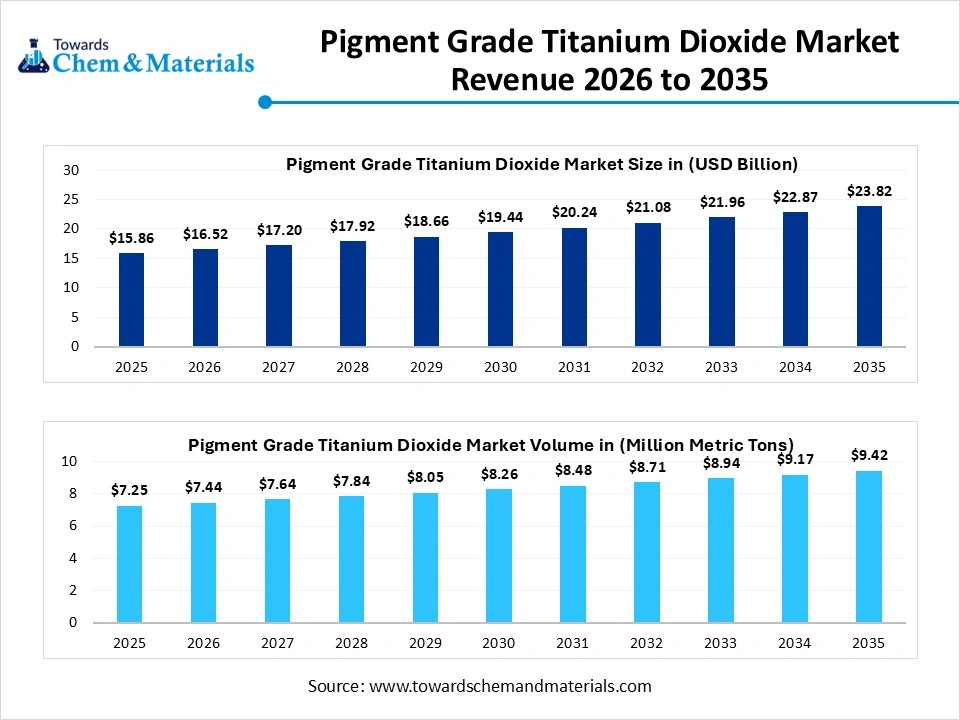
According to Towards Chemicals and Materials Analytics and Consulting, the global pigment-grade titanium dioxide market volume was valued at 7.25 million metric tons in 2025 and is expected to surpass around 9.42 million metric tons by 2035, accelerating a compound annual growth rate (CAGR) of 2.65% over the forecast period from 2026 to 2035.
This being said, one of the most recognisable characteristics of this material is its high refractive index. The particles of TiO2 are dispersed evenly through a material, projecting a visible white light. This property gives the product a bright, opaque, and visibly shiny texture; this indeed looks very presentable and appealing to the eyes of the buyer. The pigmentation effectiveness not only depends upon its chemical composition but as well it is also very well based on particle size, particle distribution, surface treatment, and distribution. To bring out the efficiency of TiO2, some factors are taken into consideration while manufacturing or melting the chemical in the boilers; some of the points are as follows;
- Melting point
- Boling point
- Density
- Bulk density
- Refractive index
- Pka
- Gravity
- Colour
All these factors are all taken into consideration when the chemical is bought within factories for manufacturing and refactoring it. Also, one of the studies by Chemical Book provided for TiO2 says that all the above-mentioned points need a certain degree of centigrade to process further, making them into a molten process, looking and observing at the cooling point of the chemical. The study specifically signified that the controlled and known temperatures of the above-written specifications allow the manufacturers to judiciously regulate these properties during production to achieve the desired results and give an expected finished product in the markets for circulation.
There are two major industrial processes used to produce pigment-grade titanium dioxide: sulphate process and chloride process. The sulphate process involves the use of various titanium-bearing raw materials which are then subjected to various purification, hydrolysis and calcination procedures to produce titanium dioxide. The chloride process involves the reaction of titanium oxide-bearing raw material with chlorine to produce titanium tetrachloride, followed by the purification of the TiCl4 and its reaction with oxygen at high temperature to give titanium dioxide. Typical of high-purity products is the chloride route, which may be more efficient and less polluting, and the sulphate process is also significant as it can process a wider range of titanium-bearing raw materials.
Certain industries represent larger application needs for pigmentation, and those are
One of the biggest application areas for pigment-grade titanium dioxide is the paint and coatings market. It gives opacity, brightness, and resistance to the environment to the paints. TiO₂ is used in architectural coatings to give a consistent colour and surface finish, and in industrial coatings to enhance durability and aesthetics. The pigment is also used in car coatings, protective coatings and special effects.
Titanium dioxide is used in the plastics industry as a whitening agent, opacity, and UV protection. It is incorporated into products such as packaging materials, pipes, household goods, synthetic fibres and various consumer products. It resists degradation and retains colour, which is very useful in outdoor plastic applications.
Outside of these industries, pigment-grade TiO₂ is used in sealants, adhesives, rubber products, selected cosmetics and personal care formulations as well as laminates. The extent of its use shows how versatile the material is and its significance for industrial production and all consumer products.
What Are Some Known Worldwide Government Initiatives in Pigment Grade Titanium Dioxide?
- New Developments: CBIC Announces ADD Exemption for Titanium Dioxide Imports from China
The Central Board of Indirect Taxes and Customs (CBIC) has issued a clarification on the application of Anti-Dumping Duty (ADD) on titanium dioxide brought into India from China. This clarificatory notification is issued based on Notification No. 12/2025-Customs (ADD), dated 10th May, 2025. The aim of the clarification is to offer more clarity for importers on when they might be able to get an exemption from the extra duty.
To deal with concerns over imports and domestic industry conditions, India has implemented anti-dumping measures for TiO2 imports from, or exported from, China. The notification, however, exempts the use of titanium dioxide for certain uses. These include applications in food products, pharmaceutical applications, skin care products, textiles and fibres, and nano- and ultra-fine grade applications. There is a downstream industry importance for titanium dioxide, and that is why it is covered by exemptions.
An important part of the CBIC clarity is the addition of an e-declaration system for those importers who are applying for the exemption. Importers can mention the intended end use of the titanium dioxide in the Bill of Entry. It should facilitate a simplified customs clearance procedure and lessen risks at customs with eligible imports.
Simultaneously, importers have to keep proper documentation of the end uses of the imported material. The exemption is not unlimited - the titanium dioxide brought in under the exemption cannot be used for a non-eligible purpose after importation. In the event of such diversion, the duty and interest due on such anti-dumping is eligible for recovery from the importer.
The ruling may help ease concerns of manufacturers in industries like pharmaceuticals, food processing and personal care whose workforce relies on the use of titanium dioxide as a specialty raw material that must be imported. It could also help to prevent delays and disagreements resulting from different interpretations of the exemption provisions.
Overall, the CBIC clarification has added more clarity and transparency in the import process for titanium dioxide from China. The government has tried to ease the burden of end-use compliance while introducing a declaration authorization process to keep the exemption for the declared use. In the business world, proper documentation and declaration, as well as proper record-keeping, will continue to be integral to claiming exemption benefits.
CBIC Clarifies ADD Exemption on Titanium Dioxide Imports from China
Anti-Dumping Duty on Titanium Dioxide Imports
Indian government stepped forward by imposing an anti-dumping duty (ADD) on titanium dioxide imports that were coming from China. This step was taken after long discussions on the imports that were coming in from China; it was being noticed that the manufacturers were facing a loss. To confirm this, an investigation was carried out by the Directorate General of Trade Remedies to see whether Chinese titanium imports were entering the markets with unfairly lower prices, which was keeping the manufacturers on the edge by giving them a loss for this. The formal order to investigate the whole scenario was released by the Ministry of Finance by announcing notification no. 12/2025-customs (ADD), dated 10th May 2025.
After a thorough investigation, the findings pointed out that the pricing of Chinese titanium dioxide imports was putting Indian manufacturers under pressure, which was indirectly contributing to adverse conditions for the domestic industry. DGTR’s recommendation was a game changer for India; the government introduced the anti-dumping measure with the intention of creating a more competitive environment within Indian manufacturers while addressing the impact of dumped imports.
The duty applies to specific titanium dioxide products (tariff headings 2823 00 10, 3206 11 10 and 3206 11 90). There are no uniform duties, depending on the manufacturer or exporter from China. The notified rates start from about US$460 – US$681/metric tonne. Specific producers, co-operative exporters and other traders have been given varying rates dependent upon their condition in the course of the investigation.
This condition of anti-dumping came with certain exemptions for certain specialised uses of titanium dioxide. These involved applications including food additives such as pharmaceutical tablet coatings, cosmetics and sunscreen products. Some titanium dioxide-containing products, for making textiles and fibres, are also prohibited. Furthermore, the duty does not apply to any nano and ultrafine titanium dioxide (TiO2) products specifically for which the particle size limit is below 100 nanometres. Titanium dioxide pigment used in textile printing is not eligible for the exemption, only for textile applications.
The anti-dumping duty will be effective for 5 years from its date of application, with provisions for earlier withdrawal, modification and replacement before 5 years of the duty. It gives domestic enterprises a window of opportunity to further evolve their production capacity and face, albeit imperfectly, imported products.
The judgement is important for the titanium dioxide industry in India as it has the potential to impact the economics of imports from China. The increased import costs also could drive up domestic manufacturing of products and even tempt investment in the manufacturing sector. Meanwhile, industries that are downstream and rely on titanium dioxide for their products will have to consider their titanium dioxide sourcing strategies and plan ahead for potential input cost increases.
In general, the anti-dumping duty appears to be an attempt to counteract unfair competition and protect the domestic industry from TiO2 being undercut by imported products, yet providing exceptions for specific special uses. Modifications in the responses of domestic producers, indigenous supply chains by importers, and Indian local manufacturing capacity to deliver the quality and quantity will affect its longer-term impact.
India Imposes Anti-Dumping Duty on China’s Titanium Dioxide
Low-Cost Technology Development for Water Waste Management System
A low-cost device to help treat industrial wastewater has been devised by researchers from Shivaji University, Kolhapur (SUK) and they have obtained a “design patent” for their solution. The technology aims to solve the issue of industrial effluents especially wastewater from textile and chemical industries can contain colored compounds and other pollutants that can have some negative impacts on aquatic ecosystems if they are released without any proper treatment.
The principle behind the device is semiconductor photocatalysis, which utilizes a photocatalyst to transform unwanted chemical compounds into less harmful ones. The researchers have created a novel composite material that is a combination of the graphitic carbon nitride (g-C₃N₄) and titanium dioxide (TiO₂). The mix is meant to increase the degradation of color-causing and possibly harmful organic compounds in the industrial wastewater stream.
There are a lot of dyes present in effluents from the industries such as textile and chemical industries, which are difficult to be removed using conventional technology. Untreated waste water discharged into watercourses or other water bodies may impact water quality, aquatic life and the environment. The approach taken by the researchers is to develop an alternative treatment method that will prove effective in the breakdown of these pollutants instead of the transfer from an effluent to another waste stream.
One of the key aspects of the innovation is the affordability of the device. For smaller wastewater-treatment systems, the capital costs and specialised equipment and operational experience required for advanced wastewater-treatment systems can be prohibitive. Therefore, if sanitation technology is cheaper, it would be possible to market this technology to more industries and drive better compliance with the environmental regulations.
The development is a proof of the capability to integrate technologies in material science, photocatalysis and academic research to tackle environmental challenges with a simple solution. Advanced materials such as TiO₂ and graphitic carbon nitride, which are applied in wastewater treatment, demonstrate the broader application of advanced materials in pollution control. Should the technology prove to be adopted and scale successfully, it may help industries to lessen wastewater pollution and transition towards more cost-efficient and environmentally conscious treatment processes.
SUK researchers secure India design patent for low-cost wastewater purification device | Kolhapur N…
The Titanium Industry and Major Companies
Titanium is an important industrial material used in a variety of sectors such as aerospace, defence, healthcare, automotive, chemical, paint, plastics and consumer products. It is used both as a metal and in the form of titanium dioxide (TiO₂). One of the most important is titanium dioxide, which is one of the most common white pigments in the world, used widely in paints, plastics, paper production, coatings, and in some consumer goods.
The versatility of the titanium industry as well as its potentially persistent expansion has continued to draw attention. Demand for the market is driven by the aerospace and defence industry, healthcare industry, advanced manufacturing industry, and pigment production, as well as growing demand. But raw material prices still have an effect on the industry, as well as economic cycles, capital, and environmental concerns.
Highlights include ATI, which is exposed to the titanium market. The company makes advanced materials and high-performance alloys, part of which is titanium and its products. Its products are especially vital in the field of aerospace and defence sectors, which account for a substantial percentage of sales. ATI is also putting its money into expanding its titanium processing range, such as more melting and remelting ability. These investments may enable the company to respond to the rising demand for special titanium materials required in challenging applications.
Chemours is another large company closely involved in titanium dioxide, with a large exposure in the Titanium Technologies segment. The company produces various kinds of TiO₂ pigment used in various ranges of application such as architectural paints, coated paper and plastic packaging. Titanium dioxide's impact on the company's overall revenue highlights its significance to the company's business.
Titanium dioxide is even more prevalent for Kronos Worldwide. The Company has manufacturing plants in several countries and a product distribution network for TiO₂ to thousands of customers in the international market. More than 98 percent of its sales are for titanium dioxide, thus its close association with the global pigment market.
Another important player in the titanium dioxide market is Tronox. It has a vertically-integrated business model, in which its mineral operations and production activities can be more controlled. The company is also working on projects that will enhance its raw material supply and future TiO2 production.
In general, the businesses mentioned are that they represent the diversity of the titanium industry. The companies generally specialise in high-performance titanium-based alloys for industries such as the aerospace and defence sectors, whereas others specialise in the use of titanium dioxide pigments in dyes and paints, in plastics, in paper and other mass products and applications. The sector is likely to remain robust and attractive to companies as industry continues to develop, and demand grows for advanced materials and components; however, companies will have to become adept at addressing industry challenges associated with market volatility, production costs, and environmental concerns, among others.
4 Best Titanium Stocks for 2026 and How to Invest | The Motley Fool
The Production Process of Titanium Dioxide? (Expectations should be lower; perception should be higher)
As mentioned in the prologue, it is important to understand the quote, “When perceptivity increases, and expectations are lowered, learning becomes faster,” in the context of the manufacturing process of this chemical. As we delve deeper into this topic, we will see how life lessons are interconnected with the manufacturing process. The key question is: how?
When the production of this chemical is conducted correctly, taking into account the melting point, boiling point, and other factors while maintaining low expectations, the results are often gratifying. The manufacturers are enhancing their perceptivity by thoroughly studying the elements, leading to a shift from lower expectations to confidence in the remarkable quality of the final product.
Now, let’s move away from philosophical reflections and focus on the actual production process as it occurs in the industry.
Pigment-grade TiO2 is manufactured with great care and precision to ensure that it is produced to a high degree of purity and has excellent whiteness, opacity, brightness and light-scattering properties. There are two main commercial processes for production: the sulfate process and the chloride process. Both processes generate the same product; the raw materials, chemical reactions and the wastes are very different.
- Raw Material Preparation: The process starts with raw materials containing titanium, such as ilmenite, rutile and titanium-rich slag. These products include impurities (such as iron and other minerals) in addition to titanium compounds, and the amount of each impurity is variable. The raw material is crushed, ground, and activated during the next processing, in order to make it react appropriately.
- Sulphate Process: The sulphate process is the one in which the product containing the titanium is treated by concentrated sulphuric acid at high temperatures. This makes the titanium soluble in titanium compounds, and some impurities undergo separation in the following process. The material is dissolved, and then undergoes purification procedures. The titanium-containing solution is freed from iron and other impurities. The purified solution is then hydrolysed to form a hydrated titanium dioxide, or hydrated titanium oxide.The material is purified by filtering and washing it. It's then heated at a high temperature and made into a brick. Water is expelled, and the crystallised structure of the particles is formed during the calcination. The product could be used for rutile pigment or anatase pigment depending on the demand for the product.
- Chloride Process: In general, high-quality feedstock (with high titanium content) is typically employed in the chloride process. The raw material is heated with chlorine and C to synthesize Titanium tetrachloride (TiCl4). This is an intermediate compound which is purified by distillation from impurities. Purified titanium tetrachloride is then reacted with oxygen at high temperature. The results of this oxidation reaction are titanium dioxide particles and chlorine. During the operation, the chlorine may be recovered and reused in the process, which results in higher resource efficiency.
- Particle Treatment and Finishing: Following either of the two production processes, the titanium dioxide is sent through several finish-up processes. Size, shape, surface properties and distribution of pigment particle size are carefully controlled as this is directly related to the optical performance. Inorganic material, usually alumina or silica, may be used to coat TiO₂ particles. Surface treatment gives the desired properties of dispersion, compatibility with various coating materials, durability, weather resistance, and others. The so-treated pigment is subsequently dried and followed by milling or micritisation to remove the pollens and break down the agglomerates to the required particle distribution. It is then mixed, lab-tested and packaged as required by the ultimate use.
- Quality Control: Quality Control is an integral component of manufacturing. The following parameters: purity, particle size, whiteness, tinting strength, opacity, oil absorption, dispersibility, surface characteristics, etc., are evaluated by producers. These properties govern the ability of the pigment to be used in an application such as paint, plastic, paper, printing inks, and coatings. In general, the manufacturing of pigment-grade TiO2 is a mixture of chemical processing, purification, high-temperature processes, particle engineering, and surface modification. Producing the necessary product by the sulphate or chloride process, energy efficiency, waste reduction, chemical recovery, and more sustainable manufacturing are key points for modern manufacturers.
What is the Source and History of Pigment Grade Titanium Dioxide?
Pigment grade titanium dioxide (TiO₂) has a long history that is closely associated with the modern pigments, paints, and coatings industry. The presence of the mineral’s containing Ti was first discovered much earlier, but the use of Ti(IV) oxide as an important commercial white paint pigment was only recently developed in the early 20th century. Titanium was discovered in 1791 by William Gregor, an English clergyman and mineralogist, who found titanium in a mineral that is now called ilmenite. In the same year, German chemist Martin Heinrich Klaproth stumbled upon it a few years later, naming it titanium. But for many decades, the use of titanium in industry was restricted, as it was difficult to produce highly pure titanium compounds.
White pigments with titanium compounds were discovered in the 19th century. Leaded pigments, especially lead white, were common in paint at the time. These pigments offered a good level of cover, but also caused health and environmental issues due to their toxicity. Other materials such as zinc oxide were available, but were not always capable of offering as much opacity and whiteness as zinc oxide. Eventually it became clear that the combination of the very high refractive index and the very strong light-scattering power of titanium dioxide made it an extremely attractive alternative. In the early 1900s, commercial development began with the start of industrial production of titanium-based white pigments. The titanium calcium compounds were some of the earlier pigments, and were not as pure as the more highly refined pigments used today, based upon TiO₂. The industry then switched to the manufacture of higher quality, optically superior titanium dioxide.
The introduction of the sulfate process in the early 1900s was a great step forward. The process enabled the production of a pigment of titanium dioxide on a large scale in industry. It contributed to the commercialization of TiO₂ as a substitute for the conventional white pigments and its use in paints and coatings, among others. The next was the chloride process, which was commercialised about 40 years later. Rather than processing the titanium-bearing raw materials using sulphuric acid, the chloride route involves converting the titanium to titanium tetrachloride and then to highly pure titanium dioxide, through oxidation. The process proved beneficial in product quality, efficiency of the process and the recycling of chlorine, making a contribution to the transformation of the industry.
In the second half of the last century, pigment grade TiO2 was gaining importance in paint, plastics, paper, printing inks, and coatings. Manufacturers began to develop more control over particle size and to apply surface treatments (e.g., alumina, silica). They improved resistance to weathering, dispersion, durability, and overall pigment performance. Another significant change was the conversion from anatase to rutile grades. Rutile has a higher refractive index and normally offers superior opacity and durability, especially when used for exterior coatings, plastics, and industrial paints. The use of anatase for applications where its specific properties were found to be beneficial did not cease.
Titanium dioxide was one of the most important white pigments in the world in the twenty-first century. It was used in construction, automotive coatings, packaging, plastics, paper, and inks, and cosmetic / consumer products. However, the industry is now more concerned than ever with the performance of the pigments as well as sustainability and resource efficiency. The manufacturers are trying to cut energy use, waste, chemical losses, and make production more efficient. Concurrently, advances in particle engineering and surface treatment further boost the performance of TiO2. Therefore, the story of pigment-grade TiO2 is one of the evolution of knowledge about the presence of titanium to the establishment of a complex international pigment industry. Its combination of brightness, opacity, durability, and chemical stability has allowed TiO2 to become an essential material in modern manufacturing.
What is the Roadmap for the Pigment Grade Titanium Dioxide?
This is expected to make pigment grade titanium dioxide (TiO₂), which has outstanding light scattering, brightness, opacity, durability and whiteness, a significant industrial material. It is widely employed as a paint, coating, plastic, paper, printing ink, and other consumer products. But more than just scaling up production capacity will be needed for the industry to survive. Manufacturers are more and more expected to enhance production efficiency, environmental performance, product quality, assurance of raw materials and technological capabilities. The industry is therefore moving towards a more sustainable and technologically advanced model. Sustainable production of TiO₂ will be one of the greatest priorities for the TiO₂ industry. The sulfate and chloride processes have high energy and chemical demands but are different in terms of environmental impact. Future production facilities will likely be aimed at minimising energy use, minimising emissions, providing water efficiency, and recovering chemicals and useful by-products. The increased use of renewable energy could also help reduce the carbon footprint of production. Manufacturers can start to use renewable electricity either completely or in part in their production processes and simultaneously optimize the energy use at high-energy-consumption steps like calcination and oxidation. Further reductions in unnecessary energy and material consumption can be achieved by increasing the automation and process control of operations. The chloride process will probably continue to be an important production method, especially for the high-quality rutile pigments. It can produce high-purity TiO₂ and recover chlorine during the process. It offers potential for better resource efficiency due to its production of high-purity TiO2 and recovery of chlorine in the process. But it needs high-quality feedstocks of the metal titanium. Future development of the project will therefore centre on increasing the recovery rate of chlorine, improving the efficiency of the processes and the utilisation of raw materials. Additionally, producers can invest in new technologies that can efficiently process a broader feedstock of titanium rich material, thereby enhancing the industry's raw material base. The chloride route is becoming important but the sulfate process will still play a part as it can be used with a much broader range of titanium bearing raw materials. It faces some serious issues such as the production of iron sulfate and other impurities.
Waste reduction and by-product utilization are likely to be the main areas for future improvement. These materials can be used as waste and can be chemically recovered by manufacturers, or the by-product can be utilized for commercially valuable materials. This might help to make the sulfate process more resource efficient and environmentally friendly. Increasingly, this next phase of industry development will be geared towards producing specialised and high-performance grades of TiO₂, rather than just output. On the other hand, particle-size distribution, surface treatment and dispersion properties are likely to be optimized, depending on the requirements of various industries.
Better weather resistance and opacity will continue to be key properties for paints and coatings. In the plastics sector, producers will want to use pigments with high whiteness, UV resistance and dispersion. The durability and application performance can still be further improved by surface treatment using various materials such as alumina and silica.
Digital technologies will play an ever greater role in pigment production. Artificial intelligence and machine learning, sensors and automated process-control systems can help manufacturers keep a close eye on production conditions and detect any deviations that could impact product quality. The parameters of the system like temperature, reaction condition, residence time and calcination can be optimised with the help of AI-based systems. Predictive maintenance can also foresee potential equipment issues before they turn into a breakdown, minimizing downtime and maintenance expenses. Digital twins and other sophisticated simulation systems could prove useful to manufacturers in the long term, to simulate process changes before putting them to the test in commercial production. The TiO2 industry will also shift to a more circular-economy business model. More and more in future, plants will be concentrating on the recovery and reuse of water, chemicals and other valuable substances produced during the manufacturing process.
Efficient recovery systems can minimize reliance on virgin resources and minimize waste-treatment needs. If technologies are developed that can regenerate process chemicals and convert by-products to useful materials, it will be important components of future manufacturing facilities. Suitable feedstock for Ti will continue to be a strategic factor. For some production routes, high-quality raw materials like natural rutile, synthetic rutile and titanium-rich slag are particularly significant. To reduce dependence on single sources of raw materials, and to develop mineral beneficiation and upgrading technologies, this could be the path for manufacturers to take. This could enhance the quality of lower-grade titanium resources and improve feedstock base and supply chain vulnerability.
This will be affected by growing environmental consciousness and regulations in the future, affecting investments in TiO2 production. Emissions, wastewater and chemical handling and disposal at manufacturing sites will have to be well under control. The most likely improvements in future plants will include additional sophisticated monitoring systems, automated handling machinery, enhanced wastewater-treatment systems and enhanced containment systems. Environmental performance could increasingly play a major part in the competitiveness of the individual producers.
Demand for pigment grade titanium dioxide is closely tied to construction, infrastructure, auto manufacturing, plastics, and packaging and consumer products. With the ongoing urbanisation and industrialisation of developing economies, growing demand for paints, coatings and plastic products will provide new opportunities for TiO2 producers.
Asian countries like India may grow to be more significant markets due to growing infrastructure and manufacturing. This demand may be met through setting up regional production and supply chains, which may help cut down on excessive reliance on imports.
As the future unfolds, it is expected that the TiO2 sector will shift towards creating more eco-friendly and efficient pigments, with even greater precision and resource efficiency. Looking forward to 2030 and beyond, the TiO2 industry is poised to continue developing new, more precise, and resource-efficient pigments, while simultaneously prioritizing eco-friendly production methods. The use of advanced chemical processing, automation, renewable energy, AI-based process management, and circular resource practices is increasingly being integrated into manufacturing processes. The ultimate objective will be to produce TiO2 more efficiently while using less energy, water, raw materials, and chemicals. Further studies of alternative production technologies could also offer additional opportunities to minimize waste and emissions.
Connect with Us
Registered Office:
Office No 707, 7th Floor, Nandan Probiz,Laxman Nagar, Balewadi Baner, Pune,
MH - 411045 India
Client Support:
USA : +1 8044 419344
APAC : +65 3106 5601 or +91 87933 22019
Europe : +44 7383 092 044