

Lithium Carbonate Market Growth Driven By EVs Batteries And Clean Energy Demand
Content
Lithium, The Trendsetter; Carbonate, The Mood Lifter
What is the Concept of Lithium Carbonate?
Lithium carbonate (Li2CO3) is a significant inorganic chemical due to its wide-ranging uses and its pivotal role within today's battery industry. It is a white, odorless, inorganic salt of lithium, which has been used in the past in a variety of ceramics, glass, lubricants, pharmaceuticals, and special industrial applications. However, in recent decades, its significance has grown significantly due to the emergence of rechargeable lithium-ion batteries, which have captured much attention in the current transition towards electric vehicles and clean energy storage.
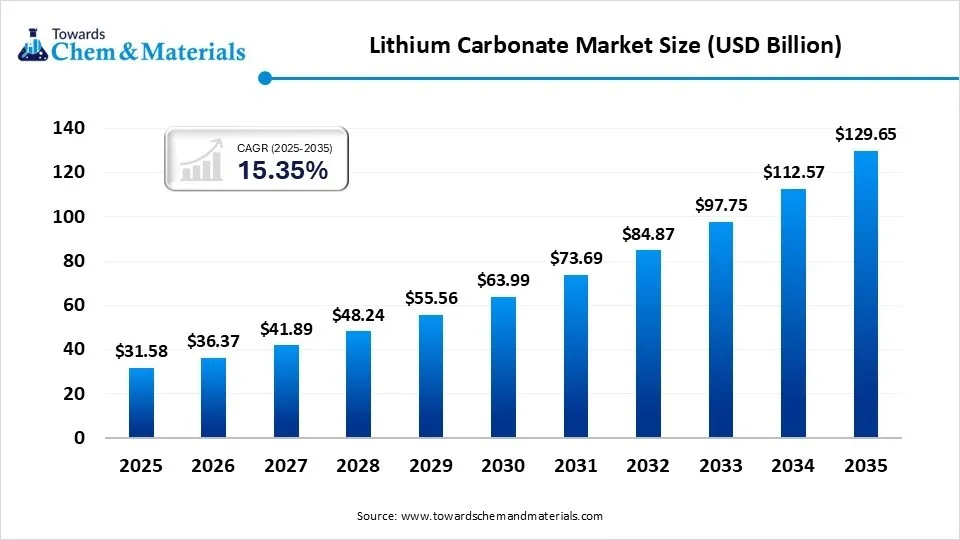
According to Towards Chemicals and Materials Analytics and Consulting, The global lithium carbonate market size was estimated at USD 31.58 billion in 2025 and is predicted to increase from USD 36.37 billion in 2026 to approximately USD 129.65 billion by 2035, and is expected to grow at a CAGR of 15.35% during 2025-2035.
The history of lithium carbonate is tied to that of lithium chemistry. Lithium is the lightest metal and has unique chemical and electrochemical properties. These properties have given lithium compounds value in numerous industries. Lithium carbonate, especially, is a commercially important and an important intermediate of lithium, as it can be converted to other lithium compounds essential to industry and technology.
With the rising electrification of transportation, lithium carbonate has truly become a material of strategic importance rather than a relatively special industrial chemical. Lithium-ion batteries are becoming increasingly vital for electric and hybrid vehicles, portable electronic devices, and stationary energy storage. Battery production has increased, and so too has the demand for raw materials with lithium. Lithium carbonate can be processed into different battery-grade lithium compounds and thus plays an important role in the development of battery production processes and in the connection between lithium resources and battery production.
Meanwhile, lithium carbonate is still relevant in the industry apart from batteries. Lithium compounds are used in certain glass and ceramic production processes to enhance their thermal and mechanical characteristics. It is also used as a lubricant in greases and in some pharmaceutical preparations. The variety of applications extends the industrial relevance of lithium carbonate beyond battery raw materials.
The future of lithium carbonate will be shaped by the growth of energy storage, technological improvements in battery chemistry, availability of lithium resources, recycling, and developments in alternative battery technologies. The production process needs to be increasingly optimized based on the increasing demand, along with the issue of using resources, water, energy, and environmental responsibility.
So, lithium carbonate is a significant nexus point for both the Old-World chemical industry and the new clean energy industry. The process of its development is a testament to the significance of lithium in contemporary technology and to the potential of a relatively simple chemical compound to evolve into a vital resource for industrial growth, electrification, and energy transition.
What is Lithium Carbonate?
Lithium carbonate is a white, inorganic lithium compound, composed of lithium, carbon and oxygen. It is one of the most commercially significant lithium compounds and is used as a product in some applications as well as in the manufacture of other lithium-based chemicals. Its ability to be utilized in a variety of industrial applications, such as chemical stability, lithium content, and versatility, has made it an important material in many industries.
It has played an important role in the battery industry. Lithium carbonate is a source of lithium to make materials for rechargeable lithium-ion batteries. For some lithium-based chemistries, battery manufacturers utilize lithium compounds for making cathode materials. The quick adoption of EVs, portable gadgets, as well as stationary energy-storage devices has thus put lithium carbonate in the strategic spotlight.
It is also a major source for ceramics and specialty glass. Lithium compounds may help reduce processing temperatures and enhance the thermal characteristics, strength, and durability of some glass and ceramic materials. It is useful in a variety of applications, including specially formulated glassware and industrial ceramic materials, because of these properties. Another important application is lubricating greases. Lithium-based greases are highly appreciated for their temperature stability, water resistance, and mechanical strength. Therefore, lithium compounds have been traditionally employed in automotive, industrial, and machinery lubrication.
Get Full Access of Report | Immediate Delivery:https://www.towardschemandmaterials.com/checkout/6510
The pharmaceutical industry also uses lithium carbonate in certain medicines. This type of application demands a high level of purity, quality control, and manufacturing procedures. Its use for pharmaceutical purposes is different from its use in industry and would be regulated accordingly. For manufacturing, lithium carbonate can be made from various sources of lithium. These are the minerals found in hard rock, including spodumene, and lithium brines. Production techniques are different for different types and compositions of resources. Typically, processing includes a concentration process, chemical conversion, purification, and crystallisation to achieve the desired degree of purity of lithium carbonate. For battery applications, material purity is of high importance as it may affect the battery performance and manufacturing uniformity. Lithium carbonate is having an increasingly significant role in the worldwide developing energy-storage industry. There is a growing demand for lithium resources and lithium-based materials due to the growing interest in electric mobility and integration of renewable energy. This has also spurred investment in mining and refining, chemical processing, as well as the production of batteries.
The business side of lithium batteries is not without its problems, however, such as the volatility of lithium prices, availability of resources, environmental issues of extraction and processing, and the need for good, effective recycling programs. The future demand for various lithium compounds could also be affected by technological innovations in batteries. Overall, lithium carbonate is an important link in the modern lithium value chain. It is used in batteries, energy storage, glass, ceramics, lubricants, and pharmaceuticals, among other applications, and is a versatile industrial chemical. With the world increasingly becoming an electric and cleaner energy province, lithium carbonate will continue to be a critical material, with production and use likely to continue developing.
What Are Some Known Worldwide Government Initiatives in Lithium Carbonate?
Earlier, Canadian company Planetary Technologies conducted a trial experiment in Halifax Harbour, Nova Scotia, to test if seawater could be made more alkaline to help the capacity of the ocean to absorb carbon dioxide (CO₂). The firm pumped in some 280 tonnes of an alkaline mineral over two months. The substance was the same as found in some antacids. The project was conceived as a study to evaluate the capacity of ocean alkalinity enhancement to be a viable solution to remove carbon dioxide from the atmosphere.
The idea has been inspired by the ocean's ability to sequester CO₂. If there is an increase in the alkalinity of seawater, then the quantity of carbon dioxide in the seawater that can be absorbed and converted to stable dissolved forms can be enhanced as well. This is a promising technique in the family of carbon dioxide removal technologies, which also includes DACs, reforestation, and mineral-based carbon sequestration.
In the Halifax trial, the alkaline material reportedly caused the water to take on a "milky pink" hue in certain areas. The changes gave an opportunity to see how the material spread and reacted with the seawater. The field experiments can be used to get more insight into the behaviour of alkaline materials in the real marine environment, rather than just in the laboratory.
The experiment is especially important as the oceans are already a major natural carbon sink. We could be talking about ways to mitigate climate change if they could increase their CO₂ uptake capabilities. This method would be used on a large scale, but has to be carefully evaluated, as changing seawater chemistry may impact marine life and ecosystems.
Long-term storage of captured carbon, monitoring, ecological impacts, and the proper scale of deployment are also issues of concern. For this reason, experiments like the Halifax project can give useful information about the feasibility and environmental impacts of ocean alkalinity enhancement.
In addition, the project is a showcase for the potential contribution of mineral and chemical technologies in climate solutions. Materials that are commonly used in industry and chemicals could be used for carbon management. But more research, testing and environmental monitoring will be necessary before such technologies can be applied on a commercial scale on a grand scale.
Planetary's Historic Alkalinity Experiment in Halifax Harbour: Aiming to Combat Climate Change | Wo…
Lithium is a crucial chemical element for the worldwide electric-car sector, as it is used in lithium-ion batteries. With the increasing development of electric mobility, demand for lithium and lithium-related compounds, including lithium carbonate and lithium hydroxide, has grown. Meanwhile, lithium prices have been extremely volatile given the fluctuations in supply, demand, mining, and battery manufacturing.
Cathode materials are used in the making of rechargeable batteries, and lithium compounds are used for this purpose. This means that fluctuations in lithium can affect the cost of producing batteries and, therefore, the economic and pricing dynamics of EVs. Either a sustained rise or fall of lithium prices can have a major impact on battery manufacturers and auto companies, as well as lithium mining and refining companies.
The relationship between EV demand and lithium production capacity is a key factor in the lithium market. Rapid growth in the number of electric vehicles sold can create a shortage of lithium, which can drive up EV prices. Conversely, an increase in supply due to new mines and processing facilities will lead to a significant drop in prices if demand has not increased proportionately. That leaves businesses unsure when making long-term investments in the battery supply chain.
The automotive industry is thus increasingly looking into the possibility of obtaining a reliable supply of lithium. Companies can mitigate the risks of price volatility through long-term contracts with suppliers, investment in raw-material projects and battery R&D. A few manufacturers are also experimenting with less expensive, scarce materials as battery chemistries.
There is a problem for lithium producers, too. Establishing a new mine or processing plant involves a lot of money, technical expertise, and time. In times of high prices, companies can expand their production, but when other firms enter into the market during a time of low demand, an excess of supply can lead to reduced prices. This can be very challenging to balance production with future demand.
Technological change is another determinant that may affect the use of lithium. The amount of new lithium needed per energy-storage capacity is expected to be lower due to the better battery energy density, production efficiency, battery life, and recycling. Eventually, it's possible that recycling will play a bigger role in the supply of lithium and other battery components.
The future of lithium carbonate producers will thus be shaped by more than just the electric vehicle market. Recycling rates, mining capacity, battery chemistry, and strategies in the global supply chain will all affect demand.
In conclusion, lithium is expected to play a crucial role in the future of electric transportation and renewable-energy storage. The future of the industry, however, will hinge on balancing the cost of raw materials, their availability, the responsible use of materials, and the innovation and sustainability of technologies and systems in recycling.
Lithium’s volatile market reshapes the future of electric cars.
What is The Production Process of Lithium Carbonate?
Lithium carbonate is produced by processing lithium-containing raw materials and transforming them into a purified lithium compound. Hard-rock minerals, primarily spodumene, and lithium-rich brines are the two major sources of lithium. The process of manufacture is largely determined by the type and content of the lithium source.
Spodumene ore is the first ore to be mined in the hard rock route and is subsequently crushed and separated by physical separation methods. The concentrated material is then burnt at a high temperature, which is called the calcination process. This alters the composition of spodumene and the chemical reactivity of the lithium. The material is then reacted with sulphuric acid. This turns lithium into a soluble compound of lithium, while many of the undesirable elements remain behind.
The product is then blended with water and undergoes leaching to separate the lithium-containing solution from the insoluble products. Impurities (iron, aluminium, calcium and magnesium) are subsequently removed by several purification stages. While it is crucial to establish the correct process conditions, impurities might also impact the quality of the final lithium carbonate, especially if the product is going to be used in batteries.
For the brine route, the lithium-rich brine is obtained from salt lakes or underground salt reservoirs. The brine is rich in lithium and has significant levels of sodium and potassium, magnesium, calcium, and other soluble salts. The brine is traditionally evaporated in a series of ponds, but newer direct lithium-extraction technologies are being developed to reduce processing time and increase resource efficiency.
The lithium-containing solution is concentrated and purified, and then treated with a source of carbonate, typically sodium carbonate. Lithium carbonate precipitates out of the solution as a solid during a chemical reaction. The material that precipitates is filtered or centrifuged out and washed to remove the soluble impurities.
The dried solid lithium carbonate is then ground to the desired size. Further purification can be performed as needed for the desired grade. Impurities must be controlled more carefully in battery-grade lithium carbonate since some impurities are potentially harmful during the production of the battery materials.
Lastly, the product is subjected to quality control tests including the measurement of lithium content, purity, moisture, particle size, and impurity content. It is then packaged and transported for applications in battery materials, ceramics, glass, lubricants, and pharmaceuticals.
In general, the production of lithium carbonate can be divided into a number of interrelated steps: extraction of resources, concentration, chemical conversion, leaching, purification, precipitation, filtration, drying, and quality control. Today, modern producers are shifting their attention to increasing recovery rates, decreasing the use of energy and water, as well as minimizing chemical waste and finding more sustainable methods of production.
What is the History of this Chemical?
The history of lithium carbonate is closely connected to the discovery and development of lithium chemistry. The new element lithium was discovered by the Swedish chemist J. A. Arfwedson in the mineral petalite in 1817. Lithium was discovered in a mineral and was therefore named from the Greek word lithos, which means stone.
After the discovery of lithium, other scientists studied the different compounds of lithium. Lithium carbonate proved to be one of the important compounds that could be prepared from materials containing lithium, and it was considered to be a relatively stable form of lithium. The knowledge of lithium chemistry slowly increased during the 19th century, but its industrial uses were still few.
The first important application of lithium compounds was in the field of medicine. Lithium salts have been studied and used in the past for a wide range of disorders, including gout due to a supposed effect on uric-acid metabolism. But there was still much to learn and to do to ensure patients' safety and health, and lithium compounds were not always used in the same way.
In the 20th century, a better understanding of lithium carbonate and its pharmacological properties was gained. With observations that lithium salts affected mood, its use in psychiatric medicine was given more significance. A few mood disorders for which lithium carbonate was later established as a treatment and long-term medication required strict medical supervision. In other fields, lithium carbonate slowly emerged as an important industrial chemical. It was also discovered to have uses in the glass and ceramics industries, where lithium compounds have a beneficial effect on the melting characteristics and thermal properties. It was also linked with the production of lubricating greases and other specialized products using lithium.
The use of lithium carbonate has come into enormous significance since the introduction of rechargeable lithium-ion batteries. With the growth of mobile electronics and the commercialization of electric vehicles, the need for lithium-based materials for batteries grew. Lithium carbonate thus became a relatively specialized chemical into one which would become of strategic importance to industry. In the present times, lithium carbonate plays an important part in the chemical and energy industry. It continues to play a significant role in pharmaceuticals, ceramics, glass and lubricants, and is also an important raw material for lithium-ion battery production. It shows the change in significance of a chemical compound over time. Lithium carbonate, which is a major component of early lithium chemistry and medicine, has evolved into a material with a strong association with 21st-century medicine, advanced manufacturing, and the worldwide transition to electrification.
How Lithium Carbonate Is Used in Medicines?
Lithium carbonate is a significant pharmaceutical ingredient, mainly known for its role in the treatment of bipolar disorder. It is part of a class of drugs called mood stabilisers and has been in use for psychiatric treatment for decades. Lithium carbonate is used in pharmaceutical formulations as a source of lithium ions, which are involved in several processes in the nervous system and are thought to help to prevent large swings in mood. Long-term use of lithium carbonate is the main medical use for bipolar disorder. Unusually elevated or irritable mood, increased activity and energy, and then periods of depression can occur in people with bipolar disorder. Lithium may also have a role in stabilizing the mood for the longer term and can be used to lower the frequency and severity of manic episodes. May be recommended for maintenance therapy to prevent further attacks.
Lithium carbonate can also be used for the treatment of acute mania, especially when the patient has a sudden mood change, increased energy, an agitated state, a decreased sleep drive, and/or extreme impulsiveness. Depending on the individual circumstances, it can be used alone or alongside other medicines. Lithium has a relatively narrow therapeutic range, and its use and dosage must be prescribed and directed by a medical professional. One other major application is to prevent relapse. Once an acute episode of bipolar disorder is controlled, lithium can help keep the person's mood more stable. This is especially important when it comes to using this as a long-term treatment, not just for when you have severe symptoms.
The exact mechanism of action of lithium is still not well understood, and there are multiple pathways inside nerve cells. Lithium has been hypothesized to modulate intracellular signalling, neurotransmitter activity, and enzymes regulating cell function. It can affect processes related to mood regulation through these effects. Researchers are still exploring the exact ways in which lithium is effective. One of the key features of lithium therapy is the need to regularly check the level of lithium in the body. The difference between an effective concentration and one that may be hazardous is rather small. Regular blood tests may then be recommended, especially at the beginning of treatment and after a dosage adjustment.
Other medicines may also affect lithium, and lithium may affect other medicines, and it may be affected by things like hydration and changes in kidney function. For this reason, it is advisable to keep patients under the supervision of health care professionals while receiving lithium therapy. Common side effects can include nausea, increased thirst, increased urination, hand tremors, and changes in body weight. Excessively high levels of lithium can have more severe effects.
In general, Li2CO3 has a significant role in current psychiatric therapeutics. It has a long history of use and effectiveness as a stabilising medication, and has been effective at reducing the recurrence of some mood episodes, contributing to its status as an important pharmaceutical compound. Concurrently, it needs to be precisely dosed, with medical supervision and proper monitoring to ensure the balance between therapeutic effectiveness and safety is maintained.