 Request Consultation
Content
The Sedimentary and Corals Paving the Way for the Morals
Introduction
Shale gas naturally contains methane, ethane, and propane. It is found in sedimentary rocks. Because other gases flow through the rocks and can be extracted, this gas is more difficult to extract, as it is trapped in the microscopic pores of the rocks, which makes the flow very slow and stagnant. Shale gas has become a prominent part of the energy mix, providing an abundant and reliable source for electricity generation, industrial production, residential heating, and chemical manufacturing. Shale gas is being used widely around the globe. Given its availability, it has improved energy security by reducing dependence on imported fuels. This gas also contributes to a greener tomorrow, as it burns more cleanly, producing lower emissions and reducing the carbon footprint.
A project was conducted with shale gas to see how it is reducing growing concerns, such as groundwater contamination, methanol leaks, and increased seismic activity. Due to its clean burning, it contributes to sustainability. The method for Barnet shale extraction is now being used in other sedimentary basins for natural gas extraction; this technique reduces carbon emissions.
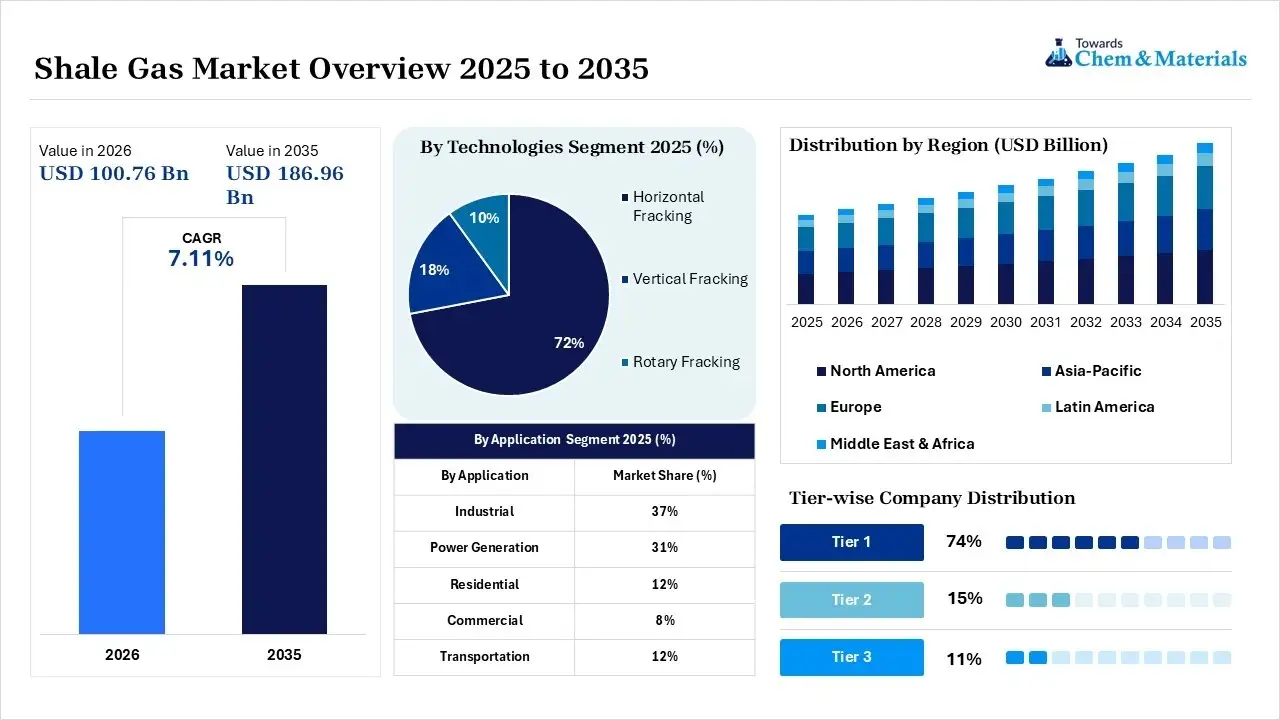
According to Towards Chemicals And Materials Analytics and Consulting, the global shale gas market is projected to grow from USD 100.76 billion in 2026 to USD 186.96 billion by 2035, registering an impressive CAGR of 7.11% during the forecast period.
Get Full Access of Report | Immediate Delivery@ https://www.towardschemandmaterials.com/checkout/6476
History of Shale Gas Extraction
The use of shale gas began in the early 1800 a rise has been noted over the years till 20th century. The first development was in the Barnett Shale in the United States. The early adoption of this gas extraction was done by Mitchell Energy in the early 2000 and this marked the beginning of the success of this gas, making it a prominent factor around the globe. If we see, then it was widely used on 5 continents.
By late 2000, a decline in conventional gas indicated a rise in natural gas production in the United States. The shale gas industry saw dominance from late 2000 to 2010 because of reducing dependence on imported fuels and providing energy security for the coming generations, as every country had an option for natural gas production due to increased use and extraction of shale gas. The supply chain was carried on to various countries on a large scale. If we peep into the procurement data, then it can be seen that the period from 2000 to 2010 has been characterized by large levels.
As the popularity and adoption were growing, the development of horizontal drilling enabled operators to develop a lot of fractures to make the flow very easy from pipe to pipe. Recent studies show that continuous technological refinement is improving efficiency, digital monitoring systems, and stronger environmental regulations. Even in late 2023, a study was conducted to see how this was encouraging environmental sustainability, and it was concluded that the materials in gas itself are a contributing factor towards a greener tomorrow. The critic points out that methane leaks during the process provide a carbon advantage, reducing carbon emissions at a greater rate.
A Short History of the Shale Revolution - RBAC Inc.
The History of Natural Gas: From Ancient China to Shale - ScienceInsights
Shale Gas: History of Development | Springer Nature Link
The Case Studies
Economic Gas Production in the Marcellus Shale
The paper examines the future economic potential of the production of natural gas from the Marcellus, the largest unconventional gas formation in North America. The team employs engineering-based reservoir models and production information to make predictions about the future behaviour of gas production. The study takes account of geological features, past well performance and economics to estimate future gas recovery, not just using historical trends.
The Marcellus Shale is divided into four production zones for this analysis, recognizing that the reservoir quality and productivity vary significantly among the zones. The study reveals that the core areas have gas resources that are more abundant and have a higher production rate, which is more economically viable for drilling. Wells in the outlying and lower-quality areas tend to yield lower volumes of gas and need more investment to generate a profit.
The research suggests short-term shale gas output will be robust, but rates of growth will ease as the best drilling sites are exhausted. Companies are working towards creating more unfavourable reservoirs, which will increase production costs, but have the potential to lower well performance. Maintenance of overall gas output will rely on continued drilling and more efficient gas extraction.
Economics is deemed to be one of the most important factors affecting future production. The viability of a shale gas project is dependent on a variety of factors, including market prices for natural gas, operating expenses, drilling costs, and technology. While there may be a lot of gas left underground, only the gas that can be produced at a reasonable cost is economically recoverable, the paper says.
New horizontal drilling and hydraulic fracturing technologies and enhanced reservoir understanding have led to increases in production efficiency and gas recovery from shale formations. While these improvements have been made, there is still only a limited supply of quality drilling sites, which will limit long-term growth in production.
Overall, the study indicates that the Marcellus Shale will remain an important source of natural gas in the future. Future expansion will become more difficult, however, because of deteriorating reservoir quality and a shift in economic conditions. It highlights the significance of coupling geology, technology, and economics in the development of long-term shale gas production and investment plans.
Forecast of economic gas production in the Marcellus Shale | AAPG Bulletin | GeoScienceWorld
Sichuan Basin, China
Advancing Shale Gas Development Through Innovation
The case study states that there was a rapid increase in demand for electricity due to ongoing hasty industrialization and urbanization within the country. This was creating dependence on imported oil and gas, which was a concern for citizens, as a shortage of electricity could immediately halt China's workflow. While the Sichuan basin contained abundant gas reserves, extraction was difficult because the shale lay beneath the ground and was located in mountainous terrain.
The development process was also tedious and challenging due to a lack of technical experts, higher drilling inefficiency, and the bad geographical location of the shale. The main reason being the leakage of ethanol, methanol, and other gases, which were harmful to the environment and were increasing the dependence on imported gases within the country.
Why was The Problem Occurring?
The main reason for this problem was that the conventional gas reserves of China could not meet the increasing demand for electricity within the country. This was indirectly making China more dependent upon the import of gas and fuel from other countries. The government's policy was to develop domestic unconventional energy resources to lessen dependence on coal and imported fuels. The shale gas extraction process was more complex and costly in the Sichuan Basin; however, due to the unique geological conditions of the basin, such as high-pressure reservoirs, faulted rock mass, and challenging terrain. Meanwhile, the need to regulate environmental effects and to find more sustainable ways to extract needed to be addressed with greater precautions.
These challenges were tackled in China by a multifaceted approach of government support, technological innovation, and infrastructure development. Policies and financial incentives were put in place to encourage investment in shale gas exploration, and the state-owned energy companies worked with research institutions to develop drilling techniques. Advanced horizontal drilling, multi-stage hydraulic fracturing, digital monitoring of reservoirs, and better geological mapping improved production efficiency and lowered risks during operations. The government also tightened environmental rules, encouraged water recycling, enhanced wastewater treatment, and established methane emission monitoring to curb the environmental footprint of shale gas development.
Production efficiency should be further improved and environmental sustainability enhanced in the future development of the Sichuan Basin. Research is ongoing on developing more sophisticated drilling and fracturing techniques to lower operational costs and boost gas recovery. Water from hydraulic fracturing will be recycled more, methane will be reduced further, and groundwater resources will be protected. China will also roll out new pipeline projects, increase environmental monitoring via digital tools, and develop ways to blend shale gas into the country's renewable energy systems to boost a cleaner, safer energy supply. Ongoing research, innovation, and regulatory investigations will continue to play an important role in the economic and environmental sustainability of shale gas development in the Sichuan Basin.
Government Initiatives
Driven by high reliance on the import of expensive Liquefied petroleum gas (LPG), the government of India is driven to take the initiative to exploit the country’s shale gas reserves to produce its own gas and reduce its dependency on the expensive imported fuels. In the editor’s conference ministry of Gas India announced that now the country will experience the shale gas revolution stage, explaining the fact that shale gas has gained prominence in the United States of America since it was adopted within the country. Even
China was there in the discussion point, stating how the project has helped them make their own fuels within the country, maintaining the electricity demand. As per DGH, India has plenty of shale resources, which can get the revolution started very smoothly, and even the United States observed that out of 290 trillion cubic feet of gas, 60 trillion cubic feet can be recovered. Now, even India has taken the solution out to meet the electricity demand.(Source: www.industrialinfo.com)
The article assesses the progress made in Argentina's Vaca Muerta shale formation and asks the question of whether it's a one-off success or a replicable example that other countries can emulate. Vaca Muerta has become one of the world's most important unconventional oil and gas resources, boosting energy production in Argentina and adding to its potential as a future energy exporter in the last ten years. The development of the project has led to a significant decrease in reliance on imported fuels and provided new economic opportunities for the country in terms of investment, employment and export opportunities. The authors say that Vaca Muerta has advanced at a high pace not just because of favourable geology. The project has been extended due to consistent government support, stable regulatory policies, attractive investment frameworks and public institutions' cooperation with private energy companies. The shale industry remained a key focus of policymakers, despite economic challenges, with continued investments in infrastructure and prudent policies in place to encourage domestic and international investors.
The article also notes that the success of the project depends on the support of infrastructure. Expansion of production has been achieved through investments in pipelines, processing facilities, transportation networks, and future liquefied natural gas export capacity. Royalty payments and economic development have also accrued to the benefit of the provincial governments, which has led to greater institutional support for the development of shale resources.
The study acknowledges, however, that shale gas drilling has some environmental issues. Hydraulic fracturing uses large amounts of water; concerns about methane emissions, wastewater management and groundwater protection have arisen. The cases show the importance of effective environmental legislation, monitoring and implementation of low-impact production technologies in order to reduce ecological impacts while maintaining production of energy. The article also draws comparisons with leading shale producers in the world, such as Algeria, Colombia and Mexico.
Despite their favourable geological prospects, many of these countries still have to overcome challenges, including regulatory uncertainty, lack of infrastructure, inadequate investment and reduced public acceptance of hydraulic fracturing. The unfriendly environment has hampered the commercialization of their energy resources that are not conventional.
The authors believe that Vaca Muerta is a unique case of successful shale development that should not be considered a blueprint for other areas. Its success is due to a combination of high-quality geological resources, favourable public policies, continued investment, infrastructure development, and institutional cooperation. To achieve similar long-term success, countries aiming to develop their own shale industry need to create comparable economic, regulatory, and environmental conditions.(Source: www.drishtiias.com)
How is AI impacting the Shale Gas Industry?
The shale gas industry is witnessing noticeable changes due to the implementation of AI and automation in the process. It has been noticed that AI is being efficiently used in some of the activities, such as efficiencies in operation, cost savings, and better decision making by exploration and production process. The AI algorithms that are put into use are the best ones to spot patterns in a vast amount of geological landscape, seismic, drilling, and production data; these factors could be used to spot the best drilling sites, refining the placement of the well. Machine learning can be of great help in the entire process.
The question that arises while reading? It is because it helps predict the behaviour; this aids the reservoir operators in guesstimating production rates at recoverable reserves more accurately. AI can be used during the drilling process to continuously analyse sensor data and alert operators to any unusual conditions, helping to minimize the risk of equipment failures, wellbore instability, and downtime costs. AI-powered predictive maintenance systems predict the condition of drilling rigs, pumps, compressors, and pipelines to schedule maintenance well before they fail.
AI can also help improve hydraulic fracturing by analysing rock formations to identify the most efficient fracture geometry, fluid composition, and pumping timeline to enhance gas production. Moreover, digital twins and automated monitoring systems allow operators to closely track production performance, optimize operations, and minimize environmental footprint, such as methane emissions and water usage, throughout the process.
Technological Advancements in Shale Gas Industry
The shale gas industry has seen tremendous changes in technology over the last 20 years. As the tool of horizontal drilling has been introduced, operators have the scope to reach a vast area of shale formation from a single well, thereby enhancing competence. Multi-stage hydraulic fracturing has magnified reservoir stimulation by creating a network of fractures, making the flow of natural gas easier for the system. High-resolution 3D seismic image usage has showcased agility, improving reservoir characterization; this has helped to recognize a better position for wells, mitigating the risk of exploitation.
Real-time pressure, temperature and fracture performance data are obtained from fibre-optic monitoring systems and smart downhole sensors, enhancing the management of production. Automated drilling rigs, robot inspection systems and remote operations centres have boosted safety and lowered operating expenses. Continuous monitoring of wells, pipelines and processing facilities using digital twin technology, cloud data platforms and Internet of Things (IoT) devices is helping to facilitate quicker decision-making and better asset management. Water recycling systems, methane detection technologies, and carbon capture initiatives have also made strides, contributing to the industry's environmental sustainability and more sustainable resource development.
In these regions, AI is not widely adopted. These are regions where there is not much use of AI. AI has been a key enabler in shale gas operations, but there are still some activities that are heavily people-dependent and reliant on manual decision-making. Legal evaluation, consultation with stakeholders, and administrative judgement in the process of government policy formulation, environmental permitting and regulatory approvals are not completely replaceable by computers. Commercial negotiations, community engagement and land acquisition are all reliant on direct contact, community development and relationship building between the company, landowner and government body.
It's important to note that while AI can provide technical insights, the final investment decision on major exploration initiatives is still in the hands of senior executives, where factors such as market conditions, political risks, financial considerations, and strategic priorities all play a role in the decision-making process. With the advent of more and more automation, skilled engineers, technicians, and field workers are still needed for drilling rig assembly, equipment installation, pipeline construction, and well completion, etc. On-site response for large-scale accidents is also heavily dependent on having staff with experience in responding to such events, and the ability to make prompt decisions based on complex situations. Therefore, AI is used as a decision support and optimiser, not a replacement for human expertise in the shale gas industry.
Where is AI not being used?
AI has been a key enabler in shale gas operations, but there are still some activities that are heavily people-dependent and reliant on manual decision-making. Legal evaluation, consultation with stakeholders, and administrative judgement in the process of government policy formulation, environmental permitting and regulatory approvals are not completely replaceable by computers.
Commercial negotiations, community engagement, and land acquisition are all reliant on direct contact, community development, and relationship building between the company, landowner, and government body. It's important to note that while AI can provide technical insights, the final investment decision on major exploration initiatives is still in the hands of senior executives, where factors such as market conditions, political risks, financial considerations, and strategic priorities all play a role in the decision-making process.
With the advent of more and more automation, skilled engineers, technicians, and field workers are still needed for drilling rig assembly, equipment installation, pipeline construction, well completion, etc. On-site response for large-scale accidents is also heavily dependent on having staff with experience in responding to such events and the ability to make prompt decisions based on complex situations. Therefore, AI is used as a decision support and optimizer, not a replacement for human expertise in the shale gas industry.
Types of Shale Gases
- Dry Shale Gas: Dry shale gas is composed largely of methane gas (CH₄) containing 90% or more methane and with very low levels of heavier hydrocarbons. It is primarily employed to produce electricity, to heat industry, for domestic cooking, and for chemical production. Typically, in highly mature shale formations, one will find dry gas reservoirs.
- Wet Shale Gas: Wet shale gas is composed of methane and the presence of substantial amounts of natural gas liquids (NGLs), such as ethane, propane, butane, and pentane. These liquids enhance the market value of resources since they can be separated and applied as input to the manufacture of petrochemicals, fuel blending, and liquefied petroleum gas (LPG).
- Associated Shale Gas: Associated shale gas is captured along with shale oil from the same shale formation. Oil extraction and collection release natural gas, instead of flaring. This type involves crude oil and gas production, associated with liquid-rich shale plays, and may be present.
- Non-Associated Shale Gas: Non-associated shale gas is produced from shale that contains a hydrocarbon with a relatively high natural gas component and is low in crude oil (often zero). These reservoirs are commercial sources of natural gas, as it is their only purpose is ‘Gas Recovery'.
- Biogenic Shale Gas: Biogenic shale gas occurs from the biological breakdown of organics, and the decomposition by microorganisms takes place in relatively shallow and low-temperature environments. Contains mainly methane and is found less frequently than Thermogenic shale gas.
- Thermogenic Shale Gas: Thermogenic shale gas forms, after millions of years, when deeply buried organic matter is heated and pressurized by high temperatures. It is the most prolific and commercially important shale gas worldwide, and often its composition includes methane as well as varying proportions of heavier hydrocarbons.
Emergent Innovations in Shale Gas
Technological advancements, including automation, digitalisation and moving to new drilling techniques, are changing the shale gas industry. Advancements in artificial intelligence and machine learning are being applied to the analysis of geological data, well optimization and forecasting production performance, all of which are helping to minimize exploration risks and enhance yields. New rotary steerable (RS) systems and real-time downhole monitoring tools have made the horizontal drilling process even more accurate, improving shale access in larger formations with fewer wells. It has also undergone development, as the strength of hydraulic proppants has increased, the aqueous systems used to recycle the fracturing fluid have been modified to reduce environmental repercussions, and the formulation of fracturing fluid itself has improved to maximise gas production.
By simulating production scenarios and detecting equipment failures before they happen, digital twins and predictive maintenance technologies help operators reduce downtime and maintenance costs. Pipeline inspections, methane detection, and environmental compliance are conducted with Unmanned aerial vehicles (drones) and satellite monitoring. Carbon capture, utilisation & storage (CCUS) is being incorporated into the shale business to minimize carbon emissions from shale production activities.
Lower emissions in operations are achieved by electrifying drilling rigs and using renewable energy for field equipment. Advanced water treatment technologies can produce water that can be recycled for reuse in hydraulic fracturing to help save freshwater. All these innovations help increase efficiency, reduce costs, protect workers, and facilitate the industry's shift to a more sustainable approach to shale gas development.
The shale gas industry is making strides with global policy.
By offering regulatory clarity, investment incentives, and energy security strategies, government policies have also emerged as key drivers in the development of shale gas. Countries are embracing shale gas as a transitional fuel that can aid growth while helping to phase out coal and imported energy. Environmental protection and water management standards, methane emissions standards, and well integrity standards have been added, while a new rule with its accompanying authority requires responsible exploration behavior.
Domestic and foreign investments in shale resources have been facilitated by fiscal measures including royalty adjustments, accelerated permitting, and tax benefits. Multiple governments have focused on investments to enhance market access and boost energy resilience through pipeline investment, liquefied natural gas (LNG) export terminals, and gas storage facilities. The sharing of technologies for drilling, work practices for environmental monitoring, and safety practices for drilling operations have also improved through international exchange.
Carbon capture technologies, methane monitoring systems, and cleaner production processes are promoted by climate policies as changes to achieve the national emission reduction targets. Meanwhile, the energy diversification measures have left shale gas as a steady stream of supply to complement all renewable sources in electricity generation. With energy demand growing across the world, the shale gas sector is expanding in response to policy support and working towards increased efficiency, environmental responsibility and long-term energy supply security.
The shale gas industry is challenged by rising early costs of both exploration and production, variable natural gas prices, stringent environmental restrictions and public fears about fracking. Project development is still impacted by issues of water availability, wastewater disposal, methane emissions and land-use conflicts. The infrastructure, skilled labour and lengthy permitting process can slow the production process. Furthermore, operating on declining commodity prices is also tough, and costs must continue to be reduced and technologies streamlined.
The Role of a Workforce in Shale Gas Industry
Safe, efficient, sustainable shale gas operations require a key role for the workforce. Petroleum exploration, production, transportation, and refining involve teams of petroleum geologists, petroleum engineers, drilling specialists, complicated data analysis, and health and safety experts throughout the entire process. Their experience helps businesses extract resources as cost-effectively as possible while meeting rising safety and environmental laws.
In an era of increasingly widespread digital technologies, workers are gaining proficiency in artificial intelligence, data analysis, automation, robotisation and tele-monitoring. Ongoing professional development ensures employees are skilled in operating sophisticated drilling hardware, methane detection systems and digital production management platforms. Safety Training continues to be a priority, contributing to workplace safety and an improved attitude to emergency preparedness.
The sector also helps create jobs in equipment manufacturing, supply and logistics, pipeline maintenance, pipeline construction, research and environmental consulting. It can be seen that University/Ti affiliations have heightened with energy companies in order to offer specialised education programmes which train future professionals for a changing industry. The workforce's use of innovation, enhancements to technical skills, and adherence to quality principles aids in boosting productivity, sustainability, and competitiveness, all contributing to a brighter future and positive outcomes for society. However, with the industry moving towards lower carbon operations, staff industry will continue to be the keystone for the roll-out of sustainable solutions and support for responsible energy generation.
Industry Initiatives Towards Sustainability
With an eye on responsible energy provision, the shale gas industry is taking a growing interest in sustainability programs to lower its environmental impact. Businesses invest in advanced methane monitoring systems that leverage sensor, drone, and satellite technology and continuous leak detection systems to detect and repair leaks at a rapid pace. Successful reduction of methane leakage greatly reduces GHG emissions and also makes the operation more efficient.
Water conservation is one other primary focus. Operators have implemented growing produced water recycling initiatives to treat and recycle hydraulic fracturing wastewater, which helps limit reliance on fresh water. Evaluation of water use with closed-loop systems can reduce the discharge of wastewater and enhance protection of the environment. More sustainable fracturing fluids are also in development, with improved water quality management, to minimise and reduce the use of chemicals.
Over time, many producers are incorporating carbon capture, utilisation and storage (CCUS) technologies into production facilities to ensure that they are not released into the atmosphere. Continuous electrification of drillers' machines, compressors, and field equipment is helping to decrease the use of diesel-powered machines, and renewable electricity is being used for some operations.
After the production activities have ended, land restoration programmes are helping restore productive ecological conditions. Re-planting of native vegetation, establishment of high soil quality and monitoring of biodiversity make recovery of the ecosystem possible. Environmental impact assessments are also being enhanced before development, as part of companies' efforts to minimise environmental disturbance. Digital technologies contribute to sustainability by providing the ability to monitor the environment in real-time, predict its maintenance needs, and manage resources effectively. AI-based drilling optimisation decreases excess fuel usage and losses of operations.
Several institutions have enhanced their corporate reports on sustainability through emissions reporting, water consumption and the protection of biodiversity, and community engagement projects. Partnerships with regulators, research centres and the community have enhanced transparency.
Data Centre Cooling: Innovating Water Management in the Process
One of the most vital parts of the current digital facilities is its data centers, which generate a significant amount of heat during data processing and storage. Optimized functionality of working temperature ranges and their variability, as well as further optimization of energy and water consumption, support sustainable use of resources by utilizing cooling systems at the best possible efficiency. With growing demand for cloud computing, AI and high-performance computing, innovations in cooling technologies are changing the way data centres look after thermal energy and water resources.
Conventional cooling equipment may consist of chilled water that flows through cooling towers and heat exchangers. These systems are effective, but can contribute millions of litres of fresh water every year due to evaporation and blowdown. To overcome this challenge, operators are increasingly turning to water-efficient cooling practices and tactics that reduce freshwater withdrawals and keep water use at a high level of cooling efficiency.
One of the greatest options that has found its way into the picture is the technologies associated with cooling through liquid. These systems move uniquely formulated coolants over processors instead of around the outside of the processors, or dip servers into dielectric coolants so the heat is drawn away effectively. Cooling by using the liquid's heat transfer capabilities, which heat liquids more efficiently than cooling air, liquid systems use less energy and demand much less water for cooling.
Many also have closed-loop cooling, meaning the water is never flushed, but is pumped back into the system. This not only helps to conserve water, but it also cuts down on water wastage and decreases reliance on the available freshwater in the area. Use of recycled or reclaimed municipal wastewater for cooling operations is growing to save valuable potable water reserves, while providing a diversion to more circular thinking on water.
The intelligent and digital monitoring systems further optimize the cooling function, based on real-time data of the cooling temperatures, air humidity, workload distribution, and weather conditions. The intelligent control system automatically controls cooling based on operational needs, thus avoiding unnecessary energy use and oversized water consumption. Predictive maintenance also helps to detect inefficiencies in equipment before they cause water loss or failure.
The free cooling technologies are becoming popular in cooler climate areas. These systems rely on something that is naturally cool, whilst the outdoor air or natural cool water source dissipates the heat, which means they do not require the use of mechanical refrigeration. Also, heat recovery systems are being introduced in data centres, which recover the excess thermal energy for district heating or any industrial process and nearby commercial buildings.
These advances offer a combination of increased reliability in operation and advantages in the area of the environment and operational costs. Data centres are implementing more resilient and sustainable cooling solutions, combining state-of-the-art cooling technologies with water recycling, automation, renewable energy, and designing efficient Data Centre infrastructure to ensure long-term digital growth and safeguard precious water resources.
The Future of the Shale Gas Sector
The trajectory of the data centre cooling industry will be influenced by the growing need for more computing power, both for green buildings and for the rapid advances in AI. As AI workloads, cloud computing, and edge computing grow, air cooling systems will become phased-out systems and gradually replaced by highly effective liquid cooling and immersion cooling technologies to meet the demand for high-density computing.
Conserving water will be a major focus through increased implementation of the closed-loop cooling system, re-use of wastewater, harvesting rainwater, and designing water-neutral facilities. The operators will be expected to integrate RE with the rest of the cooling infrastructure, reducing carbon emissions and enhancing environmental performance. AI will enhance cooling performance even more by forecasting thermal loads, load balancing, and even automating the cooling system so that it is right-sized for optimal performance and reduced energy and water use.
Looking ahead, it's also likely that modular cooling units, waste heat collection and recovery units, and smart environmental monitoring equipment with real-time optimisation and predictive capabilities are expected to be further integrated into the facilities. More collaboration around technology providers, utilities, governments, and research institutions will speed the development of low-water, low-carbon cooling techniques.
As environmental regulations become stricter and water scarcity becomes a growing concern around the world, the need for sustainable cooling technologies becomes a challenging advantage. As the industry continues to invest in innovation, efficiency, and responsible resource usage, the industry can expect data centres to stay equally dependable while playing their role in the digital transformation of the world with a much-reduced environmental impact.
Conclusion
Shale gas remains important to enhance energy security around the world by supplying a dependable, ever-larger share of natural gas with sustainability impacts on energy growth and economic development. The development of horizontal drilling, hydraulic fracturing, artificial intelligence, automation, and digital monitoring has increased operational efficiencies, lowered production expenses, and increased recovery of resources. Meanwhile, governments are enacting policies to increase responsible exploration, improve production methods, and invest more in energy infrastructure.
Despite these accomplishments, there are still many challenges for the industry, including decreasing methane emissions, water management, environmental protection, regulatory compliance, and public acceptance. A successful and sustainable future will hinge on the realisation of the dual challenge of greater energy demand with better management of its resources and the transparency of its governance.
The trajectory of the shale gas industry is toward incorporating the use of low-carbon resources into traditional shale gas production, including carbon capture, water re-use, electrifying production and advancing methane monitoring. The ability of a skilled workforce, ongoing research and development, and partnerships with government, industry, and research institutions will continue to be critical to future innovation and successful operations.
With the changing global energy landscape, shale gas will be a key transition fuel, working alongside renewable energy forms to ensure energy security. By embracing technological innovation, environmental responsibility, and sustainable practices, the shale gas industry can contribute to a more resilient, efficient, and balanced global energy system.
About the Experts

Aditi Shivarkar
Aditi serves as Vice President at Towards Chemical and Material and brings over 15 years of experience in research, strategy, and industry analysis. She focuses on sectors such as specialty chemicals, advanced materials, and sustainable solutions. She studies how regulations, raw materials, and industrial demand shape the market, and she uses that understanding to guide businesses in the right direction. Aditi helps companies stay prepared for change, improve their market position, and make well-informed decisions.



Aman Singh
Aman Singh has more than 13 years of experience in research and consulting, with a strong focus on the global chemicals and materials space. He tracks developments in areas like green chemistry, high-performance materials, and industrial innovation. At Towards Chemical and Material, he leads the research team and ensures every report is clear, accurate, and useful. Aman breaks down complex industry changes and helps businesses understand what they mean in practical terms.