
Content
The Art and Science of Fertilization: An Expedition from Seed to Bloom
Overview
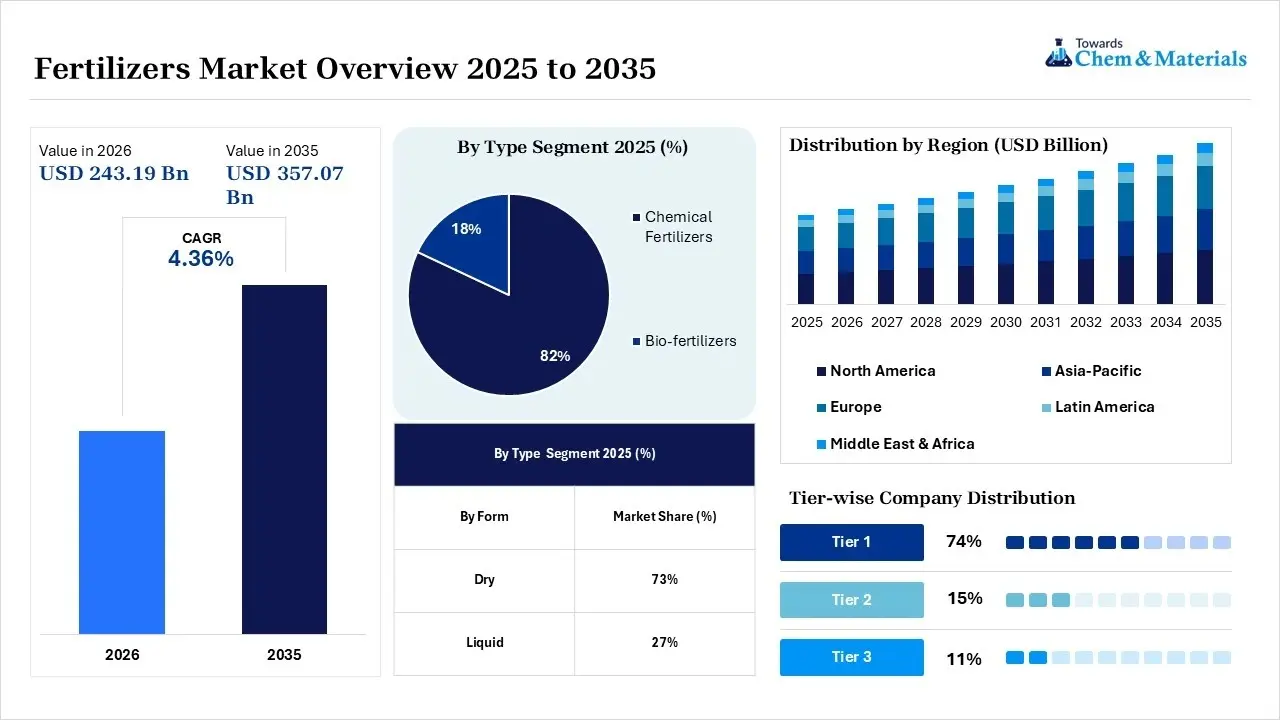
According to Towards Chemicals And Materials Analytics and Consulting, The global fertilizers market size was valued at USD 233.03 billion in 2025, is estimated to reach USD 243.19 billion in 2026, and is projected to reach USD 357.07 billion by 2035, exhibiting a compound annual growth rate (CAGR) of 4.36% over the forecast period from 2026 to 2035.Asia Pacific dominated the fertilizers market with the largest revenue share of 46% in 2025 and is expected to grow at the fastest CAGR of 4.47% during the forecast period. The article presents the use of fertilizers and how they contribute to farm health, providing us with a plentiful supply of vegetables that we consume daily. Just as we say that mitochondria are the powerhouse of cells in the human body, fertilizers serve as a crucial component for the smooth functioning of farms, helping crops grow and ultimately reach us.
This article will offer both a glance and a deep dive into the topic of fertilizer substances that include both natural and synthetic materials used to enhance crop yields. By the way, have you considered that fertilizers can also be used beyond farming? This might be a question worth pondering. If you haven't thought about it, don't worry, because you've landed on the right article. Not only will you connect with the farming industry, but you will also take a detour through many other industries that our readers appreciate. This article aims to serve its purpose while also addressing the various queries you may have while reading. We understand your questions, which is why we are delivering answers that cater to your interests. So, hold on, as there is much more ahead regarding fertilization that is yet to be uncovered.
Introduction
Fertilizers are natural or chemical substances that are present in nature and used to supply it to the soil to grow the yielding of the crops. The use of fertilizers results in an increase in the natural fertility of the soil for farmers. The fertilizers work on three pillars, namely nitrogen (N), phosphorus (P), and potassium (K). All these properties work on different bases: nitrogen is used to strengthen the leaves, phosphorus for all-round development of flowers and their roots, and finally potassium for providing calcium and magnesium for their growth. These three components help in the photosynthesis process, which proves to provide food to the plants and the crops that are being grown on the farm.
These fertilizers are being applied in various ways by the farmers; some use them in dry form, some make them into a liquefied substance and spread it across the field, and some in vaporized form. If we go back in time then the very first usage of the fertilizers can be seen in India, first the fertilizers were being made by the cow dungs and manure that were produced by animals in the country, later on the concept was widely spread across the countries like Cyro, Egypt, Unites States and many more if observe then the trajectory of fertilizers is pretty straight without any fall in the business cycle once it started growing the revolution reached to the it’s peak and still it is ongoing. Now, even fertilizers are being used for biogas production over the globe; this concept was introduced as it was reducing emissions and encouraging a greener environment for the coming world. The development of the agricultural industry can be seen right from the 19th century when discoveries were being made for the growth of plants and industries around the globe. Fertilizers are good for the soil, but overuse of fertilizers can also cause environmental damage, like water pollution, land sliding, air pollution and pollution of soil as well. Fertilizers are not limited to use in farming but as well it is used in many other things.
Beyond the Fields: Unveiling the Hidden Uses of Fertilizers
Fertilizers are generally used to grow crops, but they can be used in many other areas. The nutrients present in fertilizers, such as nitrogen, phosphorus, and potassium, are used to grow plants in many environments and are used as raw materials in several industrial and environmental applications. They have been used in landscaping, forestry, environmental restoration, research and specialized manufacturing processes.
Fertilizers are also widely used in landscaping and horticulture, one of the most important non-agricultural uses of fertilizers. Fertilizers are essential for keeping healthy lawns, ornamental plants, shrubs and flowering plants in public parks, botanical gardens, golf courses, sports stadiums, roadside plantations and residential lawns. Balanced nutrient application results in better root development, colour, flowering and health of plants, making for attractive and sustainable green spaces.
Fertilizers are also applied in forestry and afforestation initiatives to promote establishment and growth of trees on degraded forests and in reforestation projects. In nutrient-poor soil such as deforested, mined or burned landscapes, young saplings are often in need of other nutrients to survive. Fertilizers stimulate tree growth, promote survival, and facilitate ecosystem restoration.
A significant use is reclamation and environmental rehabilitation of land. Mining, industrial activities, construction and soil erosion can lead to poor soil fertility in disturbed areas as well. Grasses, shrubs, and native vegetation will establish if the essential nutrients are restored with fertilizer. It can help to: provide stability to the soil, minimize soil erosion, encourage biological diversity, and aid with long-term ecological recovery.
Urban greening programs are very popular in the application of fertilizers. In artificial growing media or nutrient-poor soils, green roofs, vertical gardens, and indoor landscaping, roadside medians, and urban forests must be carefully managed when it comes to nutrient supplementation. Fertilizers contribute to the maintenance of vegetation, which helps to improve air quality, urban heat, and the visual quality of cities.
In scientific research and education, fertilizers are used in the study of the nutrition of plants, the chemistry of soils, environmental science and crop physiology. Fertilizers in universities, research laboratories and botanical institutions are used to elucidate nutrient interactions, plant responses, fertilizer efficiency and sustainable land management practices.
Some fertilizer compounds are also used in industries. Chemical manufacturing, pharmaceutical applications, water treatment and advanced industrial formulations are some of the other uses of ammonium sulphate and potassium nitrate. One of the most commonly used nitrogen fertilizers is urea, which is used as a raw material for the production of resins, adhesives, laminates, plastics and cosmetics and as a raw material for the production of diesel exhaust fluid for vehicle emissions reduction.
Fertilizers are applied in fish ponds to promote the growth of beneficial aquatic organisms and phytoplankton in the aquaculture industry. They are the natural feed of many fish species and help in pond productivity and decreasing the need for supplementary feed.
Fertilizers are also used in ornamental plant nurseries, greenhouse crop cultivation, hydroponic systems and indoor plant production, where the correct management of the nutrients is very important in order to achieve high-quality flowers, decorative plants and seedlings. Nutrient formulations and control allow for consistent growth even without soil.
With a growing focus on sustainability, modern fertilizers are now being used in environmental conservation initiatives, urban ecological development, and in new and innovative industrial applications. Their contribution has gone far beyond agriculture, highlighting their significance in promoting green infrastructure, ecological restoration, industrial production, scientific research, and sustainable resource management in various sectors.
Types of Fertilizers
Fertilizers are substances used to provide the essential nutrients needed for healthy plant growth, improved soil fertility, and increased agricultural production. They are divided into categories depending on their origin, nutrient content, or application method. They all have their purpose, and they are chosen based upon the nutritional needs of crops, soil, and farming methods.
Organic Fertilizers
Organic fertilizers are made from natural sources like animal manure, compost, crop residues, bone meal, fish emulsion, vermicompost, etc. They help to enhance soil structure, boost organic matter, create better water-holding capacity, and support good microbial activity. Organic fertilizers may provide a slow-release or a gradual supply of nutrients, but they also have the benefit of maintaining soil health and supporting sustainable farming practices.
Inorganic or Chemical Fertilizers
Inorganic or chemical fertilizers are produced by industrial processes and are available in forms that are readily used by plants. These fertilizers produce rapid effects and are most commonly used in commercial agriculture. They are often used in industry as urea, ammonium nitrate, ammonium sulphate, potassium chloride and superphosphate. Chemical fertilizers are rich in nutrients and enable farmers to provide the exact amounts of nutrients to crops.
Straight Fertilizers
Straight fertilizers are fertilizers with one main nutrient, e.g. nitrogen, phosphorus, or potassium. Urea is a source of nitrogen and muriate of potash is a source of potassium. Mixed fertilizers are composed of two or more nutrients in a single product (compound), or a physical mixture of two or more fertilizer materials that were blended to satisfy specific crop needs.
NPK Fertilizers
The other notable category is NPK fertilizers, which contain the three macronutrients, namely nitrogen (N), phosphorus (P) and potassium (K). The balanced formulations can be used in a variety of different nutrient ratios according to the nutritional requirements of different crops. NPK fertilizers encourage general growth of the plant, including leaf expansion, root development, flowering, fruit production and disease resistance.
Micronutrient Fertilizers
Micronutrient fertilizers are those that provide elements in trace amounts such as zinc, boron, iron, manganese, copper, molybdenum and chlorine. While these nutrients are required in small quantities, their deficiency can cause substantial decreases in crop growth, yield and quality.
Specialty Fertilizers
Specialty fertilizers like slow-release, controlled-release, water-soluble and liquid fertilizers are also used in modern agriculture. Slow release/controlled release fertilizers release nutrients slowly over a long period of time, minimizing nutrient losses and enhancing fertilizer use efficiency. Water-soluble fertilizers are completely dissolved in water and are usually applied in drip irrigation, hydroponics, and greenhouses. Liquid fertilizers may be absorbed quickly by the plants and are applicable for foliar spraying and precision farming.
The correct kind of fertilizer is determined by the requirements of the crops, the fertility of the soils, climate, and farming methods. A balanced fertilization program increases the productivity of a crop, helps to keep the soil in good condition, allows for better use of nutrients by plants, and facilitates sustainable agricultural production without harming the environment.
Government Initiatives
Envision delivers low-carbon ammonia EACs to PepsiCo
Envision has made a major leap forward for low-carbon ammonia production by offering PepsiCo Environmental Attribute Certificates (EAC) for its products, offering another step to emission reduction in agricultural supply chains. The scheme showcases innovative environmental certification systems to sustainable companies to promote the use of greener technologies for fertiliser application and help them reach their long-term climate and sustainability goals. Ammonia production is one of the top emitters of GHGs in agriculture, and reducing the intensity of the GHG footprint is gaining significance for the global food industry.
The Production of Low-Carbon ammonia is achieved by using cleaner energy sources with more advanced production methods, which produce significantly less carbon emissions than traditional ammonia production. Environmental Attribute Certificates (EACs) allow companies to attribute the environmental benefits from low-carbon ammonia to production, even if delivered via existing distribution networks. This market-based system assists in moving the investment towards sustainable production systems with a gradual transition of the inventory of the industry to cleaner technologies.
PepsiCo is on the same page in regards to reducing emissions across its entire agricultural value chain. Fertilisers are an integral part of food production systems, but also have a high carbon footprint. The inclusion of certified environmental attributes is driving more sustainable farming practices and contributing to the growth of demand for cleaner fertilisers solutions and supporting the production of low-carbon ammonia.
The certification programme also creates greater transparency and accountability for sustainability reporting. EACs supply independently verifiable evidence of carbon emissions abatement and present companies with an open, transparent way of tracking environmental development and reporting their measurable decarbonisation progress. This certification will become more relevant as industries start to be more stringent with their environmental reporting and disclosure relating to climate change.
The programme does more than just cut emissions; it helps to build supply chain resilience. As low-carbon ammonia production expands in various regions, it can be less reliant on traditional production hubs, help minimise transport emissions and contribute to the better availability of fertilisers in the face of market disruptions. Growing a network of more diversified production promotes supply security and regional economic development.
The partnership demonstrates the synergies that can be achieved between technology suppliers and global food businesses for driving progress towards sustainable agriculture.
The programme strengthens emissions reduction while keeping current production processes in place to help achieve this aim by integrating innovative certification models with greener manufacturing technologies. Continued focus on climate action from governments and businesses alike can ensure that green ammonia initiatives will continue to facilitate the wider adoption of low-carbon fertilisers, incentivise investment in green ammonia production and help to drive the development of a more environmentally responsible agricultural industry.
Envision delivers low-carbon ammonia EACs to PepsiCo | World Fertilizer
Global Fertiliser Subsidy Reforms: India, Kenya and Brazil's lessons
World governments are reforming their fertilizer subsidy policies to make them more effective, less society-aware, and more sustainable. Policies for supporting people who produce food are increasingly in place in many countries, and these policies are increasingly digital, targeted, and based on markets to ensure that the people involved get the support that fits them. France can be used as a comparative example to showcase various policy strategies that shift emphasis between agricultural productivity and short- and medium-term economic and environmental sustainability. As a comparative illustration, France will be used here to demonstrate various policy scenarios that can balance agricultural productivity with short- and medium-term economic and environmental sustainability.
India has announced several significant changes to its current fertilizer subsidy policy to modernise it. This Direct Benefit Transfer (DBT) system operates on digital technology to process subsidies electronically after the fertiliser is sold, resulting in greater transparency and eliminating the opportunities for fraud and leakages in subsidies. The Nutrient Based Subsidy (NBS) policy promotes the use of fertilizers at the right levels (nitrogen and phosphorus) by providing financial support based on nutrient levels, not specific product types. Further, under the “One Nation One Fertilizer” initiative, product branding by manufacturers has been standardised, which makes it easier to distribute, identify products, and manage the supply chain.
Kenya has prioritised technology, building the basis of an e-voucher scheme to provide support to eligible farmers in the form of fertiliser vouchers via mobile platforms. These vouchers are redeemed by farmers at authorised agro-dealers in order to avoid administrative inefficiencies and to make sure that subsidies go to their targets. The use of a digital approach has increased transparency, ensured greater access by farmers to agri-investment products, and increased accountability in subsidy allocation.
Brazil has taken a different approach by not being as dependent on direct subsidies to fertiliser, and instead investing more in the agricultural sector via strategies for supporting agricultural finance and industry. The government promotes local manufacturing of fertilizers, reduces costs for agricultural credit, and provides tax benefits to support the fertiliser industry and provide a competitive edge over imported fertilizers. This market-driven and cross-sectoral strategy drives investment, builds supply chain resilience, and continues to enable competitiveness.
While every country has its own policy structure, a few commonalities have arisen. Subsidy administration has greatly benefited from greater use of digital technologies, targeted financial support, transparent governance and effective resource use and allocation. These reforms are also conducive to a meaningful balance in the use of fertilizers and better nutrient management, and more sustainable farming practices, as well as the national food security goals.
India's, Kenya's, and Brazil's experience shows that building institutional capacity, establishing a digital platform, and facilitating inter-governmental cooperation between private companies and financial institutions are essential to implementing a successful fertilizer subsidy reform. The insights gleaned from their policy models are pertinent to countries aiming to modernize agricultural support systems, enhance fertilizer use efficiency, boost agricultural production, and generate resilient and sustainable economies.
Fertilizer Subsidy Reforms 2025 | Green Gubre Group
How was the Industrial Revolution of Fertilizers?
The Industrial Revolution started in the late 18th century and it lasted into the 19th century, transforming agriculture by the emphasis on scientific farming systems, mechanised equipment, and large-scale industrial production. Prior to this, natural fertilisers, like animal waste, compost, wood ash, and crop remains were primarily used on the farm. While these resources were useful for sustaining soil fertility they were sometimes inadequate to satisfy food requirements for expanding populations. The Industrial Revolution caused a demand to boost agricultural production and therefore considerable advances were made in the manufacturing and use of fertilisers.
The Industrial Revolution brought with it an important development: a science devoted to the nutrition of plants. Scientists found plants needed certain nutrients to grow well, including nitrogen, phosphorus and potassium. This knowledge spurred the development of mineral-based fertilisers that have been developed to better provide these nutrients than traditional organic sources of fertiliser. The better understanding of soil chemistry outcomes also led to better fertilizer application to suit crop requirements, which led to improved yields and quality of the crop.
Industrialization also allowed full exploitation, mining and processing of phosphate rock and potash deposits, thus providing large quantities of essential nutrients for commercial fertiliser production. The developments in the chemical industry created the possibility to manufacture fertilisers in larger quantities of consistent quality and with increased availability. Mechanical transport such as railways and steamers also helped to spread the fertiliser, so that farmers in other areas could get it.
The industrialization of mainly agricultural machinery also altered the way farming was carried out. The adoption of tractors, seed drills, irrigation and harvesting systems helped to create efficiencies in the agricultural sector, and fertilisers supported these new technologies with better crop growth and productivity. Mechanization and the use of fertiliser were both factors involved in the Agricultural Revolution, which allowed farmers to get more food from fewer people.
In the early 1900's, technological progress took another leap forward when the synthesis of artificial nitrogen fertilisers was developed through sophisticated chemistry. This breakthrough led to large-scale production of nitrogen-based fertilisers, which boosted global production of food and for which man was less reliant on nature. Consequently, agricultural productivity increased, and food production was able to serve growing cities.
Overall, the Industrial Revolution paved the way for the present fertiliser industry, through the blending of science, industry, mechanisation, and transportation. These developments have led to a significant change from naturally sourced fertilisers to industrially produced fertiliser products being increasingly imported, traded, and exported around the world, playing an important role in food security, agricultural productivity, and economic development globally.
Historical Revolution of Fertilizers
The utilisation of fertilisers goes back numerous thousands of years, when a healthy soil was considered a fertile ground for crop production by early civilisations. Farmers have depended on natural materials to add active nutrients to the soil and enhance crop yields long before modern agricultural science became a thing. They were preferably utilized because they naturally restore the fertility of the soil and promote plant growth; animal manure, compost, crop residues, fish remains, seaweed, and wood ash are common materials that are used. These organic materials were used in agriculture and incorporated into the farming practices of ancient civilizations ranging from Egypt, China, Mesopotamia, Greece to Rome.
With the growth of knowledge in agriculture during the Middle Ages, farmers adopted practices of crop sequences/rotation, fallowing, and growing leguminous crops, methods that helped to achieve soil fertility through natural means. These practices contributed to replenishment of nutrients (especially N) and sustained long-term agricultural productivity. Traditional techniques were able to fulfil the growing food needs of the population, but not all the time.
Today's scientific fertilizer making started in the eighteenth and nineteenth centuries. Scientists started to look into plant foods and found out the plants needed certain things to grow, like nitrogen, phosphorus and potassium. This knowledge made the manufacture of fertilizer (organic) more scientific. The use of mineral fertilizers, obtained from phosphate rock and potassium salts, began to gain ground, which allowed for the release of the mineral content in a concentrated form, and showed very good results in improved crops.
This development of synthetic N production via industrial chemical processes was an important event in the history of fertilizer technology in the early part of the 20th Century. This innovation resulted in nitrogen fertilizers becoming available to a much wider audience, and spurred agricultural revolutions globally by enabling dramatic gains in food production. With the use of synthetic fertilizers, reliance on scarce natural feed sources was lessened, allowing for the growth of large populations to be supported.
After the Second World War, fertilizers became more commercially viable, as industrial production, transport and chemical engineering developed at an accelerated pace. Balanced fertilizers with multiple nitrogen, phosphorus and potassium sources were widely used, and micronutrient fertilizers were used to correct deficiencies of important trace elements. Precision farming practices subsequently allowed the use of fertilizers at a more efficient level based on crop and soil needs.
The current fertilizer industry is still going through transformation with the development of technologies and sustainability efforts. There are new ways to improve nutrient use efficiencies and minimize environmental impacts through the use of controlled-release fertilizers, water-soluble fertilizers, biofertilizers, organic fertilizers, and nano-fertilizer types that are being developed. Digital agriculture, AI technologies, and precise nutrient management are helping to further optimize fertilizer application. Fertilizers are an expression of amazing transformation from basic organics employed by ancient farmers to sophisticated nutrient technology achieved by modern science, and in their very essence, they play a critical role in the production of global food and sustainable agricultural development.
Technological innovations in the Fertiliser industry
Recent years have seen remarkable progress in this industry in terms of the ability to deliver greater nutrient efficiency and increased agricultural productivity along with a greater sustainability focus. Current innovations emphasize nutrient targeting when and where they are needed and how to reduce nutrient losses and environmental impacts.
Controlled- and slow-release and fertiliser is one of the most significant developments. The granular fertilizers are bound with special polymer or sulphur compounds that slowly release their nutrients. Controlled nutrient delivery helps to minimise leaching, volatilisation and runoff as well as provide a steady nutrient resource throughout the growth of the crop. Consequently, nutrient use efficiency and labour-saving benefits for farmers are enhanced by the reduced number of times farmers need to apply fertiliser.
One improvement has been the production of water-soluble fertilisers that will completely dissolve in water and be applied via drip irrigation systems and sprinkler irrigation systems. The use of this technology allows nutrients to be delivered straight to the plants' roots and aids nutrient assimilation while saving water. It is especially useful in greenhouse systems, horticulture, and precision farming systems.
Nano-fertilisers are a great leap forward in nutrient management. The nanoparticles are used to deliver nutrients in very efficient forms that are more effective for the plants. Nano-fertiliser would require less application, and it would increase the absorption of nutrients and lower environmental losses. Many studies are underway on their role in increasing crop productivity and sustainability.
Biofertilizers have also become more and more significant. These products include useful microorganisms which extend the availability of nutrients through nitrogen fixation from the atmosphere, solubilization of phosphorus, and boosting soil microbial activity. They help create healthier soil conditions and decrease reliance on synthetic fertilisers.
The application of fertilisers is changing with the introduction of precision agriculture technologies. Farmers can use GPS-directed machines, variable rate applicators, mapping soil nutrient measurements, and sensor-directed equipment to apply fertilisers to the specific nutrient needs of various areas in the field. This is a management approach which is specific and improves the efficiency of fertiliser use, decreases costs and reduces the pollution of the environment.
The introduction of new fertilisers has further boosted production efficiency. Today, modern plants make use of efficient processes, automated quality control, advanced granulations and better nutrient blending and preparation techniques to ensure constant high-quality fertilisers with efficient use of energy. Energy use and greenhouse gas emissions are thereby further lowered as a result of environmentally friendly production methods.
These technological advances are working hand-in-hand to bring fertiliser manufacturing and usage more precisely, efficiently and in a more environmentally friendly fashion. These innovations are helping to ensure global food security, while also addressing the needs of responsible agricultural development and the sustenance of natural resources.
The use of Artificial Intelligence in the Fertiliser Sector
The world of artificial intelligence (AI) has caught significant momentum in the fertiliser sector, transforming decision-making, enhancing production efficiency, and facilitating precision agriculture. AI doesn't replace human work; it's simply looking at big data from agriculture and industry and generating precise recommendations, all with the benefit of increased productivity at a reduced price and environmental impact.
Precision nutrient management is one of the key uses of AI. This AI system incorporates data from soil sensors, satellite images, meteorological data, previous crop productivity information, and field parameters to decide on the nutrient needs for crops. From the analyses, recommendations to farmers are included on type, quantity, and timing of fertiliser; thereby avoiding excess use of fertiliser while maximizing crop yield.
The application of AI is also very common in the production of fertilisers. The intelligent production systems track variables such as temperature, pressure, mixing ratios, moisture content, and granule size, continuously during the manufacturing process. Automated control systems facilitate making real-time corrections to keep the product standardized, optimize the production process, and reduce the waste of raw materials.
Quality assurance: AI systems with computer vision can trigger inspections of fertiliser granules for irregular shapes, varying sizes, contaminants, or colour differences. Automated inspection not only increases the accuracy of production but also reduces the risk of human error or ensures adherence to the production process.
AI has made great strides in the realm of supply chain management as well. Predictive functions work based on analysis of market demand, seasonal crop trends, inventory status, transportation planning, and raw material availability for order and distribution optimisation. These systems enhance the quality of stock control, cut storage expenses and guarantee fertiliser is available when planting is going on.
In fertiliser production plants, AI acts as a faithful manager by keeping a close eye on production equipment that relies on sensor technology to measure vibrations and monitor the performance and temperature of mechanical parts, thereby identifying the need for maintenance. Equipment failures are predicted before they occur, saving money on maintenance and limiting production downtimes.
AI-powered data analysis has enhanced research and product development.AI tools for data analysis have improved research and product development. Machine learning models are used by scientists to typically assess nutrient interactions, forecast how fertilisers will perform in various soils, and understand how to enhance the nutrient efficiency and non-toxicity of any fertilisers.
Environmental monitoring is one of the emerging applications. AI can be used to estimate nutrient losses and greenhouse gas emissions, and the potential environmental impacts of fertiliser application. These recommendations help farmers and manufacturers to adopt more sustainable practices for nutrient management.
AI's overall impact is significant in many aspects of the fertilizer value chain, including research and development, production, distribution, and application on the farm. AI-driven solutions are enhancing accuracy, efficiency, sustainability, and resource utilization, positioning the fertilizer industry to meet rising food production demands in an eco-friendly manner.
Future of Fertilizer Industry
How the fertiliser industry develops in the future will depend on a trade-off between a more productive agriculture and environmental protection. With an ever-increasing world population, the need for food will rise, and farmers will be pushed to yield more for less available natural agricultural resources. This challenge will stimulate the creation of fertilisers that have a higher efficacy and are more environmentally friendly and sustainable.
The change from quantity to efficiency is likely going to be one of the largest changes among the various things to anticipate in the upcoming years. Rather than using large applications of fertiliser, farmers will now be looking at ensuring that they are able to bring and supply the right amount, at the right time and in the right place. This will enhance nutrient utilization and minimize wastage, production costs, and pollution to the environment. Fertiliser application will be more common using precision farming techniques so that fertiliser can be used per field instead of on a whole-farm basis.
Environment friendly products also should be used more widely, with the industry expected to see such gains. Biofertilizers, organic fertilisers and slow-release fertilisers are likely to be increasingly used due to their beneficial effects on soil fertility and the minimisation of detrimental impacts on water bodies and ecosystems. Exploration of sustainable sources of nutrients (both from a resource and a production process perspective) will continue to increase in pace and scale, with companies investigating new renewable-based raw materials and environmentally friendly production processes to decrease carbon emissions.
The industry will continue to grow based on innovation. Researchers and farmers will keep developing multi-nutrient fertilisers which will have multiple benefits including better nutrient uptake, soil health, and resilience to environmental stressors. New product ingredients could include a candidate combination of essential nutrients and beneficial microorganisms, natural stimulants, or advanced delivery systems that would produce optimal plant performance without compromising soil quality.
Digital technologies will also be more and more used as a means of support. Farmers will be better informed about soil, nutrients, weather, and crops and able to make decisions on these bases. These technologies will enhance farmers' traditional knowledge but not supplant it, and will assist farmers in making their production more productive and resource efficient.
Another trend that will be important will be the attention paid to circular agriculture. The potential to transform agricultural wastes, food wastes and other organic wastes into valuable fertilizer products will progressively help reduce waste output and maintain conservation of resources. Market options for recycling nutrients from different biological resources can help to increase soil health and decrease reliance on non-renewable resources.
The future of the fertilizer industry isn't going to just be about making more fertiliser; it will be about making smarter fertilizer, increasing productivity, conserving resources, and enabling sustainable agriculture. By combining scientific innovation, responsible manufacturing, and environmentally conscious farming practices, the industry will continue to play an essential role in ensuring global food security for future generations.
Conclusion
One of the most important inputs that helped build agriculture and world food production has been fertilisers. Industry is continually adapting to the agricultural needs and increasing nutrient requirements of society, since its inception, through the use of natural manure and compost to today's scientifically formulated nutrients. Fertilizers have allowed higher yields, better food quality, and provided the agricultural platform that keeps billions of people alive around the world.
In the years that the fertilizer industry has existed, it has developed in line with scientific advances, technological innovations and improved manufacturing methods that have led to improved nutrient efficiency and improved crop performance. Agricultural productivity and environmental responsibility can march side by side with controlled-release fertilisers, biofertilizers, water-soluble fertilisers and precision nutrient management. These innovations improve nutrient use efficiency, decrease waste and harmful impacts on the natural environment.
Artificial intelligence and digital technologies are also driving a further transformation of the sector, allowing for super-charged research, production, quality control and fertiliser application. Technology must always emerge as a means to complement human knowledge, however. Farmers have great experience in practice, and their knowledge of local soil conditions, climate and crop habits is still essential to ensure optimum decisions in agriculture. Merging modern technology with traditional farming wisdom builds stronger farming systems that are more viable.
Meanwhile, the industry faces other significant needs including soil degradation, nutrient imbalance, environmental pollution and climate change. For sustainability, to ensure water resources are protected, balanced use of nutrients and nutrient application will be crucial, and responsible production of fertiliser will be paramount. The role of efficient nutrient management and sustainable farming practices includes the government, researchers, manufacturers and farmers.
The future of the fertiliser industry is characterised by continued innovation, research, and collaboration, with new technologies and products being developed to address the needs of farmers and crop-quality standards as the industry advances. Future products will be more efficient, green, and tailored for the needs of profitable crops and geographies. Increased focus on the use of renewable raw materials and circular agriculture, as well as increased care for resources, leads to a more resilient food production system.
To wrap up, fertilizers are still crucial in contemporary agriculture. They are not only critical in boosting yields, but in supporting food security, economic development and the living of farmers in the countryside. As technology advances, responsible producers and sustainable habits continue, the fertilizer industry will continue to be a vital part of the global supply for food production for current and future generations while ensuring careful balancing of production and preservation of the environment.
Contact:
Towards Chemicals and Materials Analytics and Consulting
USA: +1 804 441 9344
APAC: +61 485 981 310 or +91 87933 22019
Europe: +44 7383 092 044
Email: sales@towardschemandmaterials.com
About the Experts
Aditi Shivarkar
Aditi serves as Vice President at Towards Chemical and Material and brings over 15 years of experience in research, strategy, and industry analysis. She focuses on sectors such as specialty chemicals, advanced materials, and sustainable solutions. She studies how regulations, raw materials, and industrial demand shape the market, and she uses that understanding to guide businesses in the right direction. Aditi helps companies stay prepared for change, improve their market position, and make well-informed decisions.
Aman Singh
Aman Singh has more than 13 years of experience in research and consulting, with a strong focus on the global chemicals and materials space. He tracks developments in areas like green chemistry, high-performance materials, and industrial innovation. At Towards Chemical and Material, he leads the research team and ensures every report is clear, accurate, and useful. Aman breaks down complex industry changes and helps businesses understand what they mean in practical terms.
Request Consultation