
Asia Pacific Generative AI in Chemical Market Size, Share, Trends, and Growth Forecast
The Asia Pacific generative AI in the chemical market size was valued at USD 419.25 million in 2025, is estimated to reach USD 632.44 million in 2026, and is projected to reach USD 25,581.51 million by 2035, exhibiting a compound annual growth rate (CAGR) of 50.85% over the forecast period from 2026 to 2035. This trajectory is materially faster than the broader chemical industry's growth and reflects the region's combination of manufacturing scale, extensive chemical R&D activity, accelerating AI infrastructure investment, and government-backed digitalization. Asia accounted for approximately 58.8% of global chemical-industry revenue in 2024, establishing an unusually large industrial base for AI-enabled chemistry applications.
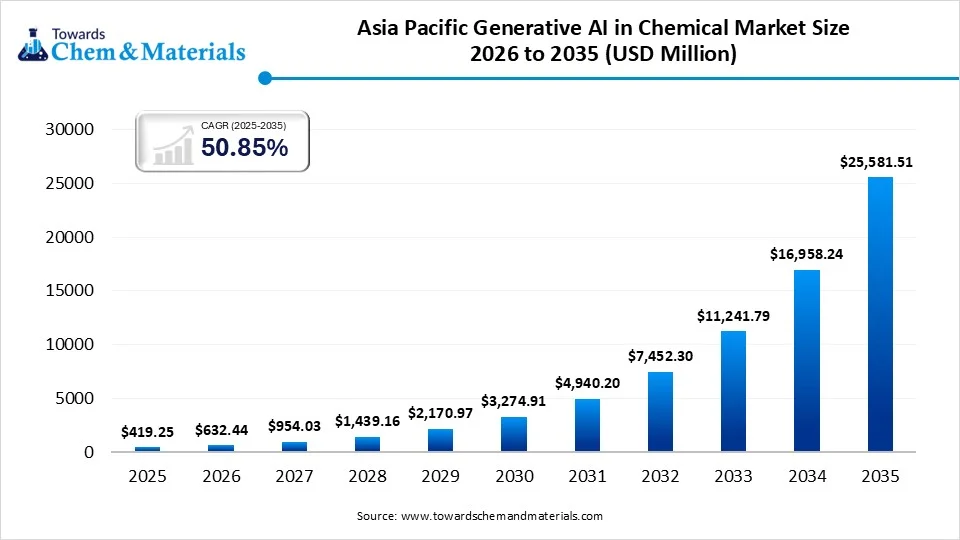
Our analysis indicates that APAC's opportunity is being created at the intersection of two large structural ecosystems: chemical production and AI infrastructure. China alone represented approximately 46% of global chemical-industry revenue in 2024, while chemical production growth in China accounted for approximately 86% of global chemical-industry growth in 2024. This concentration means that even modest penetration of AI into R&D, formulation, manufacturing, and commercial workflows can translate into a substantial addressable opportunity.
In our view, the market is transitioning from experimentation toward domain-specific deployment. The highest-value opportunities are likely to emerge where generative AI is connected to proprietary chemical datasets, simulation engines, laboratory automation, process data, and enterprise workflows rather than deployed as a standalone general-purpose chatbot.
Key Coverage
- 2026 market size of approximately USD 632.44 million
- 2035 market forecast of approximately USD 25,581.51 million
- 58.8% reported 2025-2035 CAGR
- APAC chemical-industry revenue share of approximately 58.8%
- Country-level opportunity across China, Japan, India, South Korea, Singapore, and Australia
- Chemistry-specific AI adoption and deployment maturity
- Molecular, material, process, and commercial use cases
Market Size & Forecast—A Small Current Revenue Pool Is Converting Into a Multi-Billion-Dollar AI-for-Chemistry Opportunity
The market's projected expansion from USD 222.8 million in 2024 to USD 8.8 billion by 2035 represents an increase of more than USD 8.6 billion in annual market revenue. The implied growth trajectory is substantially above the broader Asia Pacific generative AI market, reflecting the fact that chemical applications are moving beyond generic content generation into high-value scientific and industrial workflows. The broader APAC generative AI market is itself estimated at several billion dollars, highlighting the still-specialized nature of chemistry-focused AI relative to the overall regional AI economy.
Our assessment is that the forecast market expansion will depend less on the number of AI experiments and more on conversion of pilots into recurring enterprise deployments. Chemical companies have historically faced fragmented R&D data, long experimentation cycles, and high qualification requirements; therefore, platforms capable of connecting AI models with validated scientific data and laboratory or manufacturing workflows should capture a disproportionate share of incremental spending.
The report builds a base of accelerated-adoption and constrained-adoption scenarios around enterprise penetration, application monetization, model costs, AI infrastructure, chemistry-data availability, and the pace of autonomous laboratory deployment.
Key Coverage
- 2021-2024 historical market development
- 2024 base-year revenue
- 2025-2035 forecast
- CAGR and incremental revenue opportunity
- Base/upside/downside scenarios
- Country-level market forecasts
- Application-level revenue pools
- Technology and deployment-mode forecasts
Segmentation Analysis—Molecular Discovery Is Only the Entry Point; Materials, Formulation, and Process AI Expand the Addressable Pool
The APAC market spans machine learning, generative models, deep learning, molecular docking/quantum-enabled methods, graph neural networks, NLP, and reinforcement learning, with machine learning identified as the largest technology category in current regional market estimates. Globally, molecular design and drug discovery represent approximately 40% of the application market in 2025, illustrating the initial concentration of value in high-value scientific discovery workflows.
Our analysis indicates that the longer-term opportunity is broader than drug discovery. Chemical and materials companies can apply generative models to formulation optimization, polymer design, catalyst development, reaction prediction, retrosynthesis, battery materials, coatings, additives, specialty chemicals, and sustainable-material development. This creates multiple value pools with different purchasing criteria: discovery applications are driven by scientific performance and candidate quality, while manufacturing applications depend more heavily on integration, reliability, explainability, and measurable process economics.
Key Coverage
- Technology shared by ML, GenAI, deep learning, GNN, and other architectures
- Molecular design and discovery
- Materials discovery
- Reaction prediction and retrosynthesis
- Formulation and product optimization
- Process and manufacturing optimization
- Base, specialty, agrochemical, and materials end uses
- Country × application × technology segmentation
Market Dynamics—Data Availability and Workflow Integration Will Determine Whether GenAI Becomes a Core Chemical Capability
The chemical industry generates large volumes of experimental, process, formulation, patent, and product data, but much of it remains fragmented or difficult to operationalize. Across APAC, data complexity was identified by 39% of surveyed organizations as an AI challenge, while high implementation cost affected 36% and limited defined use cases affected 35%. In India, data accessibility issues affected 46% of surveyed organizations, while limited AI skills affected 42% and integration/scaling difficulties affected 38%.
Our analysis indicates that the principal constraint is shifting from model availability to enterprise readiness. General-purpose foundation models are increasingly accessible, but chemistry applications require structured molecular representations, validated reaction data, proprietary formulations, process histories, and scientific knowledge graphs. The competitive advantage therefore moves toward providers capable of embedding GenAI into existing laboratory, engineering, ERP, PLM, and process-control environments.
Key Coverage
- Adoption drivers and barriers
- Data availability and quality
- AI skills and organizational readiness
- Model cost and compute requirements
- Integration and deployment barriers
- ROI realization
- Pilot-to-production conversion
- Enterprise adoption maturity by country
Pricing & Commercial Model—The Market Is Moving From Project-Based AI Toward Platform, Consumption, and Workflow Economics
GenAI in chemicals is increasingly commercialized through combinations of software subscriptions, cloud consumption, model APIs, enterprise licenses, scientific-computing usage, and AI-enabled services. The economics differ materially between a research assistant and a high-performance molecular-design platform: the former can be priced around users or seats, while the latter can incorporate compute consumption, molecular simulations, proprietary models, laboratory integration, and outcome-based services.
Our assessment is that pricing power will increasingly correlate with measurable scientific or operational outcomes rather than model sophistication alone. A platform that shortens candidate screening, improves formulation hit rates, reduces experimental iterations, or increases plant productivity can command substantially greater enterprise value than a generic conversational interface.
Key Coverage
- Subscription and enterprise licensing
- API and consumption pricing
- Compute-linked economics
- Scientific-service pricing
- Implementation and integration costs
- Premium versus horizontal AI platforms
- Customer ROI and payback periods
- Pricing outlook through 2030
Demand-Supply & Infrastructure—AI Compute, Scientific Data, and Laboratory Capacity Are Becoming the New Bottlenecks
Demand is expanding across R&D, process engineering, manufacturing, commercial intelligence, and knowledge management, but supply-side capability depends on access to GPUs, cloud/HPC infrastructure, high-quality chemical datasets, simulation software, AI talent, and automated laboratories. The computational burden can become extreme: advanced chemical formulation problems can involve tens of millions of molecular candidates and combinatorial spaces far beyond brute-force experimentation.
Our analysis suggests that the market will increasingly favor integrated AI-for-science stacks rather than isolated models. The strongest platforms are likely to combine foundation models with domain data, simulation, scientific agents, and experimental feedback loops. Autonomous experimentation is particularly important because it creates a closed learning cycle in which AI-generated candidates can be tested, validated, and fed back into the model.
Key Coverage
- AI compute and GPU requirements
- Cloud versus private deployment
- Scientific-data availability
- Model-training infrastructure
- HPC and simulation capacity
- Autonomous laboratory capacity
- AI talent availability
- Supply-demand constraints for AI infrastructure
Value Chain & Supply Chain—Value Is Shifting Toward the Interfaces Between Models, Data, and Scientific Workflows
The market value chain extends from foundation models and accelerated computing → scientific data → chemistry-specific AI models → simulation and digital workflows → laboratory automation → chemical R&D and manufacturing → commercial deployment. The highest-value layers are increasingly those that convert generic AI capability into validated chemical outcomes.
In our view, the strategic profit pool is moving toward workflow ownership. Providers that control only the model layer may face commoditization as open and commercial models proliferate, whereas providers embedded within R&D, laboratory, engineering and manufacturing workflows can create higher switching costs through proprietary data, validation history and integration.
Key Coverage
- AI model layer
- Data and knowledge layer
- Scientific software
- Simulation and HPC
- Laboratory automation
- Enterprise integration
- Manufacturing workflows
- Value and margin pools
Which Technology Shifts Will Move APAC Chemical GenAI from Copilots to Closed-Loop Scientific Discovery?
- Technology adoption in the Asia Pacific generative AI in chemical market is moving beyond conventional predictive machine learning toward foundation models, diffusion-based generative models, graph neural networks, multimodal scientific AI, agentic systems and autonomous laboratories. The technological shift is material because generative models can move the workflow from searching and filtering known compounds toward generating candidates against predefined chemical, mechanical or performance constraints. In a demonstrated materials-design application, a generative model produced structures that were more than twice as likely to be novel and stable as prior generative approaches and more than 10× closer to the local energy minimum; one generated material was subsequently synthesized, with its experimentally measured property falling within 20% of the target value.
- Our analysis indicates that the most significant technology inflection is the convergence of generation, simulation, experimentation and decision-making rather than improvement in any single model architecture. Large language models are increasingly being positioned as interfaces to scientific tools and datasets, while agentic systems can potentially coordinate literature retrieval, hypothesis generation, simulation, experimental planning and interpretation. Research on scientific AI and self-driving laboratories increasingly describes this as a transition toward semi-autonomous or closed-loop discovery, although current systems still require human oversight, data curation and validation.
- In our view, this creates a competitive shift from “who has the strongest model?” toward “who can close the scientific learning loop most effectively?” For chemical companies, the commercial value of GenAI should increasingly be assessed through metrics such as candidate-generation throughput, experimental success rate, simulation cost per candidate, number of experiments completed, time from hypothesis to validation, formulation-development cycle time and R&D cost per successful product. This favors platforms that combine chemistry-specific models with proprietary datasets, physics-based simulation, laboratory automation and secure enterprise infrastructure. It also creates a significant adoption constraint: autonomous experimentation introduces safety, reliability and governance requirements that can limit fully unattended deployment even as technical capabilities advance.
- The full report provides a technology-by-technology assessment across foundation models, diffusion models, GNNs, multimodal AI, chemical LLMs, AI agents, digital twins, molecular simulation, quantum-HPC integration and autonomous laboratories, including technology maturity, commercialization status, application penetration and expected impact across molecular discovery, formulation, process optimization and materials development. The analysis further benchmarks the transition from copilot → agent → multi-agent workflow → closed-loop autonomous laboratory, identifying the technology layers most likely to capture incremental market value through 2030.
| Technology layer | Primary capability | Commercial maturity | Key KPI for assessment | Strategic relevance |
| Foundation models | General scientific reasoning and knowledge retrieval | Scaling | Tasks/workflows supported | High |
| Chemical LLMs | Chemistry-specific reasoning and generation | Emerging-scaling | Validated chemistry tasks | Very high |
| Diffusion models | De novo molecule/material generation | Emerging | Novel viable candidates | Very high |
| GNNs / scientific ML | Molecular/property prediction | Scaling | Prediction accuracy | High |
| Multimodal AI | Text + structures + images + experimental data | Emerging | Data modalities integrated | High |
| AI agents | Planning and tool execution | Emerging | End-to-end tasks automated | Very high |
| Digital twins | Simulation and process optimization | Scaling | Simulation/optimization cycle time | High |
| Autonomous laboratories | AI-directed physical experimentation | Emerging | Experiments per unit time | Very high |
| Closed-loop AI | Generate → test → learn → regenerate | Early | Learning-cycle time | Transformational |
- The same technology intelligence can also be structured as a granular technology and innovation database, tracking technology type, model architecture, developer, chemistry/materials application, target property, scientific workflow, deployment stage, validation status, laboratory integration, simulation capability, patent activity, launch year, partnership, geography, and commercialization status. The dataset can be filtered by technology, application, country, maturity, company, and benchmarked against technology adoption and competitive-positioning data, providing a structured complement to the strategic market assessment.
Regulatory & Sustainability Analysis - Governance and Explainability Will Become Commercial Requirements for Industrial AI
APAC regulation is becoming more explicit around AI transparency, traceability, safety and accountability. China’s AI-generated-content identification rules, effective September 1, 2025, require specified AI-generated content to carry explicit and implicit identification mechanisms. Singapore has developed a comprehensive generative-AI governance framework emphasizing explainability, transparency, fairness and human accountability, while Japan has moved toward legislation supporting AI development and utilization alongside infrastructure and skills investment.
Our assessment is that chemical applications will require a higher governance threshold than conventional enterprise GenAI because AI outputs can influence molecule selection, process conditions, safety decisions and regulated product development. This creates demand for audit trails, model validation, human approval gates, data lineage and scientific explainability features that can become differentiators rather than merely compliance costs.
Key Coverage
- China, Japan, India, Singapore and South Korea AI frameworks
- Data privacy and sovereignty
- Model governance
- Scientific validation
- Explainability and traceability
- IP and proprietary-data protection
- Sustainability and energy consumption
- Responsible AI deployment
Customer & Application Analysis - R&D Is the Initial Buyer, but Manufacturing and Commercial Functions Create the Larger Enterprise Opportunity
Early demand is concentrated in R&D, molecular discovery, materials development and scientific knowledge management, but enterprise adoption is expanding into process optimization, predictive maintenance, procurement, sales intelligence and supply-chain planning. Manufacturing evidence shows that 87% of surveyed manufacturers had initiated a GenAI pilot, 24% had deployed at least one GenAI use case in a facility and 10% had implemented GenAI across broader networks, demonstrating the widening gap between experimentation and scaled deployment.
Our analysis indicates that R&D provides the strongest initial willingness to pay, while operations may ultimately generate the broadest enterprise footprint. For chemical manufacturers, a single platform that connects laboratory knowledge with production data, process engineering and commercial intelligence can generate considerably greater lifetime value than a point solution confined to discovery.
Key Coverage
- R&D and scientific users
- Process engineering
- Plant operations
- Procurement and supply chain
- Sales and commercial intelligence
- Knowledge management
- Customer pain points
- Willingness to pay and switching barriers
Competitive Intelligence
Competitive Landscape - The Market Is Fragmented Across Cloud Platforms, Industrial Software and Chemistry-Specific AI Specialists
Competition is developing across three principal layers: horizontal AI/cloud infrastructure, industrial software and automation, and specialist AI-for-science platforms. The first group supplies models, compute and enterprise AI environments; the second embeds GenAI into engineering, process and manufacturing workflows; the third focuses on molecular, materials and chemical discovery.
Our analysis indicates that no single competitive architecture has yet become dominant. Horizontal providers possess unmatched compute and model scale, industrial-software vendors control critical workflow positions, while specialist platforms possess deeper chemistry expertise. The strategic battleground is therefore likely to be the integration layer between these capabilities.
Key Coverage
- Competitive structure
- Global versus APAC-focused vendors
- Horizontal versus chemistry-specific AI
- Platform breadth
- Scientific depth
- Enterprise integration
- Customer deployment
- Strategic partnerships
Tentative Leading Company Universe - 25 Companies Shaping APAC Chemistry-AI Adoption
| Company | Headquarters | Market Position | Core Strength | Major Applications / Segments | |
| 1 | Microsoft | U.S. | Global AI/cloud leader | Azure, AI for Science | Materials, chemistry, enterprise AI |
| 2 | NVIDIA | U.S. | AI compute/platform leader | Accelerated computing, BioNeMo | Molecular AI, simulation |
| 3 | Amazon Web Services | U.S. | Cloud/AI infrastructure leader | Bedrock, HPC | Scientific AI, discovery |
| 4 | U.S. | Foundation-model leader | Gemini, AI for science | Materials, molecular discovery | |
| 5 | IBM | U.S. | Enterprise AI/scientific computing | AI, quantum, research platforms | Chemistry, materials |
| 6 | Huawei | China | APAC AI/cloud platform | AI infrastructure | Industrial AI |
| 7 | Alibaba Cloud | China | APAC cloud/AI platform | Cloud AI, model services | Enterprise chemical AI |
| 8 | Baidu | China | Chinese AI ecosystem leader | Foundation models | Industrial and scientific AI |
| 9 | Tencent | China | AI/cloud ecosystem player | Foundation models, cloud | Enterprise AI |
| 10 | Dassault Systèmes | France | Scientific/industrial software | 3DEXPERIENCE/BIOVIA | Chemistry, materials |
| 11 | Siemens | Germany | Industrial AI leader | Industrial Copilot | Process manufacturing |
| 12 | AVEVA | U.K. | Industrial software leader | Engineering/process AI | Chemical plants |
| 13 | Aspen Technology | U.S. | Process-industry software leader | Process simulation/optimization | Chemicals, refining |
| 14 | Schrödinger | U.S. | Computational chemistry specialist | Molecular simulation/AI | Drug and materials discovery |
| 15 | Citrine Informatics | U.S. | Materials AI specialist | Materials informatics | Chemicals, formulations |
| 16 | NobleAI | U.S. | Chemistry AI specialist | Scientific ML | Formulation, materials |
| 17 | Kebotix | U.S. | Materials discovery specialist | Generative materials AI | Specialty chemicals |
| 18 | CuspAI | U.K. | Emerging materials-AI specialist | Generative materials design | Chemicals, energy, materials |
| 19 | XtalPi | China | AI-for-science specialist | AI, physics, robotics | Molecular discovery |
| 20 | DP Technology | China | AI-for-science specialist | AI + physics + HPC | Molecular/materials science |
| 21 | ChemLex | Singapore | Emerging autonomous chemistry player | AI + robotics | Chemical discovery |
| 22 | Iktos | France | Generative chemistry specialist | Molecular design | Discovery |
| 23 | Palantir | U.S. | Enterprise AI platform | AI agents/data integration | Industrial workflows |
| 24 | Dataiku | France/U.S. | Enterprise AI platform | Data/AI orchestration | Chemical analytics |
| 25 | Altair | U.S. | Engineering AI specialist | Simulation/AI | Materials and process engineering |
Market Share & Competitive Ranking - Market Leadership Is Split Between Scale, Scientific Depth and Workflow Control
Public disclosures do not isolate APAC GenAI-in-chemicals revenue consistently because most vendors report cloud, software, AI and scientific-computing revenues across multiple industries. Consequently, the full analysis treats market share as estimated rather than audited, combining chemical-specific revenue exposure, deployment footprint, product breadth and APAC presence.
The competitive structure currently separates into scale leaders with broad AI infrastructure, industrial-platform leaders with deep engineering workflows, and specialist leaders focused on chemistry and materials. For context, Schrödinger generated USD 255.9 million of total revenue in 2025, including USD 199.5 million from software products and services, while Microsoft generated USD 281.7 billion of total revenue in FY2025 and AWS generated USD 128.7 billion in 2025; these figures demonstrate the enormous scale differential between specialist scientific software and horizontal AI infrastructure, although they should not be interpreted as chemical GenAI market shares.
Key Coverage
- Estimated market shares
- Top-5 and Top-10 competitive concentration
- Chemical-specific revenue exposure
- APAC deployment footprint
- Share gain/loss indicators
- Vendor tiering
- Revenue exposure versus addressable market
Competitive Benchmarking - Domain Depth and Enterprise Integration Are Becoming More Important Than Model Scale Alone
The competitive benchmark evaluates vendors across model capability, chemistry depth, proprietary data, scientific simulation, cloud/HPC, laboratory integration, industrial software, agents, enterprise security, APAC presence and commercialization. Horizontal providers generally possess stronger compute and model ecosystems, while specialist providers differentiate through scientific workflows and chemistry-specific validation.
Our assessment is that the strongest competitive positions will increasingly belong to companies that combine at least two of these layers. Partnerships between cloud, compute and industrial-software providers demonstrate that the market is moving toward ecosystems rather than isolated products. For example, industrial AI deployments are already combining generative AI with automation, engineering and operational data.
Key Coverage
- Model capability
- Scientific accuracy
- Chemistry data
- AI agents
- Simulation
- Cloud/HPC
- Laboratory automation
- Enterprise integration
Product Portfolio Benchmarking - Broad Platforms Compete With High-Precision Chemistry Solutions
Portfolio competition ranges from general-purpose copilots and foundation models to molecular design, materials discovery, reaction prediction, formulation optimization, simulation, digital twins and autonomous laboratory systems. Specialist providers increasingly differentiate through proprietary scientific workflows, while broad platforms use APIs and cloud infrastructure to make advanced AI accessible across enterprise functions.
Key Coverage
- Foundation models
- Chemistry-specific models
- Materials platforms
- Simulation
- Formulation
- Reaction prediction
- Laboratory automation
- Enterprise copilots
Technology & Innovation Benchmarking - The Competitive Frontier Is Moving From Prediction to Closed-Loop Scientific Reasoning
Technology leaders are increasingly combining generative models with physics, simulation and experimental feedback. Materials-generation systems can directly propose candidates against desired properties, while scientific-agent architectures can call models and execute downstream workflows. NVIDIA's BioNeMo ecosystem, for example, supports generative chemistry, molecular optimization and related scientific workflows, while recent agentic extensions are designed to let AI systems reason across scientific tools and execute next actions.
Key Coverage
- Patents and R&D
- Model architecture
- Chemistry foundation models
- Scientific agents
- Simulation integration
- Experimental feedback
- Commercial deployment
- Technology maturity
Application Competitive Benchmarking - Molecular Discovery Leads, but Materials and Industrial Chemistry Create Wider White Space
Competitive differentiation varies by application. Molecular design and discovery currently represent the most established high-value AI use case, while materials discovery, formulation, process optimization and autonomous experimentation represent important expansion areas. The market increasingly rewards providers capable of connecting discovery with validation and commercialization rather than stopping at candidate generation.
Key Coverage
- Molecular discovery
- Materials discovery
- Reaction prediction
- Formulation
- Catalysis
- Process optimization
- Sustainability applications
- Application-specific leaders
Geographic Competitive Landscape - China Provides Scale, Japan and South Korea Add Advanced Manufacturing, and India Offers High Adoption Momentum
China combines the region's largest chemical base with extensive AI investment and domestic technology capabilities. India is emerging as a high-adoption market: 23% of surveyed Indian businesses reported measurable GenAI results, the highest level identified in the cited APAC comparison. Australia and New Zealand also accelerated formal GenAI deployment from 14% in 2024 to 29% in 2025.
Our analysis indicates that country attractiveness differs by application. China is particularly important for industrial-scale chemical and materials deployment; Japan and South Korea offer strong advanced-manufacturing and materials ecosystems; India combines AI talent with pharmaceutical and chemical R&D; and Singapore functions as a regional hub for AI-for-science commercialization and autonomous laboratories.
Key Coverage
- China
- Japan
- India
- South Korea
- Singapore
- Australia
- Regional revenue
- Local partnerships and deployment footprint
Manufacturing & Capacity Benchmarking - Industrial AI Is Moving From Office Copilots Into Plant-Level Operations
GenAI is increasingly being embedded into engineering, maintenance, process optimization and plant operations. Industrial AI platforms are moving toward autonomous agents capable of executing workflows rather than simply answering operator questions. One industrial platform reported deployments across more than 100 customers, while newer agent architectures target productivity improvements of up to 50% across selected industrial workflows.
In our view, this creates a major second-stage opportunity for chemical companies: once AI is connected to operational technology, its economic value can shift from knowledge-worker productivity toward throughput, energy efficiency, maintenance, yield and safety.
Key Coverage
- AI-enabled plants
- Engineering copilots
- Maintenance
- Process optimization
- Digital twins
- OT/IT integration
- Autonomous operations
- Deployment maturity
Customer & Channel Benchmarking - Enterprise Access and Scientific Trust Will Determine Platform Stickiness
The competitive advantage increasingly depends on access to R&D teams, plant engineers, enterprise IT, laboratory systems and proprietary chemical data. Specialist vendors typically compete through scientific depth and technical relationships, while cloud and industrial platforms use broader enterprise distribution.
Our assessment is that customer stickiness will rise sharply once AI becomes embedded in proprietary workflows and validated experimental histories. This creates a natural advantage for vendors that can demonstrate measurable scientific outcomes while maintaining data security and interoperability.
Key Coverage
- Enterprise customer segments
- Direct versus channel sales
- Scientific-user penetration
- OEM and platform partnerships
- Integration requirements
- Switching costs
- Technical support
- Customer retention
Strategic Developments - Investment Is Shifting Toward AI-for-Science, Agents and Autonomous Experimentation
Recent developments indicate a clear move from AI experimentation toward commercial scientific infrastructure. In Singapore, ChemLex raised USD 45 million in 2025 to establish a global headquarters and self-driving laboratory, while supporting more than 70 customers worldwide. Materials-AI specialist CuspAI expanded its funding base and operates across Tokyo and Singapore alongside European and U.S. locations.
Our analysis indicates that capital is increasingly following platforms capable of generating proprietary scientific data, not merely consuming public datasets. This is strategically important because autonomous laboratories can create a compounding data advantage: more experiments produce more proprietary training data, which can improve models and increase the value of subsequent experiments.
Key Coverage
- Product launches
- AI-agent releases
- Cloud partnerships
- Autonomous laboratories
- R&D investments
- Regional expansion
- Strategic alliances
- Funding and commercialization
M&A Landscape - Consolidation Is Likely to Target Scientific Data, Simulation and Workflow Integration
M&A activity is expected to increasingly center on chemistry-data assets, simulation capabilities, scientific software, AI agents, laboratory automation and enterprise workflow integration. The strategic rationale is shifting from simply acquiring an AI model toward acquiring capabilities that shorten the path from model output to validated chemical product.
Key Coverage
- Acquirer and target
- Transaction value
- Technology acquired
- Geography
- Application
- Customer access
- Vertical integration
- Emerging M&A themes
Company Profiles - Detailed Intelligence on the Leading AI-for-Chemistry Ecosystem
The full report profiles the 25-company universe across headquarters, revenue, AI exposure, product portfolio, scientific capabilities, technology architecture, patents, R&D, customer industries, APAC footprint, partnerships, manufacturing/compute infrastructure, funding, strategic developments and competitive positioning.
Specialist economics are benchmarked separately from diversified technology vendors to avoid misleading comparisons between total corporate revenue and chemical-AI revenue. For example, Schrödinger's 2025 software revenue of USD 199.5 million provides a useful reference point for the scale of specialized scientific software, while ChemLex's USD 45 million funding round illustrates the capital intensity of emerging autonomous chemistry platforms.
Key Coverage
- Company overview
- Financial profile
- AI/GenAI exposure
- Product portfolio
- Technology
- Applications
- APAC presence
- R&D and partnerships
- Strategic developments
- Competitive positioning
Company Strategic Positioning - Scale Leaders, Scientific Specialists and Industrial Integrators Are Following Different Routes to Advantage
The competitive universe is assessed across AI scale, chemistry depth, proprietary data, cloud/HPC, workflow integration, customer access, APAC presence, scientific validation and commercialization. The resulting strategic positioning identifies AI infrastructure leaders, industrial AI leaders, chemistry specialists, materials-AI specialists, regional challengers and emerging autonomous-science platforms.
Our assessment is that future leadership will depend on the ability to bridge these categories. Scale without scientific relevance risks commoditization; scientific depth without enterprise distribution limits commercialization; and workflow integration without differentiated models may leave vendors dependent on third-party foundation models.
Key Coverage
- Market leaders
- Technology leaders
- Scale leaders
- Scientific specialists
- Industrial integrators
- Regional challengers
- Emerging platforms
- Strategic vulnerabilities
Opportunity & White-Space Analysis - The Largest Untapped Pools Sit Where Chemistry Data Meets Autonomous Execution
The principal white spaces include AI-native formulation, specialty-chemical discovery, sustainable-material design, catalyst optimization, polymer development, process-condition generation, autonomous experimentation and AI-enabled regulatory intelligence. The opportunity is particularly strong where chemical companies possess large proprietary datasets but lack the internal AI infrastructure to operationalize them.
From our assessment, APAC offers an unusually attractive white-space environment because the region combines enormous chemical manufacturing scale with rapidly expanding AI capabilities. The commercial opportunity is therefore not limited to selling software licenses; it extends to managed scientific platforms, AI-enabled R&D services, autonomous laboratories and outcome-based discovery partnerships.
Key Coverage
- Product white spaces
- Technology gaps
- Application opportunities
- Country opportunities
- Specialty-chemical AI
- Materials AI
- Autonomous labs
- Sustainable chemistry
Industry Structure - Competitive Rivalry Is High, but Barriers to Deep Chemistry AI Remain Significant
| Force | Assessment | Strategic Evidence |
| Supplier Power | Medium-High | Dependence on foundation models, GPUs, cloud and scientific datasets |
| Buyer Power | Medium | Large chemical enterprises can negotiate, but validated AI workflows create switching costs |
| New Entrants | Medium | Model access lowers entry barriers, while chemistry data and validation remain difficult |
| Substitutes | Medium | Conventional simulation, analytics and internal data-science teams remain alternatives |
| Competitive Rivalry | High | Horizontal AI, industrial software and specialist chemistry platforms increasingly overlap |
Our analysis indicates that the most defensible competitive positions will be built around proprietary data, scientific validation and workflow integration rather than access to generic foundation models alone.
PESTLE Analysis - AI Policy, Industrial Strategy and Data Sovereignty Will Shape APAC Deployment
- Political: Government-backed AI investment and domestic technology strategies are accelerating adoption.
- Economic: Chemical margin pressure increases the value of productivity, faster R&D and lower experimentation costs.
- Social: AI skills shortages and workforce redesign remain material adoption constraints.
- Technological: Foundation models, scientific agents, HPC and autonomous laboratories are rapidly converging.
- Legal: Data governance, AI accountability, IP protection and AI-generated-content rules are increasing compliance requirements.
- Environmental: AI can support low-carbon chemistry, material substitution, process optimization and waste reduction, while its own compute intensity creates an efficiency consideration.
Market Attractiveness - APAC Combines Exceptional Growth Potential With High Technical and Integration Requirements
The market is assessed as Highly Attractive, based on the combination of approximately 50.8% reported CAGR, a chemical industry representing nearly 59% of global chemical revenue, extensive manufacturing capacity and rapidly increasing AI adoption.
The opportunity is nevertheless constrained by data fragmentation, AI skills, scientific validation requirements, integration costs and the difficulty of converting experimental AI results into regulated or production-critical workflows.
Key Coverage
- Market growth
- Addressable revenue
- Customer readiness
- Technology maturity
- Entry barriers
- Competitive intensity
- Margin potential
- Investment requirements
Future Outlook - APAC's Next AI Advantage Will Come From Autonomous Chemistry, Materials Intelligence and Industrial Agents
- Base case: GenAI becomes embedded across R&D, formulation, scientific knowledge management and selected plant workflows, with specialist chemistry platforms operating alongside major cloud and industrial ecosystems.
- Upside case: Autonomous laboratories, agentic AI and chemistry foundation models mature rapidly, enabling closed-loop discovery and materially reducing experimental cycles. Materials-generation systems and scientific agents become standard components of advanced R&D organizations.
- Downside case: Data-quality constraints, regulatory uncertainty, compute costs and weak ROI conversion slow enterprise-scale deployment, leaving many chemical companies in pilot mode.
Our analysis suggests that the most important transition through 2030 will be from “AI-assisted chemistry” to “AI-executed chemistry workflows.” The commercial winners are likely to be platforms that can move from generating hypotheses to validating candidates, executing experiments, learning from results and connecting those outputs to manufacturing and commercial decisions.
Key Coverage
- 2030 and 2035 market outlook
- Technology adoption
- Agentic AI
- Autonomous laboratories
- Materials discovery
- Molecular design
- Manufacturing AI
- Pricing and margin outlook
- Country opportunities
- Competitive evolution
- M&A outlook
- Future profit pools
Structured Market Intelligence Database - Tracking the APAC Chemistry-AI Ecosystem at Company, Technology and Application Level
The same intelligence can be structured into a granular Asia Pacific Generative AI in Chemical Market database, tracking company, headquarters, country, AI technology, model type, application, chemical end use, deployment mode, customer segment, product, partnership, funding, patent activity, R&D investment, facility/laboratory footprint, AI compute infrastructure, commercialization status, revenue exposure and strategic development by year. The dataset can be filtered by company × country × technology × application × end use × deployment stage, enabling competitive benchmarking, market-share analysis, opportunity mapping and tracking of emerging AI-for-chemistry platforms alongside the strategic report.
Key Strategic Questions Addressed
- How large is the Asia Pacific GenAI-in-chemicals market today, and how rapidly can it scale?
- Why is APAC expected to outpace other regions in chemistry-specific GenAI adoption?
- Which countries represent the largest near-term and long-term opportunity?
- How much of the opportunity sits in molecular discovery versus materials and industrial applications?
- Which chemistry workflows have the highest willingness to pay?
- How quickly are chemical companies moving from AI pilots to enterprise deployment?
- What proportion of AI value is captured by cloud, software, specialist AI and scientific-computing providers?
- Which technology architectures are gaining commercial traction?
- How important are proprietary chemical datasets to competitive differentiation?
- When will AI agents become capable of executing meaningful chemistry workflows?
- How will autonomous laboratories change the economics of chemical R&D?
- Which companies have the strongest combination of AI scale and chemistry-specific capability?
- Where are the largest product, application and geographic white spaces?
- How will AI governance, data sovereignty and scientific validation affect adoption?
- What will the APAC GenAI-in-chemicals market look like by 2030 and 2035?
Top Key Companies
- Microsoft
- NVIDIA
- Amazon Web Services
- IBM
- Huawei
- Alibaba Cloud
- Baidu
- Tencent
- Dassault Systèmes
- Siemens
- AVEVA
- Aspen Technology
- Schrödinger
- Citrine Informatics
- NobleAI
- Kebotix
- CuspAI
- XtalPi
- DP Technology
- ChemLex
- Iktos
- Palantir
- Dataiku
- Altair
Market Report Segmentation
By Technology
- Machine Learning
- Supervised Learning
- Unsupervised Learning
- Semi-Supervised Learning
- Generative AI
- Large Language Models
- Chemistry-Specific Foundation Models
- Generative Molecular Models
- Diffusion Models
- Transformer-Based Models
- Deep Learning
- Convolutional Neural Networks
- Recurrent Neural Networks
- Transformer Networks
- Graph Neural Networks
- Molecular Property Prediction
- Molecular Generation
- Reaction Prediction
- Natural Language Processing
- Chemical Literature Analysis
- Scientific Knowledge Extraction
- Patent Analysis
- Reinforcement Learning
- Molecular Optimization
- Process Optimization
- Autonomous Experimentation
- Multimodal AI
- Text and Molecular Structures
- Text and Images
- Text and Experimental Data
- AI Agents
- Research Agents
- Laboratory Agents
- Manufacturing Agents
- Regulatory Agents
- Digital Twins
- Process Digital Twins
- Plant Digital Twins
- Molecular Digital Twins
- Autonomous AI Systems
- Autonomous Laboratories
- Closed-Loop Discovery
- Autonomous Process Control
- Other Technologies
By Application
- Molecular Discovery
- De Novo Molecular Design
- Virtual Screening
- Lead Generation
- Lead Optimization
- Molecular Property Prediction
- Materials Discovery
- Polymer Discovery
- Battery Materials
- Advanced Materials
- Sustainable Materials
- Nanomaterials
- Reaction Prediction
- Reaction Outcome Prediction
- Reaction Condition Optimization
- Yield Prediction
- Retrosynthesis
- Route Planning
- Synthetic Route Optimization
- Multi-Step Synthesis
- Catalyst Development
- Catalyst Discovery
- Catalyst Screening
- Catalyst Optimization
- Formulation Optimization
- Coatings
- Adhesives
- Personal Care
- Specialty Formulations
- Agricultural Formulations
- Process Optimization
- Process Simulation
- Process Control
- Energy Optimization
- Yield Optimization
- Chemical Manufacturing
- Production Optimization
- Quality Control
- Batch Optimization
- Waste Reduction
- Predictive Maintenance
- Equipment Failure Prediction
- Asset Monitoring
- Maintenance Scheduling
- Scientific Knowledge Management
- Literature Mining
- Patent Intelligence
- Knowledge Graphs
- Research Assistance
- Regulatory Intelligence
- Regulatory Monitoring
- Compliance Management
- Safety Data Analysis
- Supply Chain Optimization
- Demand Forecasting
- Inventory Optimization
- Logistics Optimization
- Commercial Intelligence
- Market Intelligence
- Pricing Intelligence
- Customer Analytics
- Sales Forecasting
- Other Applications
By Chemical Industry
- Specialty Chemicals
- Performance Chemicals
- Functional Chemicals
- Electronic Chemicals
- Commodity Chemicals
- Basic Chemicals
- Industrial Chemicals
- Petrochemicals
- Olefins
- Aromatics
- Intermediates
- Polymers
- Plastics
- Elastomers
- Engineering Polymers
- Pharmaceuticals
- Drug Discovery
- Drug Development
- Agrochemicals
- Crop Protection
- Fertilizers
- Biopesticides
- Coatings
- Adhesives and Sealants
- Advanced Materials
- Battery Chemicals
- Personal Care Chemicals
- Industrial Chemicals
- Other Chemical Industries
By Deployment Mode
- Cloud-Based
- Public Cloud
- Private Cloud
- On-Premise
- Hybrid
- Edge / Industrial AI
By Customer Type
- Large Chemical Companies
- Specialty Chemical Manufacturers
- Pharmaceutical Companies
- Petrochemical Companies
- Agrochemical Companies
- Polymer and Materials Companies
- Chemical R&D Organizations
- Contract Research Organizations
- Universities and Research Institutes
- Small and Medium-Sized Enterprises
By Workflow
- Research and Development
- Literature Research
- Hypothesis Generation
- Experiment Design
- Molecular Design
- Molecular Generation
- Molecular Optimization
- Laboratory Automation
- Experiment Planning
- Robotic Experimentation
- Formulation Development
- Process Engineering
- Process Design
- Process Optimization
- Manufacturing
- Production Planning
- Process Control
- Quality Control
- Supply Chain
- Procurement
- Sales and Marketing
- Regulatory and Compliance
By Technology Maturity
- AI Copilots
- AI Assistants
- AI Agents
- Multi-Agent Systems
- Semi-Autonomous Workflows
- Autonomous Laboratories
- Closed-Loop Scientific Discovery
A Seven-Phase Framework
Our methodology is designed to be universally applicable across commodity chemicals, specialty chemicals, petrochemicals, construction chemicals, coatings, electronic chemicals, industrial gases, agrochemicals, water treatment chemicals, and performance materials. Each phase builds upon the last, creating a layered validation structure that minimizes estimation error and maximizes analytical confidence.
The framework ensures comprehensive market coverage, robust cross-validation, and reliable long-term forecasting — producing market estimates that withstand scrutiny from investors, regulators, and corporate strategy teams.

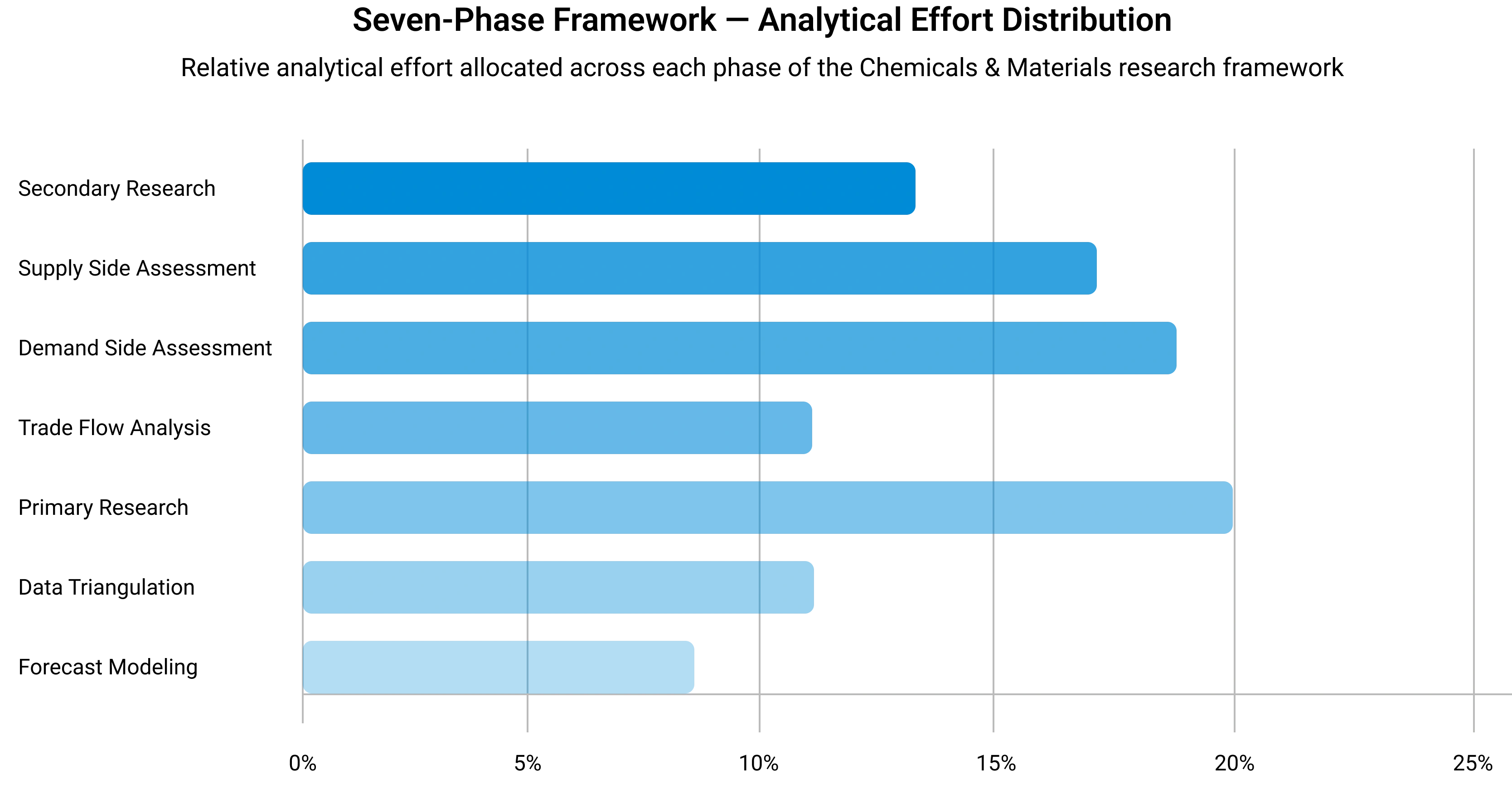
Seven-Phase Framework — Analytical Effort Distribution
Relative analytical effort allocated across each phase of the Chemicals & Materials research framework
Phase 1 - Secondary Research: Establishing the Foundation
Secondary research collects and evaluates publicly available information from authoritative sources, establishing the foundational understanding of market structure, value chain dynamics, competitive landscape, and end-use demand patterns. Every source is evaluated for credibility, recency, geographic relevance, and methodological soundness before inclusion.
Industry Associations
Sources include ACC, CEFIC, ICCA, JCIA, CPCIF, and SOCMA providing production volumes, consumption trends, capacity developments, and sustainability initiatives.
Company Disclosures
Annual reports, investor presentations, earnings transcripts, and regulatory filings reveal product portfolios, manufacturing footprints, capacity expansions, and revenue segmentation.
Government Databases
National statistical offices, customs authorities, environmental agencies, and industrial production databases provide verified statistics on output, trade flows, and regulatory compliance.
Trade Databases
UN Comtrade, ITC, Eurostat, and national customs authorities enable assessment of global product movement, import dependency, and export competitiveness across regions.
Our Secondary Research Sources
- Ministry of Chemicals and Fertilizers
- European Chemicals Agency
- United States Department of Energy
- Ministry of Industry and Information Technology
- Ministry of Economy Trade and Industry
- Ministry of Trade Industry and Energy
- National Institute of Standards and Technology
- Council of Scientific and Industrial Research
- Fraunhofer Society
- National Institute for Materials Science
Phase 2 — Supply-Side Assessment: Mapping Production Capabilities
Production Capacity Analysis
All major manufacturers are assessed for existing installed capacity, planned additions, expansions, new plant announcements, and technology adoption — mapped at global, regional, and country levels.
Capacity Utilization Adjustment
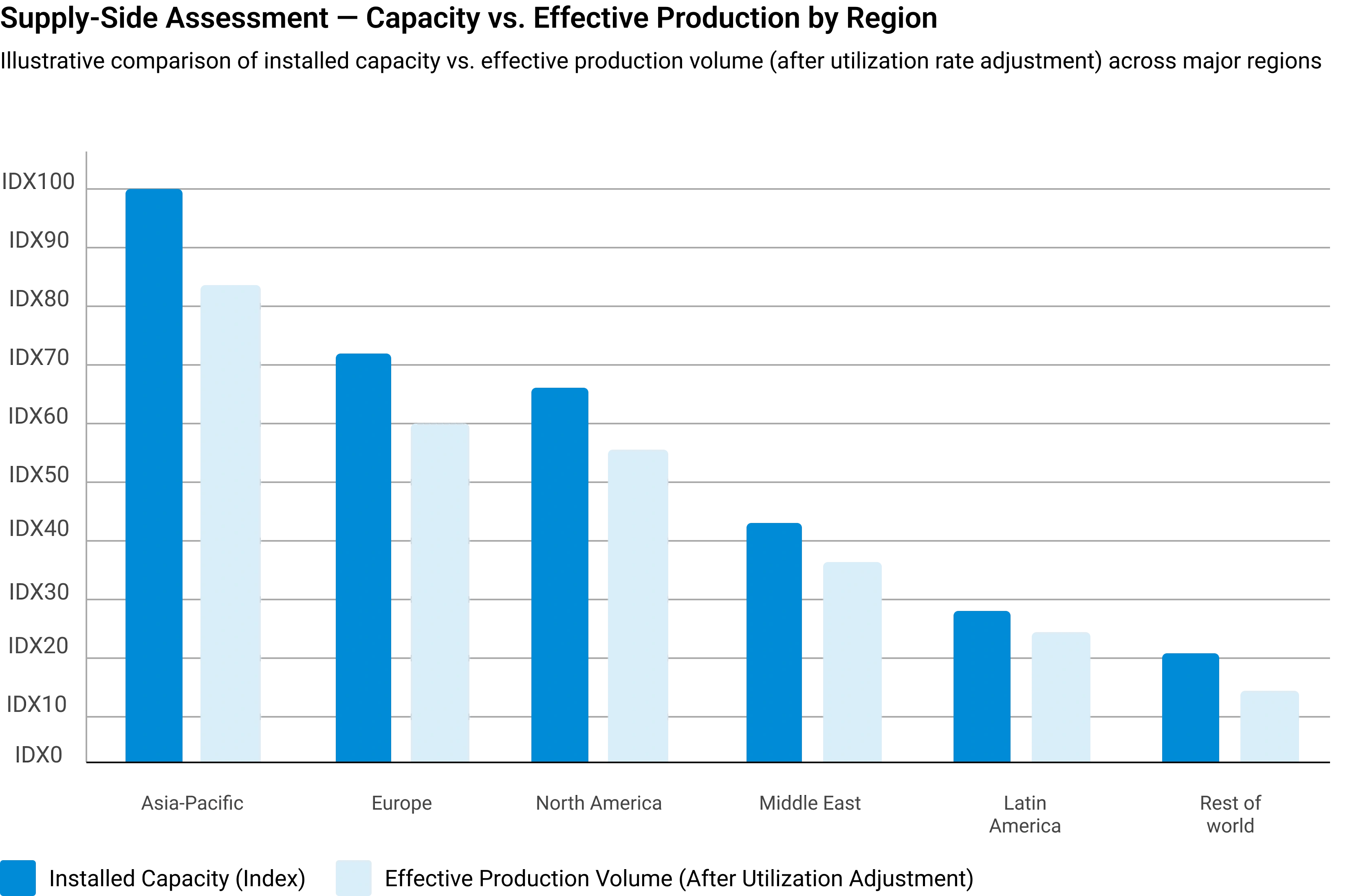
Installed capacity is adjusted using utilization rates based on demand conditions, feedstock availability, plant operating rates, maintenance schedules, and regulatory restrictions.
Manufacturer Revenue Analysis
Product-specific revenues, segment-level performance, regional distribution, average selling prices, and margin trends are evaluated to establish market value estimates.
Supply-Side Assessment — Capacity vs. Effective Production by Region
Illustrative comparison of installed capacity vs. effective production volume (after utilization rate adjustment) across major regions
Phase 3 — Demand-Side Assessment: Quantifying Chemical Consumption
Demand-side analysis quantifies chemical consumption across industries, applications, and geographies — identifying where and how chemicals are consumed throughout the value chain with precision.
End-Use Industry Analysis
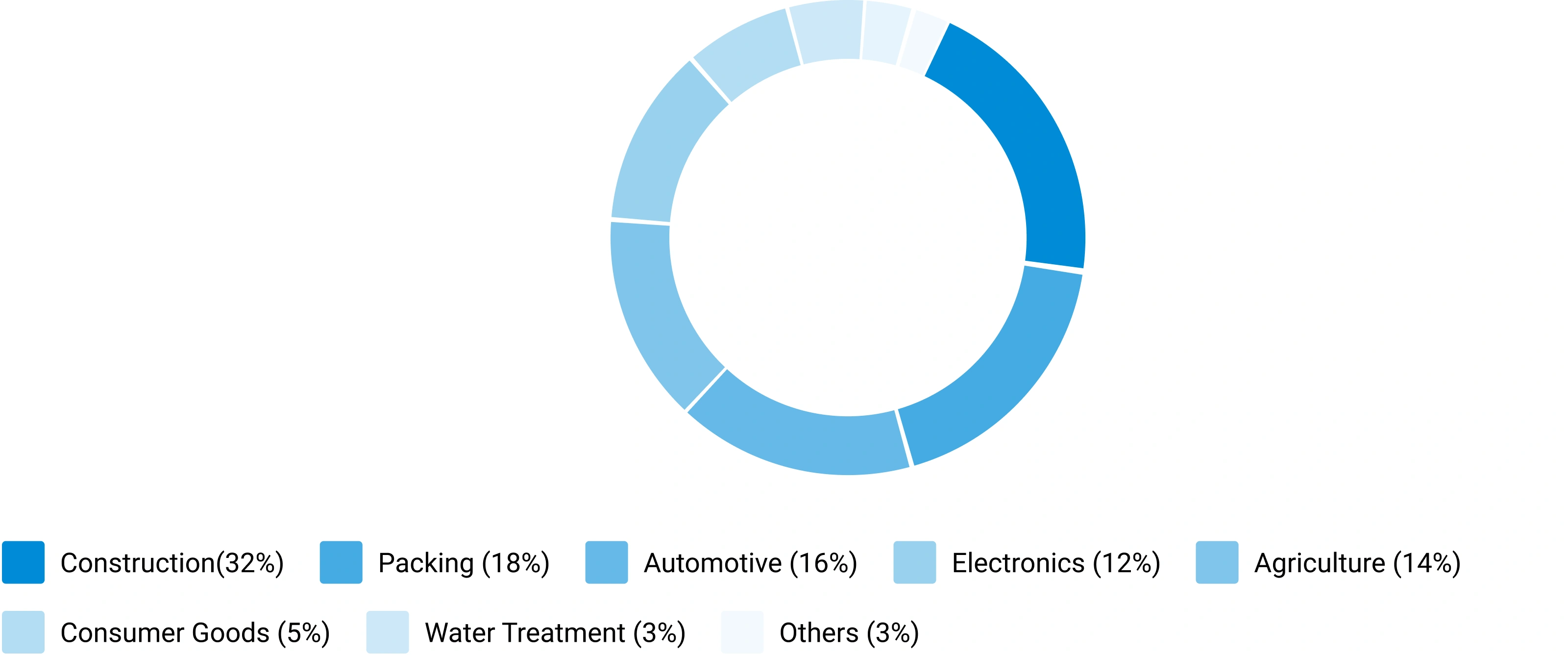
Chemical demand is evaluated across automotive, construction, packaging, electronics, agriculture, healthcare, consumer goods, industrial manufacturing, energy and utilities, and water treatment. Industry output, production trends, and consumption intensity are analyzed to determine demand patterns.
Consumption Modeling
Demand is estimated using measurable indicators: kilograms per vehicle, kilograms per square meter of construction, dosage per cubic meter of water treated, kilograms per hectare of agricultural land, and kilograms per ton of manufactured products. Consumption factors are validated through industry publications and primary interviews.
Application Analysis
The market is segmented by application area to understand product performance requirements, formulation trends, technology adoption, customer preferences, and regulatory requirements improving demand accuracy and segmentation granularity.
Demand-Side Assessment — End-Use Industry Demand Distribution
Illustrative distribution of chemical & materials demand across key end-use industries
Phase 4 - Trade Flow Analysis: Balancing Regional Supply and Demand
Trade flow analysis reconciles regional supply and demand estimates through import and export data, identifying net supply positions, regional dependencies, and market imbalances. It serves as an independent validation layer that tests the consistency of supply-side and demand-side estimates.
Import Analysis
Import data is evaluated to determine volumes, source countries, product dependency, regional supply gaps, and pricing trends — identifying markets that rely heavily on external supply and where domestic production is insufficient to meet demand.
Export Analysis
Export assessments reveal production surplus, export competitiveness, regional manufacturing strength, and global market participation. Export patterns also help validate domestic production estimates and identify net exporting regions.
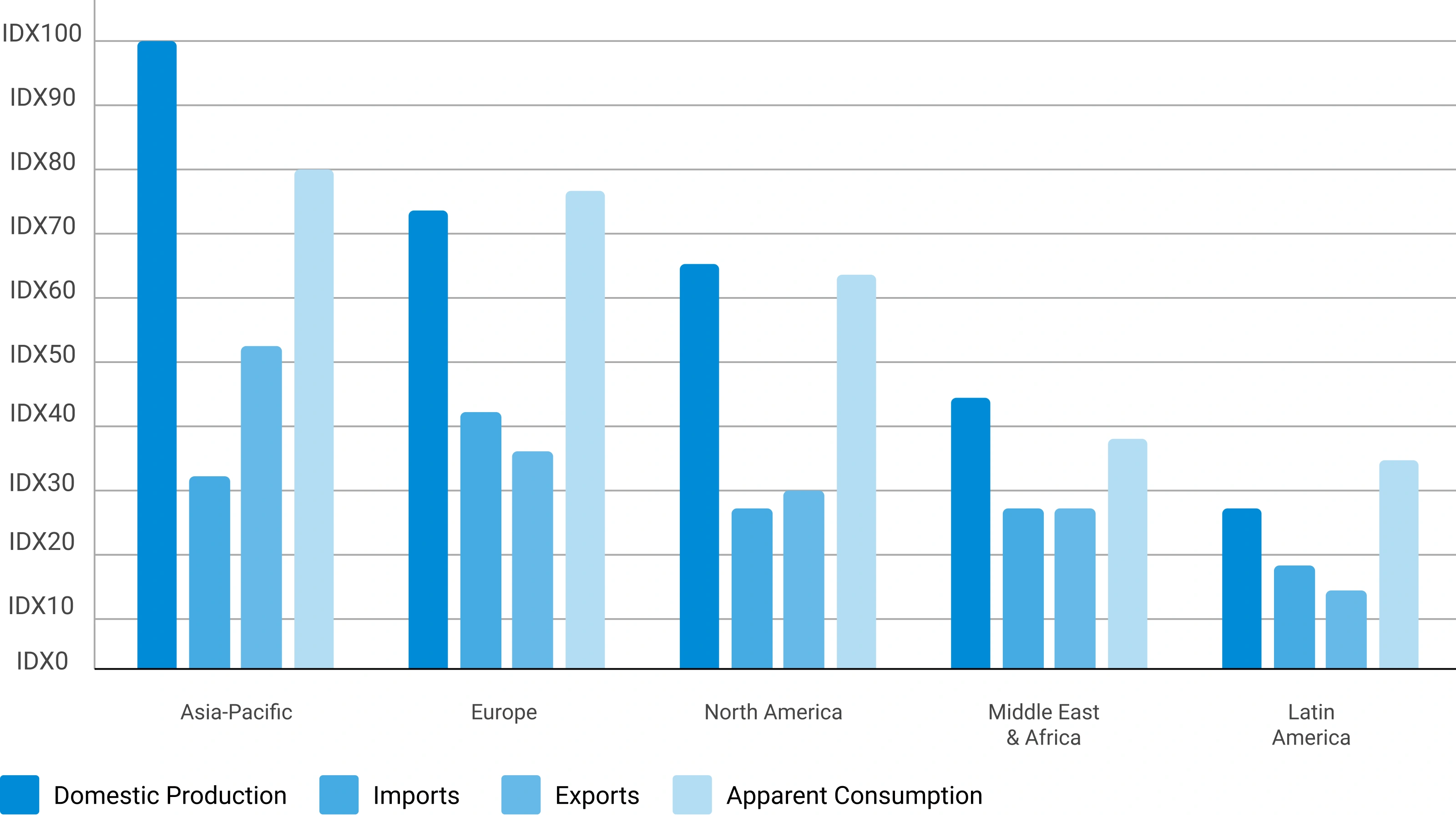
Apparent Consumption Model
Regional consumption is assessed using the standard apparent consumption formula:
Results identify net importing regions, net exporting regions, regional deficits, and surpluses — serving as an independent validation of supply and demand estimates.
Trade Flow Analysis — Net Supply Position by Region
Illustrative apparent consumption vs. domestic production across major regions — positive gap indicates net import dependency
Phase 5 — Primary Research: The Critical Validation Layer
Primary research tests and refines findings from secondary research through direct engagement with industry participants across the supply chain, demand side, and expert community. It captures intelligence that no database or published report can provide — the real-world experience of manufacturers, buyers, and specialists operating in the market.

Supply-Side Interviews
Conversations with chemical manufacturers, raw material suppliers, contract manufacturers, technology providers, and plant operators cover production trends, capacity utilization, pricing developments, technology shifts, and competitive dynamics.

Demand-Side Interviews
Engagement with OEMs, industrial consumers, procurement managers, distributors, formulators, and end-use manufacturers focuses on consumption trends, purchasing behavior, product substitution, demand outlook, and emerging applications.

Industry Expert Consultations
Additional interviews with industry consultants, independent experts, regulatory specialists, technical professionals, and research institutions provide deeper market context and validate key analytical assumptions.
Focus Areas of Primary Research:
Market Size & Forecast Validation
Revenue estimates, volume consumption, growth rates, forecast assumptions, regional demand.Supply Chain & Value Chain Assessment
Raw material sourcing, supply chain challenges, distribution networks, procurement practices.Production & Capacity Analysis
Manufacturing capacity, utilization rates, expansion projects, plant investments.Pricing & Cost Structure Analysis
Product pricing trends, feedstock costs, energy costs, margin pressures, pricing outlook.Competitive Landscape Assessment
Volume and value estimates confirmed to be fully consistent with one another before publicationInterview Volume by Market Scope
| Study Scope | Number of Interviews |
|---|---|
| Niche Market | 20 – 30 |
| Mid-Sized Market | 30 – 50 |
| Global Market | 50 – 80 |
| Highly Fragmented Market | 80 – 120 |
Interview Details:
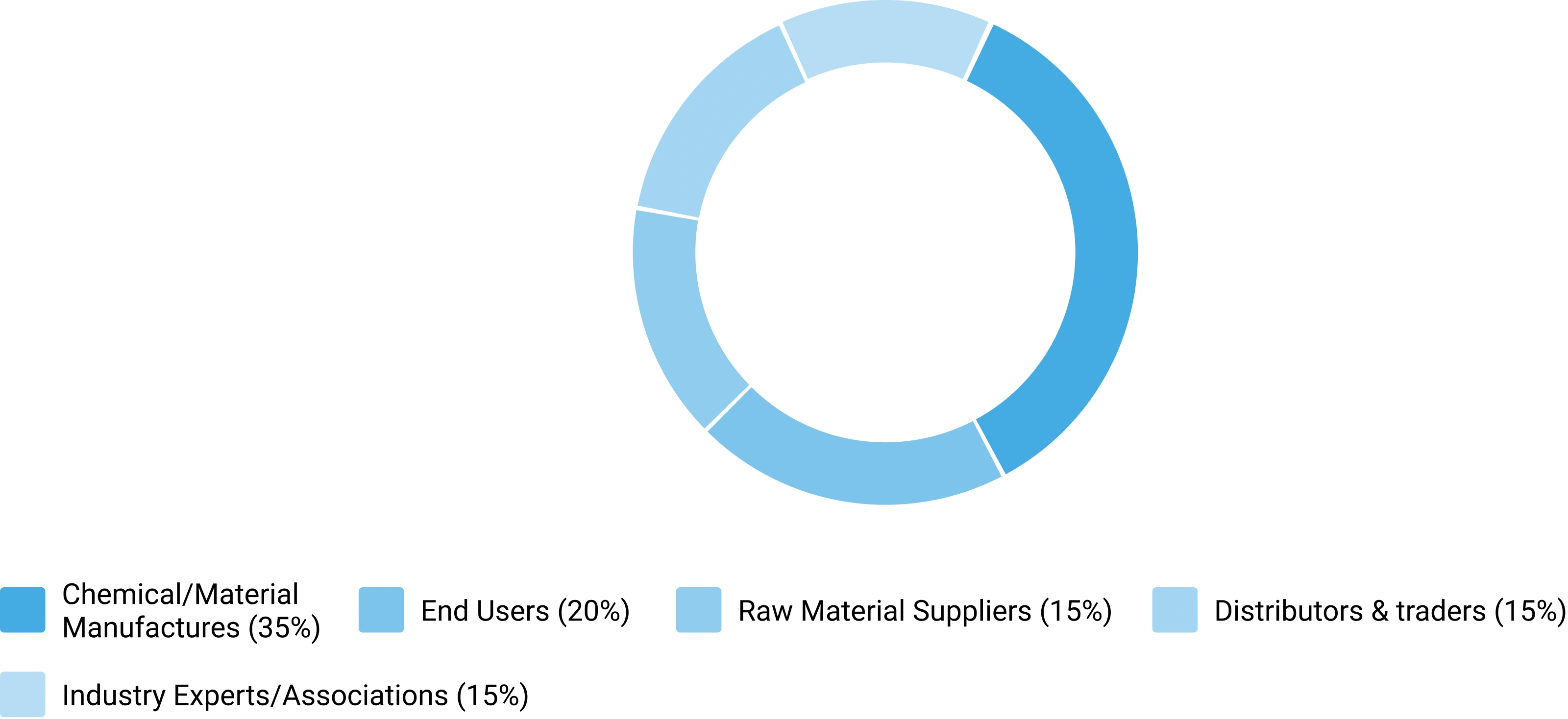
Category : Manufacturers, Suppliers, Distributors, End Users, Experts/Associations
Average Duration : 30–60 Minutes
Interview Mode : Video calls, telephonic interviews, expert consultations
Interview Format : Structured / Semi-Structured questionnaire
Focus Areas of Primary Research:
Market Size & Forecast Validation :
Revenue estimates, volume consumption, growth rates, forecast assumptions, regional demand.
Supply Chain & Value Chain Assessment :
Raw material sourcing, supply chain challenges, distribution networks, procurement practices.
Production & Capacity Analysis :
Manufacturing capacity, utilization rates, expansion projects, plant investments.
Pricing & Cost Structure Analysis :
Product pricing trends, feedstock costs, energy costs, margin pressures, pricing outlook.
Competitive Landscape Assessment :
Market share, competitor positioning, strategic initiatives, partnerships, acquisitions.
Primary Research — Stakeholder Coverage by Category
Distribution of interview respondents across stakeholder categories (% share from PPT data)
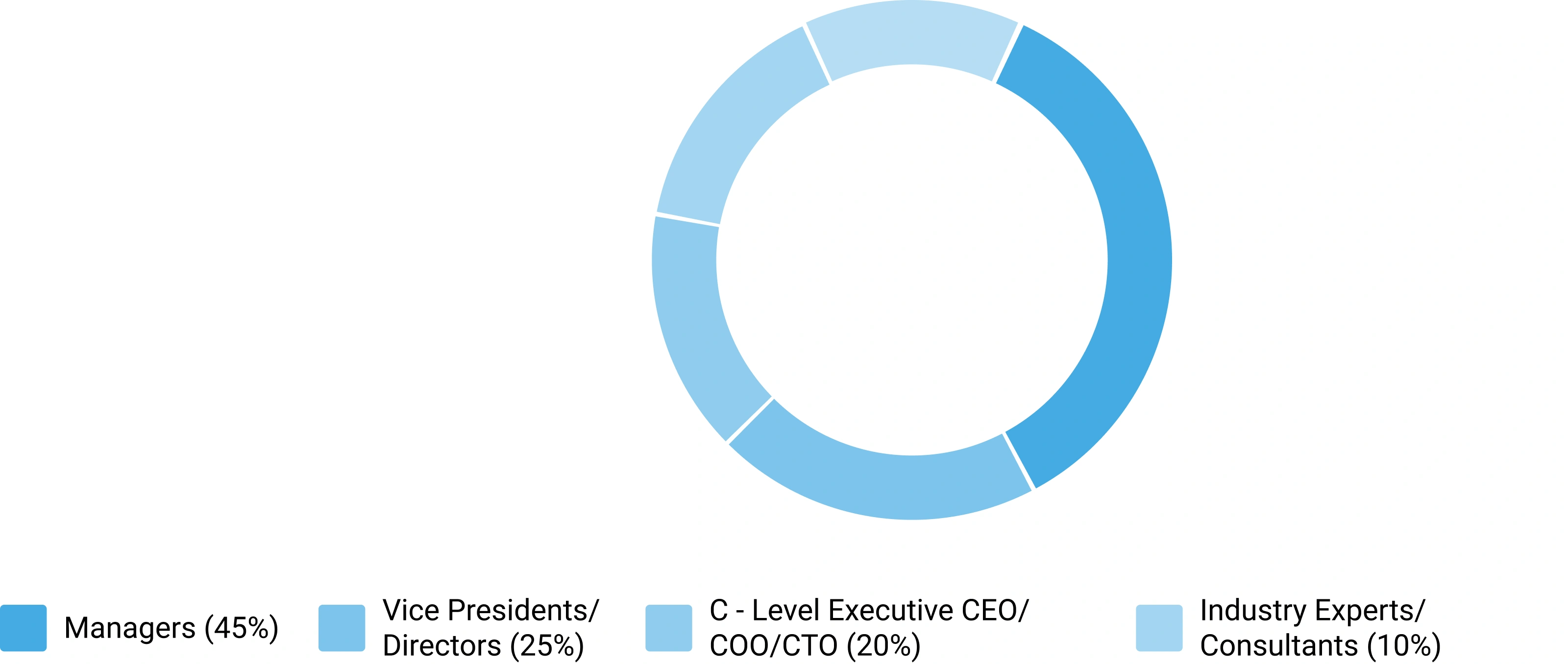
Primary Research — Respondent Designation Profile
Seniority breakdown of interview respondents (% share from PPT data)
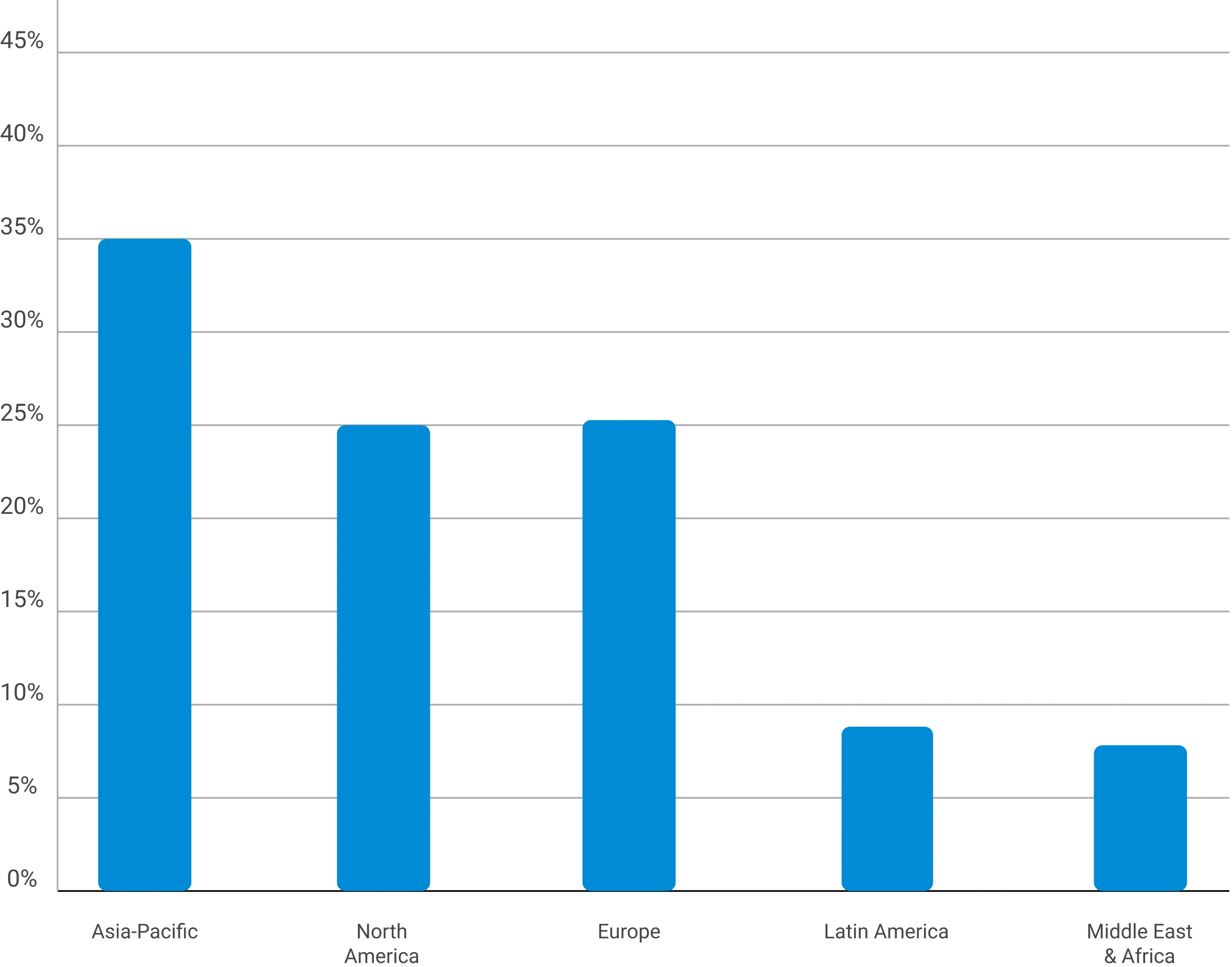
Primary Research — Geographic Coverage of Interviews
Regional distribution of primary research engagement (% share from PPT data)
Phase 6 — Data Triangulation and Market Validation
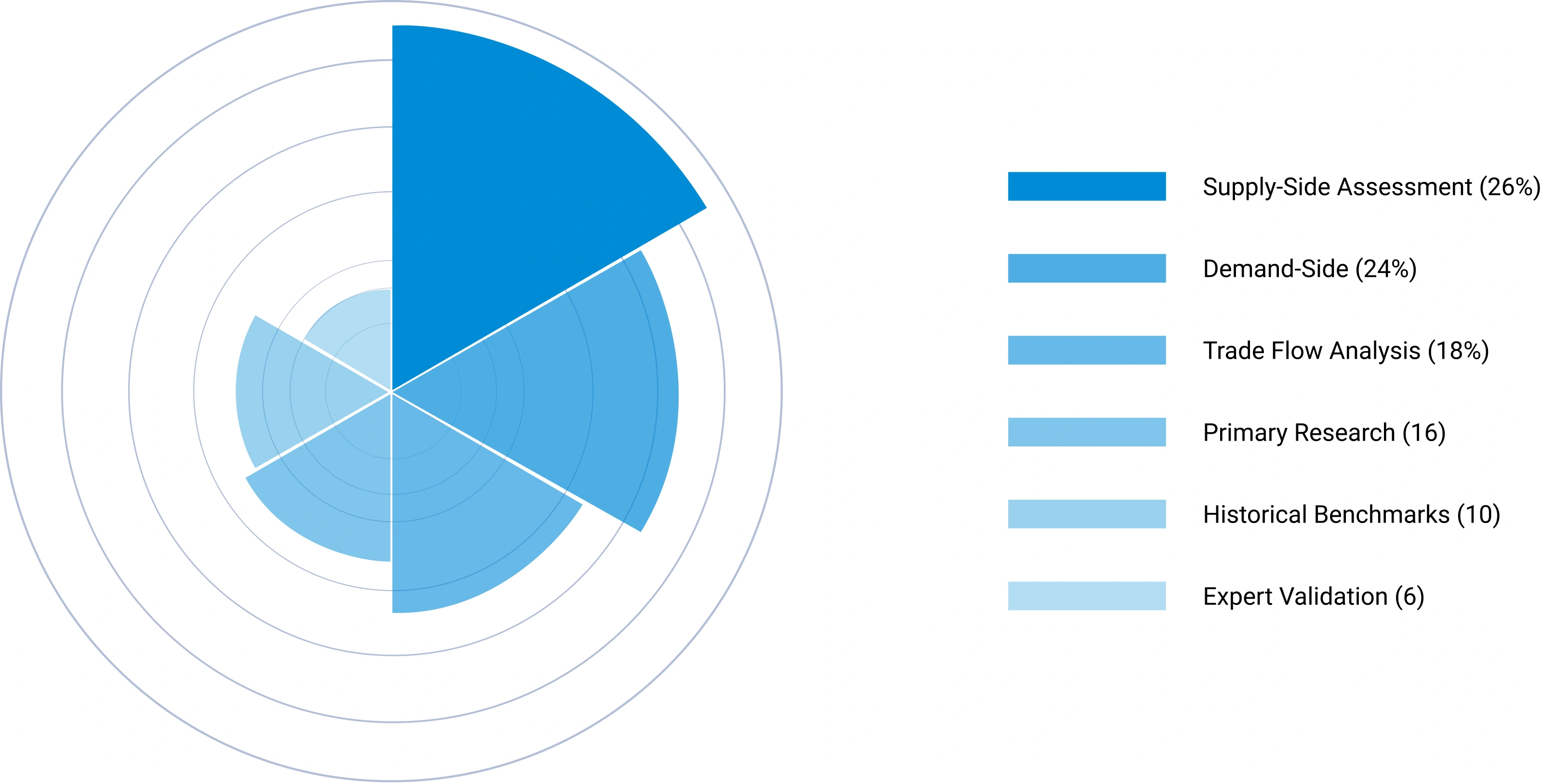
No single methodology is relied upon in isolation. Multiple independent estimation approaches are combined and reconciled to ensure consistency, accuracy, and analytical defensibility. Any material deviations between approaches are investigated and adjusted through additional validation cycles.
The final market size is derived through weighted triangulation of all validated methodologies. Any material deviations between approaches are investigated and adjusted through additional validation cycles. The outcome represents the most realistic assessment of the market based on available evidence and expert confirmation ensuring that volume and value estimates are fully consistent with one another.
Triangulation Framework — Input Contribution Weight
Relative weight each sizing input contributes to the final reconciled market estimate
Phase 7 — Forecast Modeling: Projecting Future Market Evolution
Forecasting evaluates the future trajectory of the market using a combination of quantitative indicators and qualitative assessments across economic, industry, and regulatory dimensions. Rather than simple extrapolation, each driver is independently modeled and integrated into a composite forecast.
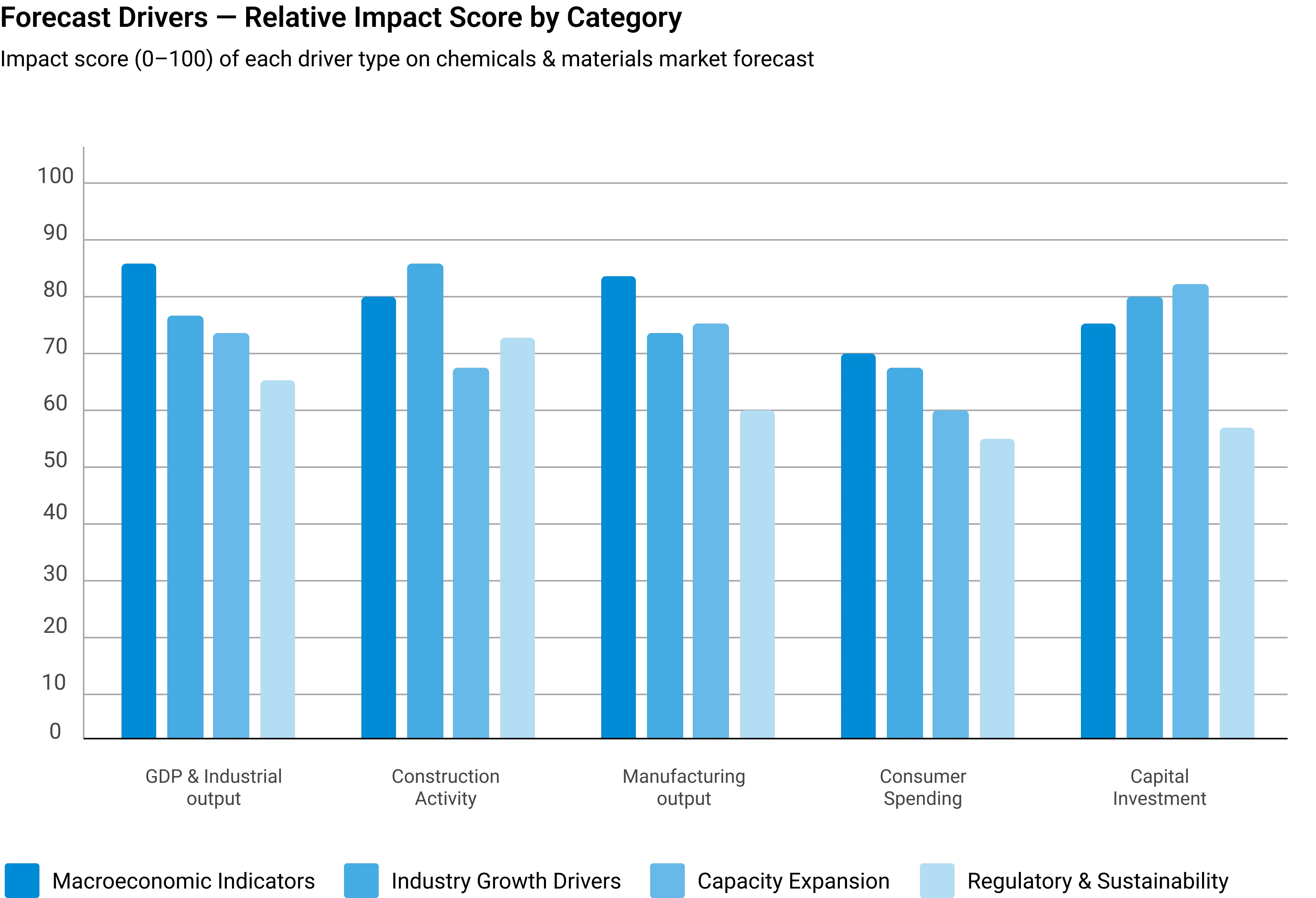
Macroeconomic Indicators
GDP growth, industrial production, manufacturing output, construction activity, consumer spending, and capital investment form the quantitative foundation of long-term demand projections. These are applied at country, regional, and global levels.
Industry Growth Drivers
Urbanization, infrastructure development, industrialization, technological innovation, sustainability initiatives, and evolving product performance requirements are assessed at regional and industry levels — capturing both structural and cyclical demand drivers.
Capacity Expansion Analysis
Announced plant expansions, new manufacturing facilities, technology upgrades, and strategic investments are evaluated to determine future supply-demand dynamics and potential market tightness or oversupply situations.
Regulatory & Sustainability
Environmental regulations, chemical safety standards, emission reduction targets, circular economy initiatives, and sustainability requirements are incorporated as they often influence product adoption rates and market growth trajectories.
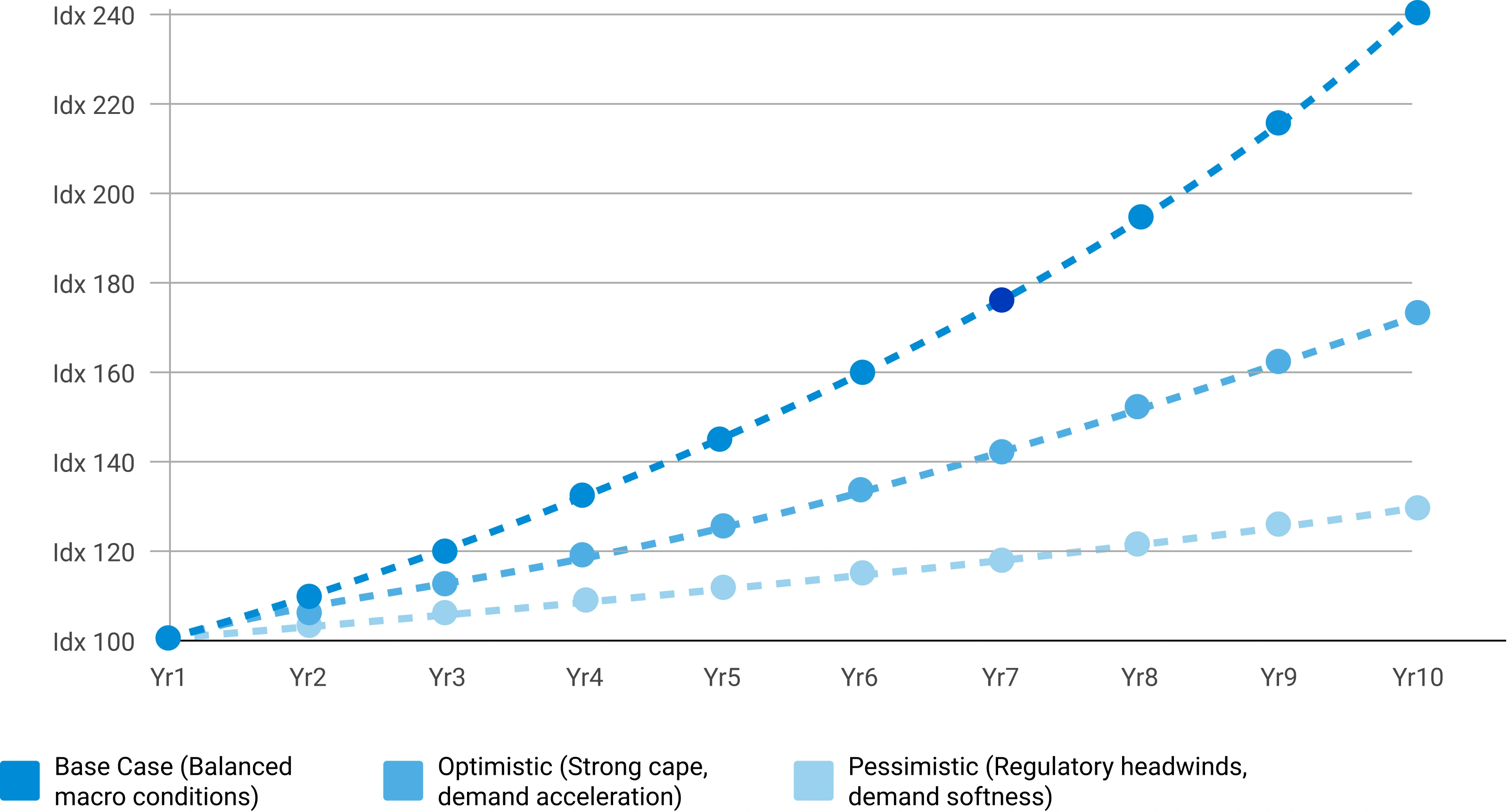
Scenario Forecast Range — Indexed Market Growth (Year 1–10)
Illustrative indexed growth trajectories across Base, Optimistic, and Pessimistic scenarios over a 10-year forecast horizon
Forecast Drivers — Relative Impact Score by Category
Impact score (0–100) of each driver type on chemicals & materials market forecast



Comments
Share your thoughts, ask a question, or provide feedback about this report.