
Algae-based Building Materials Market Top key Companies Analysis 2026 to 2035
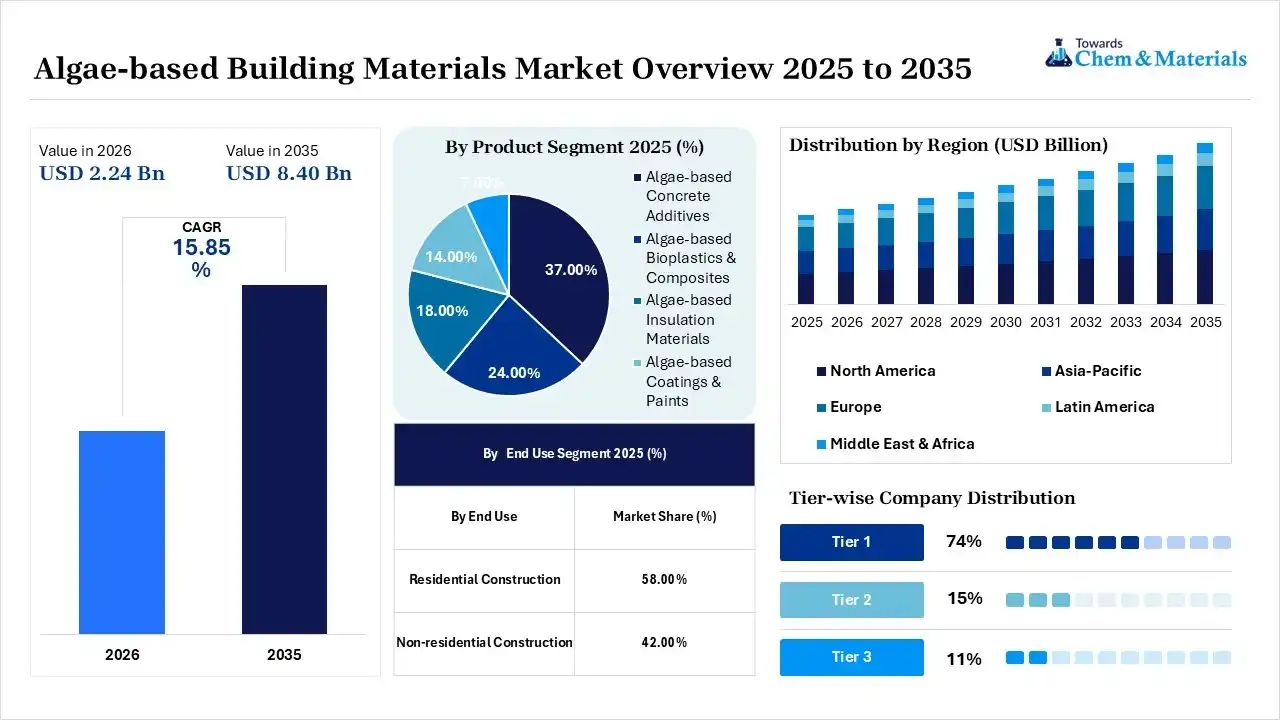
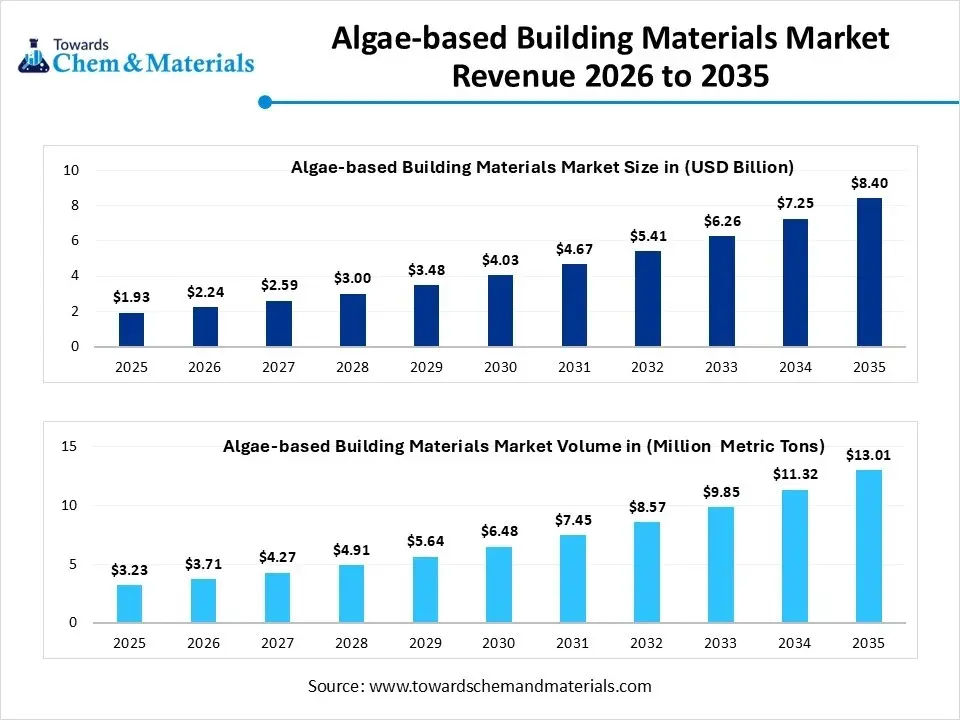
The algae-based building materials market size was valued at USD 1.93 billion in 2025, is estimated to reach USD 2.24 billion in 2026, and is projected to reach USD 8.40 billion by 2035, exhibiting a compound annual growth rate (CAGR) of 15.85% over the forecast period from 2026 to 2035.Europe dominated the algae-based building materials market with the largest revenue share of 34% in 2025 and is expected to grow at the fastest CAGR of 15.95% during the forecast period. In terms of volume, the algae-based building materials market is projected to grow from 3.23 million metric tons in 2025 to 13.01million metric tons by 2035. growing at a CAGR of 14.95% from 2026 to 2035.The commercialization is being further hastened by advances in the use of algae-based biopolymers, bio-cement technologies, and living façade systems, with an expanding number of green building certifications and circular economy projects providing additional avenues for growth in residential and commercial construction.
Market Highlights
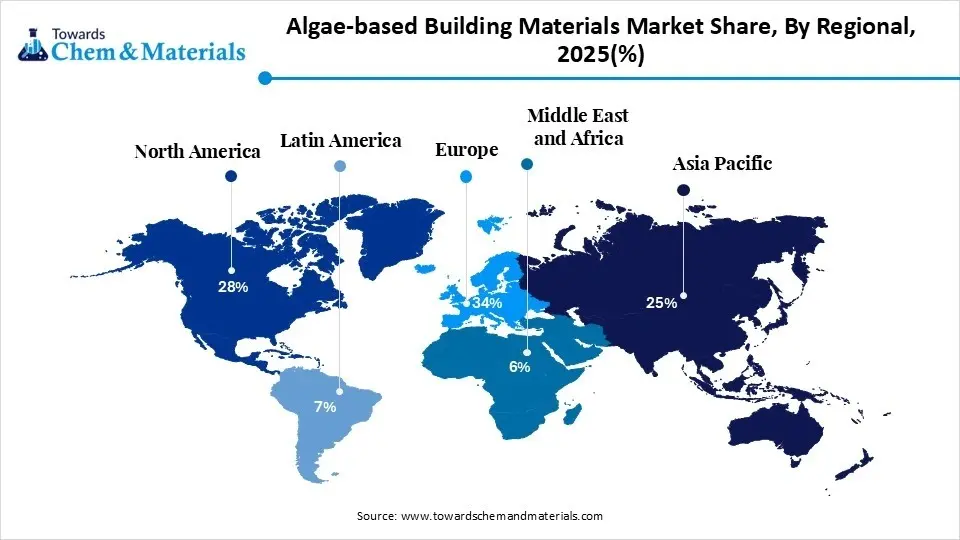
- By region, Europe dominated the algae-based building materials market by holding 34% share in 2025, driven by extensive green construction investments.
- By region, Asia Pacific held 25% market share in 2025 and is expected to grow at the fastest with a CAGR of 17.50% during the forecast period as government investments expand bio-based manufacturing.
- By product type, the algae-based concrete additives segment dominated the market with the largest share of 37% in 2025, as carbon reduction regulations accelerate adoption in cement production.
- By Product type, the algae-based bioplastics & composites segment held 24% market share in 2025 and is expected to grow at the fastest CAGR of 17.6% over the forecast period due to manufacturers replacing petroleum-based composites.
- By end use, the residential construction segment dominated the market with the largest share of 58% in 2025, as homebuilders increasingly prioritize sustainable materials.
- By end use, the non-residential construction segment held 42% market share in 2025 and is expected to grow at the fastest CAGR of 16.50% over the forecast period, driven by corporate ESG initiatives that accelerate material substitution.
As the construction sector moves toward renewable, carbon-negative, and environmentally-friendly building materials, the market for algae-based construction materials is growing rapidly. The use of algae-based concrete additives, bio-based composites, insulation materials, coatings, and biopolymers is gaining traction as a means of lowering embodied carbon emissions in the construction sector, in place of traditional petroleum-based products.
- For instance, in June 2026, by using a seaweed-based resource called sodium alginate, researchers at the University of Colorado Boulder showed that this material can be used to enhance the 3D printing of earthen construction materials, resulting in more stable structures and aiding in the development of sustainable bio-based building technologies. (Source: www.colorado.edu)
The increasing regulations promoted by the government to support “Net Zero” buildings, “Circular Economy” programmes, and “Green Building” certifications are driving the use of sustainable materials in the construction of residential and commercial developments. Technological developments such as bio-mineralization, photobioreactor-integrated façade, and scalable algae cultivation systems are making algae more commercially viable and lowering emissions in the algae production process. The worldwide market is expected to grow even faster because of the expansion of partnerships between biotechnology firms and construction material manufacturers.
Global Investment Movement for Algae-based Building Materials Market
Governments, venture capitalists, and construction companies are increasingly investing in carbon-negative building materials as they look for alternative materials that are environmentally friendly to traditional cement and concrete.
There are also strategic investments on the way for bio-intelligent building façades that incorporate photobioreactor systems that can generate biomass and enhance the energy efficiency of the building. As innovative façade technologies emerge, they are being noticed for their potential at both capturing CO2 and performing a role in the building.
Algae-derived materials such as insulation, paints, bioplastics, and structural composites are still being developed and used by manufacturers with the goal of replacing petroleum-based construction products. The investments are in line with the aims of the circular economy and material recyclability, and contribute to decreased greenhouse gas (GHG) emissions during the lifecycle.
- In August 2025, researchers in Brazil created lightweight construction materials using Sargassum algae, making effective use of the abundant marine biomass resources and increasing sustainability.(Source: www.eurekalert.org)
The alliance between biotechnology companies, research laboratories, and construction firms is driving further commercialization of high-value-added algae products, allowing for quicker product development and increased utilization of products in sustainable infrastructure initiatives.
Market Trends
- Increased Adoption of Algae Admixtures for Concrete:The use of additives derived from algae is becoming a common practice in the cement industry to enhance the durability of concrete while minimizing the need to rely on conventional Portland cement. These additives provide structural performance, lower embodied carbon, and help to meet more and more demanding environmental regulations for sustainable construction.
- Using Carbon-Negative Bio-Bricks in Sustainable Construction:Bio-bricks and masonry products are being designed by manufacturers with the use of algae-based bio-cement technologies, which skip the energy-intensive kiln process. The innovative materials can sequester CO₂ during production and deliver similar structural performance to traditional construction materials, making them appealing for low-carbon construction projects.
- Increased Awareness of The Potential Of Living Algae Facades :The building façade with the integrated photobioreactor is gaining popularity and has been investigated regarding its functionality of bio-energy production, thermal insulation, reduction of the solar heat gain, and CO2 uptake from the atmosphere. The multifunctional façade systems integrate sustainable architecture and production of renewable energy, which will enable future green building designs.
- Expanding Demand For Bio-Based Insulation Materials :Increasingly, seaweed and macroalgae are being used to create biodegradable roofing panels and insulation that are very resistant to moisture, thermal insulation, and long-lasting. As demand for greener building materials grows, manufacturers continue to build their product range of algae insulation.
Report Scope
| Report Attributes | Details |
| Market Size in 2026 | USD 2.24 Biilion/ 3.71 Million Metric Tons |
| Market Size by 2035 | USD 8.40 Billion/ 13.01 Million Metric Tons |
| Growth Rate from 2026 to 2035 | CAGR 15.85% |
| Base Year of Estimation | 2025 |
| Forecast Period | 2026 - 2035 |
| Dominant Region | Asia Pacific |
| Segment Covered | By Product, By End Use, By Region |
| Key Profiled Companies | Corbion N.V., BASF SE, DSM-Firmenich, Algix LLC, Prometheus Materials, Flora Materials, Cellana, Ocean Grows Limited, Algenesis Materials, AlgaEnergy S.A. |
Key Technological Shifts and AI in the Algae-based Building Materials Market
New and rapidly developing bio-mineralization technologies; manufacturers are able to create construction materials using algae that release much less carbon into the environment than conventional cement products. The incorporation of PBRs into building facades, a new generation of algal biopolymers, and large-scale processing technologies for biomass are advancing the commercial feasibility and enhancing the design of energy-efficient buildings. Ongoing development in the production of bio-composites is increasingly broadening the use of algae composites in contemporary construction applications.
AI is helping with every aspect of algae cultivation, production, and material development, continually optimizing environmental conditions like light intensity, nutrient concentration, temperature, and carbon dioxide supply. Predictive analytics powered by AI enhances the efficiency of photobioreactors, automates quality monitoring, and speeds up material development through computational modeling.
Supply Chain Analysis of the Algae-based Building Materials Market
Feedstock Procurement
- The first step in the supply chain involves growing and harvesting micro and macroalgae in controlled photobioreactors, open ponds, and marine farms. The algal biomass is the main raw material used for the manufacture of bio-cement, insulation materials, coatings, bio-composites, and other sustainable building materials.
- Cellana: Cellana is a company involved in the large-scale production of high-quality value microalgae, providing sustainable biomass for bio-based industrial applications.
- Other Key Players: Algenol, Cyanotech Corporation, and AlgaEnergy S.A.
Bio-Processing and Bio-Refining of Biomass
- Algae harvested are then dried, extracted, fermented, and chemically processed to yield beneficial products including polysaccharides, proteins, alginates, lipids, and bio-resins. Advanced biorefinery technologies are used to convert these materials into construction-grade additives, binders, coatings, and composite raw materials.
- Corbion N.V.: Focuses on bio-based ingredients and fermentation technologies to help produce renewable polymers and sustainable construction materials as a major player.
- Other Key Players: BASF SE, CP Kelco, Algaia.
Material Formulation and Manufacturing
- Derived from algae, processed compounds are added to cement, natural fiber, recycled aggregate, polymer, or mineral binder to produce a series of final building products such as bio-cement, insulation panels, coatings, structural composites, and lightweight construction products.
- The product has product consistency and structural performance enhanced by advanced manufacturing technologies.
Prometheus Materials: Produces carbon-negative bio-cement, a new product that uses microalgae and natural mineral binders to create sustainable masonry materials. - Other Key Players: ecoLogicStudio, Algix LLC, Flora Materials.
Regulatory Framework: Algae-based Building Materials Market
| Region | Key Regulation | Regulatory Focus |
| Asia Pacific | Green Building Evaluation Standard (China), GreenPro Certification (India) | Promotion of sustainable construction materials, low-carbon buildings, and environmentally responsible infrastructure development. |
| North America | LEED Certification, International Green Construction Code (IGCC) | Adoption of renewable construction materials, energy-efficient buildings, and reduced lifecycle carbon emissions. |
| European Union | European Green Deal, Construction Products Regulation (CPR) | Circular economy implementation, carbon-neutral construction, sustainable material certification, and climate-neutral infrastructure development. |
Algae-based Building Materials Market Dynamics
Driver:
Rising Net-Zero Construction and Sustainability Regulations
The growing severity of carbon reduction policies, green building standards, and the net-zero emission targets are being put in place by governments across the globe to support the use of bio-based building materials. Algae-based products have a notable contribution to reducing embodied carbon, meet the goals of the circular economy, and support sustainable infrastructure development. As more developers seek LEED and BREEAM certification, the need for alternative, renewable construction materials is rising and driving the commercialization process for both residential and commercial building projects.
Restraint
Limited Commercial Manufacturing Capacity
Although there is promising research on the use of algae in the production of building materials, these products are still at an initial commercialization phase. Production facilities are limited, and manufacturing costs are relatively high due to the need for large-scale production. Biomass cultivation and processing technologies, as well as the ability of the supply chain to scale up, and regulatory approvals, remain constraints and limit the adoption of biomass materials, especially in price-sensitive construction markets, where conventional materials continue to be more economically competitive.
Opportunity
Carbon-Negative Construction Materials
Algae-based building materials have strong potential to capitalize on the increasing demand for carbon-negative buildings. As more and more developers look to sustainable options to lower lifecycle emissions while maintaining structural performance, the need for sustainable options with reduced lifecycle emissions and acceptable structural performance becomes more prevalent. As governments intensify their climate policies and sustainable procurement efforts across the globe, investments in green infrastructure, bio-cement technologies, renewable insulation materials, and sustainable composites are anticipated to drive the commercialization of these materials.
Segmental Insights
Product Type Insights
The algae-based concrete additives segment dominated the market with the largest share of 37% in 2025, owing to the growing demand for low-carbon cement alternatives for residential, commercial, and infrastructure construction projects. The concrete materials with the addition of algae have better durability, mechanical properties, crack resistance, and binding performance, and can greatly reduce the use of Portland cement. Adoption of sustainable construction practices and the widespread use of concrete additives based on algae is further driven by the growing regulations imposed by the government on the carbon emissions generated by the construction industry.
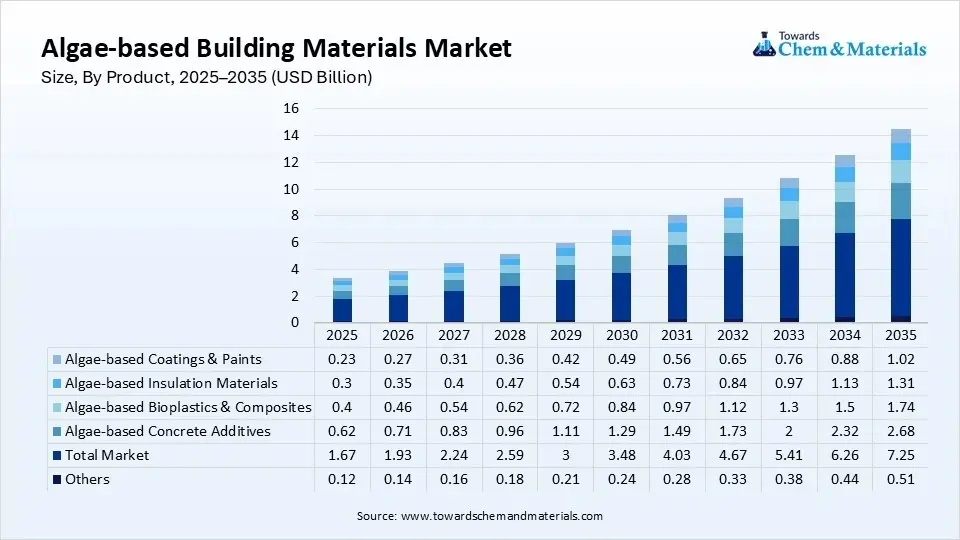
The algae-based bioplastics & composites segment held the 24% market share in 2025 and is expected to grow at the fastest CAGR of 17.6% over the forecast period, due to increase in the replacement of petroleum-based plastics with renewable construction materials. Algae-derived polymers are being used in manufacturers of structural panels, decorative boards, insulation and lightweight building materials, etc., to increase sustainability yet maintain mechanical properties. Biodegradable composites, circular economy schemes, and new biomaterial technologies will increasingly be invested in to drive commercialization and applications in modern construction industries.
Algae-based Building Materials Market Share, By Product, 2025(%)
| By Product | Market Share (%) |
| Algae-based Concrete Additives | 37.00% |
| Algae-based Bioplastics & Composites | 24.00% |
| Algae-based Insulation Materials | 18.00% |
| Algae-based Coatings & Paints | 14.00% |
| Others | 7.00% |
End Use Insights
The residential construction segment dominated the market with the largest share of 58% in 2025, with homeowners and developers keen on adopting environmentally friendly construction materials to achieve sustainability goals. The growing interest in energy-efficient homes, green building design, and re-processable building materials is continuing to drive the adoption of algae insulation, coatings, concrete additives, and composites. The residential market is anticipated to remain robust for the forecast period, due to the governments push for low-carbon houses and growing awareness among consumers about green construction methods.
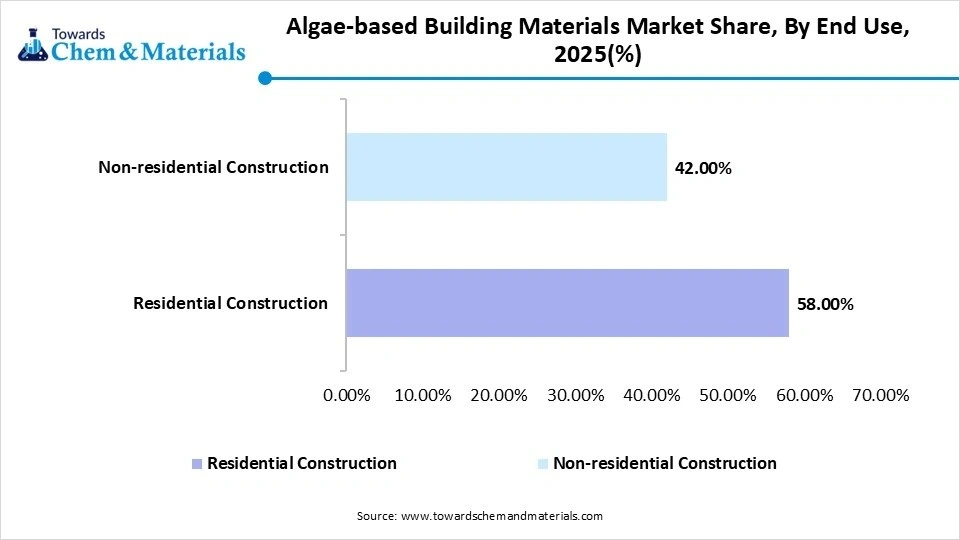
The non-residential construction segment held the 42% market share in 2025 and is expected to grow at the fastest CAGR of 16.50% over the forecast period. In the office, educational, healthcare, and industrial infrastructure sectors, the demand for building materials produced using algae is rising as a result of corporate sustainability commitments, ESG reporting requirements, and large-scale green commercial projects. Advanced bio-based building materials are anticipated to gain significant opportunities with the increasing investment in the construction of net-zero commercial buildings and sustainable public infrastructure projects.
Algae-based Building Materials Market Share, By End Use, 2025(%)
| By End Use | Market Share (%) |
| Residential Construction | 58.00% |
| Non-residential Construction | 42.00% |
Regional Insights
How Did Europe Dominate the Algae-based Building Materials Market In 2025?
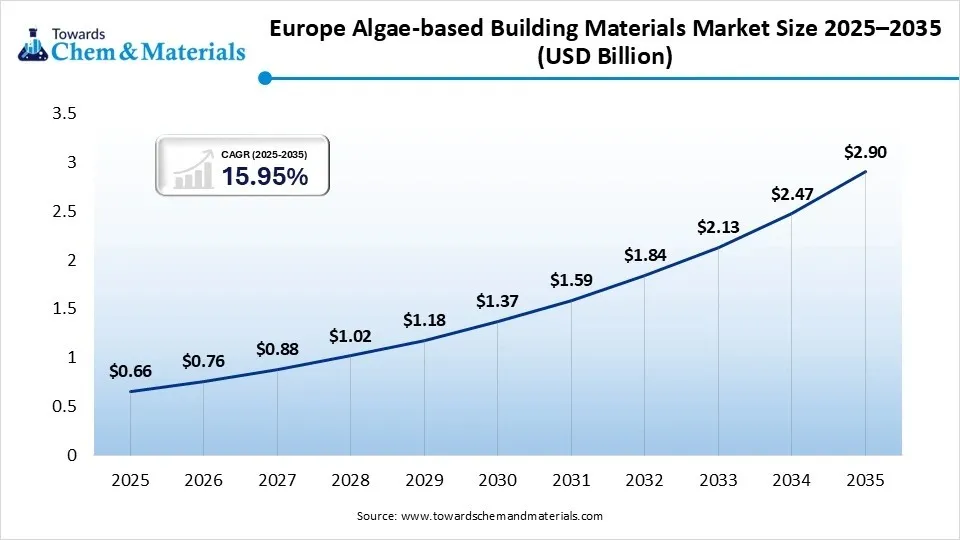
The Europe algae-based building market size was estimated at USD 0.66 billion in 2025 and is projected to reach USD 2.90 billion by 2035, growing at a CAGR of 15.95% from 2026 to 2035. Europe dominated the market with the largest share of 34% in 2025, owing to ambitious climate policies, growing acceptance of green building standards, and high investments in bio-based construction technologies. Algae materials are being adopted for use in both commercial and residential building materials, with continued support from the government, rising demand for carbon-neutral infrastructure, and the presence of major biotechnology companies.
Germany
Germanys robust green construction industry drives the use of algae-based concrete additives in infrastructure projects. Algae-derived biocomposites are the subject of extensive research collaborations that extend both in terms of the structures performance and to help commercialize sustainable building materials across the country. There are stringent environmental rules that help developers to use more environmentally friendly construction materials in residential, commercial, and public construction projects.
France
French national decarbonization measures favor the use of renewable, algae-based building materials and promote them in projects. As investments in sustainable housing rise, so does the demand for algae-based insulation and coatings and for environmentally friendly composite construction products in the whole country. Public infrastructure modernization projects promote innovative low-carbon materials that support circular economy goals and sustainable environmental projects.
Asia Pacific
The Aisa Pacific algae-based building market size was estimated at USD 0.48 billion in 2025 and is projected to reach USD 2.14 billion by 2035, growing at a CAGR of 16.12% from 2026 to 2035. Asia Pacific held 25% market share in 2025 and is expected to grow at the fastest CAGR of 17.50% during the forecast period, as investments in sustainable construction, fast urbanization, and improved bio-based manufacturing capabilities are expected to rise. The demand for carbon neutrality, increasing infrastructure development, and increased use of green building materials are continuing to boost the regional demand. The technologies of algae also have a high potential for commercialization, which further sustains the long-term market expansion.
China
The Chinese approach to carbon neutrality advances the commercialization of bio-based construction materials in rapid urbanization and house construction projects. The investments of the government enable the development of the national bio-manufacturing competencies, which will provide the basis for production at an industrial scale of sustainable construction materials and innovative bio-composites throughout the country. Other green building certifications provide an incentive to builders to use the eco-friendly algae-based materials instead of the traditional ones to improve environmental performance.
India
Urbanization has had a significant impact on the demand for sustainable materials in the construction of sustainable, environmentally friendly, and reliable residential and commercial infrastructure across the country. The government has a policy to encourage investments in algae composites, insulation materials, and low-carbon construction technologies. Stronger research collaborations speed the time it takes to bring building materials to market that utilize renewable resources and boost the sustainable building materials sector in India.
North America
The North America algae-based building market size was estimated at USD 0.54 billion in 2025 and is projected to reach USD 2.39 billion by 2035, growing at a CAGR of 16.04% from 2026 to 2035. North America held 28% market share in 2025, as investments in sustainable infrastructure continued to rise, as did carbon-negative building materials and green building regulations. Commercialisation of algae-based building products in the region is still increasing as biotechnology companies and construction companies are increasingly partnering together, and as innovation in technology is realized.
United States
As investments in carbon-negative construction continue to increase, it is projected that the use of algae-based concrete technology will continue to be adopted more widely among commercial and institutional building projects throughout the country. The strong biotechnology ecosystem provides innovation in bio-cement, renewable insulation materials, and advanced technologies for manufacturing structural composites using algae.
Canada
Canadian net-zero buildings are encouraging the procurement of building materials made with algae throughout Canadas residential and commercial construction projects. Successful commercialization of innovative algae-based composites, coatings, and environmentally friendly insulation products by research institutions and industry partners. The governments sustainability investment funds are developing renewable construction materials and promoting practices for the circular economy in national infrastructure projects.
Latin America
The Latin America algae-based building market size was estimated at USD 0.14 billion in 2025 and is projected to reach USD 0.63 billion by 2035, growing at a CAGR of 16.23% from 2026 to 2035. Latin America held 7% market share in 2025, driven by the rise in sustainable building practices, growing environmental consciousness, and investments in renewable material technologies. Opportunities for commercialization of bio-based construction solutions continue to improve in the region through further development of infrastructure and supportive research programs.
Brazil
Brazil makes use of a large amount of marine biomass resources that can be used to develop new materials based on algae for sustainable infrastructure and housing construction. The research work drives the commercialisation of algae-enhanced concrete and lightweight ceramic materials for the implementation of environmentally friendly construction in the country. The spread of green building schemes promotes the development of buildings using renewable building materials that have lower emission rates and higher environmental sustainability.
Chile
Algae applications in the sustainable construction and mining sectors, such as in environmentally responsible infrastructure development projects, are encouraged in Chile. Promoting renewable construction materials offering a reduction in embodied carbon, across residential, commercial, and public infrastructure projects across the country. Growth of innovation ecosystems drives successful research into algae-based composites, insulation materials, and sustainable architectural building solutions.
Middle East & Africa
The Middle East & Africa algae-based building market size was estimated at USD 0.12 billion in 2025 and is projected to reach USD 0.55 billion by 2035, growing at a CAGR of 16.44% from 2026 to 2035. The Middle East & Africa held 6% market share in 2025, as more investments are being made towards the field of sustainable urban development, green construction technologies, and climate-proof infrastructure. The growing interest in renewable materials and the diversification plans of governments still provide good prospects for using algae as building materials.
Saudi Arabia
Sustainable construction materials for environmentally responsible urban development and expansion of green infrastructure throughout the country are promoted through the Vision 2030 initiatives. Investment in biotechnology and renewable materials contributes to the commercialization of algae-based construction products in the future smart city development. Pioneered bio-based building materials are increasingly being used in the worlds largest infrastructure and housing construction programs in response to the increasing focus on carbon reduction.
South Africa
The aim of sustainable construction initiatives is to use renewable materials for buildings, contributing to the development of environmentally responsible infrastructure throughout the country, which has been achieved successfully. Innovation and sustainable material development programs enable universities and research institutes to promote the commercialization of algae composites. More green buildings boost demand for bio-based insulation, coatings, and lifecycle carbon-emission-reducing construction materials.
Competitive Analysis
The market is focused on cement technologies that reduce carbon emissions, algae-based composites, bio-based insulating materials, and renewable coatings, which are meeting demand for more stringent environmental regulations and green building standards.
The use of sophisticated biotechnology, artificial intelligence, and automated cultivation systems is also being incorporated into companies to maximize biomass production and material performance. With governments still championing the development of net-zero buildings and circular economy projects, the competition is shifting from the traditional price element to technological innovation, lifecycle sustainability, certification of products, and commercial scalability.
- For Instance, Holcims ongoing investments in circular and low-carbon construction solutions underscore the industrys shift towards sustainable materials, presenting opportunities for new and innovative solutions like algae concrete additives and bio-composites.(Source: www.holcim.com)
Recent Developments
- In May 2026, MicroHues came up with an environmentally friendly paint alternative to acrylic water-based paints with natural pigments extracted from microalgae and cyanobacteria for sustainable use and application in the construction industry. (Source: news.mst.edu)
- In March 2026, Researchers from the University of Miami created concrete mixtures with algae biochar to partially substitute for traditional cement, which would help lower the environmental footprint without compromising structural performance, for use in sustainable infrastructure.(Source: news.miami.edu)
Top Players in the Market & Their Offerings
| Company | Headquarters | Geographic Presence | Algae-based Building Materials Offerings | Key Strength |
| Prometheus Materials | United States | North America | Bio-cement, carbon-negative concrete blocks | Carbon-negative construction technology |
| BASF SE | Germany | Global | Bio-based polymers, specialty construction chemicals | Advanced material innovation |
| Corbion N.V. | Netherlands | Global | Bio-based polymers and fermentation solutions | Sustainable biomaterials expertise |
Other Key Players
- Corbion N.V.
- BASF SE
- DSM-Firmenich
- Algix LLC
- Prometheus Materials
- Flora Materials
- Cellana
- Ocean Grows Limited
- Algenesis Materials
- AlgaEnergy S.A.
Segment Covered in the Report
By Product
- Algae-based Concrete Additives
- Carbon-sequestering admixtures
- Cement replacement additives
- Strength-enhancing additives
- Algae-based Bioplastics & Composites
- Structural biocomposites
- Decorative panels
- Composite boards
- Algae-based Insulation Materials
- Thermal insulation panels
- Acoustic insulation products
- Spray insulation materials
- Algae-based Coatings & Paints
- Interior coatings
- Exterior coatings
- Protective coatings
- Others
- Roofing materials
- Bio-based adhesives
- Decorative construction materials
By End Use
- Residential Construction
- New residential buildings
- Residential renovation
- Non-residential Construction
- Commercial buildings
- Industrial facilities
- Institutional buildings
- Public infrastructure
By Regions
- North America
- U.S.
- Canada
- Europe
- Germany
- UK
- France
- Italy
- Spain
- Sweden
- Denmark
- Norway
- Asia Pacific
- China
- Japan
- India
- South Korea
- Thailand
- Latin America
- Brazil
- Mexico
- Argentina
- Middle East & Africa
- South Africa
- UAE
- Saudi Arabia
- Kuwait
Table of Contents
Chapter 1. Methodology and Scope
1.1. Research Methodology
1.2. Research Scope & Assumption
1.3. Information Procurement
1.3.1. Purchased Database
1.3.2. TCM’s Internal Database
1.3.3. Secondary Sources & Third-Party Perspectives
1.3.4. Primary Research
1.4. Information Analysis
1.4.1. Data Analysis Models
1.5. Market Formulation & Data Visualization
1.6. List of Data Sources
Chapter 2. Executive Summary
2.1. Market Outlook, 2025
2.2. Segmental Outlook
2.3. Competitive Insights
Chapter 3. Algae-based Building Materials Market Variables, Trends & Scope
3.1. Market Lineage/Ancillary Market Outlook
3.2. Industry Value Chain Analysis
3.2.1. Sales Channel Analysis
3.3. Regulatory Framework
3.3.1. Analyst Perspective
3.3.2. Regulations & Standards
3.4. Market Dynamics
3.4.1. Market Driver Analysis
3.4.2. Market Restraint Analysis
3.4.3. Industry Opportunities
3.4.4. Industry Challenges
3.5. Business Environmental Tools Analysis: Global Algae-based Building Materials Market
3.5.1. Porter’s Five Forces Analysis
3.5.1.1. Bargaining Power of Suppliers
3.5.1.2. Bargaining Power of Buyers
3.5.1.3. Threat of Substitution
3.5.1.4. Threat of New Entrants
3.5.1.5. Competitive Rivalry
3.5.2. PESTLE Analysis
3.5.2.1. Political Landscape
3.5.2.2. Economic Landscape
3.5.2.3. Social Landscape
3.5.2.4. Technology Landscape
3.5.2.5. Environmental Landscape
3.5.2.6. Legal Landscape
3.6. Market Disruption Analysis
Chapter 4. Global Algae-based Building Materials Market: Product Estimates & Trend Analysis
4.1. Key Takeaways
4.2. Product Movement Analysis & Market Share, 2025 & 2035
4.3. Global Algae-based Building Materials Market By Product, 2021 - 2035
4.4. Algae-based Concrete Additives
4.4.1. Algae-bases Concrete Additives Market Estimates And Forecasts, 2021 - 2035
4.5. Algae-based Bioplastics & Composites
4.5.1. Algae-based Bioplastics & Composites Market Estimates And Forecasts, 2021 - 2035
4.6. Algae-based Insulation Materials
4.6.1. Algae-based Insulation Materials Market Estimates And Forecasts, 2021 - 2035
4.7. Algae-based Coatings & Paints
4.7.1. Algae-based Coatings & Paints Market Estimates And Forecasts, 2021 - 2035
4.8. Others
4.8.1. Algae-based Building Materials Market Estimates And Forecasts, by Others, 2021 - 2035
Chapter 5. Global Algae-based Building Materials Market: End Use Estimates & Trend Analysis
5.1. Key Takeaways
5.2. End Use Movement Analysis & Market Share, 2025 & 2035
5.3. Global Algae-based Building Materials Market By End Use, 2021 - 2035
5.4. Residential Construction
5.4.1. Algae-based Building Materials Market Estimates And Forecasts, for Residential Construction, 2021 - 2035
5.5. Non-residential Construction
5.5.1. Algae-based Building Materials Market Estimates And Forecasts, for Non-residential Construction, 2021 - 2035
Chapter 6. Global Algae-based Building Materials Market: Regional Estimates & Trend Analysis
6.1. Key Takeaways
6.2. Regional Market Share Analysis, 2025 & 2035
6.3. North America
6.3.1. North America Algae-based Building Materials Market Estimates And Forecasts, 2021 - 2035
6.3.2. North America Algae-based Building Materials Market Estimates And Forecasts, By Product, 2021 - 2035
6.3.3. North America Algae-based Building Materials Market Estimates And Forecasts, By End Use, 2021 - 2035
6.3.4. U.S.
6.3.4.1. U.S. Algae-based Building Materials Market Estimates And Forecasts, 2021 - 2035
6.3.4.2. U.S. Algae-based Building Materials Market Estimates And Forecasts, By Product, 2021 - 2035
6.3.4.3. U.S. Algae-based Building Materials Market Estimates And Forecasts, By End Use, 2021 - 2035
6.3.5. Canada
6.3.5.1. Canada Algae-based Building Materials Market Estimates And Forecasts, 2021 - 2035
6.3.5.2. Canada Algae-based Building Materials Market Estimates And Forecasts, By Product, 2021 - 2035
6.3.5.3. Canada Algae-based Building Materials Market Estimates And Forecasts, By End Use, 2021 - 2035
6.3.6. Mexico
6.3.6.1. Mexico Algae-based Building Materials Market Estimates And Forecasts, 2021 - 2035
6.3.6.2. Mexico Algae-based Building Materials Market Estimates And Forecasts, By Product, 2021 - 2035
6.3.6.3. Mexico Algae-based Building Materials Market Estimates And Forecasts, By End Use, 2021 - 2035
6.4. Europe
6.4.1. Europe Algae-based Building Materials Market Estimates And Forecasts, 2021 - 2035
6.4.2. Europe Algae-based Building Materials Market Estimates And Forecasts, By Product, 2021 - 2035
6.4.4. Germany
6.4.4.1. Germany Algae-based Building Materials Market Estimates And Forecasts, 2021 - 2035
6.4.4.2. Germany Algae-based Building Materials Market Estimates And Forecasts, By Product, 2021 - 2035
6.4.4.3. Germany Algae-based Building Materials Market Estimates And Forecasts, By End Use, 2021 - 2035
6.4.5. UK
6.4.5.1. UK Algae-based Building Materials Market Estimates And Forecasts, 2021 - 2035
6.4.5.2. UK Algae-based Building Materials Market Estimates And Forecasts, By Product, 2021 - 2035
6.4.5.3. UK Algae-based Building Materials Market Estimates And Forecasts, By End Use, 2021 - 2035
6.4.6. France
6.4.6.1. France Algae-based Building Materials Market Estimates And Forecasts, 2021 - 2035
6.4.6.2. France Algae-based Building Materials Market Estimates And Forecasts, By Product, 2021 - 2035
6.4.6.3. France Algae-based Building Materials Market Estimates And Forecasts, By End Use, 2021 - 2035
6.4.7. Italy
6.4.7.1. Italy Algae-based Building Materials Market Estimates And Forecasts, 2021 - 2035
6.4.7.2. Italy Algae-based Building Materials Market Estimates And Forecasts, By Product, 2021 - 2035
6.4.7.3. Italy Algae-based Building Materials Market Estimates And Forecasts, By End Use, 2021 - 2035
6.4.8. Spain
6.4.8.1. Spain Algae-based Building Materials Market Estimates And Forecasts, 2021 - 2035
6.4.8.2. Spain Algae-based Building Materials Market Estimates And Forecasts, By Product, 2021 - 2035
6.4.8.3. Spain Algae-based Building Materials Market Estimates And Forecasts, By End Use, 2021 - 2035
6.5. Asia Pacific
6.5.1. Asia Pacific Algae-based Building Materials Market Estimates And Forecasts, 2021 - 2035
6.5.2. Asia Pacific Algae-based Building Materials Market Estimates And Forecasts, By Product, 2021 - 2035
6.5.3. Asia Pacific Algae-based Building Materials Market Estimates And Forecasts, By End Use, 2021 - 2035
6.5.4. China
6.5.4.1. China Algae-based Building Materials Market Estimates And Forecasts, 2021 - 2035
6.5.4.2. China Algae-based Building Materials Market Estimates And Forecasts, By Product, 2021 - 2035
6.5.4.3. China Algae-based Building Materials Market Estimates And Forecasts, By End Use, 2021 - 2035
6.5.5. India
6.5.5.1. India Algae-based Building Materials Market Estimates And Forecasts, 2021 - 2035
6.5.5.2. India Algae-based Building Materials Market Estimates And Forecasts, By Product, 2021 - 2035
6.5.5.3. India Algae-based Building Materials Market Estimates And Forecasts, By End Use, 2021 - 2035
6.5.6. Japan
6.5.6.1. Japan Algae-based Building Materials Market Estimates And Forecasts, 2021 - 2035
6.5.6.2. Japan Algae-based Building Materials Market Estimates And Forecasts, By Product, 2021 - 2035
6.5.6.3. Japan Algae-based Building Materials Market Estimates And Forecasts, By End Use, 2021 - 2035
6.6. Central & South America
6.6.1. Central & South America Algae-based Building Materials Market Estimates And Forecasts, 2021 - 2035
6.6.2. Central & South America Algae-based Building Materials Market Estimates And Forecasts, By Product, 2021 - 2035
6.6.3. Central & South America Algae-based Building Materials Market Estimates And Forecasts, By End Use, 2021 - 2035
6.7. Middle East & Africa
6.7.1. Middle East & Africa Algae-based Building Materials Market Estimates And Forecasts, 2021 - 2035
6.7.2. Middle East & Africa Algae-based Building Materials Market Estimates And Forecasts, By Product, 2021 - 2035
6.7.3. Middle East & Africa Algae-based Building Materials Market Estimates And Forecasts, By End Use, 2021 - 2035
Chapter 7. Supplier Intelligence
7.1. Kraljic Matrix
7.2. Engagement Model
7.3. Negotiation Strategies
7.4. Sourcing Best Practices
7.5. Vendor Selection Criteria
Chapter 8. Competitive Landscape
8.1. Key Players, their Recent Developments, and their Impact on Industry
8.2. Competition Categorization
8.3. Company Market Position Analysis
8.4. Company Heat Map Analysis
8.5. Strategy Mapping, 2025
8.6. Company Listing
8.6.1. Corbion N.V.
8.6.1.1. Company Overview
8.6.1.2. Financial Performance
8.6.1.3. Product Benchmarking
8.6.1.4. Strategic Initiatives
8.6.2. BASF SE
8.6.2.1. Company Overview
8.6.2.2. Financial Performance
8.6.2.3. Product Benchmarking
8.6.2.4. Strategic Initiatives
8.6.3. Evonik Industries AG
8.6.3.1. Company Overview
8.6.3.2. Financial Performance
8.6.3.3. Product Benchmarking
8.6.3.4. Strategic Initiatives
8.6.4. Algix LLC
8.6.4.1. Company Overview
8.6.4.2. Financial Performance
8.6.4.3. Product Benchmarking
8.6.4.4. Strategic Initiatives
8.6.5. Prometheus Materials
8.6.5.1. Company Overview
8.6.5.2. Financial Performance
8.6.5.3. Product Benchmarking
8.6.5.4. Strategic Initiatives
8.6.6. Flora Materials
8.6.6.1. Company Overview
8.6.6.2. Financial Performance
8.6.6.3. Product Benchmarking
8.6.6.4. Strategic Initiatives
8.6.7. Ocean Grows Limited
8.6.7.1. Company Overview
8.6.7.2. Financial Performance
8.6.7.3. Product Benchmarking
8.6.7.4. Strategic Initiatives
8.6.8. Algenesis Materials
8.6.8.1. Company Overview
8.6.8.2. Financial Performance
8.6.8.3. Product Benchmarking
8.6.8.4. Strategic Initiatives
8.6.9. AlgaEnergy S.A.
8.6.9.1. Company Overview
8.6.9.2. Financial Performance
8.6.9.3. Product Benchmarking
8.6.9.4. Strategic Initiatives
A Seven-Phase Framework
Our methodology is designed to be universally applicable across commodity chemicals, specialty chemicals, petrochemicals, construction chemicals, coatings, electronic chemicals, industrial gases, agrochemicals, water treatment chemicals, and performance materials. Each phase builds upon the last, creating a layered validation structure that minimizes estimation error and maximizes analytical confidence.
The framework ensures comprehensive market coverage, robust cross-validation, and reliable long-term forecasting — producing market estimates that withstand scrutiny from investors, regulators, and corporate strategy teams.

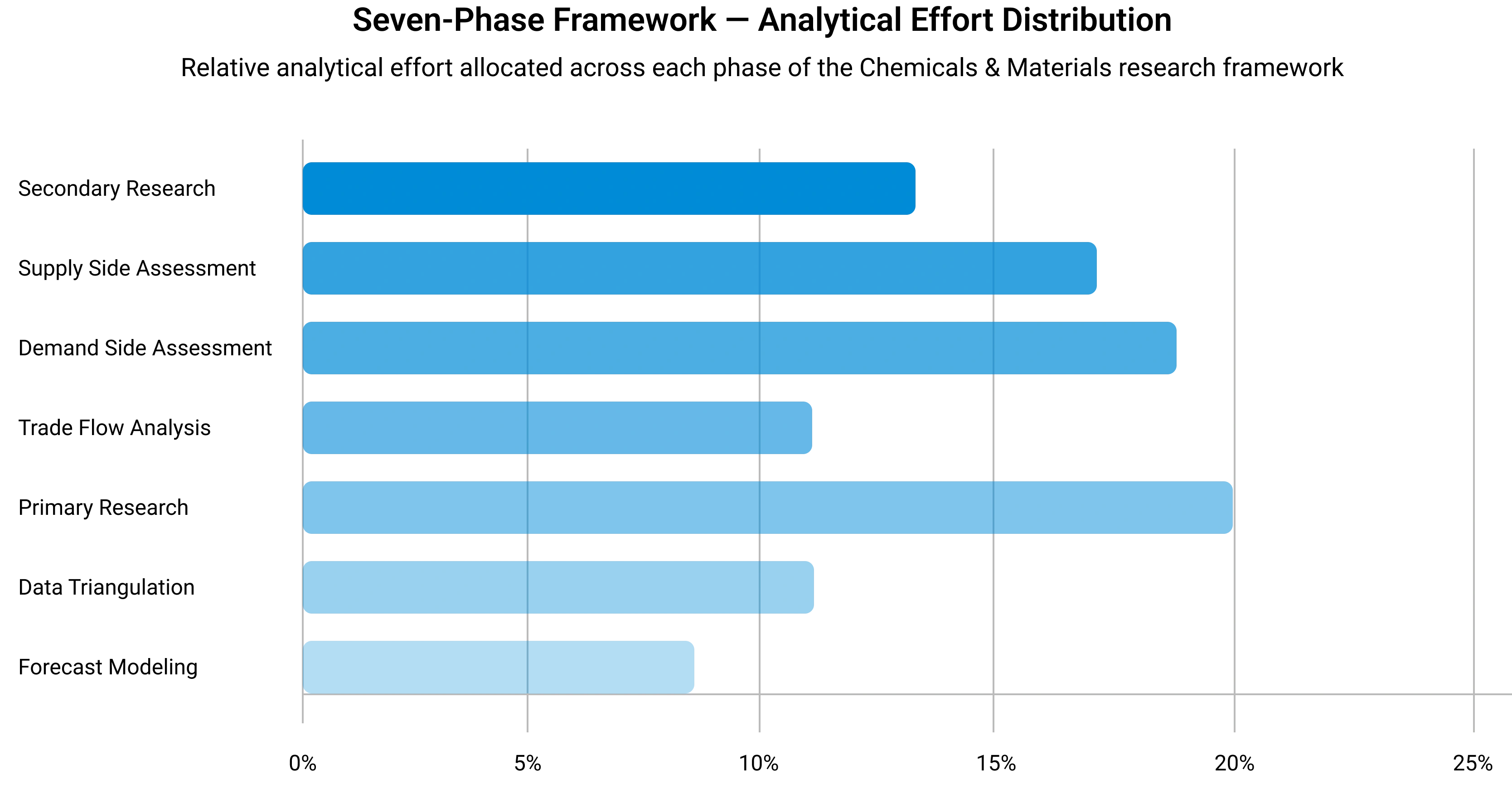
Seven-Phase Framework — Analytical Effort Distribution
Relative analytical effort allocated across each phase of the Chemicals & Materials research framework
Phase 1 - Secondary Research: Establishing the Foundation
Secondary research collects and evaluates publicly available information from authoritative sources, establishing the foundational understanding of market structure, value chain dynamics, competitive landscape, and end-use demand patterns. Every source is evaluated for credibility, recency, geographic relevance, and methodological soundness before inclusion.
Industry Associations
Sources include ACC, CEFIC, ICCA, JCIA, CPCIF, and SOCMA providing production volumes, consumption trends, capacity developments, and sustainability initiatives.
Company Disclosures
Annual reports, investor presentations, earnings transcripts, and regulatory filings reveal product portfolios, manufacturing footprints, capacity expansions, and revenue segmentation.
Government Databases
National statistical offices, customs authorities, environmental agencies, and industrial production databases provide verified statistics on output, trade flows, and regulatory compliance.
Trade Databases
UN Comtrade, ITC, Eurostat, and national customs authorities enable assessment of global product movement, import dependency, and export competitiveness across regions.
Our Secondary Research Sources
- Ministry of Chemicals and Fertilizers
- European Chemicals Agency
- United States Department of Energy
- Ministry of Industry and Information Technology
- Ministry of Economy Trade and Industry
- Ministry of Trade Industry and Energy
- National Institute of Standards and Technology
- Council of Scientific and Industrial Research
- Fraunhofer Society
- National Institute for Materials Science
Phase 2 — Supply-Side Assessment: Mapping Production Capabilities
Production Capacity Analysis
All major manufacturers are assessed for existing installed capacity, planned additions, expansions, new plant announcements, and technology adoption — mapped at global, regional, and country levels.
Capacity Utilization Adjustment
Installed capacity is adjusted using utilization rates based on demand conditions, feedstock availability, plant operating rates, maintenance schedules, and regulatory restrictions.
Manufacturer Revenue Analysis
Product-specific revenues, segment-level performance, regional distribution, average selling prices, and margin trends are evaluated to establish market value estimates.
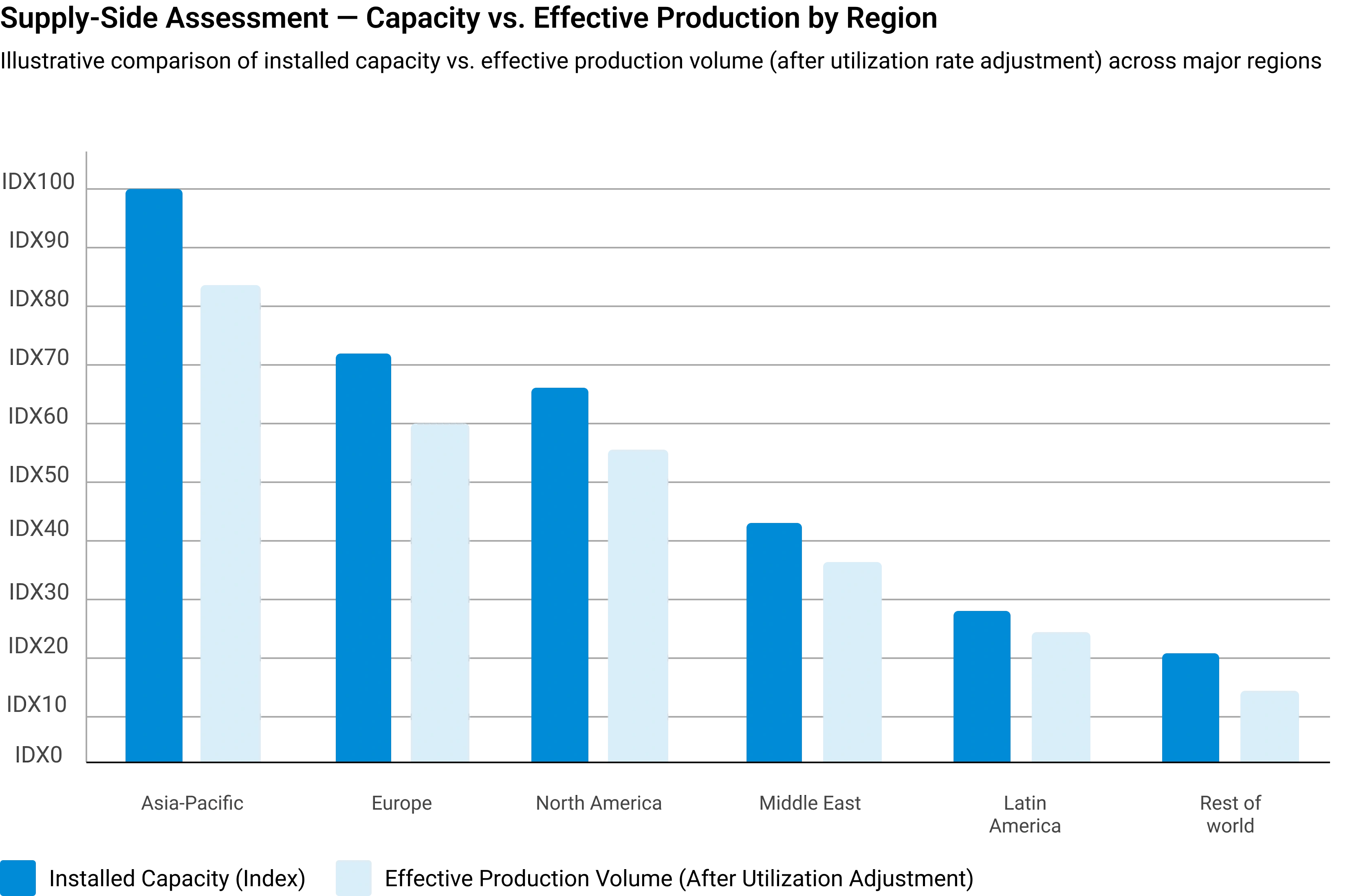
Supply-Side Assessment — Capacity vs. Effective Production by Region
Illustrative comparison of installed capacity vs. effective production volume (after utilization rate adjustment) across major regions
Phase 3 — Demand-Side Assessment: Quantifying Chemical Consumption
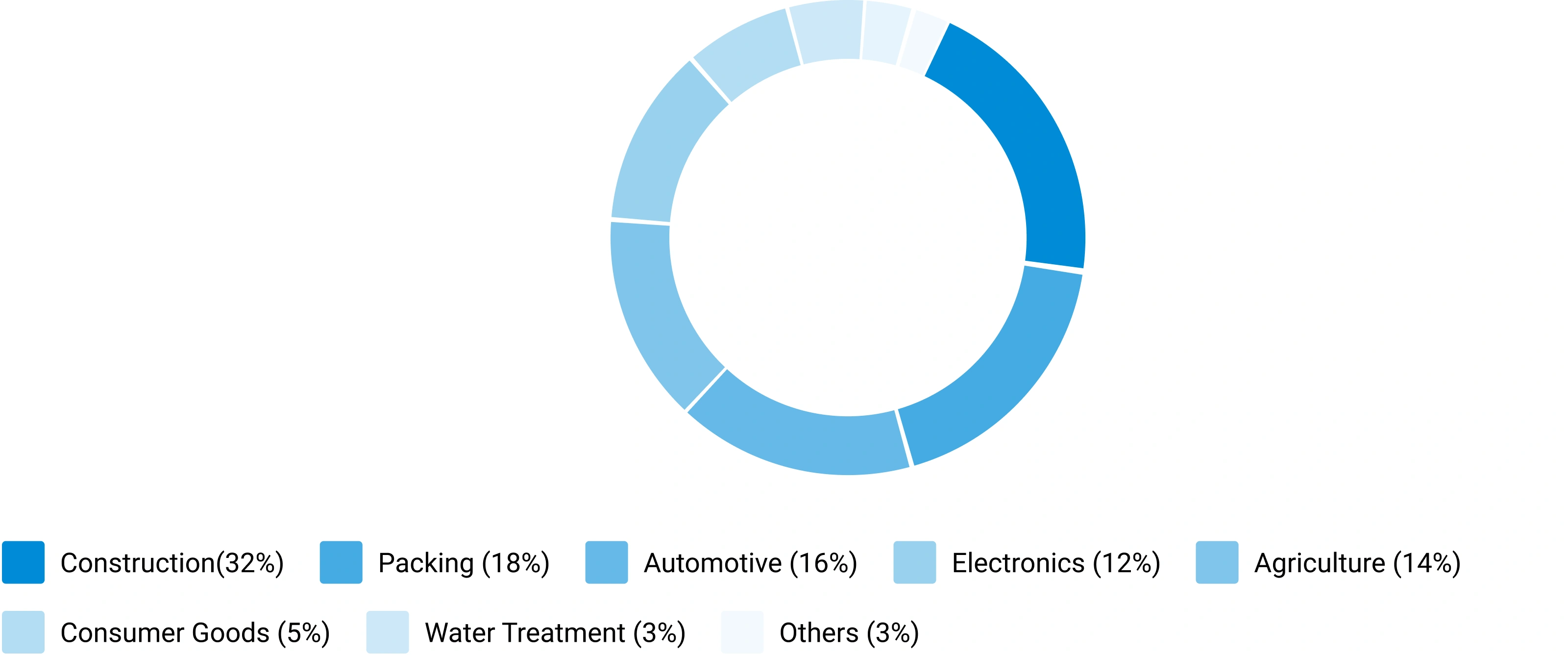
Demand-side analysis quantifies chemical consumption across industries, applications, and geographies — identifying where and how chemicals are consumed throughout the value chain with precision.
End-Use Industry Analysis
Chemical demand is evaluated across automotive, construction, packaging, electronics, agriculture, healthcare, consumer goods, industrial manufacturing, energy and utilities, and water treatment. Industry output, production trends, and consumption intensity are analyzed to determine demand patterns.
Consumption Modeling
Demand is estimated using measurable indicators: kilograms per vehicle, kilograms per square meter of construction, dosage per cubic meter of water treated, kilograms per hectare of agricultural land, and kilograms per ton of manufactured products. Consumption factors are validated through industry publications and primary interviews.
Application Analysis
The market is segmented by application area to understand product performance requirements, formulation trends, technology adoption, customer preferences, and regulatory requirements improving demand accuracy and segmentation granularity.
Demand-Side Assessment — End-Use Industry Demand Distribution
Illustrative distribution of chemical & materials demand across key end-use industries
Phase 4 - Trade Flow Analysis: Balancing Regional Supply and Demand
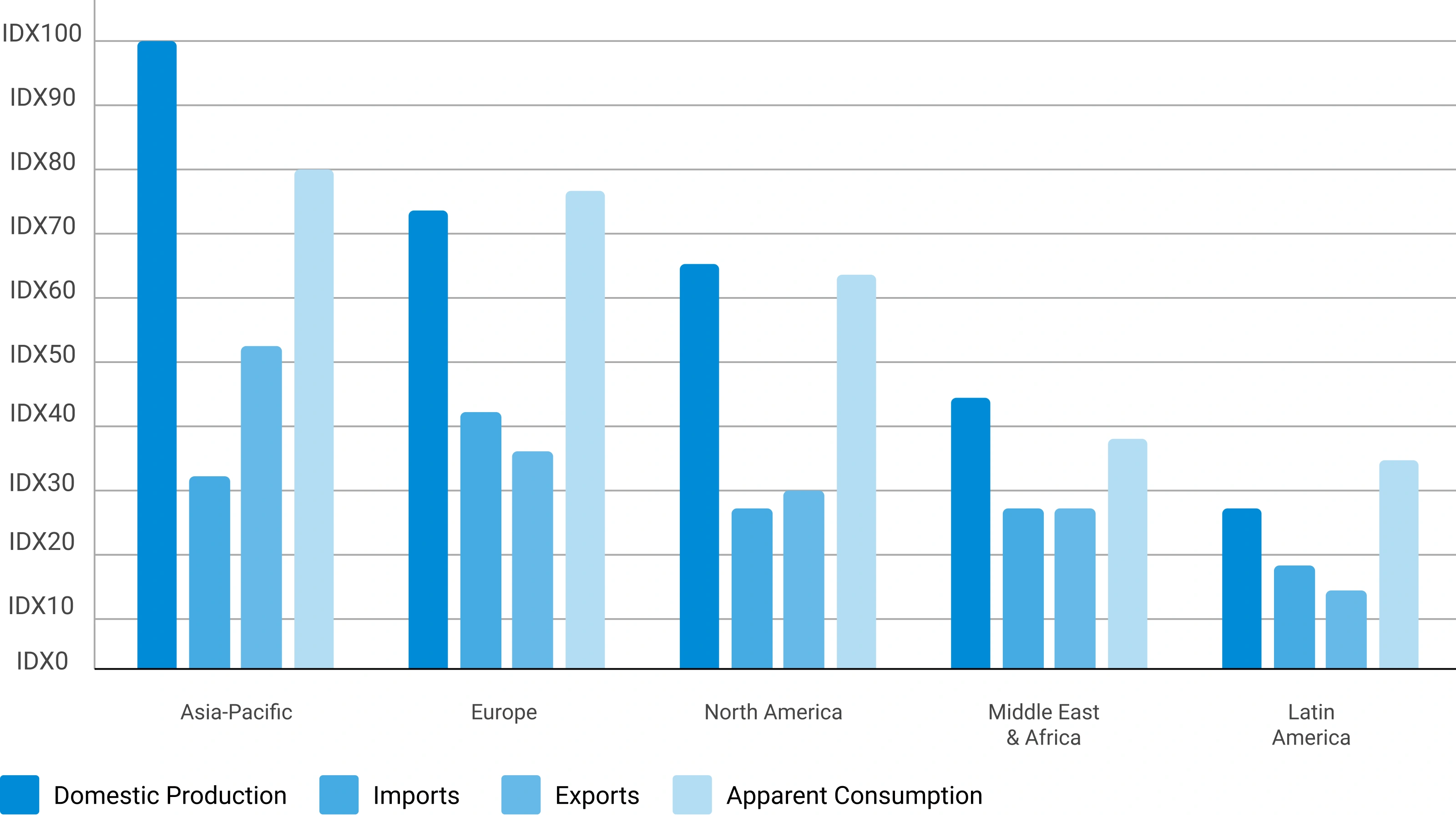
Trade flow analysis reconciles regional supply and demand estimates through import and export data, identifying net supply positions, regional dependencies, and market imbalances. It serves as an independent validation layer that tests the consistency of supply-side and demand-side estimates.
Import Analysis
Import data is evaluated to determine volumes, source countries, product dependency, regional supply gaps, and pricing trends — identifying markets that rely heavily on external supply and where domestic production is insufficient to meet demand.
Export Analysis
Export assessments reveal production surplus, export competitiveness, regional manufacturing strength, and global market participation. Export patterns also help validate domestic production estimates and identify net exporting regions.
Apparent Consumption Model
Regional consumption is assessed using the standard apparent consumption formula:
Results identify net importing regions, net exporting regions, regional deficits, and surpluses — serving as an independent validation of supply and demand estimates.
Trade Flow Analysis — Net Supply Position by Region
Illustrative apparent consumption vs. domestic production across major regions — positive gap indicates net import dependency
Phase 5 — Primary Research: The Critical Validation Layer
Primary research tests and refines findings from secondary research through direct engagement with industry participants across the supply chain, demand side, and expert community. It captures intelligence that no database or published report can provide — the real-world experience of manufacturers, buyers, and specialists operating in the market.

Supply-Side Interviews
Conversations with chemical manufacturers, raw material suppliers, contract manufacturers, technology providers, and plant operators cover production trends, capacity utilization, pricing developments, technology shifts, and competitive dynamics.

Demand-Side Interviews
Engagement with OEMs, industrial consumers, procurement managers, distributors, formulators, and end-use manufacturers focuses on consumption trends, purchasing behavior, product substitution, demand outlook, and emerging applications.

Industry Expert Consultations
Additional interviews with industry consultants, independent experts, regulatory specialists, technical professionals, and research institutions provide deeper market context and validate key analytical assumptions.
Focus Areas of Primary Research:
Market Size & Forecast Validation
Revenue estimates, volume consumption, growth rates, forecast assumptions, regional demand.Supply Chain & Value Chain Assessment
Raw material sourcing, supply chain challenges, distribution networks, procurement practices.Production & Capacity Analysis
Manufacturing capacity, utilization rates, expansion projects, plant investments.Pricing & Cost Structure Analysis
Product pricing trends, feedstock costs, energy costs, margin pressures, pricing outlook.Competitive Landscape Assessment
Volume and value estimates confirmed to be fully consistent with one another before publicationInterview Volume by Market Scope
| Study Scope | Number of Interviews |
|---|---|
| Niche Market | 20 – 30 |
| Mid-Sized Market | 30 – 50 |
| Global Market | 50 – 80 |
| Highly Fragmented Market | 80 – 120 |
Interview Details:
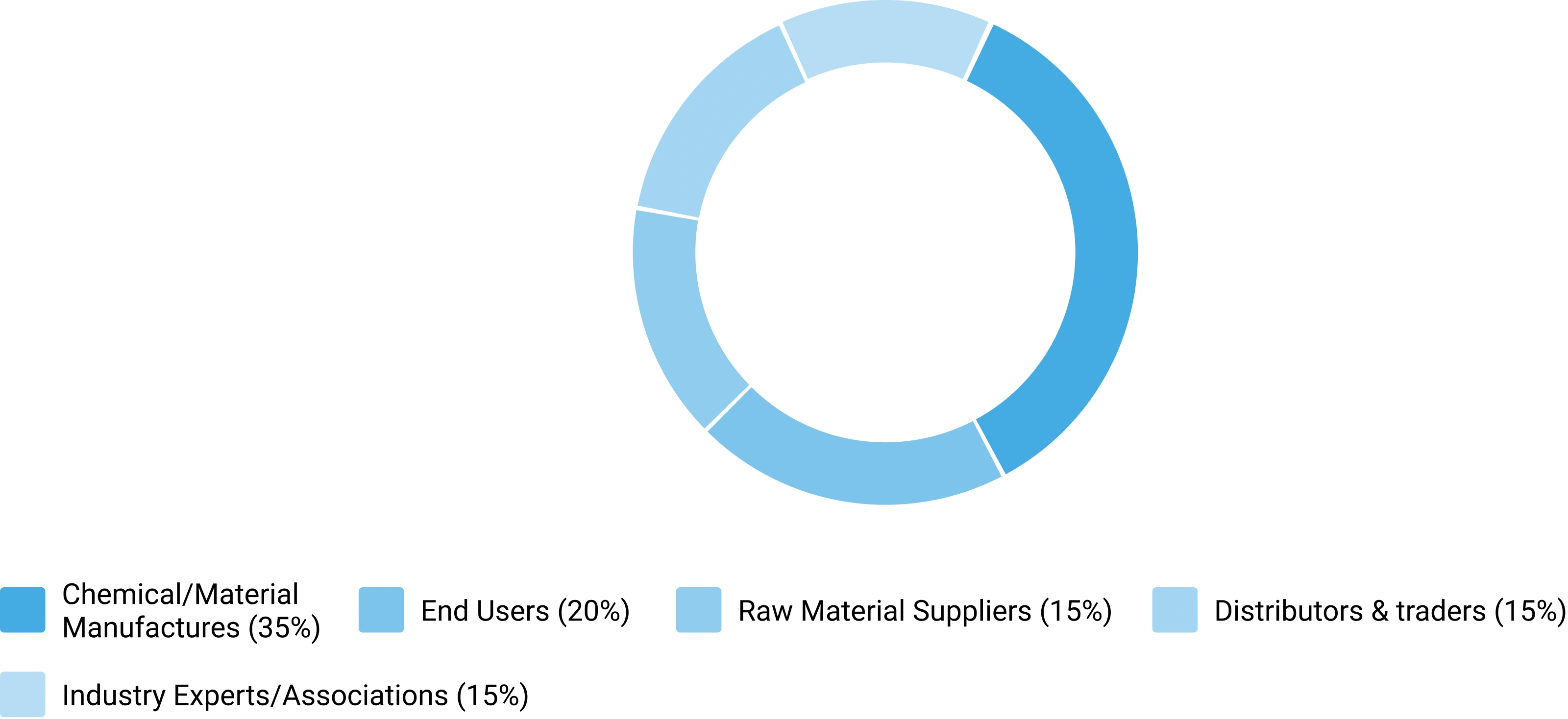
Category : Manufacturers, Suppliers, Distributors, End Users, Experts/Associations
Average Duration : 30–60 Minutes
Interview Mode : Video calls, telephonic interviews, expert consultations
Interview Format : Structured / Semi-Structured questionnaire
Focus Areas of Primary Research:
Market Size & Forecast Validation :
Revenue estimates, volume consumption, growth rates, forecast assumptions, regional demand.
Supply Chain & Value Chain Assessment :
Raw material sourcing, supply chain challenges, distribution networks, procurement practices.
Production & Capacity Analysis :
Manufacturing capacity, utilization rates, expansion projects, plant investments.
Pricing & Cost Structure Analysis :
Product pricing trends, feedstock costs, energy costs, margin pressures, pricing outlook.
Competitive Landscape Assessment :
Market share, competitor positioning, strategic initiatives, partnerships, acquisitions.
Primary Research — Stakeholder Coverage by Category
Distribution of interview respondents across stakeholder categories (% share from PPT data)
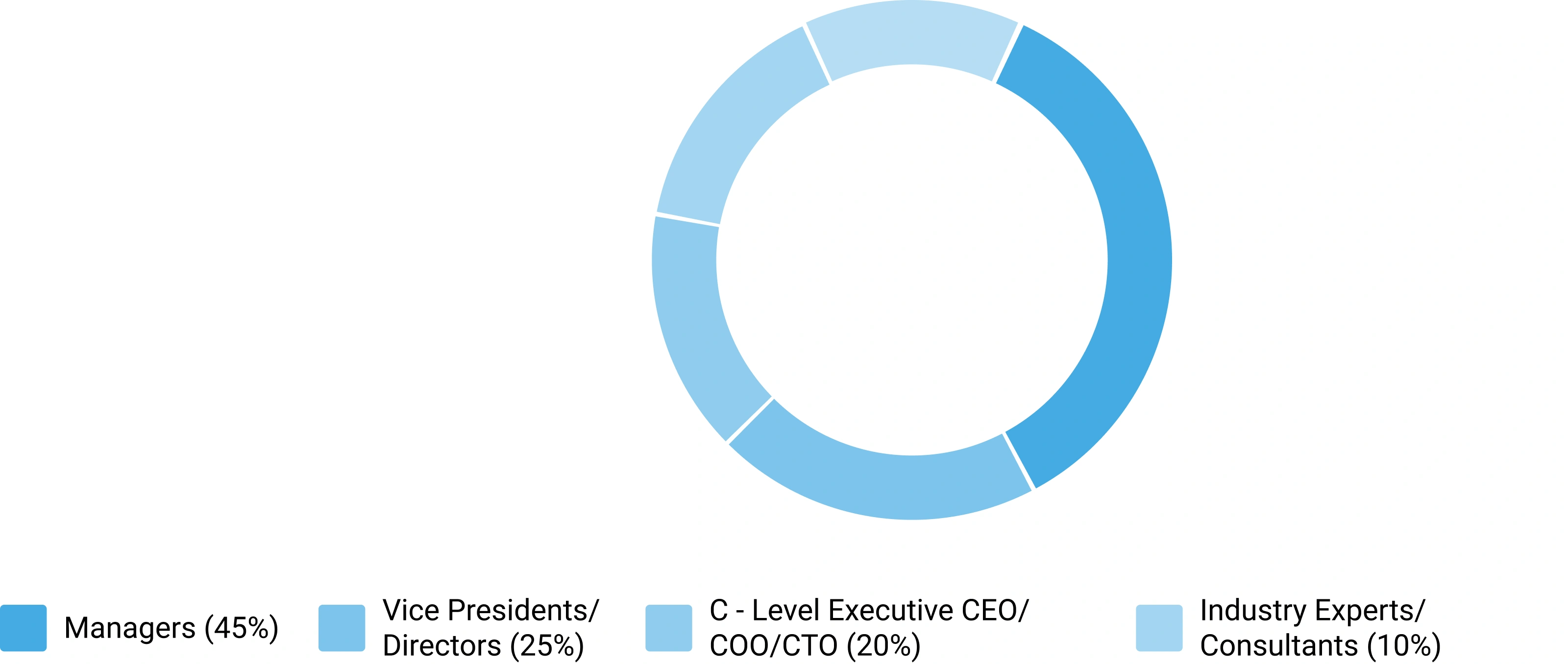
Primary Research — Respondent Designation Profile
Seniority breakdown of interview respondents (% share from PPT data)
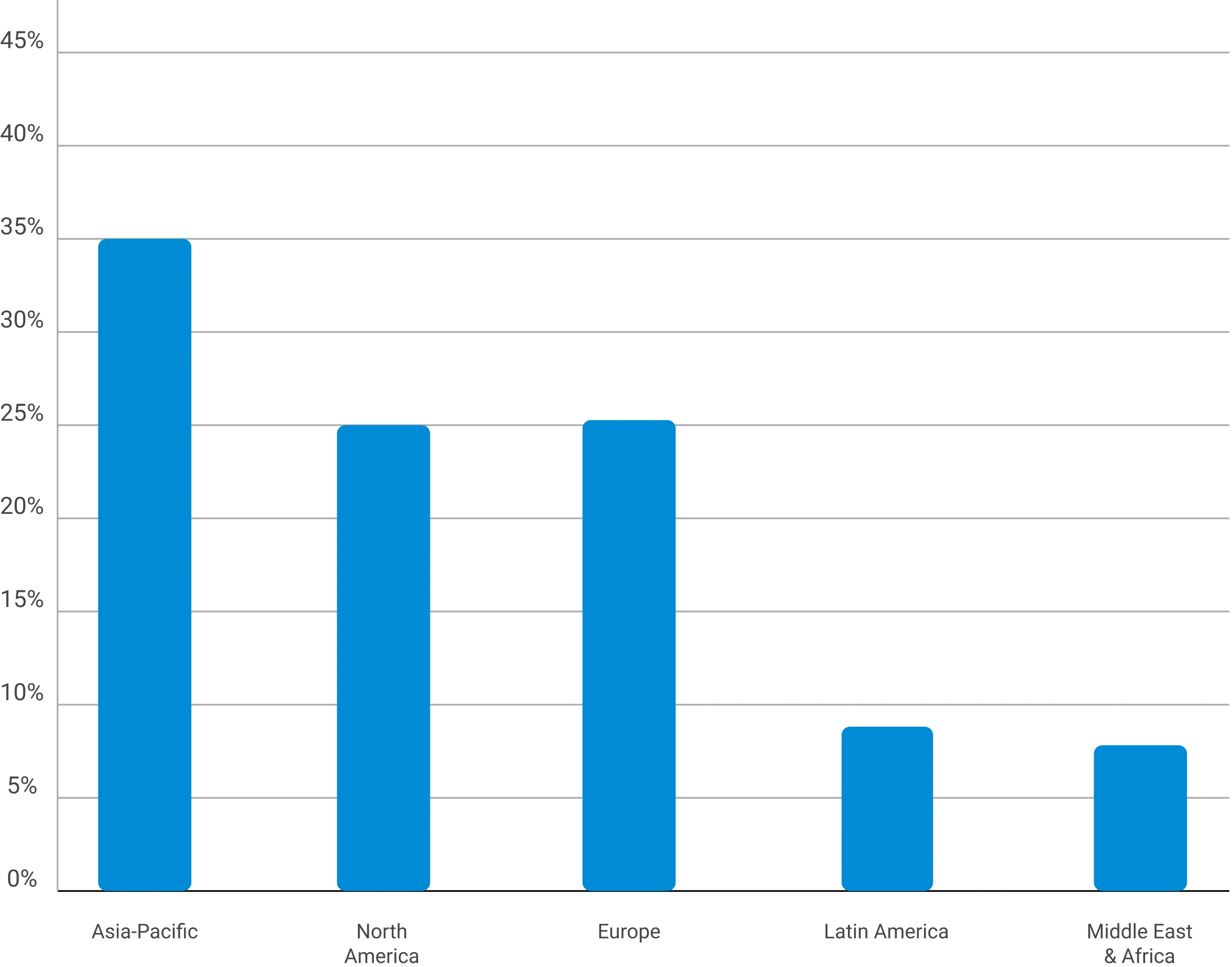
Primary Research — Geographic Coverage of Interviews
Regional distribution of primary research engagement (% share from PPT data)
Phase 6 — Data Triangulation and Market Validation
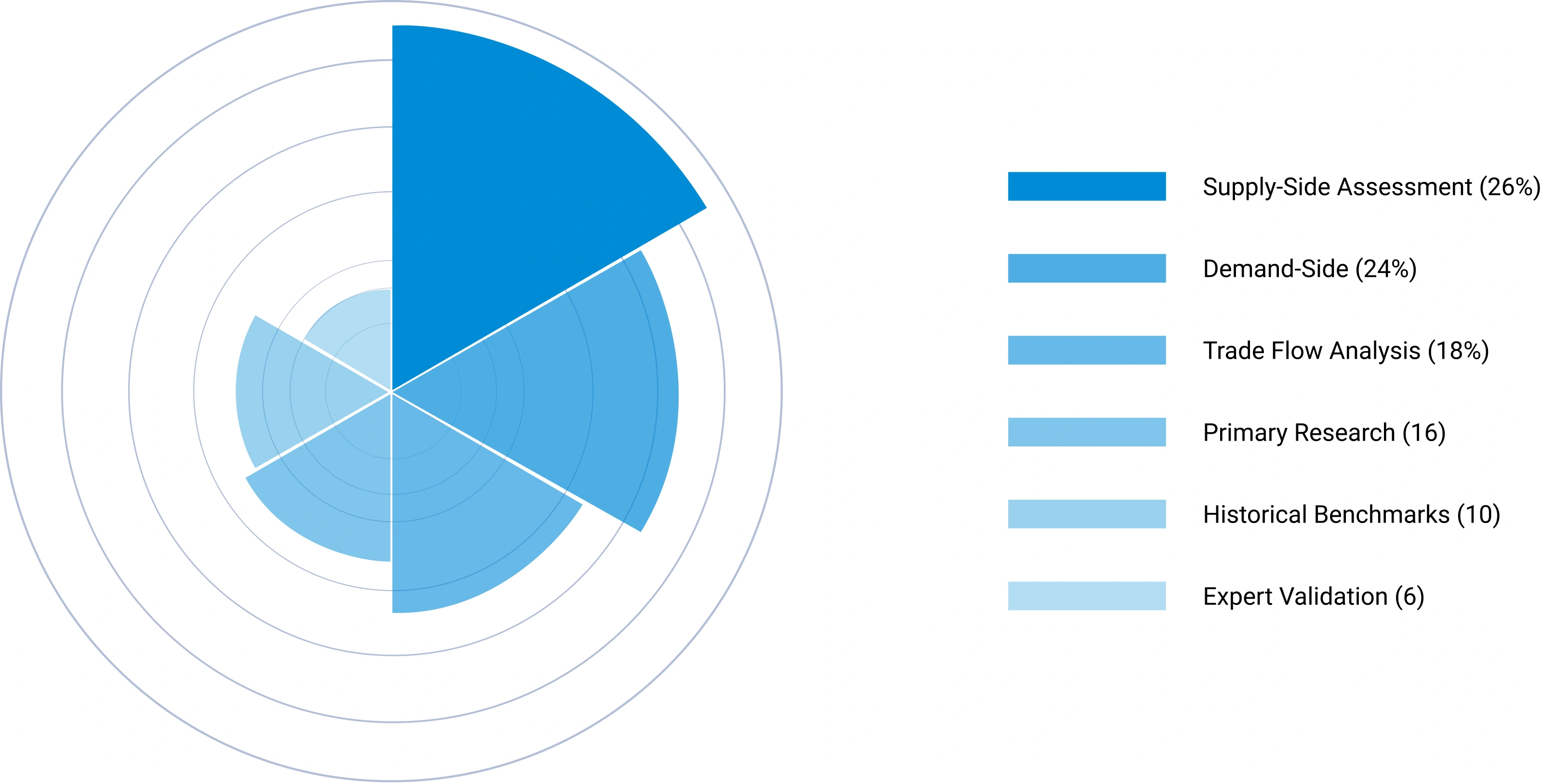
No single methodology is relied upon in isolation. Multiple independent estimation approaches are combined and reconciled to ensure consistency, accuracy, and analytical defensibility. Any material deviations between approaches are investigated and adjusted through additional validation cycles.
The final market size is derived through weighted triangulation of all validated methodologies. Any material deviations between approaches are investigated and adjusted through additional validation cycles. The outcome represents the most realistic assessment of the market based on available evidence and expert confirmation ensuring that volume and value estimates are fully consistent with one another.
Triangulation Framework — Input Contribution Weight
Relative weight each sizing input contributes to the final reconciled market estimate
Phase 7 — Forecast Modeling: Projecting Future Market Evolution
Forecasting evaluates the future trajectory of the market using a combination of quantitative indicators and qualitative assessments across economic, industry, and regulatory dimensions. Rather than simple extrapolation, each driver is independently modeled and integrated into a composite forecast.
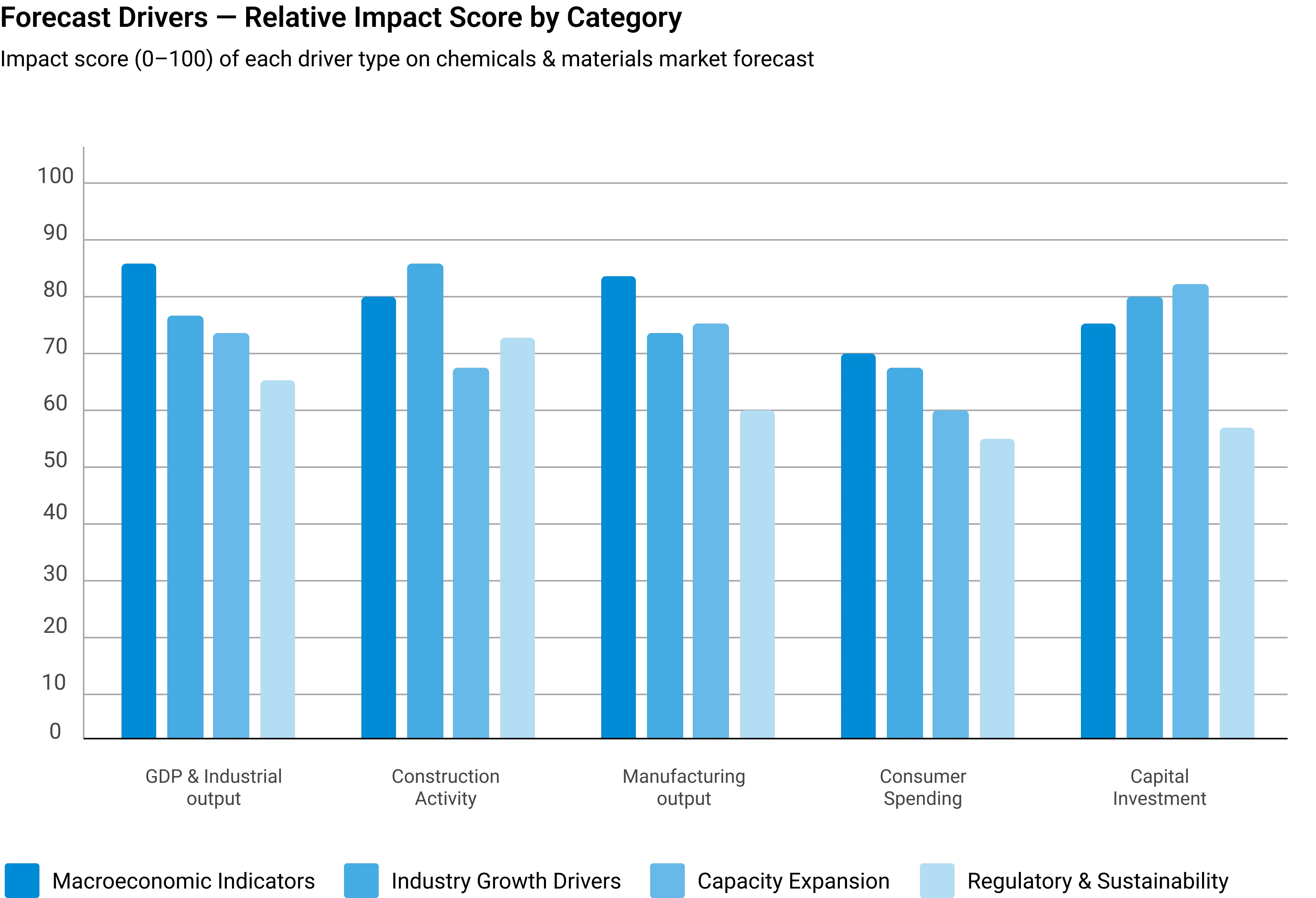
Macroeconomic Indicators
GDP growth, industrial production, manufacturing output, construction activity, consumer spending, and capital investment form the quantitative foundation of long-term demand projections. These are applied at country, regional, and global levels.
Industry Growth Drivers
Urbanization, infrastructure development, industrialization, technological innovation, sustainability initiatives, and evolving product performance requirements are assessed at regional and industry levels — capturing both structural and cyclical demand drivers.
Capacity Expansion Analysis
Announced plant expansions, new manufacturing facilities, technology upgrades, and strategic investments are evaluated to determine future supply-demand dynamics and potential market tightness or oversupply situations.
Regulatory & Sustainability
Environmental regulations, chemical safety standards, emission reduction targets, circular economy initiatives, and sustainability requirements are incorporated as they often influence product adoption rates and market growth trajectories.
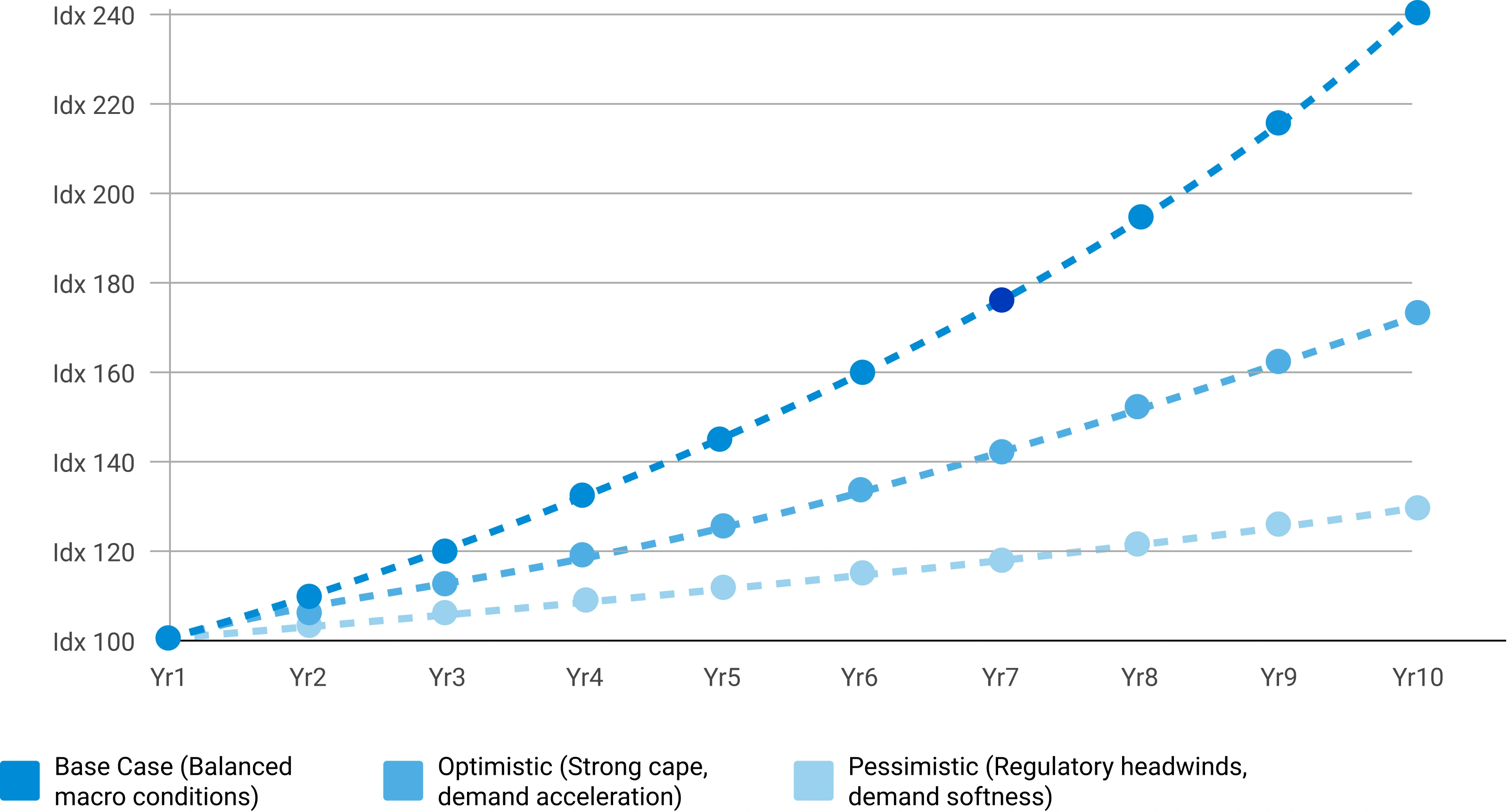
Scenario Forecast Range — Indexed Market Growth (Year 1–10)
Illustrative indexed growth trajectories across Base, Optimistic, and Pessimistic scenarios over a 10-year forecast horizon
Forecast Drivers — Relative Impact Score by Category
Impact score (0–100) of each driver type on chemicals & materials market forecast



Comments
Share your thoughts, ask a question, or provide feedback about this report.