
AI in Steel Market Size, Share, Trends and Forecast 2026 to 2035
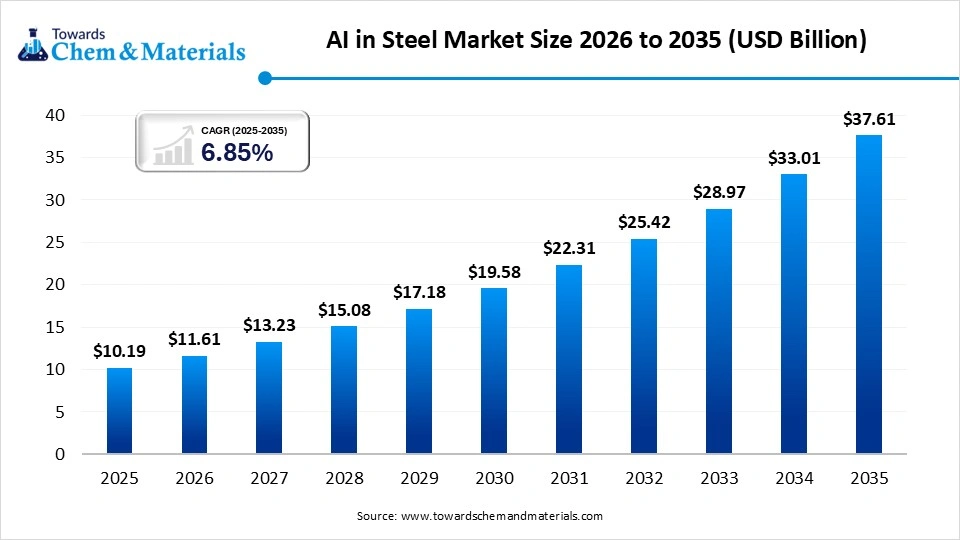
The global AI in steel market size was valued at USD 10.19 billion in 2025, is estimated to reach USD 11.61 billion in 2026, and is projected to reach USD 37.61 billion by 2035, expanding at a CAGR of 13.95% from 2026 to 2035.Asia Pacific dominated the AI in steel market with the largest revenue share of 45% in 2025 and is expected to grow at the fastest CAGR of 15.74% during the forecast period. Steel producers are expanding from conventional automation toward AI-enabled systems that support predictive maintenance, process optimization, quality inspection, energy management, and automated decision-making.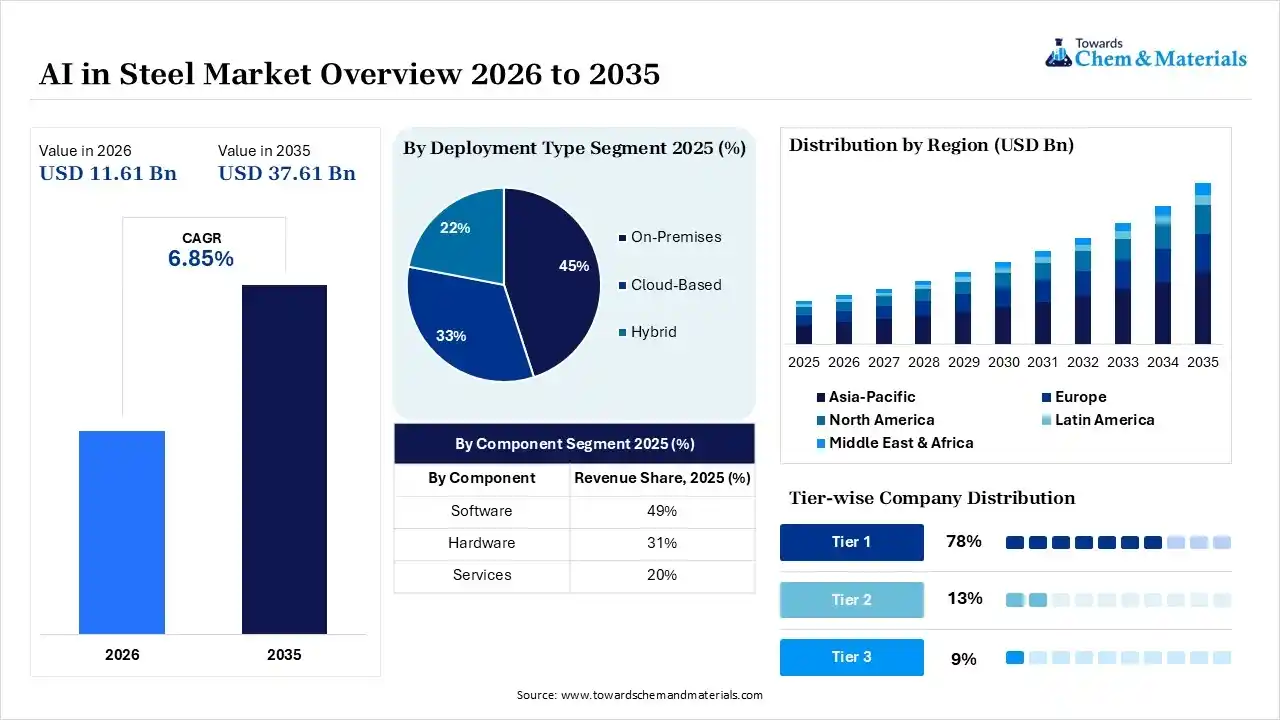
Market Highlights
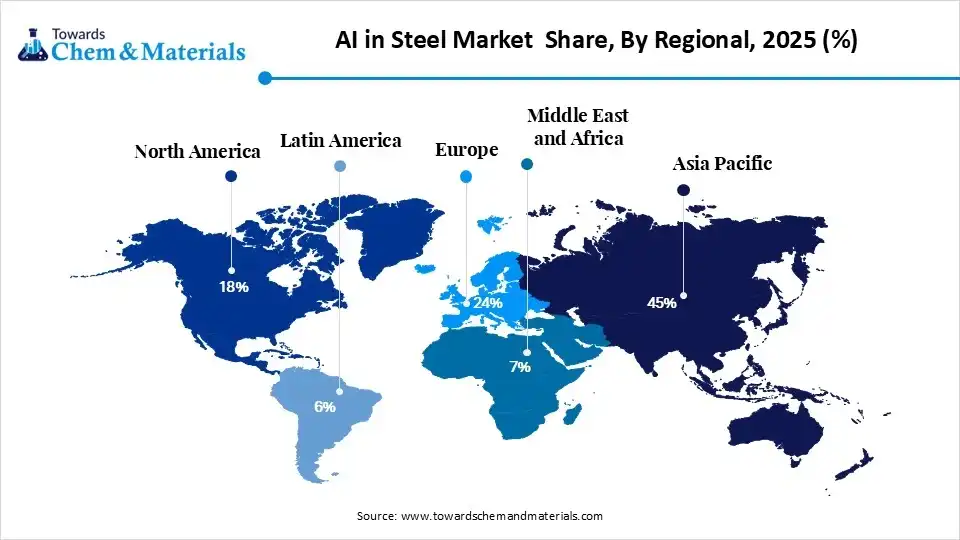
- By region, Asia Pacific dominated the market with a share of 45% in 2025, due to the region having the world's largest steel production capacity and a strong manufacturing base.
- By region, the Middle East and Africa are notably growing with 7.0% market share in 2025 and are expected to be the fastest-growing region in the market, with a CAGR of 31.80% in the forecast period, owing to many countries investing in new industrial facilities and smart manufacturing projects.
- By component, the software segment dominated the market with 49% share in 2025, akin to software acting as the core system that collects, analyzes, and processes production data.
- By component, the services segment held the 20.0% market share in 2025 and is expected to be the fastest-growing in the market, with a CAGR of 31.20% in the forecast period, owing to more steel manufacturers seeking expert support for AI implementation and management.
- By deployment type, the on-premises segment dominated the market with 45% share in 2025, as these steel manufacturers often handle large amounts of sensitive operational and production data.
- By deployment type, the hybrid segment held the 22.0% market share in 2025 and is expected to be the fastest-growing in the market, with a CAGR of 33.10% in the forecast period, owing to its combination of the benefits of both on-premises and cloud-based systems.
- By technology, the machine learning (ML) segment dominated the market with 28% share in 2025, as it is highly used for analyzing production data & identifying patterns that increase operational performance.
- By technology, the generative AI segment held the 12% market share in 2025 and is expected to be the fastest-growing segment in the market, with a CAGR of 35.60% in the forecast period, due to it can help steel manufacturers create faster insights, automate reporting, and support production planning.
- By application, the predictive maintenance segment dominated the market with 24.0% share in 2025, owing to the preventing equipment failures is a major priority for steel manufacturers.
- By application, the energy optimization & sustainability management segment held the 12% market share in 2025 and is expected to be the fastest-growing segment in the market, with a CAGR of 34.20% in the forecast period, due to reducing energy costs and carbon emissions has become a major focus for steel manufacturers.
Quick Stats at a Glance
- Market in Size 2025: USD 10.19 Billion
- Market Estimated Size in 2026: USD 11.61 Billion
- Market Projected Size by 2035: USD 37.61 Billion
- Market CAGR (2026–2035): 6.85%
- Asia Pacific: largest Regional Market Revenue Share of 45% in 2025|USD 4.59 Billion
- Middle East and Africa: Fastest-growing Regional Market Revenue Share of 7% in 2025|USD 0.71 Billion
- By country: The China held the largest Market share of 51% in 2025
 Global shift towards automation and faster production needs has presented new business opportunities for the steel manufacturers these days. Moreover, the manufacturers are observed in heavy implementation of robotics, technologies which has data analytics, and compute visions while following the aim of minimum effort and cost with greater production as per the recent survey. Furthermore, by helping manufacturers to analyze large volumes of operational data and other heavy tasks, the AI is likely to become a major integral part of every production industry in the upcoming years.
- For instance, ArcelorMittal has developed its Sentinel AI platform for predictive maintenance, including applications designed to predict motor and hydraulic-actuator failures Also, the platform is called ArcelorMittal Sentinel Platform.(Source:oxmaint.com)
The growing focus on sustainability is also encouraging the adoption of AI in the steel industry. Steel producers are under pressure to reduce energy consumption, lower carbon emissions, and improve environmental performance. AI-powered systems help manufacturers optimize furnace operations, manage energy usage, and reduce material waste.
In recent years, advancements in industrial digitalization and smart factory development have further accelerated AI adoption across steel plants.Steel producers and technology providers are expanding AI deployments through software development, industrial partnerships, automation projects, and plant-level applications
Global Investment Flow for AI in Steel 2026
- Investment is moving from traditional machinery toward intelligent production systems in recent years. Steel companies are increasingly funding AI platforms that can improve production decisions, monitor operations, and reduce manual intervention across manufacturing facilities.
- AI applications that target energy consumption and process efficiency are being deployed in steelmaking as producers seek to reduce operating costs and emissions.
- Emerging steel-producing countries are accelerating AI-related investments new and expanding steel facilities can incorporate digital and AI systems during plant design and modernization projects.Also, the nations expanding their steel manufacturing capacity are incorporating AI technologies into new projects from the beginning, creating opportunities for faster and more efficient plant operations.
Market Trends
- The shift toward predictive maintenance can support earlier detection of equipment deterioration and help steel producers reduce unplanned downtime and maintenance disruption, AI-based condition monitoring is being applied to equipment-health prediction and maintenance planning
- The growing demand for AI-based quality control and inspection increases the return on investment for manufacturers in the current period. Moreover, the manufacturers have been observed in heavy adoption of technologically advanced cameras, vision systems, and sensors, which support this trend nowadays.
- The energy optimization through artificial intelligence is likely to turn into a higher margin opportunity for manufacturers in the coming years. Furthermore, manufacturers are increasingly using AI with better data analytics, where energy conservation and its optimal usage are the major steps.
Report Scope
| Report Attributes | Details |
| Market Size in 2026 | USD 11.61 Billion |
| Revenue Forecast in 2035 | USD 37.61 Billion |
| Growth Rate | CAGR 6.85% |
| Base Year of Estimation | 2025 |
| Forecast Period | 2025 - 2035 |
| High Impact Region | Asia Pacific |
| Segment Covered | By Component, By Deployment Type, By Technology, By Application, By Region |
| Key Companies Profiled | ArcelorMittal, Tata Steel, Baosteel, JSW Steel, voestalpine, Nippon Steel, SSAB, Gerdau |
From Automation to Intelligent Manufacturing
In recent years, steel plants have relied mainly on fixed automation and manual monitoring processes. Moreover, today, AI combines machine learning, industrial sensors, cloud computing, and real-time data analytics to make production systems more intelligent and adaptive. In the current period, steel manufacturers are increasingly implementing digital twins, AI-driven process optimization, and automated decision-making platforms.
AI in Steel Market Regulatory Landscape: Regulations
| Country Region | Regulatory Body | Key Regulations | Focus Areas |
| United States | Occupational Safety and Health Administration (OSHA) | NIST AI Risk Management Framework (AI RMF 1.0): Governs industrial AI deployment. Section 3 outlines the Core Functions (Govern, Map, Measure, Manage) to mitigate operational failures in physical machinery | Lifecycle Workplace Safety & Hazard Monitoring: Tracking real-time safety via computer vision. For example, U.S. Steel leverages camera-based AI models to audit and enforce personal protective equipment (PPE) compliance in active environments. |
| Europe | European AI Office |
EU AI Act (Regulation (EU) 2024/1689):Article 6 & Annex III (High-Risk AI Systems): Classifies AI used as safety components in the operation and management of critical industrial infrastructure (such as automated blast furnaces and heavy casting lines) as High-Risk. | Quality Inspection: Minimizing product defects using high-precision AI vision. For instance, Austria's voestalpine deploys AI to spot micro-cracks in steel sheets, drastically improving structural compliance. |
| China | Ministry of Industry and Information Technology (MIIT) | MIIT Joint Industrial Digital Transformation Guidelines (September 2025 Directive) | AI+ Steel" Initiative (Phase I, 2025–2026) |
AI in Steel Market Dynamics
Driver
Real Time Intelligence for Steel Success
The growing need for efficient and cost-effective steel production is elevating earning potential for the producers in the current period. Also, steel manufacturers are facing pressure to increase output while controlling operational costs. AI helps companies improve production planning, reduce machine downtime, minimize material waste, and maintain product quality. In the current period, many steel plants are adopting AI solutions to make faster and smarter decisions using real-time data. Furthermore, rising competition in the steel industry is encouraging companies to modernize their operations.
Restraint
Cost Pressure Slow Digital Transformation
The high initial investment required for implementation is anticipated to hamper the industry's potential flow in the coming years. Also, installing AI systems often requires advanced software, digital infrastructure, sensors, and employee training programs. Many small and medium-sized steel manufacturers may find these costs difficult to manage. Furthermore, integrating AI into existing production systems can take time and require technical expertise.
Opportunity
Greener Steel Through Smart AI
The increasing focus on sustainable manufacturing is likely to support stronger cash flows for manufacturing enterprises during the forecast period. Also, the steel companies are actively looking for ways to reduce energy consumption, lower carbon emissions, and improve resource efficiency. AI is expected to help monitor production processes and identify areas where energy and raw materials can be used more effectively. In recent years, environmental regulations have become stricter, encouraging manufacturers to adopt smarter technologies. Moreover, the customers are increasingly demanding environmentally responsible products.
Segmental Insights
Component Insights
Towards Chemicals & Materials estimates,The software segment dominated the market with 49% share in 2025, akin to software acts as the core system that collects, analyzes, and processes production data. Steel manufacturers use AI software to monitor operations, improve quality control, optimize production schedules, and support decision-making. In the current period, companies are investing heavily in AI platforms because software can be integrated across multiple production processes. Furthermore, software solutions are easier to upgrade as technology advances. Since every AI application depends on software to function effectively, demand has remained strong.
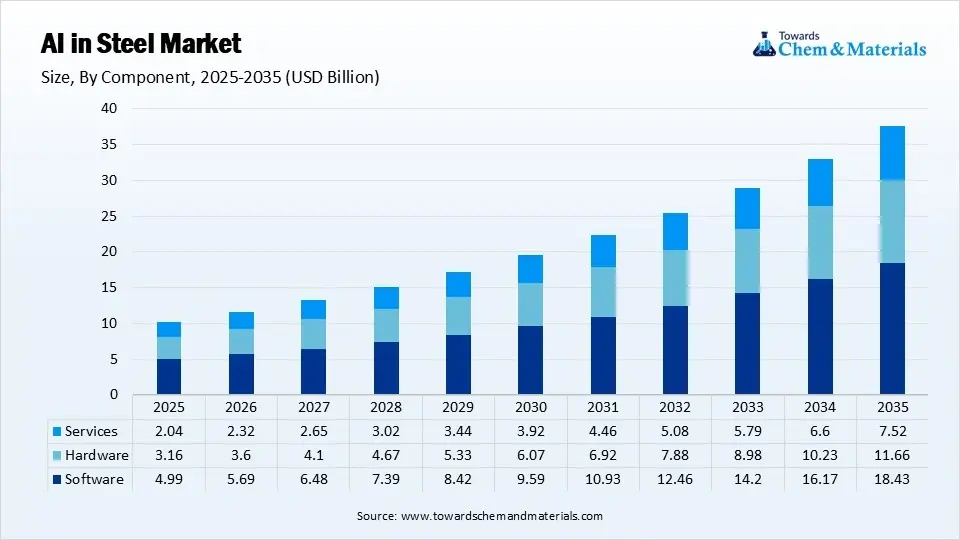 Towards Chemicals & Materials estimates, The services segment held the 20.0% market share in 2025 and is expected to be the fastest-growing in the market, with a CAGR of 31.20% in the forecast period, owing to more steel manufacturers seeking expert support for AI implementation and management. Many companies require assistance with installation, integration, maintenance, training, and system upgrades. As AI technologies become more advanced, businesses will increasingly depend on service providers to ensure smooth operations. Furthermore, continuous monitoring and optimization services help companies maximize the benefits of AI investments.
AI in Steel Market Share,By Component, 2025 (%)
| By Component | Revenue Share, 2025 (%) |
| Software | 49% |
| Hardware | 31% |
| Services | 20% |
Deployment Type Insights
Towards Chemicals & Materials estimates, The on-premises segment dominated the market with 45% share in 2025, as these steel manufacturers often handle large amounts of sensitive operational and production data. Keeping AI systems within company facilities provides greater control over data security and system performance. In the current period, many steel plants prefer on-premises deployment because it offers reliable operation even in locations with limited internet connectivity. The manufacturers can customize systems as per their specific production needs.
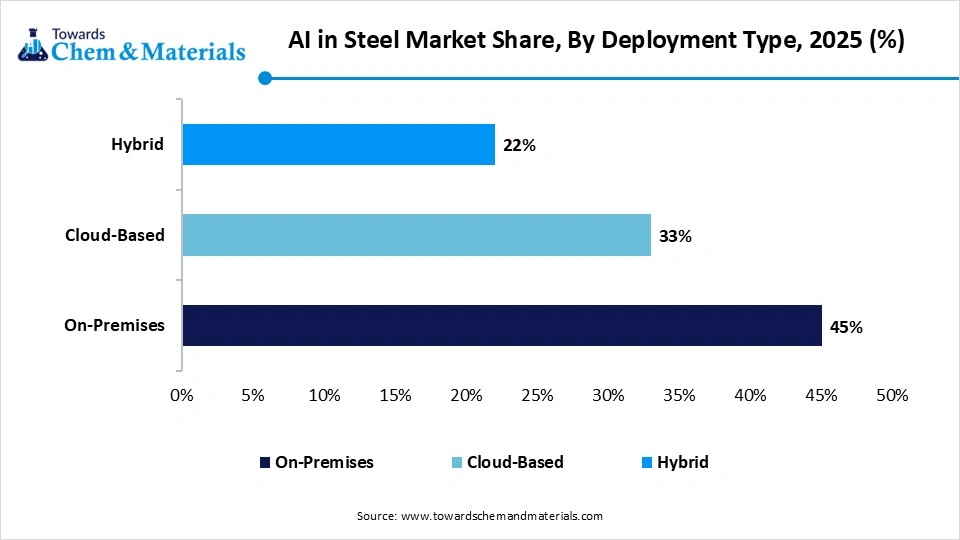
Towards Chemicals & Materials estimates, The hybrid segment held the 22.0% market share in 2025 and is expected to be the fastest-growing in the market, with a CAGR of 33.10% in the forecast period, owing to its combination of the benefits of both on-premises and cloud-based systems. Steel manufacturers can keep critical production data on-site while using cloud technologies for advanced analytics and remote monitoring. This approach offers superior scalability, flexibility, & cost efficiency. Furthermore, hybrid deployment allows companies to gradually adopt new AI technologies without completely replacing existing infrastructure. As digital transformation expands across the steel industry, businesses are increasingly looking for balanced solutions that offer security and operational flexibility.
AI in Steel Market Share,By Deployment Type, 2025 (%)
| By Deployment Type | Revenue Share, 2025 (%) |
| On-Premises | 45% |
| Cloud-Based | 33% |
| Hybrid | 22% |
Technology Insights
Towards Chemicals & Materials estimates, The machine learning (ML) segment dominated the market with 28% share in 2025, as it is widely used for analyzing production data and identifying patterns that improve operational performance. Moreover, the steel manufacturers use machine learning algorithms to predict equipment failures, optimize manufacturing processes, and improve product quality. In recent years, the availability of large industrial datasets has increased the effectiveness of machine learning applications. Furthermore, machine learning can continuously improve its performance as more data becomes available.
Towards Chemicals & Materials estimates, The generative AI segment held the 12% market share in 2025 and is expected to be the fastest-growing segment in the market, with a CAGR of 35.60% in the forecast period, due to it can help steel manufacturers create faster insights, automate reporting, and support production planning. Generative AI can analyze large amounts of information and provide recommendations in a simple and understandable format. Furthermore, it can assist engineers and plant managers by improving decision-making and reducing manual work. As companies seek higher productivity and smarter operations, demand for generative AI solutions is expected to rise significantly.
AI in Steel Market Share,By Technology, 2025 (%)
| By Technology | Revenue Share, 2025 (%) |
| Machine Learning (ML) | 28% |
| Computer Vision | 22% |
| Natural Language Processing (NLP) | 8% |
| Generative AI | 12% |
| Predictive Analytics | 18% |
| Robotics & Autonomous Systems | 9% |
| Others | 3% |
Application Insights
Towards Chemicals & Materials estimates, The predictive maintenance segment dominated the market with 24.0% share in 2025, owing to the preventing equipment failures is a major priority for steel manufacturers. AI-powered predictive maintenance systems monitor machine conditions and identify potential problems before breakdowns occur. This helps companies reduce costly downtime, improve equipment performance, and extend machine lifespan. In the current period, many steel plants are investing in predictive maintenance because it delivers clear financial and operational benefits.
Towards Chemicals & Materials estimates, The energy optimization & sustainability management segment held the 12% market share in 2025 and is expected to be the fastest-growing segment in the market, with a CAGR of 34.20% in the forecast period, due to reducing energy costs and carbon emissions has become a major focus for steel manufacturers. AI helps companies monitor energy consumption, identify inefficiencies, and optimize production processes. Furthermore, governments and environmental organizations are encouraging industries to adopt cleaner manufacturing practices. Steel producers are increasingly investing in technologies that support sustainability goals while maintaining profitability.
AI in Steel Market Share, By Application, 2025 (%)
| By Application | Revenue Share, 2025 (%) |
| Predictive Maintenance | 24% |
| Process Optimization & Production Control | 22% |
| Quality Inspection & Defect Detection | 18% |
| Energy Optimization & Sustainability Management | 12% |
| Supply Chain & Demand Forecasting | 9% |
| Safety Monitoring & Workforce Analytics | 7% |
| Autonomous Operations & Robotics | 5% |
| Others | 3% |
Regional Analysis
How will Asia Pacific Dominate AI in Steel Market in 2025?
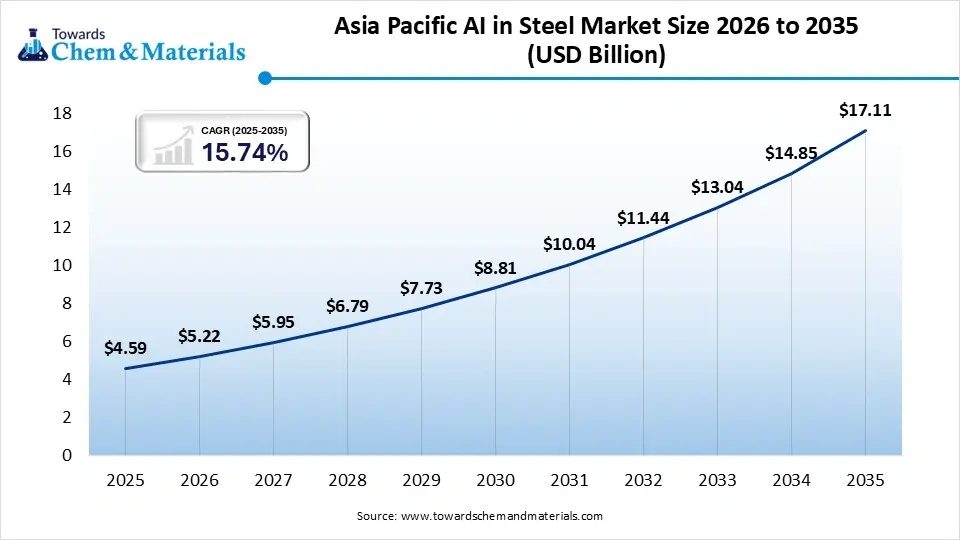
The Asia Pacific AI in steel market size was estimated at USD 4.59 billion in 2025 and is projected to reach USD 17.11 billion by 2035, growing at a CAGR of 15.74% from 2026 to 2035.Asia Pacific dominated the market with a share of 45% in 2025, due to the region having the world's largest steel production capacity and a strong manufacturing base. Countries across the region are investing in factory automation, digital technologies, and smart manufacturing systems to improve efficiency and product quality. In the current period, steel producers are increasingly adopting AI to reduce costs, optimize production, and strengthen global competitiveness. Furthermore, rising industrialization, infrastructure development, and government support for digital transformation are accelerating AI adoption.
 China
China
- The steel companies in China are implementing intelligent manufacturing systems that use AI for production monitoring, quality improvement, and operational optimization.
- The manufacturers in China have focused on improving efficiency while reducing environmental impact.
Japan
- The steel producers in Japan are utilizing AI for automated inspections, process control, and real-time production adjustments while they are supporting high-value steel products that require strict quality standards
- Labor shortages are encouraging manufacturers to increase automation and reduce dependence on manual processes in Japan.
Middle East and Africa AI in Steel Market Size and Growth
The Middle East and Africa AI in steel market size was estimated at USD 0.71 billion in 2025 and is projected to reach USD 2.82 billion by 2035, growing at a CAGR of 7.57% from 2026 to 2035.The Middle East and Africa are notably growing with 7.0% market share in 2025 and are expected to be the fastest-growing region in the market, with a CAGR of 31.80% in the forecast period, owing to many countries investing in new industrial facilities and smart manufacturing projects. Governments are actively supporting economic diversification and industrial development beyond traditional sectors. Furthermore, new steel plants are being designed with advanced digital technologies from the beginning, creating favorable conditions for AI adoption. Rising infrastructure investments and industrial expansion are increasing the demand for efficient steel production.
Saudi Arabia
- The country is investing in modern industrial infrastructure and encouraging the adoption of digital technologies across manufacturing industries, while Steel producers are exploring AI solutions to improve operational efficiency.
- The developments are positioning Saudi Arabia as an important future market for AI applications in steel manufacturing.
UAE
- UAE is promoting smart industry development through strong investments in digital transformation and advanced technologies, as many industrial facilities are adopting data-driven systems to improve productivity.
- The manufacturers in the UAE have increasingly explored AI solutions that support automation, predictive analytics, and resource management in recent years.
Europe AI in Steel Industry Conditions
The Europe AI in steel market size was estimated at USD 2.45 billion in 2025 and is projected to reach USD 9.21 billion by 2035, growing at a CAGR of 14.16% from 2026 to 2035.Europe held the 24.00% market share in 2025, owing to manufacturers' focus on sustainability, energy efficiency, and advanced industrial technologies. Steel producers across the region are investing in AI solutions that improve production performance while helping achieve environmental goals. Furthermore, Environmental and energy-efficiency requirements can increase the value of digital monitoring, optimization, and emissions-management systems in steel production. In the current period, companies are increasingly implementing AI to optimize operations, reduce waste, and improve resource utilization.
Germany
- The manufacturers are focusing on intelligent production systems that enhance product quality and reduce energy consumption, while strong engineering expertise supports the development and adoption of advanced industrial technologies.
- The advantage of advanced technology is helping steel producers remain competitive while accelerating the transition toward smarter and more sustainable production operations in the current period.
Italy
- The country is focusing on improving manufacturing efficiency and competitiveness through increased digitalization of industrial operations, and producers are adopting AI technologies to optimize production processes.
- The companies have shown growing interest in smart manufacturing solutions that help reduce operational costs and improve flexibility.
North America AI in the Steel Sector Observation
The North America AI in steel market size was estimated at USD 1.83 billion in 2025 and is projected to reach USD 6.96 billion by 2035, growing at a CAGR of 14.29% from 2026 to 2035.North America held the 18% market share in 2025, akin to the region has strong technology capabilities, advanced industrial infrastructure, and high investment in digital transformation. Steel manufacturers are increasingly adopting AI to improve efficiency, reduce costs, and strengthen competitiveness. Furthermore, the presence of leading AI developers and industrial technology providers supports rapid innovation. Companies are also focusing on sustainability, energy optimization, and smart factory development.
 United States
- The country is actively expanding the use of AI in steel manufacturing through investments in smart factories, industrial automation, and data-driven operations.
- The collaboration between technology providers and industrial companies is accelerating innovation across the sector.
Canada
- There has been growing interest in technologies that help reduce environmental impact while maintaining productivity, while the strong focus on innovation and clean industrial development is encouraging the use of advanced digital solutions.
- AI is supporting improved decision-making, better equipment management, and greater production visibility according to regional manufacturers.
AI in Steel Market Survey in Latin America
The Latin America AI in steel market size was estimated at USD 0.61 billion in 2025 and is projected to reach USD 2.44 billion by 2035, growing at a CAGR of 14.87% from 2026 to 2035.Latin America held the 6.00% market share in 2025 due to manufacturers are increasingly modernizing production facilities and investment in digital technologies. Steel companies are seeking solutions that improve efficiency, reduce operational costs, and enhance product quality. Furthermore, industrial development and infrastructure projects are creating higher demand for steel products across the region. In the current period, growing awareness of smart manufacturing benefits is encouraging companies to adopt AI-powered systems.
Brazil
- The increasing demand from construction, automotive, and industrial sectors is encouraging manufacturers to improve production capabilities, while AI is helping companies gain better visibility into manufacturing operations.
The manufacturers are exploring AI technologies that help improve productivity, equipment performance, and quality control.
Argentina
- The companies continue investing in operational improvements and technology upgrades, and AI adoption is expected to expand steadily across Argentina's steel manufacturing industry.
- The modernization efforts within industrial sectors are creating opportunities for advanced technologies in Argentina nowadays.
Competitive Analysis
Steel producers are expanding AI applications across production efficiency, quality control, maintenance, energy management, and sustainability.
- Tata Steel announced in April 2026 that it had deployed more than 300 specialized AI agents across its global organization with Google Cloud, including applications supporting asset maintenance and customer response, reduce energy usage, and predict equipment failures before they occur. The company is also expanding AI-driven automation to make manufacturing faster and more efficient.
- ArcelorMittal uses AI for production scheduling, quality checks and predictive maintenance; its Sentinel platform was developed to predict motor and hydraulic-actuator failures.(Source:www.tatasteel.com),(Source:oxmaint.com)
Competitive Landscape Analysis
Competitive Landscape and Key Participants
| Rank | Company Name | Headquarters | Country | Why Relevant to This Market | Key Products / Material Portfolio |
|---|---|---|---|---|---|
| 1 | ArcelorMittal | Luxembourg City | Luxembourg | ArcelorMittal is the second-largest steel producer by 2025 crude-steel production, according to worldsteel | Flat steel, long steel, automotive steel, AI-enabled manufacturing systems |
| 2 | Tata Steel Limited | Mumbai, Maharashtra | India | Tata Steel has expanded AI deployment across its global operations and announced more than 300 specialized AI agents with Google Cloud in April 2026 | Carbon steel, specialty steel, AI-powered steel production platforms |
| 3 | POSCO Holdings Inc. | Pohang, North Gyeongsang | South Korea | POSCO has deployed smart-manufacturing and AI-enabled technologies across steelmaking operations | Hot rolled steel, electrical steel, automotive steel, smart mill solutions |
| 4 | Nippon Steel Corporation | Tokyo | Japan | Nippon Steel applies digital and AI technologies to areas including production, quality and process optimization | High-grade steel, automotive steel, electrical steel, advanced steel products |
| 5 | ABB Ltd. | Zurich | Switzerland | ABB provides industrial automation, electrification, digitalization and process-control technologies used across industrial operations | Industrial AI platforms, automation systems, digital twins, process control solutions |
Competitive Landscape and Key Participants
| Rank | Company Name | Headquarters | Country | Why Relevant to This Market | Key Products / Material Portfolio |
|---|---|---|---|---|---|
| 1 | JSW Steel Limited | Mumbai, Maharashtra | India | Actively investing in AI, digital transformation, predictive maintenance, and smart manufacturing initiatives | Flat steel, long steel, coated steel products |
| 2 | United States Steel Corporation | Pittsburgh, Pennsylvania | USA | Uses AI-driven analytics, procurement intelligence, production optimization, and operational automation | Flat-rolled steel, tubular products, electrical steel |
| 3 | voestalpine AG | Linz, Upper Austria | Austria | Strong adoption of AI-driven quality control and advanced manufacturing technologies | High-performance steel, rail systems, specialty steel |
| 4 | SMS Group GmbH | Düsseldorf, North Rhine-Westphalia | Germany | SMS group supplies automation, digitalization and process technologies for steelmaking and metal-production facilities. | Smart mill technologies, digital metallurgy platforms, automation software |
| 5 | Google Cloud | Mountain View, California | USA | The competitive landscape includes steel producers deploying AI and technology suppliers providing AI, cloud, automation, analytics, and industrial software; these groups are not directly comparable by market share | AI platforms, cloud AI infrastructure, industrial analytics |
Competitive Landscape and Key Participants
| Rank | Company Name | Headquarters | Country | Why Relevant to This Market | Key Products / Material Portfolio |
|---|---|---|---|---|---|
| 1 | Ripik.AI | New Delhi | India | Specialized industrial AI company focused on steel process optimization, computer vision, and manufacturing intelligence | Vision AI, predictive analytics, production optimization software |
| 2 | Tata Elxsi Limited | Bengaluru, Karnataka | India | Provides AI-driven automation and Industry 4.0 solutions for steel manufacturing facilities | Industrial AI, digital factory solutions, smart manufacturing platforms |
| 3 | Huawei Technologies Co., Ltd. | Shenzhen, Guangdong | China | Active participant in AI-enabled steel industry modernization and smart manufacturing initiatives | Industrial AI platforms, cloud infrastructure, smart manufacturing systems |
| 4 | KAI Software Solutions LLC (Kaispe) | Atlanta, Georgia | USA | Focused on AI-powered steel supply chain optimization, inventory management, and logistics intelligence | Supply chain AI, forecasting software, logistics optimization tools |
| 5 | AI Steel Solution Inc. | Wilmington, Delaware | USA | Emerging AI specialist focused exclusively on steel-sector forecasting, analytics, and optimization technologies | Steel forecasting algorithms, AI analytics, decision-support software |
Recent Development
- In April 2026, Tata Steel created a strategic collaboration with Google Cloud. Also, the main purpose of the partnership is to deploy advanced AI agents in their global chain as per the published report. Furthermore, Tata Steel reported that it had deployed more than 300 specialized AI agents across its global operations.(Source:tatasteel.com)
Top Vendors in the AI in Steel Market & Their Offerings
- ArcelorMittal applies AI to safety, quality, production scheduling and predictive maintenance.
- Tata Steel is expanding agentic AI across its global value chain.
- Baowu Group and its operating companies are investing in digital and intelligent-manufacturing capabilities. This advanced automation maximizes raw energy efficiency, minimizes carbon emissions, and ensures high-volume production accuracy.
Other Key Players
- JSW Steel
- voestalpine
- Nippon Steel
- SSAB
- Gerdau
Segments Covered in the Report
By Component
- Software
- AI Platforms
- Analytics Software
- Digital Twin Software
- Process Control Software
- Quality Management Software
- Hardware
- Industrial Sensors
- Edge AI Devices
- Smart Cameras
- Industrial Servers
- Robotics Hardware
- Services
- Consulting
- Integration & Deployment
- Training & Support
- Managed Services
By Deployment Type
- On-Premises
- Private Data Centers
- Plant-Level Deployments
- Cloud-Based
- Public Cloud
- Private Cloud
- Multi-Cloud
- Hybrid
- Edge-to-Cloud Integration
- Distributed AI Architecture
By Technology
- Machine Learning (ML)
- Supervised Learning
- Unsupervised Learning
- Reinforcement Learning
- Computer Vision
- Surface Inspection
- Defect Detection
- Video Analytics
- Natural Language Processing (NLP)
- Knowledge Management
- Document Intelligence
- Operational Assistance
- Generative AI
- Process Simulation
- Digital Assistants
- Engineering Design Support
- Predictive Analytics
- Equipment Health Prediction
- Demand Prediction
- Production Forecasting
- Robotics & Autonomous Systems
- Autonomous Material Handling
- Automated Inspection Robots
- Intelligent Process Robots
- Others
- Expert Systems
- Fuzzy Logic
- Cognitive Automation
By Application
- Predictive Maintenance
- Asset Monitoring
- Failure Prediction
- Maintenance Scheduling
- Process Optimization & Production Control
- Blast Furnace Optimization
- Rolling Mill Optimization
- Yield Improvement
- Quality Inspection & Defect Detection
- Surface Quality Inspection
- Product Consistency Monitoring
- Automated Defect Recognition
- Energy Optimization & Sustainability Management
- Energy Consumption Monitoring
- Carbon Emission Management
- Resource Optimization
- Supply Chain & Demand Forecasting
- Inventory Optimization
- Procurement Planning
- Demand Forecasting
- Safety Monitoring & Workforce Analytics
- Worker Safety Monitoring
- Compliance Analytics
- Workforce Productivity Analytics
- Autonomous Operations & Robotics
- Autonomous Vehicles
- Automated Material Movement
- Robotic Process Operations
- Others
- R&D Optimization
- Environmental Monitoring
By Region
- North America
- U.S.
- Canada
- Europe
- Germany
- UK
- France
- Italy
- Spain
- Sweden
- Denmark
- Norway
- Asia Pacific
- China
- Japan
- India
- South Korea
- Thailand
- Latin America
- Brazil
- Mexico
- Argentina
- Middle East and Africa (MEA)
- South Africa
- UAE
- Saudi Arabia
- Kuwait
A Seven-Phase Framework
Our methodology is designed to be universally applicable across commodity chemicals, specialty chemicals, petrochemicals, construction chemicals, coatings, electronic chemicals, industrial gases, agrochemicals, water treatment chemicals, and performance materials. Each phase builds upon the last, creating a layered validation structure that minimizes estimation error and maximizes analytical confidence.
The framework ensures comprehensive market coverage, robust cross-validation, and reliable long-term forecasting — producing market estimates that withstand scrutiny from investors, regulators, and corporate strategy teams.

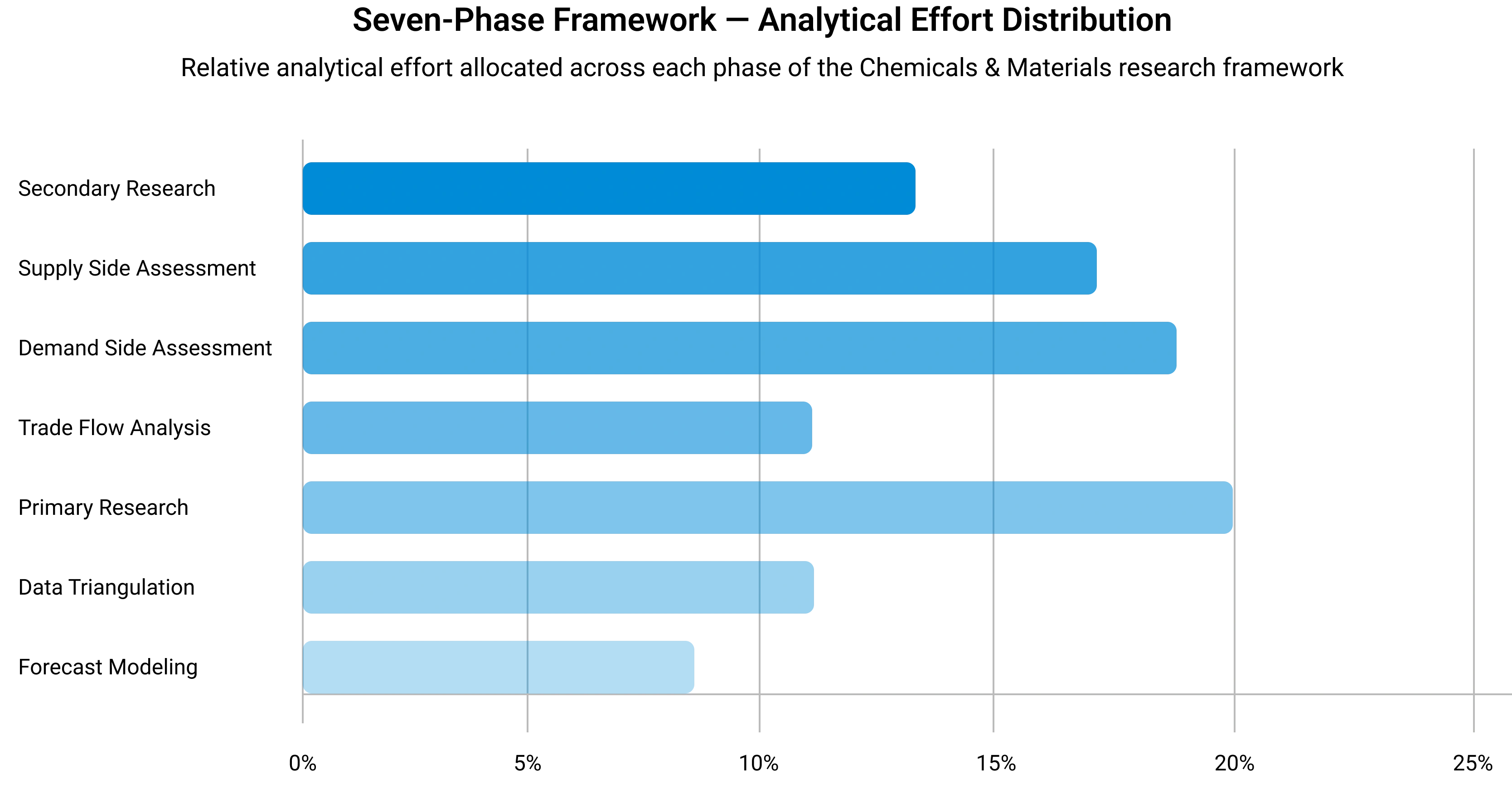
Seven-Phase Framework — Analytical Effort Distribution
Relative analytical effort allocated across each phase of the Chemicals & Materials research framework
Phase 1 - Secondary Research: Establishing the Foundation
Secondary research collects and evaluates publicly available information from authoritative sources, establishing the foundational understanding of market structure, value chain dynamics, competitive landscape, and end-use demand patterns. Every source is evaluated for credibility, recency, geographic relevance, and methodological soundness before inclusion.
Industry Associations
Sources include ACC, CEFIC, ICCA, JCIA, CPCIF, and SOCMA providing production volumes, consumption trends, capacity developments, and sustainability initiatives.
Company Disclosures
Annual reports, investor presentations, earnings transcripts, and regulatory filings reveal product portfolios, manufacturing footprints, capacity expansions, and revenue segmentation.
Government Databases
National statistical offices, customs authorities, environmental agencies, and industrial production databases provide verified statistics on output, trade flows, and regulatory compliance.
Trade Databases
UN Comtrade, ITC, Eurostat, and national customs authorities enable assessment of global product movement, import dependency, and export competitiveness across regions.
Our Secondary Research Sources
- Ministry of Chemicals and Fertilizers
- European Chemicals Agency
- United States Department of Energy
- Ministry of Industry and Information Technology
- Ministry of Economy Trade and Industry
- Ministry of Trade Industry and Energy
- National Institute of Standards and Technology
- Council of Scientific and Industrial Research
- Fraunhofer Society
- National Institute for Materials Science
Phase 2 — Supply-Side Assessment: Mapping Production Capabilities
Production Capacity Analysis
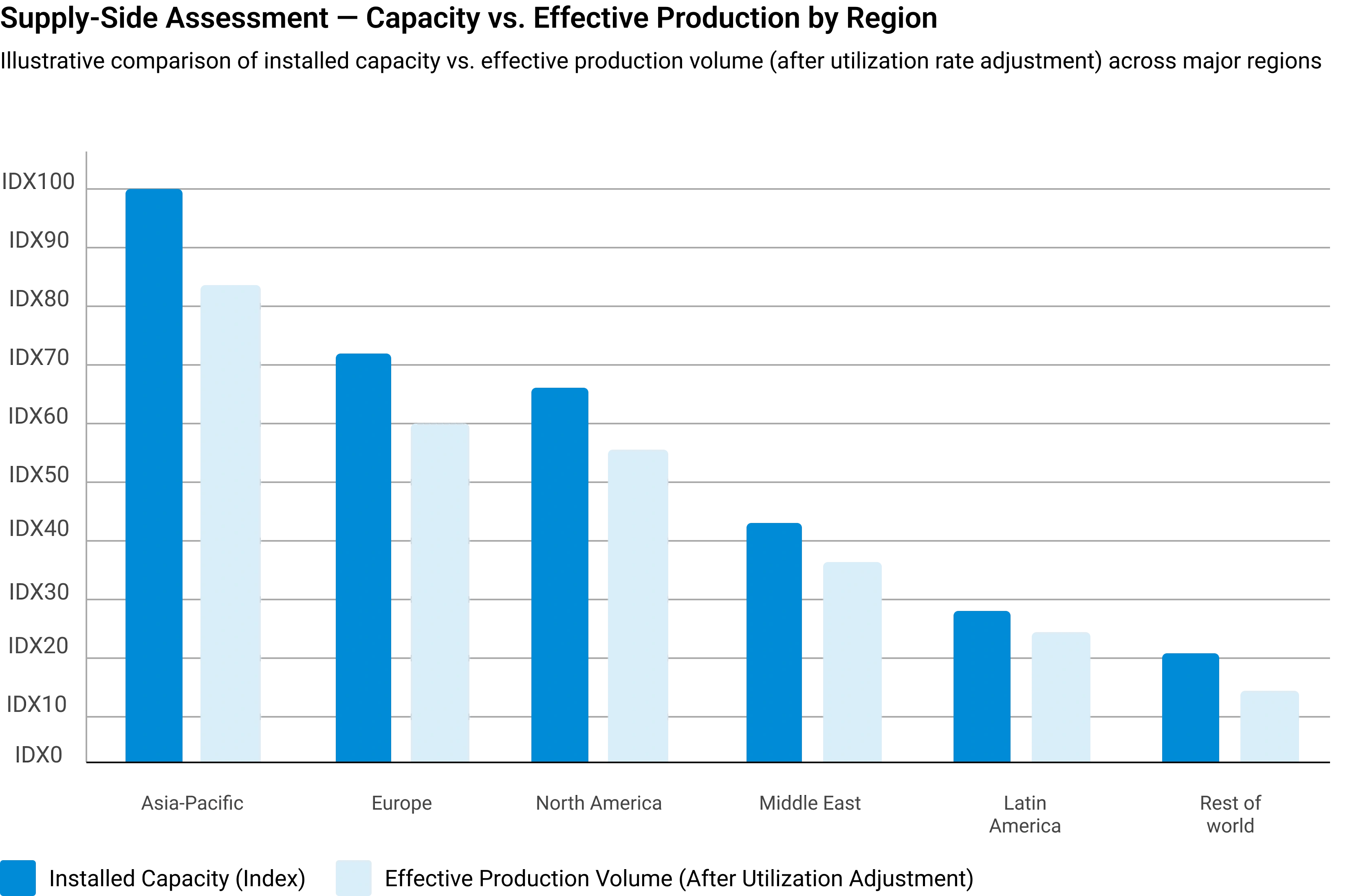
All major manufacturers are assessed for existing installed capacity, planned additions, expansions, new plant announcements, and technology adoption — mapped at global, regional, and country levels.
Capacity Utilization Adjustment
Installed capacity is adjusted using utilization rates based on demand conditions, feedstock availability, plant operating rates, maintenance schedules, and regulatory restrictions.
Manufacturer Revenue Analysis
Product-specific revenues, segment-level performance, regional distribution, average selling prices, and margin trends are evaluated to establish market value estimates.
Supply-Side Assessment — Capacity vs. Effective Production by Region
Illustrative comparison of installed capacity vs. effective production volume (after utilization rate adjustment) across major regions
Phase 3 — Demand-Side Assessment: Quantifying Chemical Consumption
Demand-side analysis quantifies chemical consumption across industries, applications, and geographies — identifying where and how chemicals are consumed throughout the value chain with precision.
End-Use Industry Analysis
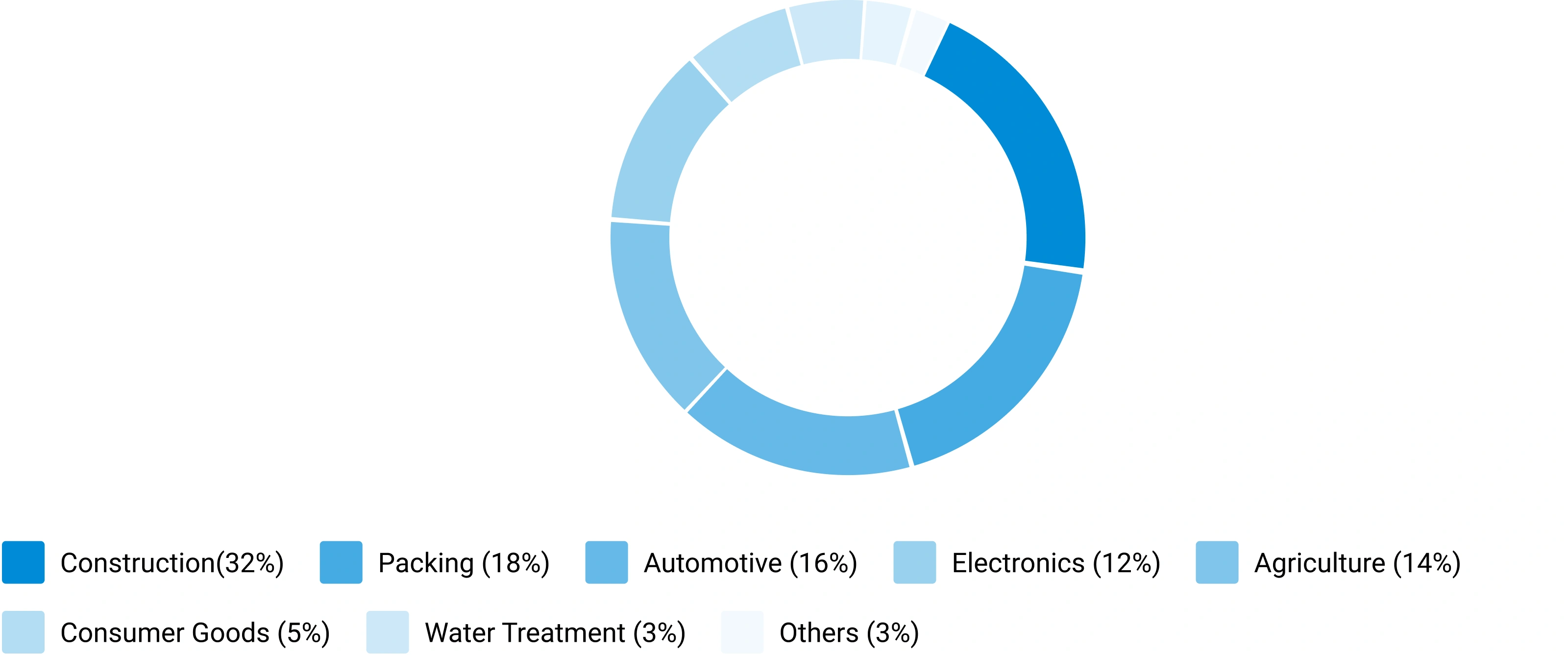
Chemical demand is evaluated across automotive, construction, packaging, electronics, agriculture, healthcare, consumer goods, industrial manufacturing, energy and utilities, and water treatment. Industry output, production trends, and consumption intensity are analyzed to determine demand patterns.
Consumption Modeling
Demand is estimated using measurable indicators: kilograms per vehicle, kilograms per square meter of construction, dosage per cubic meter of water treated, kilograms per hectare of agricultural land, and kilograms per ton of manufactured products. Consumption factors are validated through industry publications and primary interviews.
Application Analysis
The market is segmented by application area to understand product performance requirements, formulation trends, technology adoption, customer preferences, and regulatory requirements improving demand accuracy and segmentation granularity.
Demand-Side Assessment — End-Use Industry Demand Distribution
Illustrative distribution of chemical & materials demand across key end-use industries
Phase 4 - Trade Flow Analysis: Balancing Regional Supply and Demand
Trade flow analysis reconciles regional supply and demand estimates through import and export data, identifying net supply positions, regional dependencies, and market imbalances. It serves as an independent validation layer that tests the consistency of supply-side and demand-side estimates.
Import Analysis
Import data is evaluated to determine volumes, source countries, product dependency, regional supply gaps, and pricing trends — identifying markets that rely heavily on external supply and where domestic production is insufficient to meet demand.
Export Analysis
Export assessments reveal production surplus, export competitiveness, regional manufacturing strength, and global market participation. Export patterns also help validate domestic production estimates and identify net exporting regions.
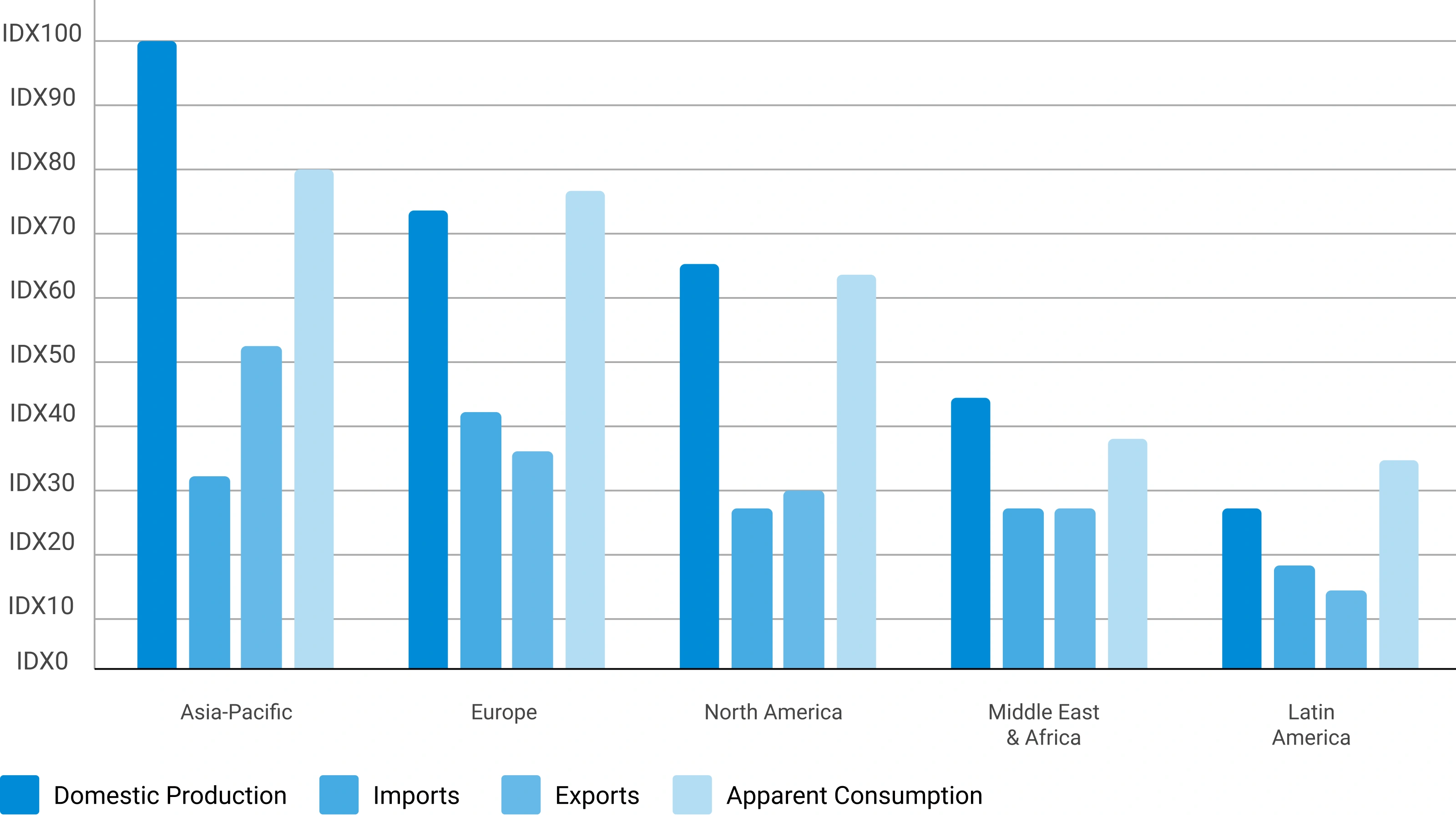
Apparent Consumption Model
Regional consumption is assessed using the standard apparent consumption formula:
Results identify net importing regions, net exporting regions, regional deficits, and surpluses — serving as an independent validation of supply and demand estimates.
Trade Flow Analysis — Net Supply Position by Region
Illustrative apparent consumption vs. domestic production across major regions — positive gap indicates net import dependency
Phase 5 — Primary Research: The Critical Validation Layer
Primary research tests and refines findings from secondary research through direct engagement with industry participants across the supply chain, demand side, and expert community. It captures intelligence that no database or published report can provide — the real-world experience of manufacturers, buyers, and specialists operating in the market.

Supply-Side Interviews
Conversations with chemical manufacturers, raw material suppliers, contract manufacturers, technology providers, and plant operators cover production trends, capacity utilization, pricing developments, technology shifts, and competitive dynamics.

Demand-Side Interviews
Engagement with OEMs, industrial consumers, procurement managers, distributors, formulators, and end-use manufacturers focuses on consumption trends, purchasing behavior, product substitution, demand outlook, and emerging applications.

Industry Expert Consultations
Additional interviews with industry consultants, independent experts, regulatory specialists, technical professionals, and research institutions provide deeper market context and validate key analytical assumptions.
Focus Areas of Primary Research:
Market Size & Forecast Validation
Revenue estimates, volume consumption, growth rates, forecast assumptions, regional demand.Supply Chain & Value Chain Assessment
Raw material sourcing, supply chain challenges, distribution networks, procurement practices.Production & Capacity Analysis
Manufacturing capacity, utilization rates, expansion projects, plant investments.Pricing & Cost Structure Analysis
Product pricing trends, feedstock costs, energy costs, margin pressures, pricing outlook.Competitive Landscape Assessment
Volume and value estimates confirmed to be fully consistent with one another before publicationInterview Volume by Market Scope
| Study Scope | Number of Interviews |
|---|---|
| Niche Market | 20 – 30 |
| Mid-Sized Market | 30 – 50 |
| Global Market | 50 – 80 |
| Highly Fragmented Market | 80 – 120 |
Interview Details:
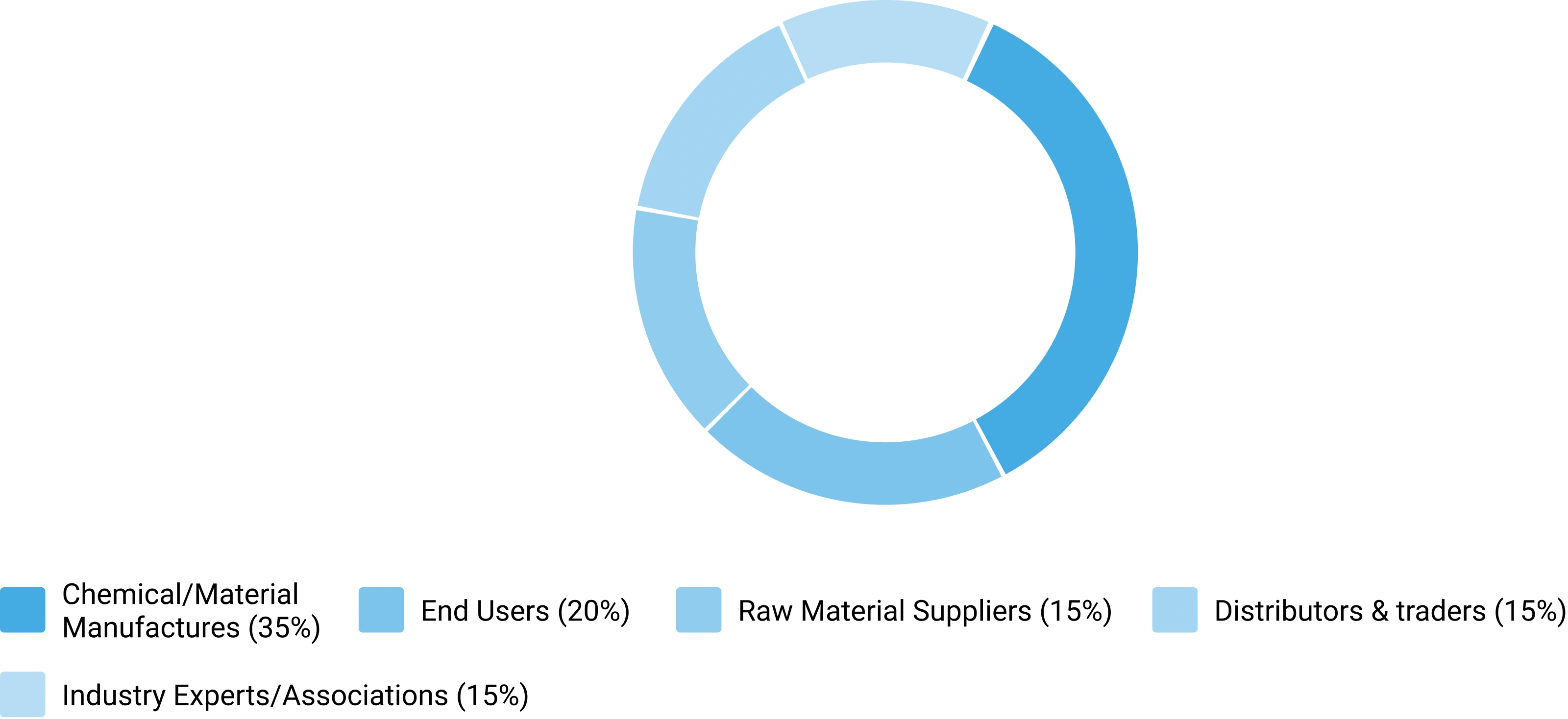
Category : Manufacturers, Suppliers, Distributors, End Users, Experts/Associations
Average Duration : 30–60 Minutes
Interview Mode : Video calls, telephonic interviews, expert consultations
Interview Format : Structured / Semi-Structured questionnaire
Focus Areas of Primary Research:
Market Size & Forecast Validation :
Revenue estimates, volume consumption, growth rates, forecast assumptions, regional demand.
Supply Chain & Value Chain Assessment :
Raw material sourcing, supply chain challenges, distribution networks, procurement practices.
Production & Capacity Analysis :
Manufacturing capacity, utilization rates, expansion projects, plant investments.
Pricing & Cost Structure Analysis :
Product pricing trends, feedstock costs, energy costs, margin pressures, pricing outlook.
Competitive Landscape Assessment :
Market share, competitor positioning, strategic initiatives, partnerships, acquisitions.
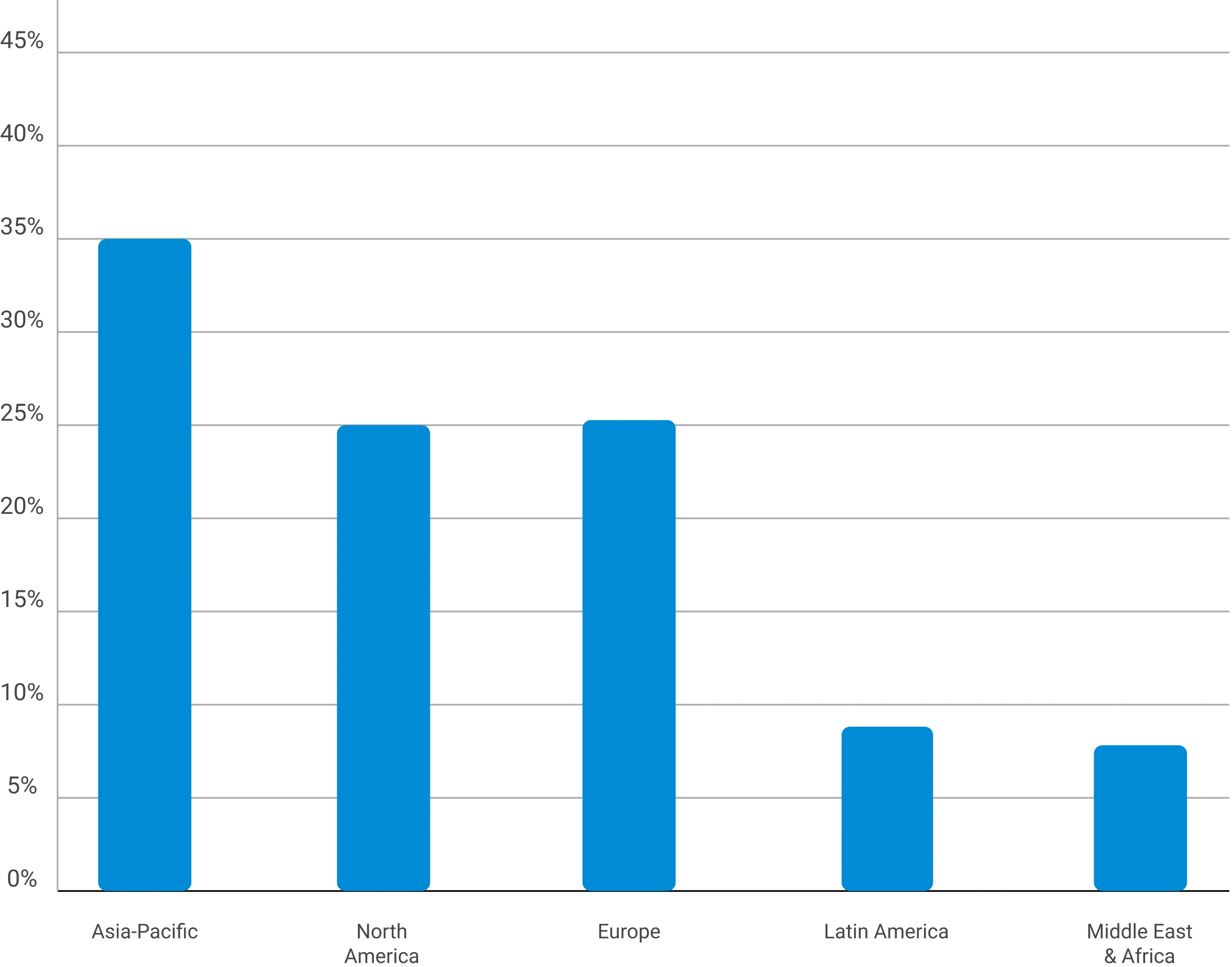
Primary Research — Stakeholder Coverage by Category
Distribution of interview respondents across stakeholder categories (% share from PPT data)
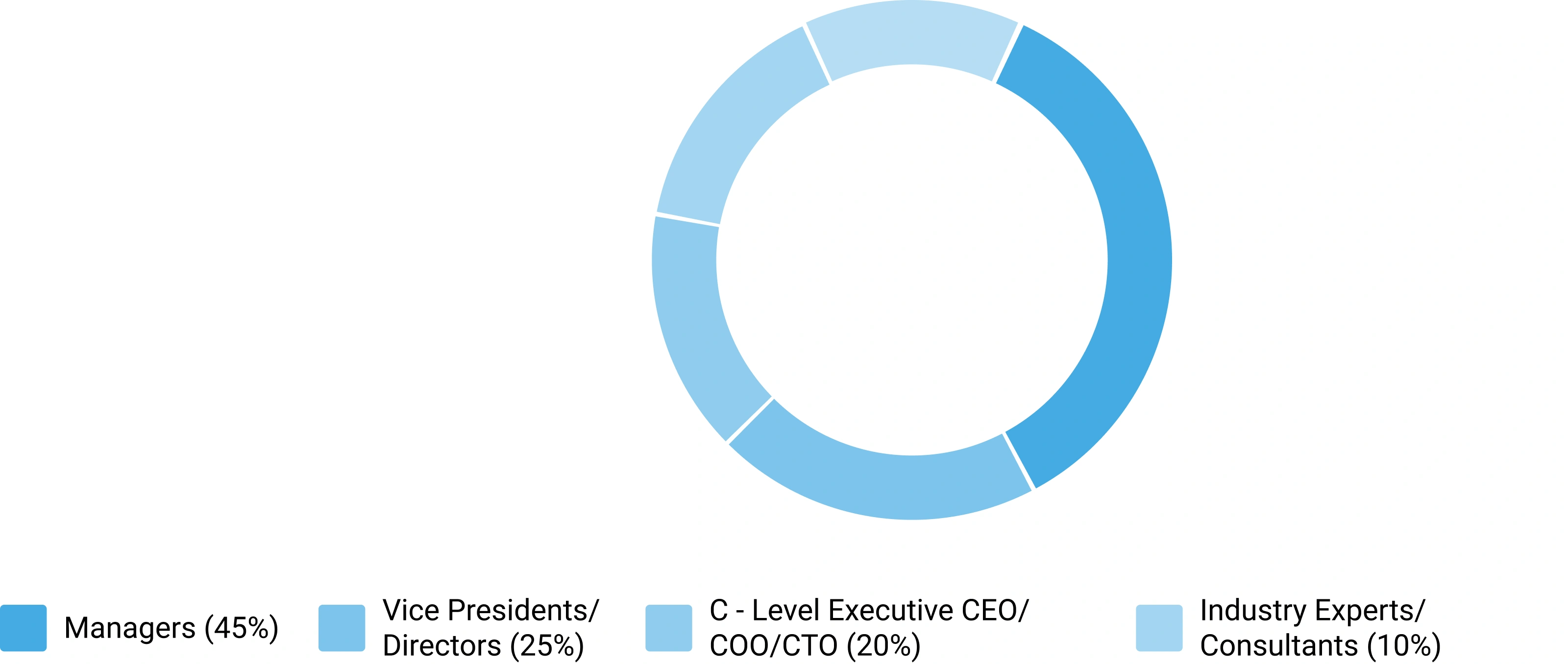
Primary Research — Respondent Designation Profile
Seniority breakdown of interview respondents (% share from PPT data)
Primary Research — Geographic Coverage of Interviews
Regional distribution of primary research engagement (% share from PPT data)
Phase 6 — Data Triangulation and Market Validation
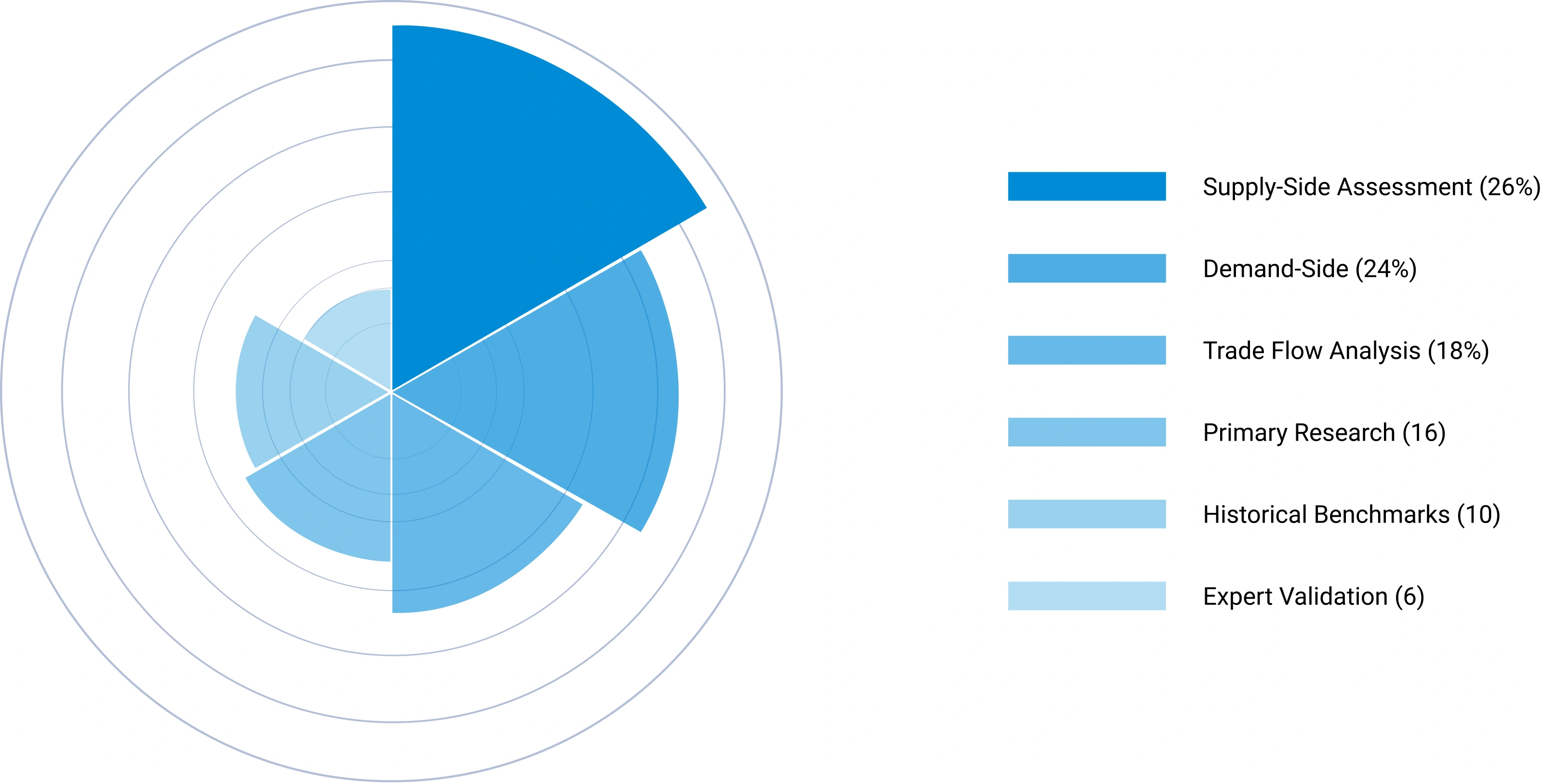
No single methodology is relied upon in isolation. Multiple independent estimation approaches are combined and reconciled to ensure consistency, accuracy, and analytical defensibility. Any material deviations between approaches are investigated and adjusted through additional validation cycles.
The final market size is derived through weighted triangulation of all validated methodologies. Any material deviations between approaches are investigated and adjusted through additional validation cycles. The outcome represents the most realistic assessment of the market based on available evidence and expert confirmation ensuring that volume and value estimates are fully consistent with one another.
Triangulation Framework — Input Contribution Weight
Relative weight each sizing input contributes to the final reconciled market estimate
Phase 7 — Forecast Modeling: Projecting Future Market Evolution
Forecasting evaluates the future trajectory of the market using a combination of quantitative indicators and qualitative assessments across economic, industry, and regulatory dimensions. Rather than simple extrapolation, each driver is independently modeled and integrated into a composite forecast.
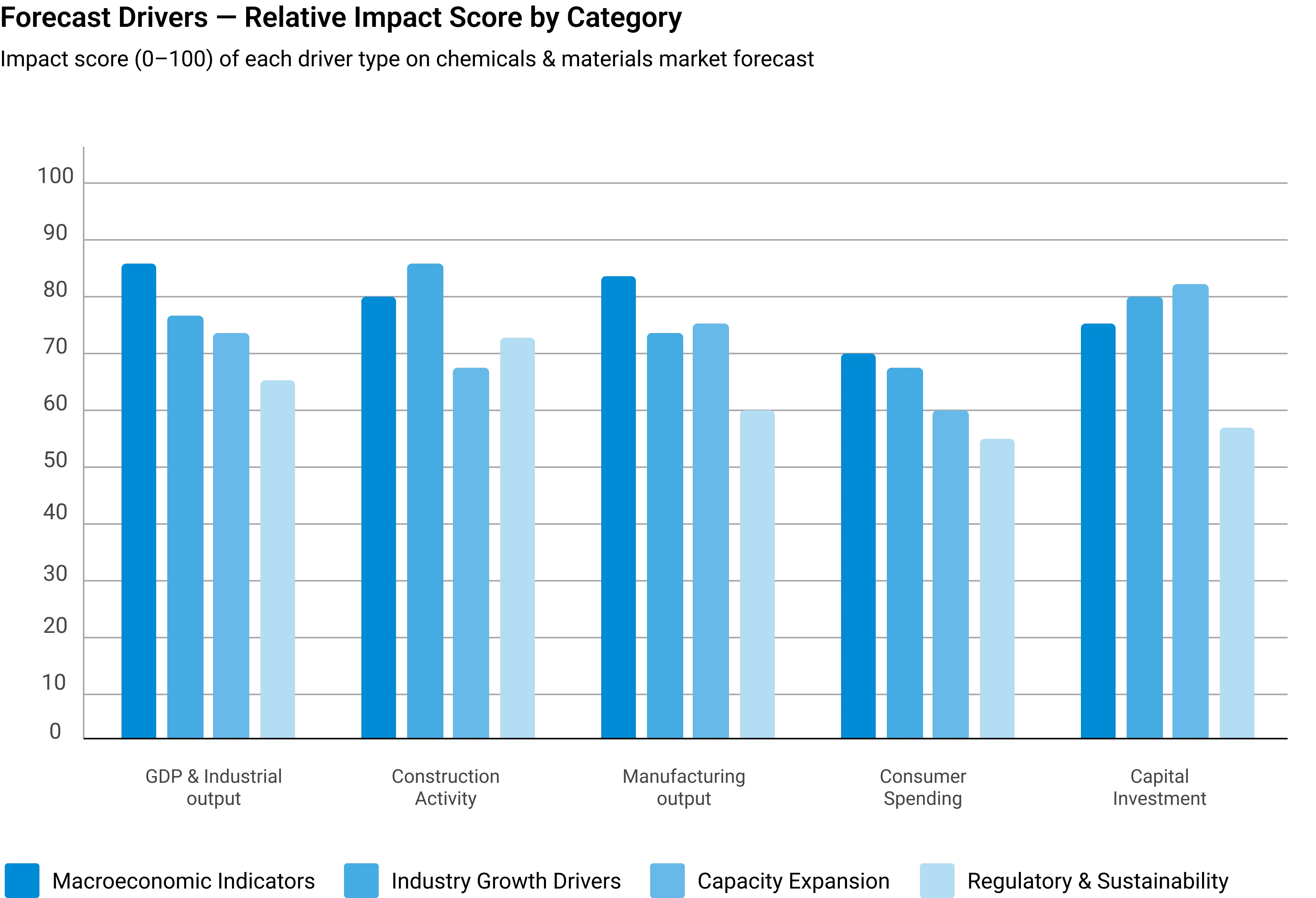
Macroeconomic Indicators
GDP growth, industrial production, manufacturing output, construction activity, consumer spending, and capital investment form the quantitative foundation of long-term demand projections. These are applied at country, regional, and global levels.
Industry Growth Drivers
Urbanization, infrastructure development, industrialization, technological innovation, sustainability initiatives, and evolving product performance requirements are assessed at regional and industry levels — capturing both structural and cyclical demand drivers.
Capacity Expansion Analysis
Announced plant expansions, new manufacturing facilities, technology upgrades, and strategic investments are evaluated to determine future supply-demand dynamics and potential market tightness or oversupply situations.
Regulatory & Sustainability
Environmental regulations, chemical safety standards, emission reduction targets, circular economy initiatives, and sustainability requirements are incorporated as they often influence product adoption rates and market growth trajectories.
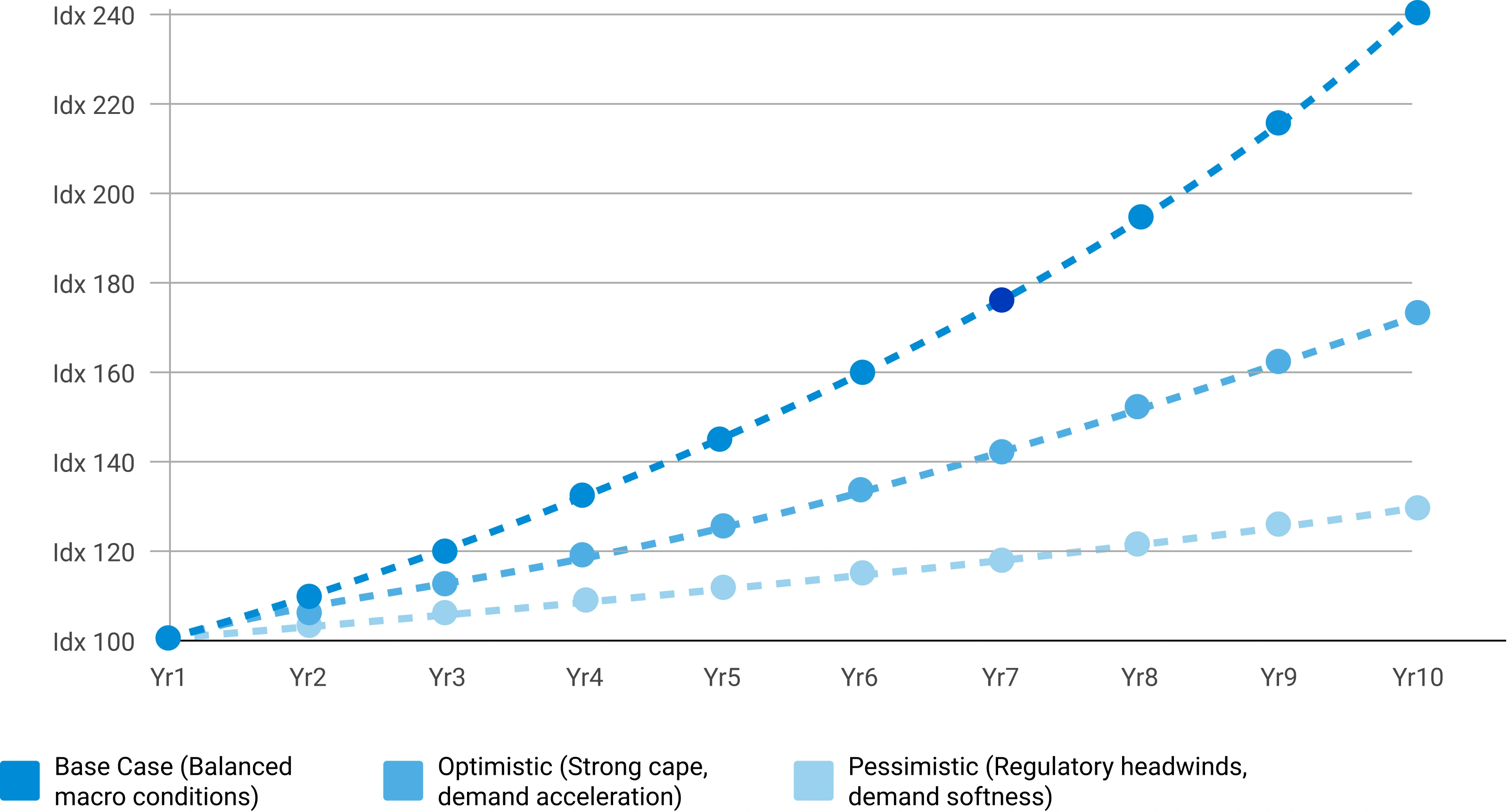
Scenario Forecast Range — Indexed Market Growth (Year 1–10)
Illustrative indexed growth trajectories across Base, Optimistic, and Pessimistic scenarios over a 10-year forecast horizon
Forecast Drivers — Relative Impact Score by Category
Impact score (0–100) of each driver type on chemicals & materials market forecast



Comments
Share your thoughts, ask a question, or provide feedback about this report.